
The Storyline
Real families. Real discoveries. Real stories.
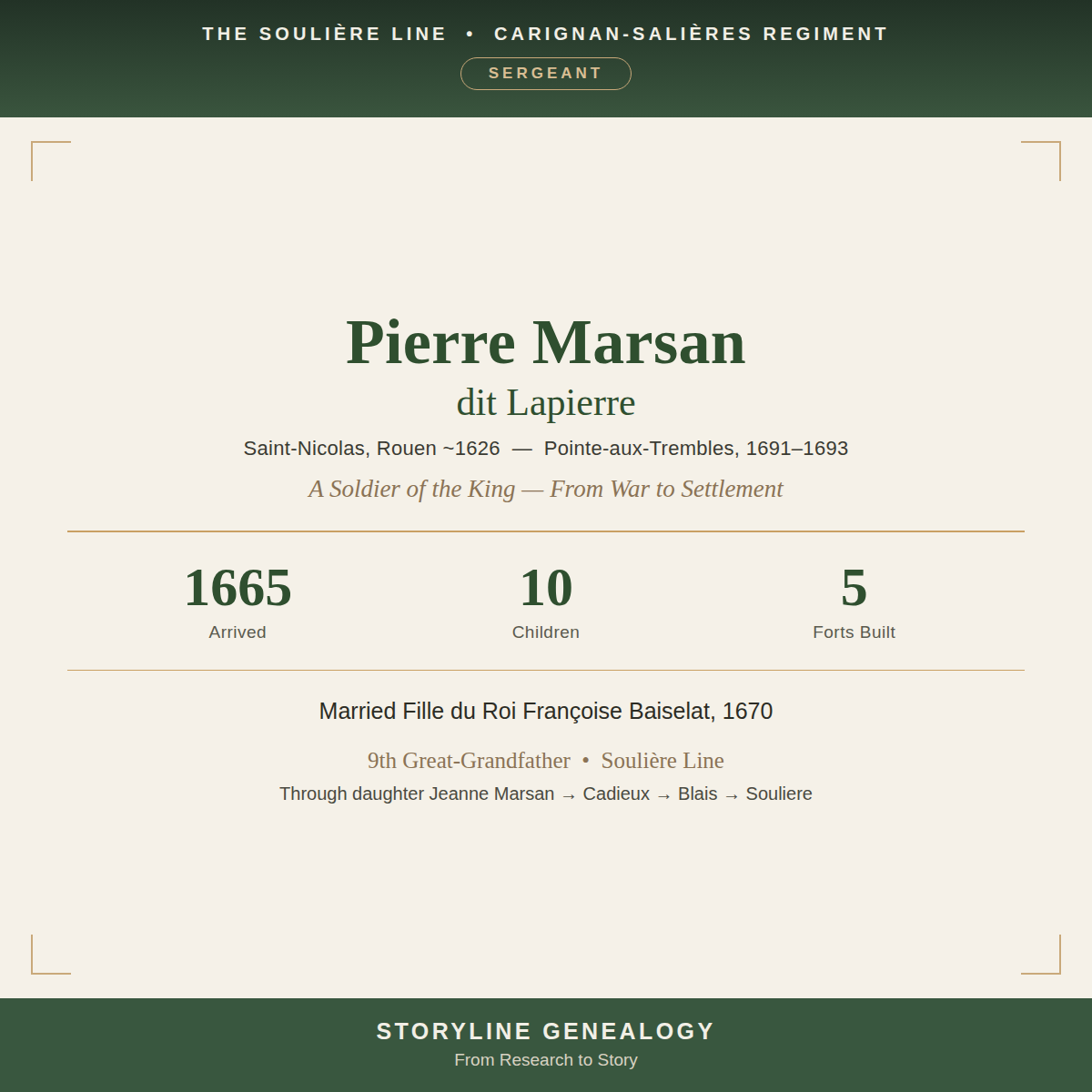
Pierre Marsan dit Lapierre
Pierre Marsan dit Lapierre came out of Saint-Nicolas parish in Rouen and went home to nothing. When the Carignan-Salières was disbanded in 1668 he took the crown's offer and stayed, married a young widow with an infant daughter, and spent twenty-one years clearing land at Pointe-aux-Trembles. Ten children, one river-lot farm, and a death recorded nowhere — only bracketed between two acts.
Part of the Storyline Genealogy series: Carignan-Salières — From Soldiers to Settlers
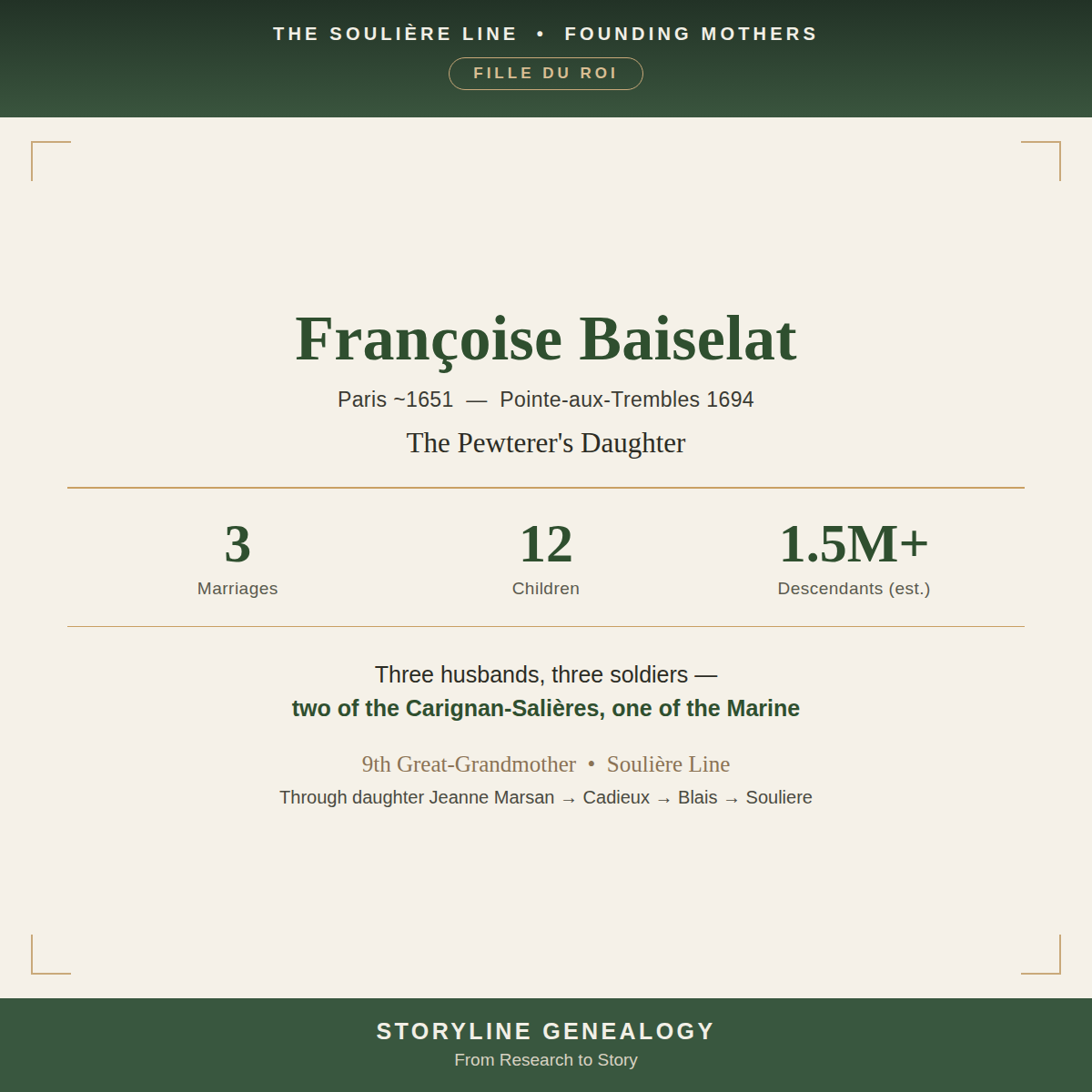
Françoise Baiselat ~1651 - 1694
Françoise Baiselat was baptized in the shadow of Saint-Sauveur in Paris, the daughter of a pewterer who also carried the verge at the parish church. Orphaned of her father at eleven and bound out to a buttonmaker at thirteen, she sailed for New France in 1668 as a Fille du Roi with three hundred livres in furniture, clothing, rings and jewels. Twenty-six years, three husbands and twelve children later, she died bearing the last of them. This is her life told from the acts themselves.
Part of the Storyline Genealogy series: Filles du Roi & Filles à Marier — The Women Who Built New France
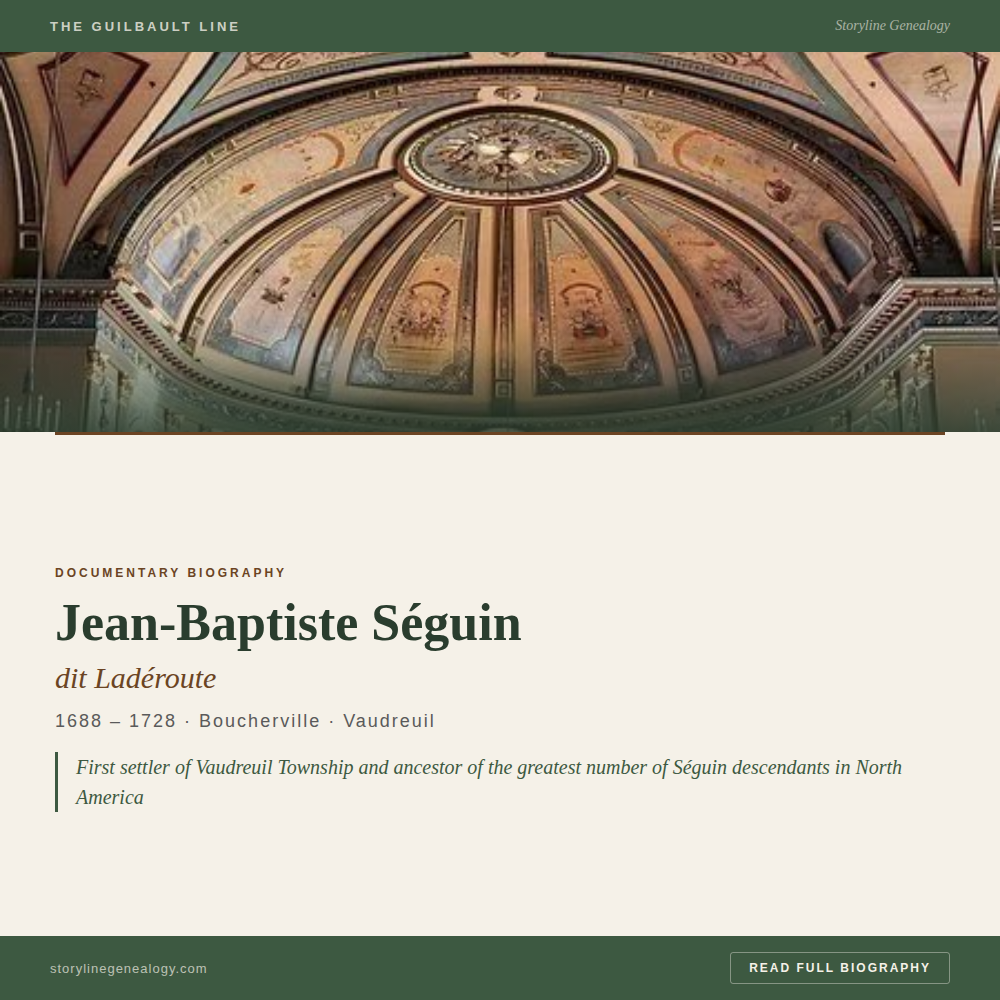
Jean-Baptiste Séguin dit Ladéroute
Born in the same Boucherville church where his father married a King's Daughter, Jean-Baptiste Séguin dit Ladéroute (1688–1728) became the first settler of Vaudreuil Township and left the greatest number of Séguin descendants in North America. This documentary biography traces his life through 53+ primary source documents — from the salt protest that tore his family apart to the mission church at Oka where his children built new lives.
Part of the Storyline Genealogy series: Documentary Biographies — From Research to Story
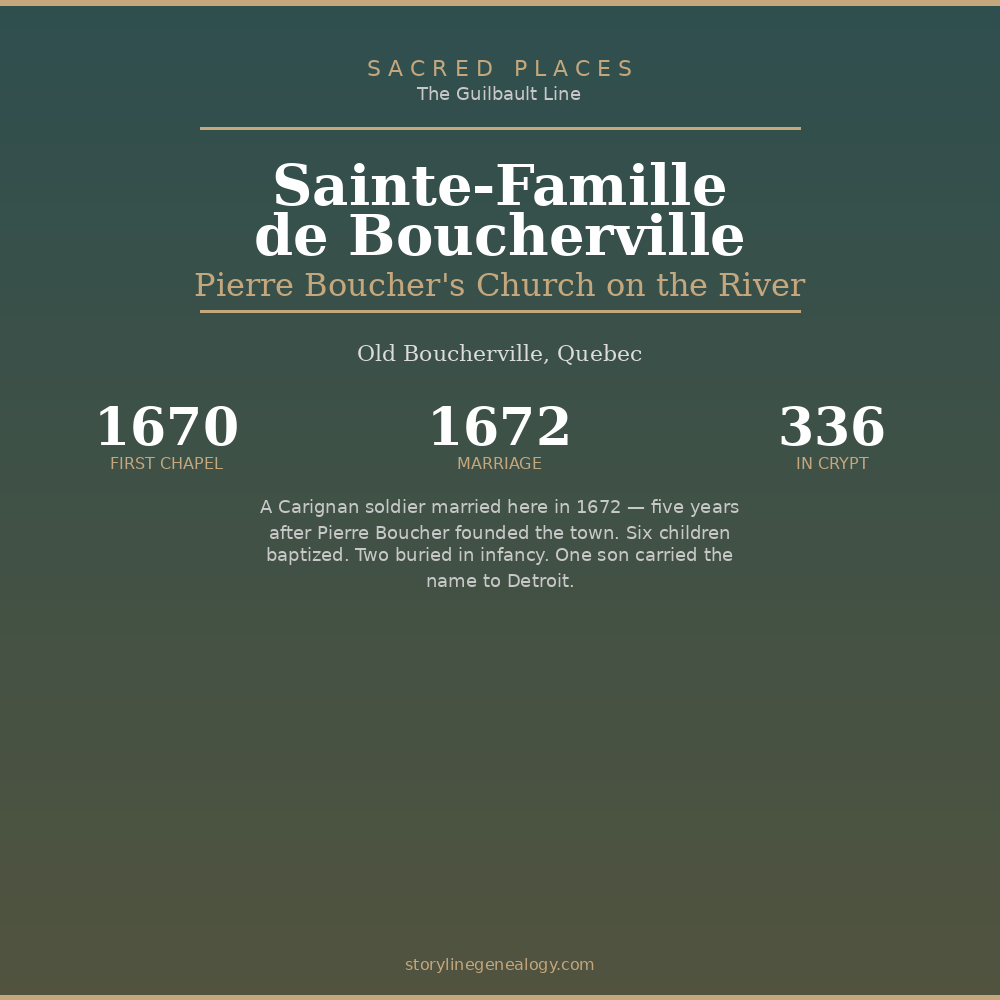
Sainte-Famille de Boucherville: Pierre Boucher's Church on the River
Sainte-Famille de Boucherville stands on land donated by Pierre Boucher himself — one of the most remarkable figures in early New France. On October 31, 1672, Carignan-Salières Regiment veteran François Séguin dit Ladéroute married Jeanne Petit in the original wooden chapel, just five years after the town was founded. Over the next two decades, the Séguin family filled the parish registers with baptisms and burials. Their son Jean-Baptiste, our direct ancestor, would carry the family name westward to the fur trade at Detroit.
Part of the Storyline Genealogy series : Sacred Places

Église Saint-François-de-Sales
The church of Saint-François-de-Sales in Neuville, Quebec, houses the oldest carved religious decor in North America and the parish registers that anchor the Soulière Line to the very beginnings of New France. In 1686, Marie Barbe Sylvestre — daughter of founding father and soldat Nicolas Sylvestre dit Champagne — married Jean Bernardin Lesage dit Lepiedmontois, an Italian soldier from Racconigi, Piedmont. Their story begins here, in the breadbasket of New France.
Part of the Storyline Genealogy series : Sacred Places
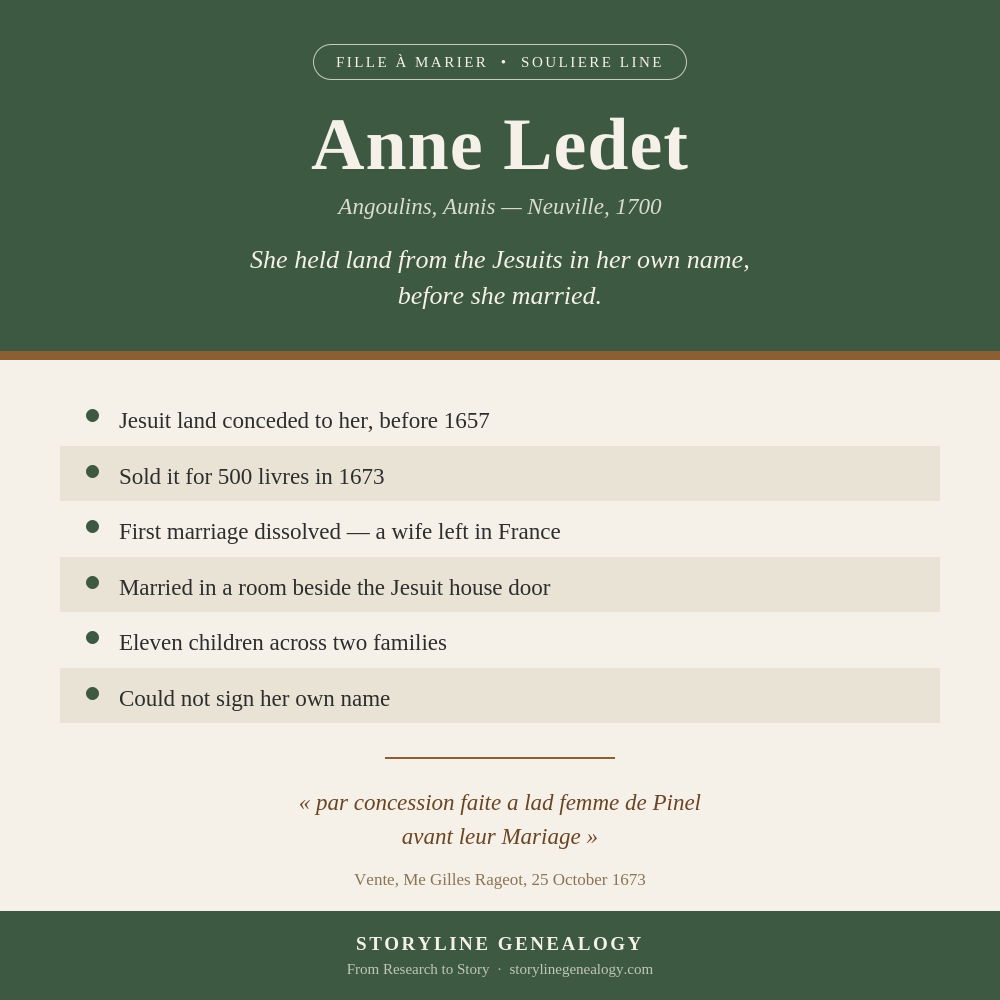
Anne Ledet: A Fille à Marier in New France
Before she married Gilles Pinel in 1657, Anne Ledet held a Jesuit land grant in her own name. Her first marriage had been dissolved — a wife left behind in France — and her daughters recorded as born out of wedlock. She raised eleven children and could not sign her name.
Part of the Storyline Genealogy series: Filles du Roi & Filles à Marier — The Women Who Built New France
Finding an Italian Ancestor in French-Canadian Research
When you're deep in French-Canadian genealogy, the last thing you expect to find is an Italian. But a dit name—Lepiedmontois, "the Piedmontese"—revealed a soldier from Racconigi, Italy, hiding in plain sight among 10,000 French settlers. Out of the founding immigrants of New France, over 95 percent were French. Italian permanent settlers were among the rarest of the rare. This is the story of how one dit name unraveled the assumption of a purely French founding population—and what it means for your research.
Part of the Storyline Genealogy series: French-Canadian Genealogy — From Research to Story
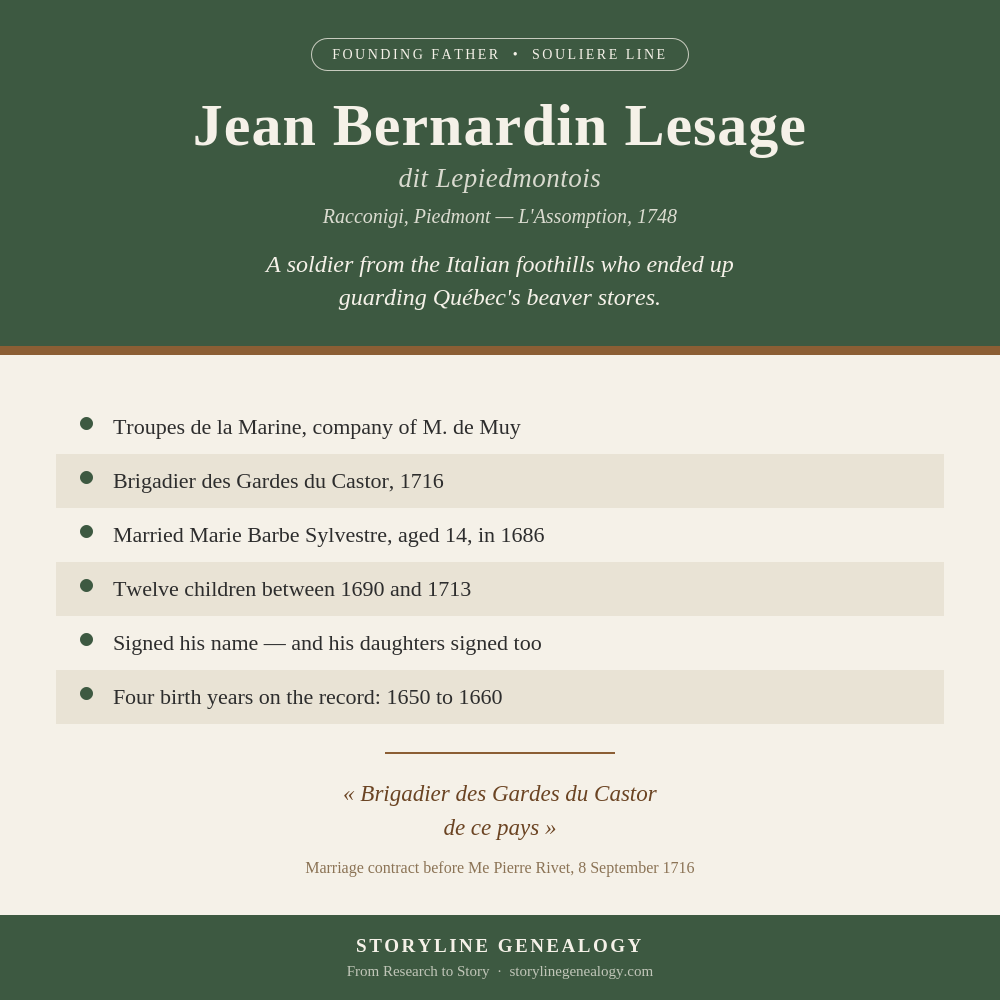
Jean Bernardin Lesage dit Lepiedmontois
In September 1716 a notary at Québec wrote down Jean Bernardin Lesage's occupation: brigadier of the beaver guards. The Piedmontese soldier who had married a fourteen-year-old at Neuville thirty years earlier had left the ranks for a post in the town — and he signed the contract, in a colony where his wife's own mother could not sign hers. Twelve children, four different birth years on the record, and a bishop's dispensation two generations on.
Part of the Storyline Genealogy series: From Soldier of the Troupes de la Marine to Settler.
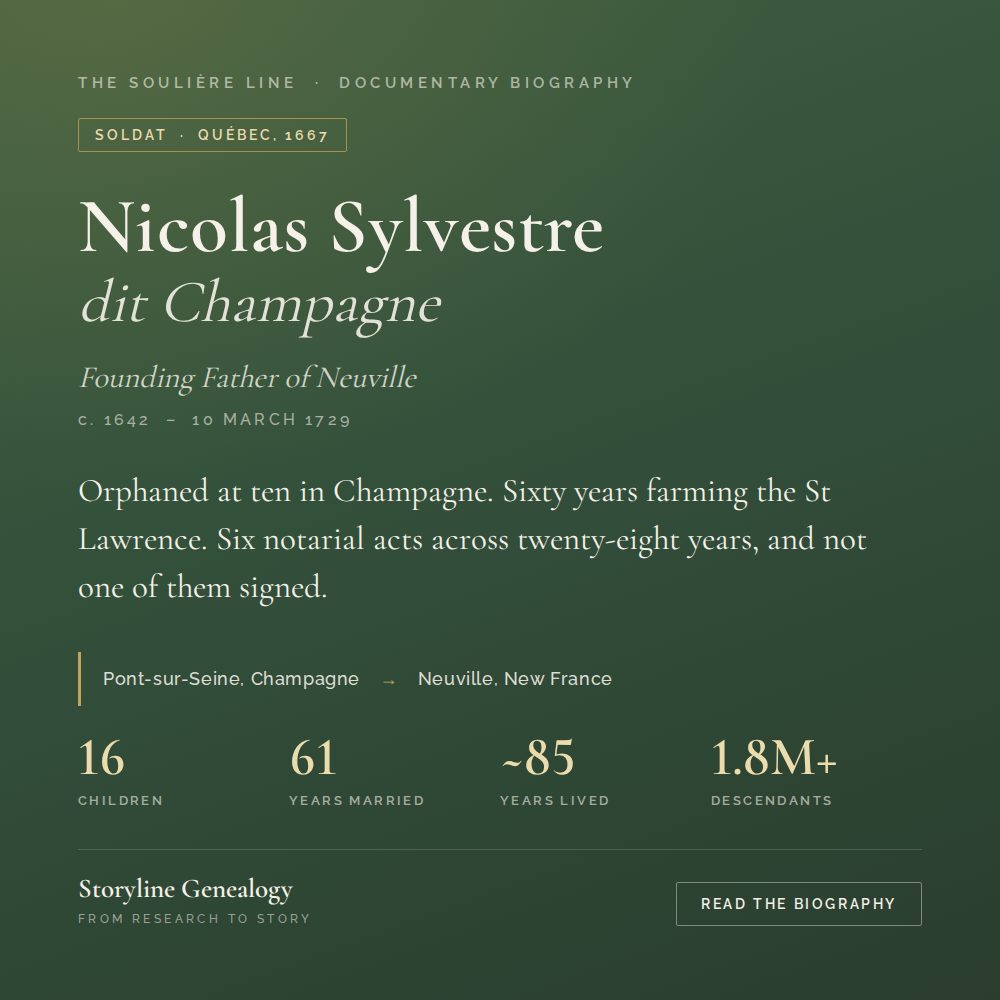
Nicolas Sylvestre dit Champagne
He came to Canada a soldier and left six notarial acts behind him across twenty-eight years. Not one of them is signed. Orphaned at ten in Champagne, Nicolas Sylvestre farmed sixty years on the St Lawrence, buried two grown sons in a single year, and died in a house appraised at twenty-five livres.
Part of the Storyline Genealogy series: Founding Fathers
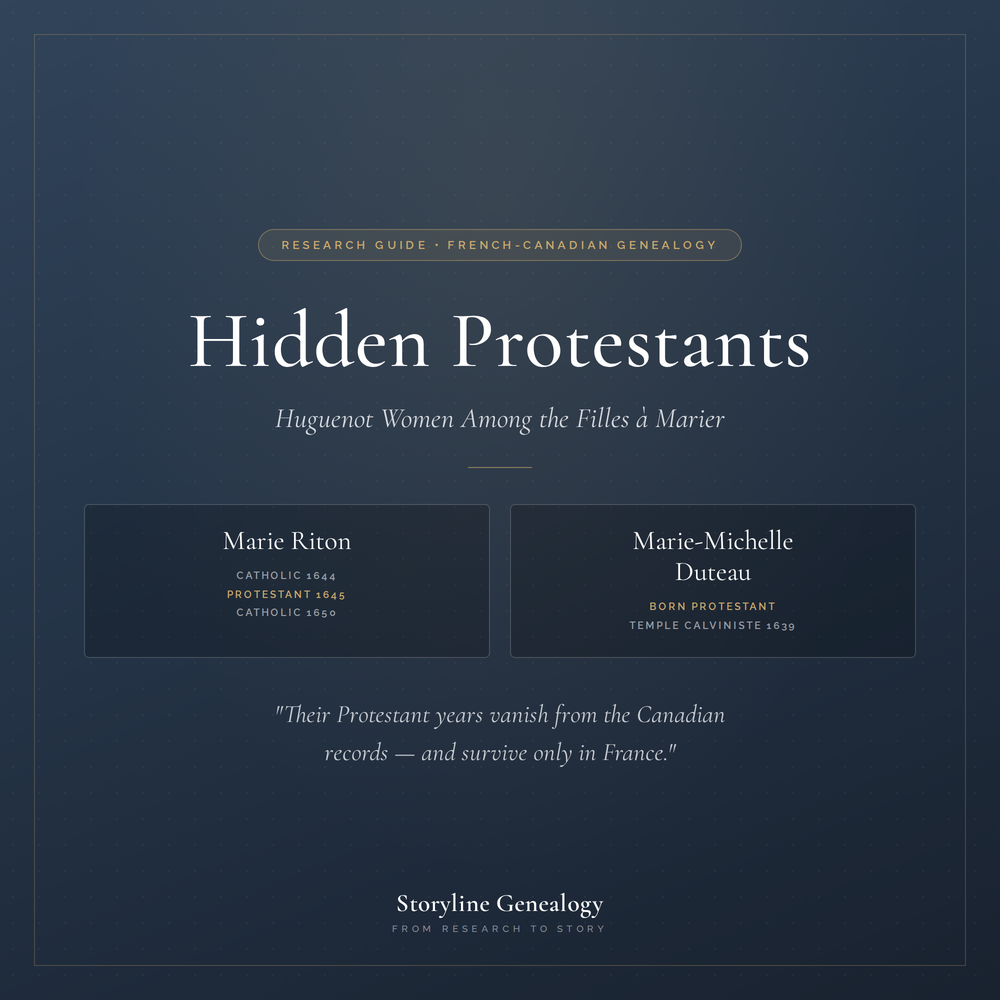
Hidden Protestants: Huguenot Women Among the Filles à Marier
One was born Protestant. The other converted to Protestantism as an adult, then converted back. Both ended in the Catholic Church, and the records that show otherwise survive only in France. Two documented cases, and how to tell which way an abjuration runs.
Part of the Storyline Genealogy series: Filles du Roi & Filles à Marier — The Women Who Built New France
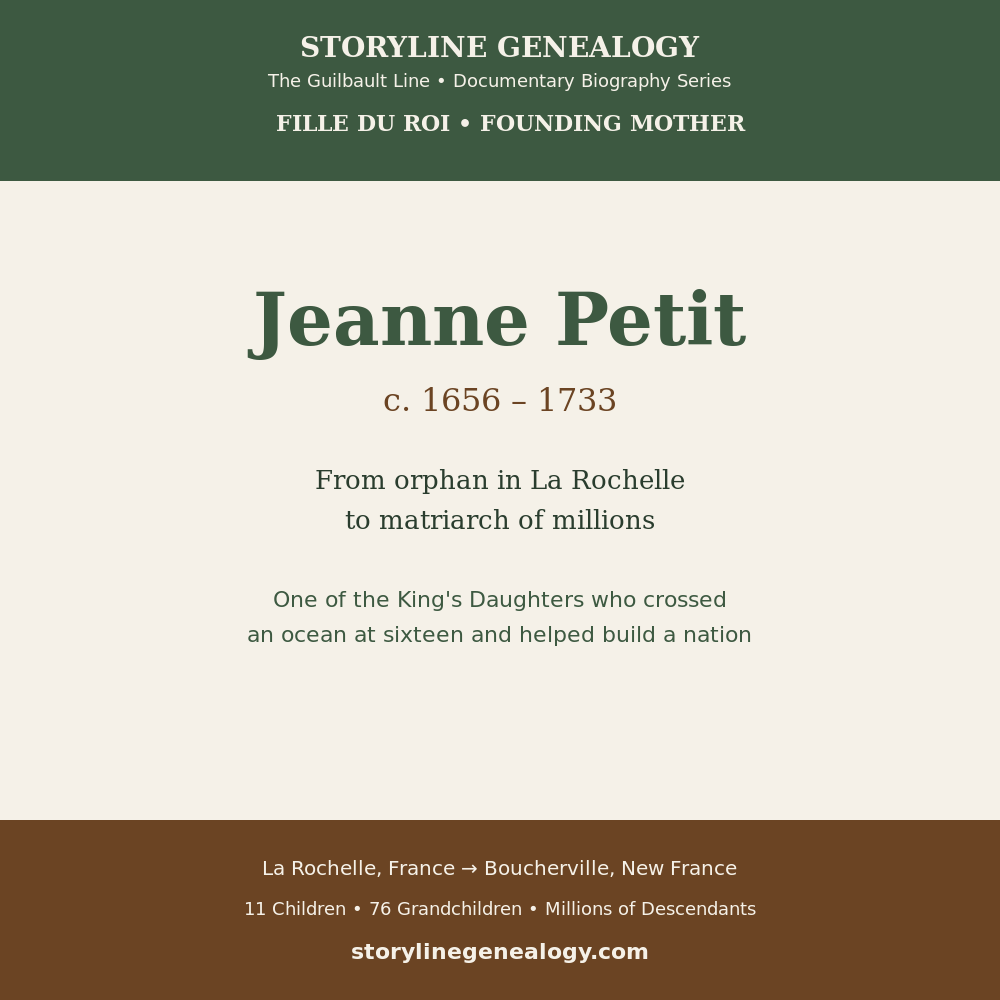
Jeanne Petit: Orphan in La Rochelle
Jeanne Petit was a young woman protected by the king, part of the contingent of 125 Filles du Roi who came to New France in 1671. At just 16 years old, already orphaned, she crossed the Atlantic to build a new life. She married François Séguin dit Ladéroute, a soldier turned weaver, and together they raised 8 children to adulthood at Boucherville. Today, her descendants number nearly 2 million people—a legacy built from nothing but hope and determination.
Part of the Storyline Genealogy series: Filles du Roi & Filles à Marier — The Women Who Built New France
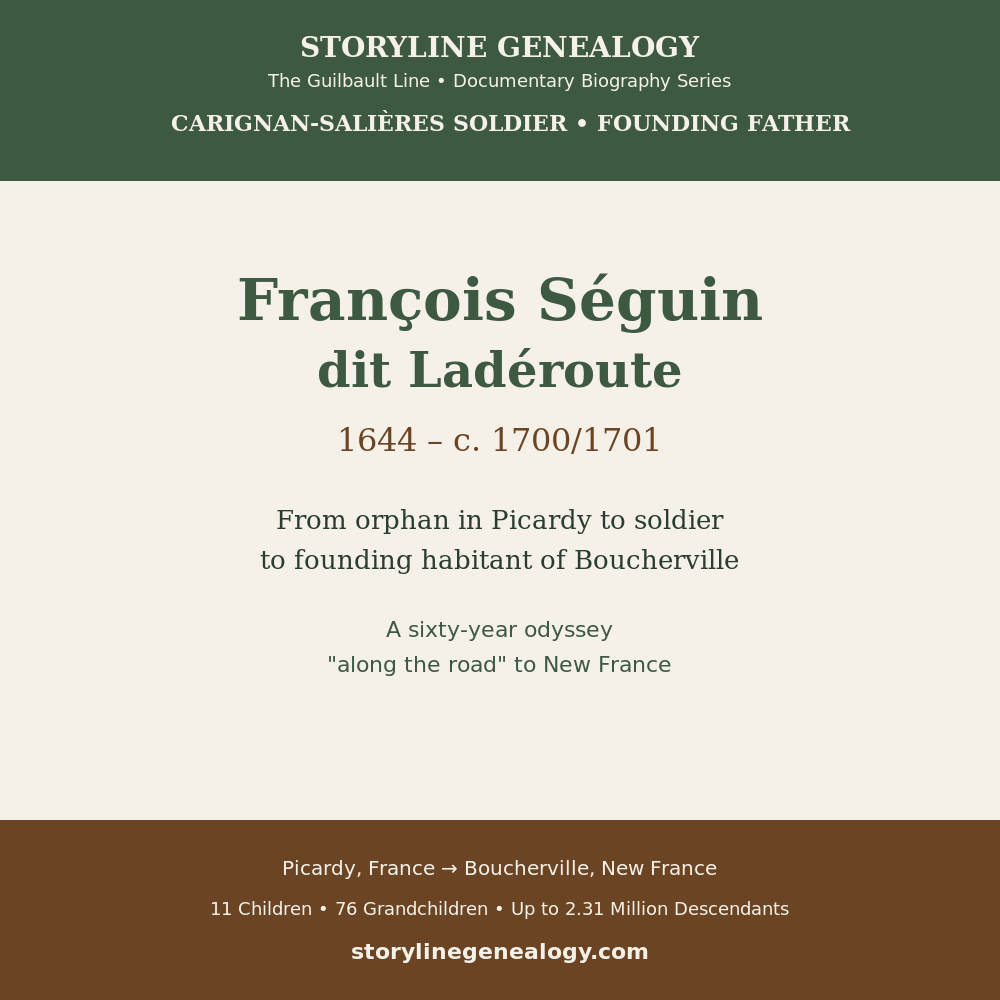
François Séguin dit Ladéroute: Carignan Soldier, Weaver, and Settler of Boucherville
François Séguin dit Ladéroute came from the region of Bray, west of Beauvais, in the former province of Picardy. Orphaned at age six when his mother Marie Massieu died, he enlisted in the Carignan-Salières Regiment and arrived in New France aboard the Saint-Sébastien on September 12, 1665. After marrying Fille du Roi Jeanne Petit in 1672, he settled at Boucherville as a weaver, raising 11 children. Today, his descendants number between 1.89 and 2.31 million people.
Part of the Storyline Genealogy series: Carignan-Salières — From Soldiers to Settlers

Jeanne Juin: A King’s Daughter From Paris
She arrived at Québec aboard La Nativité in August 1672 and signed her marriage contract with a cross eight months later. For three centuries her death has been placed somewhere in an eight-year silence — until her husband's second marriage contract, read in the original, dated it to within a month or two. This is the documentary life of Jeanne Juin: eleven original acts, a seigneury's home farm she was party to leasing, and a family that owned land twice and died owing two hundred livres.
Part of the Storyline Genealogy series: Filles du Roi & Filles à Marier — The Women Who Built New France
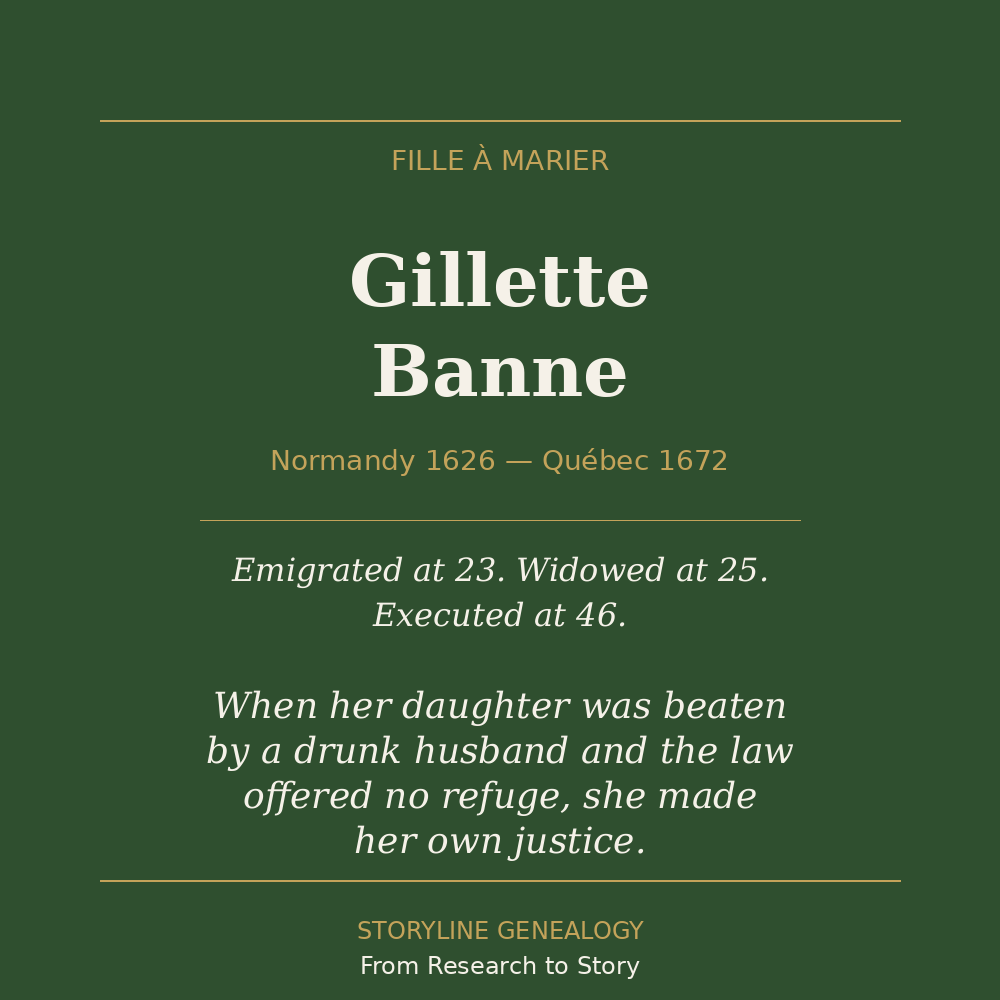
Gillette Banne: A Fille à Marier in New France
Shipped to New France at 23. Widowed at 25. Property owner at 25. Executed at 46. Gillette Banne's life spans four and a half decades, but within it lies the full complexity of women's experience in colonial New France. When her 12-year-old daughter was beaten bloody by a drunk husband and the law offered no refuge, she made her own justice—and paid with her life. Her descendants now number over 2 million.
Part of the Storyline Genealogy series: Filles du Roi & Filles à Marier — The Women Who Built New France
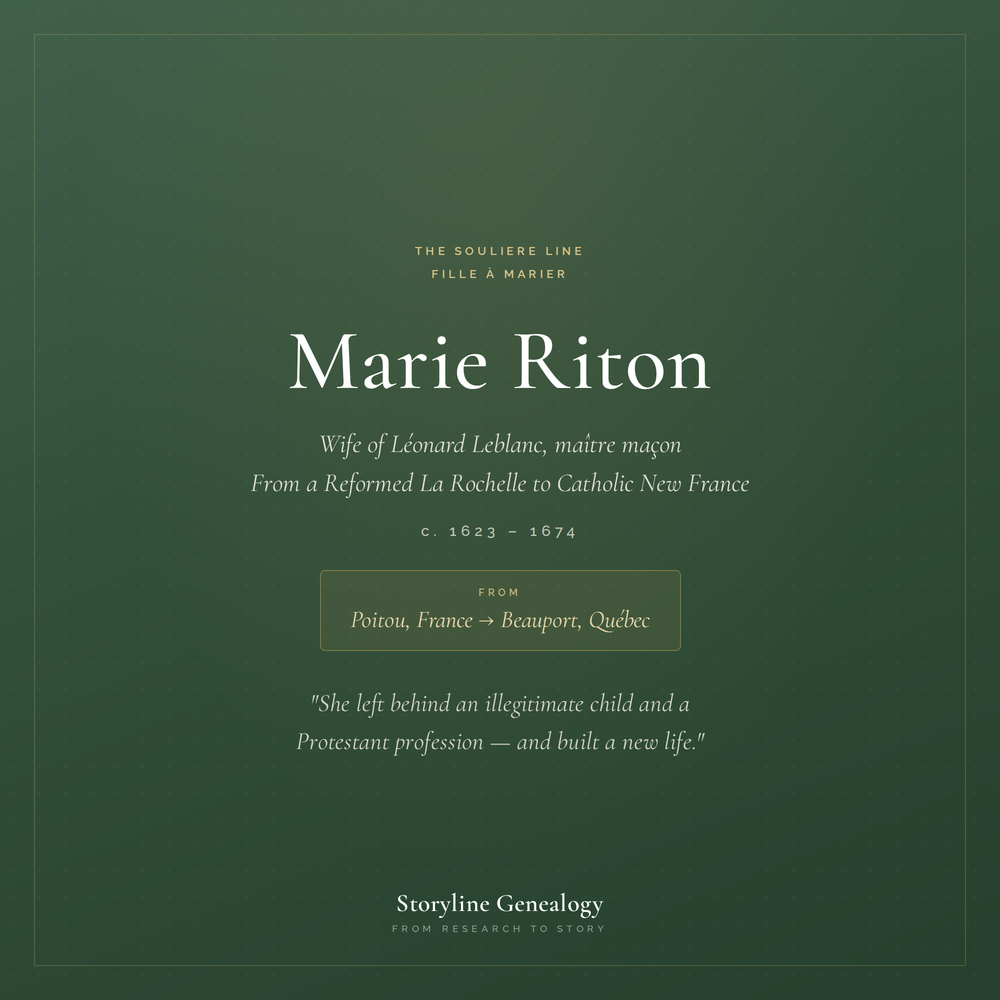
Marie Riton: A Fille à Marier in New France
Marie Riton crossed the Atlantic carrying the weight of an illegitimate birth and a Protestant conversion. In New France, she reinvented herself as a Catholic matriarch at Beauport—mother of seven, ancestor to millions.
Part of the Storyline Genealogy series: Filles du Roi & Filles à Marier — The Women Who Built New France
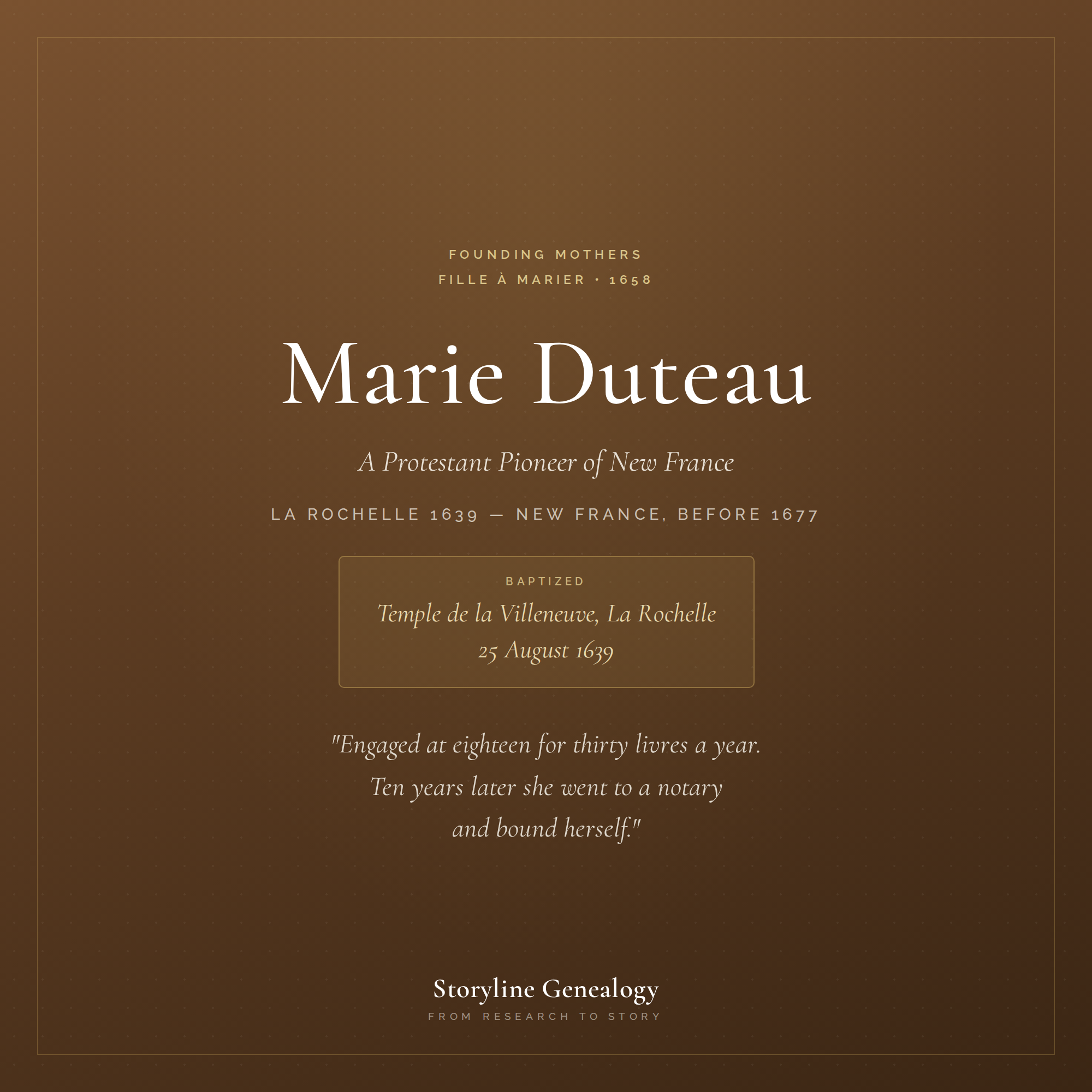
Marie Duteau: Protestant Pioneer of New France
She was baptized in a Calvinist temple at La Rochelle, engaged at nineteen for thirty livres a year, and married in a Catholic colony where her first faith was never mentioned again. Ten years after she landed, Marie Duteau went before a notary and bound herself in a contract in her own name.
Part of the Storyline Genealogy series: Filles du Roi & Filles à Marier — The Women Who Built New France

Jean Perrier dit Lafleur
Jean Perrier dit Lafleur came to Quebec as a soldier in the summer of 1665 and stayed when the troops went home. Which company he served in is disputed: the 1668 roll of soldiers turned habitants places him under La Brisardière of the Régiment d'Orléans, a notarial act of the year before places him in a company of the Carignan-Salières. He took two arpents at Beauport in 1668, married the Fille du roi Marie Gaillard in 1669, and fathered six children in ten years. The 1681 census records one gun, no livestock and no cleared land. He died before he was forty-one, with no burial record. A single document, written a year after his death, calls him a master weaver — which explains the empty columns better than anything else in the record.
Part of the Storyline Genealogy series: Carignan-Salières — From Soldiers to Settlers
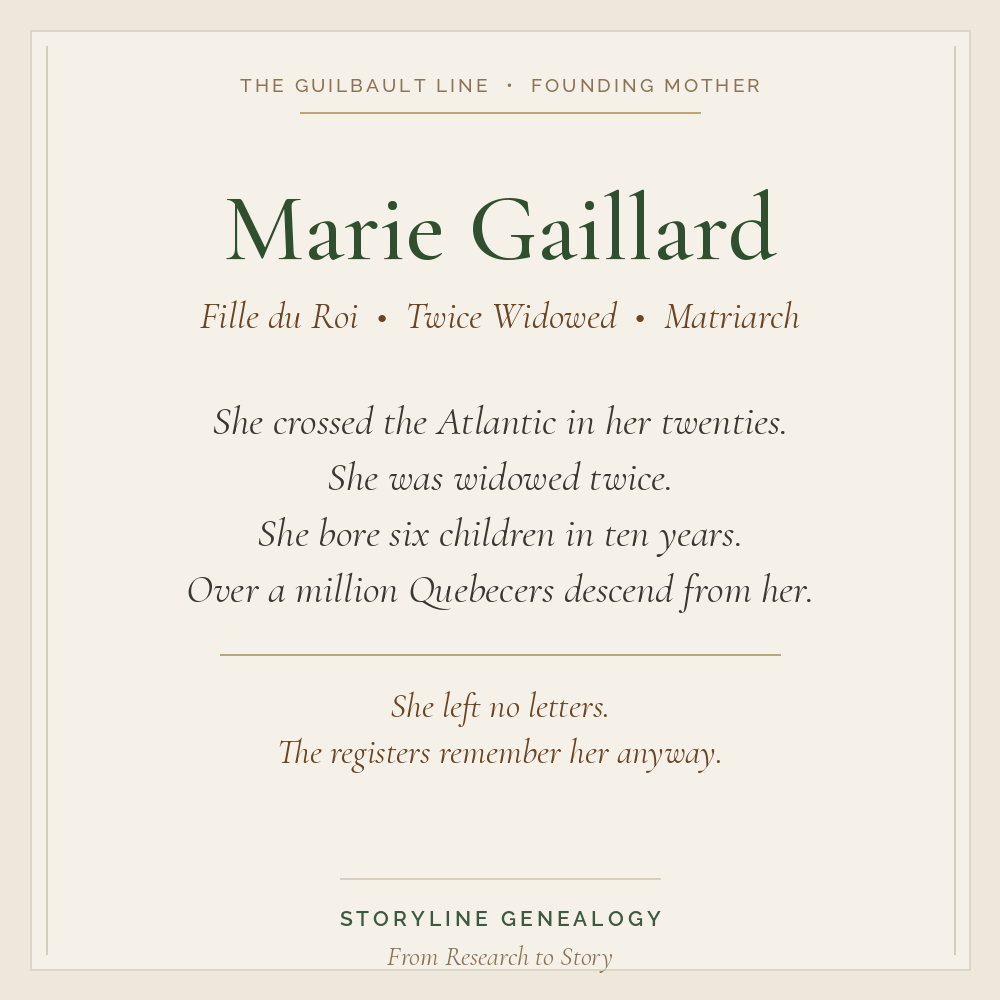
Marie Gaillard dit Daire
Marie Gaillard crossed the Atlantic in 1669 as one of the Filles du roi and married a soldier from Béarn who worked as a weaver. She bore six children in ten years. Widowed before she was forty, she remarried within the year and merged her household with another widower's; six years later her daughter married her stepson, permanently joining the two families. She outlived that second husband by fifteen years and died at Lachine in 1736, in her late eighties or early nineties. She left no letters and could not sign her name. What survives of her is her name in the margins of other people's records.
Part of the Storyline Genealogy series: Filles du roi & Filles à marier — The Women Who Built New France
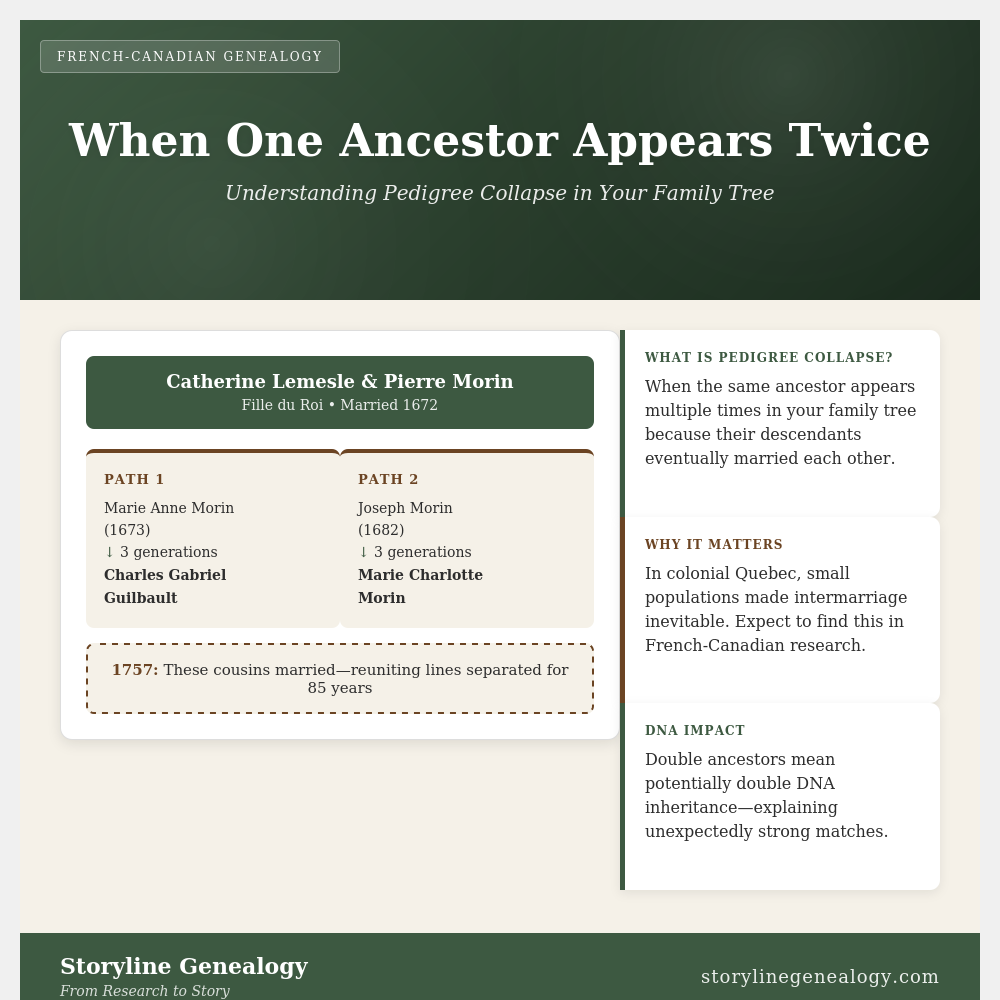
When One Ancestor Appears Twice: Catherine Lemesle
How does the same woman become your 8th great-grandmother twice? Discover pedigree collapse through Catherine Lemesle, a Fille du Roi whose descendants married each other 85 years later—and what this common phenomenon means for your French-Canadian research.
Part of the Storyline Genealogy series: Filles du Roi & Filles à Marier — The Women Who Built New France
Following the Canoe Routes: How the Fur Trade Families Moved Between the Interior and Quebec
Genealogists researching French-Canadian voyageurs often encounter a puzzling pattern: a man appears in Quebec records, disappears for years, then resurfaces—sometimes with a wife and children who seem to have materialized from nowhere. The explanation lies in the geography of the fur trade. Understanding how these families traveled helps you know where to look for records.
Part of the Storyline Genealogy Series: A Storyline Genealogy Research Guide