
The Storyline
Real families. Real discoveries. Real stories.
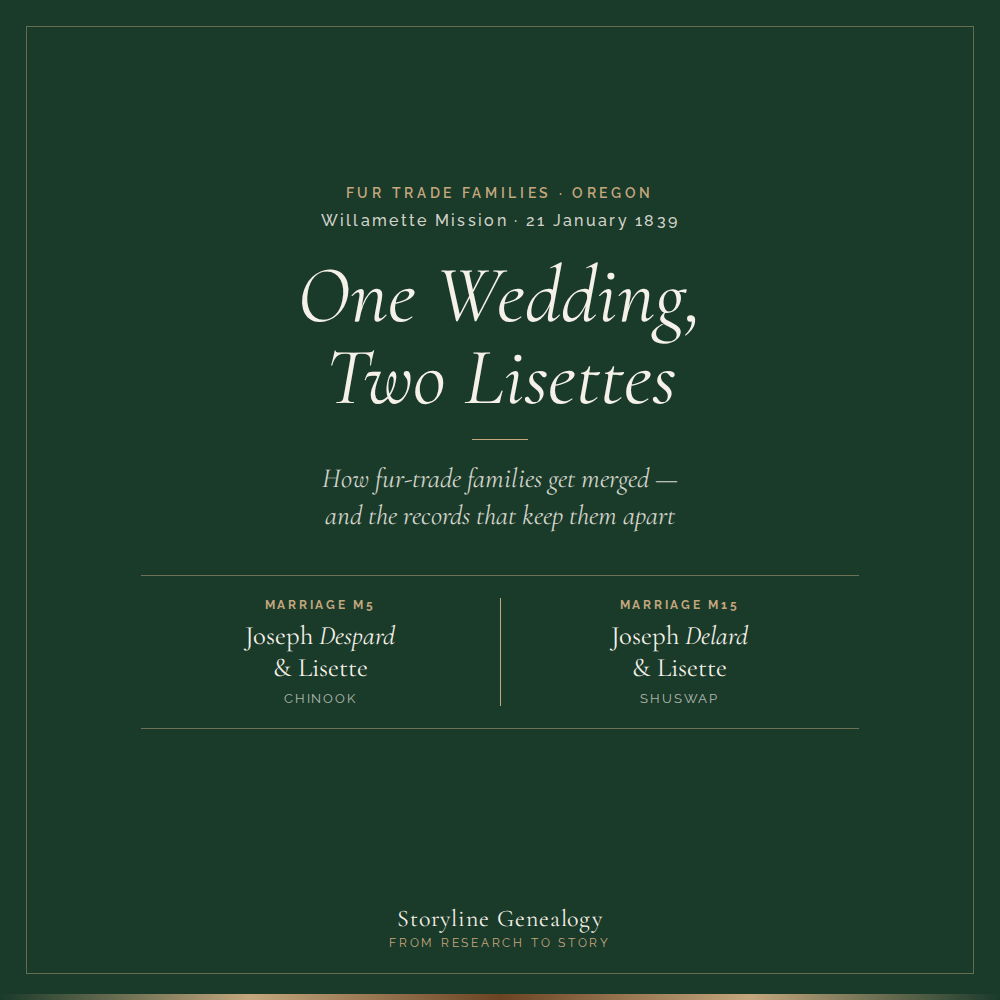
One Wedding, Two Lisettes
On a single winter day in 1839, two men named Joseph each married a woman named Lisette at the Willamette mission. The family trees made them one couple and gave a Shuswap woman a Chinook chief's ancestry. The register never merged them.
Part of the Storyline Genealogy series: Research Methodology
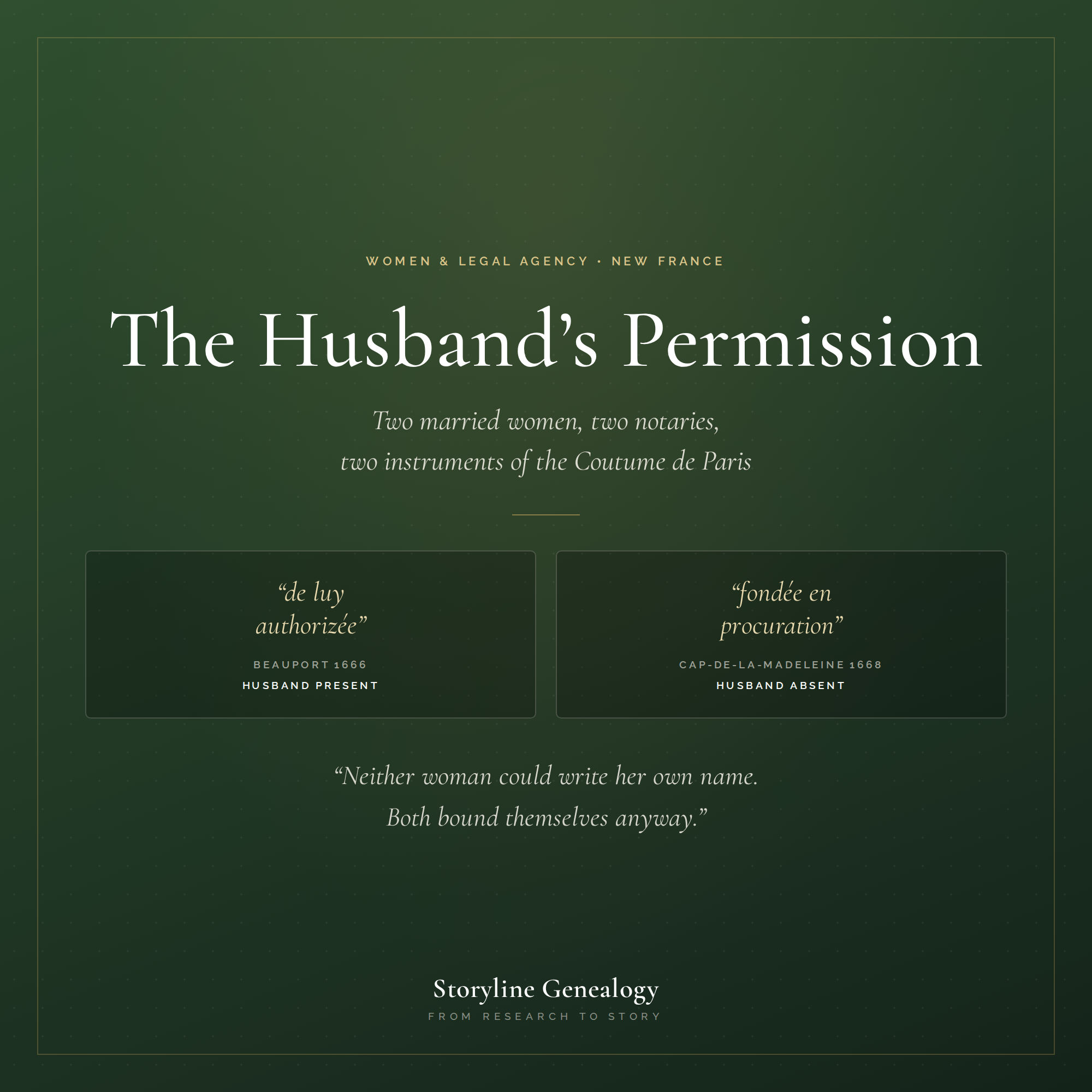
The Husband’s Permission
Every other woman in this collection is a widow — not by choice, but because a married woman could not bind herself under the Coutume de Paris, and so left far fewer records. The incapacity was never absolute. Marie Riton contracted at Beauport in 1666, authorized inside the act by the husband standing beside her. Marie Duteau contracted at Cap-de-la-Madeleine in 1668 under a power of attorney, her husband absent, and bound herself alone. Neither could write her own name.
Part of the Storyline Genealogy series: Filles du Roi & Filles à Marier — The Women Who Built New France
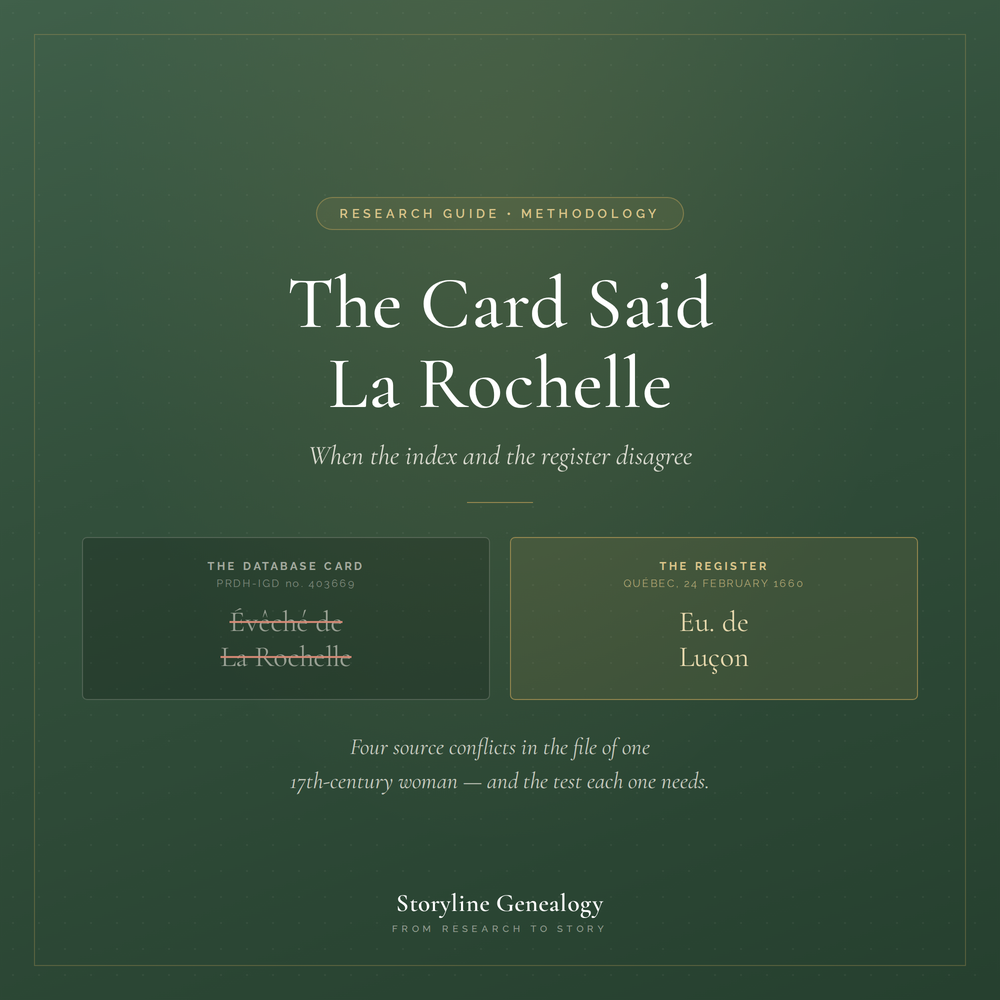
The Card Said La Rochelle
Every genealogist knows to go to the original. That is only half a rule, because it does not say what to do when the sources you have reached disagree with each other. Four worked examples from the file of one woman, and the four tests they yield.
Part of the Storyline Genealogy series: Research Methodology
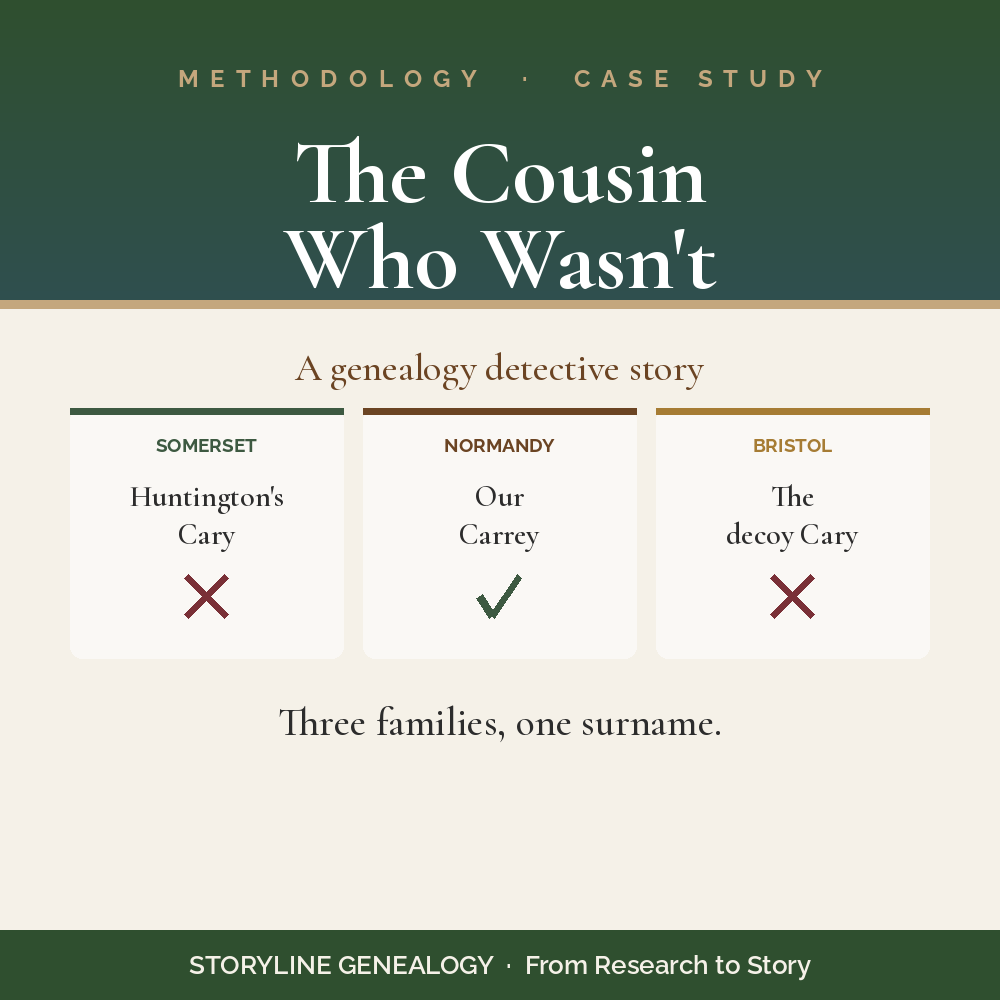
The Cousin Who Wasn’t
A family tree said we were cousins with Samuel Huntington, signer of the Declaration of Independence. The connection ran through a single surname—Cary—that appeared on both sides of the Atlantic. This is the story of how immigrant-origin records, a 1627 Norman parish register, and a 1919 genealogy pulled three families apart, and why a shared surname at the colonial-to-European transition is the most dangerous coincidence in genealogy.
Part of the Storyline Genealogy Methodology Series: How primary sources correct the family tree
Two Families, One Story: What the DNA Reveals
Three Kenny-Connors marriages bound two families across two continents—but were they always one family? This companion piece turns from parish records to the DNA of living descendants, confirming a shared Connors ancestry from County Wexford to Prince Edward Island and narrowing a century-old question to a single missing generation.
Part of the Storyline Genealogy series: DNA Analysis From Research to Story
The Brother Who Also Vanished
A son disappears from his Blairgowrie family after 1861 — vanishing into one of Scotland's most common names. He surfaces again only because an 1870 marriage register paused to name his parents, the same George Robertson and Margaret Paterson from his 1841 baptism. From there unfolds the life of David Robertson's older brother James: a gamekeeper in Liverpool, two marriages, three sons with nearly identical names, and children who scattered to Toronto and New York. A Scattered Stones companion on how a common surname is the hardest kind of family history to keep honest.
Part of the Storyline Genealogy series: From Research to Story
Petrona Quimpo: The Woman Remembered as Tonang
A family kept the mother of Mamerto Morales only as a nickname — "Tonang Quimpo" — that no register could hold. This is the story of recovering her: a girl in the Quimpo house, a widow who held her land, a grandmother named across three generations of Kalibo baptisms, and how a family's memory and a century-old register were finally made to agree.
Part of the Storyline Genealogy series: From Aklan to America | From Research to Story
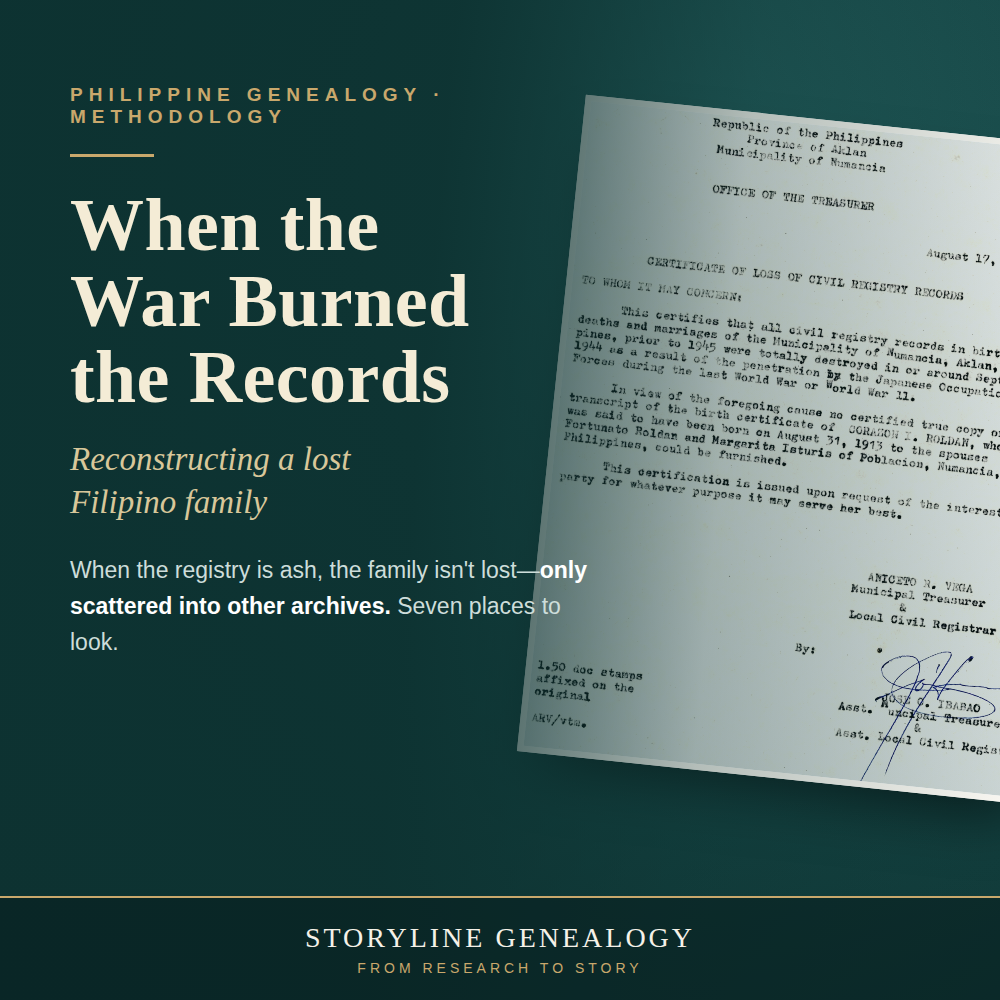
When the War Burned the Records
In much of the Philippines, the record you most want to see was burned in World War II. Drawing on the Morales-Tamayo case, this field guide shows how to reconstruct a lost Filipino family from what survived — church salvage books, notarial registers, delayed registrations, the immigration papers of relatives who emigrated, and DNA — and how to request the two U.S. records, the SS-5 and the A-File, that so often hold the answers.
Part of the Storyline Genealogy series: From Aklan to America | From Research to Story
The Mathematics of French-Canadian Cousinhood
When my son told me his coworker had French-Canadian background, I predicted we were probably 9th-to-10th cousins before either of us checked anything. I have made that prediction many times across my career, and the math always works. An essay on pedigree collapse and the founder effect.
Part of the Storyline Genealogy series: From Research to Story
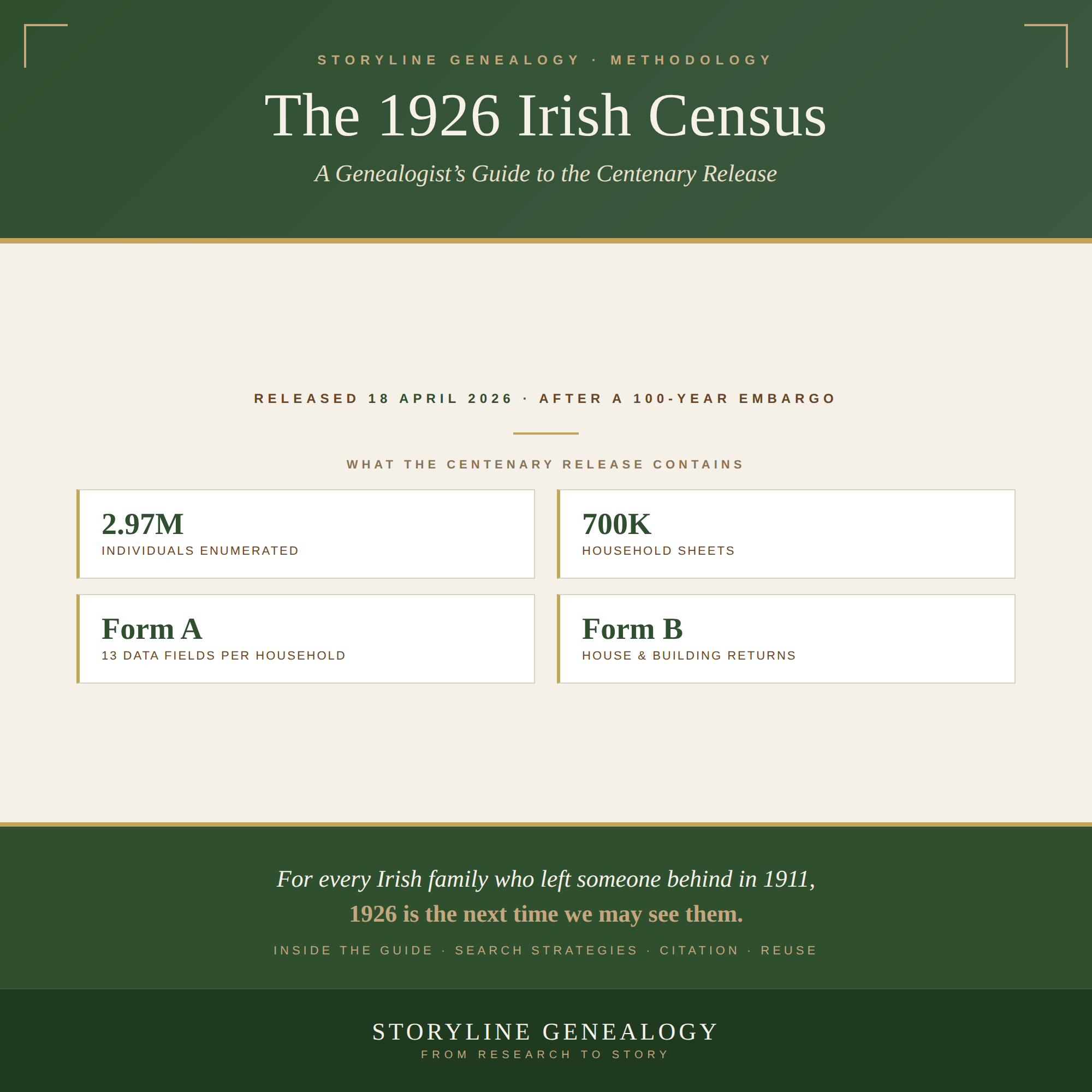
The 1926 Irish Census: A Genealogist's Guide
For one hundred years, the first census of the Irish Free State sat sealed in archival boxes. On 18 April 2026, the National Archives of Ireland released the entire collection to the public — nearly three million individuals, restored to the documentary record on the same calendar date their forms were filled in. This is a practical guide for genealogists working the new resource: what the census contains, how to search it effectively, the known data limitations and forthcoming improvements, and the citation conventions to use when sharing what you find.
Part of the Storyline Genealogy Series: A Storyline Genealogy Research Guide
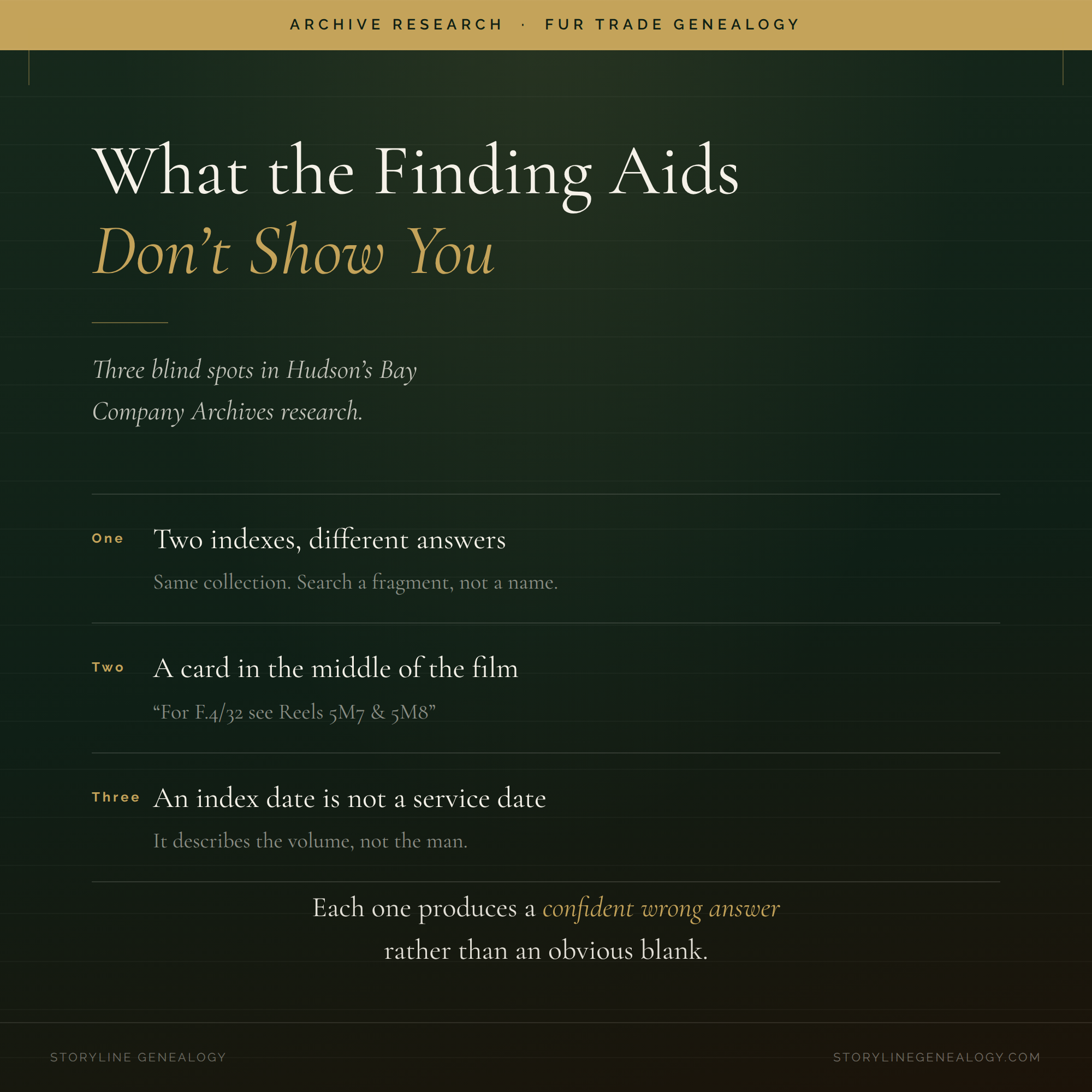
What the Finding Aids Don’t Show You
Two indexes cover the same Hudson's Bay Company Archives collection and return different answers. A microfilm reel catalogued as holding a run of account books quietly redirects one of them to two other reels. And an index entry, however precise, cannot tell you which of several men who shared a name you actually found. None is a flaw in the archive. Each will cost you a conclusion.
Part of the Storyline Genealogy series : A Research Methodology Guide
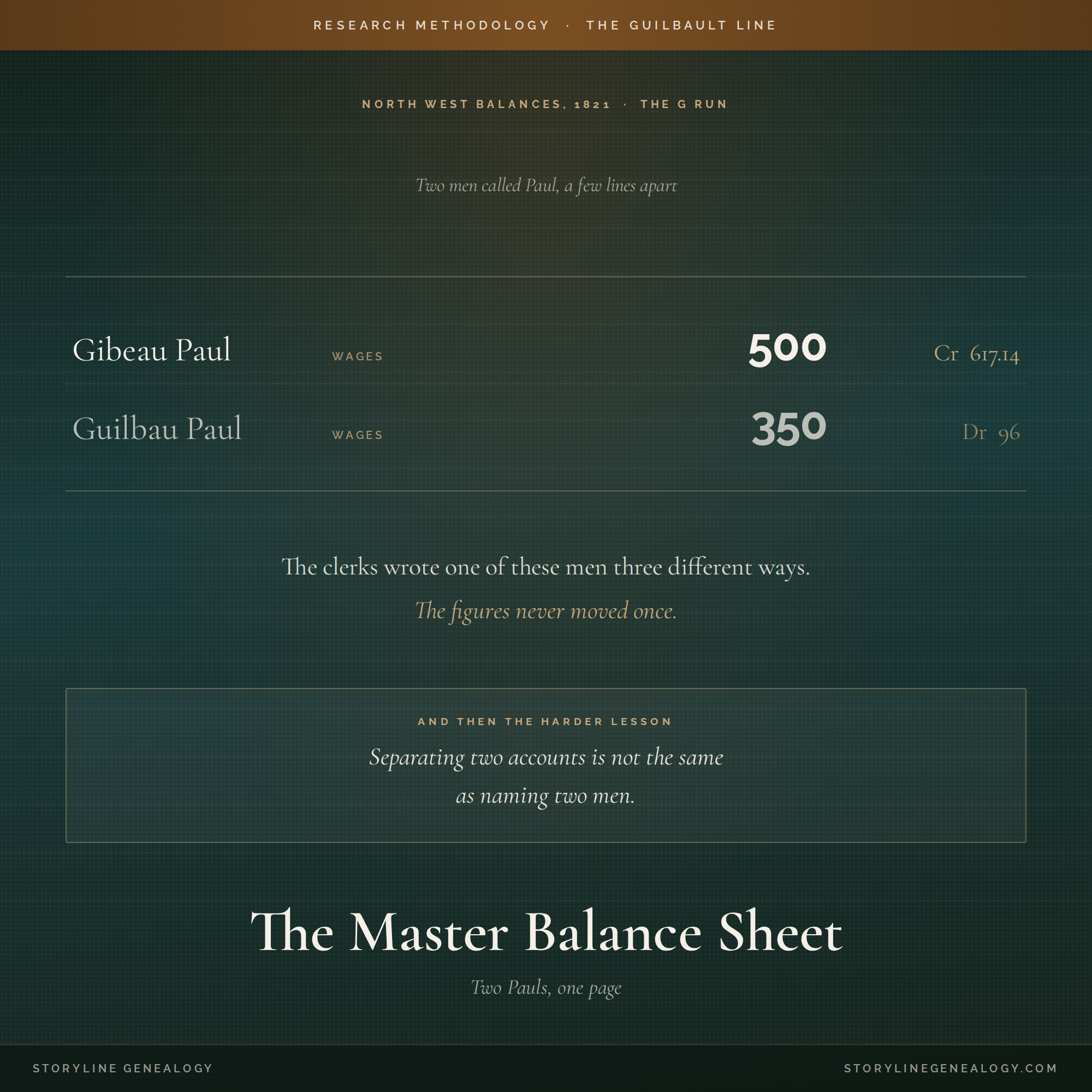
The Master Balance Sheet: Two Pauls, One Page
Two men called Paul appear in the North West Company's 1821 settlement register, in the same department, in the same season. The clerks spelled one of them three different ways, so the spelling could tell them apart from nothing. The figures could, and did — a wage of 500 against a wage of 350, holding still across every volume. What took another year to see is that separating two accounts is only half the work, and the easier half. Neither figure says who either man was.
Part of the Storyline Genealogy series: The Guilbault Line: Voyageurs of the Pays d'en Haut — and the Oregon Country
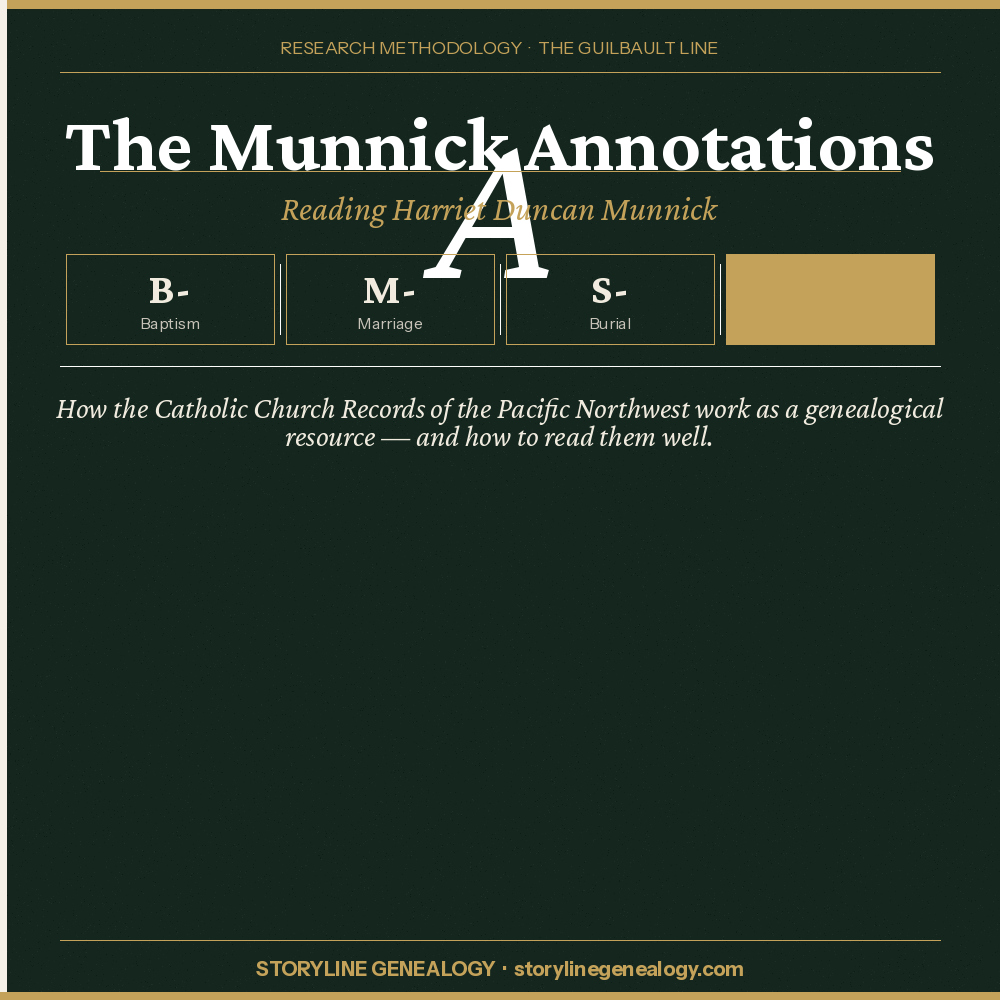
The Munnick Annotations:Reading Harriet Duncan Munnick
Harriet Duncan Munnick spent decades turning sparse sacramental registers into something no single archive could produce on its own — a record of who the people of French Prairie actually were, where they came from, and what happened to them. The Catholic Church Records of the Pacific Northwest are the essential finding tool for fur trade genealogy in the Oregon Country. This post is a practical guide to reading them: how the B-, M-, S-, and A- annotation system works, how to use transcription and annotation as separate evidentiary layers, how to track a name through its phonetic variants, and where Munnick can be wrong — and why knowing that makes the resource more useful, not less.
Part of the Storyline Genealogy series: The Guilbault Line: Voyageurs of the Pays d'en Haut — and the Oregon Country
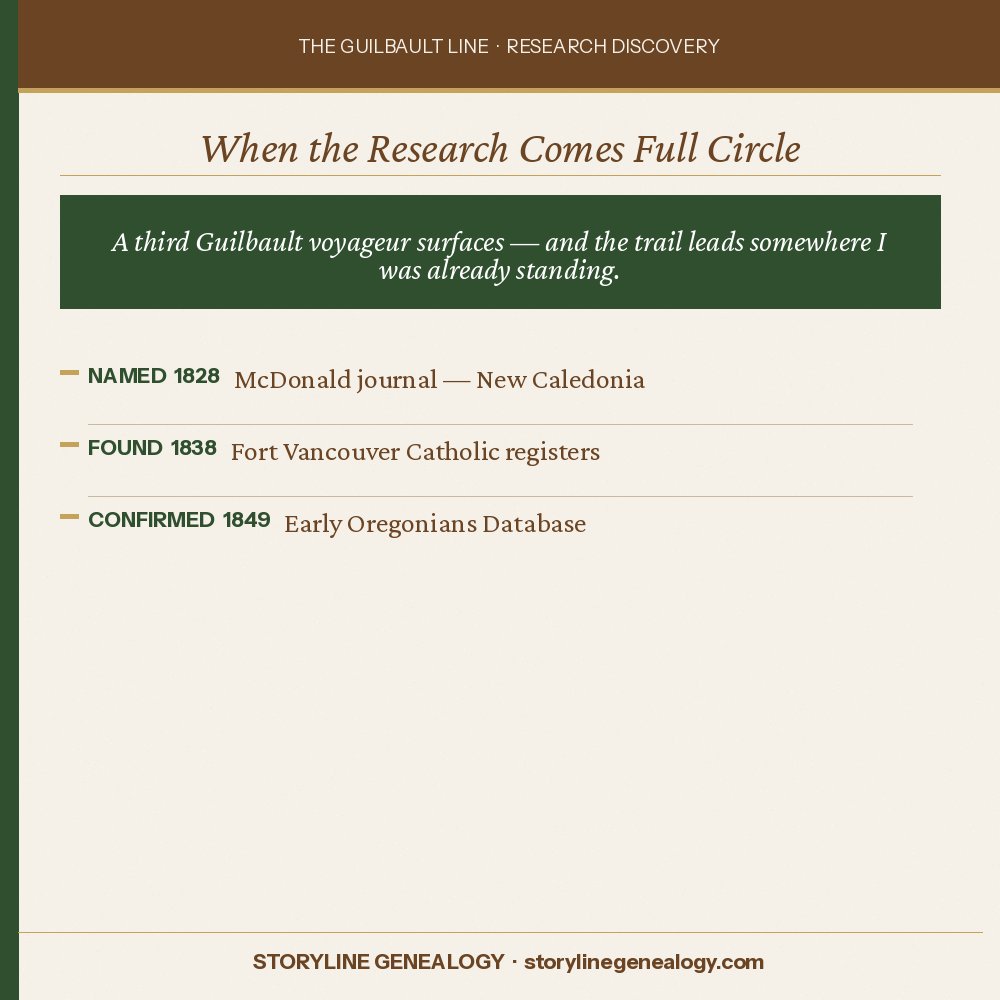
When the Research Comes Full Circle
I thought I was checking a single fact. Four PRDH family records later I had three men called Paul Guilbault instead of two: one who stayed in his parish and left a thick notarial trail, one who went to New Caledonia and Oregon and never came back, and one who exists only as figures in a company ledger, spelled three ways, with no parish to send anyone looking. Then the trail led to Marion County, Oregon — where I had already been working for weeks, on an entirely different project.
Part of the Storyline Genealogy series: The Guilbault Line: Voyageurs of the Pays d'en Haut — and the Oregon Country
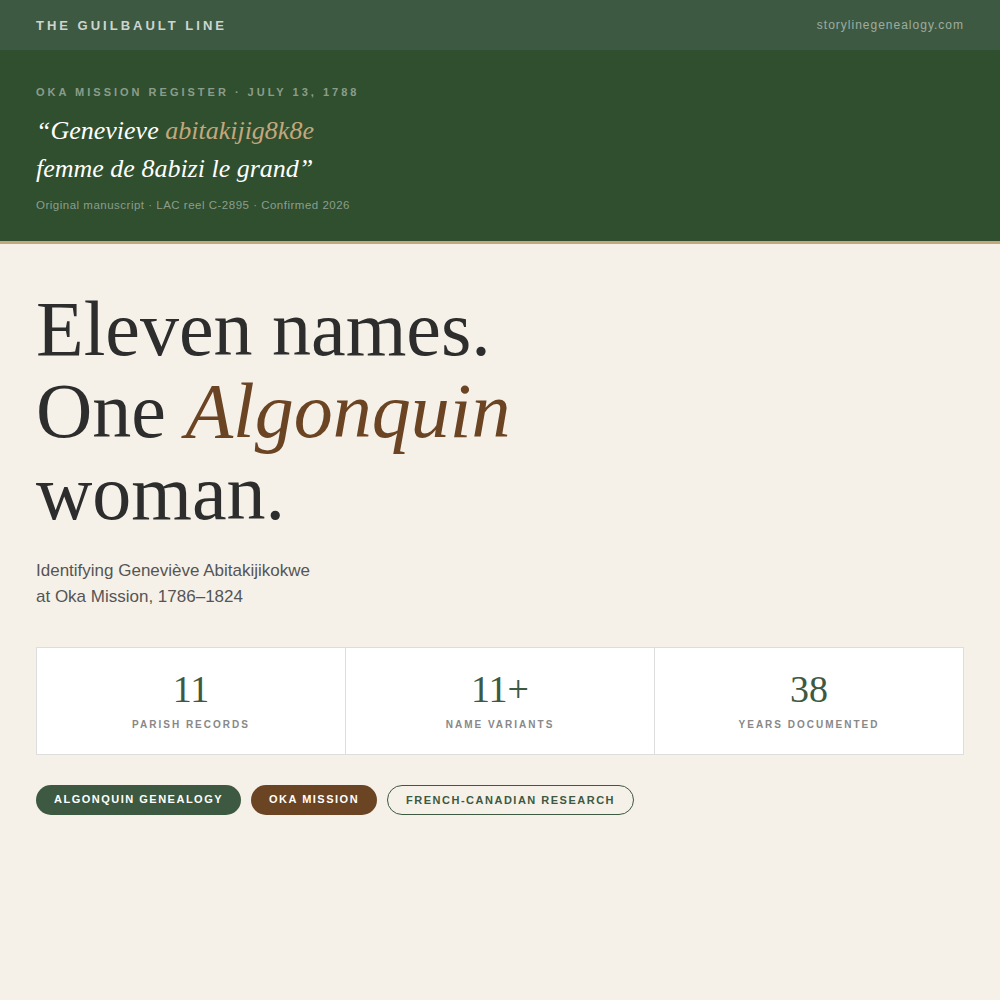
Geneviève Abitakijikokwe: Eleven Name Variants
Her name was written ten different ways across thirty-eight years of Oka Mission registers. The woman behind those names — Geneviève Abitakijikokwe, wife of the Algonquin war chief Kitchiwabisi — appears in eleven primary records between 1786 and 1824. Identifying her required going beyond the published indexes to the original manuscript. What I found there changed the entire shape of the problem.
Part of the Storyline Genealogy series: The Guilbault Line: At the Lake of Two Mountains
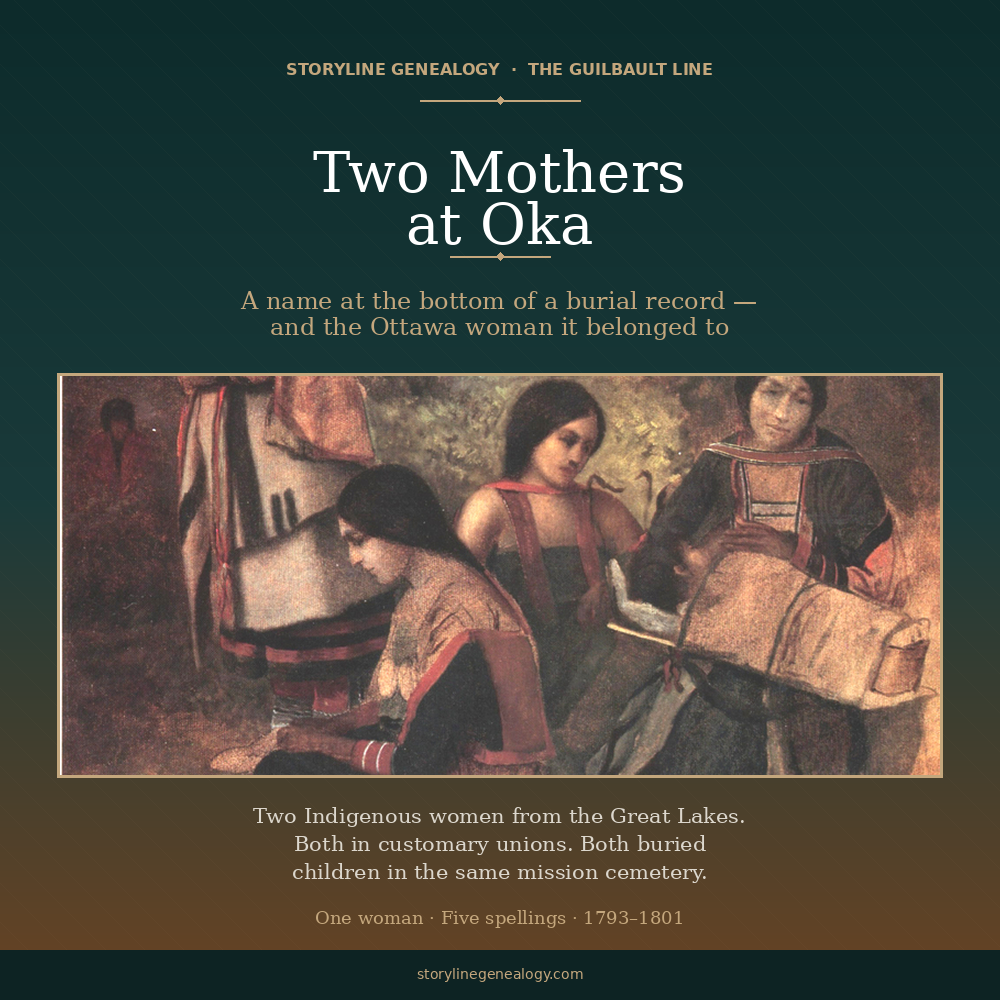
Two Mothers at Oka: Identifying Catherine Messinabikwe
On April 4, 1801, a priest at the Oka mission buried a two-year-old boy named François. Two witnesses were present: the boy's ten-year-old brother, and a woman the priest recorded as Catherine mesepik8e. She was not identified as a relative. She was simply there. Tracing her Algonquian name across five colonial spellings — Mador, Mabre, Missinebi8e, mesepik8e, Messinabikwe — revealed an Ottawa woman from Michilimackinac who had buried her own daughter in the same cemetery two years earlier.
Part of the Storyline Genealogy series: The Guilbault Line: At the Lake of Two Mountains
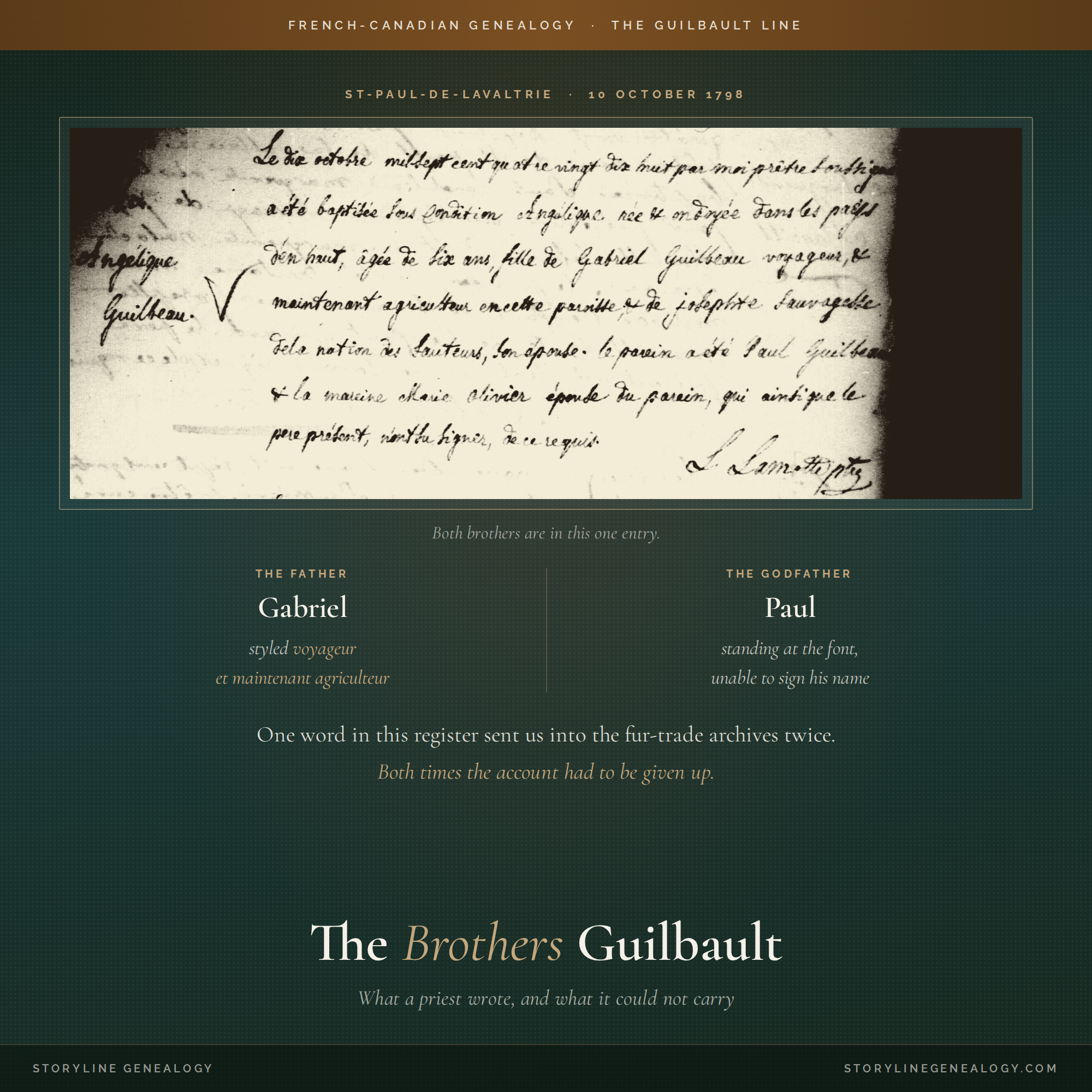
The Brothers Guilbault
On 10 October 1798, a priest at St-Paul-de-Lavaltrie baptized a six-year-old girl born in the pays d'en haut. In the same entry he named her father Gabriel Guilbault a voyageur, and her godfather Paul Guilbault — Gabriel's brother — as a man who could not sign his name. That one word sent this research into the Hudson's Bay Company Archives twice, once for each brother. Both times an account was found. Both times it had to be given up.
Part of the Storyline Genealogy series: The Guilbault Line
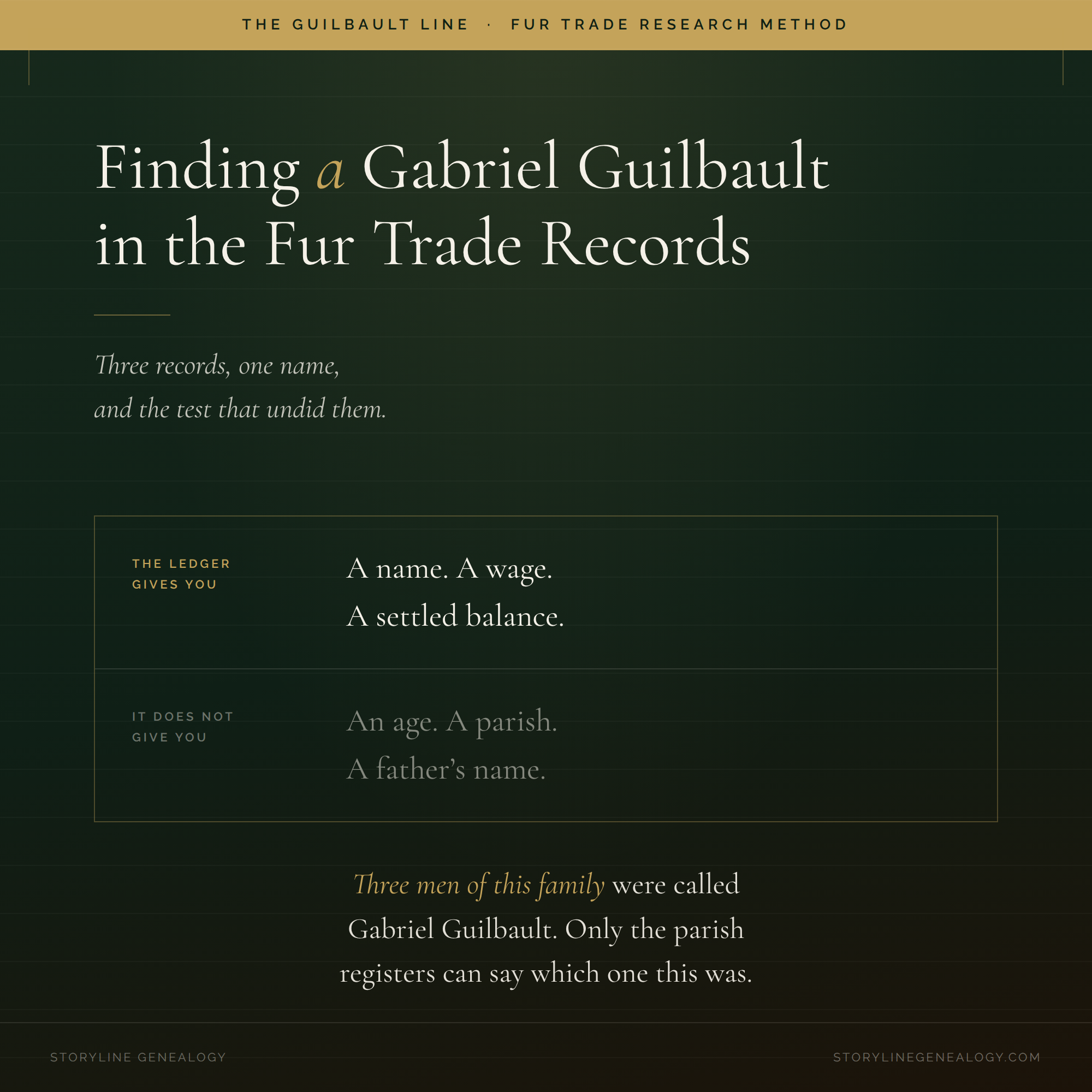
Finding a Gabriel Guilbault in the North West Company Records
A fur trade account book gives you a name and a number. No age, no parish, no father's name. This is how I found Gabriel Guilbault in the North West Company records — three volumes, a cross-post balance, an account marked settled — and how the parish registers later showed the man I had found was not the man I thought. The search method still works. It's the sixth step that decides it.
Part of the Storyline Genealogy series : A Research Journey From the Index to the Account Book
The Other Pierre Morin
There is a second Pierre Morin in the Carignan-Salières Regiment. He was born about 1643 in the diocese of Saintes, he was confirmed at Fort Chambly in May 1668, and by 1681 he was working a Sulpician domain at Lachine. He never married in the colony and left no descendants. Here is his record set out in his own right: one confirmation, one database reconstitution, and a great deal that has been attributed to him rather than documented.
Part of the Storyline Genealogy series: From Research to Story
How to Prove Carignan-Salières Service — and How to Know When You Haven't
You've traced your line to a man who married a Fille du Roi, and half a dozen trees call him a Carignan-Salières soldier. The sources aren't there. Here's the framework I use — and the citation-counting failure in my own published work that took a year and a new book to notice.
Part of the Storyline Genealogy series: From Research to Story