
The Storyline
Real families. Real discoveries. Real stories.
Two Families, One Story: The Kenny Women of Chicago
Margaret Connors Kenny came to Chicago a widow with four small children. This episode follows what the women of that family built over the next ninety years — Catherine Kenny Flynn, who kept a house for her mother for twenty-five years while raising ten children of her own, and Ellen Xavier O'Connor, who married her sister's widower in 1902 and raised her sister's children as her own.
Part of the Storyline Genealogy series: Documentary Biographies From Research to Story
Two Families, One Story: The Researcher
She compiled the family group sheet that opens the Connors line on 4 November 1991, ten weeks before her husband died. Nine years later six cousins took a house on Peaks Island and drove on to Prince Edward Island together. One by one, everyone at that table has left us. This is what they left behind.
Part of the Storyline Genealogy series: Documentary Biographies From Research to Story
Two Families, One Story: Margaret Katherine Kenny
The youngest of Thomas P. Kenny's seven children, and the bridge between two documentary biography series. Her family papers recorded her birth year as 1908 twice, in two documents written by the same hand. The parish register had it right in 1908 and still had it right sixty years later, when she wrote and asked.
Part of the Storyline Genealogy series: Documentary Biographies From Research to Story
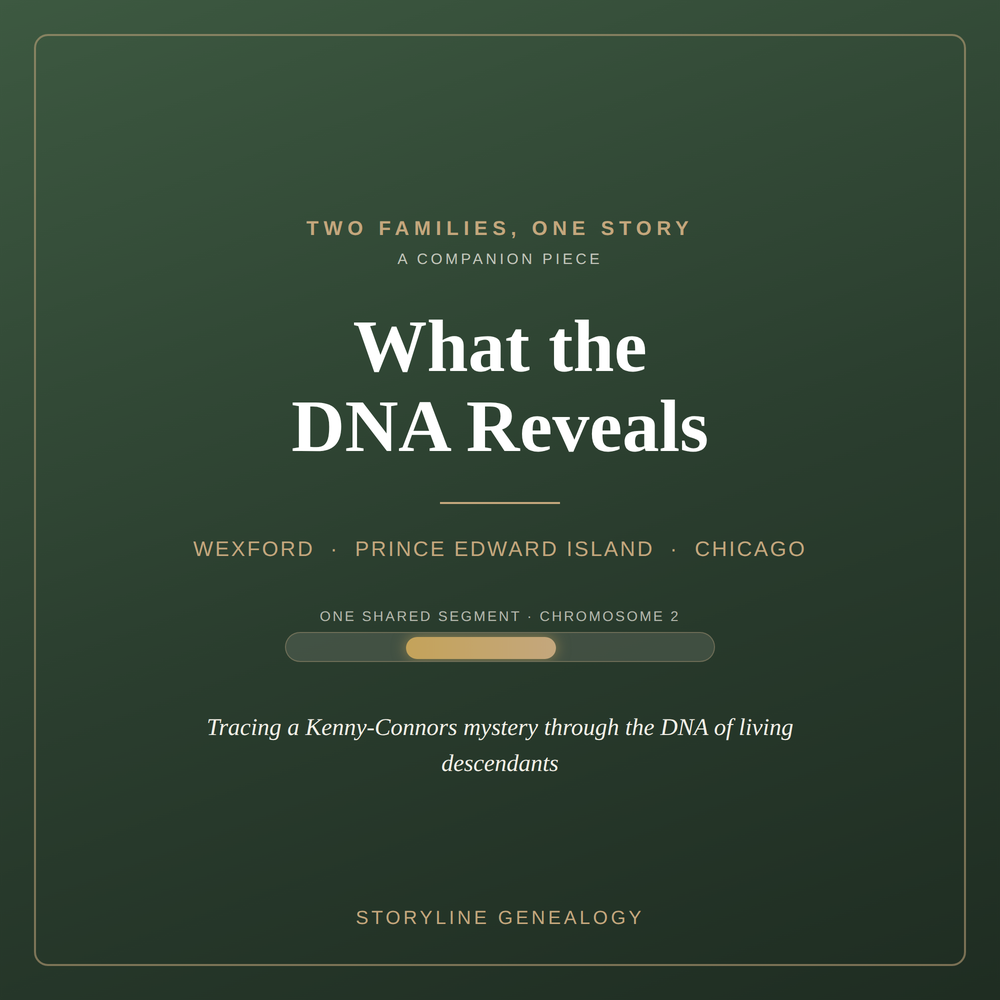
Two Families, One Story: What the DNA Reveals
Three Kenny-Connors marriages bound two families across two continents—but were they always one family? This companion piece turns from parish records to the DNA of living descendants, confirming a shared Connors ancestry from County Wexford to Prince Edward Island and narrowing a century-old question to a single missing generation.
Part of the Storyline Genealogy series: DNA Analysis From Research to Story
The Sailors’ Church: Notre-Dame-de-Bon-Secours
Thomas Patrick Kenny was six or seven years old when his widowed mother gathered her children for the long journey from Prince Edward Island to Chicago. Decades later, he still remembered stopping at a church in Quebec where tiny ships hung from the ceiling, floating in the candlelit air like prayers made visible. The church was Notre-Dame-de-Bon-Secours—the "Sailors' Church."
Part of the Storyline Genealogy series: Sacred Places
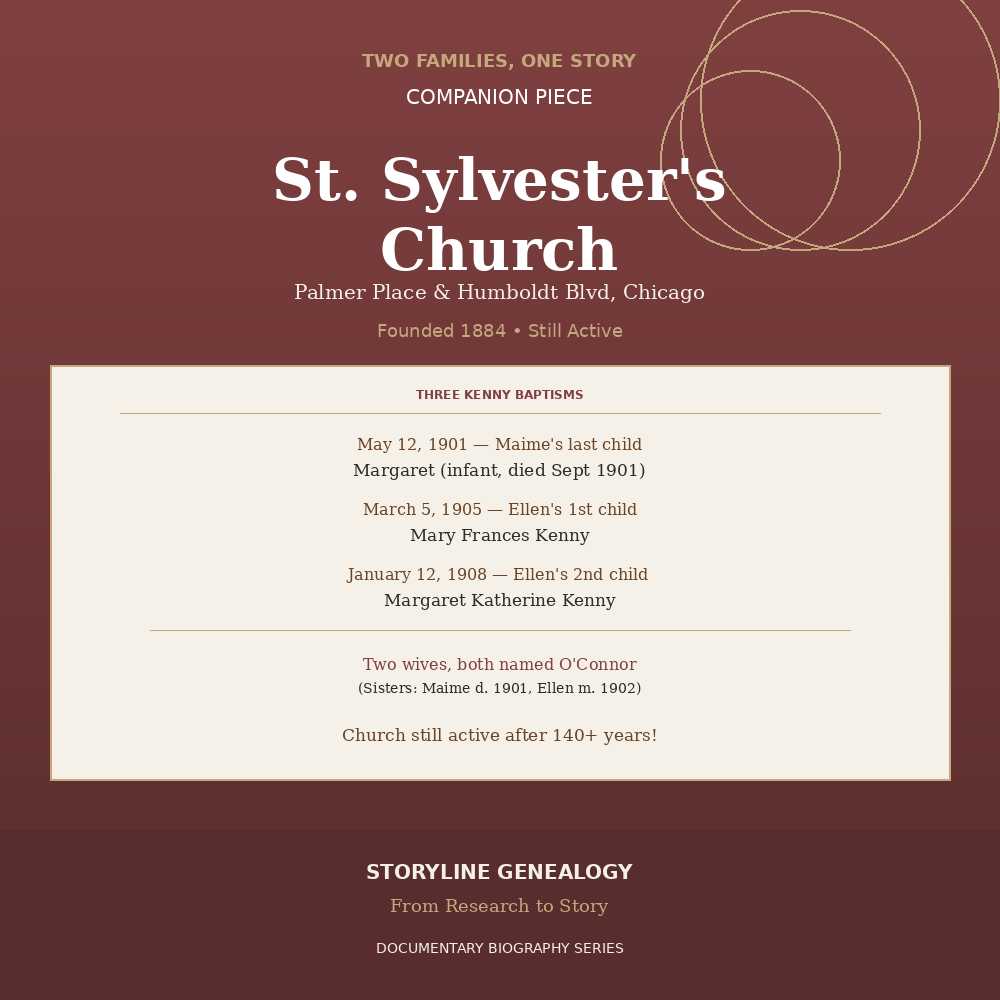
St. Sylvester's Church
After their 1902 marriage, Thomas Patrick Kenny and Ellen Xavier O'Connor moved their growing family from West Town to the Humboldt Park area. At St. Sylvester's Church—a territorial parish founded in 1884—they baptized the daughters of their new life together: Mary Frances Kenny (March 5, 1905) and Margaret Katherine Kenny (January 12, 1908). Margaret Katherine would grow up to marry Thomas Eugene Hamall, bridging the Kenny and Hamall family lines. Unlike Old St. Stephen's, which fell to the Kennedy Expressway in 1952, St. Sylvester's still stands today—over 140 years of continuous service to the Logan Square community.
Part of the Storyline Genealogy series: Documentary Biographies From Research to Story
Sacred Places : Two Churches, One Family Story
In tracing the Kenny and Connors families of Prince Edward Island, a curious pattern emerges: children baptized at St. Dunstan's in Charlottetown, yet their families buried at St. Eugene's in Covehead. This companion piece explores the history of both churches and explains why our ancestors traveled between them—following a rhythm of births and deaths that connected the rural parish to the urban cathedral.
Part of the Storyline Genealogy Series: Documentary Biographies From Research to Story
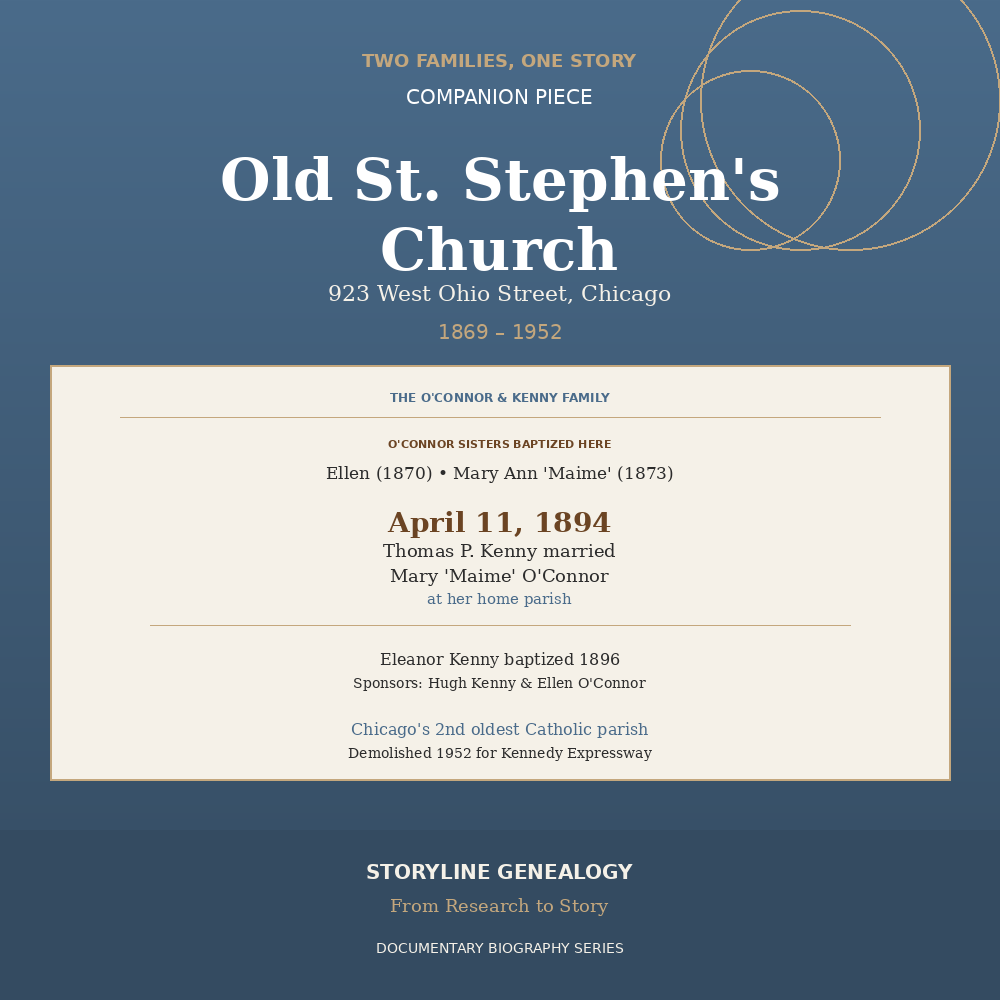
Old St. Stephen’s Church
On April 11, 1894, Thomas Patrick Kenny stood at the altar of Old St. Stephen's Church to marry Mary "Maime" O'Connor—witnessed by Laurence Walsh and Nellie O'Connor. Two years later, their daughter Eleanor was baptized there, with Thomas's brother Hugh Kenny and Mary's sister Ellen O'Connor as sponsors. That same Ellen O'Connor would become Thomas's second wife after Mary's death in 1901. The parish records reveal how Catholic godparent traditions helped prepare families for life's uncertainties—and how a 1902 sororate marriage kept orphaned children in the care of the aunt who was already their godmother.
Part of the Storyline Genealogy series: Documentary Biographies From Research to Story
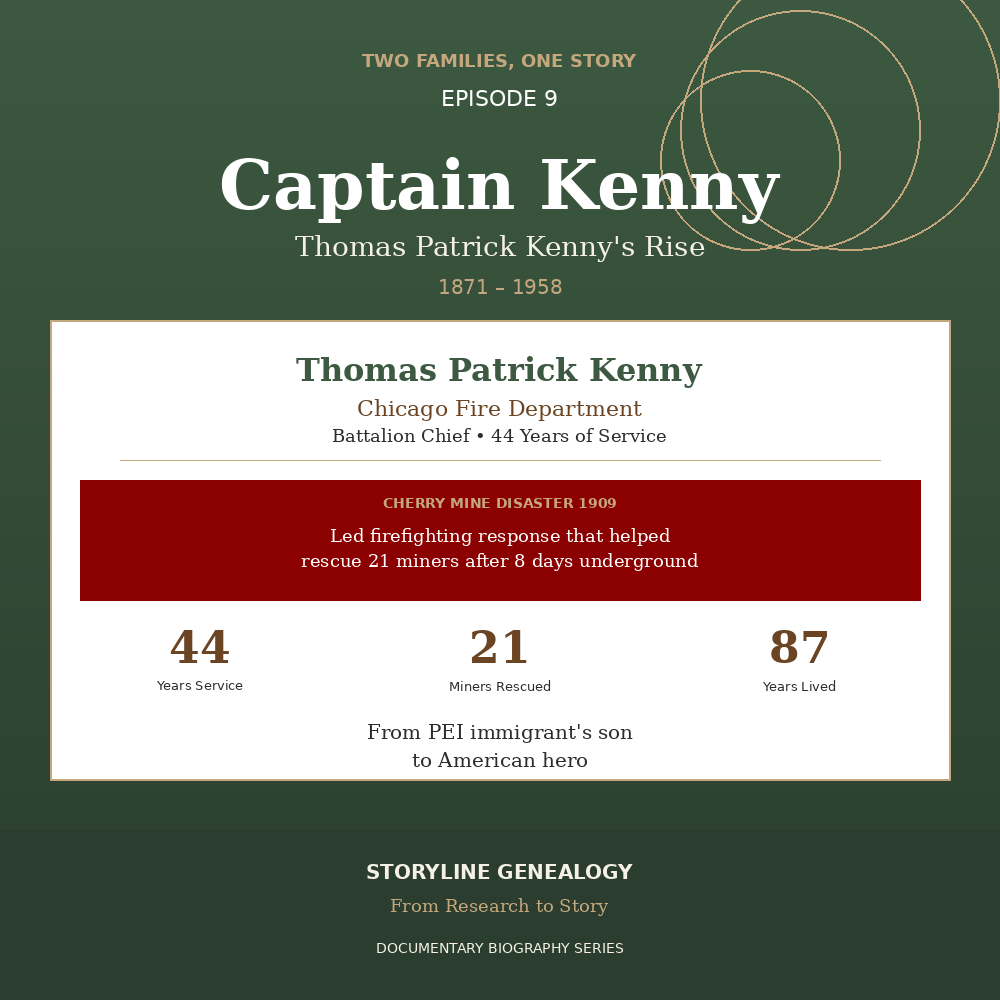
Two Families, One Story : Captain Kenny
Thomas Patrick Kenny was born in Covehead, Prince Edward Island, in 1871—barely a year before his father died. His widowed mother brought him to Chicago, where he joined the fire department at nineteen, served forty-four years, and in November 1909, descended into a burning mine to help rescue twenty-one men trapped underground for eight days. He married twice—both times to sisters from the same family—raised seven children, survived cancer, and retired to Florida where his grandchildren knew him as "Pa," the gentle giant who could fix anything.
Part of the Storyline Genealogy series: Documentary Biographies From Research to Story
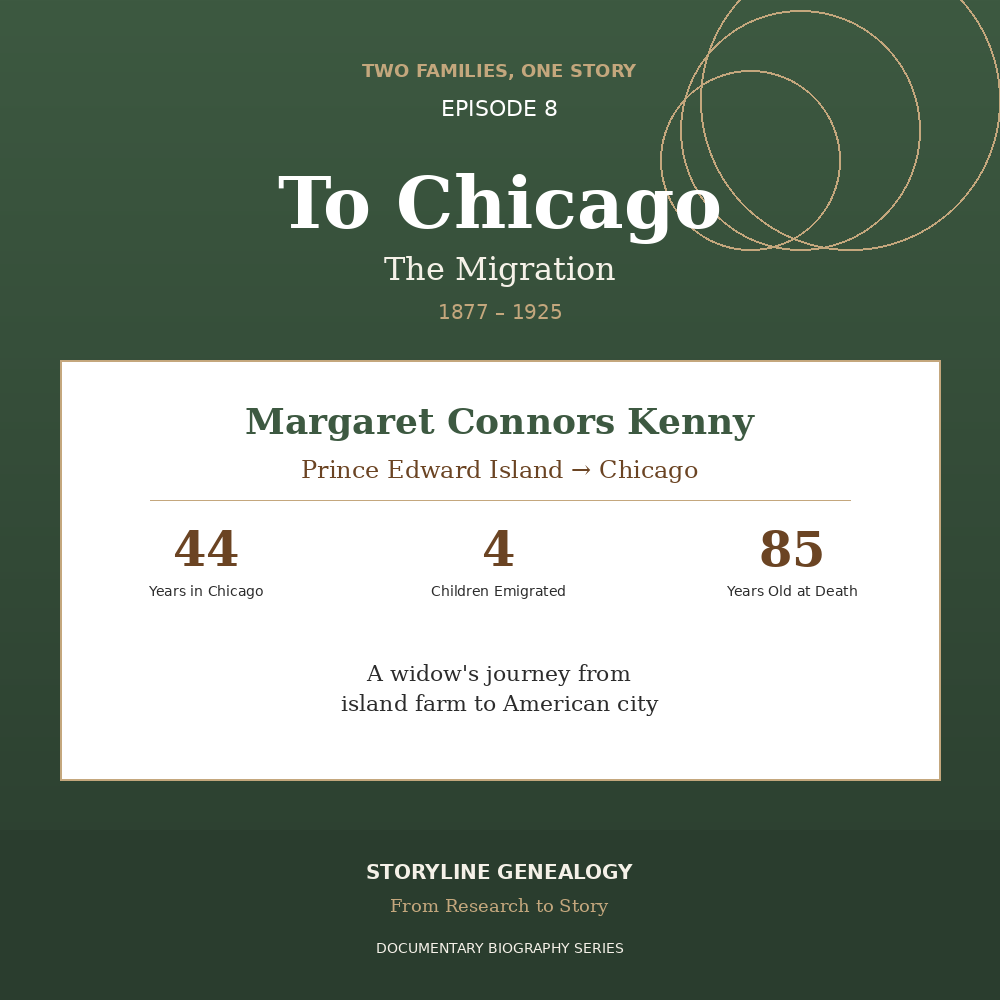
Two Families, One Story : To Chicago
In the year James Kenny died—1872—Margaret Connors Kenny was thirty-six years old, widowed, with four children under ten. Five years later, she left everything she knew and traveled a thousand miles to Chicago, a city still rebuilding from fire. She supported her young family by taking in washing, buried a son at fifteen, and lived forty-four years in her adopted city. When she died in 1925, the newspapers called her a "Pioneer."
Part of the Storyline Genealogy series: Documentary Biographies From Research to Story
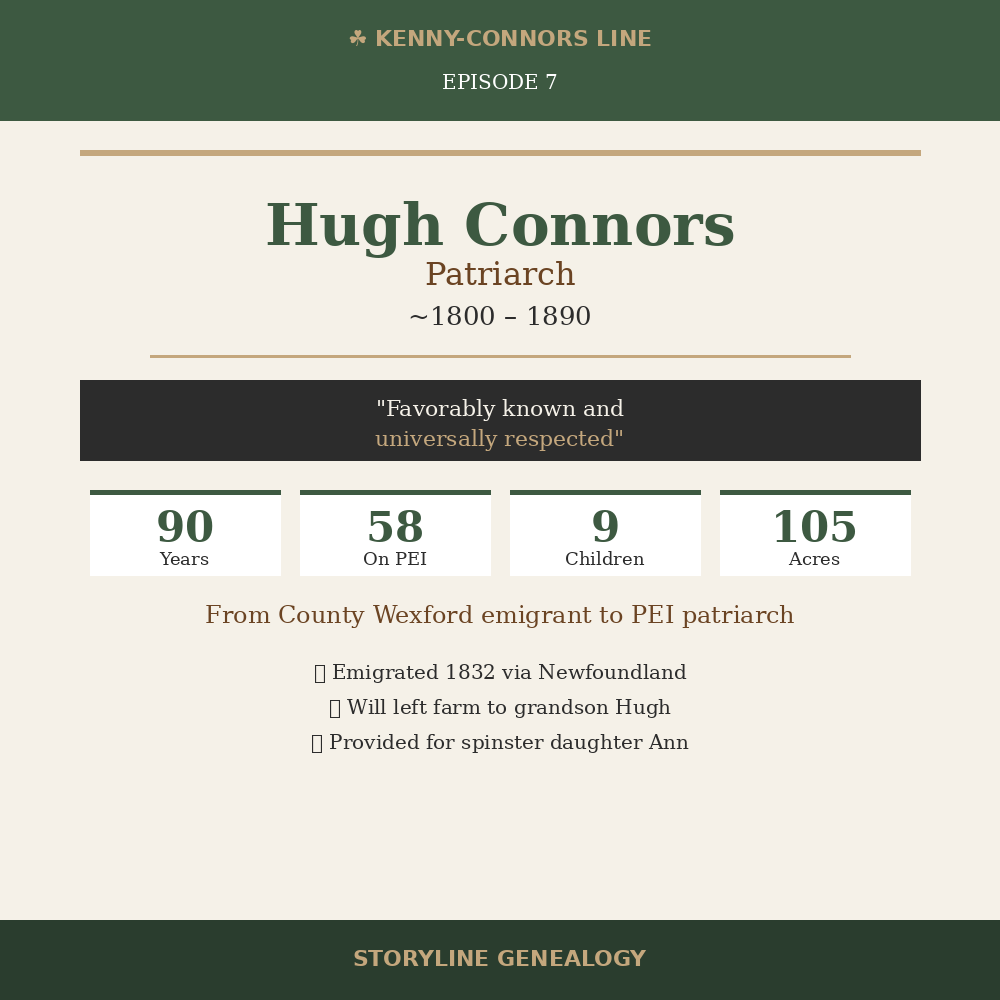
Two Families, One Story: Hugh Connors
On November 22, 1890, Hugh Connors died at his farm on Friston Road in Lot 34, Prince Edward Island. He was approximately ninety years old. The Summerside Journal recorded his passing: "age 90, widower, 4 sons, 5 daus. Came from County Wexford, Ireland, in 1832." His will, signed nine months before his death, left the 105-acre farm to his grandson Hugh with instructions that his unmarried daughter Ann "will live with my aforesaid Grandson Hugh Connors and that he will support her while she will live with him." Hugh's death marked the end of an era for the Connors family on Prince Edward Island—and the beginning of a new chapter in Chicago.
Part of the Storyline Genealogy series: Documentary Biographies From Research to Story
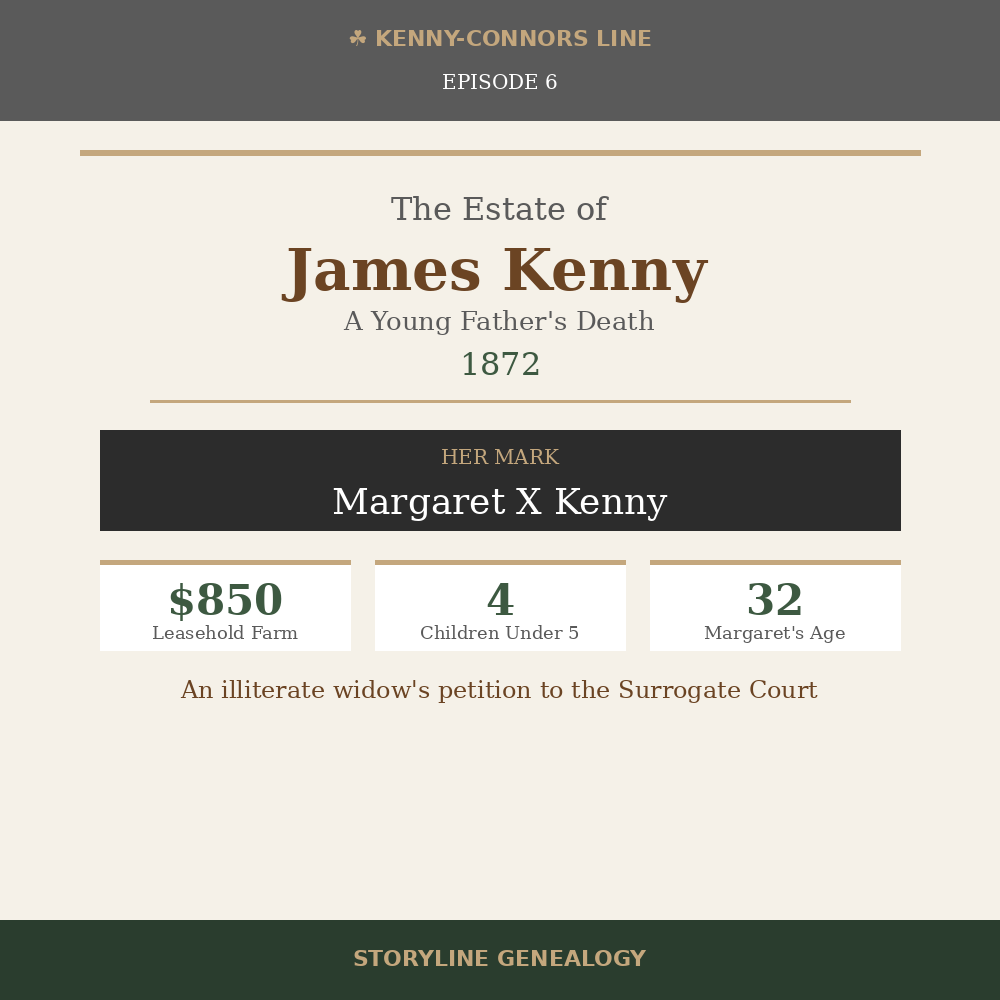
Two Families, One Story : The Estate of James Kenny
On June 25, 1872, James Kenny died at approximately 40 years old. He left behind his wife Margaret, three young children, an unborn son, a leasehold farm on Covehead Road, and a will that wasn't properly witnessed. Margaret was 32 years old and illiterate. Over a year later, she stood before the Surrogate Court of Prince Edward Island, made her mark on a petition, and secured Letters of Administration with the help of two neighboring farmers who stepped forward as sureties. The probate records tell a story of modest prosperity, legal complication, and a widow's determination.
Part of the Storyline Genealogy series: Documentary Biographies From Research to Story
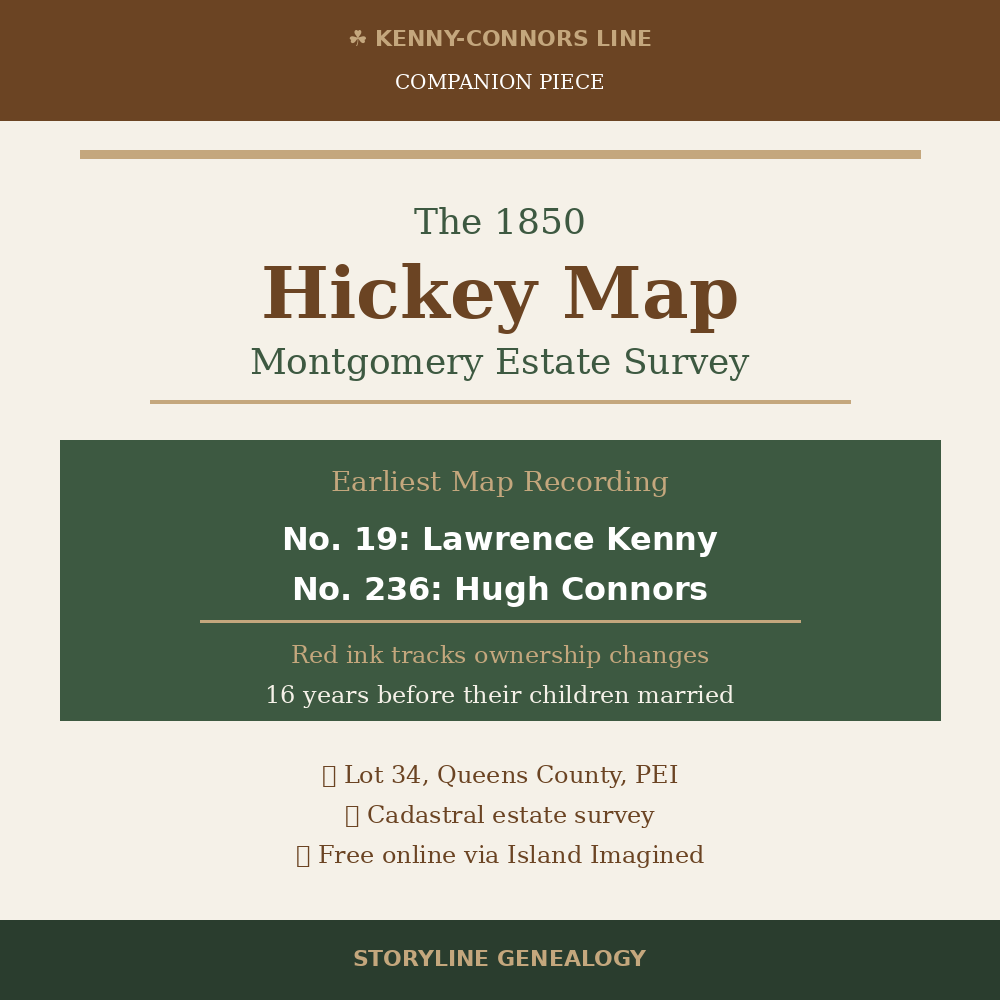
The 1850 Hickey Map: The Montgomery Estate on Lot 34
Before the 1863 Lake Map placed "L. Kenny" and "H. Connors" on the commercial record, another document had already captured their presence on Lot 34. Daniel Hickey's 1850 cadastral survey—"A Plan of Township No. 34, The Property of Sir Graham Montgomery & Brothers"—is a landlord's inventory of his tenants, recording each family by parcel number, name, and acreage. Lawrence Kenny appears at No. 19 with 50 acres; Hugh Connors at No. 236 with 84 acres. They were neighbors sixteen years before their children's weddings began.
Part of the Storyline Genealogy series: Documentary Biographies From Research to Story
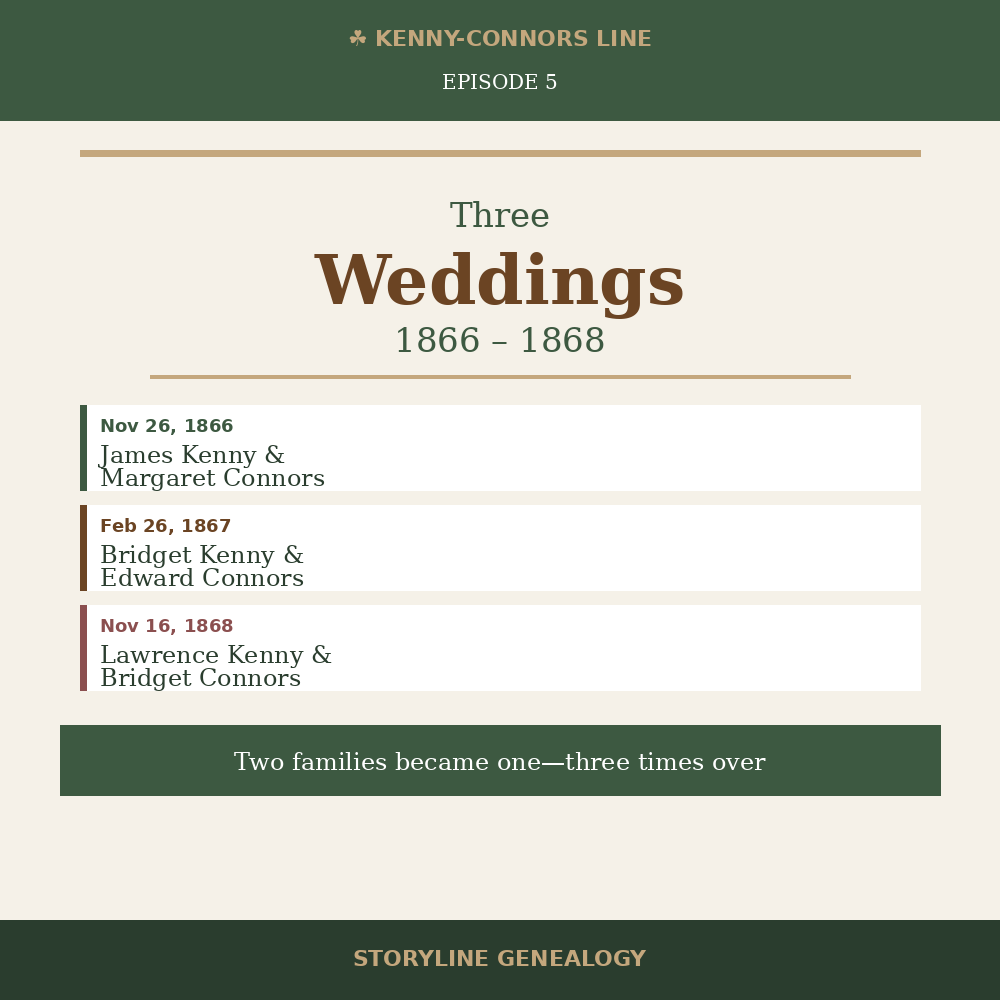
Two Families, One Story: Three Weddings
Between November 1866 and November 1868, three weddings transformed two neighboring families on Prince Edward Island into one extended kinship network. James Kenny married Margaret Connors. Three months later, his sister Bridget married Margaret's brother Edward. Two years after that, the widowed Kenny patriarch Lawrence—now 64 years old—married Bridget Connors, his children's sister-in-law. This episode explores what these marriages reveal about family bonds, community structure, and survival strategies in 19th-century Irish immigrant communities.
Part of the Storyline Genealogy series: Documentary Biographies From Research to Story
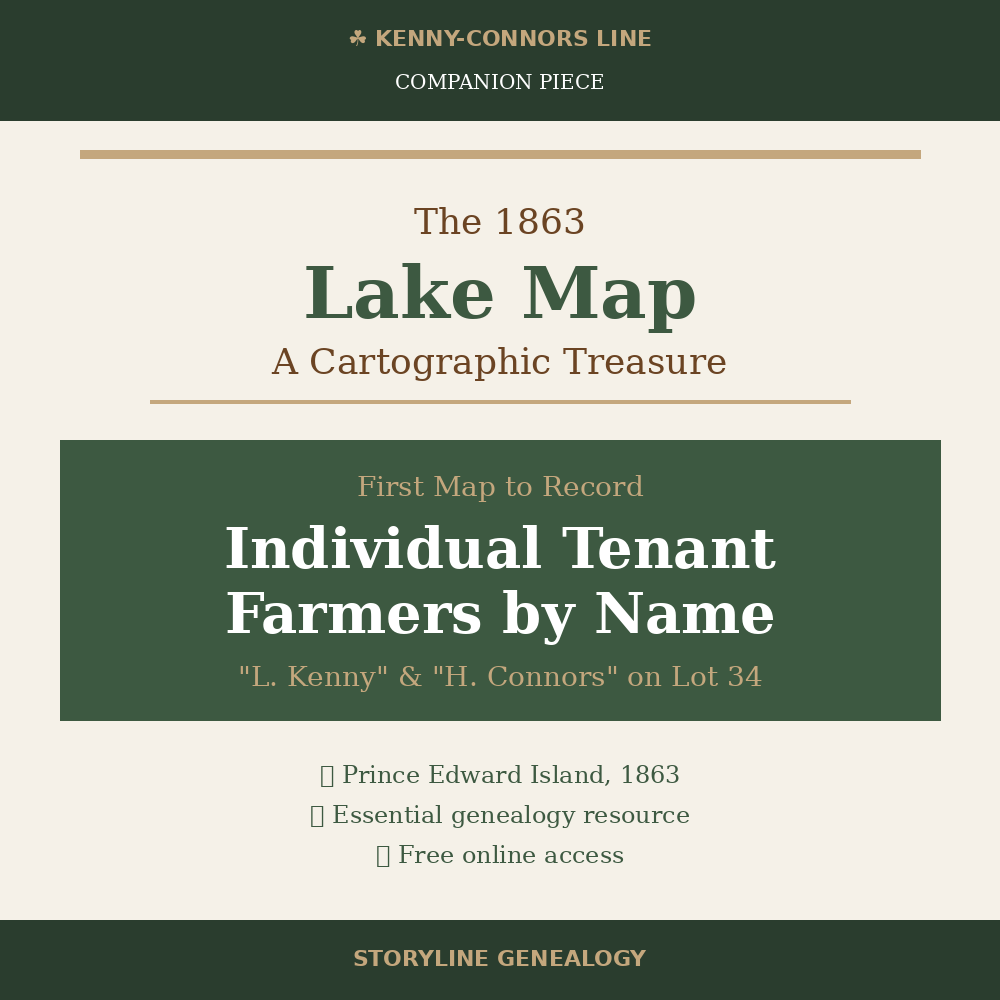
The 1863 Lake Map: A Cartographic Treasure
For genealogists researching Prince Edward Island, the 1863 Lake Map represents a holy grail: the first time individual tenant farmers were recorded by name on a commercial map. When I located "L. Kenny" and "H. Connors" on neighboring properties in Lot 34, I was looking at documentary proof of what the parish registers had suggested—these families lived close enough to walk to each other's farms. This companion piece explores the map's creation, significance, and how to use it for your own research.
Part of the Storyline Genealogy series: Documentary Biographies From Research to Story
Researching Prince Edward Island
Tracing Irish families who settled in Prince Edward Island requires navigating a unique set of records, repositories, and research strategies. This companion piece to the Kenny-Connors documentary biography series shares the methodologies developed over years of research—from the 1863 Lake Map to PEIGS cemetery transcripts—techniques applicable to any PEI genealogy project.
Part of the Storyline Genealogy series: Documentary Biographies From Research to Story
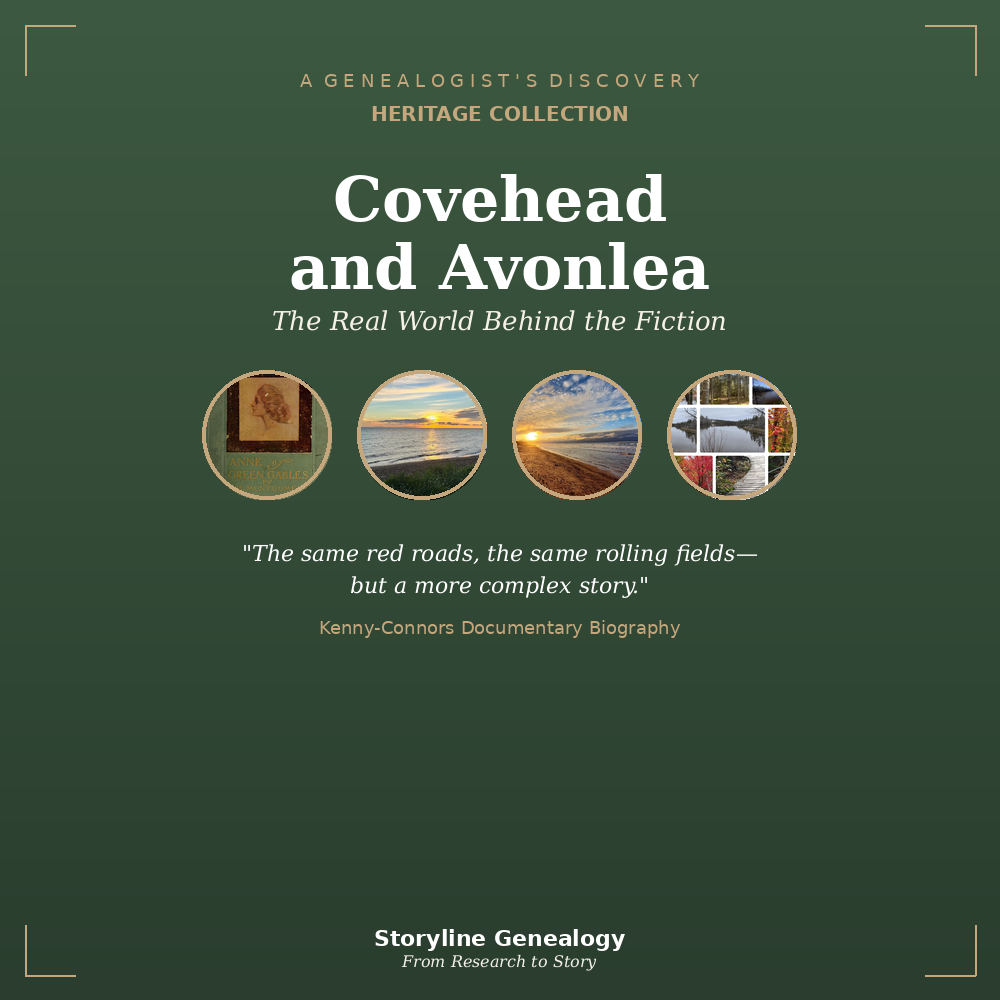
Covehead and Avonlea
If you've followed the Kenny-Connors documentary biography series, you've walked the red-clay roads of Covehead—the same landscape that inspired Lucy Maud Montgomery's beloved Anne of Green Gables. But how did real life for Irish tenant farmers compare to the fictional world of Avonlea? This companion piece explores the similarities, the differences, and what descendants can still see today on Prince Edward Island.
Part of the Storyline Genealogy series: Documentary Biographies From Research to Story
Two Families, One Story : Covehead
In 1833, Hugh Connors and Mary Crimmens married in New Brunswick—both described as "natives of Ireland." By 1841, they had settled on Lot 34, Prince Edward Island, just down the road from the Kenny family. Their children grew up as neighbors. Three of them would marry Kennys. This is the story of how two Irish immigrant families became one.
Part of the Storyline Genealogy series: Documentary Biographies From Research to Story
Two Families, One Story: From Tailor to Farmer
In October 1832, Lawrence Kenny brought his infant son James to St. Patrick's Church in St. John's, Newfoundland. Within three years, the family would leave the fishing settlement behind for the farmland of Prince Edward Island. The 1841 census captures Lawrence at a pivot point: still listed as "Tailor," the trade he brought from Ireland. By the next census, that occupation would be gone. Lawrence Kenny, tailor, would become Lawrence Kenny, farmer—and his children would marry into the Connors family three times over.
Part of the Storyline Genealogy series: Documentary Biographies From Research to Story
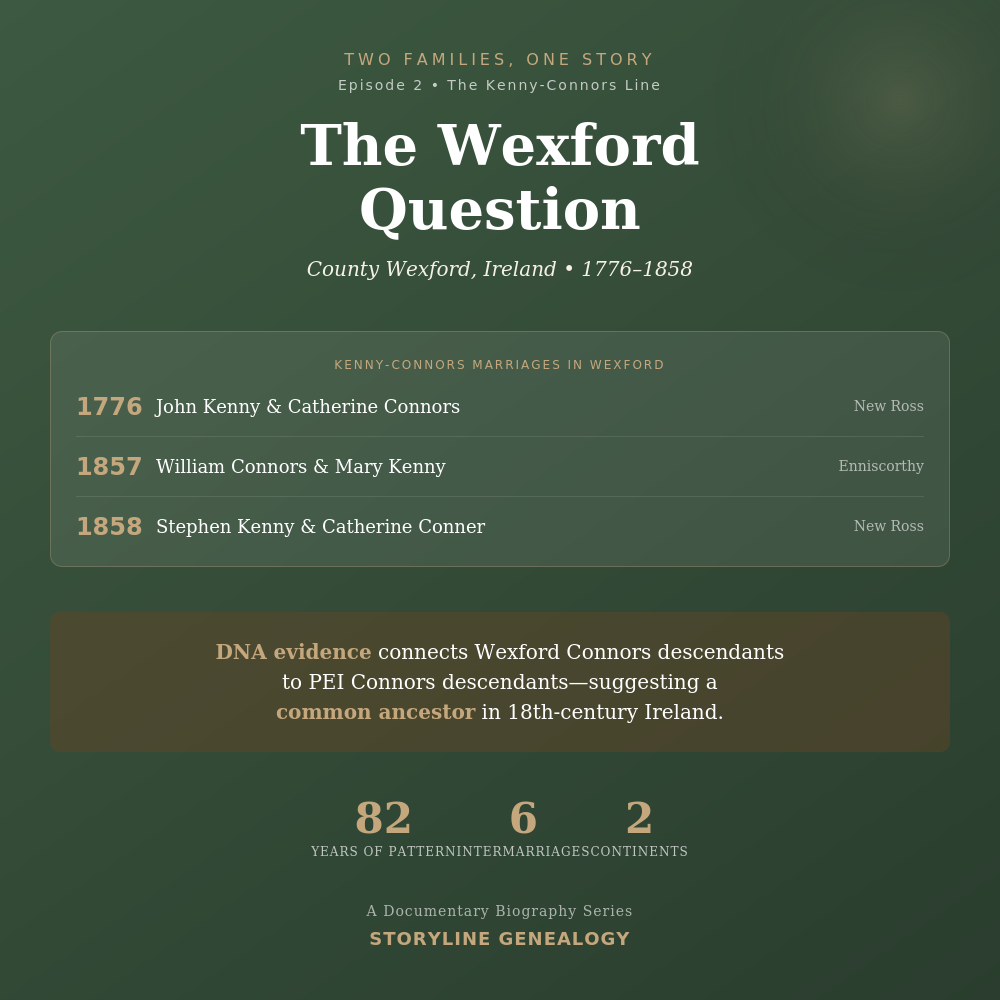
Two Families, One Story: The Wexford Question
In 1776—the same year the American colonies declared independence—John Kenny married Catherine Connors in New Ross, County Wexford. Eighty-two years and three more Kenny-Connors marriages later, were the families who intermarried on Prince Edward Island continuing a pattern that stretched back to Revolutionary-era Ireland?
Part of the Storyline Genealogy series: Documentary Biographies From Research to Story