
Following the Canoe Routes: How the Fur Trade Families Moved Between the Interior and Quebec
Following the Canoe Routes
If your French-Canadian ancestor married an Indigenous woman in the pays d'en haut and their children appear in Quebec parish records, they followed the water. Understanding the canoe routes helps explain why families appear—and disappear—from the records.
Genealogists researching French-Canadian voyageurs often encounter a puzzling pattern: a man appears in Quebec records, disappears for years, then resurfaces—sometimes with a wife and children who seem to have materialized from nowhere. The explanation lies in the geography of the fur trade. These families weren't stationary; they moved along an extensive network of waterways that connected Montreal to the heart of the continent.
Understanding these routes isn't just historical background—it's a practical research tool. When you know how families traveled, you know where to look for records. The routes have a calendar, and the calendar rules things out.
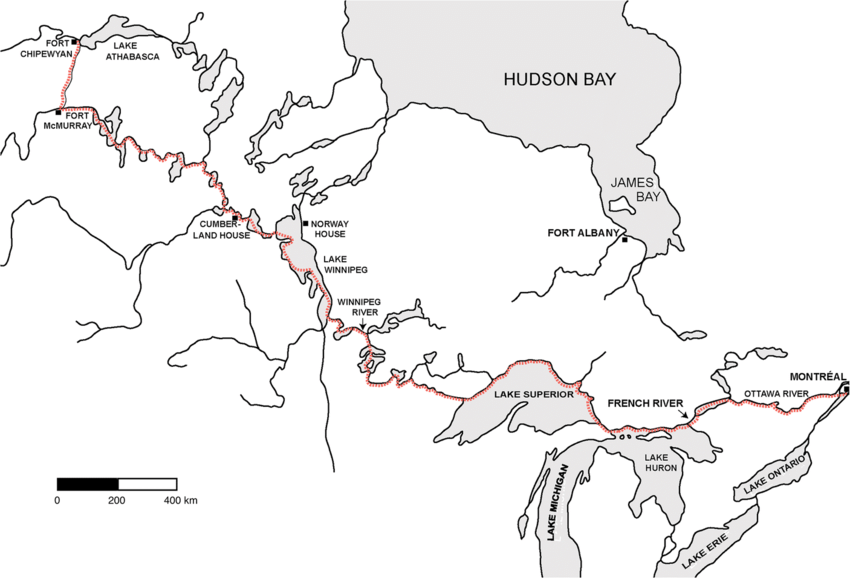
The Voyageurs Highway: the dotted line marks the canoe route from Montreal through the Great Lakes, across Lake Winnipeg, and northwest to Fort Chipewyan in the Athabasca country—a journey of over 3,000 miles that fur trade families traveled regularly.
The Fur Trade Highway
The canoe routes of the fur trade formed an interconnected highway system stretching from Montreal to the Rocky Mountains and beyond. Voyageurs paddled these routes annually, carrying trade goods west in spring and furs east in autumn. Their Indigenous wives and Métis children often traveled with them—or waited at strategic posts along the way.
The main artery connecting the St. Lawrence settlements to the upper Great Lakes. From Lachine (near Montreal), voyageurs paddled up the Ottawa River, across Lake Nipissing, and down the French River to Georgian Bay and Lake Huron.
Key stops: Sainte-Anne-de-Bellevue, Oka, various portages along the Ottawa
From the St. Mary's River rapids (Baawitigong), voyageurs crossed the vast expanse of Lake Superior to the rendezvous point at Fort William (now Thunder Bay). This was the transfer point between the Montreal brigades and the interior canoes.
Key stops: Sault Ste. Marie, Michipicoten, Fort William
From Fort William, smaller canoes carried men and goods into the interior—via Lac La Pluie (Rainy Lake), Lake of the Woods, Lake Winnipeg, and beyond to the Saskatchewan, Athabasca, and Mackenzie river systems.
Key stops: Lac La Pluie, Fort Garry, Cumberland House, Fort Chipewyan
Permanent missions along the routes—like Oka, Sainte-Anne-de-Bellevue, and later Red River—were where Catholic voyageurs could formalize marriages, baptize children, and create the records genealogists rely on today.
Key missions: Oka (Sulpician), Michilimackinac, Prairie du Chien, Red River
Among the interior stops, Lac La Pluie (Rainy Lake) occupied a uniquely strategic position. The economic historian H.A. Innis, writing in his introduction to George Simpson's 1820–21 Athabasca journal, identified it precisely: Rainy Lake was "the depot for the season's furs from the Athabasca." Every load of beaver coming south from the Athabasca country passed through Lac La Pluie before reaching Fort William. Every brigade heading north for the season was outfitted there.
And a debit in an Athabasca account reading To Sundries at Lac la Pluie means the man was moving north — the balance following him from the depot to the most demanding, most distant posting the company had.Source: Simpson, George. Journal of Occurrences in the Athabasca Department, 1820 and 1821. Ed. E.E. Rich, intro. H.A. Innis. Toronto: The Champlain Society, 1938. archive.org/details/journalofoccurreunse
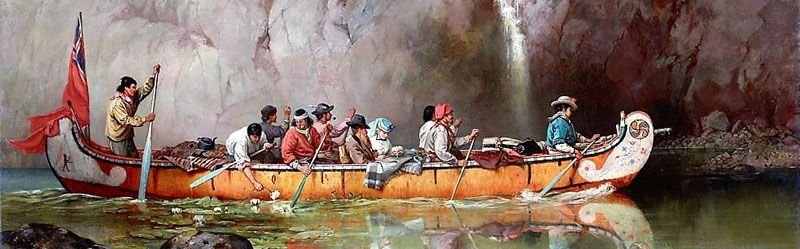
Frances Anne Hopkins traveled the canoe routes herself and painted what she saw. George Simpson — who ran the merged HBC empire after 1821 and whose 1820–21 Athabasca journal remains a primary source for this period — wrote that nothing but the almost incredible hardihood of the French-Canadian voyageur could have survived the ordeal of these routes. This is how fur trade families moved: crowded into birchbark canoes, paddling thousands of miles, season after season.
Why Travel Hundreds of Miles for a Wedding?
Country marriages (à la façon du pays) were recognized and respected within fur trade communities. So why would a voyageur and his Indigenous wife make the arduous journey from the interior to a mission like Oka for a Catholic ceremony?
Most fur trade travel happened in open-water months (May–October). But some ceremonies—like Gabriel Guilbault's January 1801 marriage at Oka—occurred in winter. This suggests the family had traveled east the previous autumn and wintered near Montreal, or that Gabriel had transitioned to working closer to Quebec. Winter dates in parish records can indicate families who were settling permanently in the east, or voyageurs on extended leave between contracts.
The Journey: Baawitigong to Oka
To illustrate what these journeys entailed, consider the route a family like Gabriel Guilbault and Marie Josephte Abitakijikokwe would have followed from the St. Mary's Rapids to the Sulpician mission at Oka — a journey of roughly 800 miles. But the full reach of the canoe network extended far beyond that. Innis documented the complete NWC interior route in precise terms:
From Montreal up the Ottawa and the Mattawa; over the height of land to Lake Nipissing; down French River to Georgian Bay; past the Sault Ste. Marie and along the north shore of Lake Superior, the Montreal agent came by canot du Maître for the annual conference at Fort William. Coming by canot du Nord to the same rendezvous, the winter partner from the Athabaska reached the Saskatchewan by the Methy Portage and a labyrinth of waterways, followed the Saskatchewan, Lake Winnipeg and Winnipeg River, Lake of the Woods, Rainy River, Rainy Lake — the depot for the season's furs from the Athabaska — and over the height of land to Fort William. No fewer than 60 large lakes, 130 portages where canoes and goods were both taken from the water, and 200 smaller décharges where goods alone had to be carried, were to be counted in the voyage from Ste. Anne on the Ottawa to the Athabaska.
These numbers are for the full interior route to the Athabasca. A family traveling only as far as the Great Lakes — from Baawitigong to Oka — would face a shorter but still demanding journey of roughly 800 miles.
Following the Water: St. Mary's Rapids to Oka
Sault Ste. Marie → Lake Huron
Departing from Baawitigong, the family would paddle or portage around the rapids, then enter Lake Huron. Following the North Channel along the Manitoulin Island shore, they'd reach the mouth of the French River.
French River → Lake Nipissing
Up the French River — a challenging stretch with numerous portages — to Lake Nipissing. This was the height of land between the Great Lakes and Ottawa River watersheds.
Lake Nipissing → Mattawa River
Across Lake Nipissing to the Mattawa River, then a portage to the Ottawa River. This was the traditional route used by Indigenous peoples for millennia before European arrival.
Ottawa River → Montreal Region
Down the Ottawa River toward the St. Lawrence — passing numerous rapids requiring portages. The final stretch brought travelers to the Lake of Two Mountains region, where Oka's Sulpician mission awaited.
Arrival at Oka
The mission of L'Annonciation at Oka — established by the Sulpicians in the early 18th century — served both the local Mohawk and Algonquin communities and the fur trade families who passed through. Here, a priest could perform baptisms, marriages, and record the families for posterity.

Anna Jameson's 1837 sketch of the St. Mary's Rapids — Baawitigong — where Gabriel and Marie Josephte likely met. This was the first major waypoint on the journey from the interior to Montreal, and the last for those heading into the pays d'en haut.
This journey — covering roughly 800 miles — would take several weeks by canoe under good conditions. With a family including young children, the pace would be slower. The voyageurs knew every portage, every campsite, every rapid along the way. For Marie Josephte, an Ojibwe woman of the Saulteaux nation, traveling these waterways would have drawn on generations of Indigenous geographic knowledge.
The Records Follow the Routes
When you understand how fur trade families traveled, you understand where to look for records. A voyageur who worked in the Lake Superior region might have children baptized at Michilimackinac, married at Oka, and buried at Red River. Following the canoe routes means following the paper trail across multiple archives and jurisdictions.
What This Means for Your Research
Practical Applications
Search Multiple Parishes
Don't limit your search to one location. A family might appear in Montreal-area parishes (Oka, Sainte-Anne-de-Bellevue, Lachine), Great Lakes missions (Michilimackinac, Sault Ste. Marie), and western posts (Red River, Prairie du Chien). Cast a wide geographic net.
Mind the Gaps — and Check the Account Books
Years-long gaps in Quebec records don't mean your ancestor died or disappeared. He was likely working in the interior, where parish records were sparse or nonexistent. Check fur trade company records (NWC, HBC) at the Hudson's Bay Company Archives in Winnipeg to fill these gaps. A man who vanishes from Quebec registers in 1816 and reappears in 1827 may have a continuous paper trail in the HBCA the entire time.
Look for Legitimization Records
When a voyageur married formally, children born à la façon du pays were often legitimized in the same ceremony. These records can list multiple children at once, with ages that help reconstruct the family's timeline in the interior.
Map the Journey
Plot your ancestor's known locations on a map. Do they follow the canoe routes? If he appears at Sault Ste. Marie and later at Oka, the connection makes geographic sense. If the locations seem random, you may be conflating two different individuals.
Understand Post Transfers
NWC accounts record movement between posts as money rather than as narrative. A debit in an Athabasca account reading To Sundries at Lac la Pluie means a balance travelled north with the man who owed it. These carried figures are geographic evidence — they tell you where your ancestor was, in what season, and in which direction he was moving. They are also, usefully, specific: a non-round figure carried between two posts ties two accounts to one man in a way a name never can.
Case Study: Following One Family
Gabriel Guilbault met Marie Josephte Abitakijikokwe in the Lake Superior country in the early 1790s. They lived together à la façon du pays for over a decade, raising four children in the fur trade world. In January 1801, they traveled to Oka, where the priest baptized Marie Josephte, married them formally, and legitimized their children — all in two days of ceremonies.
NWC records place a Gabriel Guilbault at Lac La Pluie in 1820 and a ledger account under that name running 1817 to 1821. Which Gabriel is a harder question than it first appeared — three men of this family carried the name across three generations — and the case study works through it. What is documented for Gabriel père is earlier and clearer: three children born in the pays d'en haut between about 1790 and 1797, and a parish register in 1798 that calls him voyageur et maintenant agriculteur in the same line that records him present.
Read the Guilbault Line Documentary Biography series →
The Lieutenant and the Voyageurs — a Franklin expedition connection in the same account books →

The 1801 register at Oka where Father Leclerc recorded Marie Josephte's full Ojibwe name, married her to Gabriel, and legitimized their four children — the documentary evidence of a family that had traveled hundreds of miles from the pays d'en haut to create a record that survives today.
Want to Know When New Stories Are Published?
Subscribe to receive updates on new family history research—no spam, just meaningful stories when there's something worth sharing.
SUBSCRIBE TO OUR NEWSLETTEREvery Family Has a Story Worth Telling
Whether you're just beginning your research or ready to transform years of work into a narrative your family will treasure, I'd love to hear your story.
BEGIN YOUR RESEARCH INQUIRY