
The Storyline
Real families. Real discoveries. Real stories.
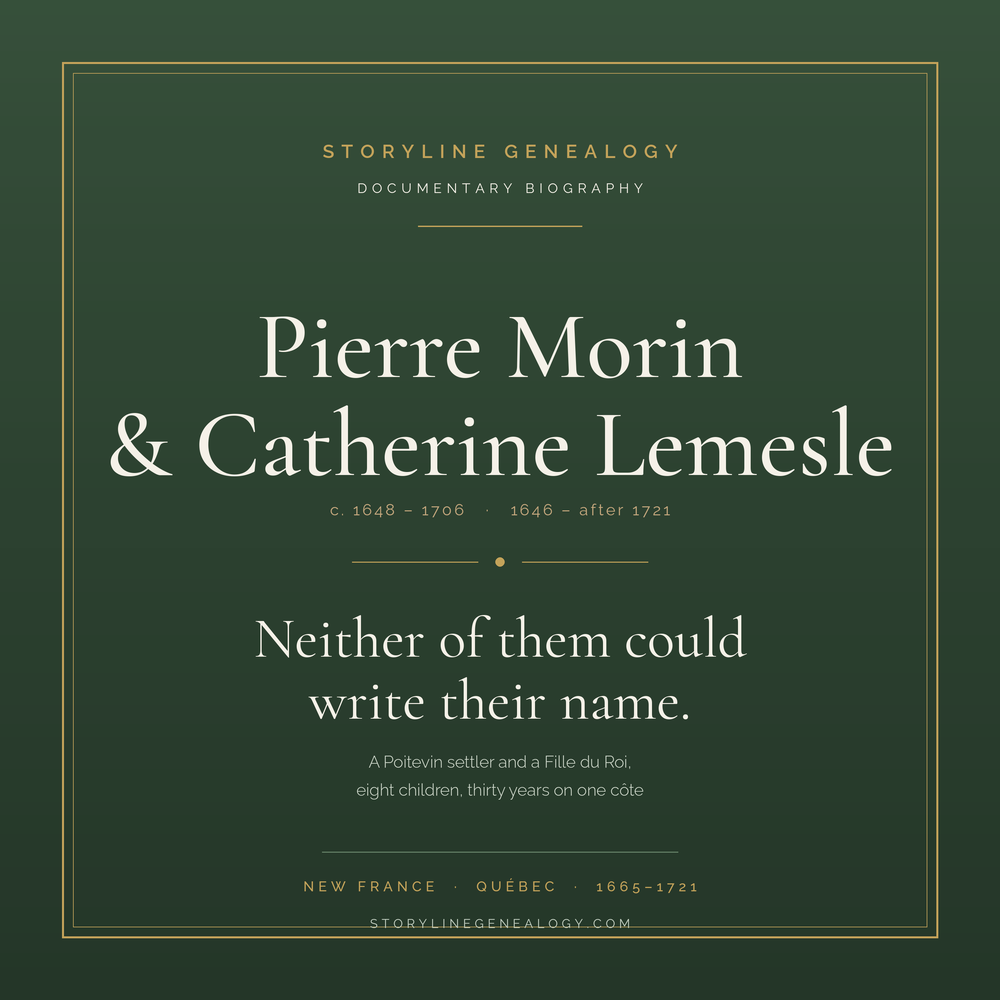
Pierre Morin & Catherine Lemesle
On 18 November 1706 a man of fifty-six was carried into the Hôtel-Dieu de Québec. Thirteen days later his wife was admitted too. Neither of them could write their name — and almost everything we know of Pierre Morin and Catherine Lemesle was written down by other people.
Part of the Storyline Genealogy series: From Research to Story
Marguerite Gaulin: A Fille à Marier of the Perche
Marguerite Gaulin was baptized on 14 May 1627 in the parish of Saint-Martin-du-Vieux-Bellême, in the rolling country of the Perche west of Paris. Twenty-seven years later she crossed an ocean as a fille à marier, married Jean Crête in the manor house of Sieur Robert Giffard at Beauport, and spent the next forty-nine years raising ten children at the heart of the Giffard-Juchereau seigneurial circle. This documentary biography traces her life through twelve primary sources, three royal censuses, and the baptism register acts of every child she bore.
Part of the Storyline Genealogy series: Filles du Roi & Filles à Marier — The Women Who Built New France
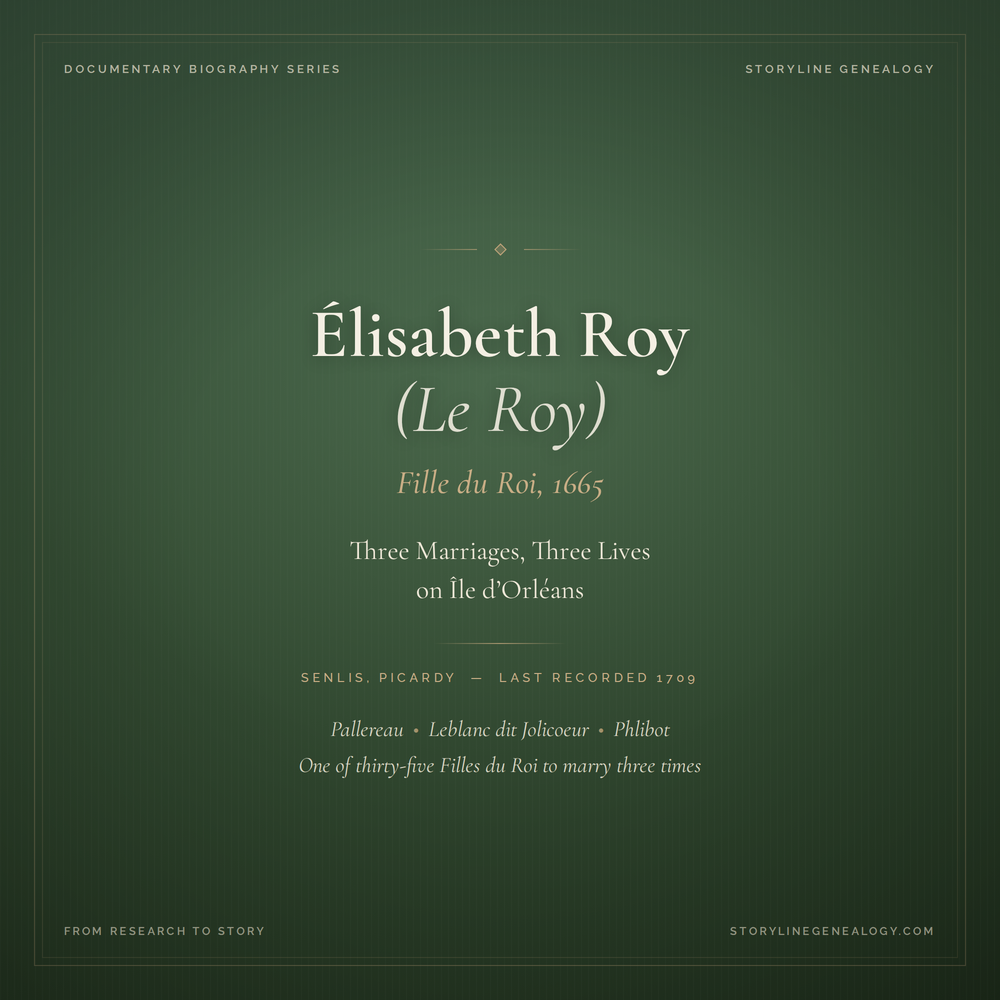
Élisabeth Roy (Le Roy)
She arrived at Québec in June 1665, an orphan from Senlis who could not write her own name, and was married by October. Over the next forty-four years Élisabeth Roy buried two husbands, lost two sons on a single day, and raised seven children across three marriages — one of only thirty-five Filles du Roi to marry three times. Her first marriage contract, read here in the original, was signed by the governor of New France, the lieutenant-general of the Americas, and the two women charged with placing the King's daughters.
Part of the Storyline Genealogy series: Filles du Roi & Filles à Marier — The Women Who Built New France
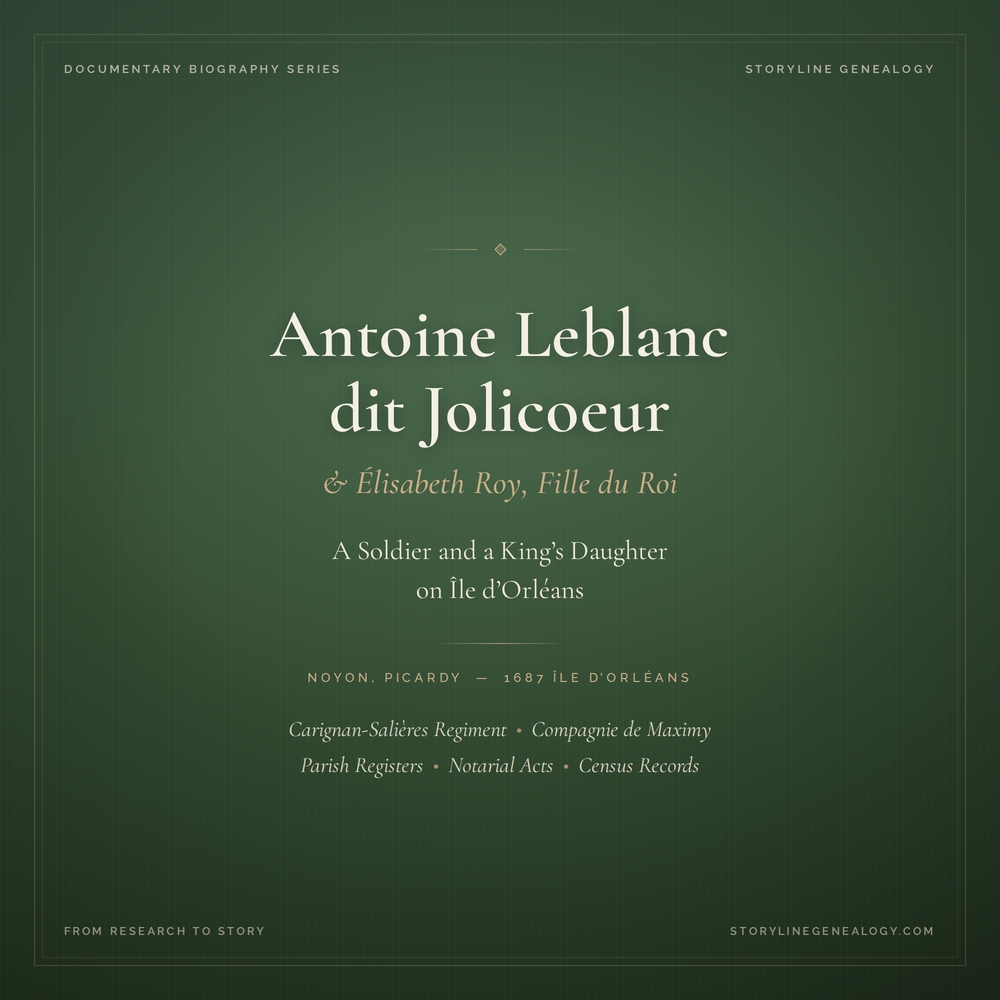
Antoine Leblanc dit Jolicoeur & Elisabeth Roy
In December 1687 a soldier called "Cheerful Heart" was buried at Saint-Jean, Île d'Orléans. Antoine Leblanc dit Jolicoeur had crossed the Atlantic with the Carignan-Salières Regiment, married a Fille du Roi from Senlis, raised five children, and buried two of them on a single day. Reconstructed from the notarial acts read in the original — the marriage contract, two concessions, a harvest engagement — alongside the parish registers, censuses and military rosters of seventeen years on an island in the St. Lawrence.
Part of the Storyline Genealogy series: Carignan-Salières — From Soldiers to Settlers
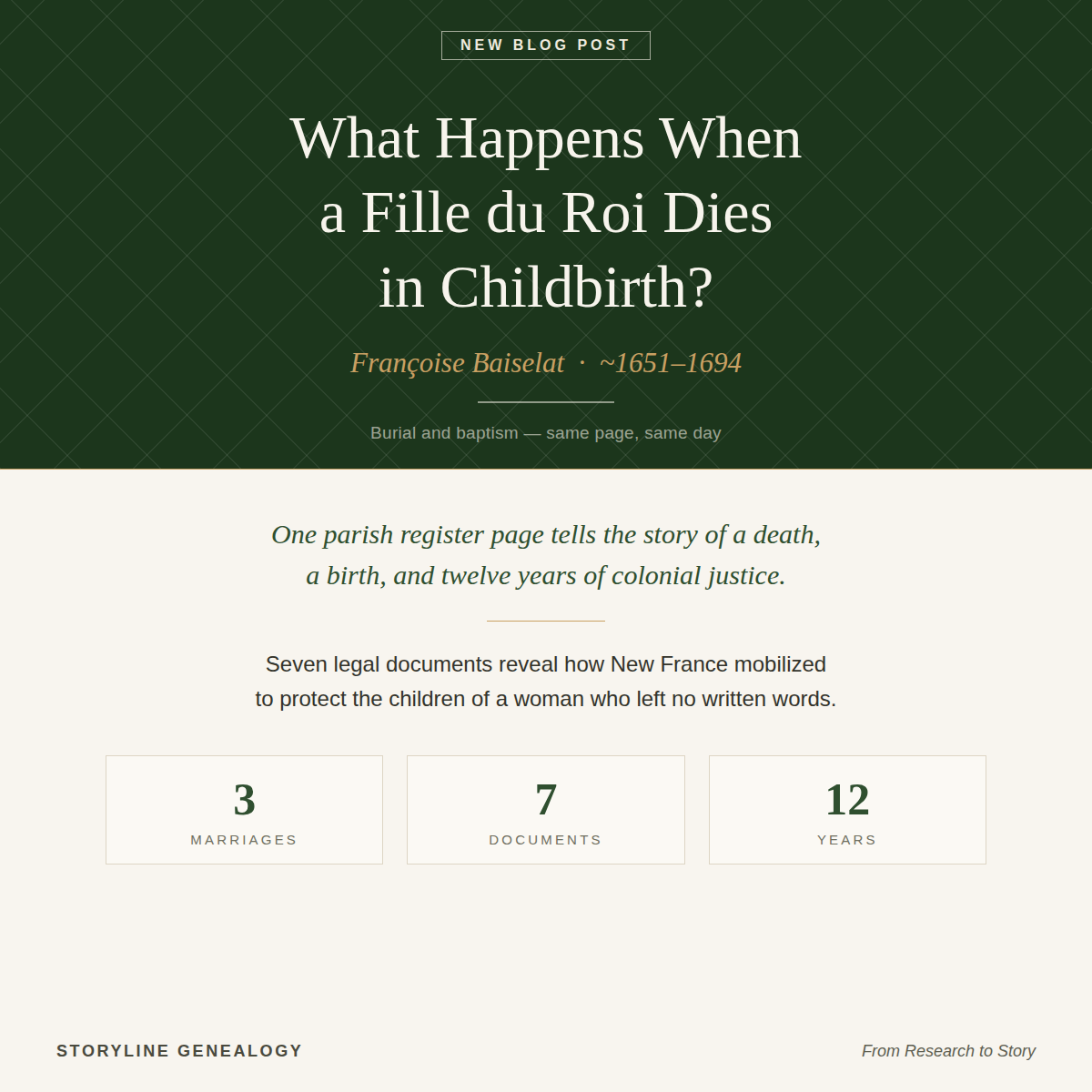
What Happens When A Fille du Roi Dies in Childbirth?
On May 30, 1694, the curé of Pointe-aux-Trembles wrote two entries on one page: a burial and a baptism, the same family, the same ink. The woman was Françoise Baiselat, a Fille du Roi of 1668. The child was her son François. What came after — three estates, children from three marriages, a widower who could not sign his name, and a priest still chasing the funeral bill three years on — is recorded in the notarial acts, and it is the part the register does not tell you.
Part of the Storyline Genealogy series: From Research to Story
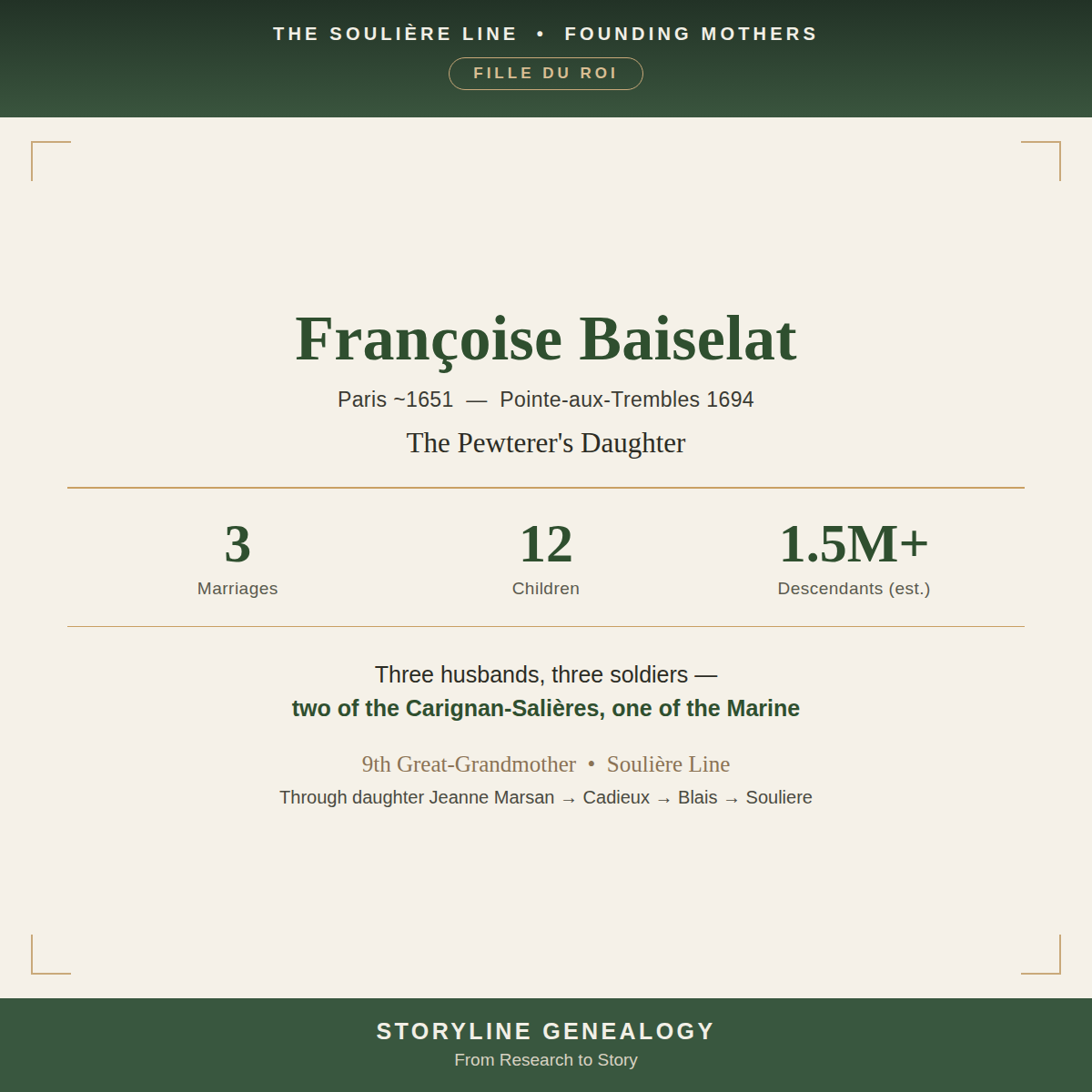
Françoise Baiselat ~1651 - 1694
Françoise Baiselat was baptized in the shadow of Saint-Sauveur in Paris, the daughter of a pewterer who also carried the verge at the parish church. Orphaned of her father at eleven and bound out to a buttonmaker at thirteen, she sailed for New France in 1668 as a Fille du Roi with three hundred livres in furniture, clothing, rings and jewels. Twenty-six years, three husbands and twelve children later, she died bearing the last of them. This is her life told from the acts themselves.
Part of the Storyline Genealogy series: Filles du Roi & Filles à Marier — The Women Who Built New France
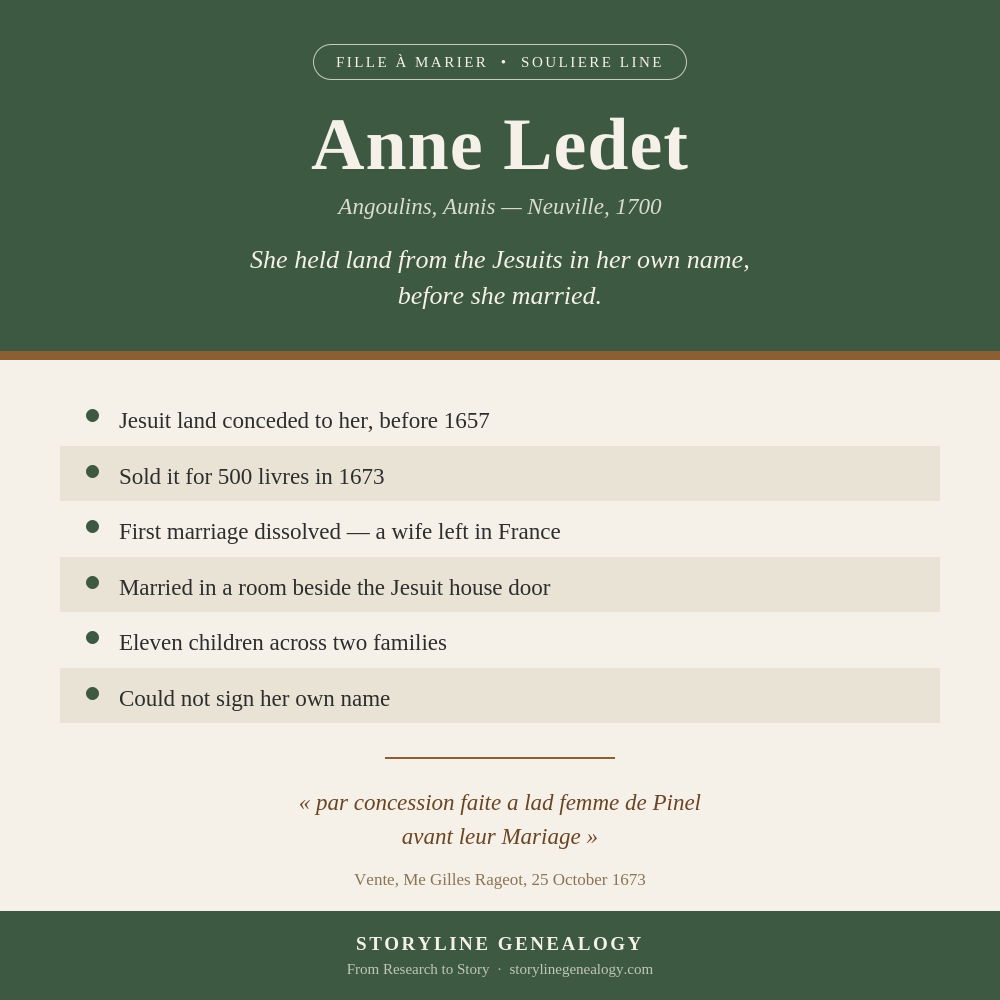
Anne Ledet: A Fille à Marier in New France
Before she married Gilles Pinel in 1657, Anne Ledet held a Jesuit land grant in her own name. Her first marriage had been dissolved — a wife left behind in France — and her daughters recorded as born out of wedlock. She raised eleven children and could not sign her name.
Part of the Storyline Genealogy series: Filles du Roi & Filles à Marier — The Women Who Built New France
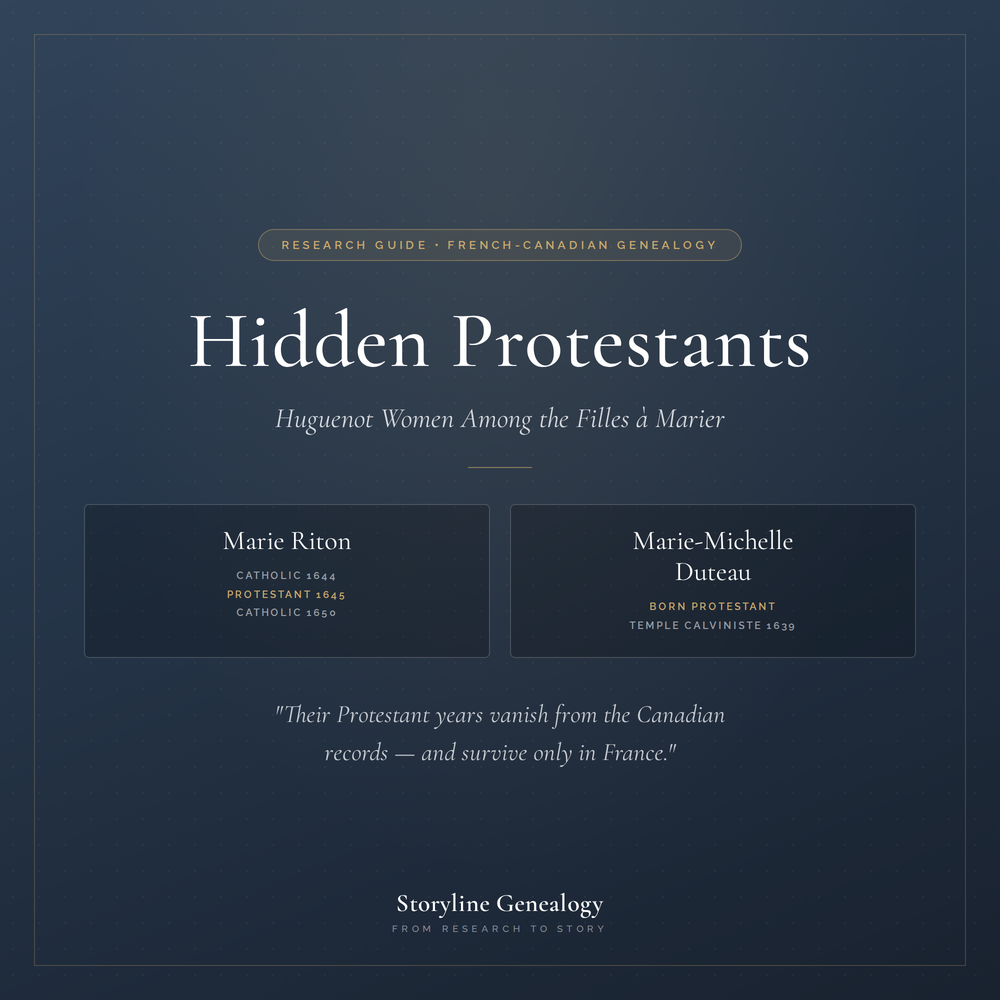
Hidden Protestants: Huguenot Women Among the Filles à Marier
One was born Protestant. The other converted to Protestantism as an adult, then converted back. Both ended in the Catholic Church, and the records that show otherwise survive only in France. Two documented cases, and how to tell which way an abjuration runs.
Part of the Storyline Genealogy series: Filles du Roi & Filles à Marier — The Women Who Built New France
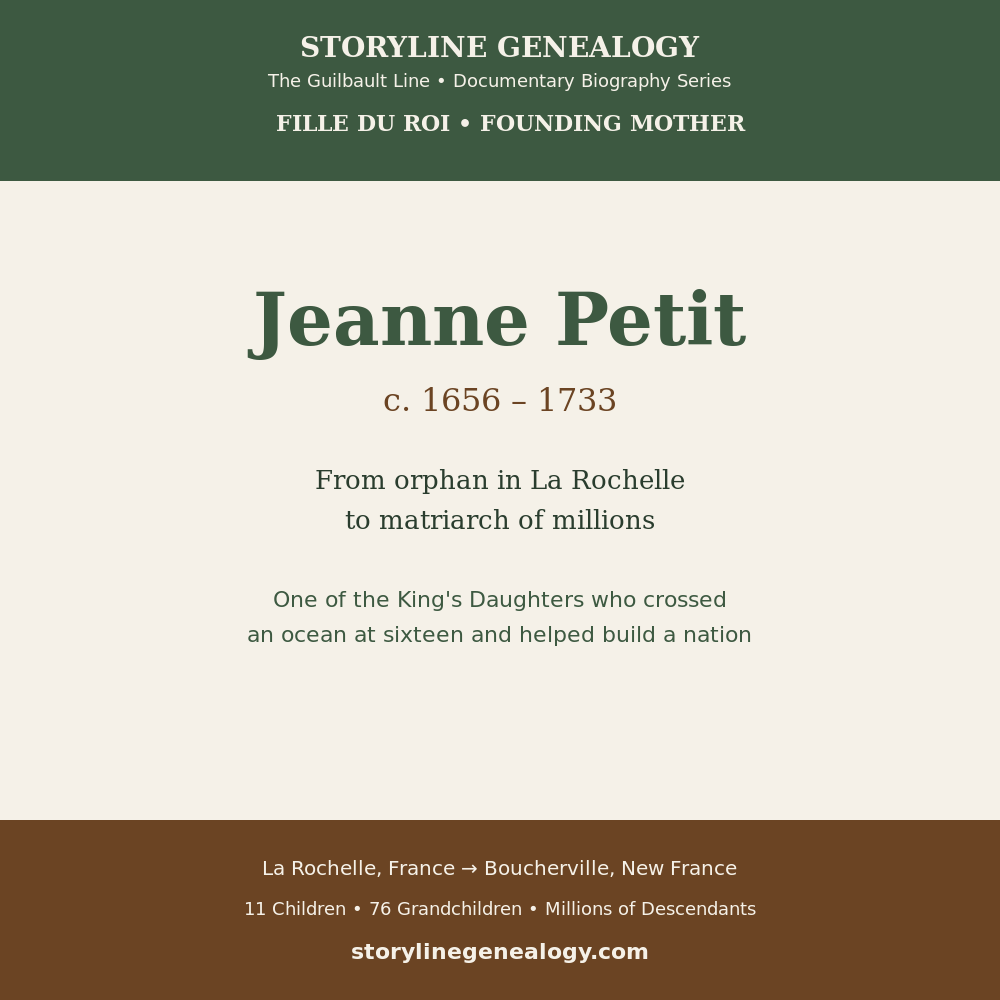
Jeanne Petit: Orphan in La Rochelle
Jeanne Petit was a young woman protected by the king, part of the contingent of 125 Filles du Roi who came to New France in 1671. At just 16 years old, already orphaned, she crossed the Atlantic to build a new life. She married François Séguin dit Ladéroute, a soldier turned weaver, and together they raised 8 children to adulthood at Boucherville. Today, her descendants number nearly 2 million people—a legacy built from nothing but hope and determination.
Part of the Storyline Genealogy series: Filles du Roi & Filles à Marier — The Women Who Built New France
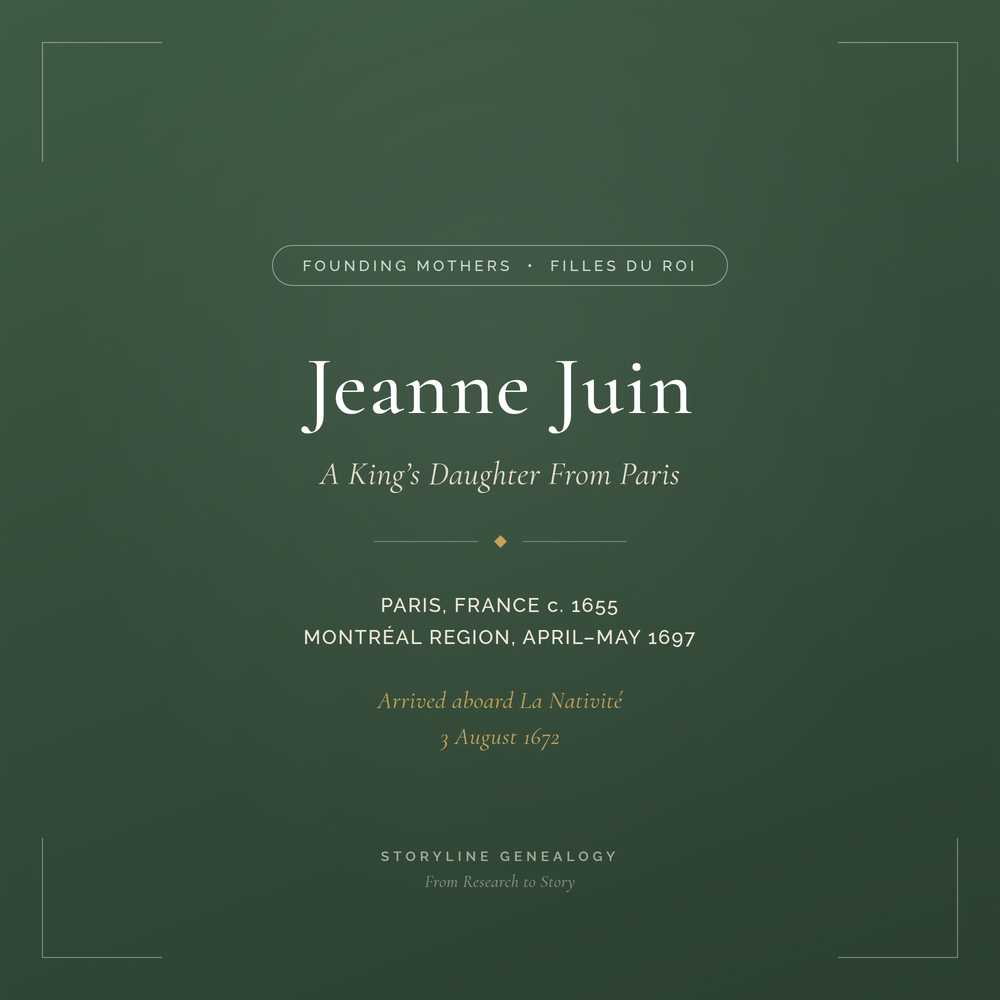
Jeanne Juin: A King’s Daughter From Paris
She arrived at Québec aboard La Nativité in August 1672 and signed her marriage contract with a cross eight months later. For three centuries her death has been placed somewhere in an eight-year silence — until her husband's second marriage contract, read in the original, dated it to within a month or two. This is the documentary life of Jeanne Juin: eleven original acts, a seigneury's home farm she was party to leasing, and a family that owned land twice and died owing two hundred livres.
Part of the Storyline Genealogy series: Filles du Roi & Filles à Marier — The Women Who Built New France
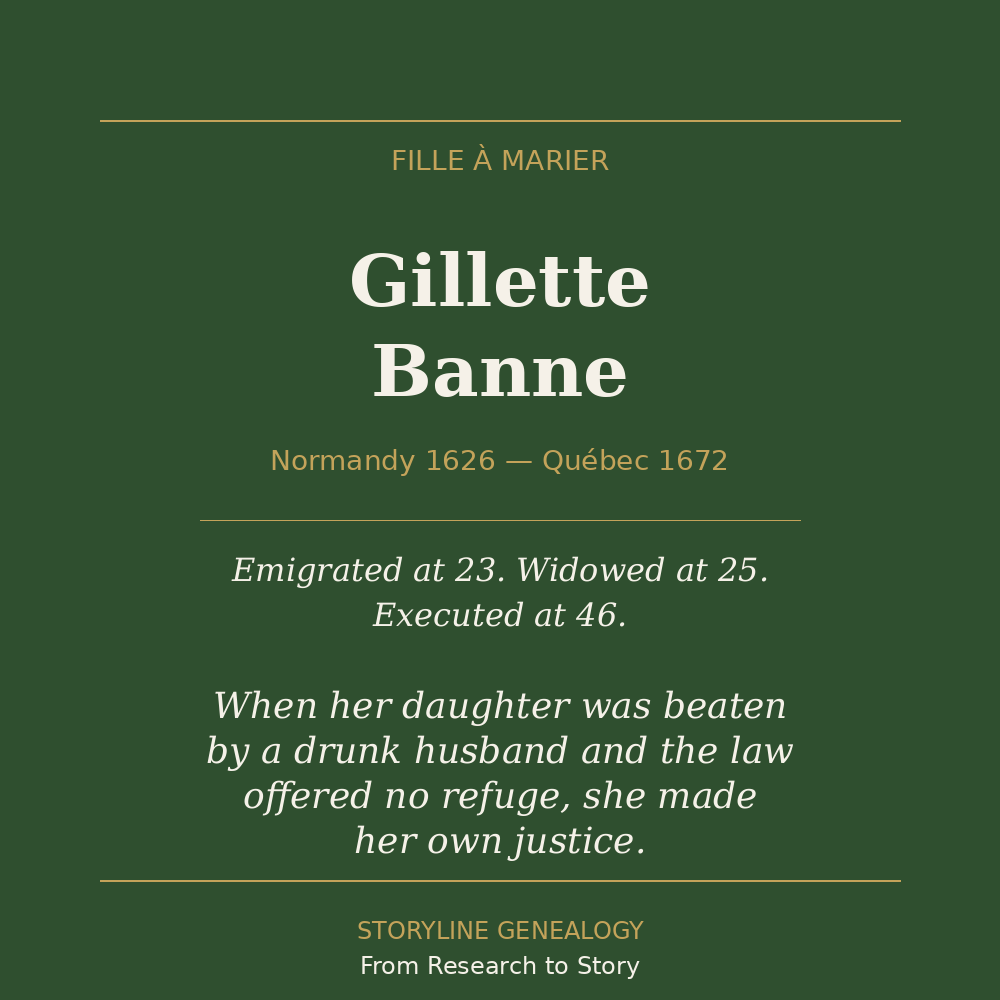
Gillette Banne: A Fille à Marier in New France
Shipped to New France at 23. Widowed at 25. Property owner at 25. Executed at 46. Gillette Banne's life spans four and a half decades, but within it lies the full complexity of women's experience in colonial New France. When her 12-year-old daughter was beaten bloody by a drunk husband and the law offered no refuge, she made her own justice—and paid with her life. Her descendants now number over 2 million.
Part of the Storyline Genealogy series: Filles du Roi & Filles à Marier — The Women Who Built New France
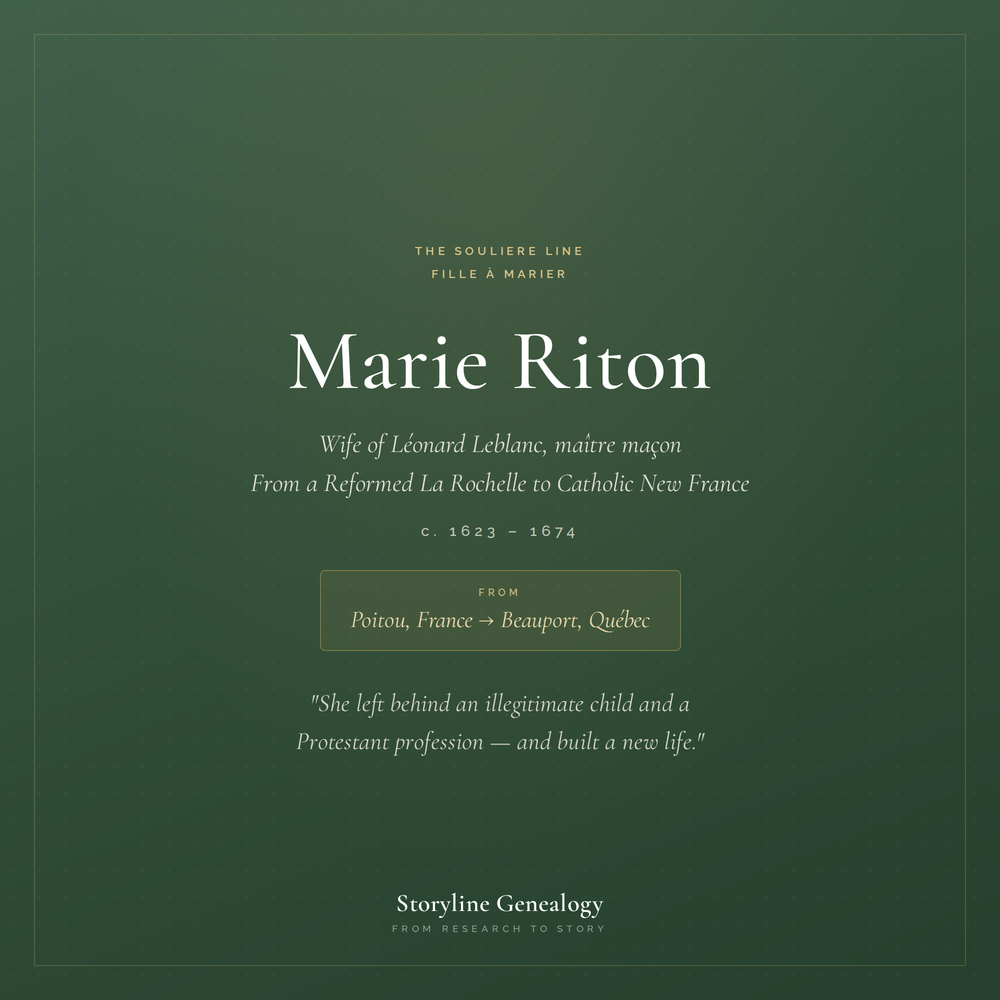
Marie Riton: A Fille à Marier in New France
Marie Riton crossed the Atlantic carrying the weight of an illegitimate birth and a Protestant conversion. In New France, she reinvented herself as a Catholic matriarch at Beauport—mother of seven, ancestor to millions.
Part of the Storyline Genealogy series: Filles du Roi & Filles à Marier — The Women Who Built New France
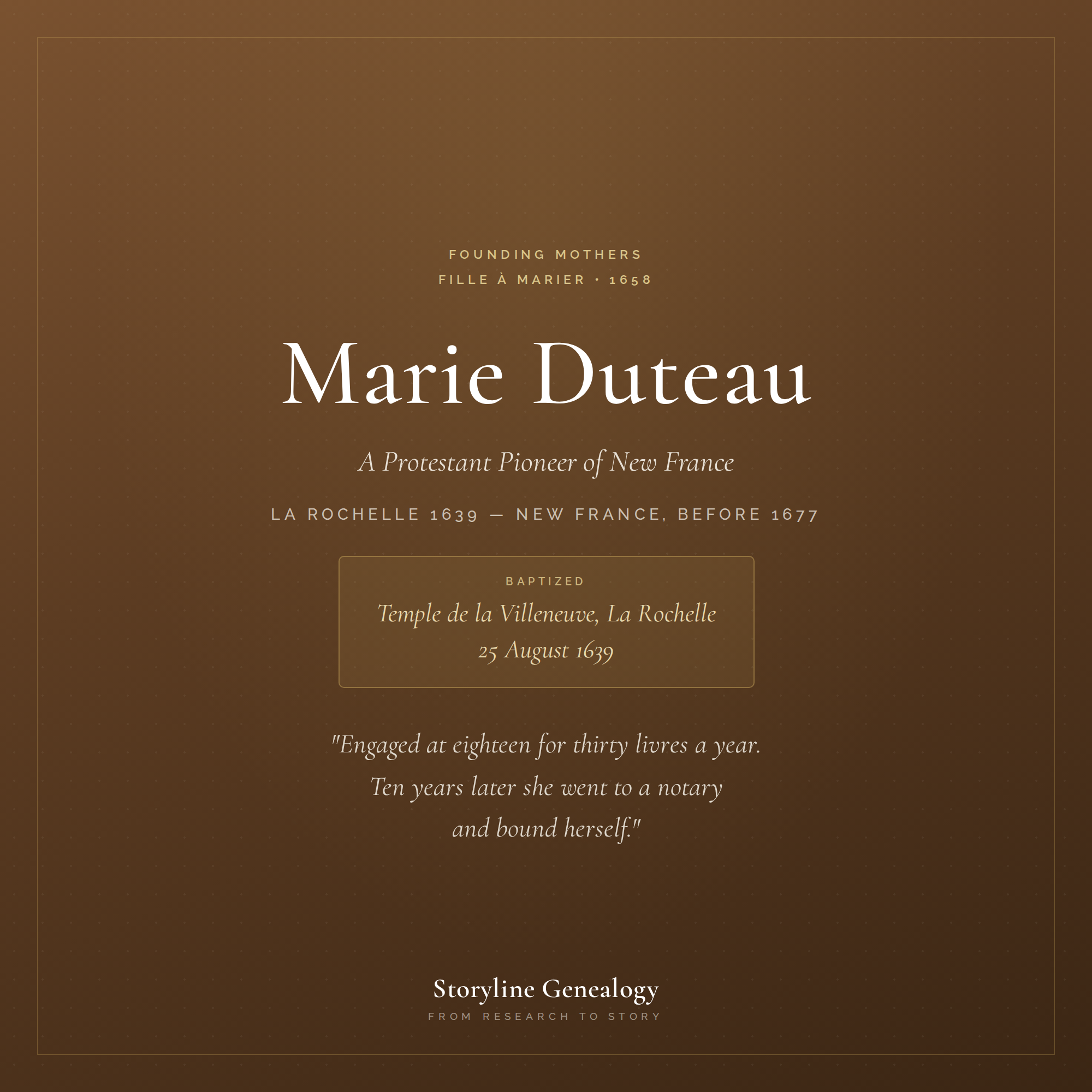
Marie Duteau: Protestant Pioneer of New France
She was baptized in a Calvinist temple at La Rochelle, engaged at nineteen for thirty livres a year, and married in a Catholic colony where her first faith was never mentioned again. Ten years after she landed, Marie Duteau went before a notary and bound herself in a contract in her own name.
Part of the Storyline Genealogy series: Filles du Roi & Filles à Marier — The Women Who Built New France
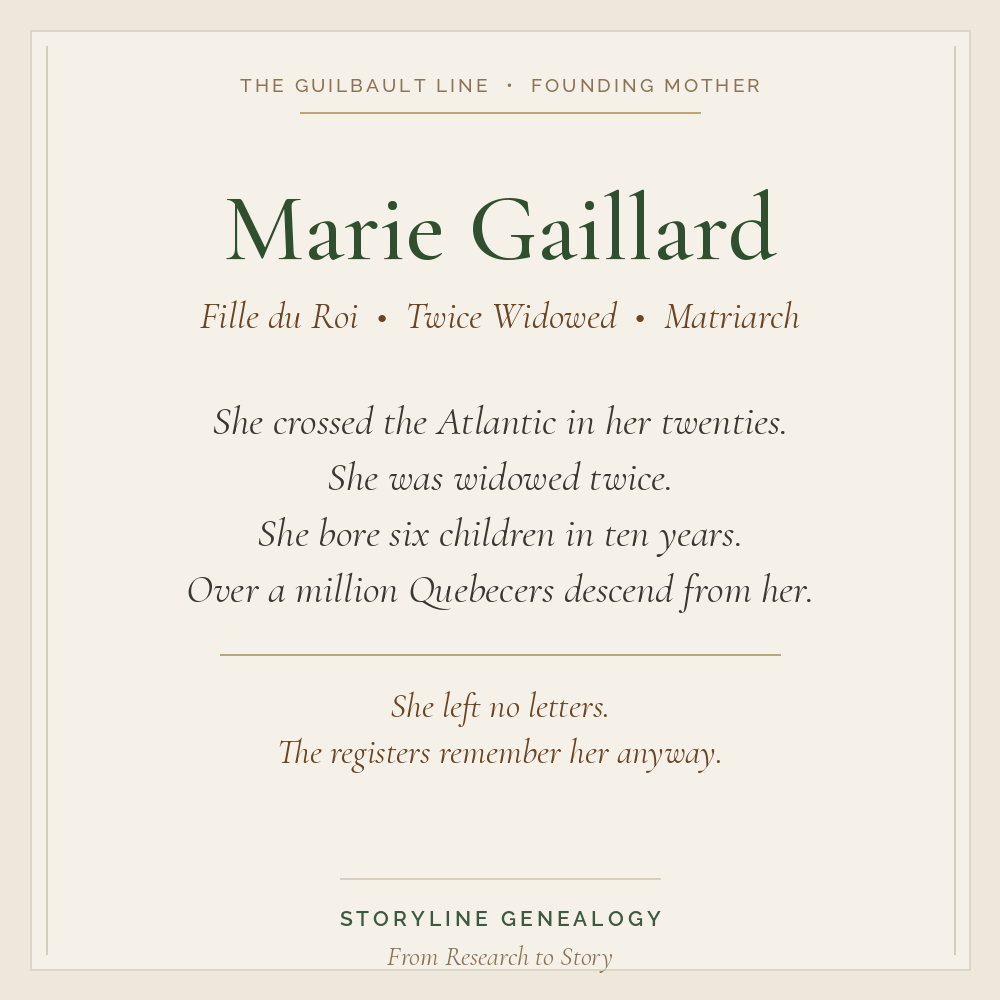
Marie Gaillard dit Daire
Marie Gaillard crossed the Atlantic in 1669 as one of the Filles du roi and married a soldier from Béarn who worked as a weaver. She bore six children in ten years. Widowed before she was forty, she remarried within the year and merged her household with another widower's; six years later her daughter married her stepson, permanently joining the two families. She outlived that second husband by fifteen years and died at Lachine in 1736, in her late eighties or early nineties. She left no letters and could not sign her name. What survives of her is her name in the margins of other people's records.
Part of the Storyline Genealogy series: Filles du roi & Filles à marier — The Women Who Built New France
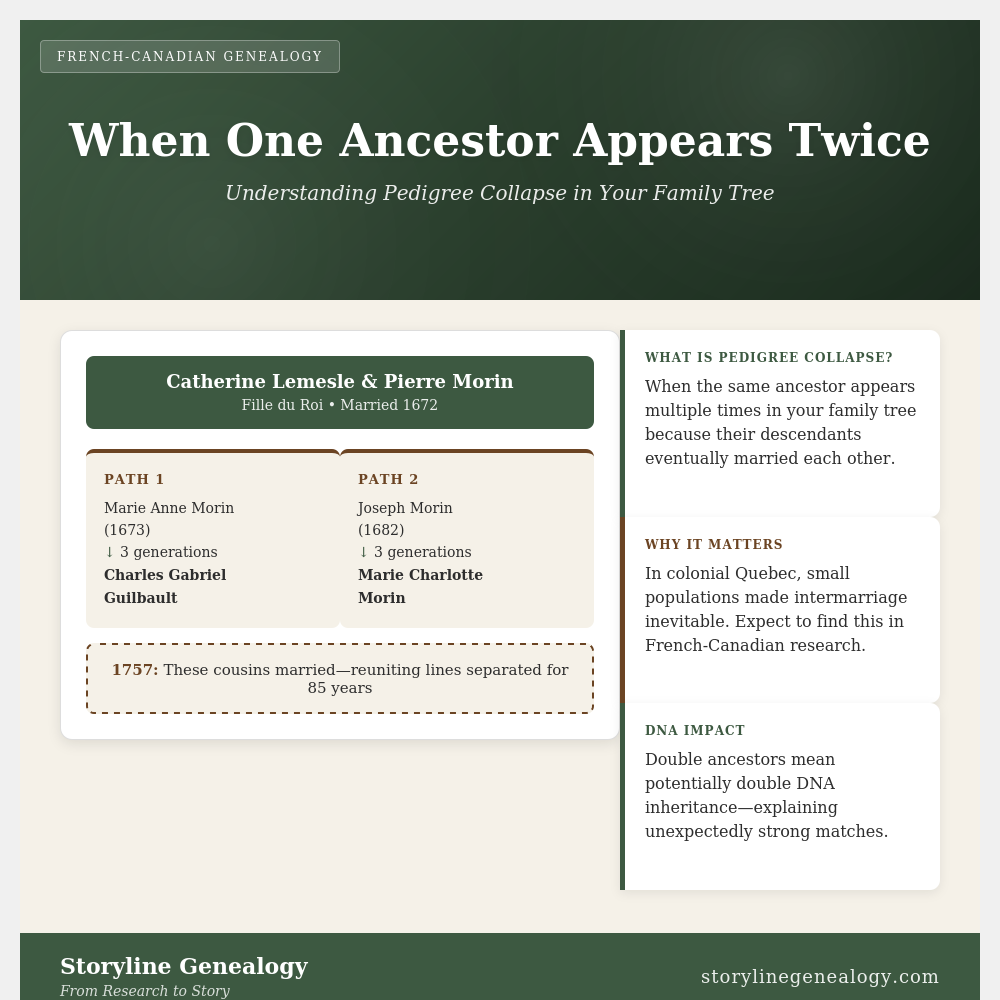
When One Ancestor Appears Twice: Catherine Lemesle
How does the same woman become your 8th great-grandmother twice? Discover pedigree collapse through Catherine Lemesle, a Fille du Roi whose descendants married each other 85 years later—and what this common phenomenon means for your French-Canadian research.
Part of the Storyline Genealogy series: Filles du Roi & Filles à Marier — The Women Who Built New France
Marie Lorgueil: A Family in Court
Between 1683 and 1738, Marie Lorgueil's family appeared in colonial courts six times across three generations. They sued neighbors, defended against criminal charges, fought for orphaned children, and—in the most extraordinary case—a seventy-year-old daughter named Françoise demanded separation from her abusive husband Jean Charpentier. This is the story of how one immigrant woman's strategic pragmatism became a family legacy of legal agency.
Part of the Storyline Genealogy series: Documentary Biographies
Marie Lorgueil: Fighting a Baron
On September 13, 1690, Gabriel Dumont, Baron de Blaignac, ran Marie Lorgueil's husband through with a sword and fled into the wilderness. Marie was 56, widowed, with eight children and mounting debt. She filed suit against the nobleman—then sold her legal rights for 520 livres and debt forgiveness. This is the story of an impossible choice, and what it reveals about justice, power, and survival in colonial New France.
Part of the Storyline Genealogy series: Documentary Biographies
Marie Lorgueil: The Documented Legacy
From her 1634 baptism in Bordeaux to her 1700 burial in Montreal, we've assembled 40+ documents tracing Marie Lorgueil's complete life. This is not typical—this is extraordinary. Most 17th-century women exist only in fragments. Marie's complete documentary arc reveals strategic intelligence, colonial resilience, and women's agency across 66 years and an ocean. Episode 4 concludes the series synthesizing what this remarkable documentation achievement means for family historians.
Part of the Storyline Genealogy series: Documentary Biographies
Marie Lorgueil: The Widowhood Years
In 1690, after 36 years of marriage, Toussaint Hunault died, leaving Marie a widow at age 56. Through legal documents from 1691 and the framework of the Custom of Paris, we examine how Marie navigated widowhood with agency and competence. She wasn't a helpless dependent—she was a legally capable woman who participated in estate settlements, protected her dower rights, and maintained dignity. Episode 3 of Marie Lorgueil's complete documented life (1634-1700).
Part of the Storyline Genealogy series: Documentary Biographies

Marie Lorgueil: Building a Family on the Frontier
In 21 years, Marie Lorgueil bore 10 children and raised 8 to adulthood—an extraordinary 80% survival rate in an era when half of all children died young. The 1666 census captures a perfect snapshot: all six children living, ages matching baptism records exactly. Through systematic analysis of baptism records, birth spacing, and documentary gaps, we reconstruct Marie's achievement as a frontier mother. Episode 2 of Marie Lorgueil's complete documented life (1634-1700).
Part of the Storyline Genealogy series: Documentary Biographies