
Hidden Protestants: Huguenot Women Among the Filles à Marier
Hidden Protestants
Among the first European women who came to Quebec in the 1600s were some who arrived with a Protestant past. A few had been born into Huguenot families; others had crossed into the Reformed church as adults, in the years when doing so was becoming dangerous. Either way, New France offered them no room for it: the Catholic Church controlled all religious matters in the colony, and Protestants could not baptize their children or hold land. They conformed. Their descendants forgot. And their Protestant years disappeared into the Catholic records that would document the rest of their lives.
This research guide examines two documented cases among the Filles à marier—the approximately 262 single women who immigrated to New France between 1634 and 1662. Unlike the later Filles du roi who received royal sponsorship, these women were recruited by private individuals, companies, or religious organizations. One of the two was born Protestant. The other converted to Protestantism as an adult and then converted back. Both ended their lives in the Catholic Church, and the documents that show otherwise survive only in France.
Genealogist Michel Barbeau has estimated that about 320 Huguenots, or French-speaking Protestants, settled in New France between 1634 and 1763. Many were forced to abjure, or renounce, their religion; others became Catholic after marrying in the Church. Those who remained Protestant were banned from certain trades, while some had their possessions confiscated.
— Jacques Gagné, Genealogy EnsembleLa Rochelle: Gateway to the New World
La Rochelle, on France's Atlantic coast, was both the last great stronghold of French Protestantism and a major departure point for emigrants to New France. The city had been besieged by Cardinal Richelieu in 1627-28, its walls falling after a devastating blockade that killed thousands. Yet its Calvinist temples still stood—for now.
The Edict of Nantes (1598) had granted Protestants certain rights, but by the 1620s and 1630s, those protections were eroding. By 1685, Louis XIV's Revocation of the Edict of Nantes would demolish the remaining Protestant temples and drive Huguenots into exile across Europe and the Americas.
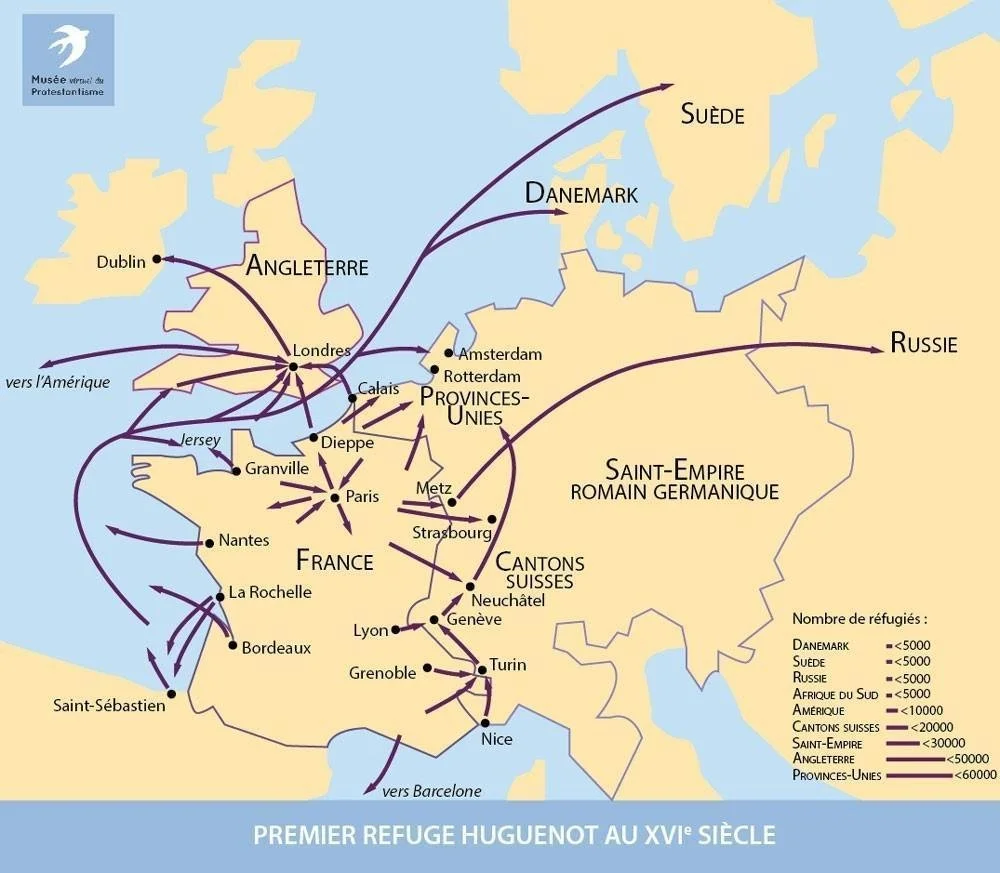
For Protestant women, the choice was stark: remain in an increasingly hostile France, flee to Protestant nations where they would be refugees, or emigrate to New France where conformity was required but a fresh start awaited. The women documented here chose the third option.
Marie Riton
Poitou ~1623 — Beauport 1674 • 10th Great-Grandmother
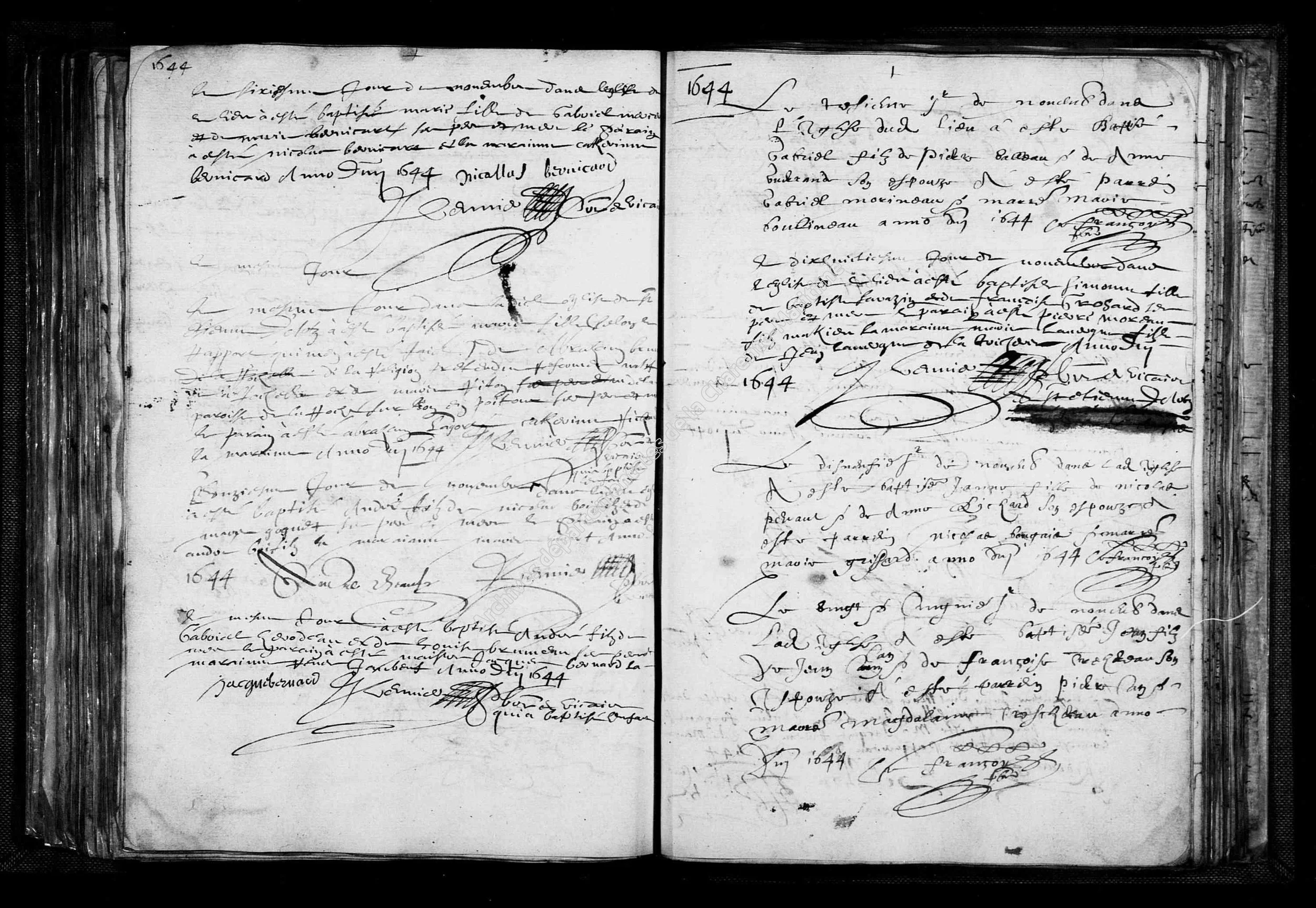
Marie Riton's documented life begins in a Catholic parish church. Born about 1623 near La Roche-sur-Yon in Poitou, she had relocated to the La Rochelle area by the early 1640s. In November 1644, a daughter named Marie was baptized at Ars-en-Ré on the Île de Ré and the register names Marie Riton as her mother. The child's father, Abraham Brunet, was recorded as belonging to the religion prétendue réformée.
Seven months later, on 29 June 1645, Marie appeared before the consistory of the Reformed church at La Rochelle and abjured the Roman Church.
Read the direction of travel
In a Canadian context, "abjuration" almost always means a Protestant renouncing the Reformed faith in order to marry in the Catholic Church. Marie Riton's 1645 act is the opposite, and the register it sits in makes that unmistakable: it is a Reformed consistory's register of abjurations, and every act in it records someone leaving Rome.
The 1644 baptism is the corroboration. A Catholic parish register recording a Catholic baptism, with the father—not the mother—flagged as of the so-called reformed religion, places Marie inside the Roman church in November 1644 and inside the Reformed church by the following June.
For researchers, the lesson is procedural: before you classify an ancestor as a Huguenot on the strength of an abjuration, establish which church kept the register.

"Marie Ritoz natifue du bourg de la Roche sulion en Poitou a faict abjuration des erreurs de l'Eglise Romaine et protesté de vouloir vivre et mourir en la profession de la verité enseignée en noz Eglises. Ensuitte de quoy Elle a esté receue a n[ost]re Communion et admise au benefice d'icelle."
— Abjurations register, La Rochelle, 29 June 1645; signed Papin, ancienFrom Protestant to Catholic
Between 1645 and 1650, Marie crossed the Atlantic to New France. No Canadian record refers to her Reformed profession—not the marriage act of 1650, not seven baptisms, not the confirmation of 1660, not the notarial acts of 1666 and 1674.
On 23 August 1650 she married Léonard Leblanc, a master mason from Blessac, at the house of the seigneur Robert Giffard in Beauport. She bore seven children between 1651 and 1662, all of whom lived to marry, and she died between 16 April and 4 November 1674—the dates of her will and of the inventory taken after her death.
| Register | Registre des confirmés et des abjurations, Québec, 1649–1663, p. 23 |
| Entry as written | Marie Riton 22. ans, Eu. de Luçon, |
| Recorded origin | Évêché de Luçon — the diocese containing her birthplace |
| Recorded age | 22, which cannot be reconciled with a birth about 1623 (see below) |
| Officiant | François de Montmorency-Laval |
| Extent of the act | Forty entries on this folio; the act continues on the following folio |
| Database entry | PRDH-IGD no. 403669 |
Transcribed from the original register. Note that the PRDH-IGD card for this act gives her origin as the Évêché de La Rochelle; the four entries nearest hers in the register are from La Rochelle, which is very likely how that error entered the database. Cite ages and origins to the register, never to the card.
The age that does not fit
The register gives Marie Riton's age as twenty-two in February 1660, which would place her birth about 1638. That is impossible against the rest of her file: a woman born in 1638 could not have borne a child in 1644, abjured in 1645, or married in 1650.
The ages around hers in the same act are not careless—they run 19, 25, 27, 28, 30, 33, 35, 44, 49, 50, 68 and 70—so this is not a scribe defaulting to one figure. The likeliest explanation remains clerical error; the alternative, a second Marie Riton in the colony, is unsupported and is contradicted by the recorded diocese, which matches our Marie's birthplace exactly. The conflict is recorded rather than resolved.
The Documentary Evidence
Marie Riton's case is unusual because three documents survive across two countries and two churches: a Catholic baptism naming her as a mother in 1644, a Reformed abjuration in 1645, and a Catholic confirmation in 1660. Together they trace a complete religious trajectory—Catholic, then Reformed, then Catholic again—that no single archive could have shown on its own.
Case Study 2: The Duteau Family of La Rochelle
The migration of Jeanne Perrin and her children in 1658 is a textbook example of a Huguenot family navigating the increasingly restrictive religious and economic landscape of La Rochelle. Unlike Marie Riton, Marie Duteau was born into the Reformed church.
A Protestant Family in the Shadow of Persecution
Marie Duteau was born on 21 August 1639 into a Protestant family in La Rochelle—just eleven years after Richelieu's siege had broken the city's resistance. Four days after her birth, she was baptized at the Temple Calviniste de la Villeneuve, one of the smaller Protestant meeting houses that survived the siege.
Her father, Pierre Duteau, worked as a porter in the Catholic parish of Saint-Nicolas—one of the story's many ironies. After the siege of 1628, Catholicism had been restored to La Rochelle, and Protestant families like the Duteaus navigated the uneasy peace: Protestant children baptized in Calvinist temples, their fathers working in Catholic institutions.
| Born | 21 August 1639, La Rochelle |
| Baptized | 25 August 1639 |
| Place of baptism | "temple calviniste, v. et ev. la rochelle, aunis" — the Calvinist temple, city and bishopric of La Rochelle, Aunis |
| Father | Pierre Duteau, portefaix — a porter on the docks of La Rochelle, living in the Saint-Nicolas quarter |
| Mother | Jeanne Perrin, born 26 May 1615 and baptized at the temple Saint-Yon, daughter of David Perrin and Jeanne Danieau |
| Godparents | Abraham [Gousault]; Marie Dutau |
| Note in the act | le dit père n'a sceu signer — the said father did not know how to sign |
| Source | Archives départementales de la Charente-Maritime, cote I 171-173, register 1632-1648, view 255/645, folio 133. Compare PRDH-IGD no. 24206, which records a single date and omits the baptism. |
The place of baptism is the evidentiary point: a temple rather than a parish church. This is the field to look for when you suspect Huguenot origins behind an otherwise Catholic Canadian file.
Marie had four full siblings and three half-siblings by her father's first marriage. Six of the seven died as children and were buried in the Temple de la Villeneuve: only Charles, born 1641, and Madeleine, born 1649, lived to sail. Of Pierre Duteau's eight children, three saw Canada.
The Duteau Family
- Pierre Duteau — Father, portefaix on the port of La Rochelle, baptized Protestant; for years he unloaded cargoes arriving from Canada
- Jeanne Perrin — Mother, baptized 1615, daughter of David Perrin and Jeanne Daniau
- Marie — Born 21 August 1639, baptized 25 August at the Temple de la Villeneuve
- Charles — Born 1641, would emigrate with the family
- Madeleine — Born 1649, would become a Fille à marier herself
April 1658: A Family Divided
In the spring of 1658, the Duteau family made a decision that would scatter them across an ocean. Over two days in April, four members of the family appeared before Notary Teuleron in La Rochelle to sign contracts for passage to Canada. It was a coordinated family emigration—mother and three children, leaving together but signing separate contracts based on their age and circumstances.
The Father Who Stayed Behind
But where was Pierre Duteau? He remained in La Rochelle. According to Peter Gagné's research, "he may have already been struck with a disease that claimed his life later that year." Pierre gave permission for his wife to take their youngest daughter to Canada. He signed no contract himself. He would never see his family again.
Pierre Duteau was buried on 12 December 1658 at the Calvinist temple in La Rochelle—eight months after his family sailed for New France. By then, his wife and children were somewhere in the wilderness of Canada, building new lives he would never witness.
The Mother Who Vanished
And Jeanne Perrin? She signed the most substantial contract of all—five years of service. She brought her youngest daughter. She crossed the Atlantic with her three children. And then she disappeared.
According to the researcher Bersyl, Jeanne Perrin "left no trace of herself in New France." Whether she died during the crossing, shortly after arrival, or simply vanished from the records, we cannot say. The mother who organized this family emigration, who received permission from her dying husband, who signed a five-year contract to build a new life—she is a ghost in the archives.
But her children survived. All three would marry in New France. All three would have families. Two of them, Marie and Madeleine, are counted among the rare Filles à marier—though Madeleine's classification is disputed, and some authorities place her among the Filles du roi instead.
The Path to Conversion
For Protestant women who arrived in New France, entry into Catholic sacramental life could involve two steps:
Step 1: Abjuration
A Canadian act of abjuration was a formal renunciation of the Reformed faith, typically recorded in parish registers or in a dedicated register of abjurations. The individual publicly declared their rejection of Protestant "errors" and their acceptance of Catholic doctrine.
Step 2: Confirmation
Confirmation marked full participation in Catholic sacramental life. Where a convert was concerned, it often followed the abjuration closely, and sometimes fell just days before a marriage.
A caution about sequence
This two-step model describes a convert's path. It does not describe every confirmation. Marie Riton was confirmed at Québec in 1660 alongside dozens of others, ten years after her marriage and with no surviving Canadian abjuration anywhere in her file. A bishop working systematically through a colonial population produces long confirmation lists that say nothing about the religious history of any one name on them.
Treat a confirmation as evidence of conversion only when an abjuration, a stated origin, or a European record supports it.
Where to Find These Records
- PRDH-IGD: Acts of abjuration in parish registers
- BAnQ Advitam: Registers of abjuration (search by "cote #")
- Guy Perron's Blog: Detailed research on confirmations
- Parish Registers: Trois-Rivières, Cap-de-la-Madeleine, Quebec City
Comparing the Cases
| Aspect | Marie Riton | Marie Duteau |
|---|---|---|
| Birth | ~1623, Poitou | 1639, La Rochelle |
| Religion at birth | Catholic (inferred from the 1644 Catholic baptism of her daughter) | Protestant (baptized in a Calvinist temple) |
| Protestant Evidence | 1645 abjuration of the Roman Church, La Rochelle | 1639 baptism at Temple Calviniste de la Villeneuve |
| Emigration | ~1645-1650, alone | 1658, with mother and siblings |
| Catholic Confirmation | Feb 24, 1660 (Bishop Laval), ten years after marriage | No record found |
| Marriage | Aug 23, 1650, to Léonard Leblanc | June 15, 1659, to Michel Lemay |
| Settlement | Beauport | Cap-de-la-Madeleine |
| Children | 7 (all lived to marry) | Ten born, nine surviving |
| Death | Between 16 April and 4 November 1674, Beauport | Between 1672 and 12 April 1677 |
| Descendants (GFNA estimate) | 4.27-4.69 million over 14 generations | 2.03-2.45 million over 13 generations |
A descendant count measures how completely a founding population propagates. It is not a statement about inherited DNA: at fourteen generations' remove, most descendants carry no measurable segment from any one ancestor. Only the unbroken maternal line carries a founding mother's mitochondrial DNA.
How to Research Huguenot Ancestors
Because Huguenots were officially barred from New France after 1627, their records are often "hidden" within Catholic or commercial documents. Here are the key resources:
In New France (Quebec)
- Abjuration Records: Look for formal "acts of abjuration" in parish registers (available on PRDH-IGD), where Protestants renounced their faith to marry in the Church.
- BAnQ Advitam: The Bibliothèque et Archives nationales du Québec has replaced its online tool Pistard with Advitam (advitam.banq.qc.ca), making it easier to find these records.
- Notarial Acts: BAnQ holds original marriage contracts and indentures, which often provide more detail than church records.
In France
- La Rochelle Protestant Registers: Check the Registres du Consistoire or temple records for birth and baptismal data prior to departure. The Archives départementales de la Charente-Maritime hold the consistory's abjuration registers under cote I 171-173, digitized on Archinoë.
- Fichier Origine: This database links New France settlers back to their specific baptismal records in France, Protestant ones included.
- Archives Départementales: Search by commune (village/town) for parish registers from 1535 to 1789.
Important: Your family name in France may have had a different spelling than the modern one. When researching online in France, try variant spellings. For example, "Gagné" in America is "Gasnier" or "Gagnier" in France—same pronunciation, different spelling.
— Jacques Gagné, Genealogy EnsembleA rule for database fields
Database entries are indexes, not transcriptions, and religious research is where that matters most. The PRDH-IGD card for Marie Riton's 1660 confirmation gives her origin as the diocese of La Rochelle; the register says Luçon. The four entries nearest hers are La Rochelle, which is almost certainly how the error arose.
Had that field gone unchecked, it would have placed her birth in the Protestant heartland and quietly strengthened a Huguenot-origins argument that the register does not support. Take names from the card if you must. Take ages, origins and religious affiliation from the register.
Key Online Resources
- How to Search for Huguenot Ancestors in France (Genealogy Ensemble)
- How to Find Protestant Abjurations in Quebec (Genealogy Ensemble)
- Michel Barbeau's Huguenot Database
- Fichier Origine
Document Gallery


Conclusion: Hidden Heritage
The stories of Marie Riton and the Duteau family illustrate a hidden chapter in French-Canadian history. These women were not simply "Catholic" settlers—they were people who made pragmatic religious choices to survive. Their Protestant years were subsumed into the Catholic records that documented the rest of their lives, and their descendants often forgot them entirely.
Today, with access to digitized Protestant temple records in France and abjuration records in Quebec, genealogists can recover these identities. The woman who abjured the errors of the Roman Church at La Rochelle in 1645 became a Catholic matriarch whose descendants number in the millions. Her story—and stories like it—remind us that identity is often more complex than the records suggest, and that a single archive rarely shows the whole of it.
While Quebec Premier François Legault recently stated that "all" French Canadians are Catholic, the historical record tells a more nuanced story. A small but significant minority of early settlers had Protestant pasts—forced to conform, their history hidden in Catholic archives, their descendants often unaware of it.
Every Family Has a Story Worth Telling
Whether you're just beginning your research or ready to transform years of work into a narrative your family will treasure, I'd love to help.
BEGIN YOUR RESEARCH INQUIRY