
Église Saint-François-de-Sales
Neuville, Portneuf, Québec
Église Saint-François-de-Sales
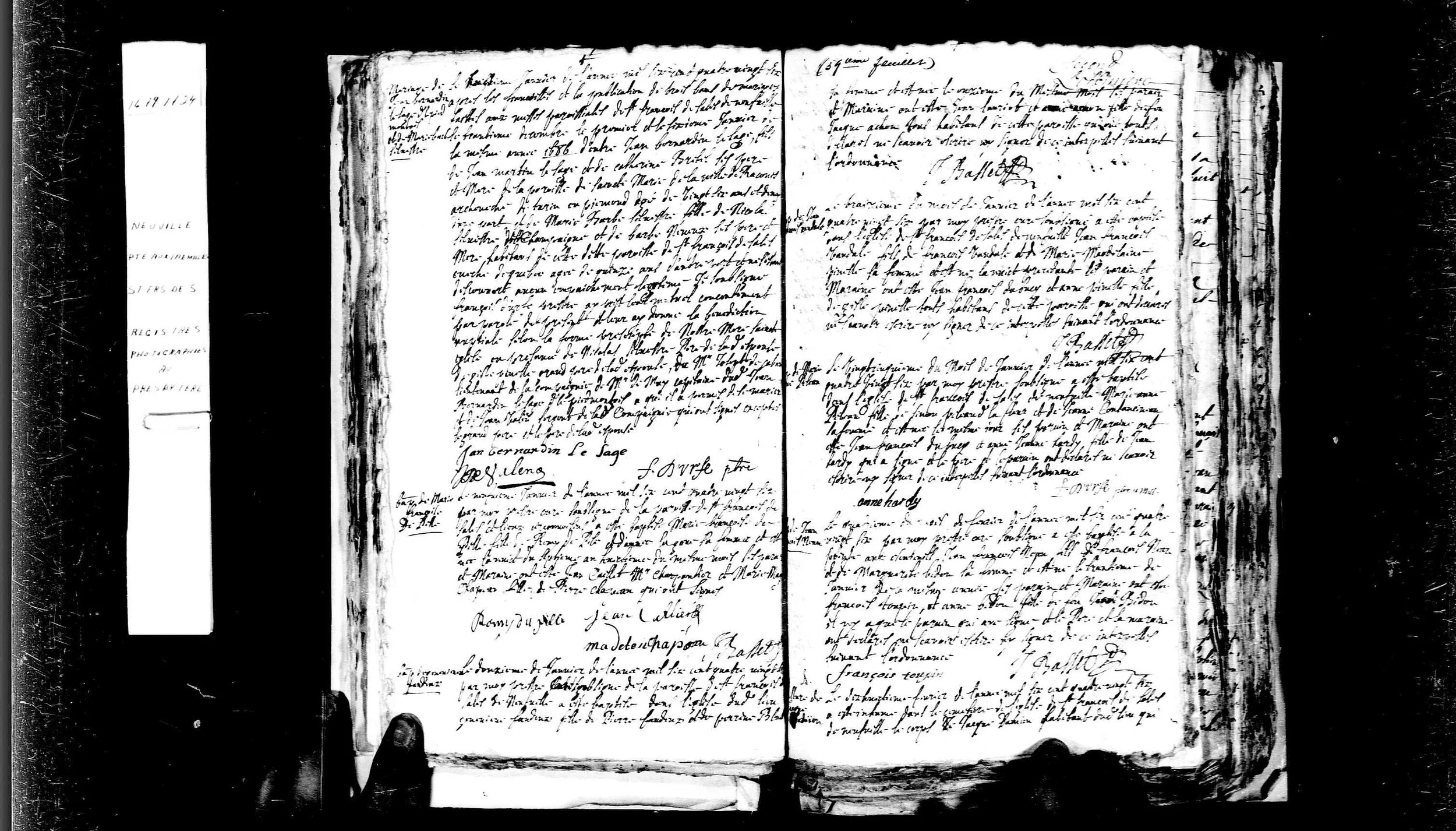
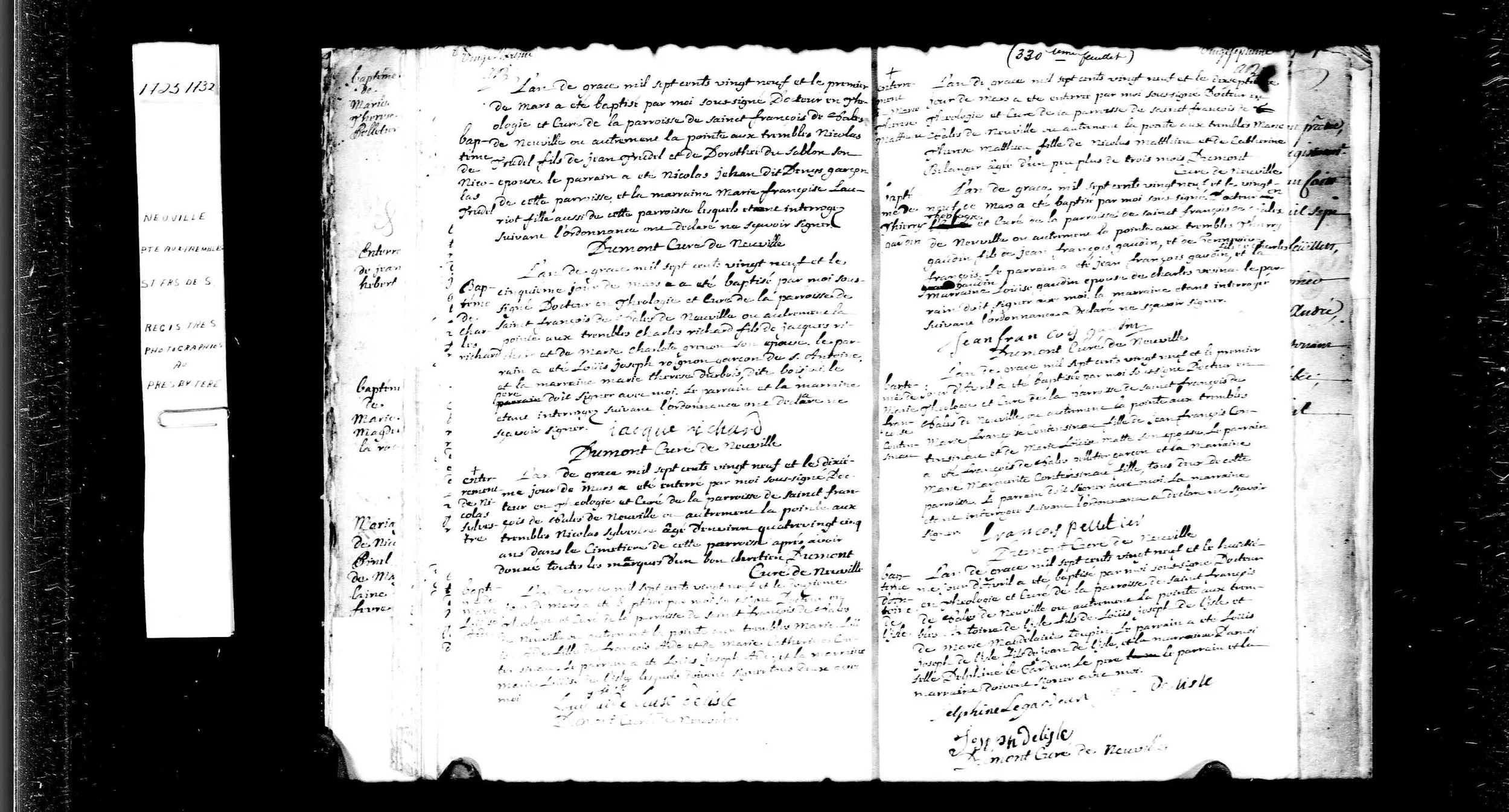
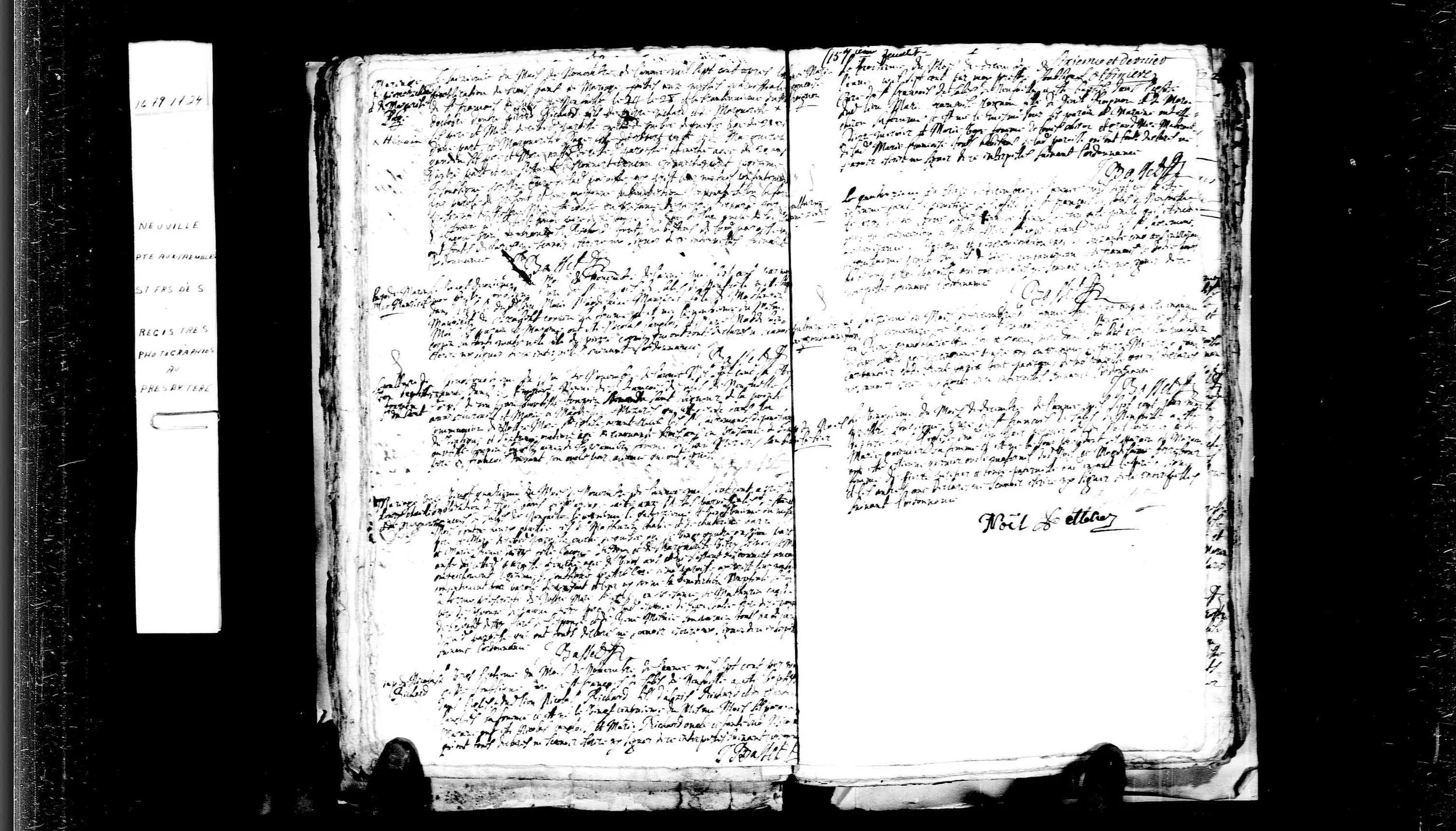
On a January day in 1686, a young woman named Marie Barbe Sylvestre married a soldier called Jean Bernardin Lesage dit Lepiedmontois in this church on the Chemin du Roy. She was the daughter of Nicolas Sylvestre dit Champagne, who had come to Canada a soldier and taken land in the seigneury of Dombourg in 1667. The registers of Saint-François-de-Sales hold the baptisms, marriages and burials of the Sylvestre and Lesage families across three generations — the sacramental record that anchors the Soulière Line to the first years of New France.
The Sylvestre & Lesage Families at Neuville — Key Events
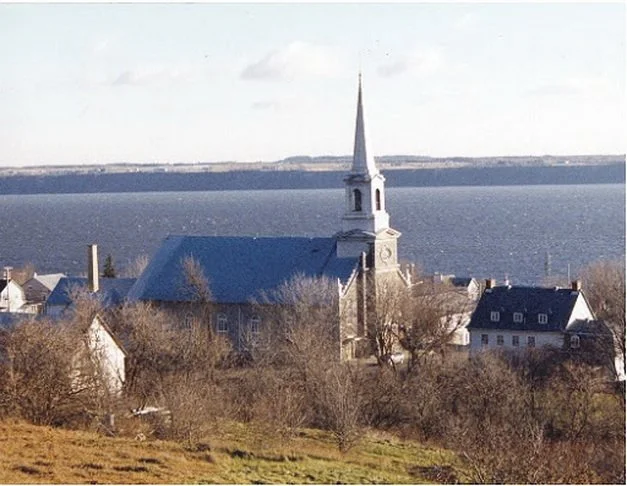
Église Saint-François-de-Sales, Neuville, Quebec. The current facade dates from the 1854 nave construction and 1915 restoration, but the sanctuary behind it preserves the 1761 stone structure where three generations of Sylvestre and Lesage families received the sacraments.
The church of Saint-François-de-Sales stands at the heart of Neuville, on a rise above the St. Lawrence River along the Chemin du Roy — the first road connecting Québec City to Montréal. Its parish registers, opening in 1667, are among the oldest in the colony. Within those pages, written in the careful hand of missionary priests, lie the records of a soldier who took up land here, his daughter who married a Piedmontese, and the children who would carry both families westward into the Lanaudière region.
For the Soulière Line, Neuville is the origin point. It is the seigneury where Nicolas Sylvestre dit Champagne received his land grant from Jean Bourdon in March 1667. It is the parish where his children were baptised, where Marie Barbe Sylvestre married, and where she bore her first children. And it is the church where a child named François de Sales Lesage was baptised in 1704 — named for the parish's own patron saint — before dying in infancy fifteen months later.
The Oldest Religious Decor in North America
The church of Saint-François-de-Sales houses a carved and gilded Baroque canopy dating from 1695 — the oldest cohesive ensemble of religious architecture in North America. Acquired in 1717 from Bishop de Saint-Vallier in exchange for wheat to feed the starving population of Québec City, it survived only because it left the capital before the English bombardment destroyed the cathedral.
The canopy, the choir, and the Napoléon Déry organ are all classified cultural assets of Québec. When Marie Barbe Sylvestre's children were baptized in this church, the baldaquin had not yet arrived — but the font where they received the sacrament stood beneath the same vaulted ceiling their descendants would know for centuries.
Neuville: The Breadbasket of New France
Neuville sits on the north shore of the St. Lawrence River, roughly 30 kilometers west of Québec City. Known historically as the seigneury of Dombourg, it earned its permanent name from Nicolas Dupont de Neuville, a member of the Sovereign Council of New France, who gave his name to the settlement in the late seventeenth century.
The change of name can be watched happening in the records themselves. The baptism of Pierre Sylvestre in 1675 gives the family's residence as Dombourg. By November 1686, when Nicolas Sylvestre acknowledged a debt before a Québec notary, the act calls him habitant de Neuville.
The area was first settled in the 1660s, and by the time Nicolas Sylvestre took his concession there in 1667 it was emerging as one of the colony's most fertile agricultural districts. The phrase "breadbasket of New France" was literal — when famine struck Québec City in 1717, it was Neuville's wheat stores that saved the population, exchanged for the now-famous baldaquin.

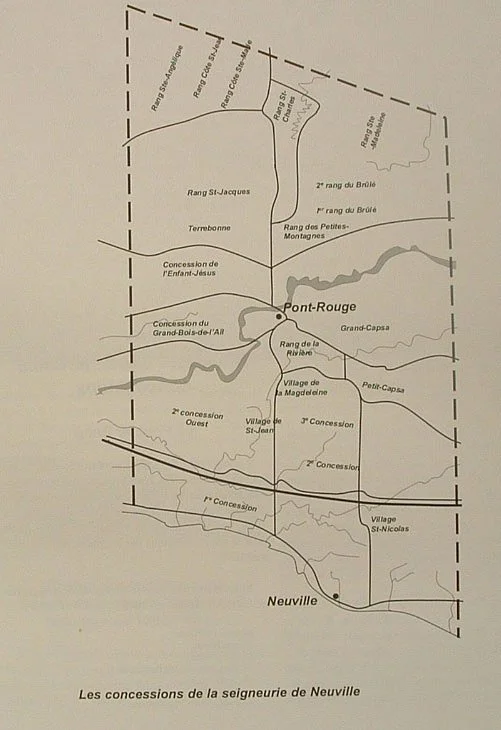
Neuville's church sits on what was once the Chemin du Roy — the King's Road — New France's first overland route, completed in 1737. Before the road, the St. Lawrence River was the sole highway. The church's unique angled apse was actually a consequence of the 1854 nave addition: the builder had to create an angle with the older sanctuary to prevent the nave from opening directly onto the Chemin du Roy (now Rue des Érables). This architectural quirk — shared only with the churches of Saint-Michel in Vaudreuil and La Purification in Repentigny — is a physical reminder of how road and church have always been intertwined in Neuville.
The Church Through the Centuries
The first Catholic chapel appeared in Neuville as early as 1669, located across the Chemin du Roy from the current sacristy. Missionaries served the entire territory from Neuville to Batiscan from this modest structure. In 1696, a stone church was erected on the present site — and it was in this building that Marie Barbe Sylvestre's later children were baptized and where the Lesage family received the sacraments.
That first stone church was demolished and rebuilt in 1761, on the same foundations, to accommodate a growing parish. The sacristy was added in 1783. Then, in 1854, the current nave was grafted onto the 1761 structure starting from the transept, and the facade was restored in 1915. The result is a church built in layers — each generation adding to what came before.

The interior of Saint-François-de-Sales, showing the magnificent 1695 baldaquin with its twisted Solomonic columns, the painted dome, the high altar by François Baillargé (1801), and paintings by Antoine Plamondon. The two statues flanking the baldaquin represent Saint John the Baptist and Saint John the Evangelist.
The Baldaquin: From Bishop's Chapel to Neuville
The baldaquin — a monumental carved and gilded canopy — was created in 1695 for the episcopal chapel in Québec City, likely by sculptor Jacques Leblond De Latour, carved from ash-colored walnut. In 1717, Bishop de Saint-Vallier traded it to Neuville for a significant quantity of wheat to feed the starving population of the capital.
Had it remained in Québec City, it would have been destroyed during the English bombardment of 1759. Instead, it survived in Neuville — initially painted entirely black. During the 1854 renovation, Father Parent found it "terribly ugly" and convinced the churchwardens to replace the statue atop its dome with a cross. The two statues at the base of the front columns represent Saint John the Baptist and Saint John the Evangelist, named for Bishop de Saint-Vallier, who bore the name Jean-Baptiste.
Today the baldaquin, the choir, and the Napoléon Déry organ are all classified cultural assets of Québec.
Saint-François-de-Sales is unique among the listed churches of Portneuf: it is the only one built according to the plan known as "à la récollette" — the Recollect plan — rather than the Latin cross plan used by all its neighbors. This plan, associated with the Recollect Franciscan missionaries, features a rectangular nave without transepts and an angled apse. Only two other churches in Québec share Neuville's distinctive angled apse: Saint-Michel in Vaudreuil and La Purification in Repentigny.
Timeline: Saint-François-de-Sales, Neuville
The Sylvestre Family at Neuville
Nicolas Sylvestre dit Champagne was a soldier at Québec in the summer of 1667 — his marriage act says so in a single word, soldat. On 20 March of that year he took a concession of land from Jean Bourdon in the seigneury of Dombourg, and on 20 August he married Barbe Nepveu at Notre-Dame-de-Québec. Together they raised sixteen children across three decades, making the Sylvestre name one of the most deeply rooted in the parish.
Earlier versions of this page described Nicolas Sylvestre as a veteran of the Grandfontaine company of the Carignan-Salières Regiment. That attribution has been withdrawn.
The 1667 marriage act calls him a soldier and names neither regiment nor company. A roll of the four hundred and three Carignan-Salières soldiers who settled in Canada in 1668 carries a man called Champagne in ten different companies, and gives no surnames at all. Three specialists have tried to identify the Grandfontaine Champagne and reached three different answers, only one of which is Nicolas Sylvestre. Given the date and place, the Carignan-Salières Regiment remains much the likeliest unit — but it is an inference, and it is offered here as one. The full reasoning is set out in his documentary biography.
The Neuville registers record the rest: the baptisms of children across eighteen years in this parish, the marriages that linked the Sylvestres to the Labadies, Mattes, Piché-Pichets and Doucets, and the burials that mark the sorrows — including the loss of two grown sons in 1699, six months apart, both at the Hôtel-Dieu de Québec.
"The registers of baptisms, marriages and burials begin in 1667."
Among the sixteen Sylvestre children, one name stands out for our line: Marie Barbe Sylvestre, born 22 April 1671 and baptised at Notre-Dame-de-Québec three days later. She was the eldest daughter, and in January 1686 — at fourteen years and eight months — she married Jean Bernardin Lesage dit Lepiedmontois at Neuville. His dit name, "the Piedmontese", marks him as one of the rarest origins in the colony.
Children of Nicolas Sylvestre dit Champagne & Barbe Nepveu
Sixteen children born across three decades. Events marked with ★ were recorded in the Neuville parish registers.
| # | Name | Born/Baptized | Key Life Events |
|---|---|---|---|
| 1 | Nicolas, the eldest | 7 Jul 1669, Sillery | ★ Married Jeanne Labadie, Neuville, 23 Nov 1694. Died 26 Apr 1699 at the Hôtel-Dieu de Québec |
| 2 | Marie Barbe OUR LINE | 22 Apr 1671, Québec | ★ Married Jean Bernardin Lesage, Neuville, 8 Jan 1686. Buried L'Assomption, 6 Apr 1759 |
| 3 | Louis | 23 Mar 1673, Québec | ★ Married Marie Élisabeth Isabelle Labadie, Neuville, 24 Nov 1698. Admitted to the Hôtel-Dieu 22 Oct 1699, died there on the 26th, aged 26 |
| 4 | Pierre | 2 Jun 1675, Québec | ★ Married Marie Anne Labadie, Neuville, 8 Nov 1700. Buried Neuville, 25 Dec 1744 |
| 5 | Marie Anne | 23 Oct 1678, Québec | ★ Married Pierre Dupré dit Piché, Neuville, 4 Nov 1697; widowed by 1714; 2nd m. François Biron, Cap-Santé, 1718 |
| 6 | Élisabeth | 23 Mar 1681, Neuville | ★ Baptized and ★ buried at Neuville, 16 Apr 1681. Died at 24 days |
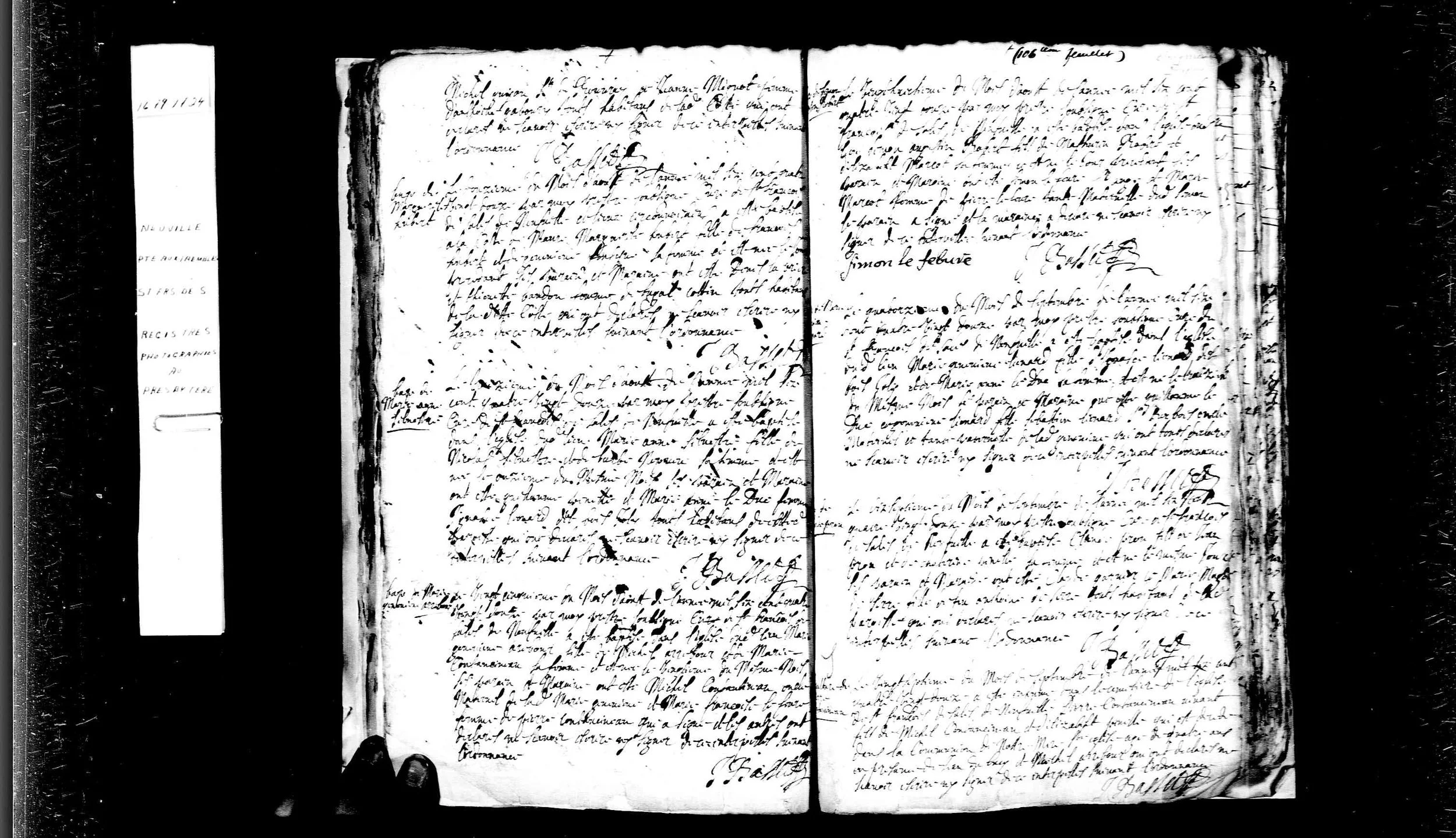
| 7 | Marie Françoise | 21 Feb 1682 | ★ Married Laurent Matte, Neuville, 12 Aug 1702, contract of 3 August; widowed and living at Québec by 1714; 2nd m. Simon Pleau, Cap-Santé, 1720 |
| 8 | François | 30 Aug 1684, Neuville | ★ Baptized Neuville, 31 Aug 1684. Bought his father's Maure land in 1710 in payment of six years' wages. Buried Ste-Croix de Lotbinière, 1740 |
| 9 | Marie Jeanne | 2 May 1686, Neuville | ★ Baptized Neuville. Married four times; her first husband, Jean François de la Fontaine, was a surgeon at Neuville and a widower with two children. Lived to 86, buried Ste-Marie-de-Beauce, 1772 |
| 10 | Jean | 15 Jun 1688, Neuville | ★ Baptized and ★ buried at Neuville. Took the family land by lease in 1712 and by donation in 1714. Died 23 Apr 1732 |
| 11 | Marie Madeleine | 3 Sep 1690, Neuville | ★ Baptized Neuville, 5 Sep 1690. No marriage and no burial has been found for her |
| 12 | Marie Anne | 11 Aug 1692, Neuville | ★ Baptized Neuville. Married André Content, a cooper of Québec, Neuville, 18 Oct 1712. Died 20 Mar 1732, Champlain |
| 13 | Marie Thérèse | 18 Jun 1694 | ★ Buried Neuville, 30 Jan 1695, at seven months |
| 14 | unnamed | 16 Nov 1695 | ★ Born and buried at Neuville the same day. No baptism is recorded |
| 15 | Marie Élisabeth Isabelle | 11 Jun 1697, Neuville | ★ Baptized Neuville. Still at home, aged seventeen, in 1714. Married Pierre Doucet, Neuville, 3 Feb 1716. Buried Berthierville, 1762 |
| 16 | Nicolas | 8 Jul 1699, Neuville | ★ Born and baptised the same day, seventy-three days after his elder brother's death, and given his name. Married M.É.I. Laporte, Saint-Sulpice, 1721. Buried L'Île-Dupas, 1750 |
Jean Bernardin & Marie Barbe: The Lesage Children at Neuville
Jean Bernardin Lesage dit Lepiedmontois — his dit name literally meaning "the Piedmontese" — arrived in New France in the early 1680s. His marriage record at Neuville notes the permission of Captain Demuy, which places him in service at the time. He was one of a very small number of settlers of Italian origin in the entire colony.
Together he and Marie Barbe raised twelve children over some twenty-three years, from 1690 to about 1713. The Neuville registers capture the earliest of these — baptised at the same font where Marie Barbe's own younger siblings had been christened. As the family grew, Jean Bernardin and Marie Barbe eventually moved to L'Assomption, where they became pioneer settlers of that region. But by 1714 the couple were living in the city of Québec, where Jean Bernardin came before a notary to settle with his father-in-law for a marriage contract he had lost.
Children of Jean Bernardin Lesage & Marie Barbe Sylvestre
Nine of the children are documented in the parish registers and database records below. The Sylvestre family network runs through them: uncles, aunts and the grandfather himself standing as godparents at several of the baptisms.
| # | Name | Born/Baptized | Key Life Events |
|---|---|---|---|
| 1 | Marie Françoise | 29 Jan 1690, Neuville | Married Jean Paul Daveluy dit Larose, Québec, 26 Jan 1712. Buried L'Assomption, 12 Jan 1761 |
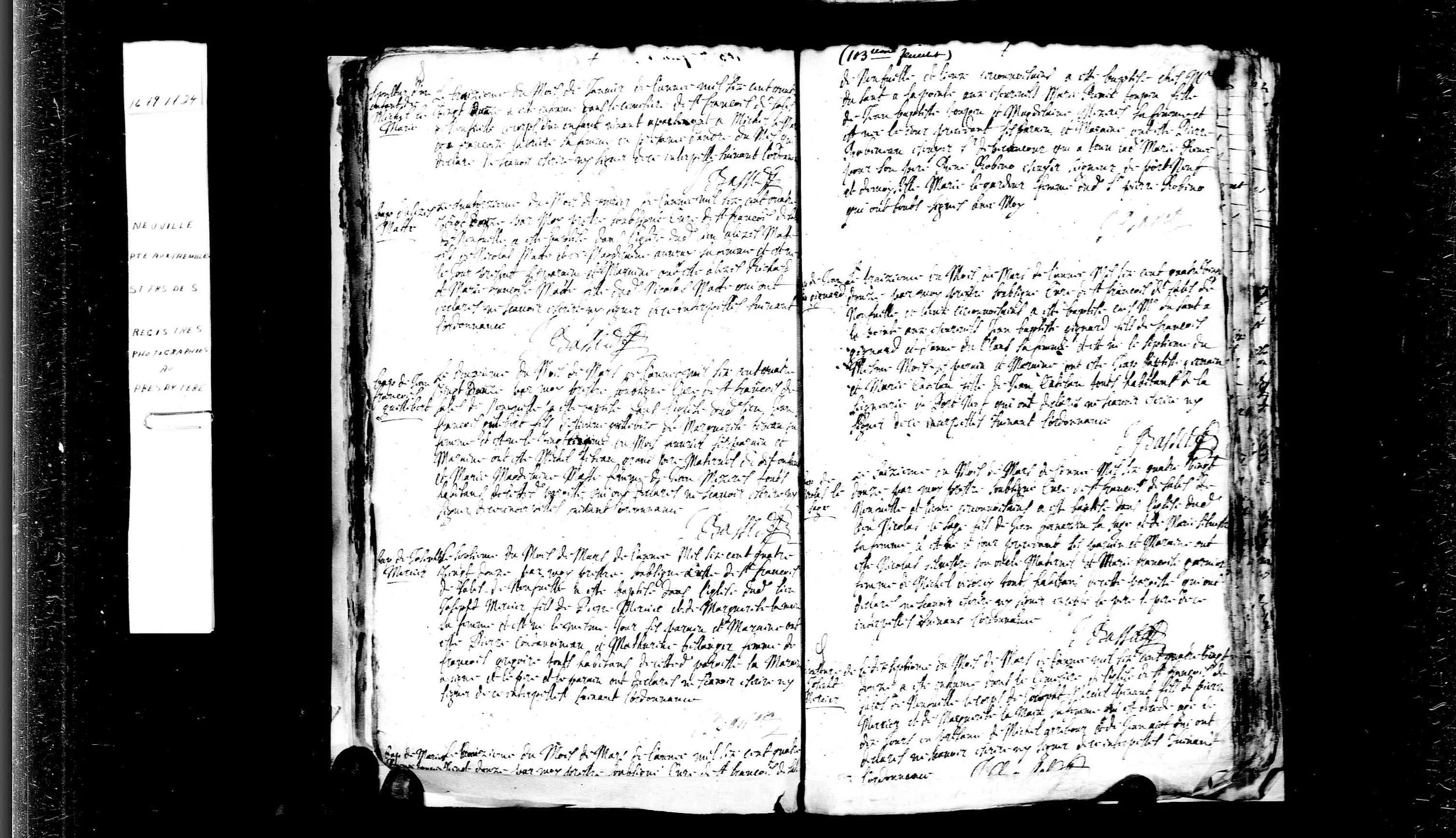
| 2 | Nicolas | b. 15 Mar 1692, bapt. 16 Mar, Neuville | His uncle Nicolas Sylvestre stood godfather. Two marriages: Marie Françoise Paris (1714), Marie Thérèse Lamothe (1759) |
| 3 | Marie Louise OUR LINE | b. 1 Jan 1694, bapt. 2 Jan, Neuville | Married Jean Sulière dit Tranchemontagne, Québec, 14 Sep 1716. Buried L'Assomption, 31 Jan 1757 |
| 4 | Marie Catherine | May 1696, Neuville | Godfather: Louis Silvestre, her uncle. Died 20 Feb 1710, Québec, aged 13 |
| 5 | Jean Baptiste | 2 Nov 1698, Neuville | Godmother: Marie Françoise Silvestre, her aunt. Grandfather Nicolas Sylvestre present. Married Marguerite Barette, 1721 |
| 6 | Joseph Étienne | 18 Nov 1700, Québec | Baptized at Notre-Dame-de-Québec. Buried 14 Mar 1703, Québec. Died in infancy |
| 7 | Jean Baptiste (#2) | 26 Feb 1702, Québec | Baptized at Notre-Dame-de-Québec. Married Marie Madeleine Allard, L'Assomption, 1726. Buried L'Assomption, 1762 |
| 8 | François de Sales | 24 Mar 1704, Neuville | Named for the parish patron saint. Godmother: Marie Jeanne Silvestre, his aunt. Died 20 Jun 1705, Québec. Died in infancy |
| 9 | Marie Scholastique | 15 Jun 1706, Québec | Baptized at Notre-Dame-de-Québec. Married Pierre Piché Pichet, 1724 |
Baptism of Nicolas Lesage
Neuville (St-François-de-Sales), MRC Portneuf. Born 15 March 1692, baptised the following day. PRDH-IGD record no. 53914.
| Rank | Name | Role and residence | Fields |
|---|---|---|---|
| 01 | Nicolas Lesage | Residence: Neuville (St-François-de-Sales) | c · present · m |
| 02 | Jean Bernardin Lesage | Father of 01, spouse of 03. Residence: Neuville | m · present · m |
| 03 | Marie Silvestre | Mother of 01, spouse of 02. Residence: Neuville | m · present · f |
| 04 | Nicolas Silvestre | Uncle of 01. Residence: Neuville | — · present · m |
| 05 | Marie Francoise Garnier | Spouse of 06. Residence: Neuville | m · present · f |
| 06 | Michel Desorcy | Spouse of 05. Residence: Neuville | m · named only · m |
| 07 | J Basset | Curé. Residence: Neuville | — |
The mother is entered simply as Marie Silvestre, not Marie Barbe. The child's uncle Nicolas Sylvestre — Marie Barbe's eldest brother, then twenty-two — stands godfather; he would be dead within seven years. Note on the fields: the age, marital status and presence columns are database fields generated from linked records, not transcriptions from the register itself, and are treated as such throughout this series.
Baptism of Marie Louise Lesage
Neuville (St-François-de-Sales), MRC Portneuf. Born 1 January 1694, baptised the following day. PRDH-IGD record no. 53963. Our direct ancestor.
| Rank | Name | Role and residence | Fields |
|---|---|---|---|
| 01 | Marie Louise Lesage | Residence: Neuville (St-François-de-Sales) | c · present · f |
| 02 | Jean Bernardin Lesage | Father of 01, spouse of 03. Residence: Neuville | m · present · m |
| 03 | Marie Silvestre | Mother of 01, spouse of 02. Residence: Neuville | m · present · f |
| 04 | Jean Carpantier | Residence: Neuville | — · present · m |
| 05 | Louise Tibeau | Spouse of 06. Residence: Neuville | m · present · f |
| 06 | Rene Grandalarie | Spouse of 05. Residence: Neuville | m · named only · m |
| 07 | J Basset | Curé. Residence: Neuville | — |
Twenty-two years later Marie Louise married Jean Sulière dit Tranchemontagne at Québec, carrying the Sylvestre and Lesage lines westward into the Lanaudière. The curé who baptised her, Basset, appears in the Neuville registers across nearly two decades of this family's life — and was still there in 1714 to witness the appraisal of her grandfather's farm.
Saint Francis de Sales: The Patron of the Parish
The church in Neuville is dedicated to Saint Francis de Sales — born in Thorens, Savoy, in 1567, ordained a priest in 1593, and named Bishop of Geneva in 1602. He founded the Order of the Visitation with Saint Jane Frances de Chantal in 1610 (she, in turn, is the patron saint of the church in Pont-Rouge, a parish that separated from Neuville in 1867). His feast day is January 24.
That the Lesage family named a son François de Sales — born 24 March 1704, and baptized the same day at Neuville — was a direct tribute to the parish where the family worshipped. The child's godmother was Marie Jeanne Silvestre, Marie Barbe's sister. Little François de Sales died fifteen months later, buried at Québec on 20 June 1705.
Artistic Treasures: Plamondon, Baillargé, and Déry
The church of Saint-François-de-Sales is not just a repository of sacramental records — it is a gallery of Québec's finest religious art. Antoine Plamondon (1804–1895), the celebrated copyist painter who settled in Neuville in 1845 and became its first mayor in 1855, created twenty-eight paintings for the church. A skilled organist, Plamondon donated $1,000 — half the cost — of the Napoléon Déry organ installed in 1885, on the condition that he could play the Gradual Mass every Sunday.
The high altar was crafted by the renowned sculptor François Baillargé in 1801, with the side altars following in 1802. The vault and cornice of the chancel were decorated in 1827 by three sculptors from Trois-Rivières: François Normand, François Routhier, and François Lafontaine. Works by wood sculptors Louis Jobin and Henri Angers — the latter born in Neuville — also grace the interior.
The Neuville organ, built in 1885, is the second largest instrument created by Napoléon Déry, after the one in the Saint-Jean-Baptiste church in Québec City. It is one of only eight Déry organs still in existence and one of only five still in use. Originally bellows-operated — it cost $2.25 to play at funerals and weddings: $1 for the organ, $1 for the organist, and $0.25 for the bellows operator — it was electrified in 1953 by the Casavant brothers. The organ was designated a historical monument in 1965.
The Fresco: 350 Years of History
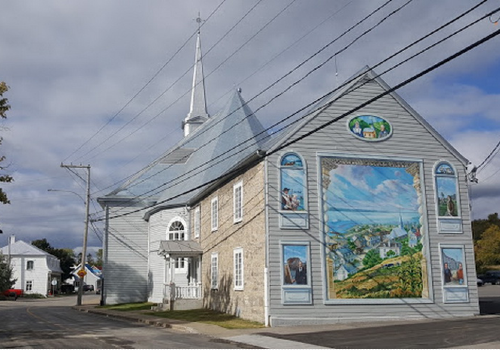
The east wall of the sacristy bears a monumental mural created by the firm SauteOzieux to commemorate 350 years of settlement in Neuville. The fresco depicts the village's terraced landscape across four centuries, flanked by columns that echo the baldaquin inside the church.
Commissioned for the 350th anniversary of the first settlers' arrival, the mural on the east wall of the sacristy tells Neuville's story across six panels. A bull's-eye window at the top shows a nun, a priest, and the Sainte-Anne chapel — "the eye of religion" in the lives of the ancestors. Below, a panoramic scene depicts the village in the early 1900s, with terraces showing the waterfront, village center, and agricultural lands. Four corner windows represent the 1600s (a soldier and a King's Daughter arriving by canoe), the 1700s (Nicolas Dupont de Neuville and the seigneurial system), the 1800s (Antoine Plamondon as first mayor, with the Dubord shipyard), and the 1900s (the storefronts and merchants of mid-century Neuville).
The two columns flanking the central scene are a direct reference to the baldaquin inside the church — a reminder that it was Neuville's wheat that saved Québec City from famine and brought that masterpiece to the parish.
Sainte-Anne Processional Chapel

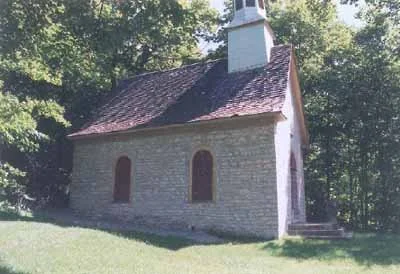
Behind the main church, on Jean-Basset Street, stands the Sainte-Anne Processional Chapel — a National Historic Site of Canada. The original chapel was built in 1679, ten years after Neuville's first chapel and seven years before Marie Barbe Sylvestre married Jean Bernardin Lesage in the parish church. The current stone structure dates to about 1830 and has been renovated several times, most recently in 1999 ($80,000) and 2004 ($50,000).
The chapel is a living remnant of the processional traditions that would have been part of Nicolas Sylvestre's and Barbe Nepveu's world — a tangible link to the devotional life of Neuville's founding generation.
The Church Today
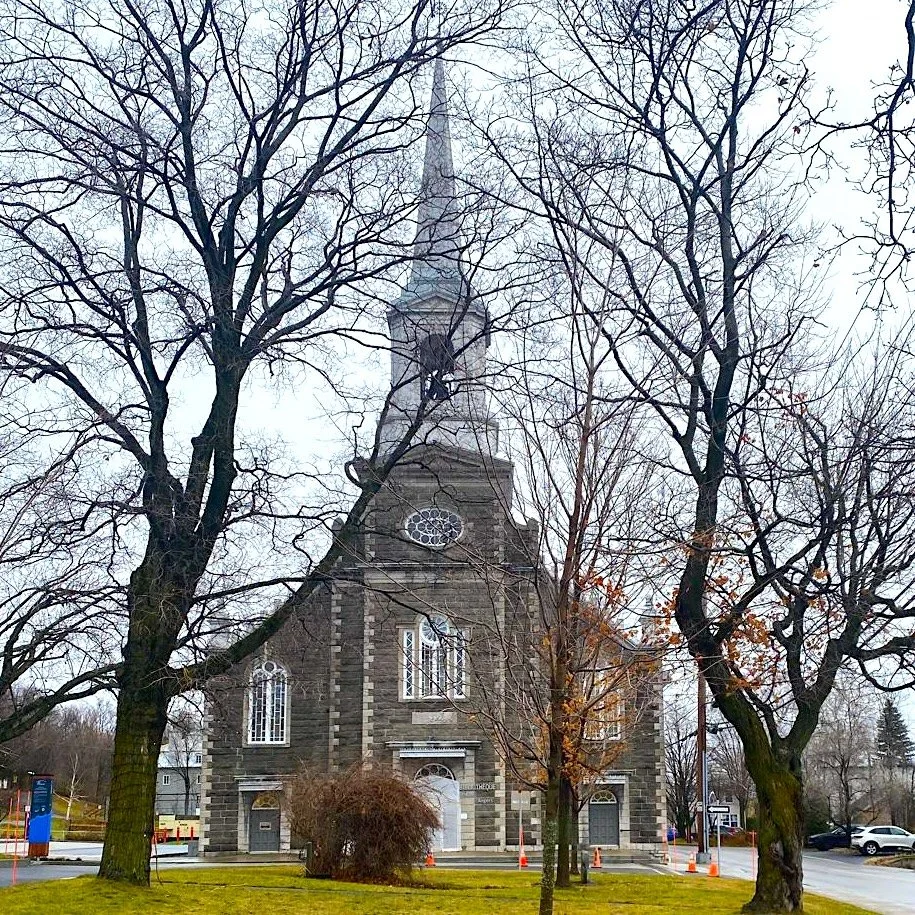
Église Saint-François-de-Sales in late autumn. Since 2017, the building has served a dual role: it remains an active place of worship while also housing the municipal library of Neuville — a unique blending of sacred heritage and community life.
Since 2017, the church of Saint-François-de-Sales has served a dual purpose that would perhaps have pleased its practical founders: it remains an active place of Catholic worship while also functioning as the municipal library of Neuville. The rehabilitation preserved the heritage interior while incorporating modern community spaces — a fitting continuation for a building that has served Neuville's people in one form or another since 1669.
The baldaquin still stands. The Plamondon paintings still hang on the walls. The Napoléon Déry organ — the one that once cost $2.25 per performance — still plays. And the parish registers, beginning in 1667, still hold the names of the Sylvestres and Lesages who shaped this corner of New France into a home.
Visiting the Site
Church Address: 714 Rue des Érables, Neuville, QC G0A 2R0, Canada
Phone: +1 418-876-2022
Parish: Paroisse Bienheureuse-Mère-Saint-Louis
Heritage Features: 1695 Baroque baldaquin (classified cultural asset); 28 paintings by Antoine Plamondon; 1801 high altar by François Baillargé; 1885 Napoléon Déry organ (classified cultural asset, designated historical monument 1965)
Nearby: Sainte-Anne Processional Chapel (National Historic Site), 660 Rue des Érables; the Presbytery (1715), the oldest building in Neuville
Note: Since 2017, the church also serves as the municipal library of Neuville
Document Gallery






Every Family Has a Story Worth Telling
Whether you're just beginning your research or ready to transform years of work into a narrative your family will treasure, I'd love to hear your story.
BEGIN YOUR RESEARCH INQUIRY