
When One Ancestor Appears Twice: Catherine Lemesle
When One Ancestor Appears Twice
If you have done any deep genealogical research, you have probably run into something that seems mathematically impossible: the same ancestor appearing in more than one place on your family tree. It is called pedigree collapse, and once you understand it you realise it is not just possible. It is unavoidable.
In my own research I found that Catherine Lemesle — a Fille du Roi who arrived in Quebec in 1671 — is my 8th great-grandmother twice. Not two women with the same name. The same person, appearing in two separate branches of my tree that converged when her great-great-grandchildren married each other, eighty-five years after her children were born.
This is her story, and the story of how two lines that began with her became one again.
The Mathematics of Ancestry
Before Catherine's story, some numbers. Go back ten generations — roughly to the late 1600s — and you have, in theory, 1,024 ancestors in that one generation. Go back another and it doubles. Keep going and by twenty generations you would need more than a million people, all alive at once, all in the same region, all marrying each other's neighbours.
There were never that many. The arithmetic does not balance unless some of those ancestor positions are filled by the same people more than once.
That is pedigree collapse. It is not a mistake in your tree. It is a feature of how human populations actually worked.
In colonial Quebec, where communities were small and the choice of marriage partners smaller, collapse happened constantly. French Canadians today have, on average, roughly half as many distinct ancestors as the theoretical maximum would predict. The same families married each other generation after generation, and the tree folds in on itself.
In my case the fold happens at Catherine Lemesle, who had two children whose descendants married each other. If you want the calculation itself — how to work out which generation an ancestor sits in, how many slots she occupies, and what share of your DNA she is expected to account for — I have set it out step by step in the case study. The short version: appearing twice at ten generations back gives her the same expected genetic weight as a single ancestor one generation nearer. About one part in five hundred.
Who Was Catherine Lemesle?
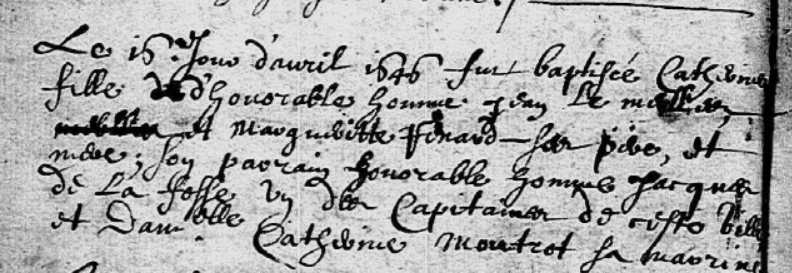
Catherine Lemesle was baptized on 16 April 1646 in the parish of Saint-Pierre-du-Châtel in Rouen, one of the largest cities in France. Her father, Jean Lemesle, is called honorable homme in the register and a marchand bourgeois in the compiled record — a merchant of comfortable means. Her mother was Marguerite Renard. Her godfather was a captain of the town.
By 1671 both of her parents were dead. Every record afterwards calls her the daughter of the late Jean Lemesle. She was twenty-five, unmarried, with some inheritance and no parents — a narrow position in seventeenth-century France. Across the Atlantic, Louis XIV was offering passage, a dowry supplement, and the near-certainty of marriage in a colony that had far more men than women.
These women became known as the Filles du Roi, the King's Daughters.
The Voyage
In the summer of 1671 Catherine sailed from Dieppe on Le Prince Maurice. The season's contingent was chaperoned by Madame Anne Gasnier Bourdon, the widow appointed by Intendant Jean Talon to oversee the programme — remember her name, because she comes back.
The crossing took six to eight weeks. Catherine landed at Quebec on 30 July 1671 with a dowry of 200 livres, fifty of it from the King himself. Ten months later she was married.
Marriage to Pierre Morin
Pierre Morin came from Saint-Étienne-de-Brillouet in western France, in the diocese of Luçon. He was about twenty-four. Both his parents were dead, like hers.
He has long been identified as a former soldier of the Carignan-Salières Regiment — the force sent to New France in 1665 to fight the Iroquois — and I published that identification myself, in several places on this site. I no longer publish it as settled. A Pierre Morin is named on the regiment's 1668 muster roll, but two specialist compilations now read that single line as two different men, and no document has been produced that says which one it is. It may well have been him. It is not proven, and this post no longer says otherwise. The other candidate has a page of his own.
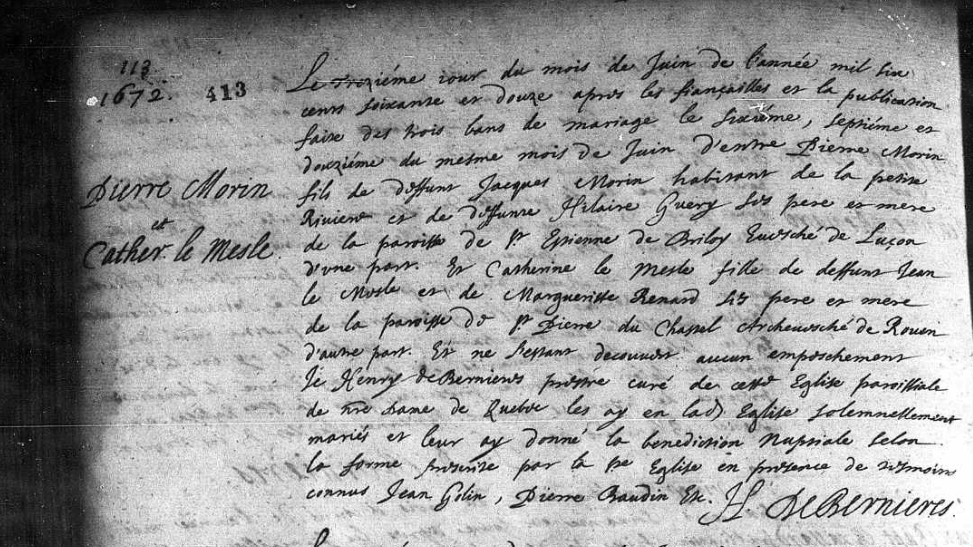
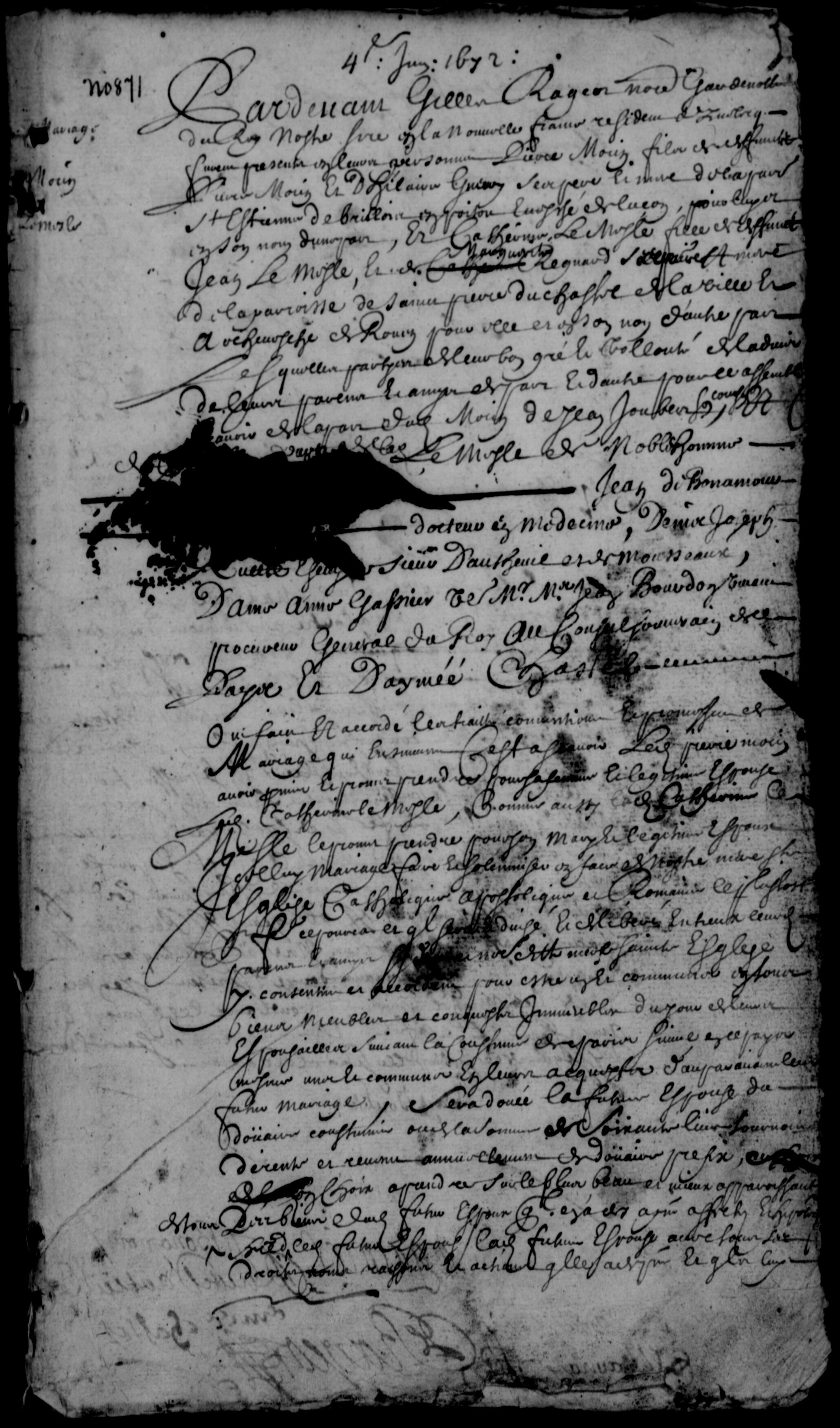
On 4 June 1672 Pierre and Catherine signed a marriage contract before the notary Gilles Rageot. Nine days later they were married at Notre-Dame-de-Québec. Anne Gasnier, who had brought Catherine across the ocean the summer before, signed the contract — one of seven signatures on it. Neither the bride nor the groom is among them. Both were illiterate.
Over the next seventeen years they had eight children. Five survived to adulthood. Two of those five became the starting points of the lines that would eventually rejoin.
Why the soldier is gone from this post
When I first wrote this, Pierre Morin's regiment was one of the fixed points in the story — the kind of detail that makes an ancestor feel legible. It was also, as it turns out, the least well-supported thing on the page. Four sources appeared to confirm it; on inspection, three of them were reading the same document, and the fourth had declined to make the identification at all.
I have withdrawn the claim rather than quietly softening it, and left this note in its place. Nothing else about Catherine changes. Her baptism, her crossing, her marriage, her eight children and her double descent are all documented exactly as they were. What changed is one line in her husband's biography, and the honest version of it is shorter.
The Two Paths
Catherine's firstborn was Marie Anne Morin, baptized 22 July 1673. Her fifth child was Joseph Morin, baptized 6 January 1682. These two — nine years apart, raised in the same house on the same côte outside Quebec — each began a line that would grow separately for eighty-five years before meeting again.
Catherine Lemesle & Pierre Morin
Married 1672, QuebecPath 1: Through Marie Anne (1673)
- Marie Anne Morin (1673–1743)
married Guillaume Deguise, 1691 - Marie Catherine Deguise (1704–1731)
married Charles Guilbault - Charles Gabriel Guilbault (1731–1784)
married Marie Charlotte Morin, 1757
Path 2: Through Joseph (1682)
- Joseph Morin (1682–1735)
married Marie-Anne Brideau, 1704 - Joseph Morin II (1709–1781)
married M.C. Charles Croquelois - Marie Charlotte Morin (1738–1767)
married Charles Gabriel Guilbault, 1757
In 1757 Charles Gabriel Guilbault married Marie Charlotte Morin. He was her great-great-grandson through her daughter Marie Anne. She was her great-great-granddaughter through her son Joseph. Neither is likely to have known. But in marrying, they rejoined lines that had been apart since the 1670s.
Their son — Gabriel Guilbault, the voyageur who would later marry an Ojibwe woman named Marie Josephte Abitakijikokwe — carried Catherine Lemesle's ancestry through both parents. And so do I.
What This Means for DNA
Pedigree collapse has practical consequences for genetic genealogy. Descending from one ancestor along two lines means you may have inherited from her twice, through two independent paths of transmission.
A note on DNA inheritance
Ten generations back, a single ancestor accounts for about 0.098% of your DNA in expectation. Two paths roughly double that, to about 0.195% — the same weight a single ancestor one generation nearer would carry.
But expectation is not measurement. Autosomal DNA is reshuffled at every generation, and at ten generations there is a real chance of having inherited nothing at all from a particular ancestor through a particular path. Doubling the paths improves the odds; it does not guarantee anything. The practical effect is that matches who also descend from Catherine may share more than the paper relationship predicts — and that relationship estimators, which assume a single path, will read those matches as closer than they are.
Why This Matters for Your Research
If you are working in French-Canadian ancestry, expect pedigree collapse. A small colonial population, limited marriage pools, and families that stayed put for generations all pushed in the same direction. Here is what to watch for.
Research tip: when you find pedigree collapse, document it explicitly. I label each line of descent from a doubled ancestor — Path 1, Path 2 — and keep them separate in every file. It makes the relationship easy to explain to relatives, and it stops the two paths quietly merging in your own head, which is the real risk.
The Broader Significance
Catherine Lemesle was one of roughly 800 Filles du Roi who came to New France between 1663 and 1673. Between them, those women became the maternal ancestors of millions of French Canadians and their descendants across North America. Something like two-thirds of French Canadians can trace at least one line to a Fille du Roi.
To descend from the same one twice says something more specific about colonial Quebec. These were not isolated households. They were a web of relationships — marriages, godparents, neighbours on the same côte — crossing and recrossing until the tree folded over on itself.
Catherine could not have known, stepping off Le Prince Maurice in July 1671, that her descendants would marry each other. She could not have imagined that three and a half centuries later someone would assemble the paper trail of her life — a baptism in Rouen, a marriage contract in Quebec, the baptisms of eight children — and find her standing in two places at once.
But here we are. And now you know her story.
Want to Explore Your French-Canadian Ancestry?
Storyline Genealogy specialises in French-Canadian research, including Filles du Roi connections, voyageur families, and complex multi-generational analysis.
Learn About Our ServicesWant to Know When New Stories Are Published?
Subscribe to receive updates on new family history research—no spam, just meaningful stories when there's something worth sharing.
SUBSCRIBE TO OUR NEWSLETTEREvery Family Has a Story Worth Telling
Whether you're just beginning your research or ready to transform years of work into a narrative your family will treasure, I'd love to help.
BEGIN YOUR RESEARCH INQUIRY