
François Séguin dit Ladéroute: Carignan Soldier, Weaver, and Settler of Boucherville
François Séguin dit Ladéroute
Quick Facts
The Death Date
PRDH-IGD and the Dictionnaire généalogique des familles du Québec record François's death as 9 May 1704. Two documents place it earlier. On 20 November 1700, before notary Pierre Raimbault, Jeanne Petit acts as the wife of François Séguin, "absnt pour son indisposition"—absent on account of his illness. On 9 October 1701, before the same notary, she acts as "veufue de deffunct françois Seguin," widow of the late François Séguin. A Boucherville parish act of 11 November 1715 independently records him as deceased, with Jeanne present in the church.
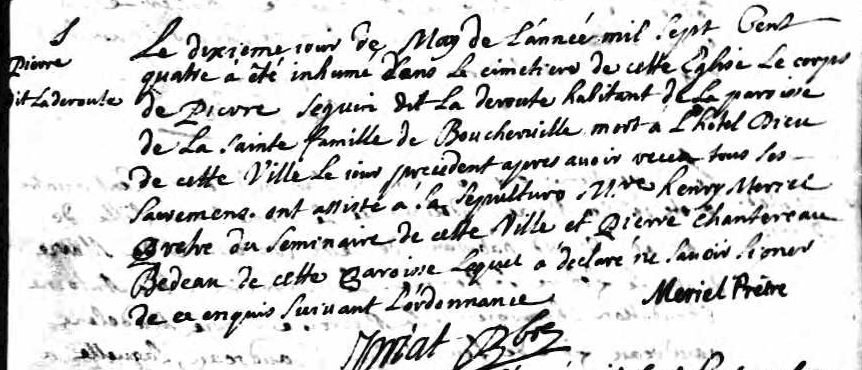
This narrower range was first published by the Association des Séguin d'Amérique in La Séguinière in 1994 and is carried by Denis Beauregard's Genealogy of the French in North America. The 1704 burial at Notre-Dame-de-Montréal names a different man, recorded in the register as Pierre Séguin dit La Deroute, an habitant of Boucherville who died at the Hôtel-Dieu.
A 2025 study of the Carignan-Salières Regiment maintains that the May 1704 burial is François's, entered under an erroneous given name. Two notarial acts of 1703 and 1704 naming a François Séguin dit Ladéroute at Boucherville bear on that reading and are under examination; a documentary case study will follow.
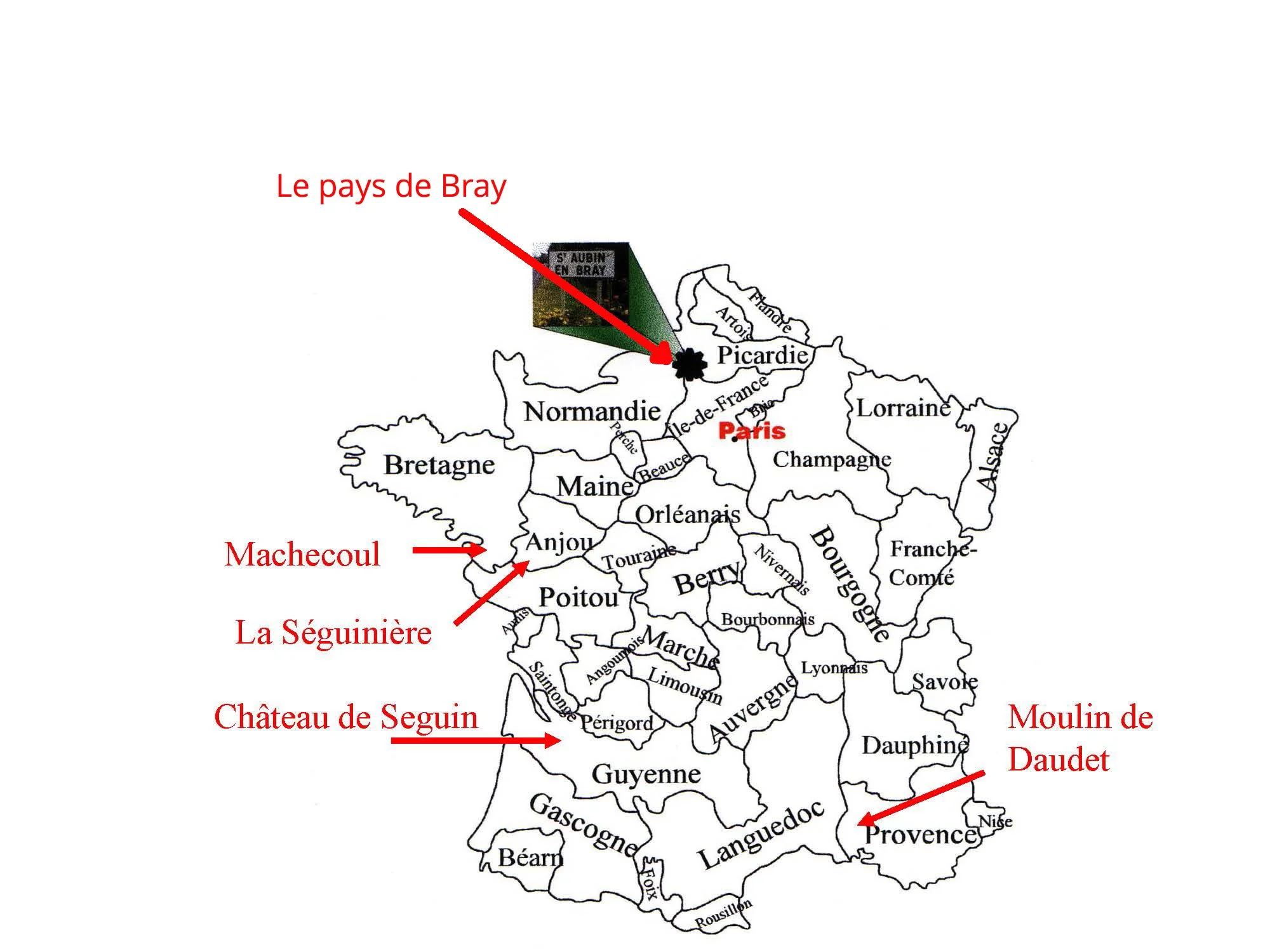
Several immigrants bearing the name Séguin came to New France. The most humble, but perhaps the best known due to his numerous descendants, was named François Séguin dit Ladéroute. He came from the region of Bray, west of Beauvais, almost within the boundaries of the present department of the Oise, canton of Le Coudray-Saint-Germer, in the former province of Picardy. His story begins with a marriage in a small village church and ends roughly fifty-six years later—a journey that would establish one of the most prolific families in French-Canadian history, with descendants numbering between 1.89 and 2.31 million today.

Le Pays de Bray—the rolling countryside of Picardy where François was born.
On Tuesday, 14 July 1643, in the small church of Cuigy-en-Bray, Laurent Séguin and Marie Massieu celebrated their marriage. Laurent, the father of our Canadian ancestor, bore the title of clerc—at that time meaning a layman with an education. At Saint-Aubin-en-Bray, on 4 July 1644, Laurent and Marie had their first child, François, baptized. François Boudin and Jeanne Dufour, his godparents, held the little one at the baptismal font; he would become our Canadian Ancestor Séguin.
The Clerc's Family in the Bray
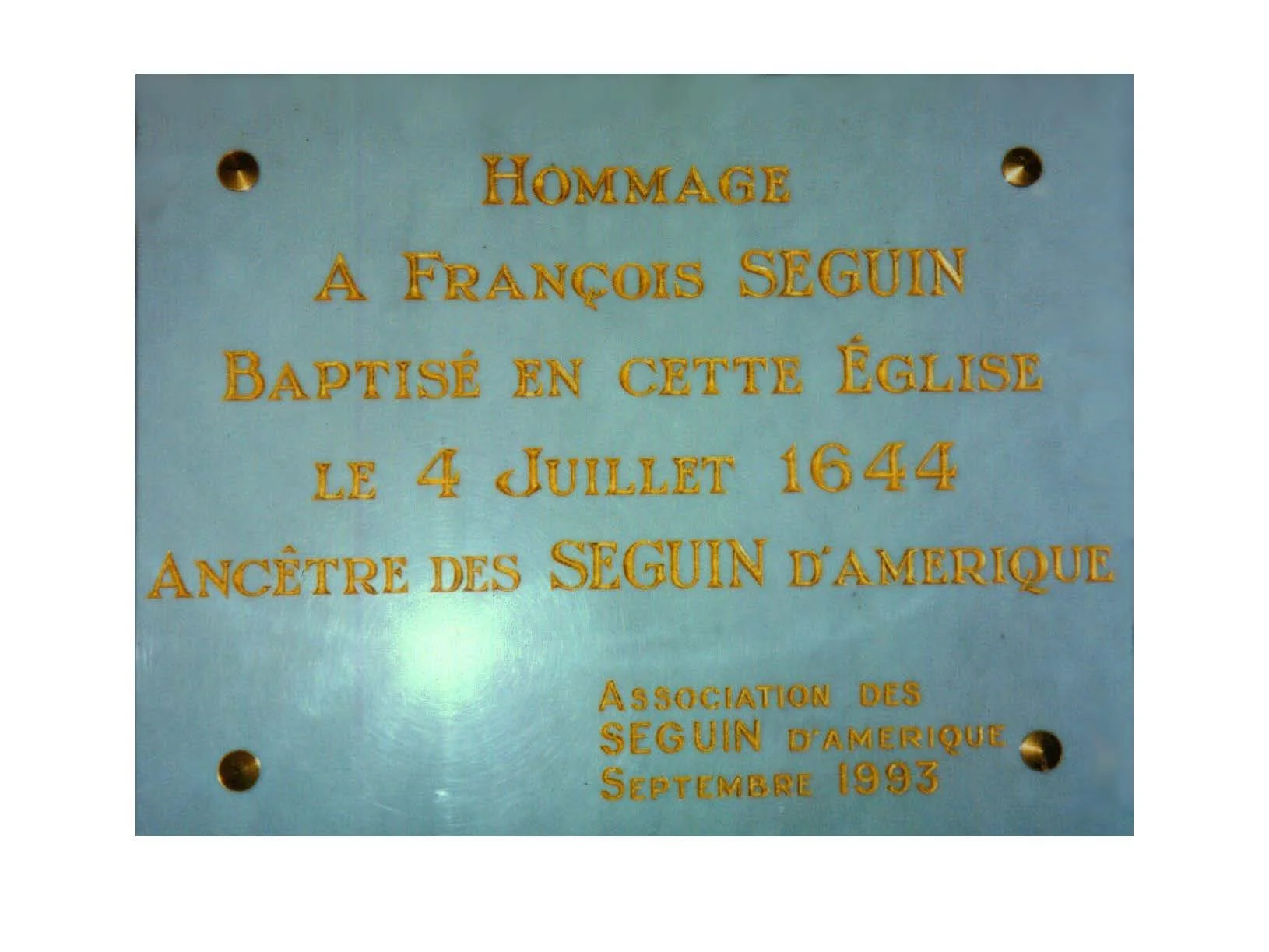
Commemorative plaque at Saint-Aubin-en-Bray: "Hommage à François Séguin... Ancêtre des Séguin d'Amérique." Placed September 1993 by the Association des Séguin d'Amérique.
Five more children followed François. Renée was baptized at Jaméricourt on 19 November 1645, and at her baptism Laurent was again styled clerc—this time clerc of Jaméricourt. Four more were baptized at Jouy-sous-Thelle: Pierre on 29 January 1648, Michel on 21 July 1657, a second Laurent in 1659, and Marguerite on 26 May 1660. Marriage at Cuigy-en-Bray, a first child at Saint-Aubin, a second at Jaméricourt, four more at Jouy-sous-Thelle, and the family's later records at Senantes—five parishes within a few miles of one another, the ordinary geography of a parish clerk who went where the work was.
François left in 1665 and did not return. His mother lived another twelve years: Marie Massieu was buried at Senantes on 12 February 1677, aged fifty-eight, and the act names her as the wife of Laurent Séguin, son premier mary, aged fifty-eight, with the said Séguin present at the graveside. Laurent remarried three months later, on 26 May 1677, at Villembray, to Sainte Dumont of that parish.
He outlived his eldest son. Laurent Séguin was buried at Senantes on 22 November 1706, aged about eighty-five, and the act still calls him maistre Laurent Seguin, clerc de l'église—the office he had held when he married in 1643, sixty-three years before. His sons Michel and Pierre stood at the burial, and both signed the register. Whether word of François's death in New France ever reached the Bray is not recorded.
Earlier versions of this page followed Thomas J. Laforest in placing her death in 1650, at the age of twenty-eight, and described François as motherless at six. That reading rests on a burial entered in the mortuaires of Cuigy-en-Bray on 25 October 1650, which gives a name, an age and a date and nothing further—no filiation, no husband named. The identification of that woman as Laurent Séguin's wife was an inference from the name alone.
The act quoted above, supplied by the Association des Séguin d'Amérique, names the husband and records his presence, and is decisive against it. The 1650 attribution is withdrawn.
The act is entered in the register of Senantes under the heading febvrier 1677. The Association des Séguin d'Amérique, which supplied the image, records the burial at Senantes and states plainly that it is not the Cuigy-en-Bray burial of a twenty-eight-year-old that has been cited since 1947.
The Soldier Years: Carignan-Salières Regiment (1665–1668)
At a very young age, François Séguin left his family home and went to earn his living by whatever means at hand. Perhaps he did an apprenticeship in a trade. As soon as he could, he enlisted as a soldier—joining the elite Carignan-Salières Regiment, the first professional military force King Louis XIV sent to defend New France.
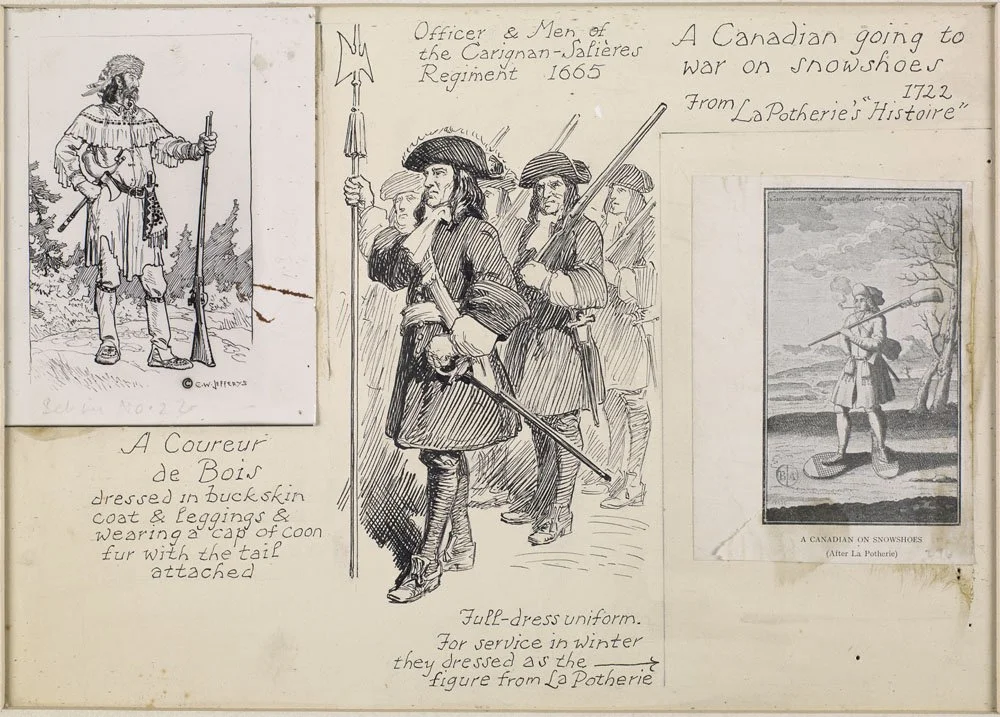
Officer and Men of the Carignan-Salières Regiment, 1665. Full-dress uniform at center; for winter service they dressed as the figure at right—"A Canadian going to war on snowshoes." From La Potherie's Histoire, 1722.
François was assigned to the Company of St-Ours, commanded by Captain Pierre de Saint-Ours, a minor French noble who would later become one of the most prominent seigneurs in New France. The regiment departed La Rochelle on 24 May 1665 aboard Le Justice, arriving at Quebec on 12 September 1665, carrying 1,200 soldiers and officers in 24 companies.
The regiment's mission was critical: defend the colony and suppress the Haudenosaunee (Iroquois) raids that had brought New France to its knees. This was a professional military force—well trained, disciplined, and organized—something the colony had never had before.
The Meaning of "Ladéroute"
Why did François bear the surname dit Ladéroute—literally "along the road" or "on the march"? This military nickname is telling. Dit-names like this were common among career soldiers and often associated with men accustomed to long marches, patrol duty, and escorting supplies or messengers. It fits a man used to movement and frontier service, not a sedentary garrison role.
Such nicknames often originated before arrival in Canada, hinting that François may already have had military experience in France before joining the regiment. As Thomas J. Laforest noted, the exact origin remains "a military mystery"—but the name itself speaks to a life defined by the road.
Fort Duty on the Richelieu River
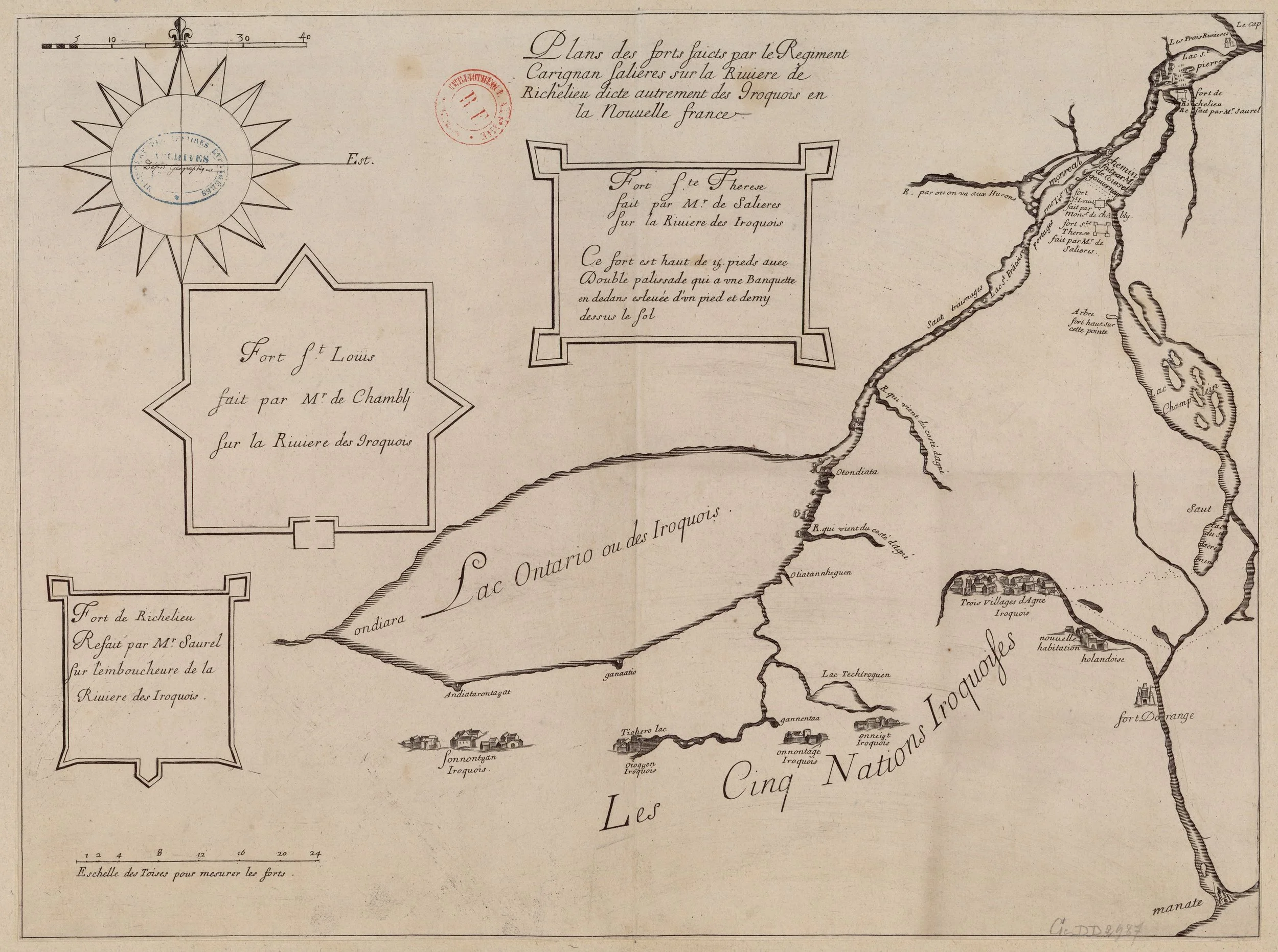
Plan des forts faicts par le Regiment Carignan Salières—the chain of forts along the Richelieu River, New France's most vulnerable invasion corridor.
The Richelieu River was the invasion corridor used by Iroquois war parties coming north from present-day New York. The regiment, company by company, built a chain of forts to guard this vulnerable approach: Fort Richelieu at Sorel, Fort Chambly, Fort Sainte-Thérèse, and Fort Saint-Jean.
As part of the St-Ours Company, François spent the winter of 1665-1666 at the newly built fort at Sorel. His duties would have included clearing land, building palisades, digging ditches, standing watch along river corridors, and conducting patrols between forts. This was grueling physical labor mixed with constant military readiness.
Unlike European warfare, these soldiers had to adapt quickly: enduring harsh Canadian winters in cramped forts, learning to move on snowshoes, and adapting to woodland warfare against an enemy who knew the terrain intimately. Conditions that defeated many European soldiers.
The 1666 Campaign Against the Mohawk
In 1666, companies of the regiment—including St-Ours'—took part in punitive expeditions south into Mohawk territory under the command of Alexandre de Prouville de Tracy. Villages were burned. Crops were destroyed. The campaign, though brutal, forced a lasting peace treaty that would hold for nearly two decades.
This peace is one reason New France survived long enough to grow. François Séguin was there—part of the first successful military defense of the colony, present at one of the most decisive moments in Canadian history.
Captain Pierre de Saint-Ours himself went with Tracy's expedition. He would later receive the seigneury of Saint-Ours on the Richelieu River, and when he drew up his will in 1704, he bequeathed 400 livres to the soldiers whom he had previously commanded. The name of François Séguin was mentioned on the list of beneficiaries—proof that the bond between officer and men endured across four decades.
From Soldier to Settler

Commemorative plaque at Boucherville listing the 22 soldiers of the Carignan-Salières Regiment who settled there between 1669 and 1695. François Séguin dit Ladéroute appears in the final line. Société d'histoire des Îles-Percées.
When the Carignan-Salières Regiment was officially disbanded in 1667-1668, about 800 soldiers returned to France. The remaining 400 stayed. Officers were encouraged to remain with promises of seigneuries; their troops were promised concessions of land within those same fiefs. Many married the newly arrived Filles du Roi and began new lives as habitants.
François Séguin was among those who stayed. A commemorative plaque erected by the Société d'histoire des Îles-Percées lists the 22 soldiers of the regiment who settled at Boucherville between 1669 and 1695. There, in the final line, appears his name: François Séguin dit Ladéroute.
This is the moment when men like him stopped being "troops" and became founders of families. About 1668, the governor asked Saint-Ours to raise troops for the garrison of Ville-Marie. François Séguin, still a bachelor, left the fief of Saint-Ours to go to the defense of Montréal. By 1671, he had leased his first piece of land at Boucherville. By 1672, he would marry a King's Daughter named Jeanne Petit.
The soldier had become a settler. The road that began in Picardy, wound through the forts of the Richelieu, and led at last to a concession on the St. Lawrence—Ladéroute had found his destination.
Jeanne Petit: A King's Daughter
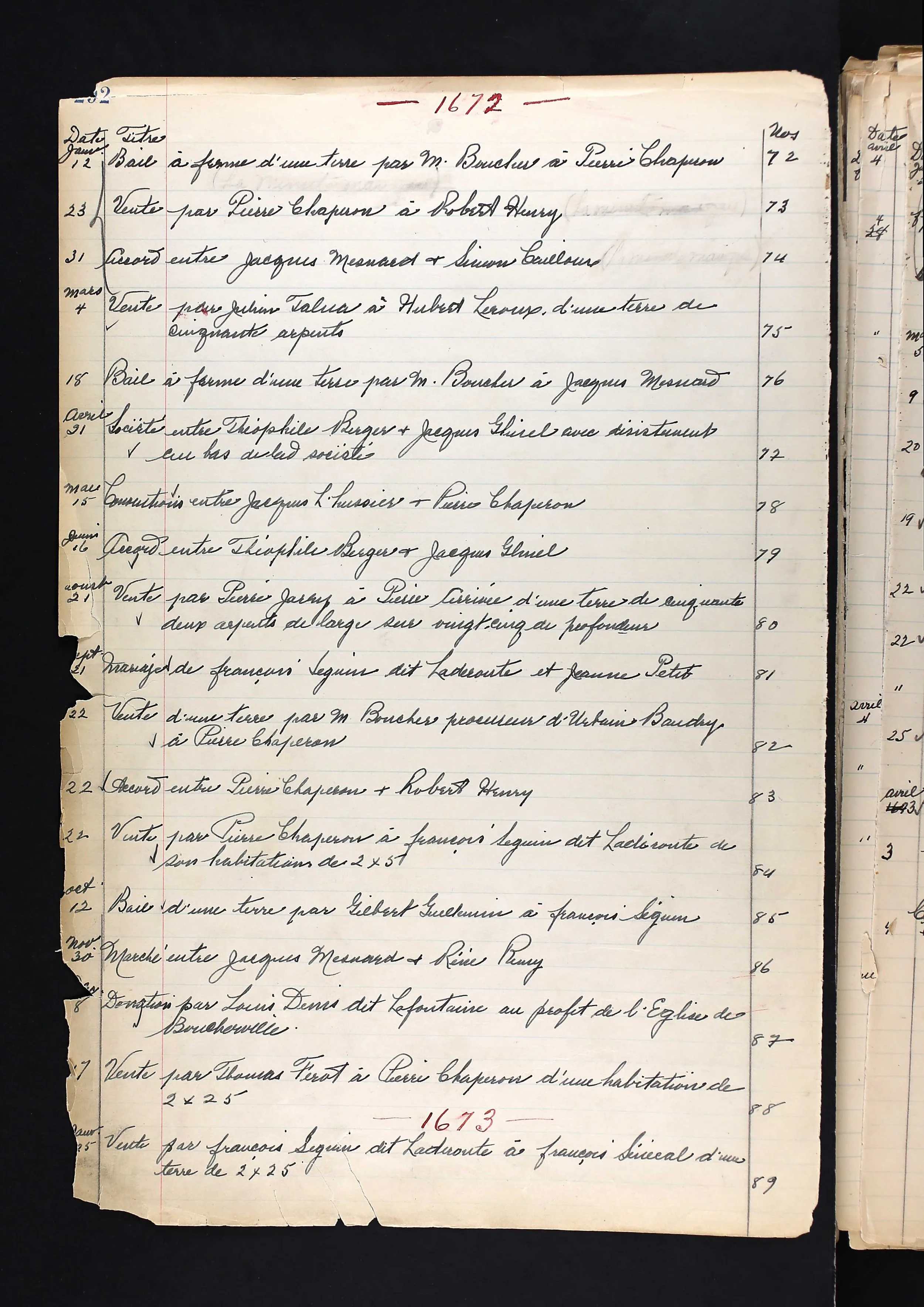
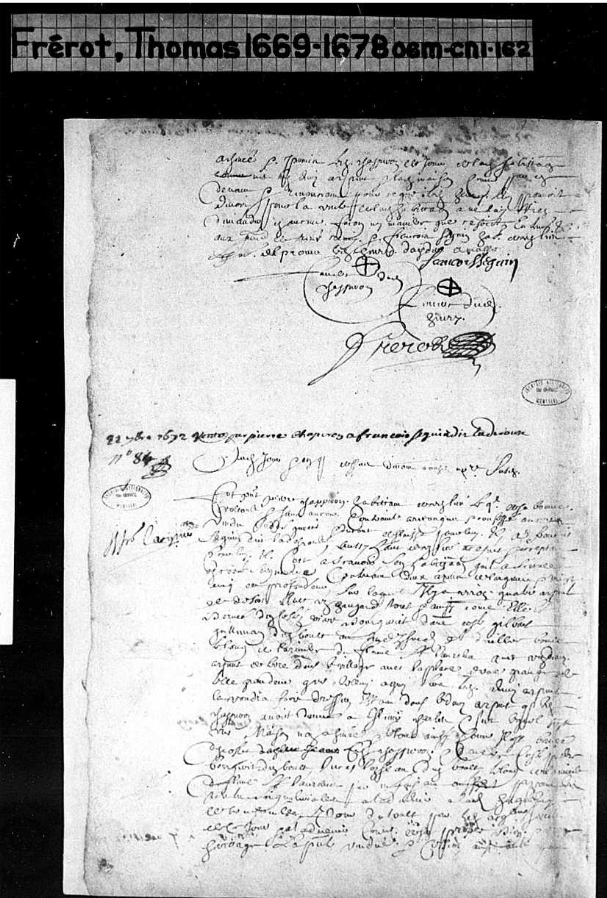
Jeanne Petit was part of the contingent of 125 Filles du Roi who came to New France in 1671. On Wednesday, 21 September 1672, there was a marriage contract between Jeanne—born at Sainte-Marguerite de La Rochelle—and François Séguin. At age 16, she was already an orphan. Pierre Boucher himself witnessed the ceremony. Pierre De Caumont joined François and Jeanne in bonds of matrimony on Monday, 31 October 1672.
Building at Boucherville
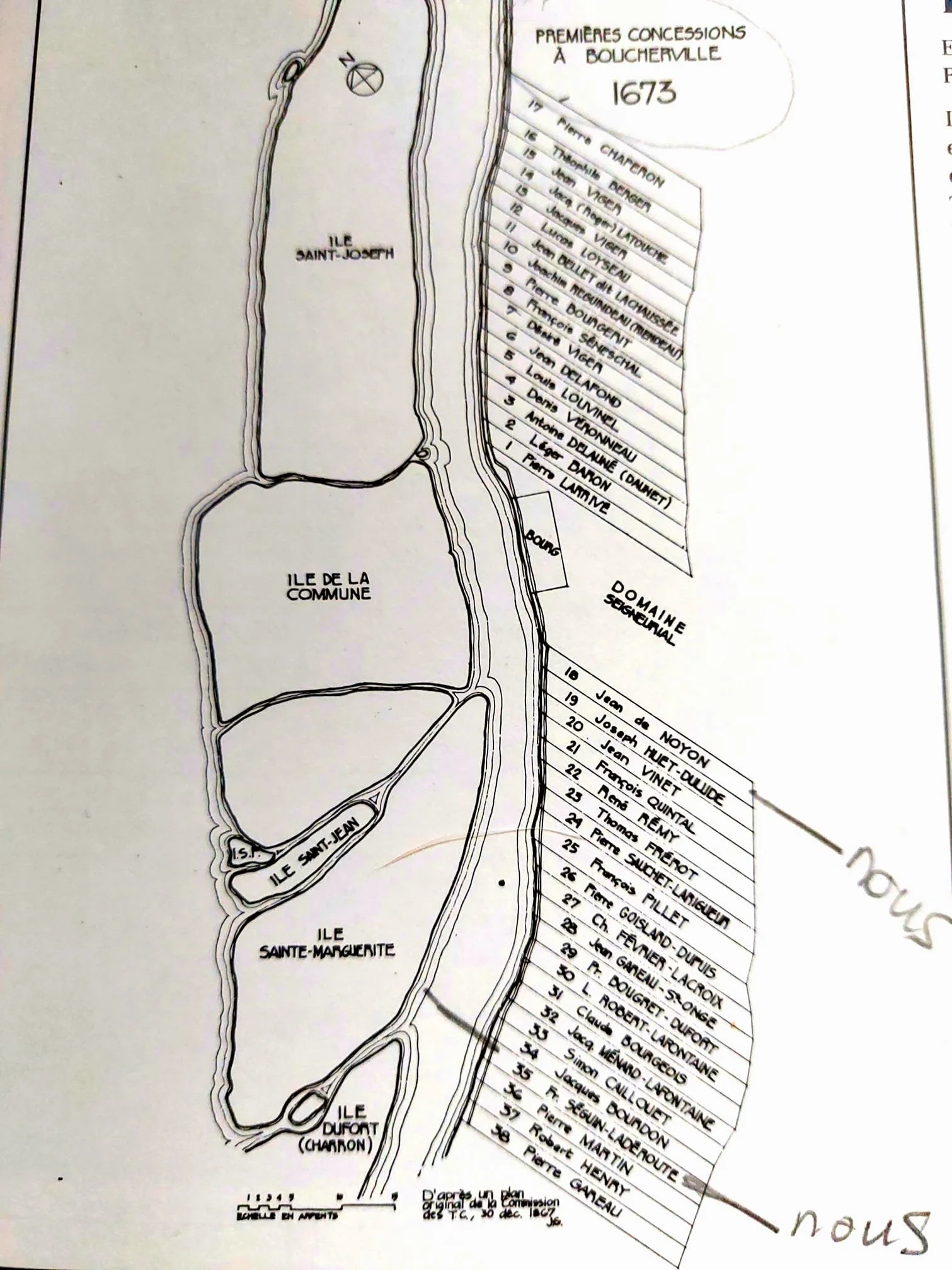
François Séguin's lot (#36) is fourth from the bottom, between Jacques Bourdon and Pierre Martin. From "François Séguin ou L'impossible défi" (1992).
On 22 September 1672, François Séguin bought a homestead from Pierre Chaperon consisting of 2 arpents by 25 deep. On 4 April 1673, with 37 other concessionaires, he obtained his plot of land from seigneur Pierre Boucher. In the census of 1681, we learn that François stated his profession: WEAVER! In the early days of New France weaving was a man's trade.
The Séguin Family
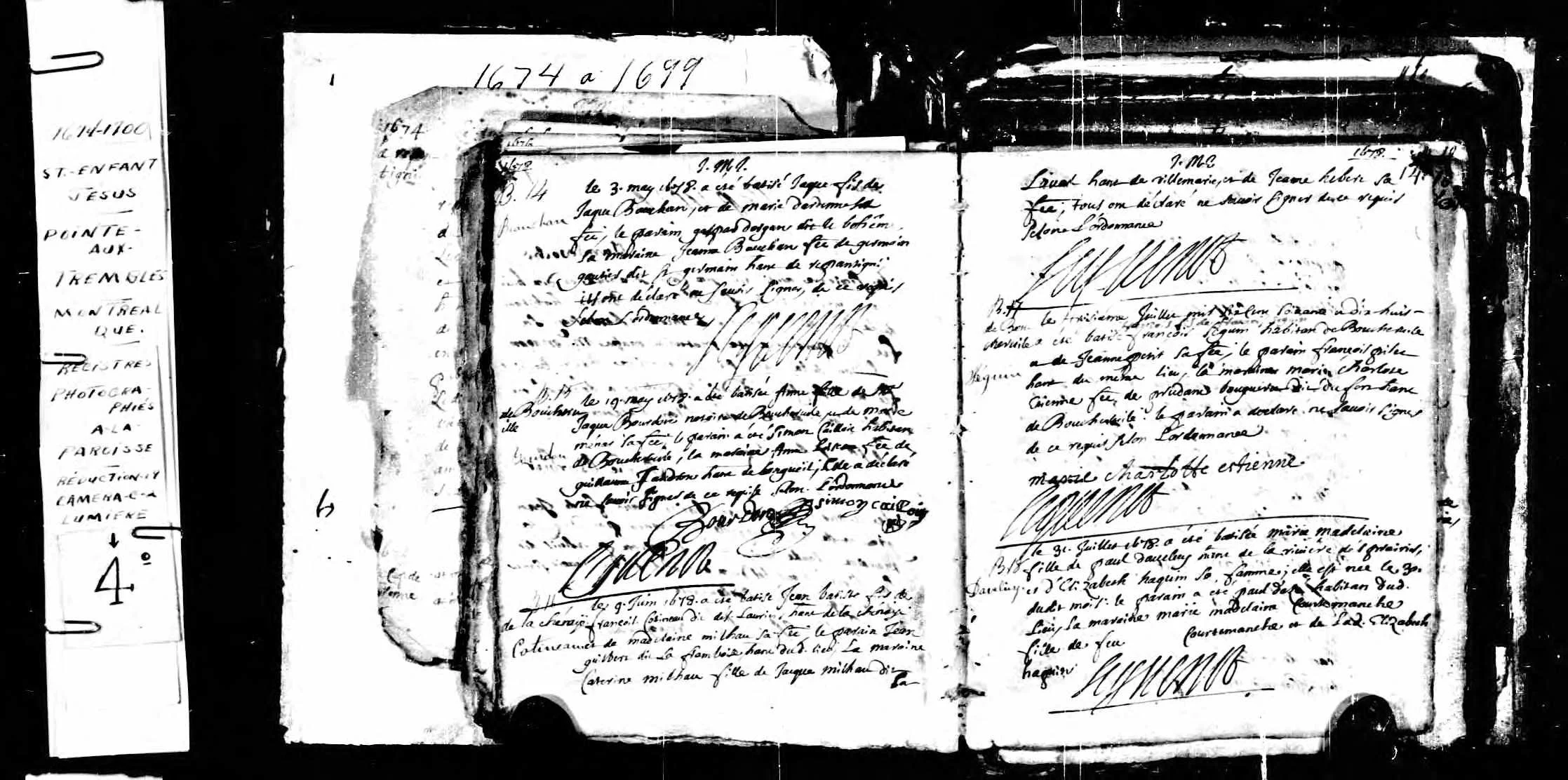
Eleven children were born to François and Jeanne: Françoise, Marie-Madeleine, François, Jeanne, Pierre, Simon, Catherine, Jean-Baptiste, Geneviève, Joseph and Joseph. Catherine, Geneviève, and Joseph (born 10 August 1692) died in infancy. All three were buried in the cemetery of Sainte-Famille de Boucherville.
The Séguin family counted 76 members in the third generation and seems to have enjoyed the gift of longevity.
Jean-Baptiste, my own ancestor through the Guilbault Line, married Geneviève Barbeau dit Boisdore on 7 June 1710 at Boucherville and brought ten children into the world. He died at the hospital in Montréal on 13 May 1728 and was buried the following day at Notre-Dame de Montréal.
Twenty-Fourth Hour
On 24 November 1698, François sold his concession to Jean-Baptiste Lamoureux for 850 livres. For his 50 arpents of land "with a poor building built upon it", he received 400 livres in playing card money, 200 in merchandise, and 60 in wheat. Did he feel his strength declining? Was his final hour approaching?

The Îles-de-Boucherville today. François and Jeanne spent their final years together on Île Grosbois, visible across the water from their former concession.
On 15 April 1700, François Séguin and Jeanne Petit were granted permission by Madame Marie-Anne de La Valtrie, widow of Pierre Boucher's son Ignace Boucher, Sieur de Grosbois, to live on 16 square arpents of land on the Île Grosbois. The grant was for their lifetime only. François, in addition to giving two work days each autumn, was committed to taking care of the widow's two cows.
Unfortunately, François's health declined rapidly. On 20 November 1700, when his daughter Marie-Madeleine contracted to marry Antoine Marie of Longueuil, François could not attend. The notary Pierre Raimbault recorded Jeanne Petit acting alone, as "femme de françois Seguin... habitant de Boucherville absnt pour son indisposition, de laquelle elle promet faire agreer et ratifier ce present toutes fois et quand"—wife of François Séguin, resident of Boucherville, absent on account of his illness, and she promises to have him approve and ratify this present contract whenever required.
He was alive, then, but too ill to travel, and expected to recover enough to sign. He never did. By 9 October 1701, at the marriage contract of daughter Marie-Jeanne, Jeanne is "veufue de deffunct françois Seguin"—widow of the late François Séguin. He would have been 56 or 57 years old.
There is no church recording at Sainte-Famille in Boucherville of his death and burial. He likely died at home on Île Grosbois and was buried there without being transported across the river to Boucherville for burial—a quiet end for the soldier who had traveled so far "along the road."
On 19 March 1713, after living on the island for thirteen years—twelve of them as a widow—Jeanne returned the land to Madame de La Valtrie and went to live with her eldest son François's family, then settled on Île Jésus; they would move to Lachenaie only in the 1720s. This brave ancestress continued her pilgrimage until her death on 29 March 1733, at about age 77. She was buried the next day from Saint-Antoine-de-Padoue Church in Longueuil.
François and Jeanne, that which you have desired, you saw; that which you hoped for, you held; you are now together in Paradise with all those whom you loved in France and in New-France, with all your descendants who carry today in their veins your pure and generous blood.
Additional research on Île Grosbois and François's final years contributed by Kenneth Seguin via the Association des Séguin d'Amérique.
Key Dates
Connection to The Guilbault Line
Primary Source Documents
Maps & Places

Military Service
Census Record

Origin & Marriage Documents



Children's Baptism Records
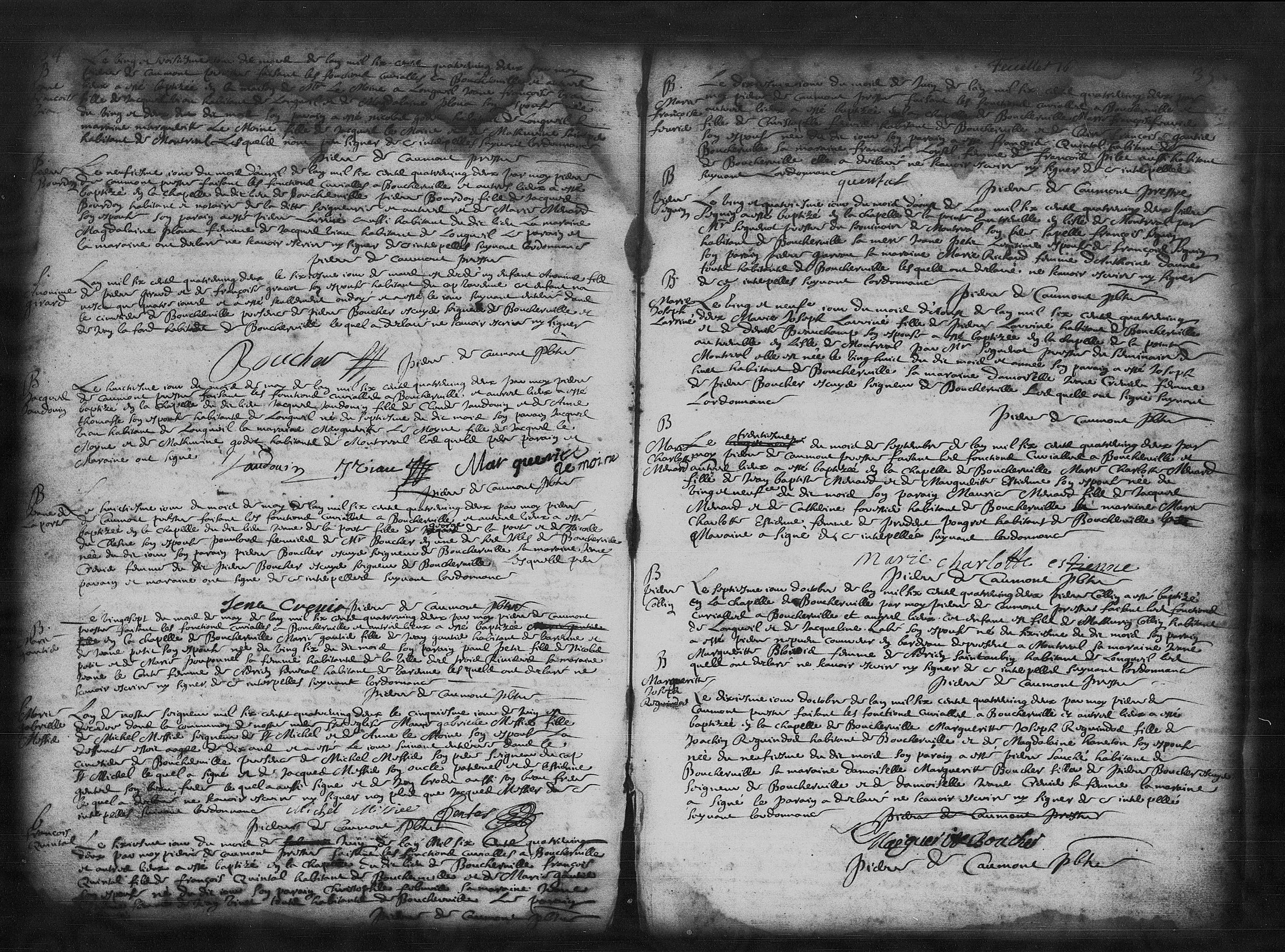
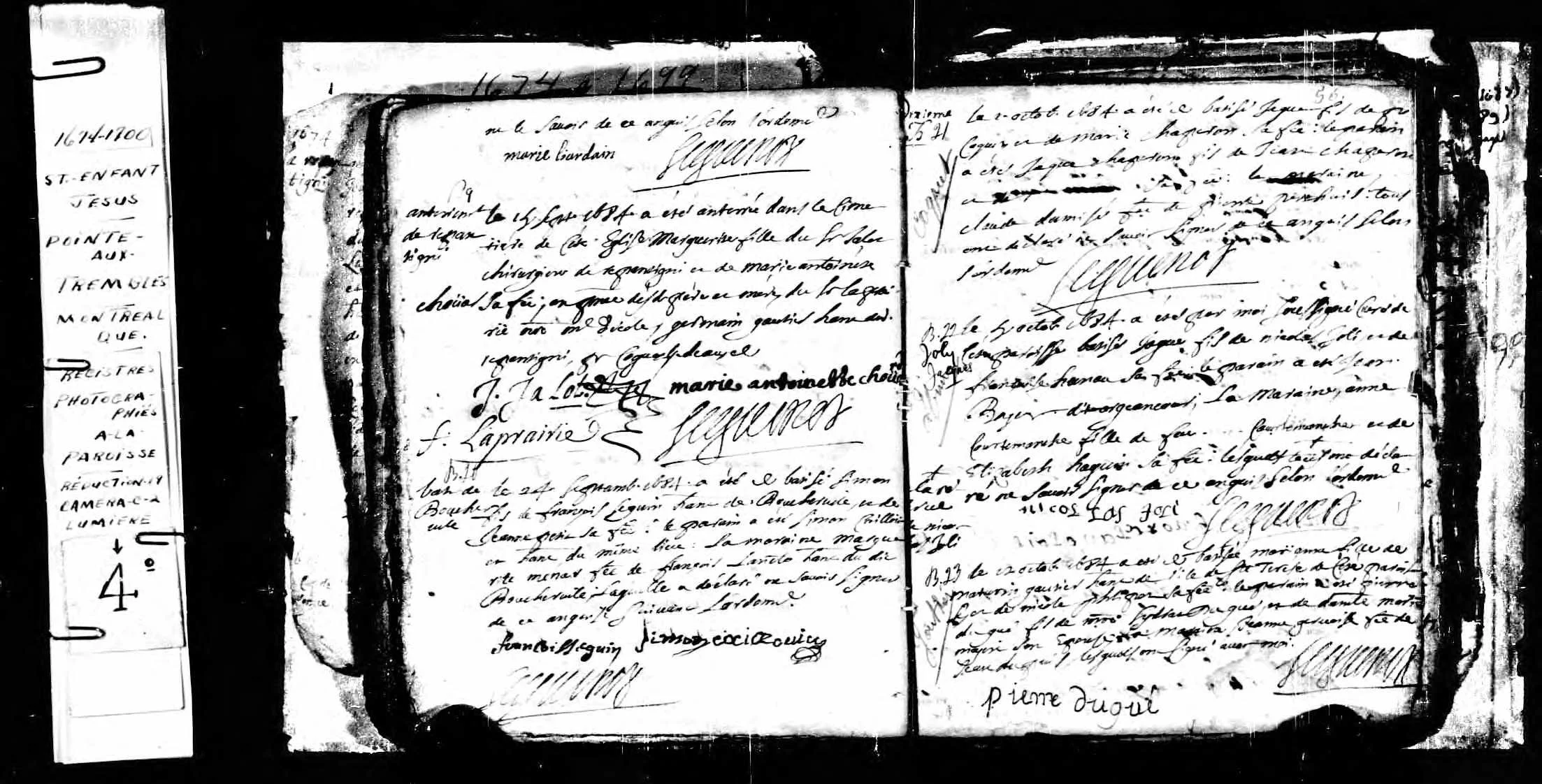


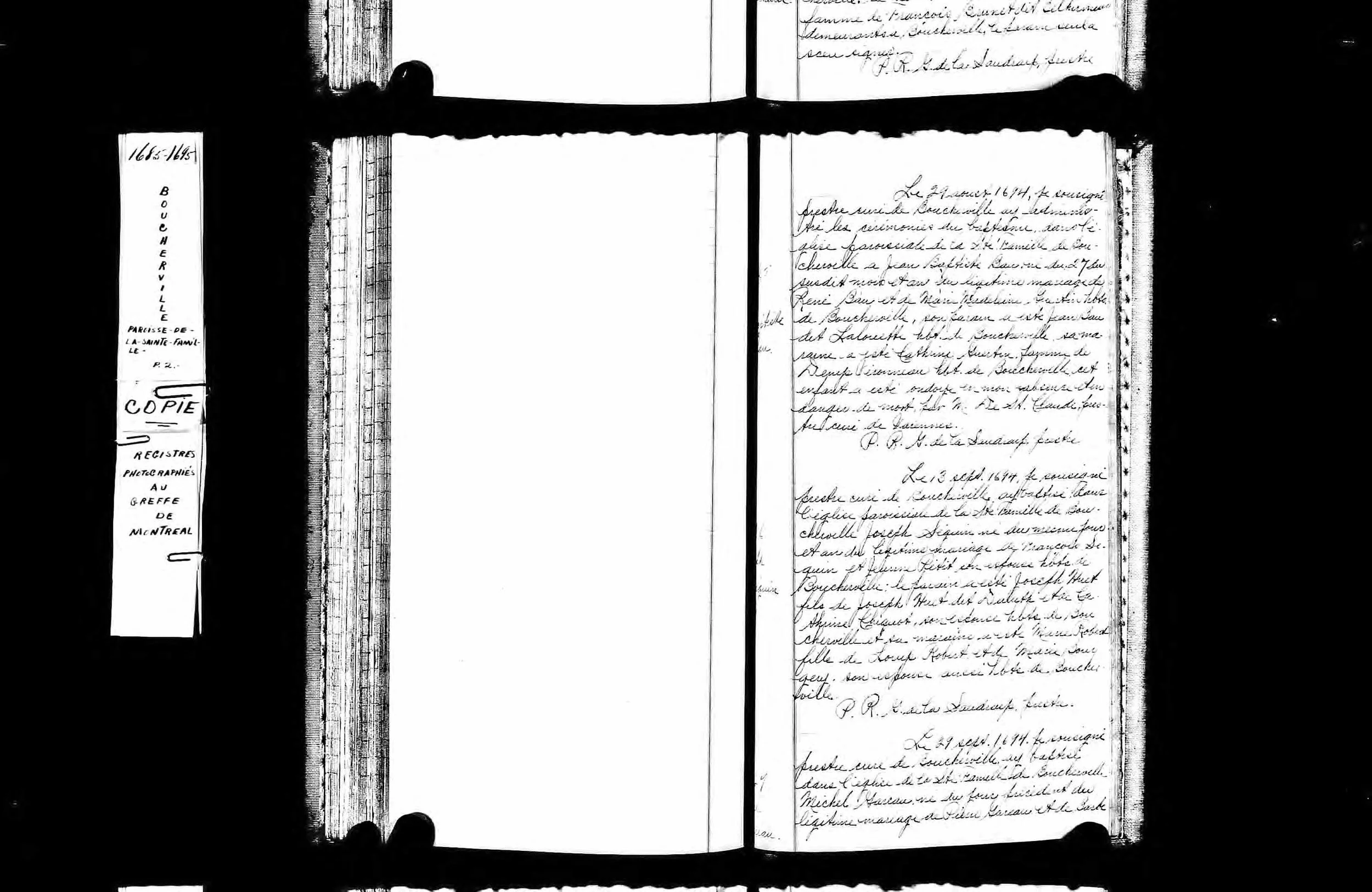
Children Who Died in Infancy


Death Date Evidence (Case Study)


Database Records: Transcriptions
The entries below transcribe the compiled database records for François Séguin dit Ladéroute. These are derivative compilations, not original documents. They index and interpret the parish registers and notarial acts shown above, and where the two disagree, the register governs.
| Name | Francois SEGUIN LADEROUTE |
| Father | Laurent SEGUIN |
| Mother | Marie MOSSIEU |
| Baptism | 4 July 1644 — st-aubin-en-bray, ev. beauvais, picardie (ar. beauvais, oise) |
| Death | 9 May 1704 (disputed — see note) |
| Burial | 10 May 1704 — Montréal (Notre-Dame-de-Montréal) (disputed — see note) |
| First marriage | 31 October 1672 — Boucherville (Ste-Famille), with Jeanne PETIT, daughter of Jean PETIT and Jeanne GAUDREAU |
Death and burial entries in dispute. The 1704 burial recorded here belongs to a man named in the register as Pierre Séguin dit La Deroute. François is documented alive on 20 November 1700 and identified as deceased by 9 October 1701. See the death date case study.
Mother's surname. PRDH renders it MOSSIEU; the French parish records and Beauregard's compilation render it MASSIEU. The variant is preserved here as the database states it.
| Rank | Name and role | M.S. | Pr. | Sex |
|---|---|---|---|---|
| 01 | Francois SEGUIN — spouse of 02 Occupation: habitant Residence: Boucherville (Ste-Famille) Origin: Dombre, évêché de Beauvais, Picardie | c | p | m |
| 02 | Jeanne PETIT — spouse of 01 Origin: Ste-Marguerite, ville et évêché de La Rochelle | c | p | f |
| 03 | Laurent SEGUIN — father of 01, spouse of 04 | m | — | m |
| 04 | Marie MOSSIEU — mother of 01, spouse of 03 | m | — | f |
| 05 | Jean PETIT — father of 02, spouse of 06 | m | — | m |
| 06 | Jeanne GAUDRAU — mother of 02, spouse of 05 | m | — | f |
| 07 | Pierre DECAUMONT Occupation: prêtre, curé Residence: Boucherville (Ste-Famille) | c | p | m |
Legend. M.S. = marital status at the act (c = single, m = married). Pr. = presence at the act (p = present, a = absent, d = deceased, em dash = not stated). No ages are stated for any party. All four parents were in France and are named in the act only as parents of the couple.
Two points of interest. François is recorded as habitant, not soldier — by 1672 the military identity had given way to the land. And the origin stated in the marriage act, Dombre in the diocese of Beauvais, does not match the baptismal parish of Saint-Aubin-en-Bray, though both lie in the same diocese.
| Sex | Child | Birth | Marriage | Death |
|---|---|---|---|---|
| f | Marie Françoise m. Charles Patenaude | 1 Nov 1674 Boucherville | 8 Feb 1694 Montréal | 19 May 1751 Longueuil |
| f | Marie Madeleine m. (1) Antoine Marie Marier Stemarie m. (2) François Achin St-André, Longueuil, 7 Jan 1704 | 16 Aug 1676 Boucherville | 20 Nov 1700 Lieu indéterminé (au Québec) | 25 May 1753 Longueuil |
| m | François m. Marie Louise Filion | 3 Jul 1678 Pointe-aux-Trembles | 22 Feb 1702 Boucherville | 6 Feb 1727 Terrebonne |
| f | Marie Jeanne m. Joseph Robidou | 9 Aug 1680 Boucherville | 10 Oct 1701 Longueuil | 20 Dec 1749 Longueuil |
| m | Pierre m. Marie Barbe Filion, widow of Jean Baptiste Lebert | 24 Aug 1682 Bapt. Pointe-aux-Trembles | 4 Feb 1704 Boucherville | 9 Nov 1760 Mascouche |
| m | Simon m. (1) Marie Lalouette Lebeau m. (2) Madeleine Cole, Boucherville, 11 Nov 1715 | 24 Sep 1684 Pointe-aux-Trembles | 9 Nov 1706 Boucherville | 29 Mar 1758 Boucherville |
| f | Catherine bapt. 20 Nov 1686 | 19 Nov 1686 Boucherville | — | 16 Jan 1688 Boucherville |
| m | Jean Baptiste m. Geneviève Barbeau Boisdore OUR LINE | 10 Nov 1688 Boucherville | 7 Jun 1710 Boucherville | 13 May 1728 Montréal |
| f | Geneviève buried 17 Jul 1691 | 9 Apr 1691 Boucherville | — | 16 Jul 1691 Boucherville |
| m | Joseph (first) | 10 Aug 1692 Boucherville | — | 30 Aug 1692 Boucherville |
| m | Joseph (second) m. Marie Françoise Sauvage | 13 Sep 1694 Boucherville | 12 Apr 1723 Ste-Anne-de-Détroit | 29 Apr 1753 Ste-Anne-de-Détroit |
On the italics. Italics reproduce the database's own typographic convention, which distinguishes a date inferred from a related act — a birth taken from a baptism, a death taken from a burial — from a date stated in the act itself. An italicised date should be verified against the register before being treated as record-stated.
Scope. The family sheet lists children born before 1800 and gives one marriage per child. It does not record later remarriages.
| Subject | SÉGUIN dit LADÉROUTE, François, son of Laurent Séguin and Marie Massieu [entry 3298] |
| Baptism | 4 July 1644 — Saint-Aubin-en-Bray (Notre-Dame-et-Saint-Aubin), Oise 60567 |
| Death | Between 20 November 1700 and 10 October 1701 |
| Error flag | The compilation flags the alternative death date carried by the Dictionnaire généalogique des familles du Québec (1042) as an error, resolving it on the two Raimbault marriage contracts of his daughters |
| Marriage | 31 October 1672, Boucherville; contract 21 September 1672, depositary Thomas Frérot |
| Wife | PETIT, Jeanne, daughter of Jean Petit and Jeanne Gaudreau [entry 4483]; King's daughter; born about 1656 per the 1681 census, or 1643 per the 1733 burial; La Rochelle (Sainte-Marguerite), Charente-Maritime 17300; died 29 March 1733, buried 30 March 1733, Longueuil |
| Children | Eleven, as listed in the PRDH family record above, with two additional remarriages noted: Marie Madeleine to François Achim dit Saint-André at Longueuil, 7 January 1704; Simon to Madeleine Cole at Boucherville, 11 November 1715 |
| Descendants | Estimated between 1,890,000 and 2,310,000 Quebecers; 12 generations and 6,725 marriages recorded in the database, the most recent in 2020 |
| Ancestry | Two generations and three marriages traced, the earliest in 1622 |
| mtDNA | Haplogroup T2b2b, computed from Jeanne Petit's female-line progeny. This is a reconstruction from documented descent, not a tested result for Jeanne Petit herself |
| Cited authorities | La Séguinière (1994, 4:2) 9; MSGCF (1947, 2) 219; Landry 355; Dumas 310; Denissen 642; PRDH-RAB; Parchemin; Genealogy of the French families of the Detroit River region |
Source. Denis Beauregard, Genealogy of the French in North America, entry [1732]. © Denis Beauregard, 2005–2026. Data transcribed and rearranged; the compilation's own text is not reproduced.
Both remarriages are confirmed. Simon's second marriage at Boucherville on 11 November 1715 to Madeleine Cole is documented by PRDH individual no. 68334 and union no. 3959, and by the register act itself. Marie Madeleine's second marriage at Longueuil on 7 January 1704 to François Achin dit Saint-André is documented by PRDH individual no. 153. Neither appears on the PRDH family sheet, which records only a first marriage for each child.
Sources & Citations
Primary Sources
- Baptism (1644): Notre-Dame-et-Saint-Aubin Parish, Saint-Aubin-en-Bray, Oise, France. FichierOrigine.
- Marriage Contract (1672): Notary Thomas Frérot, 21 September 1672. BAnQ.
- Marriage Record (1672): Boucherville (Ste-Famille) Parish, 31 October 1672. Officiant Pierre de Caumont.
- Census (1681): Recensement de la Nouvelle-France, Seigneurie de Boucherville. LAC.
- Marriage Contract, Marie Madeleine (1700): Notary Pierre Raimbault, Act 402. BAnQ.
- Marriage Contract, Marie Jeanne (1701): Notary Pierre Raimbault, Act 527. BAnQ.
- Children's Baptisms and Burials (1674–1694): Boucherville (Ste-Famille) and Pointe-aux-Trembles Parish Registers, registers of 1669–1695 and 1685–1695.
- Marriage of Simon Séguin and Madeleine Cole (1715): Boucherville (Ste-Famille) Parish Register, 1696–1717, feuillet 148, 11 November 1715.
- Judicial proceedings (1705–1706): BAnQ, Fonds Intendants, E1,S1,D1, pieces P21, P22, P38, P47, P53, P54.
- Negative search: The Boucherville (Ste-Famille) register of baptisms, marriages, and burials for the year 1700 was examined; it contains no marriage act for Antoine Marie and Marie Madeleine Séguin. PRDH likewise assigns the union no parish location. The 20 November 1700 contract is the only located record of the marriage.
Derivative Compilations
- PRDH-IGD. Individual #68331, Couple #3764, Family #4015. Université de Montréal. Death and burial entries for #68331 are in error; see the case study.
- Beauregard, Denis. "Genealogy of the French in North America." Family Sheet [1732]. © 2005–2026.
- La Séguinière (Association des Séguin d'Amérique), 1994, vol. 4, no. 2, p. 9 — earliest published statement of the corrected death range.
Secondary Sources
- Laforest, Thomas J. Our French Canadian Ancestors, Volume 18. LISI Press, 1990.
- Séguin-Pharand, Yolande. François Séguin ou L'impossible défi. Association des Séguin d'Amérique, 1992.
Related Case Study
Are You Connected to the Guilbault Line?
If you descend from the Guilbault (Guilbeau, Guilbeault) family of Charlesbourg and the Quebec parishes, from the children of Marie Josephte Abitakijikokwe, or from the founding families of the line — Senécal, Séguin dit Ladéroute, Morin, Couillaud dit Roquebrune, Gaulin — I’d like to compare notes. Documented trees, DNA matches, family papers, and even half-remembered stories have all moved this research forward.
Get in Touch About This FamilyCousin connections are informal and reciprocal — no fee, no obligation, just shared work on shared ancestry.
Every Family Has a Story Worth Telling
Whether you're just beginning your research or ready to transform years of work into a narrative your family will treasure, I'd love to hear your story.
BEGIN YOUR RESEARCH INQUIRY