
Anne Ledet: A Fille à Marier in New France
Anne Ledet
The Woman Who Owned the Land
On the afternoon of 25 October 1673, Gilles Pinel and his wife Anne Ledet came into the study of the notary Gilles Rageot at Québec to sell a farm. The act names them both, present in person. It describes what they were selling: a habitation at Sainct François Xavier, two arpents of frontage by twenty deep, with the shed that stood on it, the right to fish in the St Lawrence, and the fir stand in front. And then, in the ordinary language notaries use to establish title, it says where the property came from. It had been granted by the Jesuits of Québec « a lad femme de Pinel avant leur Mariage » — to the said wife of Pinel, before their marriage.
The land was hers. It had been conceded to Anne Ledet, by name, before she married Gilles Pinel in September 1657 — which is to say at some point in the five years between her arrival in the colony and her second wedding. It sold that afternoon for five hundred livres tournois.
Anne Ledet is usually told as a story about what was done to her: a bigamous first husband, an annulment, two daughters made illegitimate by a court's stroke. All of that is in the record. But so is a Jesuit land grant made out to a young immigrant woman, and a farm she brought into her second marriage that was worth more than most of her neighbours owned. The scandal is the beginning of her story. It is not the whole of it.
This page distinguishes what a record states from what a database reports. The 1673 sale is held as a twentieth-century typed transcription of the Rageot minute, not as the minute itself; the notarial minute has not yet been read. Statements drawn from the PRDH database are identified as such. Where a register act has been examined directly, the page says so. Transcriptions marked as working readings have been taken from digital images and not collated against the originals.
Origins: Angoulins, Aunis
Anne Ledet was the daughter of Nicolas Ledet and Isabelle Pineau, of the parish of Angoulins, a coastal village just south of La Rochelle in the former province of Aunis. Her own marriage act of 1653 gives her as « fille de Nicolas Ledet e d'Isabelle Pineau de la paroisse d'Angoulan proche de la Rochelle ». Neither parent is known to have crossed the Atlantic.
Her birth year is not settled. The PRDH database gives about 1632. The census of 1666 records her age as 35, which implies about 1631. Her burial act of 1700 gives 65, which implies about 1635. No baptism has been located at Angoulins, and the registers there have not been searched by this researcher. The range is three or four years wide and the page does not pretend otherwise.
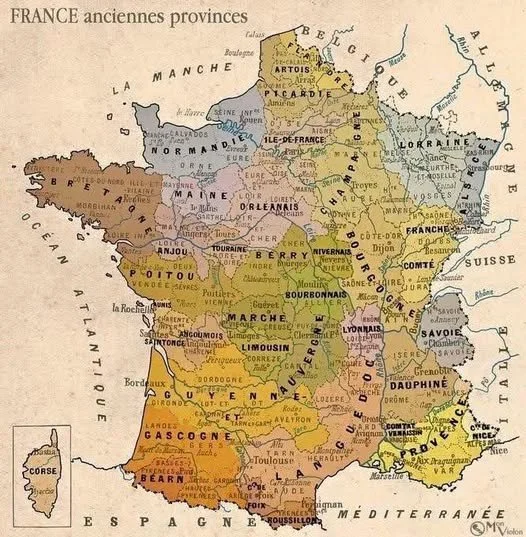
Anne appears in the colonial record for the first time at her marriage in January 1653. Peter Gagné places her arrival at about 1652; no passenger list, engagement or recruitment contract has been found, and the estimate appears to be an inference from the marriage date rather than a documented crossing. La Rochelle was the usual port of embarkation for the St Lawrence, but the record does not say she sailed from there.
Nothing documents why Anne left France, who paid her passage, in whose household she lived before she married, or what she brought with her. The Jesuit concession that would later prove she held land in her own name has not been found, so the date and the circumstances of that grant are also unknown.
28 January 1653: Marriage to Jean Neveu
The act was entered in the register of Notre-Dame-de-Québec, but the wedding did not take place there. Jean Dequen, Jesuit superior of Sillery and deputed for the purpose, married the couple « dans l'Eglise de Sillery ». One ban had been published; dispensation was given of the other two.
The groom was Jean Nepveu, son of Jacques Nepveu and Marie Michel, of the parish of Saint-Georges près de Montaigu in Poitou. Gagné adds that he was a mason and had enlisted for Canada at La Rochelle on 10 June 1645, seven years before Anne's arrival; those details come from Gagné, not from the act.
Two men stood as known witnesses: Denys Joseph Ruet, and Nicolas Pinel.
That second name matters. Nicolas Pinel was the father of Gilles Pinel, the man Anne would marry four years and seven months later. Whatever brought the Pinels into Anne Ledet's life, it was already there on the day she became Jean Neveu's wife.

| Rank | Name and role as printed | M.S. | Pr. |
|---|---|---|---|
| 01 | Jean NEPVEUSpouse of 02 · Origin: paroisse de St-Georges près de Montaigu, Poitou | c | p |
| 02 | Anne LEDETESpouse of 01 · Origin: paroisse d'Angoulan près de La Rochelle | c | p |
| 03 | Jacques NEPVEUFather of 01 · Spouse of 04 | m | — |
| 04 | Marie MICHELMother of 01 · Spouse of 03 | m | — |
| 05 | Nicolas LEDETFather of 02 · Spouse of 06 | m | — |
| 06 | Isabelle PINAUMother of 02 · Spouse of 05 | m | — |
| 07 | Denis Joseph RUET | — | p |
| 08 | Nicolas PINELNo role coded — the father of Gilles Pinel | — | p |
| 09 | Jean DEQUENOccupation: supérieur · Residence: Sillery | c | p |
Reading the transcription tables
These tables replace the PRDH card images that formerly appeared on this page. The columns reproduce the database's own fields. Pr. is the presence field:p for present, d for deceased, — for named in the act but not recorded present. M.S. is marital status: c célibataire, m marié, v veuf or veuve, — not given. These are database fields, derived by the PRDH from the acts. They are not transcriptions of the acts, and they are not always right. Where the register act itself has been read, this page says so and prefers it.
Two daughters, and a secret
Marie Barbe was baptised at Notre-Dame-de-Québec on 3 December 1653. Suzanne followed on 11 October 1655 at Sillery, in a Latin act written by the Jesuit Pierre Bailloquet. Both parents were recorded present at that second baptism — the last record in which Jean Neveu and Anne Ledet appear together.
Standing beside them was Gilles Pinel.

The PRDH does not code godparent roles. Gilles Pinel and Suzanne Barbet appear at ranks 04 and 05 of the baptism card with no relationship recorded and both marked present — the ordinary shape of a godparent pair, and the child carries Suzanne Barbet's forename. The Latin act appears to support the identification. It has not been collated by this researcher, so the role is stated here as an inference from the structure of the record.
The bigamy
At some point after October 1655 and before September 1657, it emerged that Jean Neveu had a wife living in France.
Jetté claims that Jean Neveu or Nepveu died some time before 02 September 1657, when Anne remarried, but this is not the case. The remarriage was the result of the only other thing that could dissolve a marriage in New France: bigamy. It was discovered that Jean had a wife that he had left in France and he was expelled from the colony and forced to return to France.
— Peter J. Gagné, Before the King's Daughters: The Filles à Marier, 1634–1662The consequence for Anne's daughters was that their parents' marriage was treated as never having existed. The PRDH records both Marie Barbe and Suzanne with the status born out of wedlock, and attaches an editorial note explaining why.
No record of the bigamy proceeding, the annulment, or Jean Neveu's expulsion has been located. Gagné is the only source, and he does not say what his account rests on. The Conseil Souverain was not erected until 1663, so any such proceeding would belong to the earlier machinery of the Compagnie des Cent-Associés or to the ecclesiastical authority of the day. Until such a record is found, the bigamy is a well-argued claim by a named author, not a documented fact. The PRDH note is the database's own gloss on a status field, not a statement transcribed from any act. And the date on which the marriage was dissolved is not established: the window runs from October 1655, when the family last appears together, to September 1657, when Anne remarried — twenty-three months.
The Daughters
Both girls survived, married and raised families. Marie Barbe's line runs directly into the Souliere research through her marriage to Nicolas Sylvestre dit Champagne. Suzanne took her stepfather's surname alongside her father's and carried it for the rest of her life.
Marie Barbe Neveu
- Baptised 3 December 1653, Notre-Dame-de-Québec
- PRDH status: born out of wedlock
- Married 20 August 1667, Nicolas Sylvestre dit Champagne
- Buried 18 April 1729, Neuville
- Aged 12 in the census of 1666, a year before her marriage
Suzanne Neveu Pinel
- Baptised 11 October 1655, Sillery
- PRDH status: born out of wedlock
- Marriage contract 25 March 1670 with Nicolas Pot, before Me Romain Becquet
- Married 18 October 1692, Jean Baptiste Devine
- Died 28 January and buried 29 January 1727, Notre-Dame-de-Québec
Marie Barbe's marriage act of 1667 names her as the daughter of Jean Nepveu and Anne Ledet, preserving both parents despite the annulment. The banns were dispensed for that wedding, as they were dispensed for her mother's two marriages, and as they were dispensed routinely at Québec in these years — the neighbouring entries in the same registers show the same formula again and again. It is not evidence that anything unusual was being smoothed over.

Suzanne's marriage to Nicolas Pot is a subtler case. What survives is a marriage contract, drawn on 25 March 1670 before the notary Romain Becquet. No religious act has been found, which is why the PRDH gives the place of the marriage as lieu indéterminé and carries the contract date forward into the marriage field. The date on this page is a contract date. It should not be read as a wedding date.
| Rank | Name and role as printed | M.S. | Pr. |
|---|---|---|---|
| 01 | Nicolas POTSpouse of 02 · Residence: Batiscan · Origin: ville de St-Vallery, Caux, archevêché de Rouen | c | p |
| 02 | Suzanne NEPVEUSpouse of 01 · Residence: Côte-St-Ignace | c | p |
| 03 | Nicolas POTFather of 01 · Spouse of 04 | m | — |
| 04 | Marguerite GUILLEBERMother of 01 · Spouse of 03 — rendered GILBERT on two other cards | m | — |
| 05 | Jean NEPVEUFather of 02 | — | d |
| 06 | Anne LAIDETTEMother of 02 · Residence: Côte-St-Ignace | — | — |
| 07 | Romain BECQUETOccupation: notaire | — | p |
This act has not been located. Everything stated here about it comes from the PRDH card. The minute should be in the greffe of Romain Becquet at BAnQ, and reading it would settle what the contract actually says about Anne's role and about her first husband.
2 September 1657: Marriage to Gilles Pinel
The second marriage act is short, and every clause in it is unusual.
Jean Dequen — the same Jesuit who had married Anne to Jean Neveu four years and seven months earlier, and who would therefore have known exactly how that marriage had ended — dispensed the publication of the banns « pour bonne raison ». He then dispensed something else: « un empeschement qui intervenoit », an impediment standing in the way, acting « avec pouvoir » — with the faculty to do so.
Then he married them in a room beside the door of the Jesuit house.
« Le 2 septembre 1657 après avoir dispensé de la publication des bans pour bonne raison et dispensé d'un empeschement qui intervenoit avec pouvoir, Je Jean Dequen ay interrogé Gilles Pinel et Anne Liedet de cette paroisse, lesquels ayant donné leur mutuel consentement par parolles de present les ay solemnellement marié en une salle proche de la porte de nostre maison en presence de tesmoins cognus Guillaume Routier et Robert Hache. »
Register of Notre-Dame-de-Québec, page 126 — working reading from the image, not collatedTen days later, on the same page of the same register, Dequen dispensed the banns for another couple, Georges Cadoret and Anne Popie, and they were married « en nre Chapelle » — in the chapel. The contrast is in the priest's own hand, ten days apart. One couple in the chapel. The other in a hall by the door.

| Rank | Name and role as printed | M.S. | Pr. |
|---|---|---|---|
| 01 | Gilles PINELSpouse of 02 · Residence: Québec (Notre-Dame-de-Québec) | — | p |
| 02 | Anne LIEDETSpouse of 01 · Residence: Québec (Notre-Dame-de-Québec) | — | p |
| 03 | Guillaume ROUTIER | — | p |
| 04 | Robert HACHE | — | p |
| 05 | Jean DEQUENOccupation: prêtre | c | p |
The act says an impediment stood in the way and that Dequen dispensed it. It does not say what it was. Canon law recognised many — affinity, consanguinity, spiritual affinity arising from godparenthood, a prior bond — and this page will not choose among them. The phrase avec pouvoir refers to the priest's faculty to grant the dispensation, not to anything about the couple: the neighbouring act of 12 September 1657 uses the same language for a dispensation of banns alone.
Gilles Pinel
Gagné gives Gilles as a twin baptised 28 February 1635 in the parish of Sainte-Marguerite at La Rochelle, the third of five children of Nicolas Pinel, a carpenter and longsawyer, and Madeleine Maraud or Marotte. The PRDH names his mother Marie Madeleine Marotte. None of the French detail has been collated against the La Rochelle register.
The elder Pinel returned to Québec City by September 1650, then came back to Canada with sons Gilles and Pierre. Nicolas Pinel received a land grant at Sillery from the Jesuits on January 23, 1652, but died from wounds sustained from an Iroquois musket and was buried September 18, 1655, at Notre-Dame de Québec. Gilles and his younger brother Pierre continued to cultivate their father's land, and Gilles also worked as a cooper.
— Peter J. Gagné, Before the King's DaughtersNicolas Pinel died in September 1655, two years before Anne married his son. He was never her father-in-law. But he had stood at her first wedding, and the Jesuit grant he held at Sillery in 1652 sat in the same censive as the land Anne herself would be granted.
Gilles was the brother of Pierre Pinel, who married the fille à marier Charlotte Fougerat. Gagné reports that no marriage contract has been found for Anne and Gilles; the extent of that search is not stated, so it is not treated here as a demonstrated absence.
Anne's Land
On 25 October 1673, in the afternoon, Gilles Pinel and Anne Ledet appeared together before Gilles Rageot at Québec. The act names them « presents en leurs personnes », Anne « sa femme de luy duement autorisee » — his wife, duly authorised by him for the purpose, as the Coutume de Paris required — and binds them jointly and severally, each for the whole.
They sold to Michel Desorcis, an habitant living on the route St Ignace, a habitation at Sainct François Xavier: two arpents of frontage by twenty deep, with the shed standing on it, the fishery in the St Lawrence, and the fir stand in front of the twenty arpents, running down to the river. It was bounded on one side by the Sieur François de la Ville, on the other by Jean Noel, at one end by the St Lawrence and at the other by the road of the route St Ignace.
And then the clause that changes this page:
« auxdits vendeurs appartenant par concession faite a lad femme de Pinel avant leur Mariage estant en la Censive des RR.PP. Jesuites de cette ville et par eux a elle conceddee »
Vente par Gilles Pinel et Anne Ledet son épouse à Michel Desorcis, Me Gilles Rageot, 25 October 1673, no. 1156Belonging to the said vendors by a concession made to the said wife of Pinel before their marriage, being in the censive of the Jesuit fathers of this town, and by them conceded to her. The grammar is unambiguous and it is repeated: a lad femme, and again a elle.

The price was five hundred livres tournois, payable in two equal terms — two hundred and fifty the following day, the other half at Toussaint a year on. The purchaser mortgaged all his goods, moveable and immoveable, present and to come, against it. The vendors undertook to hand over the title of concession.
Four years later, on 16 April 1677, Gilles sold two arpents by forty at Dombourg to Pierre Richard of L'Ange-Gardien. That land was his own, held by concession from the Sieur de Dombourg, and Anne was not a party to the act. It fetched thirty livres — eight already received, the remaining twenty-two payable in two minots of good merchantable wheat and in days of labour at the ordinary rate, after the next sowing. Gilles undertook to obtain his wife's agreement and ratification. She gave it on 24 June 1677, by a separate act in her own name.
The two sales are four years apart and both are Rageot's. The difference between them is the difference between a working habitation with buildings and river rights and an uncleared lot in a new seigneurie. The land Anne brought to the marriage was the more valuable holding the couple ever sold.
Neither of them could write
Both acts end the same way. In 1673: « lesd vendeurs declaré ne sçavoir escrire ny signer de ce interpellés suivant l'Ordonnance » — the said vendors declared they could not write or sign, having been formally questioned on the point as the ordinance required. The witnesses signed. The purchaser signed. The notary signed. Anne and Gilles did not.
The 1677 act records the same declaration of the parties. Two notarial acts, four years apart, taken under the ordinance: the woman who held a Jesuit concession and sold it for five hundred livres could not write her own name.
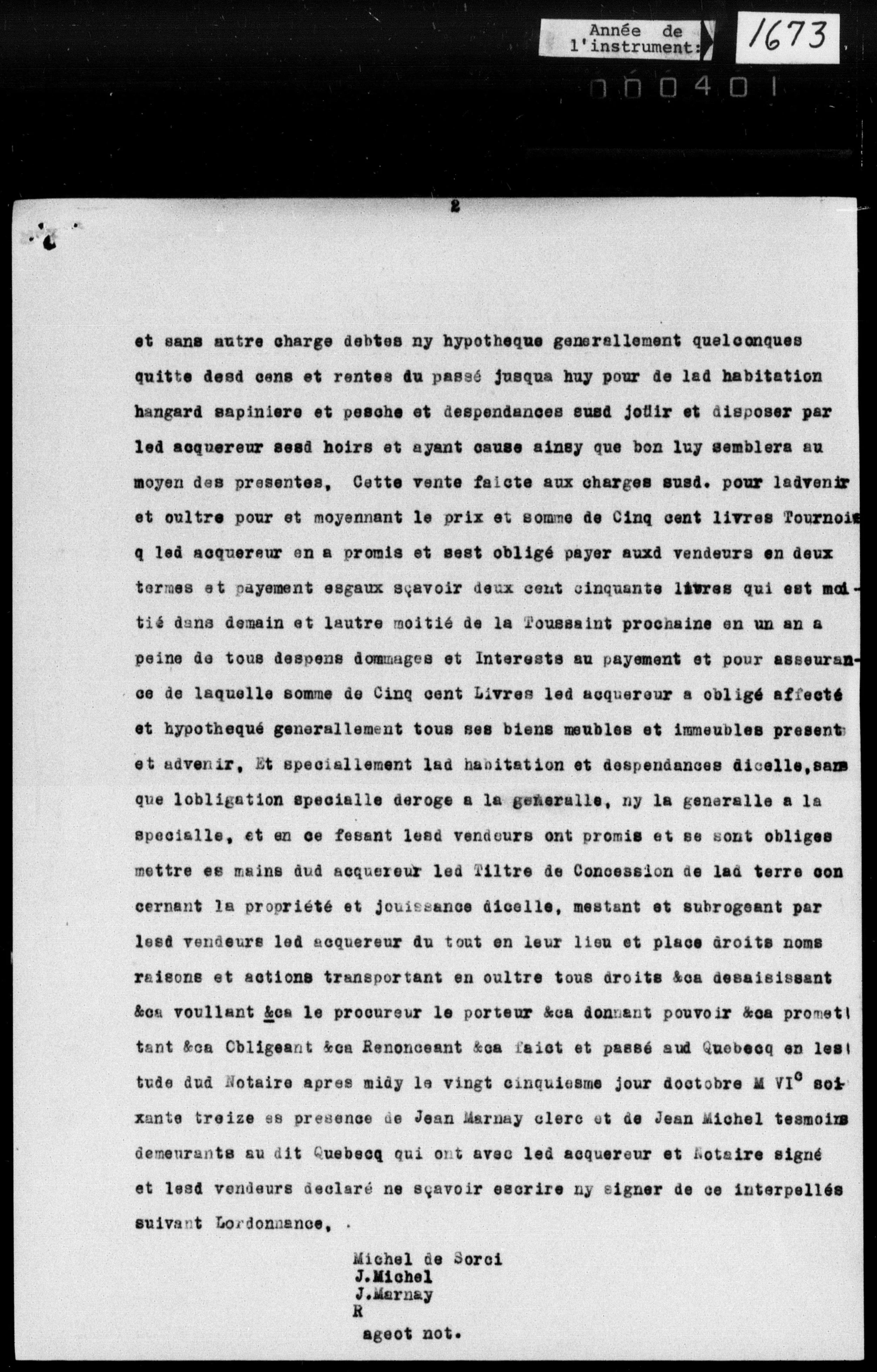
Both are held as twentieth-century typed transcriptions from a BAnQ series digitised by FamilySearch, not as the notarial minutes. They read as full transcriptions rather than summaries and they carry the notary, the number, the date, the parties, the boundaries, the price and the signatures — but they are derivative, and the minutes in the greffe of Gilles Rageot have not been read. The concession to Anne is recited within them and has not itself been found; its date, and the circumstances under which the Jesuits granted land to an unmarried or newly widowed immigrant woman, remain unknown.
A Blended Household
Anne brought her two Neveu daughters into the marriage. With Gilles she had nine more children between 1658 and 1675, the first six baptised at Sillery or Québec, the last two in the new settlement at Dombourg.
| Children of the first marriage: Jean Neveu & Anne Ledet | |||
|---|---|---|---|
| Child | Baptism | Burial | Marriage |
| Marie Barbe | 3 Dec 1653, Notre-Dame-de-Québec | 18 Apr 1729, Neuville | 1667 Nicolas Sylvestre dit Champagne |
| Suzanne | 11 Oct 1655, Sillery | 29 Jan 1727, Notre-Dame-de-Québec | contract 1670 Nicolas Pot; 1692 Jean Baptiste Devine |
| Children of the second marriage: Gilles Pinel & Anne Ledet | |||
|---|---|---|---|
| Child | Birth and baptism | Burial | Marriage |
| Marie Catherine | b. 7 Apr, bapt. 10 Apr 1658, Notre-Dame-de-Québec | not established | 1671 Denis Massé |
| Françoise | c. 1660; no baptism act known | 11 Mar 1703, Neuville | none recorded |
| Marie Madeleine | c. 1662; no baptism act known | 5 May 1715, Neuville | 1680 François Vandal; 1700 Pierre Allard |
| François Xavier | 15 Jan 1664, Sillery | not established | 1687 Marie Louise Constantineau |
| Élisabeth Ursule Isabelle | 29 Jun 1666, Sillery | 11 Jun 1736, Neuville | 1683 Michel Constantineau |
| Guillaume | b. and bapt. 16 Jan 1669, Sillery | 30 Sep 1740, Neuville | 1692 Marie Madeleine Faucher StMaurice |
| Marie Anne | b. 26 Jul, bapt. 27 Jul 1671, Sillery | 23 Aug 1708, Neuville | 1693 Romain Dubuc |
| Nicolas | b. and bapt. 30 Nov 1673; baptised at Pointe-aux-Trembles, act at Notre-Dame-de-Québec | 20 Jul 1698, Neuville | 1695 Marie Anne Constantineau |
| Jean | b. 15 Nov, bapt. 17 Nov 1675 in the chapel at Dombourg, act at Notre-Dame-de-Québec | 24 Feb 1703, Neuville | 1699 Marie Romaine Constantineau |
A PRDH couple card enumerates married children only. The card for Gilles Pinel and Anne Ledet lists eight; Françoise, who never married, reaches this table through her own individual card. Any child who died before marrying would be invisible in both. Nine is what the records in hand support, not necessarily what the family had.
The Constantineau marriages
Four of Anne's children married Constantineaus at Neuville between 1683 and 1699. Three of the four spouses are documented children of Julien Constantineau and Marie Langlois: Michel, who married Élisabeth Ursule in 1683; Marie Anne, who married Nicolas in 1695; and Marie Romaine, who married Jean in 1699 — one son and two daughters of the same couple. The parentage of Marie Louise, who married François Xavier in 1687, has not been established.
There may be an earlier thread. At Guillaume's baptism at Sillery on 16 January 1669, fourteen years before the first of those marriages, the man standing as godfather is entered as Guillaume Contantin, and the child was named for him. Whether that is a Constantineau under a variant spelling, or a man of a different name altogether, the register act would show. It has not been read.
Françoise
Françoise Pinel never married. On 10 May 1682 at Neuville a son of hers was born and buried on the same day. The PRDH enters him as Anonyme — no given name — with a birth and a burial and no baptism act. A birth and a burial in one day, with no name and no baptism, points to a child who died before he could be baptised, possibly after an emergency ondoiement. The burial act has not been read. Françoise herself was buried at Neuville on 11 March 1703.
Anne in the parish
On 17 March 1661 at Sillery, Anne stood godmother at the baptism of Marie Anne Migneron. The record marks her present. In the same act, her husband Gilles is named as her spouse and is not marked present — one act, two codes, the distinction visible on the face of it.
| Rank | Name and role as printed | M.S. | Pr. |
|---|---|---|---|
| 01 | Marie Anne MIGNERON | c | p |
| 02 | Jean MIGNERONFather of 01 · Spouse of 03 | m | p |
| 03 | Marie PANIEMother of 01 · Spouse of 02 | m | p |
| 04 | Sebastien LIENAR DURBOIS | — | p |
| 05 | Anne LEDETSpouse of 06 | m | p |
| 06 | Gilles PINELSpouse of 05 | m | — |
| 07 | Gabriel DRUILLETESOccupation: jésuite, curé · Residence: Sillery | c | p |
The Census of 1666
The enumeration of 1666 catches the household at Sillery, on folio 96, eight people under one roof. The Trut household stands immediately above them on the page and the Dubois Morel household immediately below.
The household as enumerated
- Gilles Pinel, 31, habittant
- Anne Ledettes, 35, sa femme
- Catherine Pinel, 8, fille
- Françoise Pinel, 6, fille
- Marie Magdelaine Pinel, 4, fille
- François Xavier Pinel, 2, fils
- Barbe Nepveu, 12, fille
- Suzanne Nepveu, 10, fille
What it shows
- Both Neveu daughters living with the family, nine years after the annulment
- Barbe at 12, a year from her own marriage
- Élisabeth Ursule, baptised that June, is not in the household
- Gilles entered as habitant
- Anne's age implying a birth about 1631
- Ursule Trut, 8, in the household above — godmother to Marie Anne Pinel five years later

Anne's entry carries a notation after sa femme that has been read as identifying her by her former husband's name. The hand is compressed and the reading is not settled; it is not relied on here. The plain facts of the entry are enough: nine years after the marriage was dissolved, the two Neveu girls were living in Gilles Pinel's house and were counted as part of it.

From Sillery to Dombourg
The move can be dated to twenty-seven months, and the sale of Anne's land dates the break itself.
Marie Anne was baptised at Sillery on 27 July 1671, the last of the family's Sillery baptisms. By 25 October 1673 Gilles and Anne are described in the Rageot act as habitans de Dombourg, and on that afternoon they disposed of the Sillery habitation. Five weeks later, on 30 November 1673, their son Nicolas was baptised at Pointe-aux-Trembles. Two years after that, Jean was baptised in the chapel at Dombourg, and the family's residence is recorded as Dombourg on his baptism card for all three of them — father, mother and child.
Both of those late baptisms were registered at Notre-Dame-de-Québec, and both cards carry the same footnote: Cyprien Dufort officiated at the baptism and Henri de Bernières drew up the act. The children were not carried to Québec. A missionary priest came out to them, and the act was written up afterwards in the city register. On the 1675 card de Bernières, who wrote the act, is not marked present at the baptism.

A son-in-law at the font
When Nicolas Pinel was baptised on 30 November 1673, the godfather was Nicolas Sylvestre — Anne's son-in-law of six years, the husband of her eldest daughter Marie Barbe. The godmother was the baby's own sister Catherine, then fifteen. The child was named for the man who held him.
It was not one-directional. Four years earlier, in July 1669 at Sillery, Gilles Pinel had stood godfather to a Sylvestre child. Five years later, in October 1678, Anne Ledet stood godmother to her granddaughter Anne Silvestre at Dombourg, described in that act as the wife of Gilles Pinel. Across at least nine years the two households exchanged godparenthood in both directions.
| Rank | Name and role as printed | M.S. | Pr. |
|---|---|---|---|
| 01 | Nicolas PINEL | c | p |
| 02 | Gilles PINELFather of 01 · Spouse of 03 | m | p |
| 03 | Anne LEDETMother of 01 · Spouse of 02 | m | p |
| 04 | Nicolas SYLVESTRENo role coded — Anne's son-in-law | — | p |
| 05 | Catherine PINELNo role coded — the child's sister | — | p |
| 06 | Henri DEBERNIERESOccupation: curé · Residence: Québec (Notre-Dame-de-Québec) | c | p |
| 07 | Cyprien DUFORTOccupation: prêtre | c | p |
The Baptisms
Seven of the nine Pinel children have baptism acts. Françoise and Marie Madeleine have none that has been found; the PRDH gives their births only as vers 1660 and vers 1662.
| Child and card | Date and place | Godparents as recorded | Officiant |
|---|---|---|---|
| Catherine Pinelno. 57664 | b. 7 Apr, bapt. 10 Apr 1658 Notre-Dame-de-Québec |
Guillaume Audouard; Catherine Legardeur de Repentigny, wife of Desmuceaux (his forename not given in the act) | Gabriel Dequeylus, prêtre |
| François Xavier Pinelno. 74676 | 15 Jan 1664 Sillery |
François Boucher; Marguerite Morisseau | Pierre Bailloquet, jésuite |
| Élisabeth Ursule Pinelno. 74730 | 29 Jun 1666 Sillery |
François Madeleine Ruete; Elisabeth Denevers | Thierry Bechfer, prêtre |
| Guillaume Pinelno. 74799 | b. and bapt. 16 Jan 1669 Sillery |
Guillaume Contantin; Anne Masse | André Richard, jésuite |
| Marie Anne Pinelno. 74847 | b. 26 Jul, bapt. 27 Jul 1671 Sillery |
Sebastien Ginguereau; Ursule Tru | Charles Albanel, jésuite, curé |
| Nicolas Pinelno. 58980 | b. and bapt. 30 Nov 1673 baptised Pointe-aux-Trembles, act at Notre-Dame-de-Québec |
Nicolas Sylvestre; Catherine Pinel | Cyprien Dufort officiated; Henri de Bernières wrote the act |
| Jean Pinelno. 59299 | b. 15 Nov, bapt. 17 Nov 1675 baptised in the chapel at Dombourg, act at Notre-Dame-de-Québec |
Jean Prou; Mathurine Bellanger, wife of Antoine Deserre | Cyprien Dufort officiated; Henri de Bernières wrote the act |
Five Jesuits move through these acts across eighteen years at Sillery — Dequen, Bailloquet, Druillettes, Richard, Albanel — and then, at Dombourg, a missionary from the Séminaire de Québec riding a circuit. The record of one family's baptisms is also a record of how the colony's clergy reached the people who lived outside the town.
1700
Gilles Pinel was buried at Neuville on 15 January 1700. Anne survived him by eleven months.
She was buried on 14 December 1700 in the same parish. The register act names her « femme de feu gille pinelle » and gives her age as sixty-five. Present at the graveside were her son Guillaume, Pierre Coutancineau, François Ledodi, and the priest, J. Basset.
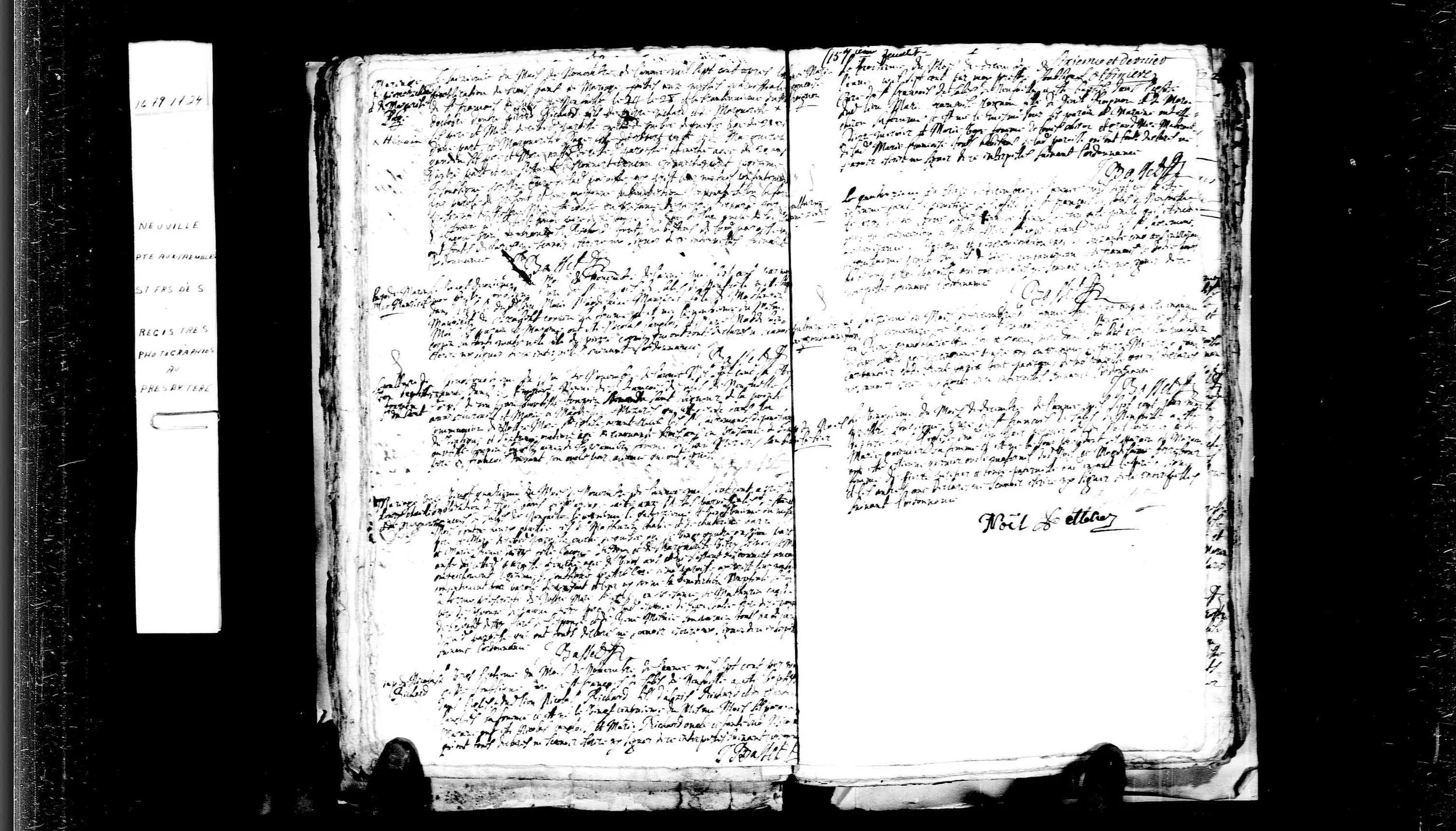
| Rank | Name and role as printed | Age | M.S. | Pr. |
|---|---|---|---|---|
| 01 | Anne LEODETThe deceased | 065 | v | d |
| 02 | Gilles PINELLESpouse of 01 · Father of 03 — himself buried eleven months earlier | — | m | d |
| 03 | Guillaume PINELLESon of 02 | — | — | p |
| 04 | Pierre COUTANCINEAU | — | — | p |
| 05 | François LEDODI | — | — | p |
| 06 | J BASSETOccupation: prêtre | — | c | p |
By the time she died, one of her nine Pinel children had gone before her: Nicolas, dead at about twenty-four in July 1698, three years after his marriage. Guillaume, who stood at her grave, would outlive her by forty years.
Anne Ledet had been in New France for roughly half a century. She had married twice, been unmarried by a court, raised eleven children, held land from the Jesuits in her own name and sold it for five hundred livres, appeared before a notary and been formally asked whether she could sign, answered that she could not, and been buried in the parish where four of her children had married into the same neighbouring family.
What the Record Shows
The bigamy is the part of Anne Ledet's story that is usually told, and it deserves to be: a woman with two small daughters had her marriage voided by the discovery of a wife in France, and her children were made illegitimate by that voiding. Colonial records document other such cases. Few of them are as visible in their consequences.
But it rests on a single compiled source. No record of the proceeding has been found. What is on the record — in notarial acts, in a parish register, in a census — is a different and in some ways more interesting woman: one who held a Jesuit concession before she remarried, who appeared in person to sell it and was bound jointly for the whole, whose consent had to be sought and separately ratified when her husband sold land four years later, and who could not write her own name.
The four Constantineau marriages at Neuville between 1683 and 1699 show a family knitting itself into a parish. Three of those four spouses were brother and sisters. The exchange of godparenthood with the Sylvestre household across nine years shows the same thing at the level of the font rather than the altar.
The notarial minutes in the greffe of Gilles Rageot, which would carry the 1673 and 1677 sales from a typescript to an original. The Jesuit concession recited in the 1673 act, which would date the grant to Anne and describe her as she was described at the time. Anne's own ratification of 24 June 1677. Any record of the bigamy proceeding. And the marriage act of François Xavier Pinel and Marie Louise Constantineau in 1687, which would close the last gap in the Constantineau group.

Document Gallery




Sources
Original records examined
- Marriage of Jean Nepveu and Anne Ledete, 28 January 1653 — Québec, Notre-Dame-de-Québec, baptêmes, mariages, sépultures 1621–1679, page 118. FamilySearch; Archives nationales du Québec.
- Marriage of Gilles Pinel and Anne Liedet, 2 September 1657 — same register, page 126.
- Baptism of Jean Pinel, 17 November 1675 — same register, pages 204–205, image 382 of 512.
- Burial of Anne Ledet, 14 December 1700 — Neuville, Saint-François-de-Sales, baptêmes, mariages, sépultures 1679–1752, image 170 of 587.
- Census of Canada, 1666 — Library and Archives Canada, Archives des Colonies, Série G1, volume 460, first part, folio 96.
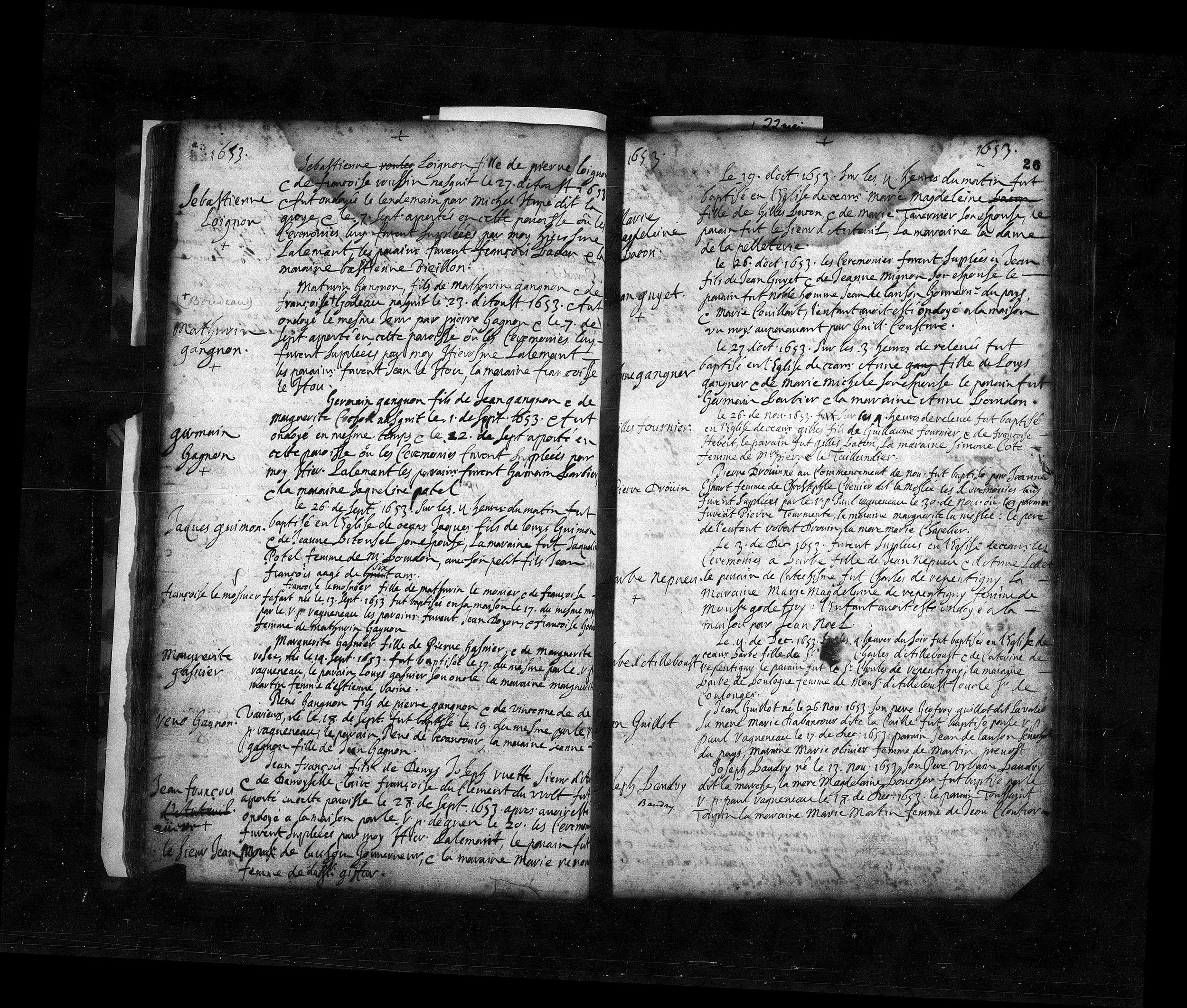
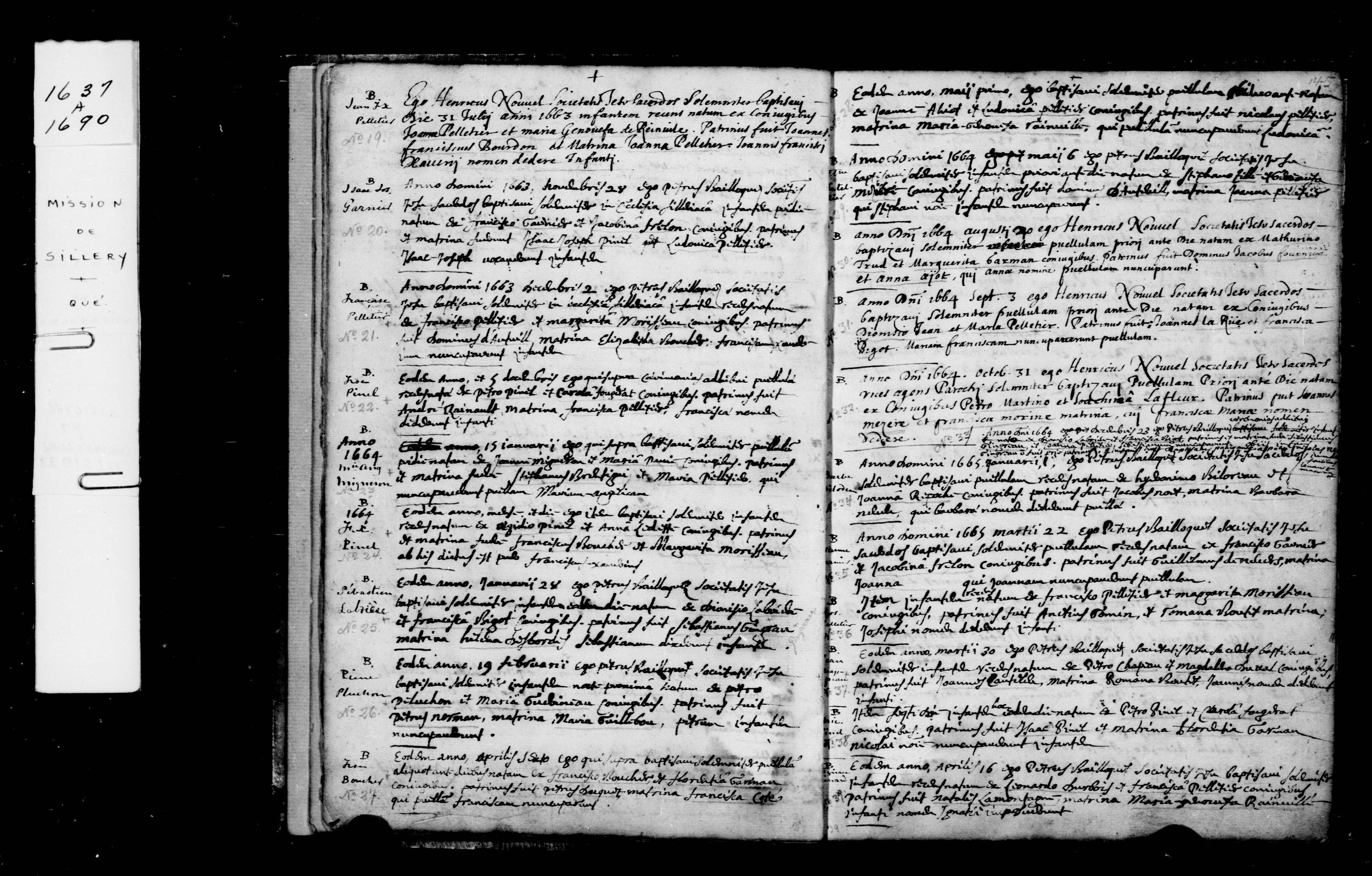
- Register images for the baptisms of Marie Barbe Neveu (1653), Suzanne Neveu (1655), Catherine Pinel (1658), François Xavier Pinel (1664), Élisabeth Ursule Pinel (1666), Guillaume Pinel (1669), Marie Anne Pinel (1671) and Nicolas Pinel (1673) are reproduced in the gallery above and have not yet been collated.
Notarial acts
- Vente par Gilles Pinel et Anne Ledet son épouse à Michel Desorcis, Me Gilles Rageot, 25 October 1673, no. 1156. Held as a twentieth-century typed transcription, BAnQ via FamilySearch, image group 100626713, image 410 of 2347. The minute in the greffe de Gilles Rageot has not been read.
- Vente par Gilles Pinel à Pierre Richard, Me Gilles Rageot, 16 April 1677, no. 1613. Same series, image 1213 of 2347. The typescript records a ratification by Anne Ledet on 24 June 1677; that act has not been located.
- Concession by the Jesuits of Québec to Anne Ledet, before September 1657 — recited in the 1673 sale. Not located.
- Marriage contract, Nicolas Pot and Suzanne Nepveu, Me Romain Becquet, 25 March 1670 — known only from the PRDH card. The act has not been located.
Databases and compiled sources
- PRDH-IGD (Programme de recherche en démographie historique, Université de Montréal) — twenty-six cards, transcribed in the tables above. Database fields are not transcriptions of acts.
- Peter J. Gagné, Before the King's Daughters: The Filles à Marier, 1634–1662 — the source for the bigamy and expulsion, for Jean Neveu's trade and 1645 engagement, for Gilles Pinel's La Rochelle baptism, and for Nicolas Pinel's Acadian engagement and death. Gagné expressly corrects Jetté, who had Jean Neveu dead before September 1657.
- René Jetté, Dictionnaire généalogique des familles du Québec — cited here only as the account Gagné corrects. Not consulted directly.
Research note. This page was rebuilt in September 2026 against twenty-six PRDH cards, five collated register or census images and two notarial acts. Where earlier versions of this page stated something the record does not support, the statement has been corrected here; corrections are tracked in the research log for this family rather than annotated on the page. Anne Ledet belongs to the Souliere Line's Founding Mothers collection, and her daughter Marie Barbe's husband, Nicolas Sylvestre dit Champagne, is the subject of a separate documentary biography on this site.
Every Family Has a Story Worth Telling
Whether you're just beginning your research or ready to transform years of work into a narrative your family will treasure, I'd love to help.
BEGIN YOUR RESEARCH INQUIRY