
The Storyline
Real families. Real discoveries. Real stories.
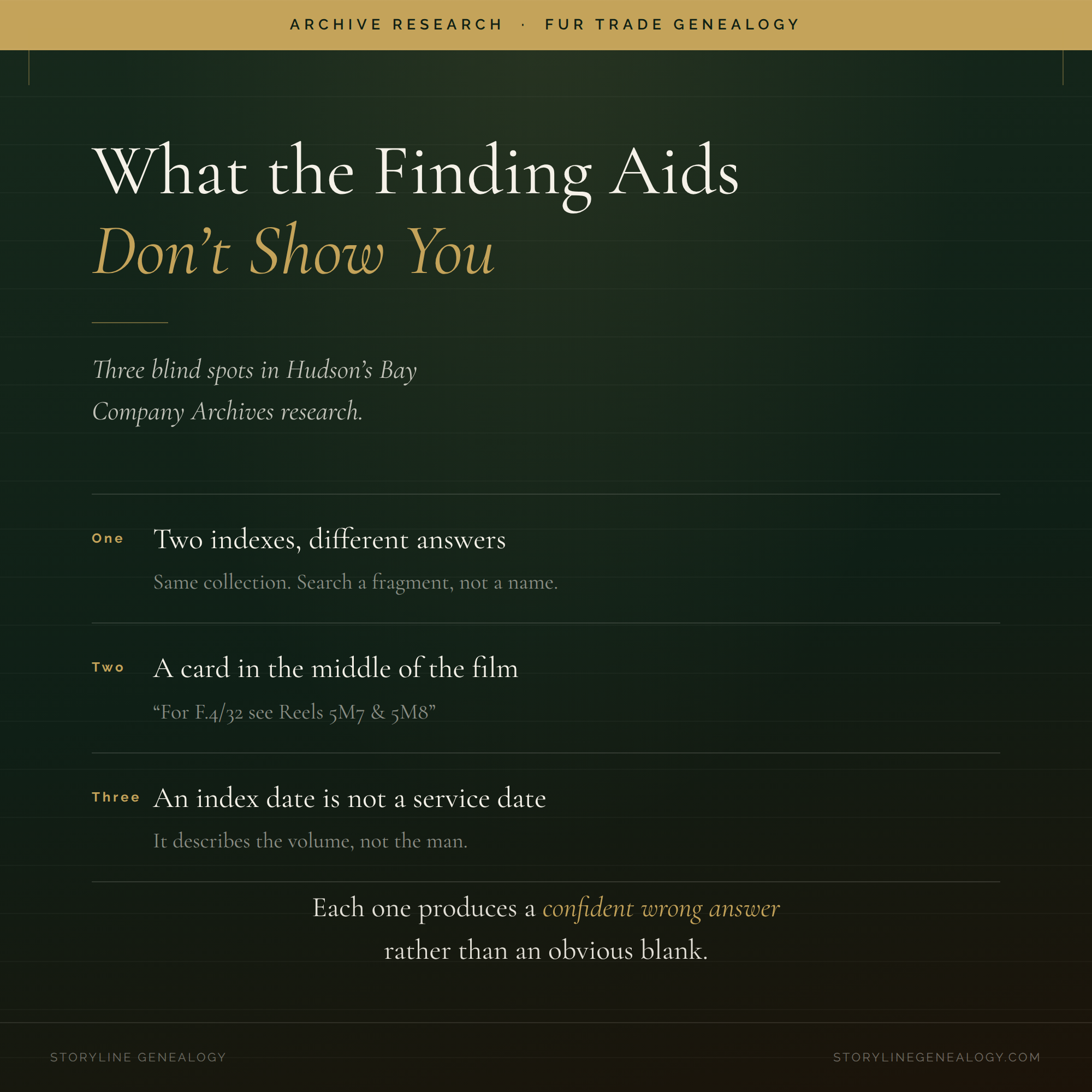
What the Finding Aids Don’t Show You
Two indexes cover the same Hudson's Bay Company Archives collection and return different answers. A microfilm reel catalogued as holding a run of account books quietly redirects one of them to two other reels. And an index entry, however precise, cannot tell you which of several men who shared a name you actually found. None is a flaw in the archive. Each will cost you a conclusion.
Part of the Storyline Genealogy series : A Research Methodology Guide
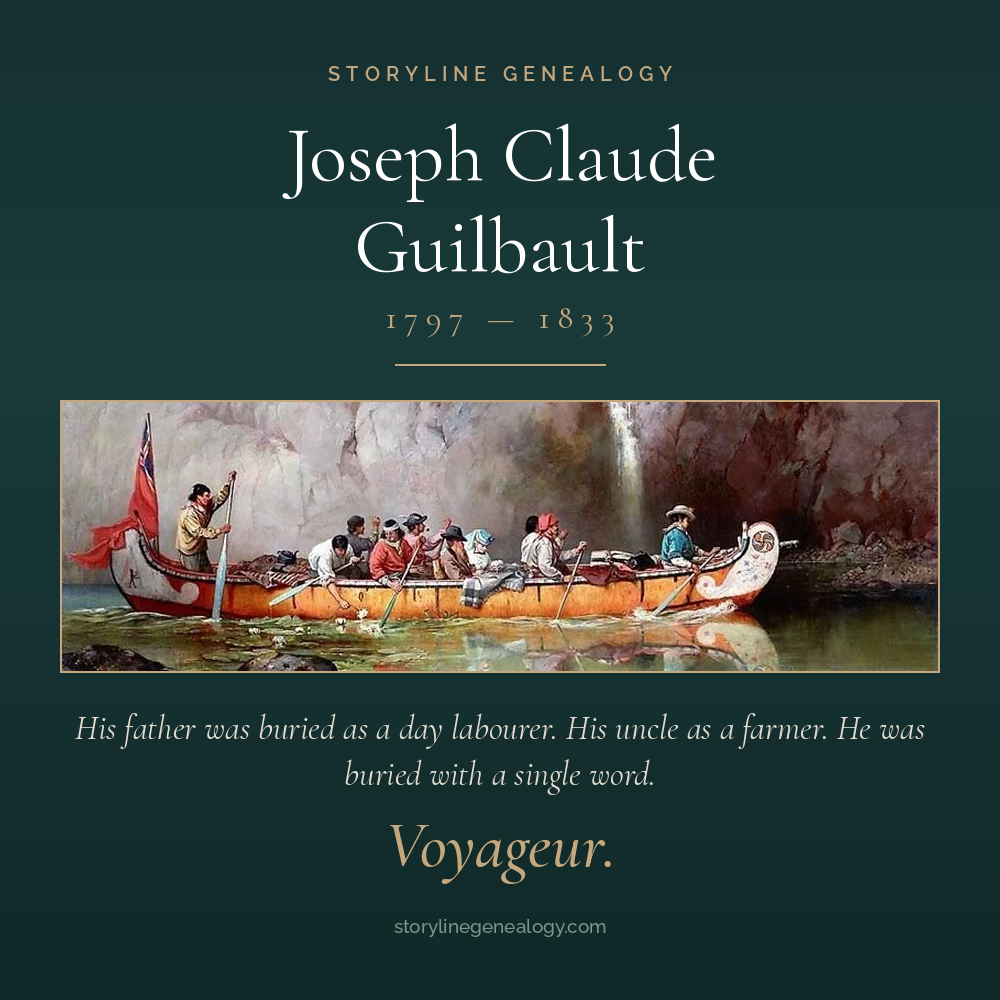
Born in the Pays d’en Haut
Joseph Claude Guilbault was born in June 1797 somewhere in the pays d'en haut, to a French-Canadian voyageur and an Anishinaabe mother from Lake Superior. He was baptized at sixteen months, named once more at four, and then disappears from the Quebec record for thirty-one years. When a man of his name was buried at Oka in 1833, the priest wrote one word for his occupation — and the Grand Chief of the Algonquins stood at the grave.
Part of the Storyline Genealogy series: The Guilbault Line: Voyageurs of the Pays d'en Haut
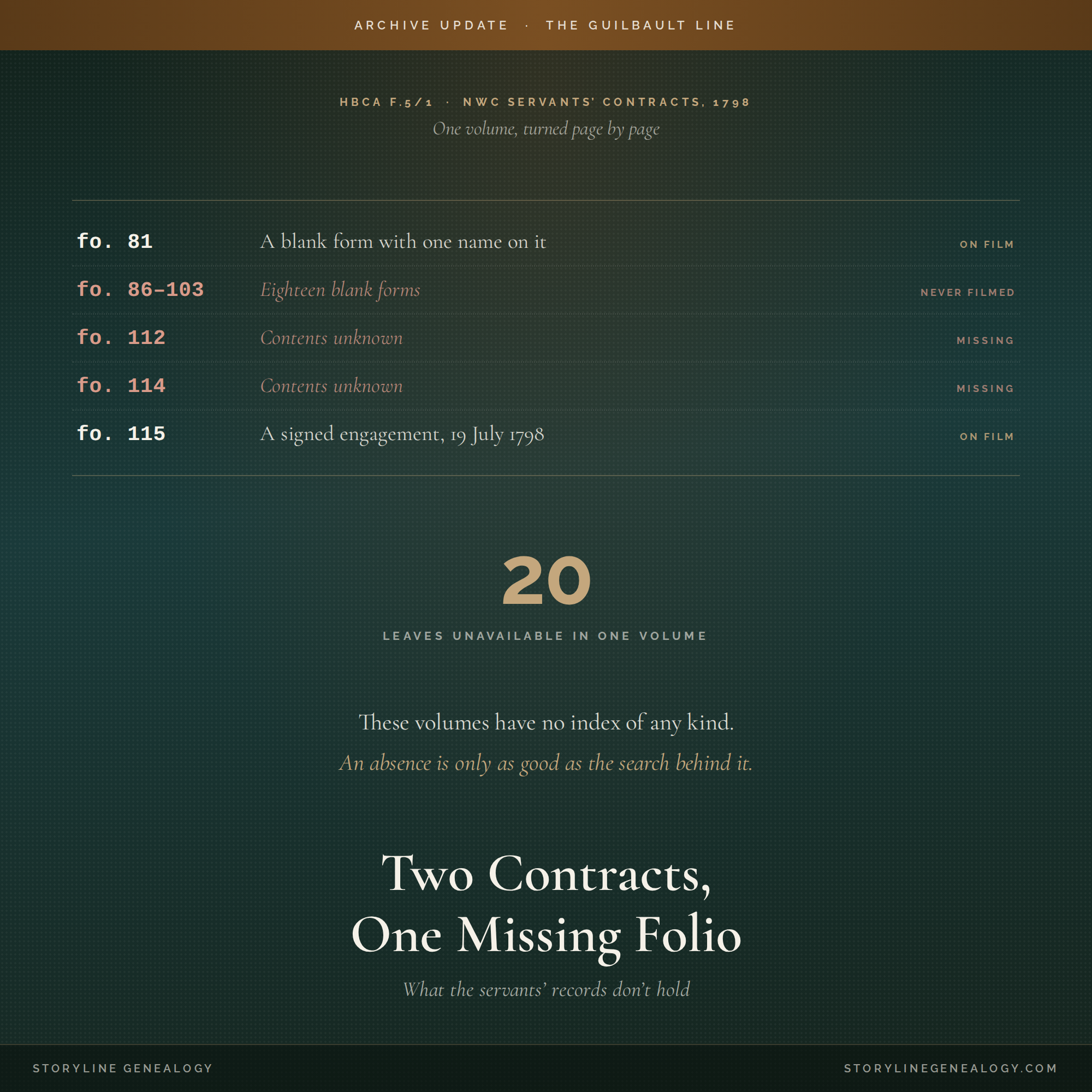
Two Contracts, One Missing Folio
The North West Company's servants' contracts are the most informative documents in the fur-trade archive and almost unusable: the volumes carry no name index of any kind, so finding a man means turning every page. Do that, and you start noticing what isn't there. In one volume alone, two folios are lost and eighteen more were never filmed — twenty leaves unavailable, any of which could hold an engagement. One man in this family has two signed contracts and no identity. Another has five years of wages and nothing signed anywhere.
Part of the Storyline Genealogy series: From Research to Story
From Death Rapids to Saint Paul Mission: Hilaire Guilbault
In September 1838, Hilaire Guilbault of Verchères, Québec, survived the worst disaster on the Columbia River brigades — the bateau capsizing at Les Dalles des Morts that killed twelve people, including the wife of Governor Sir George Simpson. He did not go home. Four years later he gave sworn testimony before James Douglas at Cowlitz Farm. Six months after that he stood godfather at Saint Paul Mission. Three documents tell the arc of a life built from the wreckage of a river crossing.
Part of the Storyline Genealogy series: The Guilbault Line: Voyageurs of the Pays d'en Haut — and the Oregon Country
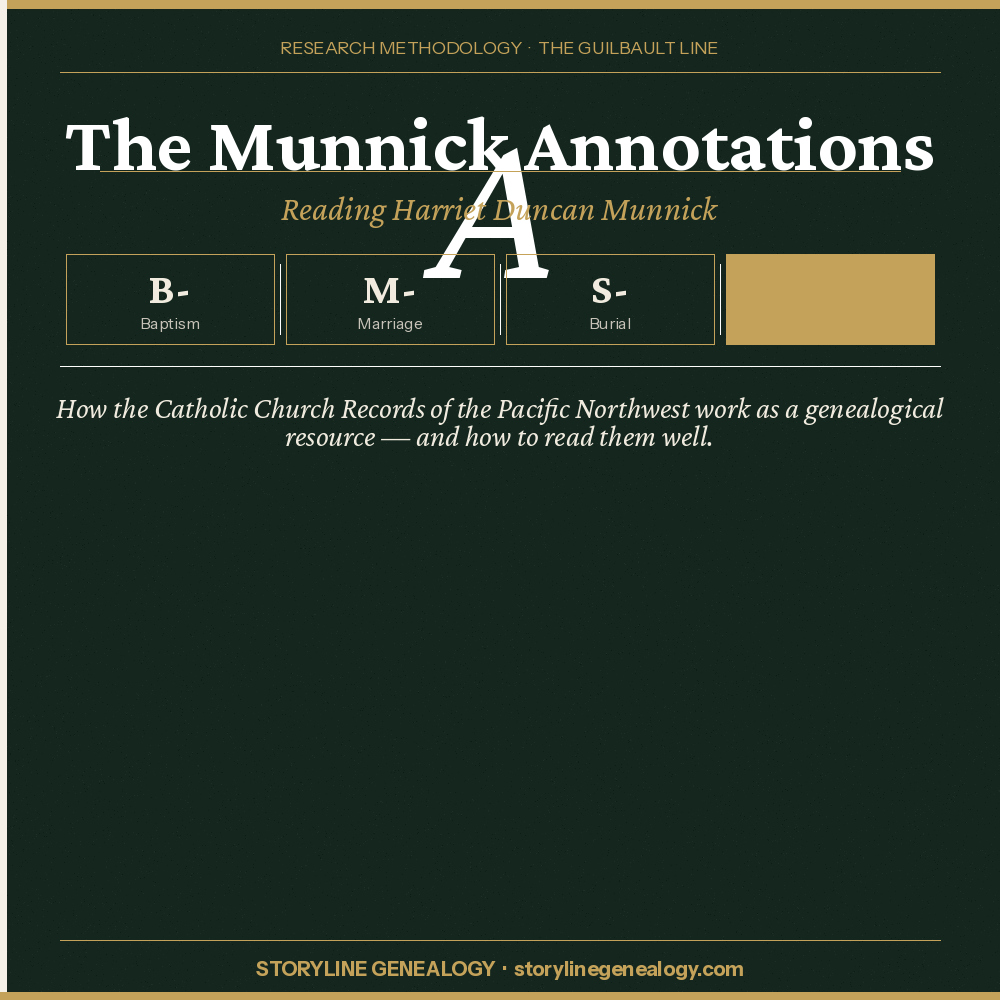
The Munnick Annotations:Reading Harriet Duncan Munnick
Harriet Duncan Munnick spent decades turning sparse sacramental registers into something no single archive could produce on its own — a record of who the people of French Prairie actually were, where they came from, and what happened to them. The Catholic Church Records of the Pacific Northwest are the essential finding tool for fur trade genealogy in the Oregon Country. This post is a practical guide to reading them: how the B-, M-, S-, and A- annotation system works, how to use transcription and annotation as separate evidentiary layers, how to track a name through its phonetic variants, and where Munnick can be wrong — and why knowing that makes the resource more useful, not less.
Part of the Storyline Genealogy series: The Guilbault Line: Voyageurs of the Pays d'en Haut — and the Oregon Country
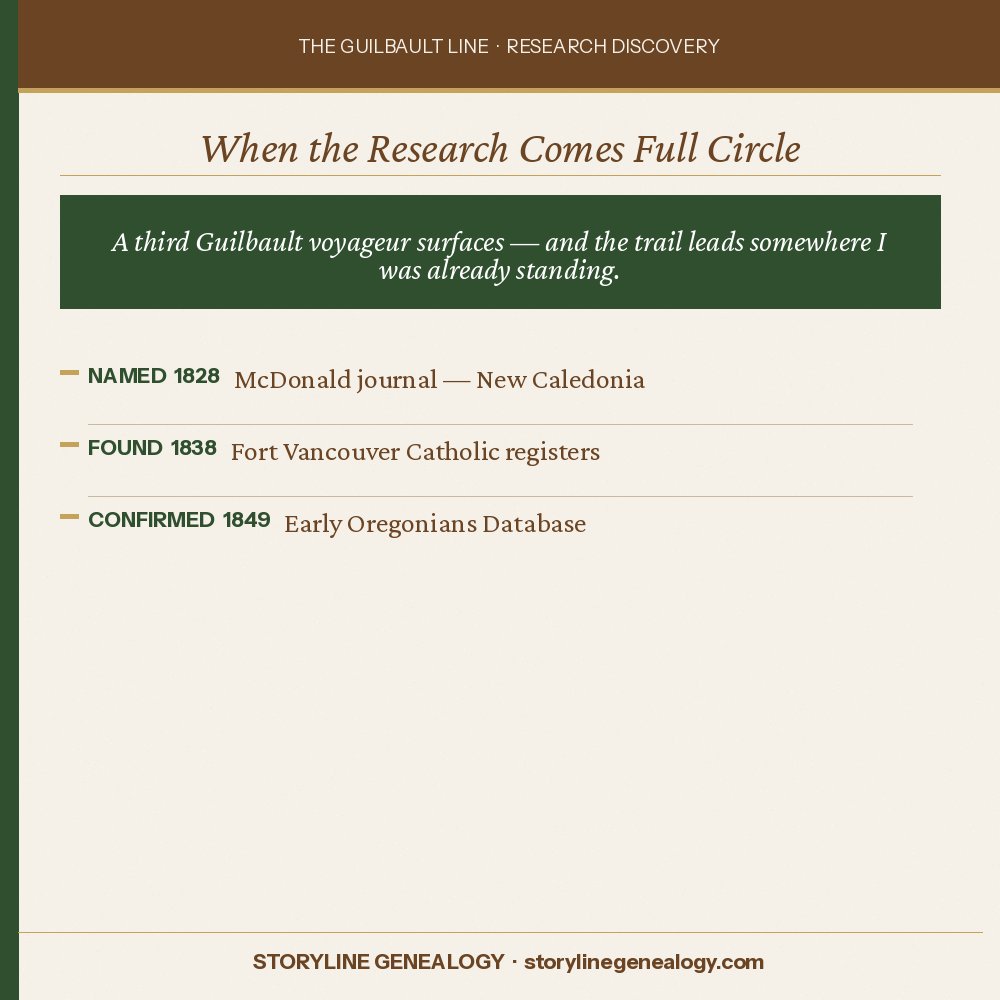
When the Research Comes Full Circle
I thought I was checking a single fact. Four PRDH family records later I had three men called Paul Guilbault instead of two: one who stayed in his parish and left a thick notarial trail, one who went to New Caledonia and Oregon and never came back, and one who exists only as figures in a company ledger, spelled three ways, with no parish to send anyone looking. Then the trail led to Marion County, Oregon — where I had already been working for weeks, on an entirely different project.
Part of the Storyline Genealogy series: The Guilbault Line: Voyageurs of the Pays d'en Haut — and the Oregon Country
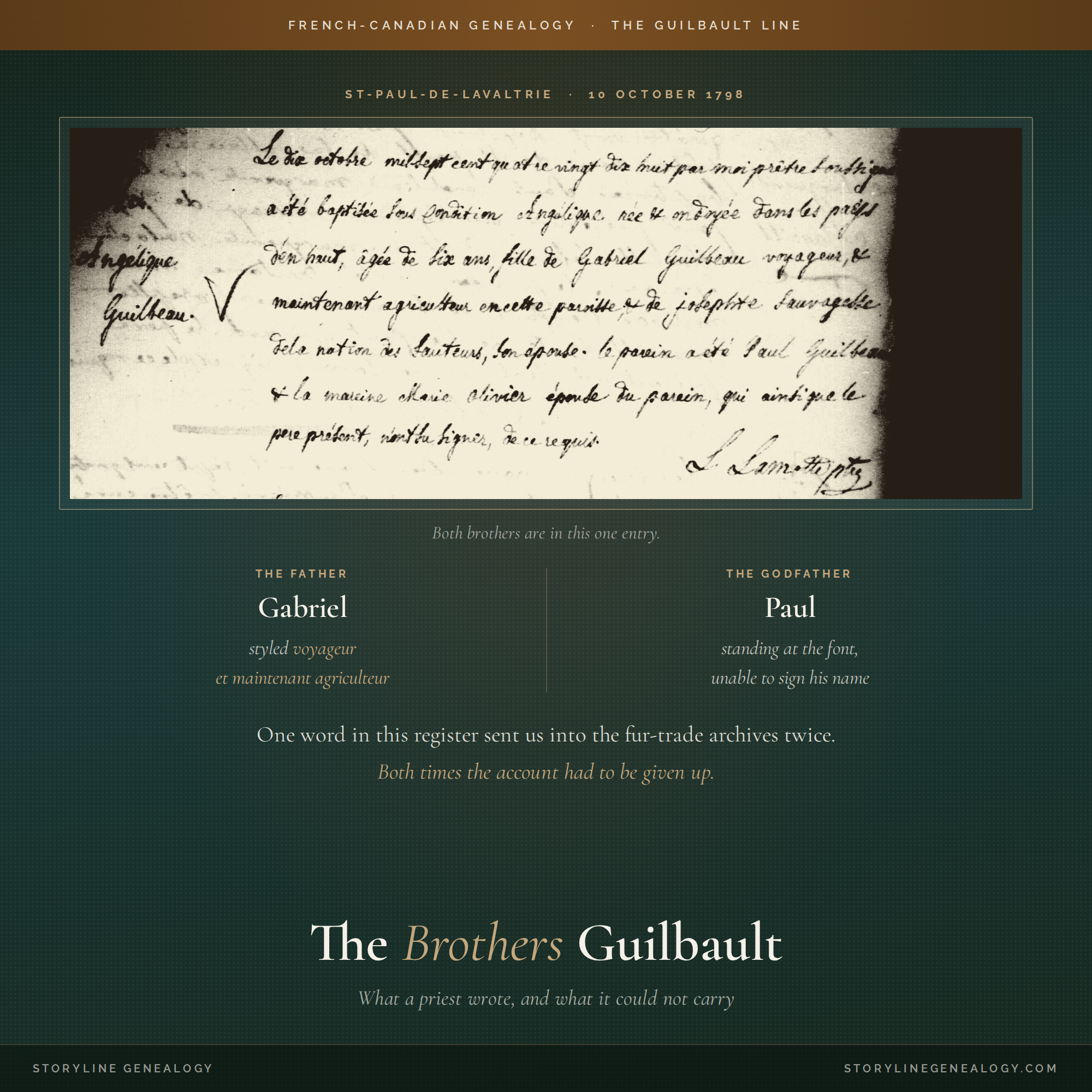
The Brothers Guilbault
On 10 October 1798, a priest at St-Paul-de-Lavaltrie baptized a six-year-old girl born in the pays d'en haut. In the same entry he named her father Gabriel Guilbault a voyageur, and her godfather Paul Guilbault — Gabriel's brother — as a man who could not sign his name. That one word sent this research into the Hudson's Bay Company Archives twice, once for each brother. Both times an account was found. Both times it had to be given up.
Part of the Storyline Genealogy series: The Guilbault Line
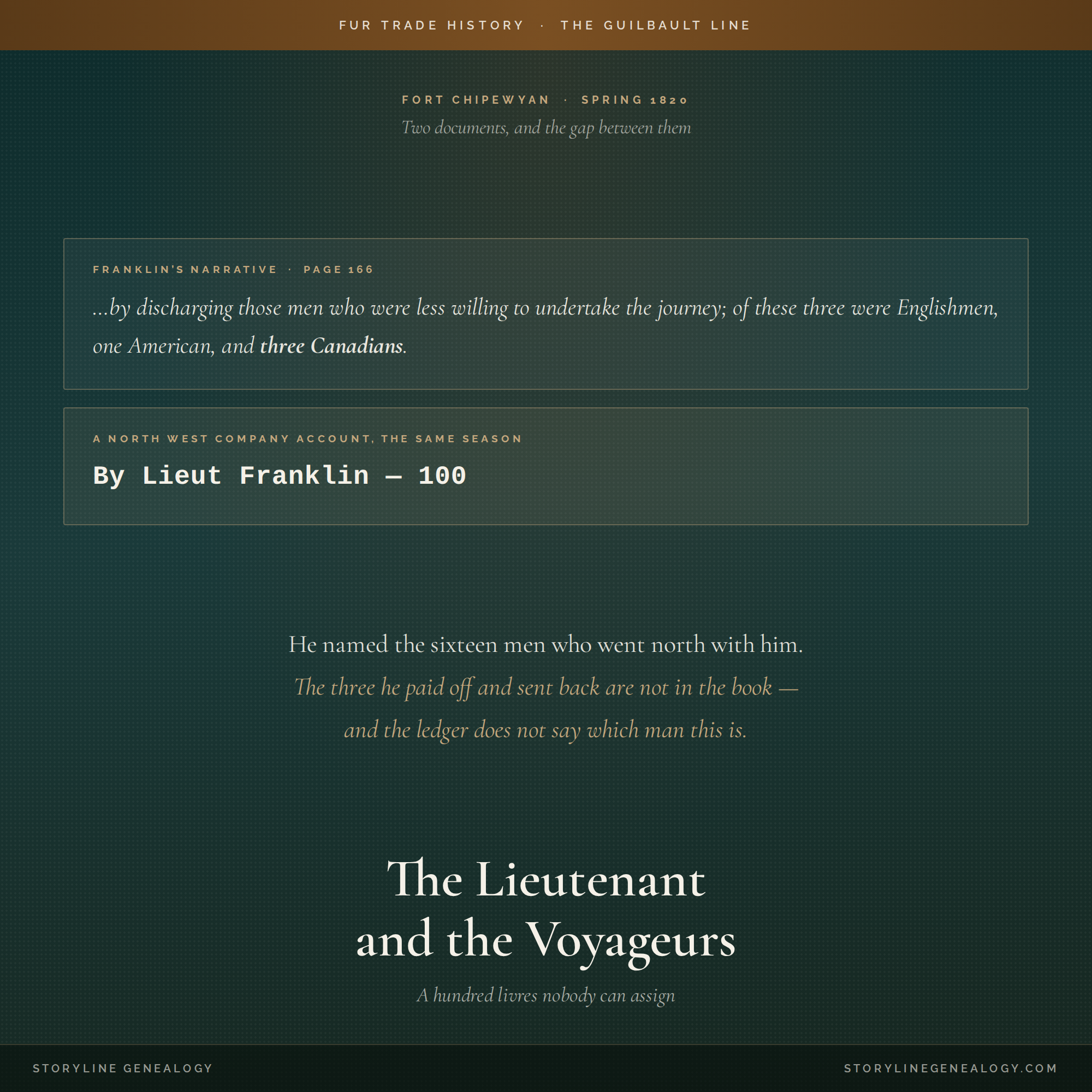
The Lieutenant and the Voyageurs
In the spring of 1820, Lieutenant John Franklin spent four months at Fort Chipewyan trying to hire French-Canadian voyageurs willing to paddle him toward an unmapped Arctic coast. Some agreed. Some refused — sensibly, since a North West Company crew had recently been killed in the same country. And in July, before the party went north, Franklin discharged three Canadians and paid them off. He named the sixteen who went. He did not name the three who didn't, and one line in a company ledger may be all that survives of one of them.
Part of the Storyline Genealogy series: From Research to Story
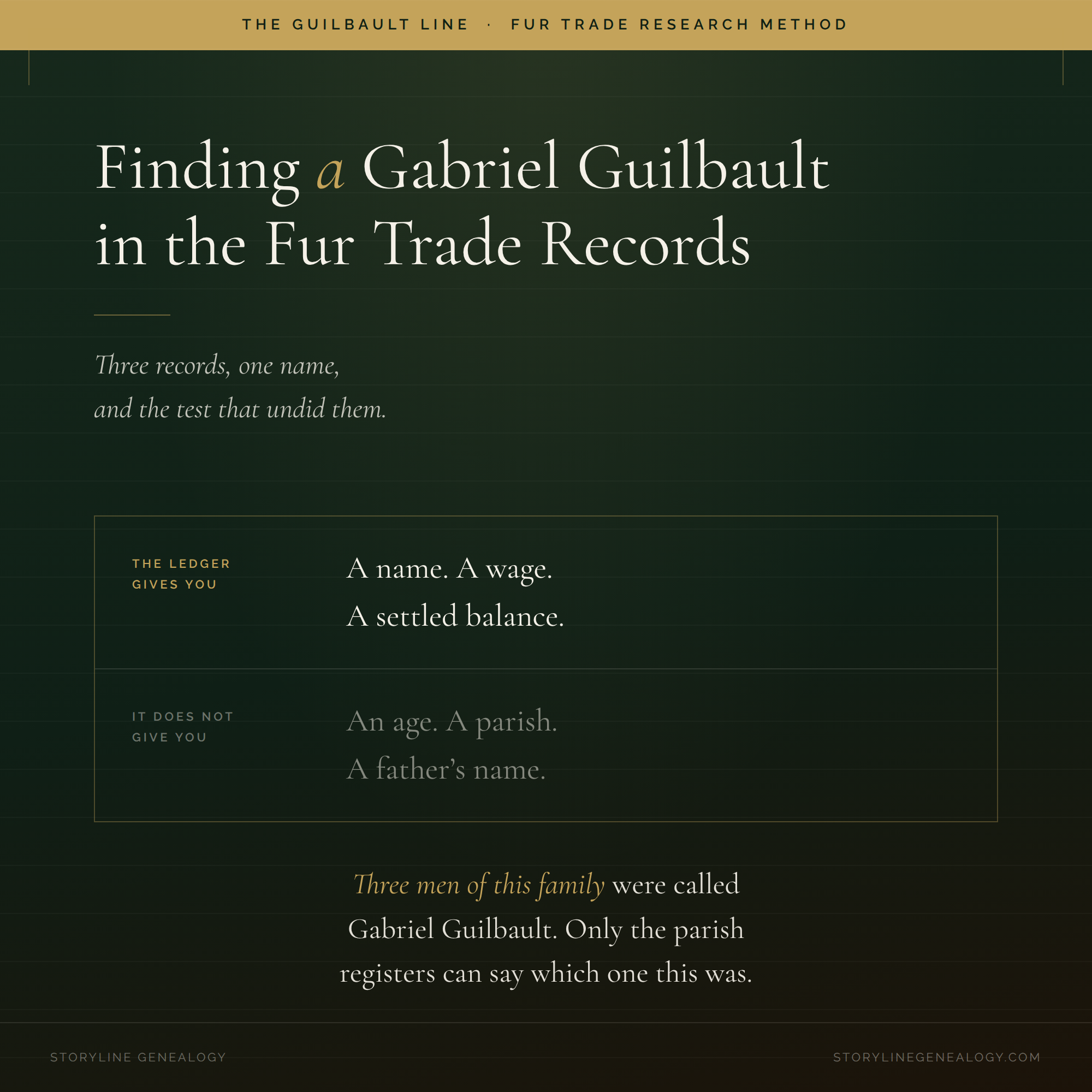
Finding a Gabriel Guilbault in the North West Company Records
A fur trade account book gives you a name and a number. No age, no parish, no father's name. This is how I found Gabriel Guilbault in the North West Company records — three volumes, a cross-post balance, an account marked settled — and how the parish registers later showed the man I had found was not the man I thought. The search method still works. It's the sixth step that decides it.
Part of the Storyline Genealogy series : A Research Journey From the Index to the Account Book
Following the Canoe Routes: How the Fur Trade Families Moved Between the Interior and Quebec
Genealogists researching French-Canadian voyageurs often encounter a puzzling pattern: a man appears in Quebec records, disappears for years, then resurfaces—sometimes with a wife and children who seem to have materialized from nowhere. The explanation lies in the geography of the fur trade. Understanding how these families traveled helps you know where to look for records.
Part of the Storyline Genealogy Series: A Storyline Genealogy Research Guide
The North West Company: A Genealogist’s Guide to the “Pedlars from Quebec”
For forty years the North West Company employed thousands of French-Canadian voyageurs and kept remarkably detailed accounts of what they earned and what they bought. This is a guide to those records — what survives, where it's held, and how to search it. Including the limitation nobody warns you about: an account book gives you a name and a number, and nothing else.
Part of the Storyline Genealogy Series: A Storyline Genealogy Research Guide
Gabriel’s World: Life as a Voyageur in the Pays d'en Haut
What was it actually like to be a voyageur? To paddle 18 hours a day, carry 180 pounds across brutal portages, sleep under an overturned canoe, and spend years in the wilderness waiting to be paid? This was Gabriel Guilbault's life—and understanding it helps us understand the man behind the records.
Part of the Storyline Genealogy series: Documentary Biographies From Research to Story
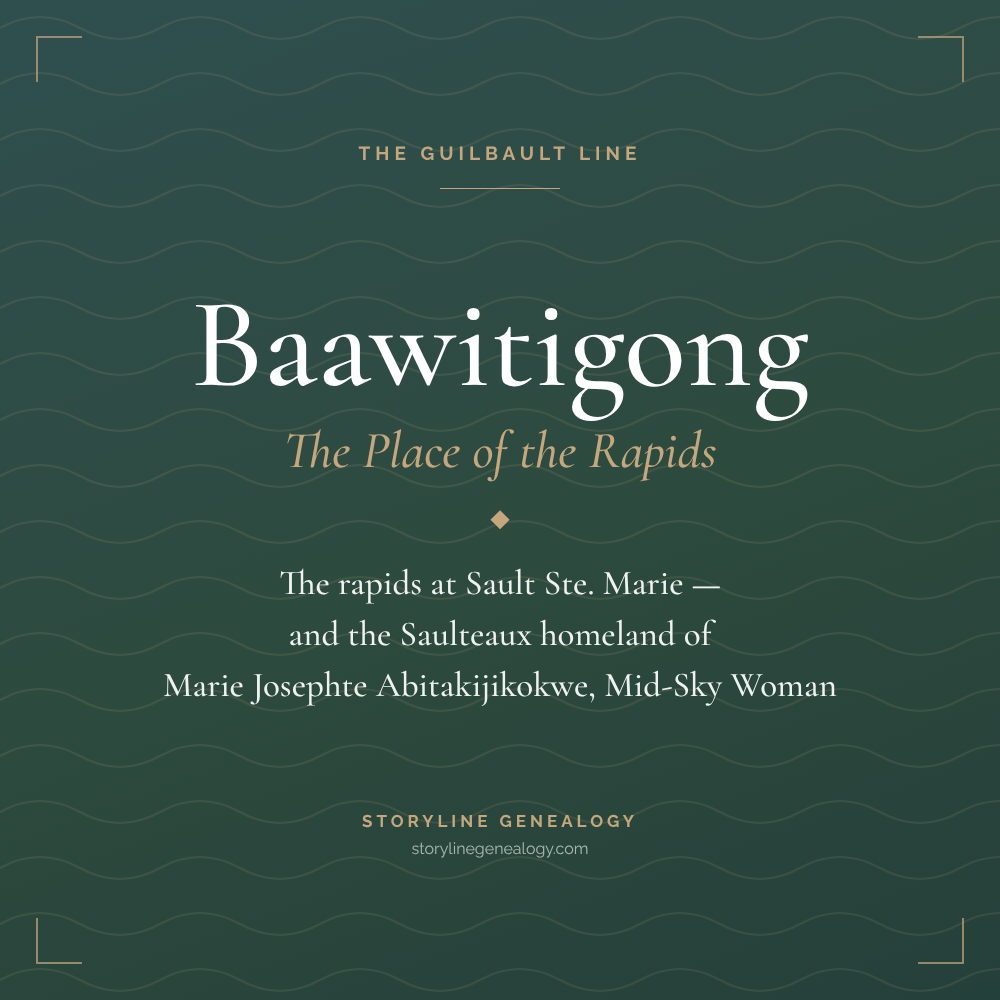
Baawitigong: The Place of the Rapids
At the St. Mary’s River, Lake Superior drops twenty-one feet into the lower Great Lakes. The Ojibwe called the place Baawitigong; the French called its people the Saulteurs. When Father Leclercq baptized Marie Josephte at Oka in 1801, he wrote that she was “de la nation Sauteuse sur le lac supérieur.” This is the world that phrase points to.
Part of the Storyline Genealogy series: Documentary Biographies From Research to Story
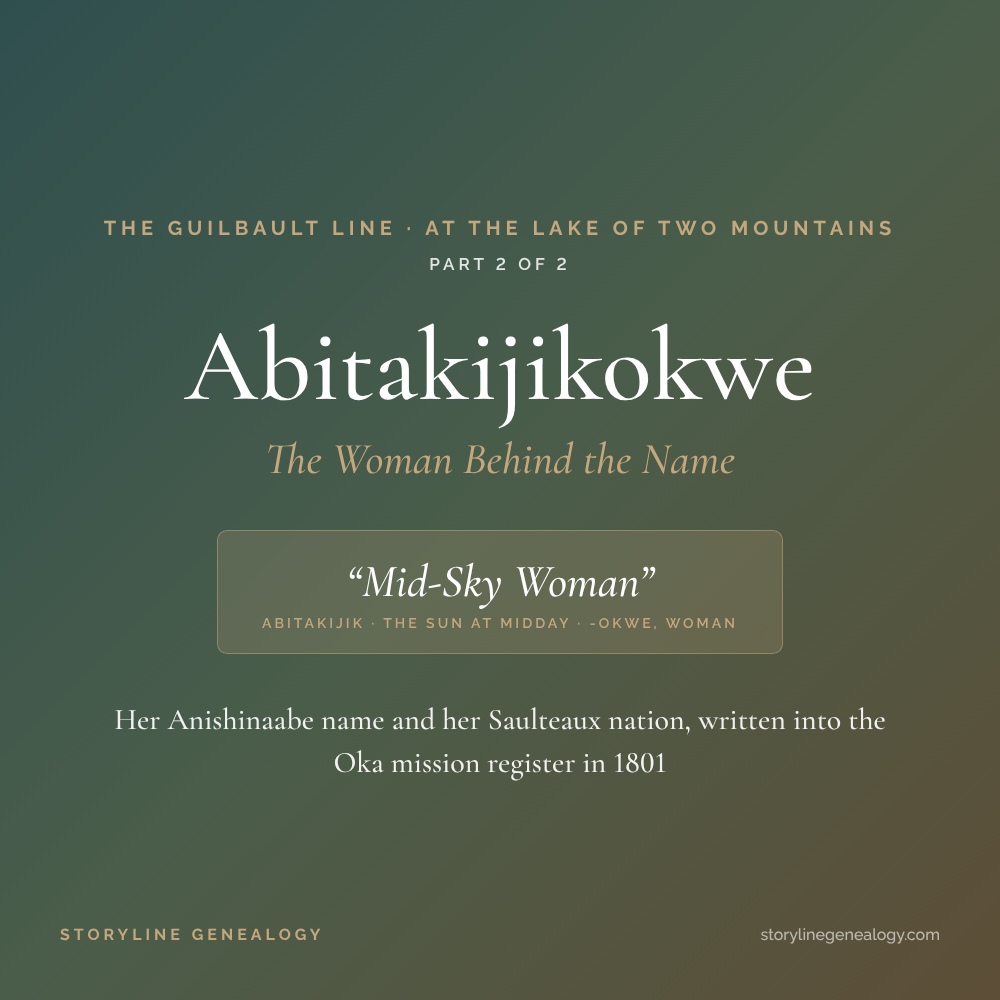
Abitakijikokwe: The Woman Behind the Name
On January 26, 1801, Father Leclercq baptized a Saulteaux woman from Lake Superior at the Oka mission and wrote down who she was: Marie Josephte Abitakijikokwe. Her name means Mid-Sky Woman. This post looks at what the name means, who the Saulteaux were, and why her name survived at Oka when most parish registers would have written only “Sauvagesse.”
Part of the Storyline Genealogy series: When a name carries centuries of meaning.
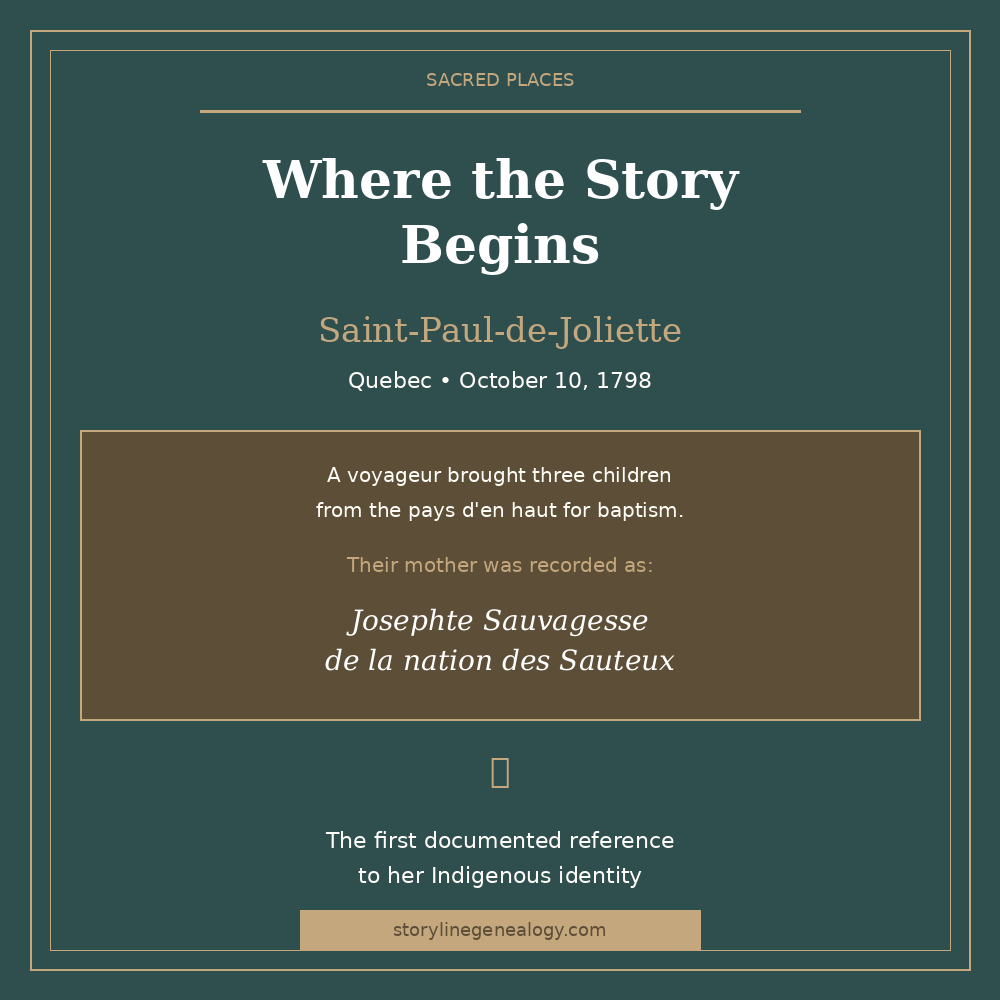
Saint-Paul-de-Lavaltrie
On October 10, 1798, a voyageur named Gabriel Guilbault brought three children to Saint-Paul-de-Joliette for baptism. They had been born and "ondoyé" (emergency baptized) in the pays d'en haut—the upper country of the fur trade. Their mother was identified as "Josephte Sauvagesse de la nation des Sauteux"—the first documented reference to her Indigenous identity. The story of Marie Josephte Abitakijikokwe begins here.
Part of the Storyline Genealogy series : Sacred Places
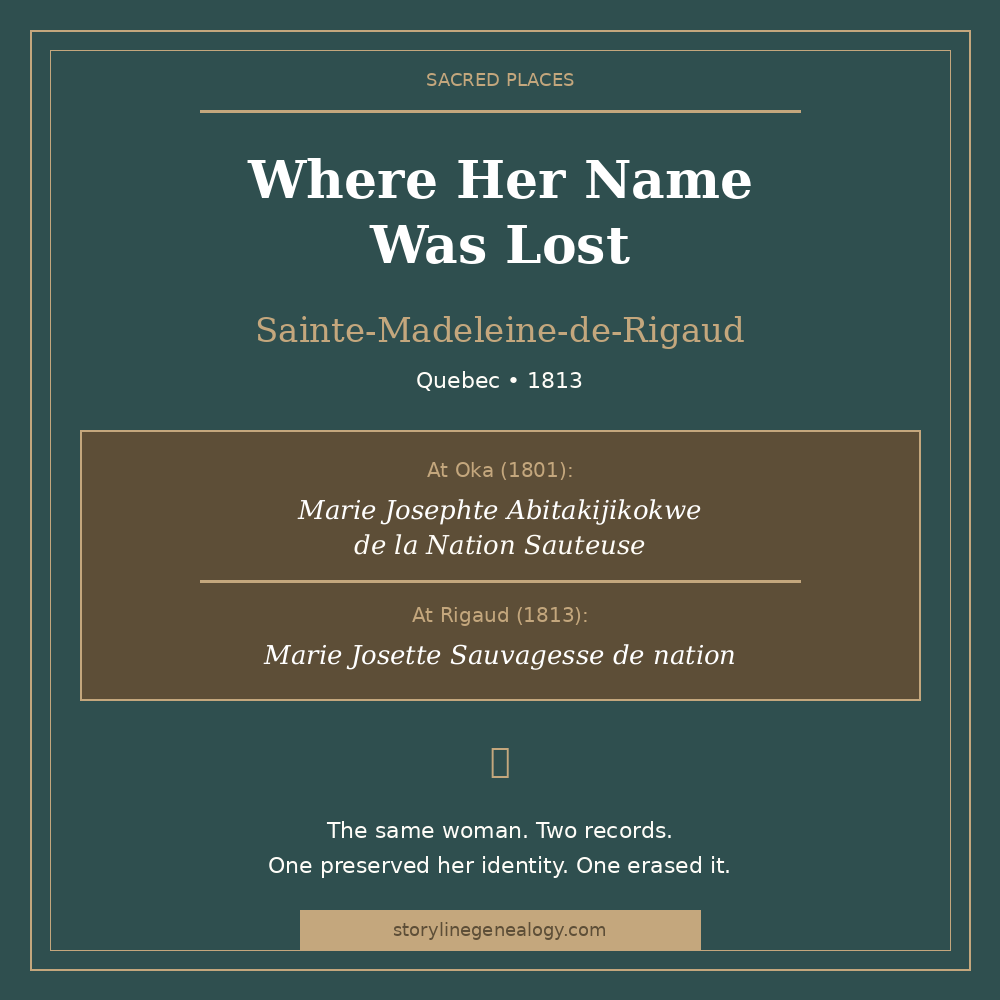
Sainte-Madeleine-de-Rigaud
In 1801, Father Leclerc at Oka carefully recorded her full Ojibwe name: Marie Josephte Abitakijikokwe de la Nation Sauteuse. Twelve years later, when she was buried at Rigaud, she had become simply "Marie Josette Sauvagesse de nation"—an Indigenous woman, unnamed. The contrast tells the story of colonial record-keeping and the erasure of Indigenous identity.
Part of the Storyline Genealogy series : Sacred Spaces
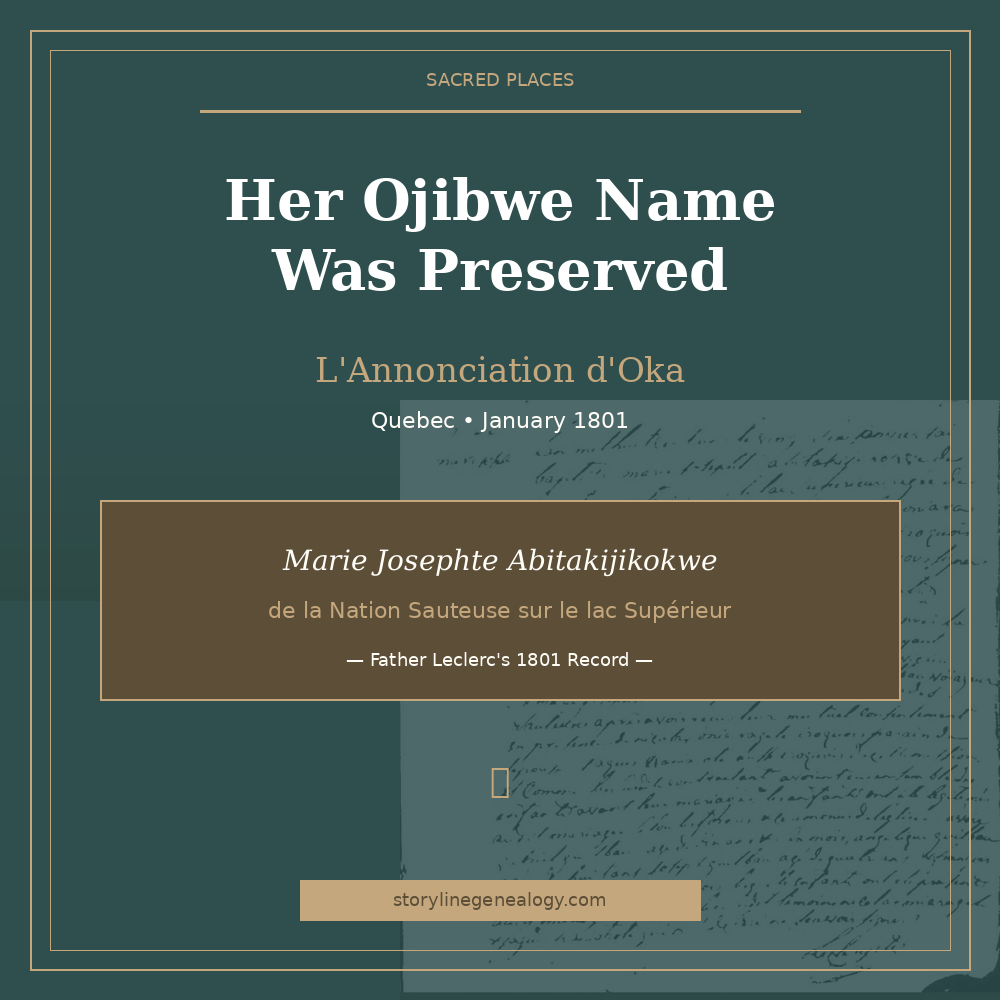
L’Annonciation d’Oka : Mission of the Lake of Two Mountains
For three centuries, this Sulpician mission has stood at the confluence of Indigenous and French Canadian cultures. Here, on January 27, 1801, Father Leclerc did something extraordinary: he recorded the full Ojibwe name of an Indigenous bride—Marie Josephte Abitakijikokwe de la Nation Sauteuse sur le lac Supérieur—preserving her identity when most priests simply wrote "Sauvagesse."
Part of the Storyline Genealogy series : Sacred Spaces
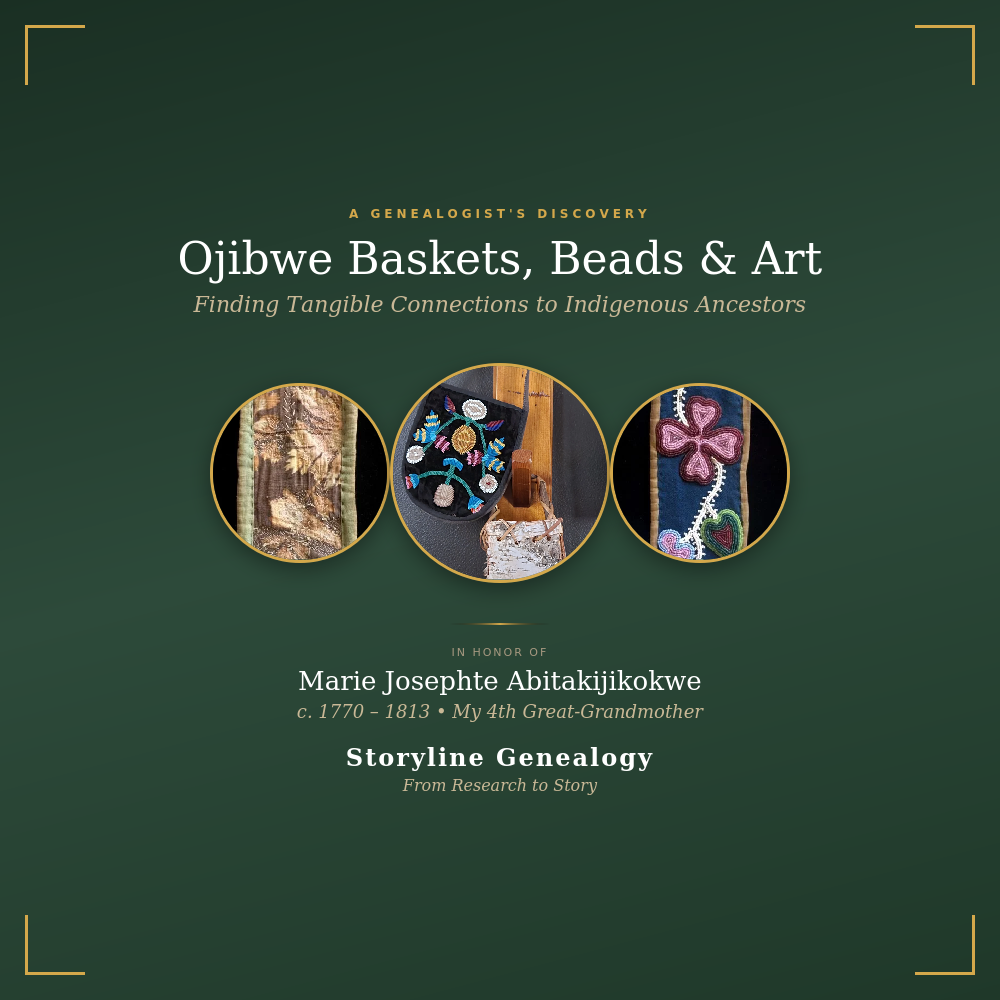
Ojibwe Baskets, Beads, and Art
When I discovered my Ojibwe 4th great-grandmother, Marie Josephte Abitakijikokwe, I wasn't prepared for how profoundly that discovery would change the way I understood my family's history. For generations, she had existed only as a shadow in the records—"Sauvagesse," a generic French term meaning "Indigenous woman." No name. No story. No identity.
Then, in a marriage record from 1801, a priest had written her full Ojibwe name: Abitakijikokwe. After 200 years of silence, she emerged from the records with her Indigenous identity intact.
And so began my journey into the world of Ojibwe art—searching for tangible connections to the woman who founded my Métis family line.
Part of the Storyline Genealogy series: Documentary Biographies — From Research to Story
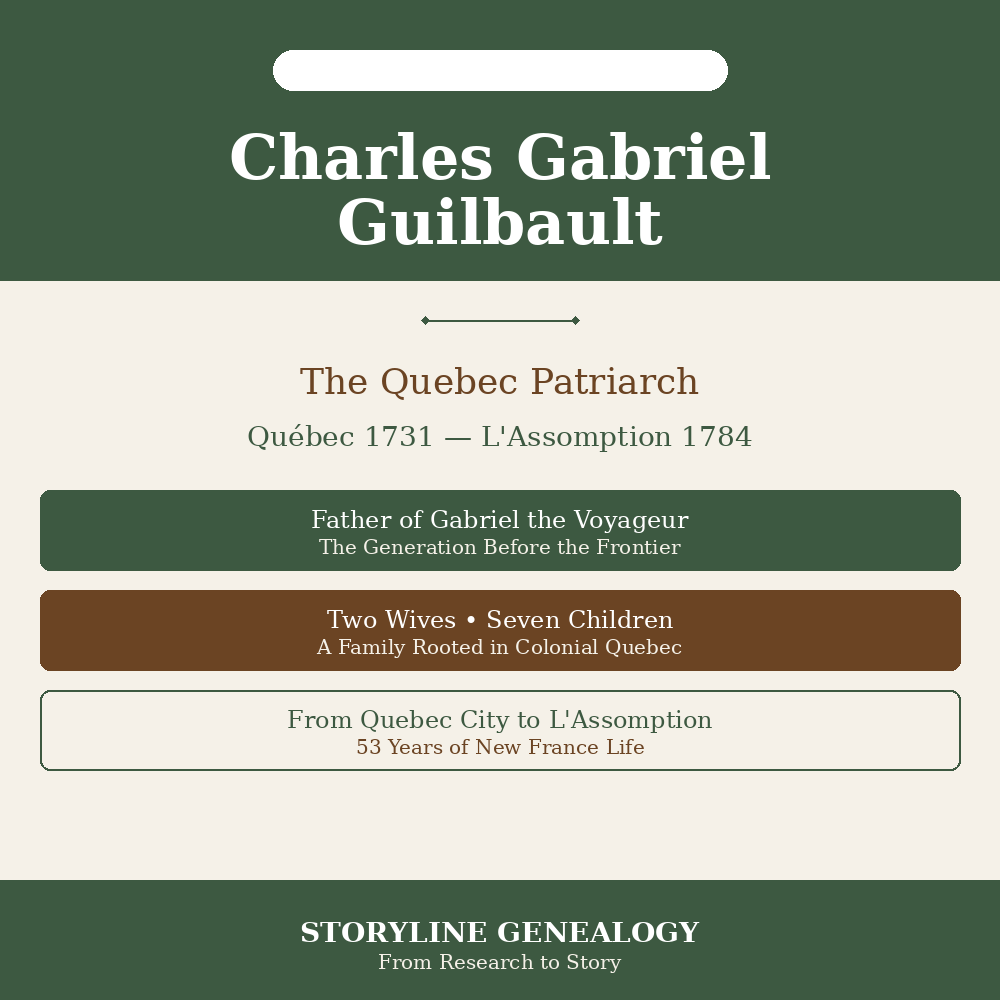
Charles Gabriel Guilbault: 1731 -1784
Before Gabriel Guilbault paddled canoes into the pays d'en haut and married an Ojibwe woman, there was his father—another Gabriel, born Charles Gabriel Guilbault in Quebec City in 1731. This Quebec patriarch married twice, raised four sons to adulthood, and established the family in L'Assomption that would eventually bridge French and Indigenous worlds. His 53-year life span encompassed the British Conquest and the transformation of New France, setting the stage for his son's frontier adventures.
Part of the Storyline Genealogy series: Documentary Biographies From Research to Story
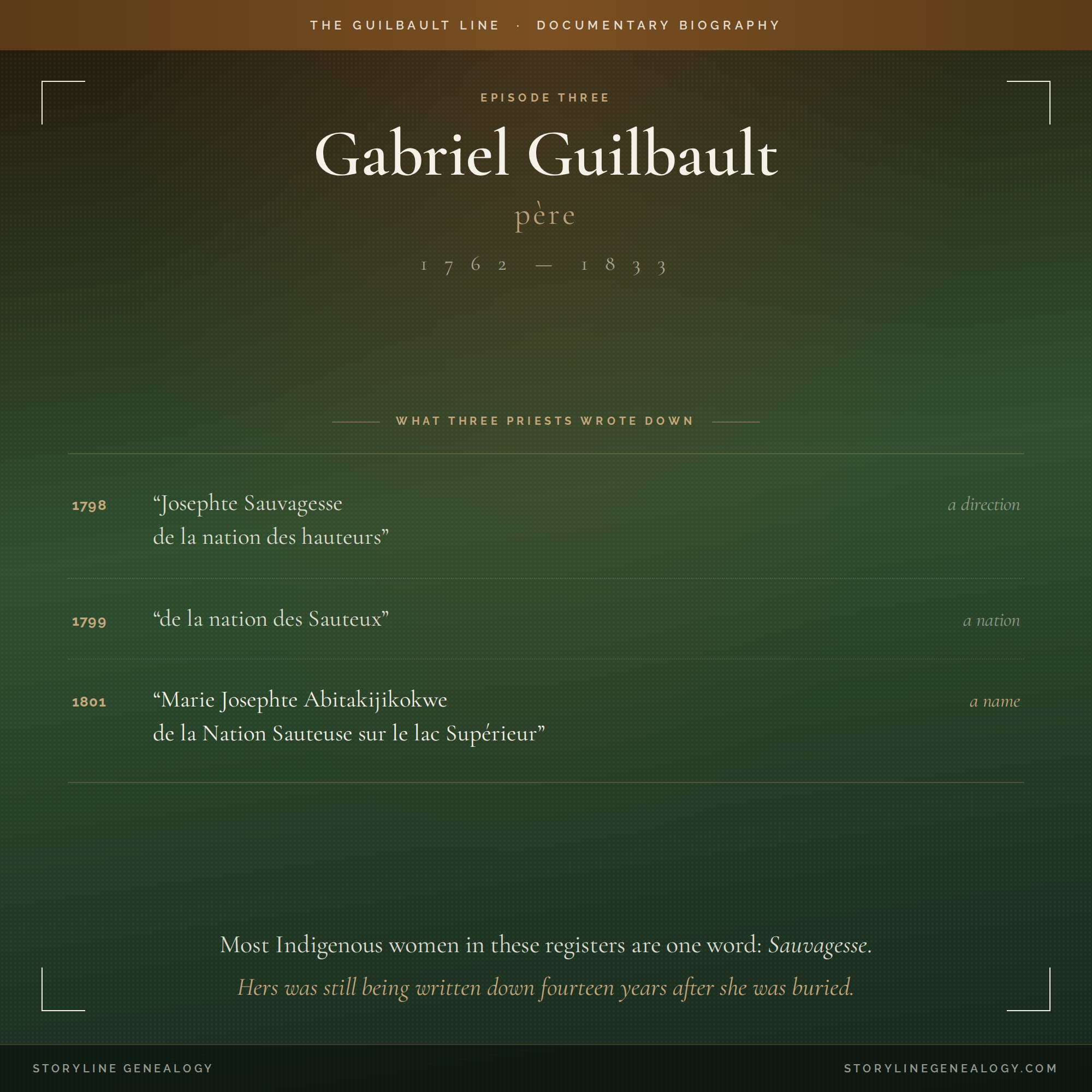
Gabriel Guilbault père 1762 - 1833
Gabriel Guilbault was born at L'Assomption in 1762, in the last year of New France, and lived to see the world that made him disappear. He went to the pays d'en haut as a voyageur; three of his children were born there and did not see a parish church until 1798. The Ojibwe woman he married is named in the registers of three parishes across nearly thirty years — the last of them written fourteen years after she was buried. His own record runs voyageur, farmer, mason for twenty-five years, and day labourer at the end.
Part of the Storyline Genealogy series: Documentary Biographies From Research to Story