
Women & Legal Agency in New France
In the courts of seventeenth-century New France, women stood against noblemen, defended donations through five judicial levels, carried property through three marriages — and, in one case, were condemned to death by the same system that protected the others. These are their documented lives, recovered from the legal record.
The women of New France are usually recovered from what happened to them — a marriage contract, a baptism, a burial. The court records show something rarer: what they did.
Under the Custom of Paris, a widow in the colony held legal standing a married woman did not. She could sign binding contracts, transfer property, sue, and be sued in her own name. The judicial and notarial series of New France — Sovereign Council judgments, notarial minutes, the registers of the Prévôté — therefore preserve women as legal actors, not merely as entries in someone else’s record. Read carefully, these files reconstruct lives that no parish register could hold.
The six cases gathered here were each built from primary legal documents. Five show women exercising that agency — against a nobleman, through the courts, across widowhoods, and in the defense of a legacy. The sixth shows the same system turned the other way. Together they map the full range of what colonial law meant for a woman’s life.
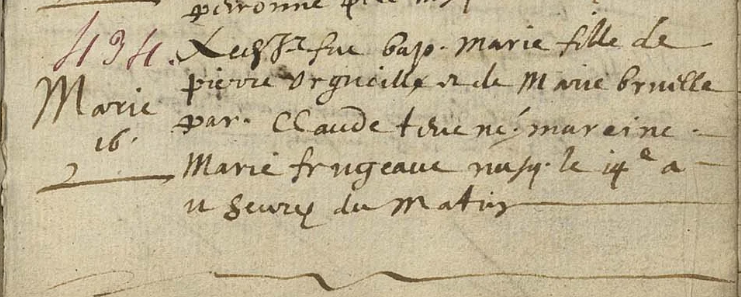
Marie Lorgueil
In 1690 a lieutenant of the Marine forces ran her husband through with a sword and fled. Fifty-six years old and already in debt, Marie Lorgueil held the one thing the law gave her: the right to sue him. Twenty-seven days later she sold it — ceding the family’s rights of action to a Montréal merchant for 520 livres, cash. The deed reads like surrender, but to sell a right you must first be recognized as holding it. It is the documentary proof that colonial law granted a habitant widow legal standing against a nobleman — even as colonial power ensured she could not use it to win.
View Case Study →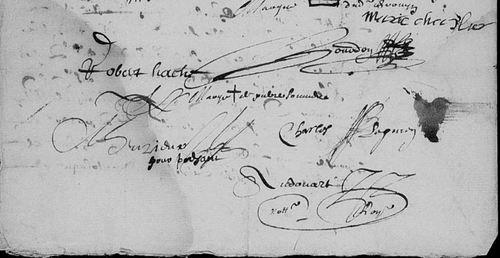
The Donation Dispute
When a stack of court victories surfaced in an ancestor’s file with no explanation, the record revealed a seventy-one-year-old literate widow who fought her stepdaughter and son-in-law through five judicial levels — from the local bailiff’s court to the Sovereign Council of New France — and never lost once. The dispute turned on a donation the younger couple had made and later tried to recover after her husband’s death. Marie Chapelier held every level.
View Case Study →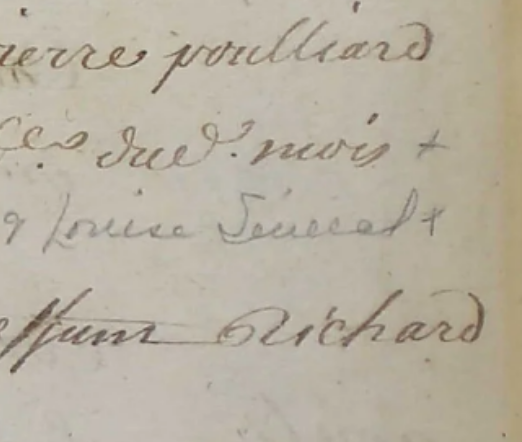
Louise Senécal
Louise Senécal never signed a document, yet the law gave her a stake in every one. Her 1667 marriage contract settled on her a widow’s douaire of 200 livres and recorded 100 livres of her own brought into the community. In 1679 a priest recorded, on her own account, that she was separated from her husband. Under the Coutume de Paris half of what the couple held was hers, and after her death her heirs pressed that half before the seigneurial court of Notre-Dame-des-Anges — where, in February 1697, the judge wrote of the “aversion” between them and their father.
View Case Study →
One Parcel, Three Households
A marriage contract scribed in 1705 recorded her third husband under a surname some readers transcribed as “Soudain.” Two later Crown records, bearing the man’s own signature, corrected it to Jourdain. Read across parish, notarial, judicial, seigneurial, and Crown-taxation series, the documents reconstruct a twice-widowed wife who carried a single parcel of land through three marriages, four surnames, and sixty-five years — a woman visible only because property law kept recording her.
View Case Study →The Françoise Baiselat Inheritance
When a Fille du Roi died in childbirth leaving children from three marriages — to two soldiers of the Carignan-Salières and one of the Compagnies franches de la Marine — colonial New France mobilized every level of authority to protect her children's inheritance. A chain of notarial acts spanning twelve years reveals how notaries, curé, tutor, and the Intendant himself untangled three estates for twelve children — and the instrument they kept returning to was the marriage contract she had signed herself at seventeen, before the Governor and the Intendant of New France, twenty-six years earlier.
View Case Study →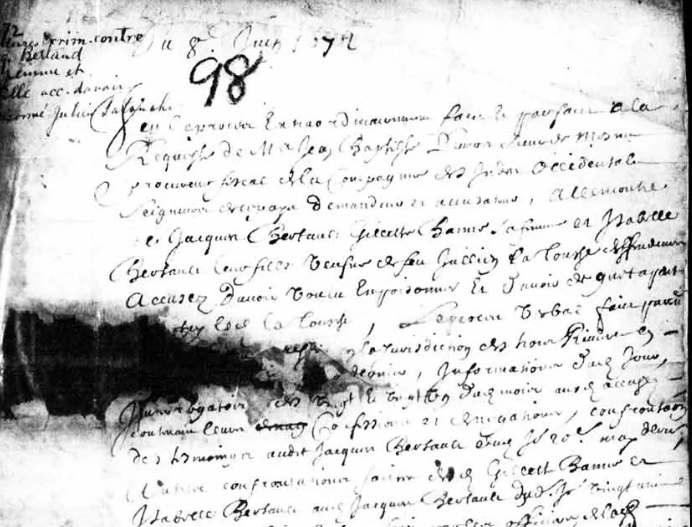
Gillette Banne
The same legal system that recognized Marie Lorgueil’s standing against a nobleman condemned Gillette Banne to the gallows. Tried before the Prévôté de Québec for the murder of her son-in-law — a man her husband had married their daughter to over her refusal — she and her husband were sentenced to death. Their thirteen-year-old was convicted with them but not condemned to die, and the Crown appealed that as too lenient, asking the court to look past her “prétendu age” and send for her baptismal extract. The Sovereign Council refused — and still made her walk to the church door with the rope at her neck and then watch her parents die. Gillette’s life survives almost entirely in her own trial file: her age, her birthplace, her voice under interrogation. A collection about women and colonial law is not honest without her.
View Case Study →Court files reach beyond these six lives
Colonial and later court records document far more than the women who stood before them — property precedents, disputed identities, careers that left no other trace. This collection will grow to gather those cases too. For now, it begins where the legal record speaks most clearly: in the lives of six women of New France.
A brick wall in the colonial records?
Court files, notarial minutes, and Sovereign Council judgments often hold the fact a family tree cannot — a widow’s standing, a disputed surname, a life the parish registers never recorded. If your New France or French-Canadian research has stalled, I take a small number of client projects each season.
Begin Your Research Inquiry → All Case Studies