
Jean Perrier dit Lafleur
Jean Perrier dit Lafleur
He came to Quebec as a soldier in the summer of 1665 — in which company, two contemporary documents disagree — and chose to stay when the troops went home. He took a concession at Beauport, married a Fille du roi, and worked at a trade a single document names a year after his death. He died in his late thirties or early forties, leaving a widow and six children on two arpents of uncleared ground.
A Weaver from Béarn
Jean Perrier was born at Pau, in Béarn, in the early or middle 1640s. The two censuses in which he appears disagree about the year: in 1666 he is twenty-four, which points to about 1642; in 1681 he is thirty-five, which points to about 1646. Both figures were estimates recorded by others, and the range is stated here rather than reconciled.
What the records agree on is his parentage. At his marriage in 1669 the priest at Notre-Dame de Québec named him fils de deffunct Jean poirier et de Marie Dervé — son of the late Jean Poirier and Marie Dervé. His father was already dead. Pau is placed in the diocese of Bayonne in that record and in the diocese of Bordeaux in the record of his daughter's marriage fourteen years later; neither is correct for the period, and both were written down in Canada by priests working from what the parties told them.
He was a tradesman. The 1683 marriage of his eldest daughter describes him as deffunct jean perier vivant maître tisserand — the late Jean Perier, in his lifetime a master weaver. That single phrase, written a year after his death, explains more about his life in New France than any other line in the record. Where he learned the trade is not documented; whether he brought it from Béarn or acquired it in the colony cannot be established from anything located so far.
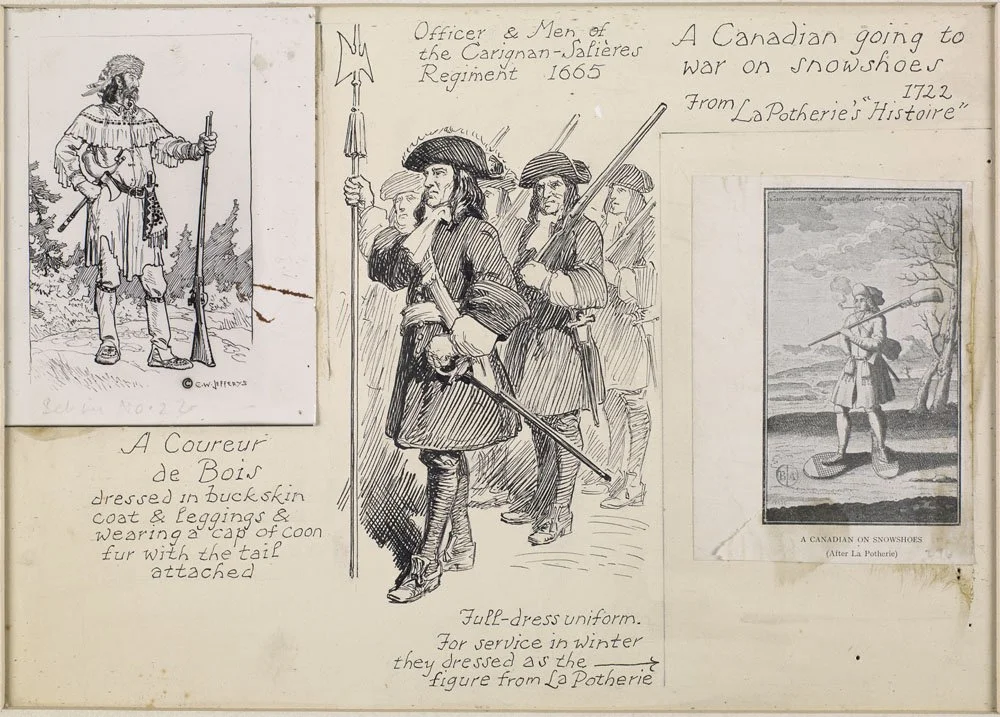
Around 1664 he enlisted in the La Brisardière company of the Régiment d'Orléans. Like most soldiers of his era he acquired a dit name to distinguish him from the other Perriers and Poiriers in the ranks. His was Lafleur — the flower — among the commonest noms de guerre in the French service. In France such names were rarely inherited. In New France they became permanent family surnames, and his descendants carried both.
Key Facts: Jean Perrier dit Lafleur
Two Companies, Two Arrivals
Jean Perrier's military service is documented by two contemporary records, and they do not agree. Both are set out here, because neither can be dismissed and the choice between them changes almost everything about his first years in Canada.
What the 1667 act says
On 23 October 1667, in the house of the master surgeon Faurre at Beauport, the notary Paul Vachon drew the marriage contract of Pierre Rivaux and Marie Quequejeu. Among the friends assembled on the bride's side the act names Benois Faurre sieur Mongion, sergent en la compagnie de Monsieur Vincent au Regiment de Carignan, de Nicolas Morin sieur La Roze, de Jean Perier sieur Lafleur, soldats en la dite compagnie.
That is a full identification — surname and dit name together — and it is the earliest document naming him in Canada apart from the 1666 census. What it does not give is the company's usual name. Peter Gagné supplies one, and states his reasoning in a single sentence: the act “was in fact the Chambly Company, whose ensign, Jean-Vincent d'Abbadie de Saint-Castin, is sometimes referred to as a captain.”
The identification therefore turns entirely on the ensign's given name. The other two soldiers named in the act, Benoît Faure de Mongion and Nicolas Morin dit Larose, appear as Chambly's sergeant and one of its soldiers in Gagné's reconstructed roster, and at first glance they look like corroboration. They may not be. Gagné's entry for Nicolas Morin dit Larose gives no birth date, no death date and no French origin; its only sources are Langlois, Parchemin and PRDH; and the entry's substance is this same 1667 act. Mongion is described in it as a “company mate,” which assumes the conclusion rather than supporting it. Unless the Chambly placements of Mongion and Morin can be shown to rest on some document other than this one, what looks like three men confirming a company may be one act read three times.
That has not been tested here, and it is the first thing to test. If Mongion's sergeancy of Chambly is independently attested, Gagné's reading becomes strong. If it is not, the Chambly identification reduces to an inference from a given name.
On that reading Jean Perrier was a soldier of the Chambly company, which reached Quebec on 19 June 1665 aboard the Vieux Siméon. Chambly was a Carignan-Salières company. It was never in the Caribbean. That is the reading Peter Gagné adopts in his biography of Perrier, and lists in his reconstructed Chambly roster.
What the 1668 roll says
The roll of soldiers who became inhabitants of Canada is arranged by company, each heading written large and offset. It runs through the Carignan companies — La Colonelle, Salière, Contrecoeur, Chambly, Grandfontaine, Saurel and the rest — before closing, in sequence, with Berthier, La Durantaye, Monteil and La Brisardière: the four companies detached to Tracy, grouped together at the end, after every Carignan company. The clerk knew they were a separate contingent and placed them apart.
Under La Brisardière he wrote three names: La Combe, Tranchemontagne, and — read at high magnification, with a long initial swash and no descender in the third letter — Perier.
On that reading Jean Perrier was a soldier of the La Brisardière company of the Régiment d'Orléans, captained by André Labrisardière, which reached Quebec on 30 June 1665 aboard the Brézé after a year in the West Indies.
What Langlois says
The roll does not stand alone. Michel Langlois's Carignan-Salière, 1665–1668 reconstructs the companies independently of Gagné, and Denis Beauregard's tables cite it throughout by page and rank under the abbreviation cs. Jean Perrier is cs 517.24. His neighbours in that sequence are Pierre Joncas dit Lapierre at 517.23 and Pierre Toupin dit Lapierre at 517.25 — alphabetical, consecutive, and all three assigned to the La Brisardière company of the Régiment d'Orléans. Perrier sits inside Langlois's own roster of that company, not beside it.
Two qualifications on that. Langlois's volume runs to 517 pages, and Beauregard notes that it gives biographies only for soldiers of the Carignan regiment proper; the cs references for the four attached companies fall at pages 515 to 517, which is end matter. So cs 517.24 is Perrier's name in a roster of the La Brisardière company, not a reasoned identification with evidence attached. And Beauregard's tables are the only report of it consulted here; the book itself has not been seen.
The second qualification cuts the other way, and it is the more interesting. The Société des Filles du roi et soldats du Carignan publishes an alphabetical list of the regiment's soldier-settlers which, by the Society's own account, is primarily the work of Peter Gagné, drawn from lists he supplied in 2008. That list, current as of January 2025, gives: Perrier, Jean, LaFleur, Parrier, soldier, La Brisandière — alongside Balan dit LaCombe, Joncas dit LaPierre and Toupin dit LaPierre of the same company. Its Chambly roster does not include him. Gagné's 2025 volume moves him to Chambly without remarking on the change.
So the Chambly reading is not the standing position of the literature but a revision to it, made between 2008 and 2025 and not flagged as one. The compiler's earlier judgement, his own scapular appendix, Langlois, Beauregard and the roll all say La Brisardière.
Beauregard keeps the Carignan regiment and Tracy's four companies in two separate tables, stating that the first excludes the four detached companies. Jean Perrier appears on the troupes de Tracy table, with Joncas, Toupin and Gilles Bourré dit Lespine of the same company. He is absent from the Carignan table altogether. The four companies are given there as Berthier of the Régiment de l'Allier, La Brisardière of the Régiment d'Orléans, Monteil of the Régiment du Poitou, and Morel of the Régiment de Chambellé — the last being the company Gagné names for its captain, Olivier Morel de La Durantaye. That is the same four the 1668 roll groups at its end.
Neither reading can be set aside
The two documents are fourteen months apart and both are contemporary. Three explanations fit. He transferred between October 1667 and the compiling of the roll. The roll's clerk placed him under the wrong heading. Or the roll's Perier is a different man, and the Chambly reading is simply correct.
Transfers are not a convenient invention: they are documented across this corpus. Séraphin Margane de Lavaltrie is recorded in the Monteil company from 1665 to 1666 and in Berthier from 1666 to 1668; Pierre Marsan dit Lapierre appears as Chambly then La Motte; Gagné notes further moves for Bécard de Grandville, Lafont de Cujula and René Lemerle. A man moving between October 1667 and the compiling of the roll would be unremarkable, and would leave exactly the trace we have.
Two further observations bear on the Chambly reading. The first is a negative: Gagné's list of soldiers confirmed at Chambly on 20 May 1668 does not include Jean Perrier dit Lafleur. It does include Jean Poirier dit Lajeunesse of the Chambly company and Pierre Morin of the Lanoraye company. Had Perrier been confirmed with the Chambly men that day, it would have told for Chambly; he was not, which tells a little the other way. It is a weak negative — a man may serve in a company without being confirmed on any particular date — but it is the direction of the weak negative that matters here.
The second is a caution about the name itself. Gagné's Chambly roster contains, in consecutive entries, Jean Perrier dit Lafleur at no. 9 and Jean Poirier dit Lajeunesse at no. 10; three places further down, at no. 12, stands René Poupard dit Lafleur. Our man's name alternates between Perrier and Poirier throughout his life and his dit name is Lafleur. Every element of it is present in that company, distributed among two other soldiers. That is precisely the circumstance in which a spurious identification is generated: a compiler meeting Jean Poirier in a Chambly context, or a dit Lafleur in the same company, has the materials to construct a Chambly Perrier who was never there. This does not show that anyone did so. It shows that the Chambly company is an unusually dangerous place to identify this particular man by name alone, and that the 1667 act's value lies in giving both his surname and his dit name together.
A third complication touches the Chambly reading directly and needs checking rather than repeating. Beauregard's table of cases rejected by Langlois — men other compilers place among the 1665 troops but Langlois does not — includes Jean Vincent d'Abbadie de Saint-Castin, at cs 138.01. If Langlois declines to count Saint-Castin among these companies at all, the identification of the act's Monsieur Vincent with Chambly's ensign loses the footing Gagné gives it. Jacques Doublet dit Delisle, whom Gagné assigns to the Petit company, is on the same rejected list at cs 141.07. Both points rest on Beauregard's summary of Langlois and should be verified at Langlois pages 138 and 141 before either is relied on.
One further observation cuts in favour of La Brisardière, and it should be weighed for what it is. When the twins were baptized in August 1670, the godfather of the child Marie was Pierre Toupin dit Lapierre, listed among the six soldiers of the La Brisardière company. Godparenthood among discharged soldiers tracked the company a man had served in; it was the nearest thing most of them had to kin. But it is one sponsorship, and it has a counterweight: Jacques Doublet dit Delisle, witness to the 1669 marriage contract and godfather to the son Jacques in 1672, belonged to the Petit company. This family's sponsors did not come from a single company.
Gagné is not settled on it himself. His appendix of soldiers who took the scapular at Quebec assigns a company to every man on the list — Tousignant to Monteil, Badel to Grandfontaine, Gourdon to Berthier, Guibert to Lamotte — without qualification. Against Jean Perrier dit Lafleur, under May 1666, he writes instead possible Labrisardière, the hedge set in italics. One man on that page gets a hedge, and it points away from the company his own biography asserts.
That is inconsistency across a long compilation rather than concealment, and the hedge deserves credit: on the one page where he weighs the question in isolation, he declines to close it. This page reaches the same conclusion by a different route.
This page does not resolve the question, but it does not pretend the weight is even. On the La Brisardière side stand the 1668 roll, Langlois's roster, Beauregard's filing of him with Tracy's troops rather than the Carignan regiment, the Société's published list, the godfather of 1670, and Gagné's own possible Labrisardière. On the Chambly side stands one document — the Vachon act of 1667 — but it is a good one, contemporary, naming him in full, and identifying its company through two men whose Chambly service is independently attested. A single well-made contemporary record is not outweighed by any number of compilations descended from the same roll. The anomaly is real and it has not been explained.
If the Roll Governs: the Caribbean, 1664–1665
What follows applies only on the roll's reading. If the Chambly identification is correct, none of it describes Jean Perrier's service, and the section should be read as the history of a company he may never have belonged to.
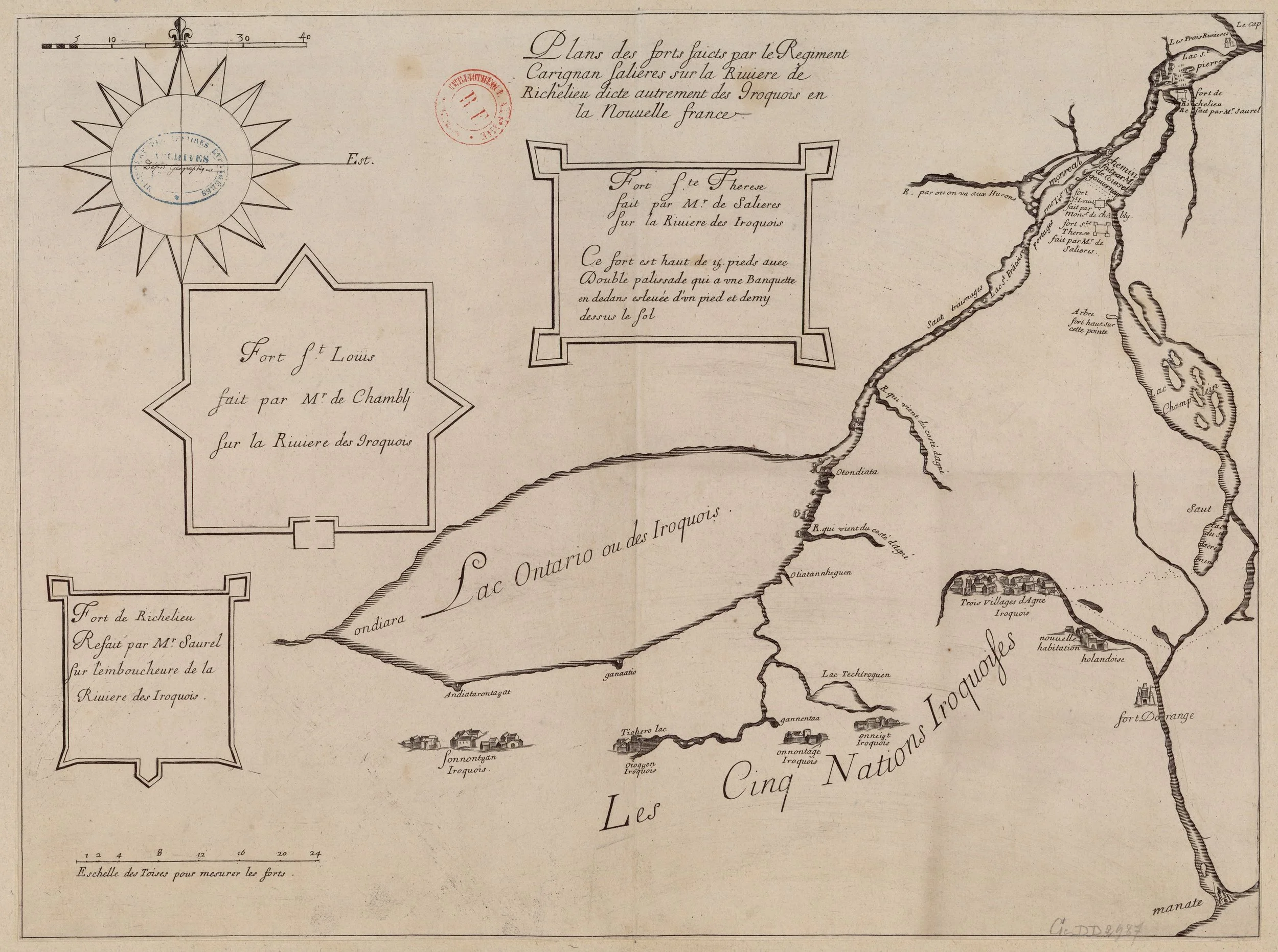
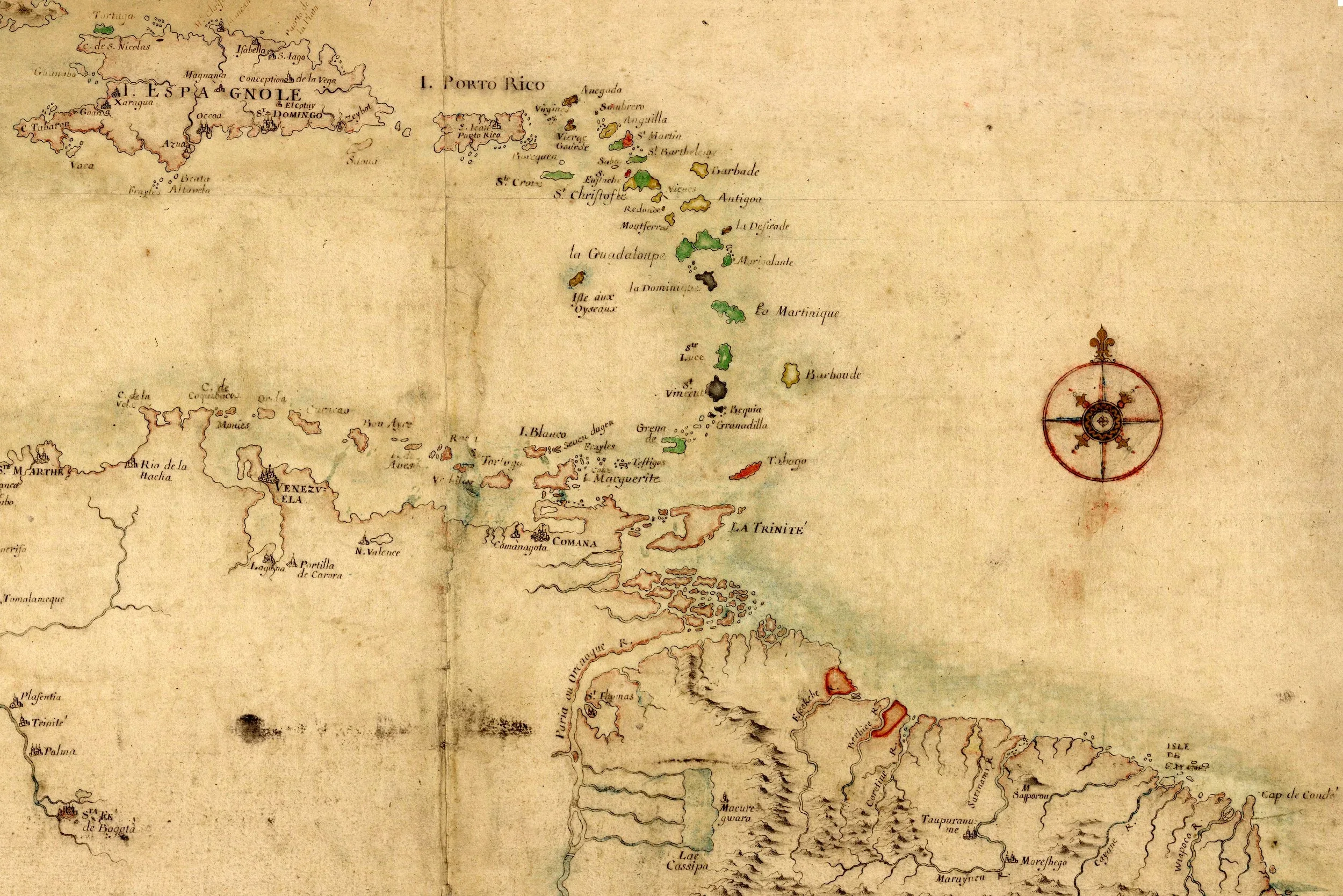
The La Brisardière company was one of four detached from their regiments to serve under Alexandre de Prouville de Tracy, newly appointed Lieutenant-General of French America. The others were Berthier, La Durantaye and Monteil. Their mission was to re-establish French authority across the Americas, beginning in the Caribbean.
The published history of that expedition is well established: departure from La Rochelle aboard the Brézé in February 1664; the recapture of Cayenne from the Dutch that May; a passage through Martinique, Guadeloupe and Grenada; and a winter in the islands before the voyage north. Tropical disease killed more men than fighting did. The Brézé left Guadeloupe on 25 April 1665 with Tracy aboard, and did not dock at Quebec: she moored at Gaspé, and two smaller vessels carried the four companies upriver, arriving 30 June.
The four Caribbean companies joined the main body of the Carignan-Salières Regiment, which had crossed separately, and served under the same command and in the same campaigns. They were exempted from the fort-building along the Richelieu during the winter of 1665–66; they had done their service already.
From Soldier to Habitant, 1666–1668
When the campaign closed, the soldiers were offered a choice: sail home with the regiment, or stay in Canada as settlers with land, seed and supplies. Of roughly twelve hundred men, something near four hundred stayed. Jean Perrier was one of them.
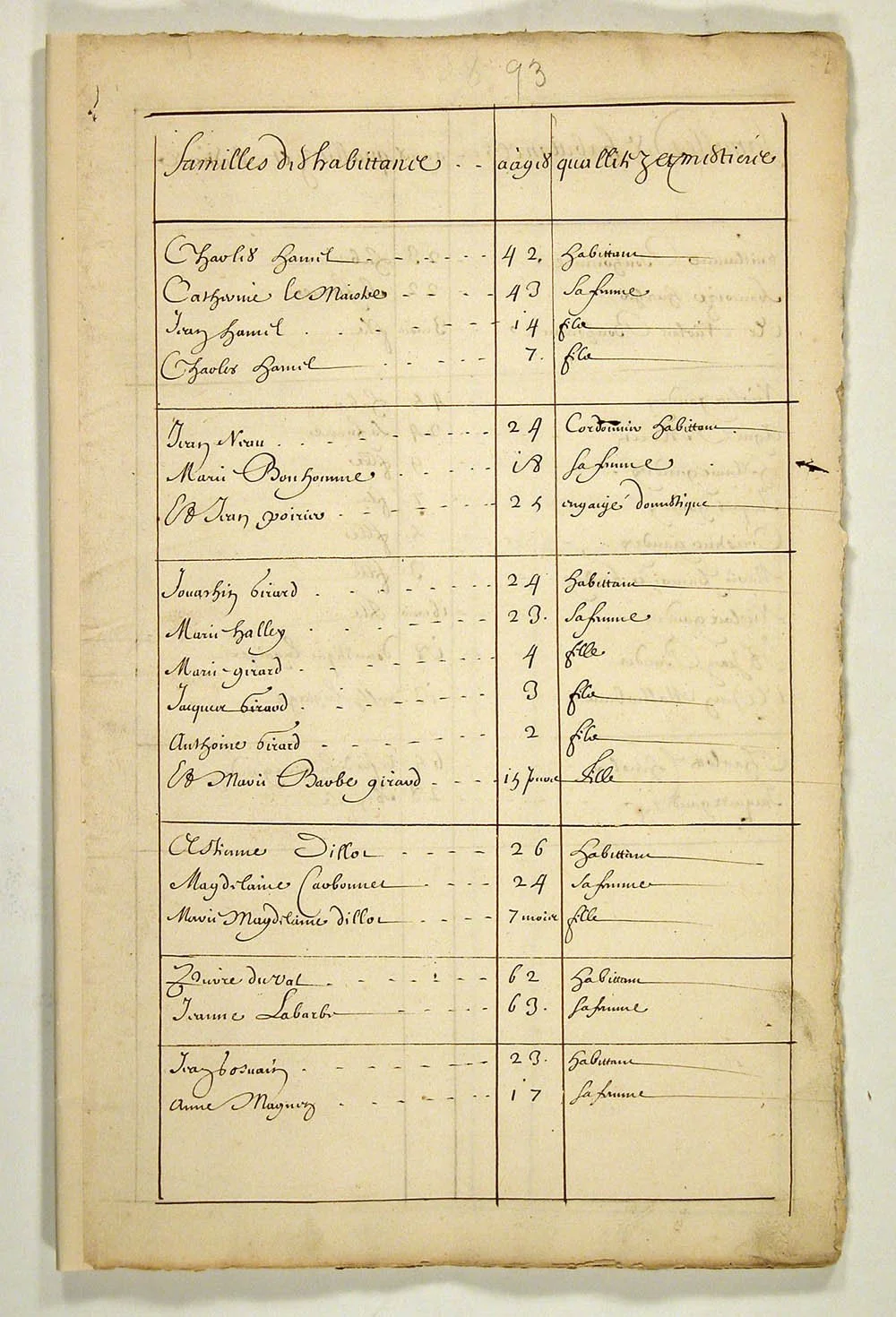
The transition was not immediate. He received the scapular at Quebec in May 1666 — Gagné's appendix of those who took it gives the month, his biography of Perrier the 23rd. The census of that year finds him not on land of his own but in another man's house, in the Côte Saint-Jean or Saint-François near Quebec City:
Census of 1666, household of Jean Nau
Marie Bonhomme — 18 — sa femme
Et Jean poirier — 24 — engagé domestique
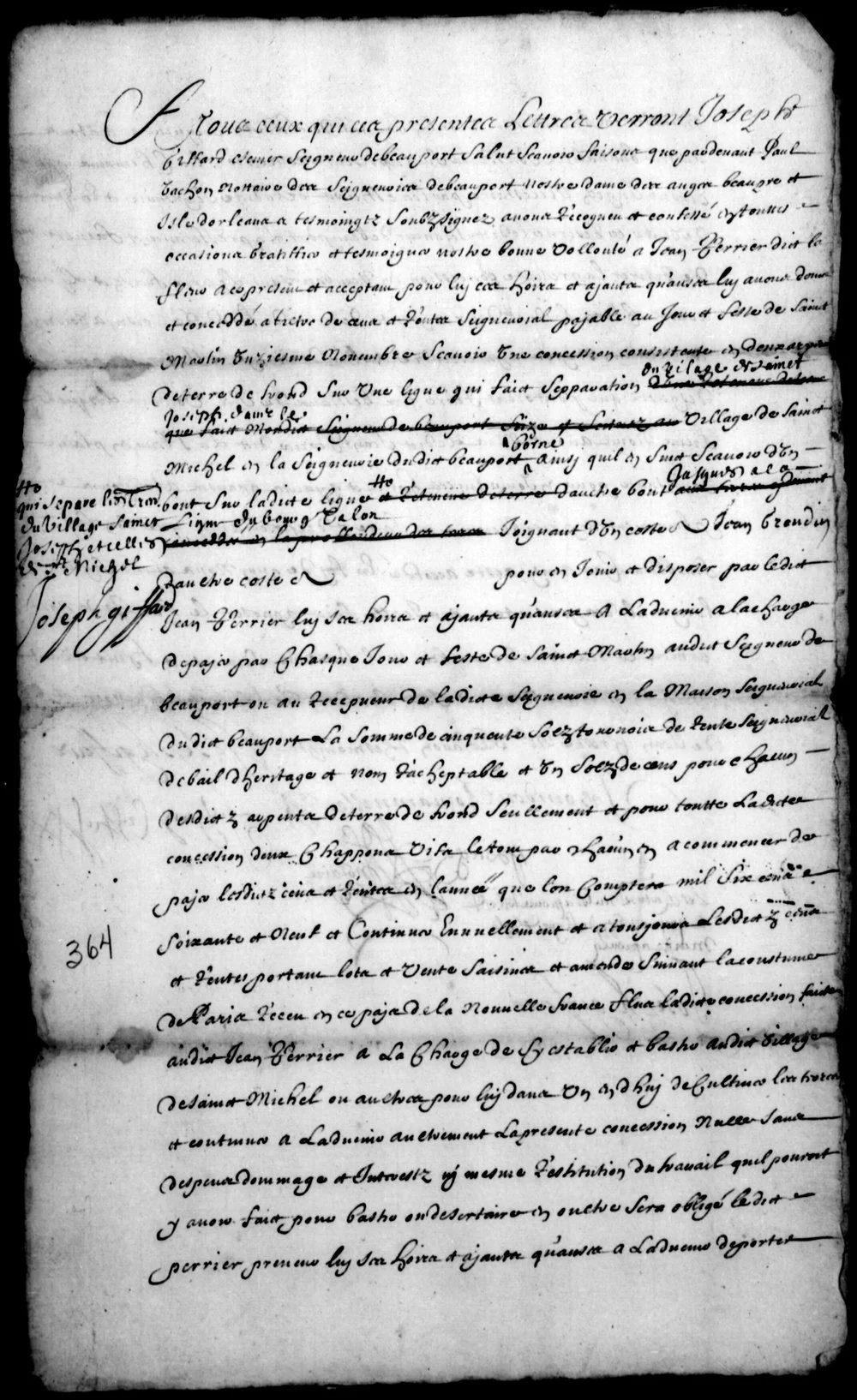
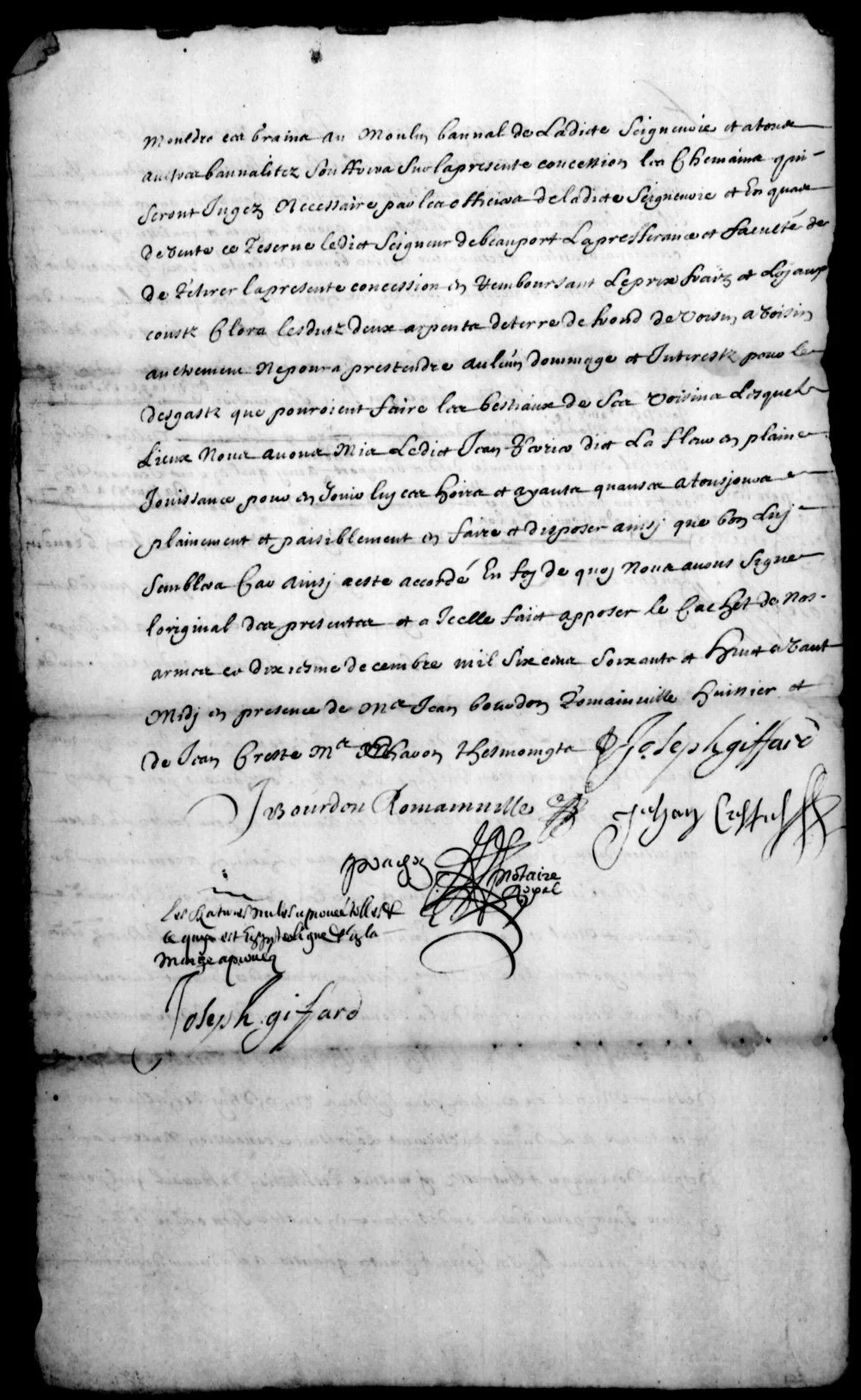
On 10 December 1668, before noon, Joseph Giffard, écuyer and seigneur of Beauport, granted him a concession of his own. The document was drawn by Paul Vachon, notary of the seigneuries of Beauport, Notre-Dame-des-Anges, Beaupré and the Île d'Orléans, and witnessed by Jean Bourdon Romainville, bailiff, and Jean Cresté, master wheelwright.
The grant was two arpents of frontage in the village of Saint-Michel. Against it Jean owed an annual cens et rentes of fifty sols payable at Martinmas, one sol of cens for each arpent of frontage, and two live capons, the payments to begin in 1669. He was bound to grind his grain at the seigneurial mill, to permit roads across the land where the seigneury judged them necessary, and to fence his frontage from neighbour to neighbour. He could claim nothing for damage done by his neighbours' livestock.
Marriage to a Fille du roi, 1669
In the summer of 1669 the ships brought another cohort of Filles du roi. Among them was Marie Gaillard, from the parish of Clermont-Sainte-Croix in the archdiocese of Rouen, then in her early twenties. A marriage contract was drawn on 22 September before the notary Romain Becquet. Two weeks later they were married.
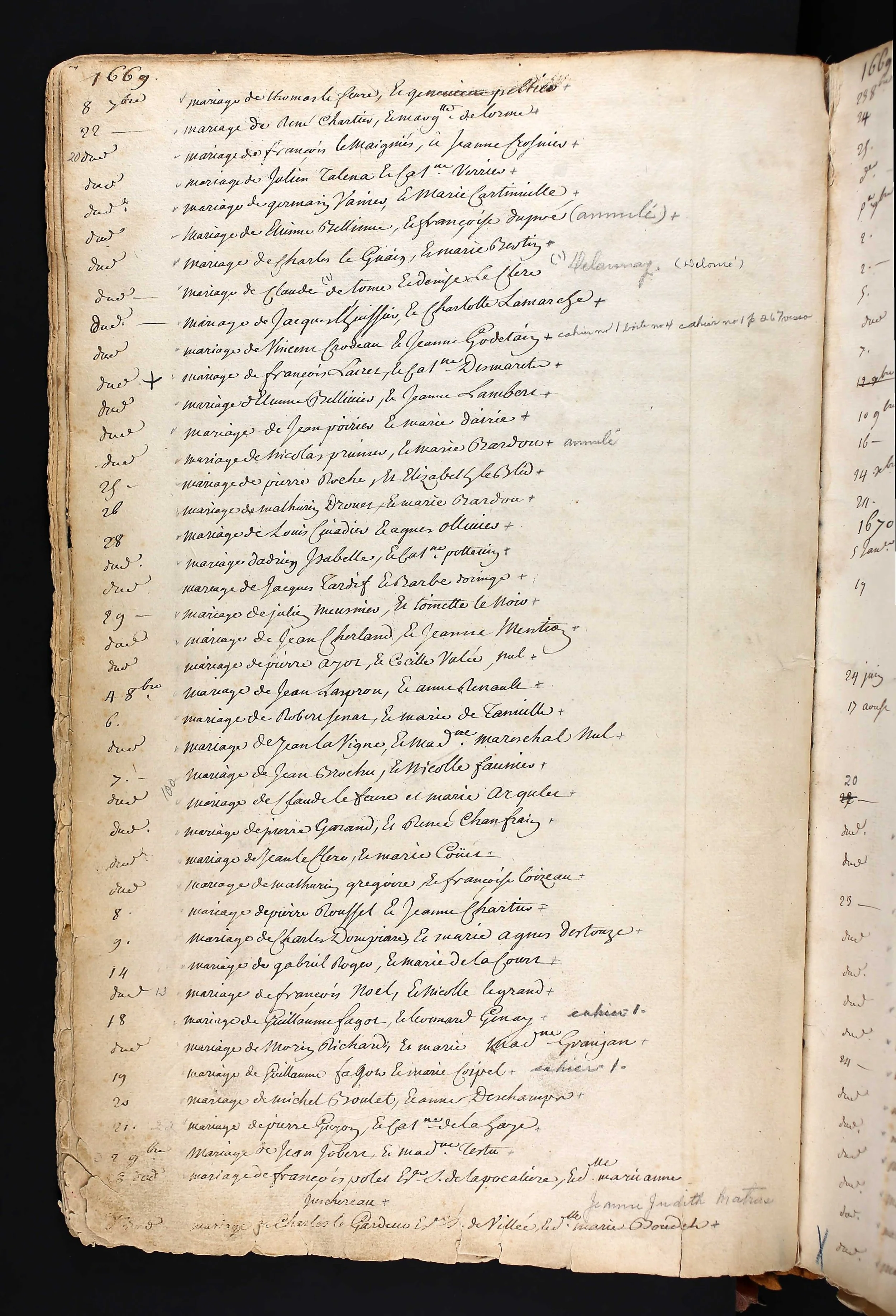
Marriage Register, Notre-Dame de Québec, 6 October 1669
The register calls him Poirier. His children's baptisms call him Perier dit Lafleur. The forms alternate throughout the records of this family, and the compiled databases index him under both.
The Bishop dispensed the couple from the third bann. The register entry carries no signature clause, but the marriage contract of two weeks earlier does, and it is explicit: led. futur espoux et la future espouse ont declaré ne sçavoir escrire ny signer de ce enquis suivant l'ordonnance. Neither of them could write.
That contract, drawn before Romain Becquet on 22 September 1669, also records where the match was made. It was passed at Québec en la maison de lad. dame Bourdon — the house of Anne Gasnier, widow of Jean Bourdon, procureur général au Conseil Souverain, where the Filles du roi were lodged. She signed it, and so did Marie-Barbe de Boullongne, widow of Louis d'Ailleboust, formerly governor of New France; both are named in the act among the parens et amis assembled for the bride. Jean is described there as an habitant at the côte de Beauport, so he came to the arrangement with the concession of December 1668 already his. The full act is treated on Marie Gaillard's page.
How Jean Perrier Connects to the Guilbault Line
8th ggf → Marie Madeleine Josephe Perrier
7th ggm • m. Pierre Sabourin → Marie Madeleine Sabourin
6th ggm → Jean Baptiste LaRocque dit Roquebrune
5th ggf → Joseph Couillaud Larocque
4th ggf → Marie Madeleine Roquebrune Laroque → Evangeliste Guilbault → Elisabeth Emma Guilbault Gilbert
Because his daughter married her stepbrother in 1688, descendants of that union descend from Jean Perrier through Madeleine and from Jean Sabourin through Pierre. The two lines converge in Marie Madeleine Sabourin, born 1699.
The Household at Beauport, 1669–1682
Between 1670 and 1680 Marie Gaillard bore six children, and possibly a seventh. Six of them were living when the census-taker came in November 1681.
The Children of Jean Perrier and Marie Gaillard
Six or seven children born between 1670 and 1680; six living at the 1681 census. The cards below give six, because the two compilations differ over whether the February 1674 baptism records a seventh child.
Marie Perrier
Marie Marthe Perrier
Jacques Perrier
Marie Madeleine Josephe Perrier — or a son Jean
Marie Marguerite Perrier
François Madeleine Perrier
What the 1681 Census Shows
The enumeration of 14 November 1681 records the household at Beauport in full: Jean Perrier at thirty-five, Marie Gaillard at thirty-four, and six children beneath them — the twins bracketed together at eleven or twelve, Jacques at eight, Madeleine at six, Marguerite at four, and François given in months.
Against the household stands one entry: fusil. One gun. The columns for livestock and for arpents under cultivation are blank.
| Household (same folio) | Arms | Livestock | Arpents in value |
|---|---|---|---|
| Michel Filion | 1 fusil, 1 pistolet | 10 bêtes à cornes | 25 |
| Mathurin Chaillé | 1 fusil | 4 bêtes à cornes | 10 |
| Jean Perrier | 1 fusil | blank | blank |
The enumerator filled those columns wherever there was something to record. The Perrier blanks are therefore evidence, not omission.
Thirteen years after the concession, the two arpents of frontage had produced nothing worth writing down. The older reading of this page attributed that to a soldier's lack of farming skill. The 1683 record suggests a simpler explanation: Jean Perrier was a master weaver. He held land because land was what the crown gave discharged soldiers, and he worked at the trade he knew.
A Death Without a Record
Jean Perrier died between 14 November 1681, when the census found him alive, and 22 September 1682, when his widow married again. He was somewhere between thirty-six and forty.
No burial record has been located. His death is established entirely by the description of Marie Gaillard as veufve de deffunct Jean Baptiste Perier in the Beauport marriage register of September 1682, and again in her marriage contract of 1684.
Those two documents are also the only ones that call him Jean Baptiste. Every other record touching him uses the plain form: Jean poirier at his marriage in 1669, Jean Perier dit lafleur at his son's baptism in 1674, deffunct jean perier at his daughter's marriage in 1683, and defunct Jean Perrier at his daughter Madeleine's marriage in 1688. He is styled Jean throughout this series on that evidence.
His widow did not wait. A single bann was published at Beauport on 21 September 1682, the Bishop of Quebec dispensing with the other two, and on the 22nd Marie Gaillard married Jean Sabourin, a widower from the parish of Mont-Lambert in the diocese of Angoulême. The witnesses were Paul Vachon, royal notary, and his son Vincent. Their marriage contract was not drawn until 27 September 1684, two years afterward — and the original minute, when read, proves to be written in the future tense of a contract drawn before a wedding. That anomaly belongs to her page rather than his, but it is worth noting that the two documents establishing Jean Perrier's death are the same two that pose it.
There is a coincidence of dates worth noting and not overreading: Marie's 1669 marriage contract with Jean Perrier and her 1682 marriage to Jean Sabourin fall on the same day of the year, thirteen years apart. It is an interval between two different kinds of instrument, and nothing in either document suggests it was intended.
Legacy
Jean Perrier lived in New France for seventeen years. He died young, on land he had never cleared, and left a widow with six children and one gun. By any measure available to him at the time, the life was unremarkable.
Denis Beauregard's Genealogy of the French in North America estimates that between 1,050,000 and 1,470,000 Quebecers descend from his marriage to Marie Gaillard — thirteen generations and 4,021 marriages in the database, the most recent recorded in 2020. The line that carried his surname fared less well: by strict male descent the same database records nine generations and thirty-eight marriages, the last of them in 1956.
Unresolved Questions
| Question | State of the evidence |
|---|---|
| Year of birth | 1666 census implies c. 1642; 1681 census implies c. 1646. Both are estimates recorded by others. |
| The February 1674 child | The greffe transcript of the Beauport register names Jean; PRDH assigns the entry to Marie Madeleine; DGFQ and DGAQ presume one person. The census age of six for Madeleine implies a birth about 1675 and leans against the merge without settling it. The contemporaneous Beauport volume has not been read for this entry, and collation at the 1682 marriage shows the transcript is not word-perfect — so the given name itself is not yet secure. |
| The groom of 1711 | The Lachine register names him Jean Perrier, son of Jean Perrier and Marie Gaillard, and PRDH transcribes the act the same way in marriage no. 14381 — then attaches it, in family no. 2848, to Jacques, baptized December 1672. Whether one man is meant under two names, or a second son survived to 1711, is not established. The entry survives as a later registrar's copy, which is a further reason not to press the spelling too hard. |
| Death and burial | No burial record located in the Beauport register for 1681–82. Death established only by his widow's status in September 1682. |
| The name Jean Baptiste | Appears in only two documents, the 1682 marriage register and the 1684 contract, both made after his death and both concerning his widow's remarriage. Four other records — 1669, 1674, 1683 and 1688 — use the plain Jean. Treated here as an outlier in a related pair of documents rather than as his name. |
| His company, and therefore his arrival | The Vachon act of 23 October 1667 places him in the company of Monsieur Vincent, identified as Chambly by three of its own people — the sergeant Mongion, the soldier Nicolas Morin dit Larose, and the ensign Jean-Vincent d'Abbadie de Saint-Castin. The 1668 roll places a Perier under La Brisardière of the Régiment d'Orléans, whose captain was André Labrisardière. The two are fourteen months apart and both contemporary. A transfer, a clerical misplacement on the roll, or a second man named Perier would each account for it. Gagné is divided against himself here: the biography and the Chambly roster give Chambly, while the scapular appendix reads possible Labrisardière and the La Brisardière roster leaves that company's third roll name unaccounted. Langlois, independently, places Perrier within the La Brisardière company at cs 517.24, between Joncas at 517.23 and Toupin at 517.25. Documented transfers elsewhere in the corpus make a move between the act and the roll a live explanation. The consequence is not trivial: Chambly reached Quebec on 19 June 1665 aboard the Vieux Siméon and was never in the Caribbean, while La Brisardière reached Quebec on 30 June 1665 aboard the Brézé after a year in the West Indies. |
| François Madeleine after 1700 | Engaged for the West with his brother Jacques on 9 August 1700, so alive at twenty. No marriage, death or burial found thereafter. The engagement contract itself has not been retrieved. |
| The diocese of Pau | Bayonne in 1669; Bordeaux in 1683. Neither correct for the period. |
| His father's trade | Previously stated on this page as master weaver. No source for it has been located. The trade is documented for Jean himself, not for his father, and where he learned it is unknown. |
Timeline
Primary Sources
The documents in which Jean Perrier appears, from the military roll of 1668 to the record that names his trade a year after his death.







Sources
Census Records
- “Recensement du Canada, 1666,” digital images, Library and Archives Canada, household of Jean Nau, page 93; Jean Poirier, age 24, engagé domestique; finding aid MSS0446, MIKAN 2318856; citing Centre des archives d'outre-mer (France), G1 vol. 460, folio 45v.
- “Recensement du Canada fait par l'intendant Du Chesneau,” digital images, Library and Archives Canada, household of Jean Perrier, 14 November 1681, Beauport; Jean Perrier 35, Marie Gaillard 34, six children (twins bracketed at 11 or 12, Jacques 8, Madeleine 6, Marguerite 4, François in months); one fusil, livestock and arpents columns blank. Compare on the same folio the households of Michel Filion and Mathurin Chaillé. Finding aid MSS0446, MIKAN 2318858; citing G1 vol. 460.
Military Records
- “Roll of the Soldiers of the Regiment of Carignan-Salières who became inhabitants of Canada in 1668,” Library and Archives Canada. The manuscript is arranged by company, each heading written large and offset; the four companies detached to Tracy — Berthier, La Durantaye, Monteil and La Brisardière — close the roll, after every Carignan company. Under the heading La Brisardière stand three names only: La Combe, Tranchemontagne and Perier, the last read at 400 dpi with a long initial swash and no descender in the third letter. Gagné's reconstructed rosters, which mark roll names in bold, bold the first two under La Brisardière and bold Perrier under Chambly; the third La Brisardière roll name is left unaccounted. The finding-aid index renders the company La Brisandière. That is not simply an index slip: the Société des Filles du roi et soldats du Carignan records that the company “was detached from the Orléans Regiment and was also listed as La Brisandiere,” so both forms are attested. The manuscript form is used throughout this page because it is the manuscript form. The Genealogy of the French in North America also gives Brisardière, under source code cs 517.24 — on which see the Langlois entry below.
Parish Registers
- Notre-Dame de Québec, “Baptêmes, mariages, sépultures 1621–1679,” page 347, marriage of Jean Poirier and Marie Daire, 6 October 1669; witnesses Guillaume du Bault, Pierre le Mercier, Clement Guerin; officiating H. de Bernières.
- Notre-Dame de Québec, “Baptêmes, mariages, sépultures 1667–1679,” page 59, baptisms of Marthe and Marie, 22 August 1670, born the previous day, administered en la chapelle de Beauport by Father Jean Blanchet, S.J.; godparents Nicolas Bellanger and Marthe de Rainville, wife of Pierre Marcou (Marthe), and Pierre Toupin dit Lapierre and Marie Michel, wife of Paul de Rainville (Marie).
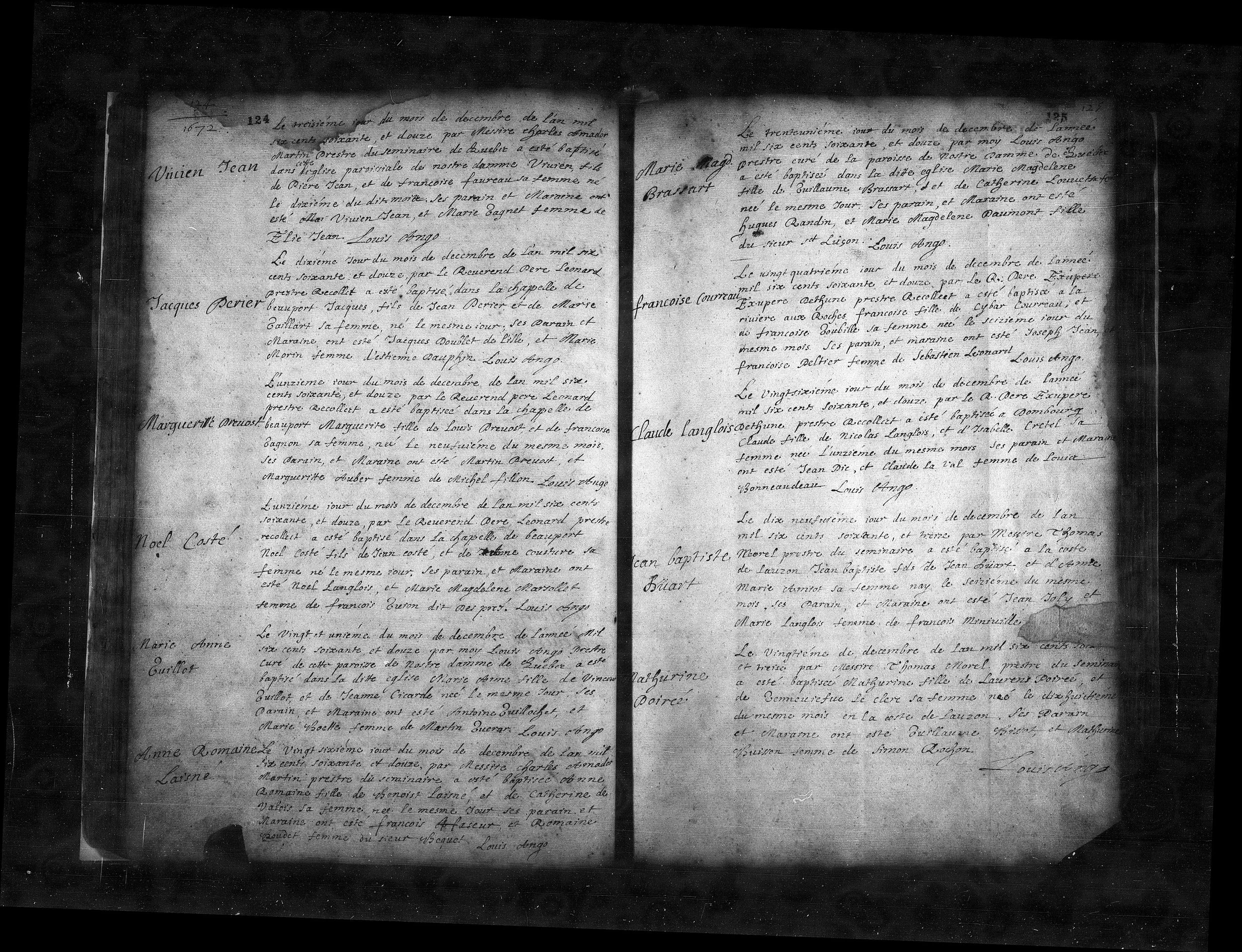
- Notre-Dame de Québec, “Baptêmes, mariages, sépultures 1667–1679,” page 124, baptism of Jacques, son of Jean Perier and Marie Gaillart, 10 December 1672, born the same day, administered dans la chapelle de Beauport by Father Léonard, Récollet; godparents Jacques Doublet de l'Isle and Marie Morin, wife of Estienne Dauphin; entry written by Louis Ango, curé of Notre-Dame de Québec. Indexed to Québec although the ceremony took place at Beauport, as with the 1670 twins; PRDH notes the point on its baptism card.
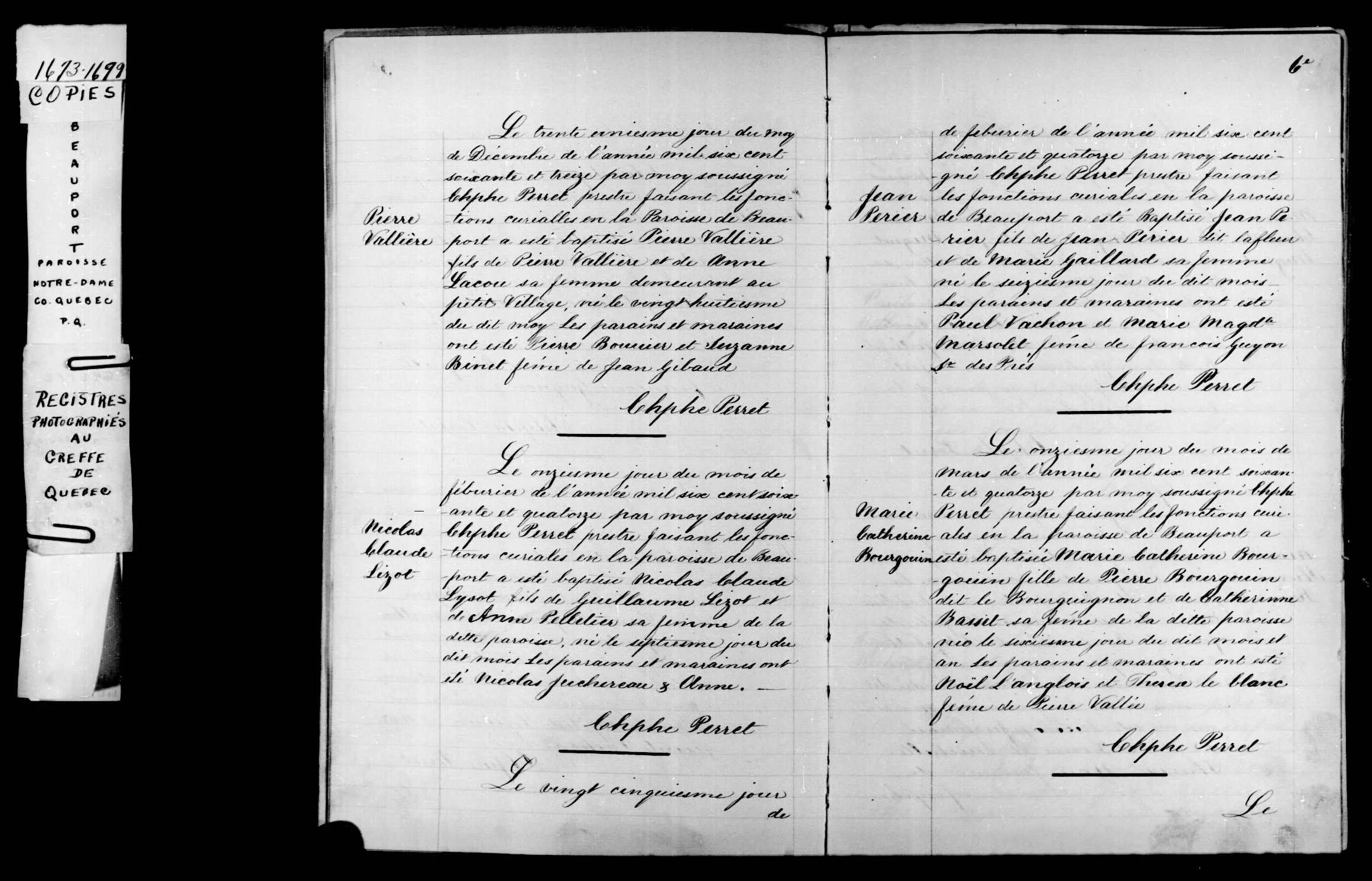
- Nativité-de-Notre-Dame de Beauport, “Baptêmes, mariages, sépultures 1673–1699” (greffe transcript), folio 6, baptism of Jean Perier, born 16 February and baptized 25 February 1674; godparents Paul Vachon and Marie Madeleine Marsolet, wife of François Guyon Sieur des Prés; officiating Christophe Perret. Read in the transcript only. The contemporaneous Beauport volume covers February 1674 and has not yet been checked for this entry; since the transcript is demonstrably not word-perfect (see the 1682 marriage below), the given name needs confirming in the seventeenth-century hand.
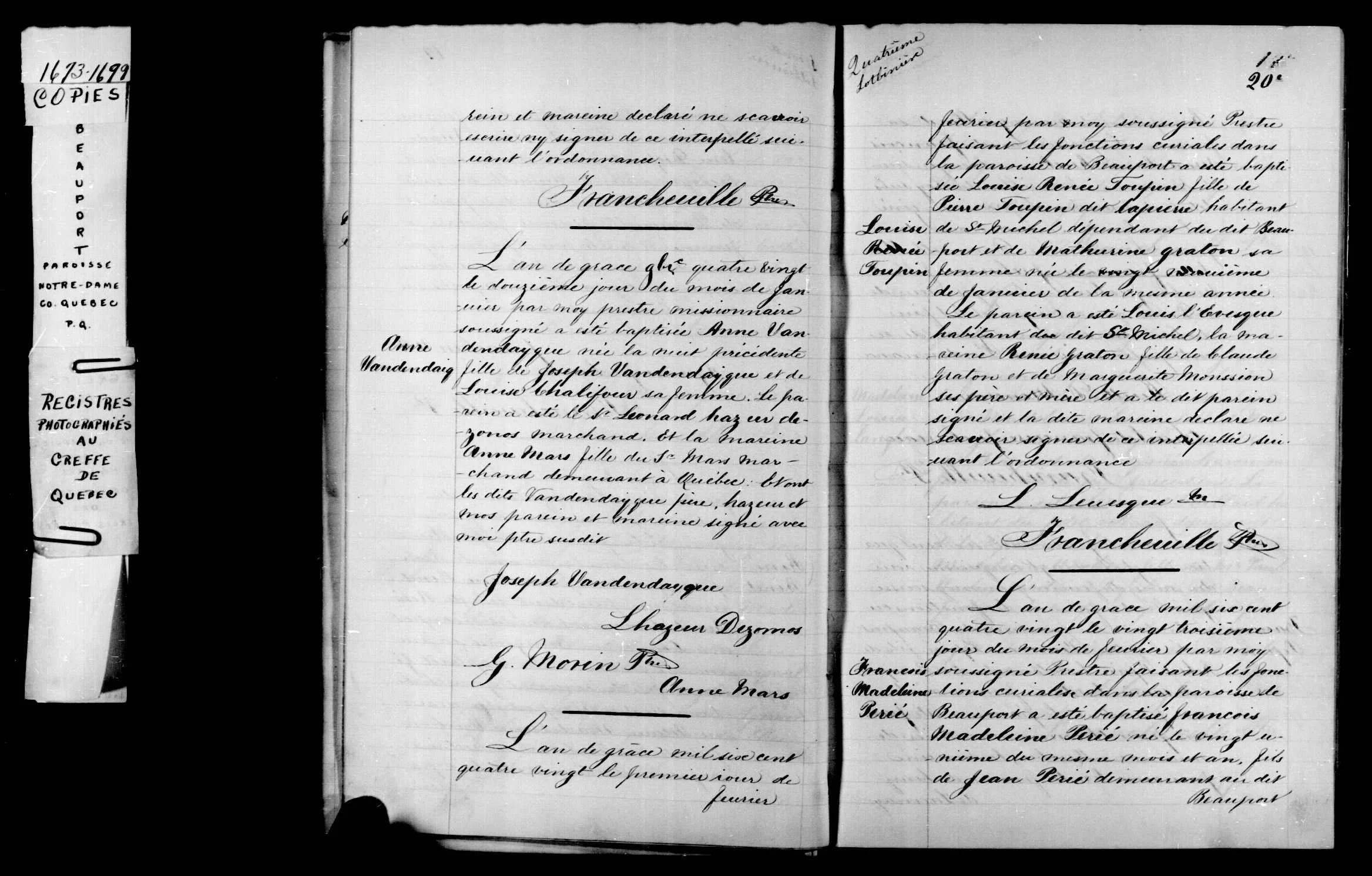
- Nativité-de-Notre-Dame de Beauport, “Baptêmes, mariages, sépultures 1673–1699” (greffe transcript, not yet collated with the contemporaneous register), folio 20, baptism of François Madeleine Perié, son of Jean Perié and Marie Gaillard, 23 February 1680, born 21 February; godfather François Madeleine Ruette Demonceaux, écuyer, conseiller du roi and deputy attorney general at the Conseil Souverain; godmother Charlotte Françoise Juchereau, six-year-old daughter of Nicolas Juchereau des Denis, écuyer; officiating Francheville, priest. Compare PRDH-IGD baptism no. 75932.
- Nativité-de-Notre-Dame de Beauport, folio 43, marriage of Jean Sabourin, widower of Mathurine Renou, of Mont-Lambert, diocese of Angoulême, and Marie Gaillard, widow of the late Jean Baptiste Perier, 22 September 1682; officiating Charles Amador Martin; witnesses Paul Vachon, royal notary, and Vincent Vachon, both signing. Read in both surviving exemplars: the contemporaneous cahiers (“Baptêmes, mariages, sépultures 1681–1744,” image 12 of 389, FamilySearch ark:/61903/3:1:3QSQ-G99S-NZW5, waypoint HCSM-FM9) and the greffe transcript, which differ in one sentence: the former styles the officiant prestre faisant les fonctions curiales en la paroisse de Beauport and calls the bride de cette paroisse, the latter prestre curé de Beauport without the phrase. Neither exemplar records the parties as signing or as unable to sign. The phrase veufve de deffunct Jean Baptiste Perier stands in both.
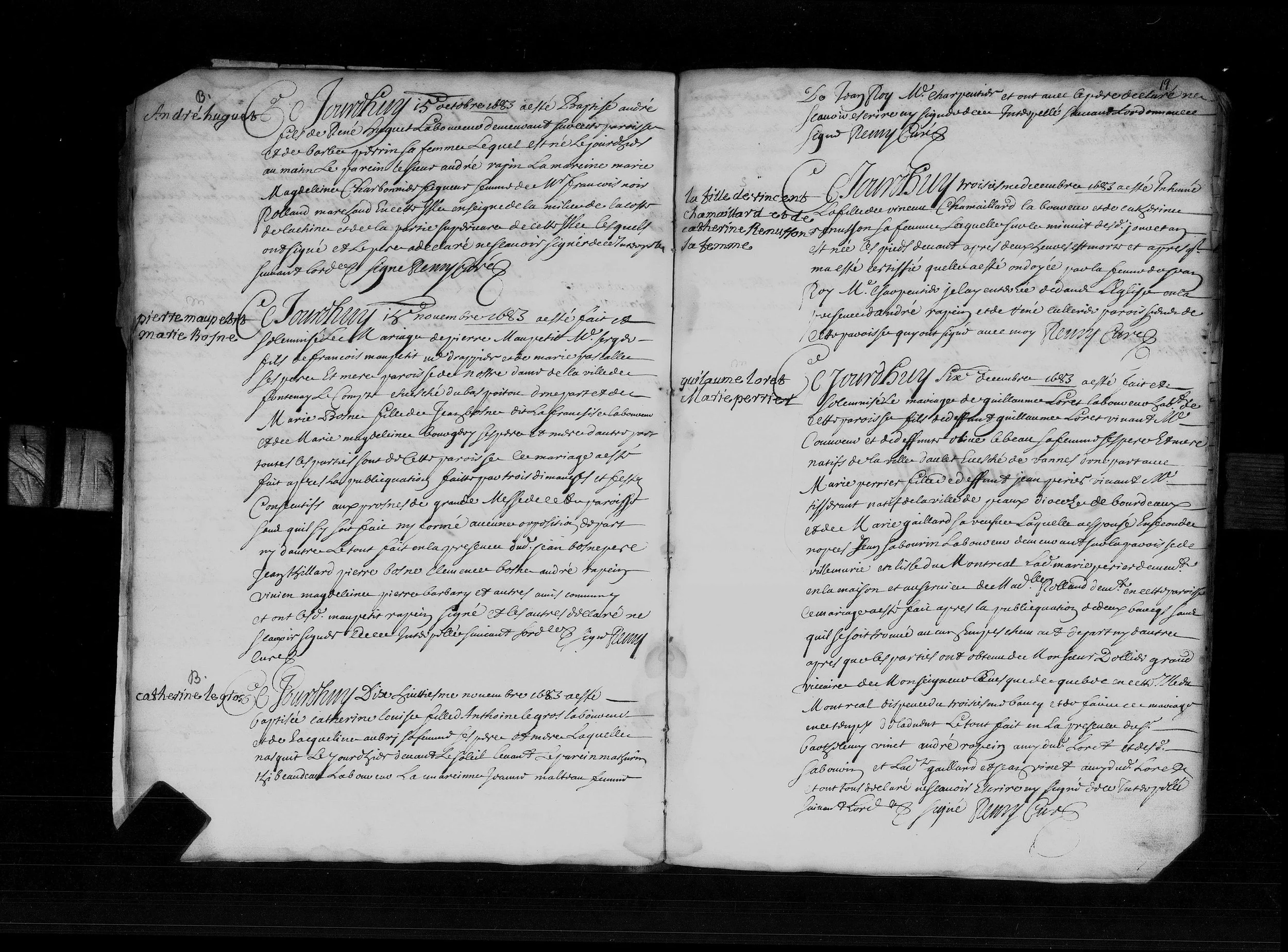
- Saints-Anges de Lachine, marriage of Guillaume Loret and Marie Perrier, 6 December 1683, naming the bride's father as deffunct jean perier vivant maître tisserand natif de la ville de Pau; digital image, FamilySearch (https://familysearch.org/ark:/61903/3:1:3QS7-L993-4QMP), image 346 of 862; citing Archives nationales du Québec, Montréal.
- Notre-Dame de Montréal, “Baptêmes, mariages, sépultures 1681–1694,” marriage of [given name not recorded] Charlebois dit Jolly, of the company of the Marquis de Crisafy, son of Antoine Charlebois of the parish of Saint-André, ville de Saint-Macaire, diocese of Bordeaux, and of Marie Dosque, and Marthe Perrier, daughter of the late Jean Perrier and Marie Gaillard, 25 November 1686; banns published without impediment. Compare PRDH-IGD marriage no. 47505, which leaves the groom's given name blank and records that the officiant did not sign.
- Notre-Dame de Montréal, marriage of Pierre Sabourin and Magdeleine Perrier, 24 May 1688, naming the bride's father as defunct Jean Perrier; digital image, FamilySearch (https://familysearch.org/ark:/61903/3:1:3QSQ-G9MB-DQ4G), image 560 of 1937; citing Archives nationales du Québec, Montréal.
- Notre-Dame de Montréal, “Baptêmes, mariages, sépultures 1681–1694,” marriage of Jacques Thommelet, son of Jean Thommelet and Catherine Badreau, of the bourg de la Coupechanière, diocese of Luçon, and Marguerite Perrier, daughter of the late Jean Perrier and Marie Gaillard, 1 September 1692; dispensation from two banns; witnesses Alexis Bau and Jean Sabourin, described in the entry as le beau-père de l'épouse, with Jacob Tournelet; officiating Étienne Guyotte, curé. Compare PRDH-IGD marriage no. 47586.
- Saints-Anges de Lachine, “Baptêmes, mariages, sépultures 1676–1756,” folio 45, marriage of Jean Brunet, son of Mathieu Brunet dit Lestang and Marie Blanchard, and Marie Perrier, widow of Guillaume Lauret dit Lafontaine, 19 October 1694; present on the bride's side Jean Sabourin and Marie Gaillard his wife, mere de la dite Perrier, and Barbe du Chesne, all declaring they did not know how to sign; officiating Rémy, curé. Compare PRDH-IGD marriage no. 14309.
- Saints-Anges de Lachine, “Baptêmes, mariages, sépultures 1676–1756,” folio 47 (registrar's copy laid over the original leaf), marriage of Jean Perrier, fils de Jean Perrier et de Marie Gaillard, and Marguerite Paré, daughter of Jean Paré and Marguerite Picard, 30 November 1711; two banns published and the third dispensed by M. de la Colombière, vicar general; present Jean Paré and Jacob Toumelet, who signed, and Jean Brunet and Martin Foucher, who could not; officiating Villermaula, curé. PRDH-IGD marriage no. 14381 transcribes the groom's given name as Jean; PRDH family no. 2848 attaches the marriage to Jacques Perrier, baptized 10 December 1672.
- Saints-Anges de Lachine, “Baptêmes, mariages, sépultures 1676–1756,” folio 160, marriage of Michel Baugis, widower of Marie Manville, and Marguerite Perier, widow of Jacques Tomelet, aged about forty-eight, 2 December 1726, after one publication, the other two dispensed by M. de Belmont, vicar general; present Marie Perier of Pointe-Claire, sister of the bride, and Élisabeth Messaguer, her niece; officiating J. Le Tessier, curé. Compare PRDH-IGD marriage no. 14431.
Notarial Records
- Land concession, Joseph Giffard to Jean Perrier dit Lafleur, 10 December 1668, before Paul Vachon; two arpents of frontage at Saint-Michel, Beauport; witnesses Jean Bourdon Romainville and Jean Cresté. Bibliothèque et Archives nationales du Québec.
- Marriage contract, Pierre Rivaux and Marie Quequejeu, 23 October 1667, before Paul Vachon, notary and greffier of the seigneuries of Beauport, Notre-Dame-des-Anges and l'Isle d'Orléans; original minute, Greffe de Paul Vachon, CN301,S266, Bibliothèque et Archives nationales du Québec; digital images, BAnQ numérique (https://numerique.banq.qc.ca/patrimoine/details/52327/4215634 : accessed 4 September 2026), files 1144–1147. Names among the bride's friends Benois Faurre sieur Mongion, sergent en la compagnie de Monsieur Vincent au Regiment de Carignan, de Nicolas Morin sieur La Roze, de Jean Perier sieur Lafleur, soldats en la dite compagnie. Passed in the house of the said Faurre, master surgeon. Signed by Nicolas Morin, Jacques Cassé, Pierre de la Vallée and Vachon; the closing clause lists those declaring they could not write or sign, the first name on that line reading as Perier, the leaf stained at the margin. The act names no company beyond that of Monsieur Vincent.
- Marriage contract, Jean Poirier and Marie Daire, 22 September 1669, before Romain Becquet, royal notary, Québec; original minute, folios 272–273, Greffe de Romain Becquet, CN301,S13, Bibliothèque et Archives nationales du Québec; digital images, BAnQ numérique (https://numerique.banq.qc.ca/patrimoine/details/52327/4064889 : accessed 4 September 2026), files 968–970. Groom described as habitant at the côte de Beauport, son of the late Jean Poirier and Marie Dervé of the parish of Pau, diocese of Bayonne. Passed at Québec in the house of dame Bourdon before noon; among the parens et amis for the bride, Marie-Barbe de Boullongne, widow of Louis d'Ailleboust, and Anne Gasnier, widow of Jean Bourdon; signed by both women and by the notary. The act closes: led. futur espoux et la future espouse ont declaré ne sçavoir escrire ny signer de ce enquis suivant l'ordonnance — the only located document to state that Jean Perrier could not write.
- Marriage contract, Jean Sabourin and Marie Gaillard, 27 September 1684, before Paul Vachon, royal notary, bourg du Fargy, Beauport; original minute, Greffe de Paul Vachon, CN301,S266, Bibliothèque et Archives nationales du Québec; digital images, BAnQ numérique (https://numerique.banq.qc.ca/patrimoine/details/52327/4215637), files 459–462. Names the bride as widow of the late Jean Baptiste Perier. Cited here only for its description of Jean Perrier as deceased; the act is treated in full on Marie Gaillard's page.
Compiled Databases
- PRDH-IGD, Université de Montréal: couple no. 2848 (Jean Perrier and Marie Gaillard); couple no. 2849 (his parents, Jean Poirier Perrier and Marie Dervie); individual no. 22753 (Marie Gaillard); individual no. 28379 (Marie Madeleine Josephe Perrier); individual no. 5034 (Marie Marguerite Perrier); baptisms nos. 58457 and 58460 (the twins); baptism no. 75932 (François Madeleine, 1680); marriage nos. 47505 (1686), 47586 (1692), 14309 (1694), 14381 (1711) and 14431 (1726). Read in the French interface.
- Langlois, Michel. Carignan-Salière, 1665–1668. Page 517, rank 24: Jean Perrier ou Poirier dit Lafleur, soldier of the compagnie La Brisardière, régiment d'Orléans. Ranks 23 and 25 on the same page are Pierre Joncas dit Lapierre and Pierre Toupin dit Lapierre of the same company. Not consulted directly for this page; the placement is taken from Beauregard's tables, which cite Langlois by page and rank under the abbreviation cs and state that convention explicitly. Langlois's volume also contains lists of presumed soldiers identified through joint confirmations and through enrolment in the confrérie du Scapulaire, which is the likely origin of the scapular dates repeated by later compilers.
- Beauregard, Denis. “Régiment de Carignan” and “Troupes de Tracy,” FrancoGène (https://www.francogene.com/gfan/gfan/998/carignan.html and .../tracy.html : accessed 4 September 2026). Two tables, the first expressly excluding the four companies that came with Tracy. Jean Perrier appears on the second, among the La Brisardière men, and not on the first. The four detached companies are given as Berthier (Allier), La Brisardière (Orléans), Monteil (Poitou) and Morel (Chambellé). A further table of cases rejected by Langlois includes Jean Vincent d'Abbadie de Saint-Castin at cs 138.01 and Jacques Doublet dit Delisle at cs 141.07; both readings are Beauregard's summary of Langlois and require verification in Langlois himself.
- Beauregard, Denis. “Genealogy of the French in North America,” family sheet [1125]; reference line PRDH-RAB, Parchemin. Gives his company as La Brisardière of the régiment d'Orléans under source code cs 517,24, and his birth as about 1646 on the 1681 census alone. Source of the descendant estimate of 1,050,000–1,470,000 Quebecers — 13 generations and 4,021 marriages in the database, the most recent in 2020; by strict male line 9 generations and 38 marriages, the last in 1956 — and of the note that DGFQ and DGAQ presume Jean and Madeleine to be the same person.
- Fichier Origine, Fédération québécoise des sociétés de généalogie: Jean Perrier, Pau, Pyrénées-Atlantiques.
Secondary Sources
- Eccles, W. J. Canada Under Louis XIV, 1663–1701. Toronto: McClelland and Stewart, 1964. Source for the movements of the Tracy expedition and the Iroquois campaign.
- Gagné, Peter J. From Soldiers to Settlers: The Carignan-Salières Regiment in Canada, 1665–1668. Volume 2, pages 531–532, entries for Perrier dit Lafleur, Jean, and (page 532) Sabourin, Jean. 2025. Source line for the Perrier entry: Gareau, Jetté, PRDH, Roy & Malchelosse, Tanguay, Trudel, Verney — compilations, several dependent on one another, so not an independent witness on register facts. Additive on archival matters: the Vachon act of 23 October 1667, the engagements Ouest of 9 August 1700, and Marie Gaillard's dowry figures. Also the source for the reconstructed company rosters used above: the Labrisardière company of the Régiment d'Orléans under Captain André Labrisardière, arriving 30 June 1665 on the Brézé, with Pierre Toupin dit Lapierre among its six soldiers; and the Chambly company, arriving 19 June 1665 aboard the Vieux Siméon, with Benoît Faure de Mongion as sergeant, Jean-Vincent d'Abbadie de Saint-Castin as ensign, and Nicolas Morin dit Larose among its soldiers. Also for Jacques Doublet dit Delisle's service in the Petit company and for Jean Vincent of the Monteil company (c. 1642–1687), a private soldier and therefore not the Monsieur Vincent of the 1667 act. Also, at pages 731 to 734, the appendix “Soldiers and Officers Who Took the Scapular in Quebec City,” which lists Jean Perrier dit Lafleur under May 1666 with the company given as possible Labrisardière — the only qualified attribution on the page, where every other man is assigned a company outright. The appendix supplies companies from Gagné's own rosters rather than from the scapular record, which does not carry them. The rosters are not closely proofed: the Chambly soldier numbering runs 1 to 6, restarts at 1 to 2, then resumes at 7. On Perrier's company the volume is internally divided, as set out above.
- Landry, Yves. Orphelines en France, pionnières au Canada: Les Filles du roi au XVIIe siècle. Montréal: Leméac, 1992.
- Jetté, René. Dictionnaire généalogique des familles du Québec des origines à 1730. Montréal: Presses de l'Université de Montréal, 1983.
Note on Independence
- PRDH-IGD and the Genealogy of the French in North America both derive from the Quebec parish registers, and Beauregard cites PRDH-RAB throughout. Where they agree on a register fact they are one witness restated, not two. One qualification: the reference line on family sheet [1125] reads PRDH-RAB, Parchemin, so for this couple Beauregard also drew on the notarial index. Where they disagree — as over the February 1674 baptism — the register reading governs. The same rule applies within PRDH: its transcription of a single act and its family reconstitution are not independent of each other, and where they conflict, as at the 1711 marriage, the conflict is internal to one source.
Continue the Story
Jean Perrier's widow, Marie Gaillard, lived fifty-four years after his death — remarrying within the year, merging two households, and becoming the point at which two family lines converge.
Part of the Storyline Genealogy series: Carignan-Salières — From Soldiers to Settlers
From Research to Story
Every Family Has a Story Worth Telling
Whether you're just beginning your research or ready to transform years of work into a narrative your family will treasure, I'd love to hear your story.
BEGIN YOUR RESEARCH INQUIRY