
Françoise Baiselat ~1651 - 1694
Françoise Baiselat
The Pewterer's Daughter
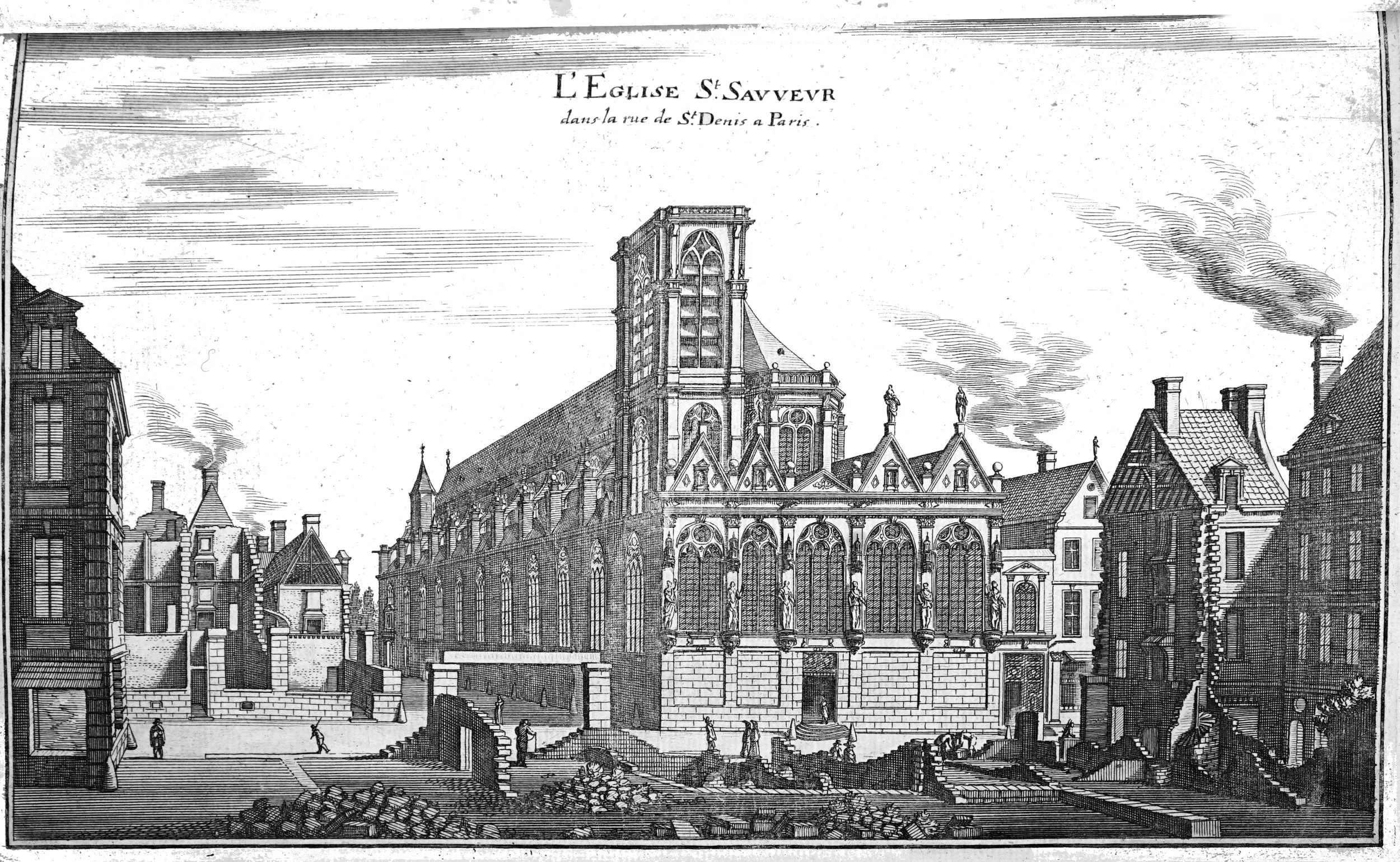
Françoise Baiselat was born in the parish of Saint-Sauveur, Paris, probably in 1650 or 1651 — the daughter of Benjamin Baiselat, a potier d'étain or master pewterer, who also served as porte-verge of that church, and of Claude Prou. She grew up in one of the most crowded quarters of the French capital, a dense network of narrow streets near the ancient church of Saint-Sauveur along the Rue Saint-Denis.
Her father died before February 1662, when she was about eleven. Two years later her mother, remarried to a Paris mason, bound her into three years' service with a master buttonmaker. And in 1668, at about seventeen, Françoise left everything she knew and departed for Canada as a Fille du roi — one of the "King's Daughters" sponsored by Louis XIV to populate New France. Her marriage contract, passed at Québec that August, records that she brought three hundred livres in furniture, clothing, rings and jewels.
What followed was a life shaped by the rhythms of the colony — three marriages, twelve children across three families, and a quarter century at Pointe-aux-Trembles on Montreal Island. Two of her husbands were soldiers of the Carignan-Salières Regiment, the military force that transformed New France from a vulnerable outpost into a permanent settlement. Françoise herself died in childbirth in 1694 at about forty-three, leaving behind a legacy woven into the fabric of French Canada. Denis Beauregard's genealogical database estimates that between 1.26 and 1.68 million Quebecers descend from her.
Origins: Rue Saint-Sauveur, Paris
In the 1640s, the Rue Saint-Sauveur was a bustling and somewhat notorious street in the heart of Paris. Part of the neighborhoods surrounding the Cour des Miracles, it was characterized by dense, labyrinthine narrow streets where artisans, tradespeople, and the city's poorest residents lived in close quarters. The Church of Saint-Sauveur, at the corner of Rue Saint-Sauveur and Rue Saint-Denis, gave the parish its name.
Into this world Françoise was born, the daughter of a skilled craftsman. Benjamin Baiselat was a potier d'étain — a master pewterer, part of the artisan class that formed the productive backbone of Parisian commercial life — and he also held the office of porte-verge, or bedeau, at the church of Saint-Sauveur itself. The surname appears in numerous variations across the records: Baiselat, Baisela, Bizelan, Baisla, Baiselot and Beselat, a common phenomenon in an era when spelling followed pronunciation rather than standardization.
Three Paris Acts
Three notarial acts, preserved in the Minutier central des notaires de Paris, carry Françoise's early life.
11 June 1649 — her parents' marriage contract. Benjamin Baiselat, pewterer, living in the Rue Saint-Denis in the parish of Saint-Sauveur and a widower of Paulette Quinsin, married Claude Prou, daughter of the late Claude Prou and of Élisabeth Olivier. Her dowry was five hundred livres, half of it as propre. Benjamin signed the contract. Claude Prou did not.
10 February 1662 — the inventory after Benjamin's death. He is described as pewterer and porte-verge of Saint-Sauveur at his death, the family living in the rue et paroisse Saint-Sauveur. All of his children were still minors, including the daughters of his first marriage. Françoise had half-sisters, Jeanne and Anne, and sisters of the whole blood — Espérance, Marie, and a second Françoise.
27 July 1664 — Françoise is placed in service. This is the only document in which she appears as a person rather than as a name in a filiation. Her mother, by then remarried, bound her out for three years:
"Claude Prou, femme autorisée de Pierre Aubry, maçon à Paris, auparavant veuve de Benjamin Baiselat, bedeau en l'église Saint-Sauveur, demeurant rue Neuve et paroisse Saint-Sauveur, laquelle pour le profit faire de Françoise Baiselat, sa fille d'elle et dudit défunt, l'avoir baillée et mise ce jour d'hui en service et allouée durant le temps de trois années, avec Pierre Sellier, maître boutonnier, demeurant rue Montmartre, paroisse Saint-Eustache, absent et acceptant par Marguerite Fournier, sa femme."
Contrat d'apprentissage, 27 July 1664, before Louis Giron, Étude CII, 57 — as transcribed in Fichier Origine no. 310120. No payment is recorded.She was about thirteen. The three-year term would have run to the summer of 1667; she sailed the following year.
Françoise Baiselat was born at Paris, in the parish of Saint-Sauveur, after 11 June 1649 and probably in 1650 or 1651. Her parents contracted marriage on 11 June 1649, and she is named as their daughter — "sa fille d'elle et dudit défunt" — in the service contract of 27 July 1664. She cannot therefore have been born in 1646, the year implied by her stated age of thirty-five in the census of 1681. Stated ages in colonial censuses are approximations and are frequently overstated; the marriage contract of her parents is a contemporaneous record of an event that fixes the earliest date she could have been born. PRDH-IGD and Fichier Origine both estimate vers 1651, which is consistent with that limit. The date of about 1646 used by Yves Landry and by the Filles du roi dictionaries derives from the census age, and is superseded here.
With her father dead and her service ended, Françoise faced sharply limited options. In seventeenth-century Paris, an unmarried woman of the artisan class without a living father had few. The Filles du roi program, launched by Louis XIV in 1663 to address the colony's severe shortage of marriageable women, offered an alternative: passage to New France, a modest royal dowry, and the near-certainty of marriage upon arrival.
1668: Crossing the Atlantic
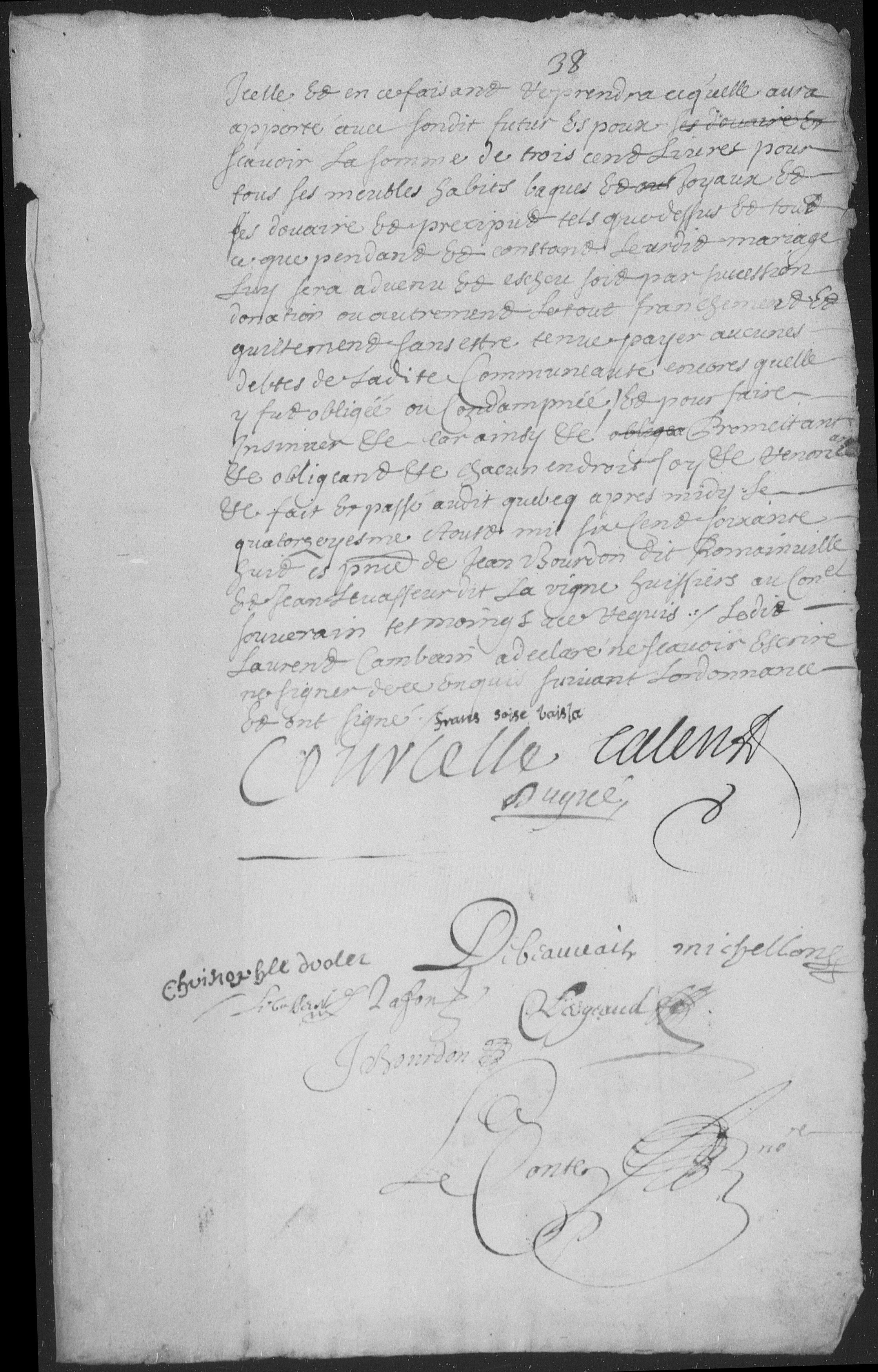
Françoise left for Canada in 1668 at about seventeen. Her marriage contract, passed six weeks after her arrival, states what she brought: three hundred livres, which her husband acknowledged receiving "en meubles, habits, bagues et joyaux" — in furniture, clothing, rings and jewels. This was not an estimate by a later compiler but a figure declared in the act itself.
The Filles du roi who sailed in 1668 were part of the program's peak years. Between 1663 and 1673, approximately 770 women made the crossing under royal sponsorship, transforming the demographic balance of New France. These were not aristocrats — they were primarily daughters of artisans, minor officials, and laborers from the Paris region and northwestern France. What they shared was the willingness to leave everything familiar and cross an ocean to a colony that, even after sixty years of settlement, remained raw, cold, and often dangerous.
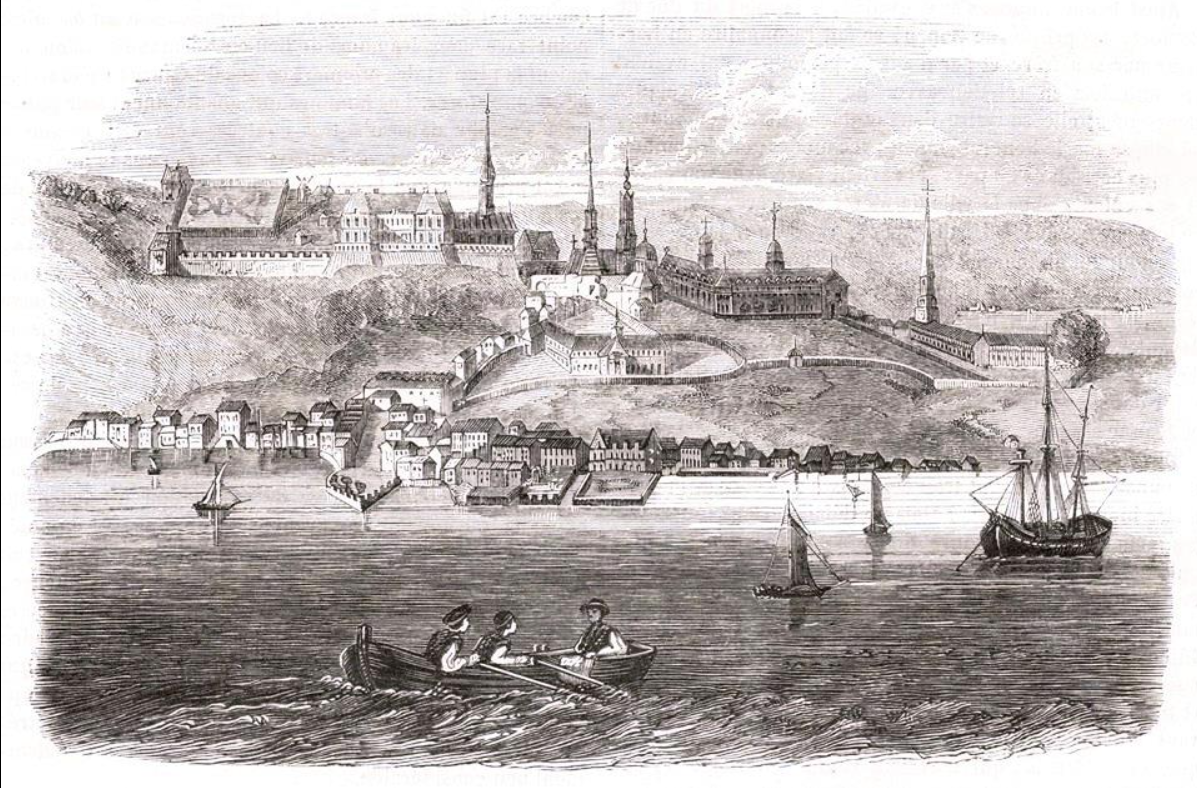
Upon arrival at Québec, Françoise would have been received by religious authorities — likely the Ursulines or the sisters of the Hôtel-Dieu — who provided temporary housing for the Filles du roi while marriages were arranged. The process moved quickly. Within weeks, most women were matched with prospective husbands. In Françoise's case, the match came with a soldier.
First Marriage: Laurent Cambin dit Larivière
On 16 August 1668, Françoise married Laurent Cambin dit Larivière at Notre-Dame de Québec. The marriage record identifies Laurent's origins in the parish of Saint-Agricol in Avignon, in the Comtat-Venaissin, the son of the late master woodworker Denis Cambin and of Pierrette Caillot (also spelled Caillaud).
The Marriage Contract of 14 August 1668
Two days before the wedding, on the afternoon of 14 August, the couple appeared before the royal notary Jean Lecomte at Québec. The act that survives in his greffe is remarkable for who stood in the room. It was made in the presence of, and signed by, Daniel de Rémy, seigneur de Courcelle, Governor and Lieutenant-General for the King, and Jean Talon, Intendant of justice, police and finances — the very architect of the Filles du roi programme. Also present was "le sieur Dugué, capitaine incorporé au Régiment de Carignan-Salières", Laurent's own company captain.
The contract established a community of goods under the Coutume de Paris; recorded the bride's three hundred livres and the groom's acknowledgement of receiving them; provided a douaire coutumier and a préciput of three hundred livres, equal and reciprocal; and made an irrevocable mutual gift to the survivor, defeated by any living child of the marriage. It also reserved to Françoise the right to renounce the community and take back her three hundred livres free of its debts — the protection that mattered most to a woman who would be widowed twice. Laurent "a déclaré ne sçavoir escrire ny signer". Twenty-five years later, a notary at Montréal would cite this contract by name, place and date, and argue its clauses one by one.


| Rank | Name | Role, origin and status as recorded |
|---|---|---|
| 01 | Laurent Cambin | Groom. Origin: St-Agricole, ville et évêché d'Avignon |
| 02 | Françoise Baisela | Bride. Origin: St-Sauveur, ville de Paris |
| 03 | Denis Cambin | Father of 01 — marked deceased |
| 04 | Pierrette Caillot | Mother of 01 — no status marked |
| 05 | Benjamin Baisela | Father of 02 — marked deceased |
| 06 | Claude Prou | Mother of 02 — no status marked |
| 07 | Jean Levasseur Lavigne | Present — also a witness to the contract two days earlier |
| 08 | Christophe Drolet | Present — also named at the contract |
| 09 | Adrien Michelon | Present — also named at the contract |
| 10 | Henri Debernières | Priest, officiating |

Laurent Cambin was baptized on 1 January 1636 at the parish of Saint-Agricol in Avignon, the son of a master woodworker. A published account of the Avignon record gives his birth as 1 January and his baptism as the following day, and names his godparents as Laurent Léopard, innkeeper of the Trois Couronnes, and Guillemette Giraud, wife of Jean du Trueil, innkeeper of the Paon — suggesting a family embedded in Avignon's commercial networks.
Laurent had come to Canada as a sergeant with the Dugué Company of the Carignan-Salières Regiment; his burial record names the company explicitly. This elite military force, originally raised to fight the Ottoman Empire in Hungary, had been redirected to New France to subdue the Iroquois Confederacy. After completing his service, Laurent chose to remain in the colony, as did many soldiers who saw opportunity in the vast, undeveloped territory.
A Brief Marriage
Laurent and Françoise settled at Montréal, where their only child, Marie-Françoise, was baptized on 13 June 1669 at Notre-Dame de Montréal. The baptism record identifies Laurent as "sergent de la compagnie de M. Duguey" and names Séraphin de la Valterie, a lieutenant in the Régiment de l'Estrade, and Marie Moyen, wife of Captain Sidrac Dugué, as godparents — testimony to the military social networks that shaped colonial life, and the second appearance of the Dugué family in Françoise's records within a year.
| Rank | Name | Role and detail as recorded |
|---|---|---|
| 01 | Marie Françoise Cambin | The child |
| 02 | Laurent Cambin | Father. Occupation: sergent de la compagnie de M. Duguey |
| 03 | Françoise Beselat | Mother |
| 04 | Séraphin Delavalterie | Lieutenant dans le régiment de l'Estrade |
| 05 | Marie Moyen | Spouse of 06 |
| 06 | Sidrac Dugué | Capitaine dans le régiment de Chambly |
| 07 | Gilles Pérot | Priest, officiating |
Less than a year after their daughter's baptism, Laurent Cambin dit Larivière was buried on 5 May 1670 at Notre-Dame de Montréal. The burial record gives his age as thirty-five and notes that he had been taken from the hospital — "pris à l'Hôpital" — though by his baptism of January 1636 he was in fact thirty-four. Françoise, now a widow with an infant daughter, had been married barely two years.
| Rank | Name | Detail as recorded |
|---|---|---|
| 01 | Laurent Cambin Larivière | The deceased. Age: 35. Profession: sergent de la compagnie de M. du Gué. Origin: Avignon |
| Field | Entry as recorded |
|---|---|
| Laurent's parents | Denis Cambin and Pierrette Caillau |
| Françoise's parents | Benjamin Bizelan and Claude Proulx |
| Child | Marie Françoise Cambin — b. and bapt. 13 June 1669, Montréal (Notre-Dame); m. 19 July 1688, Pointe-aux-Trembles, Antoine Galipeau; d. 17 March 1730, bur. 18 March 1730, Longue-Pointe (St-François-d'Assise) |
Second Marriage: Pierre Marsan dit Lapierre
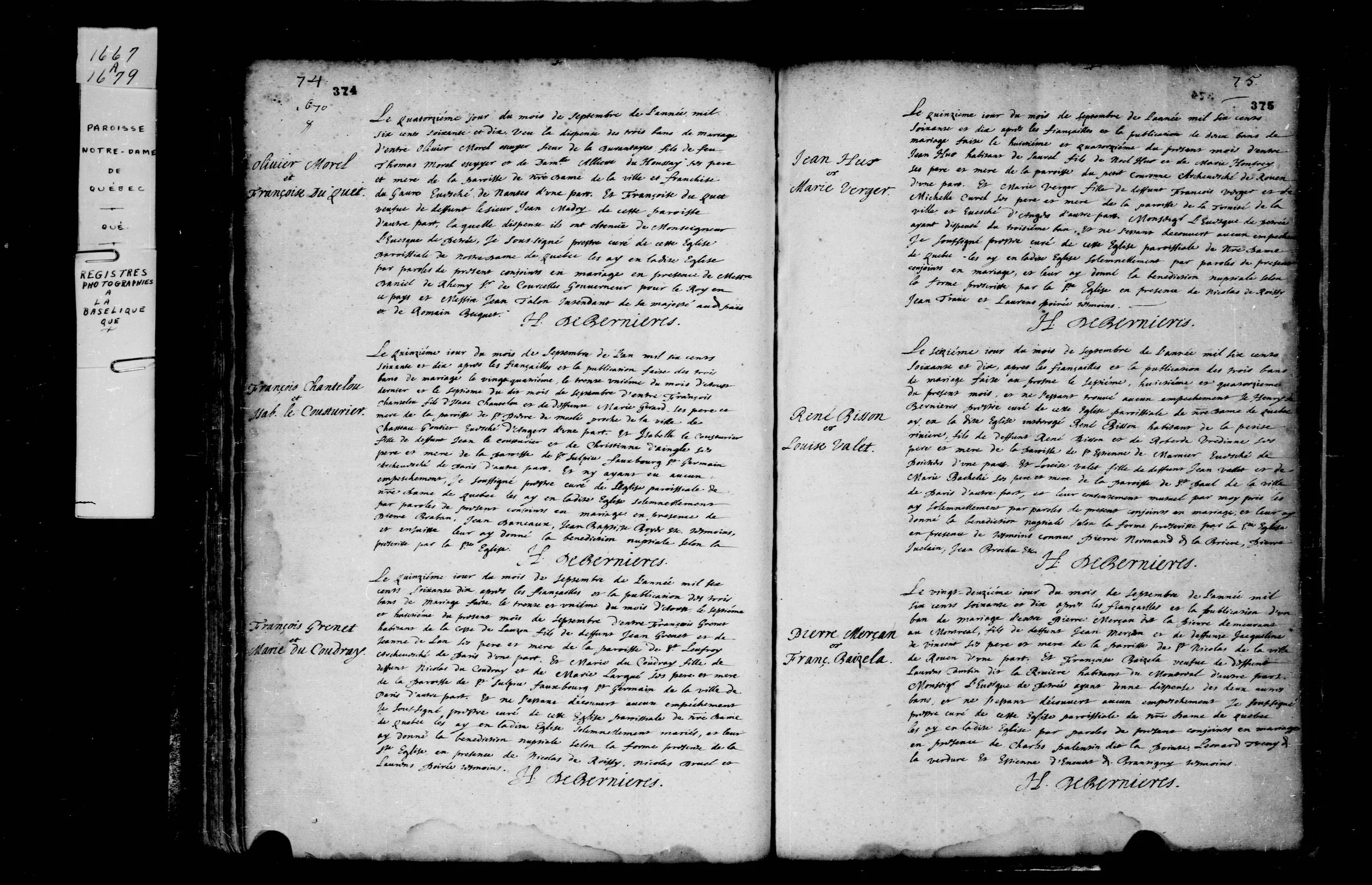
Widowhood in New France was rarely permanent. The colony's need for intact households, combined with the economic vulnerability of women without husbands, meant that remarriage typically followed within months. On 22 September 1670 — less than five months after Laurent's death — Françoise married Pierre Marsan dit Lapierre at Notre-Dame de Québec.

Pierre Marsan dit Lapierre: Sergeant of the Carignan-Salières
Pierre Marsan (also written Mersan or Merçan) was born about 1626 in the parish of Saint-Nicolas in Rouen, Normandy, the son of the late Jean Marsan and the late Jacqueline de Vincent. Like Laurent before him, Pierre had come to New France as a soldier of the Carignan-Salières Regiment.
The published regimental compilations record that he arrived aboard the Vieux Siméon de Dunkerdam, which departed La Rochelle on 19 April 1665 and reached Québec on 19 June 1665, all the soldiers aboard reported in good health. On 24 August 1665 he was confirmed at Québec, his age recorded as thirty years — consistent with a birth around 1635, though the 1681 census would later record him as fifty-five, suggesting a birth closer to 1626. PRDH adopts the census figure.
On his rank and company. Two records call Pierre a sergeant: the baptism of his daughter Jeanne in 1680, where the register itself describes him as "ancien sergent du régiment de Carignan", and the marriage of his stepdaughter Marie Cambin in 1688, where his occupation is given as sergent. Neither names his company. Denis Beauregard's GFNA database places him in the Chambly–La Motte company but calls him a soldier rather than a sergeant; where a database and a parish register disagree, the register governs. Some sources refer to him as Pierre-François Marsan; the name "François" appears on no original record for him and seems to derive from later compilations.
| Rank | Name | Role, origin and status as recorded |
|---|---|---|
| 01 | Pierre Mersan Lapierre | Groom, first marriage. Residence Montréal; origin paroisse de St-Nicolas, ville de Rouen |
| 02 | Françoise Baizela | Bride, widow |
| 03 | Jean Mersan | Father of 01 — deceased |
| 04 | Jacqueline Devincent | Mother of 01 — deceased |
| 05 | Laurent Cambin Larivière | Former spouse of 02, residence Montréal — deceased |
| 06 | Charles Palentin Lapointe | Present |
| 07 | Léonard Treny Laverdure | Present |
| 08 | Étienne Denevert Brantigny | Present |
| 09 | Henri Debernières | Curé of Notre-Dame-de-Québec, officiating |
| Field | Entry as recorded |
|---|---|
| Father | Jean Marsan |
| Mother | Jacqueline Devincennes |
| Birth | Vers 1626 — st-nicolas, v. et archev. rouen, normandie |
| Marriage | 22 September 1670, Québec (Notre-Dame-de-Québec), Marie Françoise Bizelan |
| Death / burial | Not recorded |
The marriage was celebrated by Henri de Bernières — the same priest who had married Françoise to Laurent two years earlier — in the presence of Charles Palentin dit Lapointe, Léonard Treny dit Laverdure, and Étienne Denevers dit Brantigny. Françoise was identified as the widow of the late Laurent Cambin dit Larivière, resident of Montréal. The Bishop of Pétrée had granted a dispensation from two of the three required banns.
After his discharge from the regiment, Pierre and Françoise established their household at Pointe-aux-Trembles on Montreal Island — the community where they would spend the rest of their lives together.
Family Life at Pointe-aux-Trembles: 1670–1691
Over the next twenty-one years, Françoise and Pierre raised a large family. Together they had ten children, baptized between 1671 and 1691 — the first two at Notre-Dame de Montréal and the remaining eight at Pointe-aux-Trembles. Three died in infancy; seven survived to adulthood. Counting Marie-Françoise Cambin from her first marriage, and the son who would be born in 1694, Françoise was mother to twelve children in all.
| Child | Baptism | Marriage | Death / Burial |
|---|---|---|---|
| Marie-Françoise Cambin | 13 June 1669, Montréal (ND) | 19 July 1688, Antoine Galipeau (PAT) | 17 March 1730; buried 18 March, Longue-Pointe |
| Françoise Mersan | 5 October 1671, Montréal (ND) | 26 November 1685, Gilles Marin (PAT) | 16 September 1745, Pointe-aux-Trembles |
| Marie Renée Mersan | 14 May 1674, Montréal (ND) | 23 November 1693, Jean Baptiste Dufresne (PAT) | 19 October 1716, Montréal (ND) |
| Anne Antoinette Mersan | 18 October 1676, PAT | 19 April 1700, Pierre Biroleau dit Lafleur (PAT) | 17 December 1735, Rivière-des-Prairies |
| Pierre Mersan | 22 November 1678, PAT | — | 29 November 1678, PAT — aged one week |
| Jeanne Mersan Direct Ancestor | 2 January 1680, PAT | 29 May 1702, Pierre Cadieux (PAT) | 28 December 1755; buried 30 December, Rivière-des-Prairies |
| François Mersan | 13 March 1683, PAT | 14 February 1707, Marie Élisabeth Desroches (PAT) | 2 January 1750, Pointe-aux-Trembles |
| Jean Baptiste Mersan | 11 March 1685, PAT | 16 October 1709, Marie Anne Denis de Fronsac | 16 April 1718, Pointe-aux-Trembles |
| Marie Catherine Mersan | 15 April 1687, PAT | — | 24 October 1687, PAT — aged six months |
| Joseph Mersan | 19 March 1689, PAT | 23 November 1711, Marie Jeanne Foran (PAT) | 18 June 1740, Pointe-aux-Trembles |
| Catherine Mersan | 28 April 1691, PAT | — | 6 June 1691, PAT — aged one month |
| Field | Entry as recorded |
|---|---|
| Marriage | 22 September 1670, Québec (Notre-Dame-de-Québec) |
| Pierre's parents | Jean Marsan and Jacqueline Devincennes |
| Françoise's parents | Benjamin Bizelan and Claude Proulx |
| Children | Ten, as set out in the table above |
The family table reveals a pattern common to colonial life: children arriving every one to two years, named for saints, for family, and sometimes for each other when earlier children died. Pierre, Marie Catherine and Catherine, who each died in infancy, bear witness to the fragility of life even in a household that was, by the standards of New France, prospering.
A Note on Names: Françoise's first daughter from her marriage with Laurent Cambin, Marie-Françoise, carries both her mother's name and the feminine form of her father's given name. In the Marsan family, the eldest daughter was also named Françoise — a naming pattern that honored the mother. The surname itself shifted between Marsan and Mersan in the parish registers, following the inconsistent spelling conventions of the era.
The 1681 Census
The census of 1681 provides a snapshot of the Marsan household at Pointe-aux-Trembles, part of the Ville de Montréal enumeration. The entry, recorded under the phonetic spelling "Mexent," captures the family at a moment of modest rural prosperity:
1681 Census — Ville de Montréal
- Pierre Mexent, 55
- Françoise Biselon, sa femme, 35
- Marie, 12 (Marie-Françoise Cambin)
- Françoise, 10
- Madeleine, 5 (likely Renée)
- Jeanne, 2
- 3 bêtes à cornes (cattle)
- 6 arpents en valeur (cleared land)
What the Census Tells Us
- Pierre's age (55) places his birth at ~1626
- Françoise's age (35) is overstated — see below
- Marie-Françoise Cambin included in the household
- "Madeleine" likely misrecorded for Renée
- 6 arpents (~5 acres) under cultivation
- 3 head of cattle — a solid beginning
- Anne Antoinette (age 5) absent — possibly with relatives
Françoise's recorded age of thirty-five would place her birth about 1646, and that figure has been repeated by every compilation since. But her parents did not marry until June 1649, and she is expressly named as their daughter in the Paris act of 1664. The census age is overstated by roughly five years — an ordinary occurrence in colonial enumerations, where ages were given from memory and frequently rounded or inflated.
The census reveals that Pierre, at roughly fifty-five, was considerably older than his wife — a common pattern in colonial marriages where experienced settlers married younger Filles du roi, and rather more pronounced here than the census itself suggests. The six arpents under cultivation and three head of cattle represent the household of a habitant who had transitioned from soldier to farmer.
Marie-Françoise Cambin, Françoise's daughter from her first marriage, is enumerated as part of the Marsan household at age twelve — evidence that Pierre had taken on the role of stepfather alongside his own growing family. Seven years later he would attend her wedding, and be named in the record as her stepfather.
Pointe-aux-Trembles: A Settlement Takes Root
The community where Françoise and Pierre raised their family was one of the oldest settlements on Montreal Island. Founded in 1674, the parish of Saint-Enfant-Jésus-de-la-Pointe-aux-Trembles served as both a defensive outpost and an agricultural hub near the eastern tip of the island, where the St. Lawrence River meets the Rivière des Prairies.
The original land concessions had been granted by the Sulpician priests — the seigneurs of the Island of Montreal — starting in 1669, when M. Queylus granted sixty arpents to Jean Oury dit Lamarche with the obligation to build a windmill and a chapel. By 1671, the Sulpicians had issued fifty land concessions, laid out as the characteristic "ribbon farms" of New France: narrow strips of land ensuring every habitant had direct access to the river. A wooden fort was erected around 1675 to protect the settlement from Iroquois attacks.
It was the same abbé de Queylus who, on 8 January 1670, granted Laurent Cambin a concession on the côte Sainte-Anne within this parish — four months before Laurent died. That land, and the arguments over it, would occupy Françoise and her eldest daughter twenty-three years later.
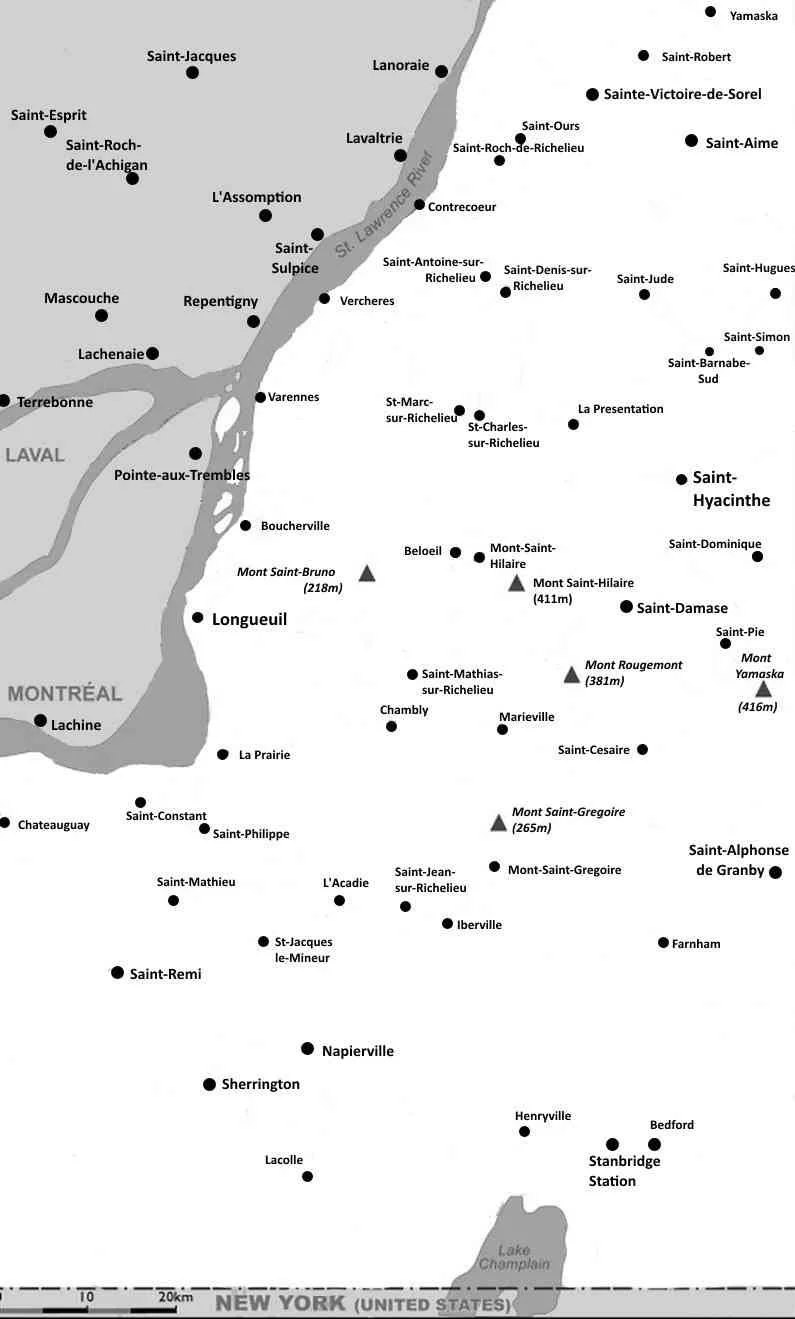
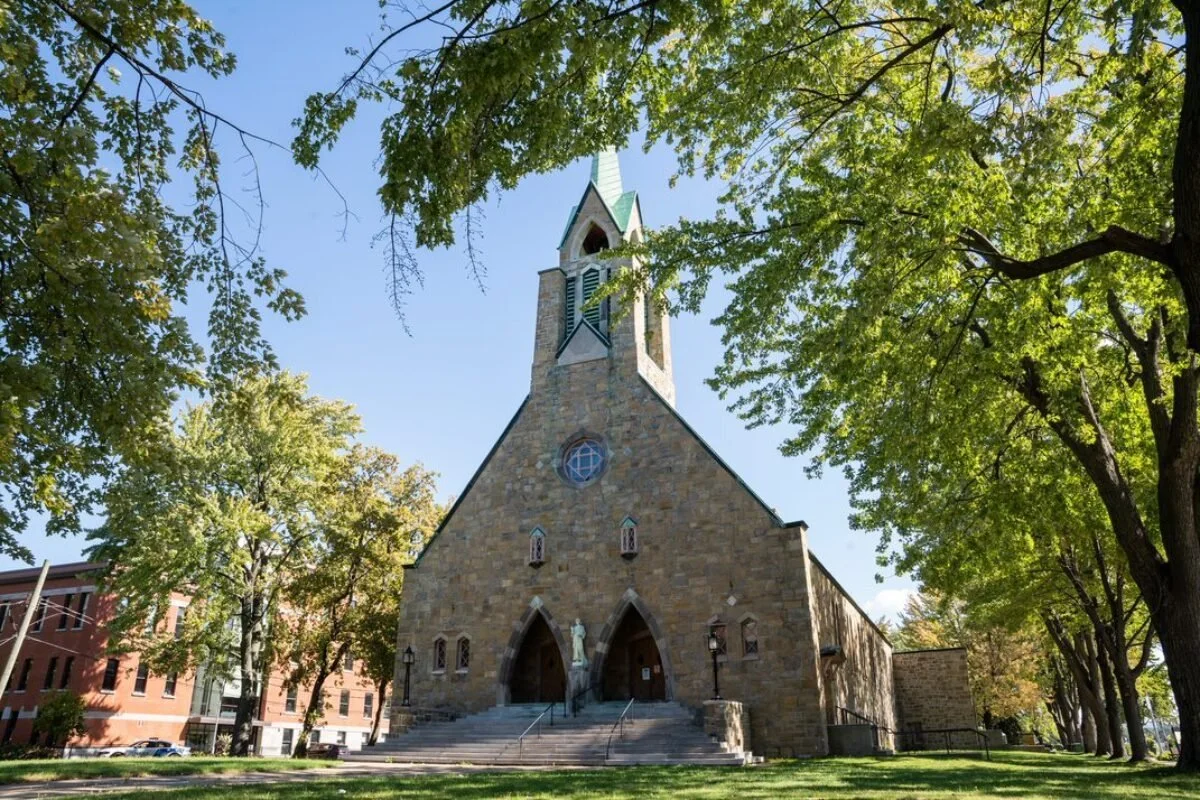
This was the world Pierre and Françoise inhabited for twenty-one years. The parish registers of Saint-Enfant-Jésus, which began as early as 1674, recorded the baptisms of their children, the marriages of their neighbors, and the burials of those who did not survive the harsh colonial winters. By the 1680s the settlement had grown to include a convent founded by Marguerite Bourgeoys's Congrégation de Notre-Dame in 1690, and the community served as a vital stop on the Chemin du Roy between Montreal and Quebec City.
The habitants of Pointe-aux-Trembles, like the Marsans, were required to pay cens and rent to the Sulpicians, often in money or in farm products like wheat. In return they held concessions that could be passed to their children — the foundation of a new kind of stability for families who had crossed an ocean to find it.
Today, the area of Pointe-aux-Trembles forms part of the Rivière-des-Prairies–Pointe-aux-Trembles borough of Montreal. The old church and presbytery, designated a heritage site, are being repurposed into a cultural, community, and recreation destination — a new chapter for one of Montreal Island's founding villages.
The Death of Pierre Marsan dit Lapierre
Pierre Marsan dit Lapierre died between 6 June 1691 and early January 1693. The date is bracketed by two documents: the burial record of his youngest daughter Catherine on 6 June 1691, in which Pierre is not listed as deceased, and the date of Françoise's third marriage on 4 January 1693, at which she is already described as his widow. A concession act of 4 March 1693, naming "Françoise Bizelan, veuve de feu Pierre Marsan dit Lapierre," confirms his death.
No burial record for Pierre has been found in the parish registers of Pointe-aux-Trembles, and PRDH records neither a death nor a burial for him — a gap that is frustrating but not unusual for the period.
Françoise Alone: The Concession of 4 March 1693
Two months after her third marriage, Françoise received a town lot in the bourg of Pointe-aux-Trembles from François Dollier de Casson, superior of Saint-Sulpice and seigneur of the island: twenty-five feet wide on the line of the rue du Cimetière by seventy feet deep, bounded in front toward the cemetery, behind by Jean Chaperon the elder, and at the sides by Jean Guilbert dit Laframboise and Léonard Simon.
The act is curious. It styles her "Françoise Bizelan veuve de feu Pierre Marsan dit Lapierre", present and accepting in her own person, with no mention of her new husband and no clause recording his authorisation — although under the Coutume de Paris a married woman contracting normally appeared authorised by her husband, as Françoise herself did six months later. She did not sign.


Pierre left Françoise, now about forty-one, with six surviving children still at home — the youngest, Joseph, not yet four. Once again she faced the prospect of managing a household alone in the colony.
Third Marriage and Death: 1693–1694
On 4 January 1693, Françoise married for the third time. Her new husband was André Corbeil dit Tranchemontagne, baptized on 28 April 1666 in the parish of Saint-Porchaire, diocese of Saintes, in Saintonge (now Charente-Maritime). He was twenty-six; she was about forty-two. The marriage record carries a notable annotation: the wife is said "widow in her third marriage of Pierre Mercan" — confirmation that the curé carefully distinguished Françoise's marital history.
| Rank | Name | Role and status as recorded |
|---|---|---|
| 01 | André Corbeil Tranchemontagne | Groom, first marriage |
| 02 | Françoise Bizelon | Bride, widow |
| 03 | Pierre Mercan | Former spouse of 02 — deceased |
| Field | Entry as recorded |
|---|---|
| Parents | Jean Gourbil (or Corbeil) and Marie Bernard |
| Baptism | 28 April 1666 — St-Porchaire, diocese of Saintes, Saintonge (Charente-Maritime) |
| Burial | 13 October 1740 — Montréal, Rivière-des-Prairies (St-Joseph) |
| First marriage | 4 January 1693, Pointe-aux-Trembles, Marie Françoise Bizelan, daughter of Benjamin Bizelan and Claude Proulx |
| Second marriage | 14 February 1695, Pointe-aux-Trembles, Marie Charlotte Poudret Lavigne |
On the three husbands and their soldiering. All three of Françoise's husbands were soldiers, but not of the same army. Laurent Cambin and Pierre Marsan were Carignan-Salières men — Cambin in the Dugué company, Marsan a sergeant of the regiment. André Corbeil was not, and could not have been: baptized in 1666, he was two years old when the regiment was disbanded and its soldiers settled. He belonged to the military generation that followed. Cyprien Tanguay, writing in the 1880s, recorded that Corbeil had been a soldier of Monsieur de Crisafy; the brothers Antoine and Thomas de Crisafy took their captains' commissions in April 1684 and brought their companies of the Compagnies franches de la Marine — the crown's permanent colonial troops, raised to replace the Carignan — to Canada that same year, and André reached Québec on 24 September 1684. The marriage act Tanguay drew the attribution from has not since been located, so the company rests on his reading of it; the date of arrival and the identity of the Crisafy companies are independently documented. What the three marriages do show is the social fabric of Pointe-aux-Trembles — a community founded by soldiers, in which a soldier's widow remained within the same circle for twenty-six years.
Françoise and André remained at Pointe-aux-Trembles. Their only child, a son named François, was baptized on 30 May 1694. But the birth proved fatal. Françoise Baiselat died in childbirth and was buried the same day, in the same parish register, on the same page as her son's baptism. She was about forty-three.

| Rank | Name | Role and status as recorded |
|---|---|---|
| 01 | Françoise Bizelan | The deceased |
| 02 | André Gourbeil Tranchemontagne | Spouse of 01, now widower |
| 03 | Seguenot | Curé, Pointe-aux-Trembles (St-Enfant-Jésus) |
| Rank | Name | Role as recorded |
|---|---|---|
| 01 | François Gourbeil | The child |
| 02 | André Gourbeil | Father of 01, spouse of 03 |
| 03 | Françoise Bizelan | Mother of 01, spouse of 02 |
| 04 | François Rainau Planchard | Godfather |
| 05 | Marie Roy | Godmother |
| 06 | Seguenot | Curé, officiating |
| Field | Entry as recorded |
|---|---|
| Father | André Corbeil Tranchemontagne |
| Mother | Marie Françoise Bizelan |
| Baptism | 30 May 1694 — Montréal, Pointe-aux-Trembles (St-Enfant-Jésus) |
| Anything further | Nothing recorded |
André Corbeil dit Tranchemontagne remarried on 14 February 1695, to Marie Charlotte Poudret Lavigne at Pointe-aux-Trembles, with whom he had further children. He lived until 13 October 1740, buried at Rivière-des-Prairies (St-Joseph) — nearly half a century longer than the wife he had lost in childbirth.
Historical Significance
Françoise Baiselat's life traces the arc that defined a generation of women in New France: departure from France, rapid marriage, relentless childbearing, and an early death. In twenty-six years in the colony, she bore twelve children to three husbands, raised a blended family at Pointe-aux-Trembles, and helped establish one of the foundational households of Montreal Island.
Her surviving children from the Marsan marriage — Françoise, Marie Renée, Anne Antoinette, Jeanne, François, Jean Baptiste, and Joseph — married into families across the Montreal region: the Marins, Dufresnes, Biroleaus, Cadieux, Desroches, Denis de Fronsacs, and Forans. Marie-Françoise Cambin, her daughter from her first marriage, married Antoine Galipeau in 1688, extending the family network further still.
She was also, in the last year of her life, a litigant. In September 1693 Françoise went before the notary Antoine Adhémar to press her claim against that same eldest daughter for the préciput and dower written into her marriage contract of 1668 — twenty-five years earlier. She settled for fifty livres. Eight days after her burial, three families assembled before the royal notaries at Ville-Marie to divide what she left. That story is told in the accompanying case study.
Daughter Jeanne Marsan: The Direct Ancestor
The line of descent traced in this profile runs through Françoise's daughter Jeanne Marsan, born 2 January 1680 at Pointe-aux-Trembles. On 29 May 1702 Jeanne married Pierre Cadieux at the parish of Saint-Enfant-Jésus.
| Field | Entry as recorded |
|---|---|
| Father | Pierre Marsan Lapierre |
| Mother | Marie Françoise Bizelan |
| Birth and baptism | 2 January 1680 — Montréal, Pointe-aux-Trembles (St-Enfant-Jésus) |
| Marriage | 29 May 1702, Pointe-aux-Trembles, Pierre Cadieux, son of Jean Baptiste Cadieux and Marie Valade |
| Death and burial | Died 28 December 1755; buried 30 December 1755 — Montréal, Rivière-des-Prairies (St-Joseph) |
| Rank | Name | Role and detail as recorded |
|---|---|---|
| 01 | Jeanne Mersan | The child, born 2 January 1680 |
| 02 | Pierre Mersan | Father. Occupation: ancien sergent du régiment de Carignan |
| 03 | Françoise Bizetan | Mother |
| 04 | Pierre Perthuis Lalime | Godfather |
| 05 | Jeanne Colet | Godmother, spouse of 06 |
| 06 | Grégoire Simon | Present |
| 07 | François Seguenot | Priest, officiating |

| Rank | Name | Role and detail as recorded |
|---|---|---|
| 01 | Pierre Cadieu | Groom. Origin: Ville-Marie |
| 02 | Jeanne Mersan | Bride. Residence: Montréal, Pointe-aux-Trembles |
| 03 | Jean Cadieu | Father of 01 |
| 04 | Marie Valade | Mother of 01 |
| 05 | Pierre Mersan | Father of 02 |
| 06 | Françoise Bizela | Mother of 02 |
| 07 | Jean Baptiste Dufrene | The bride's brother-in-law |
| 08 | Pierre Birollot | The bride's brother-in-law |
| 09 | Cécile Ozon | Present |
| 10 | L. Chaigneau | Priest, officiating |
Jeanne lived to seventy-five — a long life by colonial standards — dying on 28 December 1755 and buried two days later at Rivière-des-Prairies. Through her marriage to Pierre Cadieux, the Marsan line continued through the Cadieux, Blais, Poulin Souliere, and Souliere families to the present day.
Line of Descent: The Souliere Line
9th great-grandmother ▸ Jeanne Marsan Mercan
8th ggm • 1680–1755 ▸ Marie Marguerite Cadieux
7th ggm • 1706–1757 ▸ Joseph Blais
6th ggf • 1736–1813 ▸ Marie Celeste Blais
5th ggm • 1759–1823 ▸ Marie Elisabeth Poulin Souliere
4th ggm • 1781–1852 ▸ Janvier Souliere Sr
1806–1889 ▸ Marie Marguerite Louise Souliere
1854–1945 ▸ Elisabeth Emma Guilbault Gilbert
1883–1970
By the Numbers
Denis Beauregard's Genealogy of the French in North America records the scale of this legacy by couple. Through Françoise and Pierre Marsan, the database counts twelve generations and 3,823 documented marriages, with an estimated 1,120,000 to 1,540,000 Quebecers connected. Through Françoise and Laurent Cambin — a line carried by a single daughter — the estimate is 70,000 to 490,000 across twelve generations and 865 marriages. Counting all three of her marriages together, the database estimates between 1,260,000 and 1,680,000 descendants.
Her mitochondrial haplogroup is given as U5a1g1. This is a prediction, derived from the testing of descendants through the female line in the Family Tree DNA projects and triangulated in Beauregard's database; it is not a test result for Françoise herself, and no remains have been examined.
The girl who was bound into service in the Rue Montmartre at about thirteen, and who left the Rue Saint-Sauveur four years later with three hundred livres in furniture, clothing, rings and jewels, became — through her children and their children's children — one of the founding mothers of French Canada. She is buried at Pointe-aux-Trembles, in the parish of Saint-Enfant-Jésus, the same community where she had lived for a quarter century, the same church where her children were baptized and her husbands were mourned.

Document Gallery




Sources and Further Reading
Françoise Baiselat's story has been reconstructed from notarial acts at Paris, Québec and Montréal, parish registers, and the 1681 colonial census, supplemented by published biographical dictionaries of the Filles du roi and the soldiers of the Carignan-Salières Regiment. Key sources include:
- Marriage contract of Laurent Cambain and Françoise Baisla, 14 August 1668, act no. 21, ff. 37r–38r, greffe de Jean Lecomte; Fonds Cour supérieure, district judiciaire de Québec, CN301,S169; BAnQ, Archives nationales à Québec.
- Minutier central des notaires de Paris, Archives nationales — marriage contract of Benjamin Baiselat and Claude Prou, 11 June 1649, before Jacques Roussel I and Michel Desprez, Étude LXXXI; inventaire après décès de Benjamin Baiselat, 10 February 1662, before Pierre Gary and Adrien Dupuis, Étude LXIX; service contract of Françoise Baiselat, 27 July 1664, before Louis Giron, Étude CII, 57. Cited here as abstracted and transcribed by Jean-Paul Macouin; the originals have not been examined.
- Jean-Paul Macouin, Les familles pionnières de la Nouvelle-France dans les archives du Minutier central des notaires de Paris, présentées et annotées par Marcel Fournier (Société de recherche historique Archiv-Histo), entry 25, pp. 23–24.
- Fichier Origine, fiche no. 310120, "BAISELOT / BAISELAT, Françoise"; researcher Jean-Paul Macouin.
- Greffe d'Antoine Adhémar dit Saint-Martin, BAnQ 06M,CN601,S2 — concession to Françoise Bizelan, 4 March 1693, vol. V p. 175; accord et conventions between André Gourbeil and Françoise Baisela and Antoine Galipeau and Marie Cambin, 28 September 1693, vol. V p. 194, with the November 1693 ratification.
- PRDH-IGD (Programme de recherche en démographie historique), Université de Montréal — Individual nos. 11941 (Bizelan), 38208 (Cambin), 54664 (Marsan), 32499 (André Corbeil), 32500 (François Corbeil), 38501 (Jeanne Marsan); Marriage nos. 66778, 66943, 11476, 11494, 11534; Baptism nos. 39991, 10138, 10431; Burial nos. 48912, 11824; Family nos. 2497, 3334.
- Denis Beauregard, Genealogy of the French in North America (GFNA/FrancoGène) — couple records [801] Cambin–Bizelan, [1596] Marsan–Bizelan, [4705] Bizelan–Proulx, [6403] Corbeil–Bizelan, with descendant estimates and predicted DNA signatures.
- Peter J. Gagné, King's Daughters and Founding Mothers: The Filles du Roi, 1663–1673 — biographical entry for Françoise Baiselat.
- Yves Landry, Orphelines en France, pionnières au Canada: Les Filles du roi au XVIIe siècle (revised edition 2013).
- M. Chabaud, in Mémoires de la Société généalogique canadienne-française (1948), no. 3, pp. 139–140 — for the Avignon baptism of Laurent Cambin.
- Cyprien Tanguay, Dictionnaire Généalogique des Familles Canadiennes (1887, 7 volumes).
- Notre-Dame de Québec, Notre-Dame de Montréal, and Pointe-aux-Trembles (St-Enfant-Jésus) parish registers — original marriage, baptism and burial records via FamilySearch and Généalogie Québec.
- Thomas J. Laforest, Our French-Canadian Ancestors, vol. 9 (1989), chapter 16, pp. 171–179 — biographical sketch of Pierre Marsan dit Lapierre.
- Census of New France, 1681 — Benjamin Sulte transcription via Wikisource.
Research Note: This profile documents Françoise Baiselat as part of the Souliere Line's Founding Mothers collection. Françoise is the 9th great-grandmother of the researcher. The descent runs through her daughter Jeanne Marsan (b. 1680), who married Pierre Cadieux, and continues through the Cadieux, Blais, Poulin Souliere, and related families to the present day. Database entries are reproduced here as structured transcriptions rather than screen captures: a database field is an editorial rendering of a record, not a transcription of it, and where a field and an original register differ, the register governs. A separate profile for Pierre Marsan dit Lapierre will appear on the Carignan-Salières Regiment page.
Related Case Study
The Françoise Baiselat Inheritance
Three Marriages, Three Estates, Twelve Years of Colonial Justice
What happened after Françoise's death — the guardianship petition, the funeral debt settled with a meadow, the children's shares paid in wheat, and the Intendant's ordonnance that closed three estates twelve years later — is traced through seven legal documents spanning 1694 to 1706.
View Case Study →Are You Connected to the Souliere Line?
If you descend from the Souliere, Suliere, or Soulier (dit Tranchemontagne) family of L’Assomption and St-André-d’Argenteuil, from the nineteen children of Janvier Souliere Sr., or from the allied Gravel, Poulin, Migneron, Lacasse, or Lesage lines — whether your branch stayed in Quebec or came to Chicago — I’d like to compare notes. Documented trees, DNA matches, family papers, and even half-remembered stories have all moved this research forward.
Get in Touch About This FamilyCousin connections are informal and reciprocal — no fee, no obligation, just shared work on shared ancestry.
Every Family Has a Story Worth Telling
Whether you're just beginning your research or ready to transform years of work into a narrative your family will treasure, I'd love to help.
BEGIN YOUR RESEARCH INQUIRY