
Sainte-Famille de Boucherville: Pierre Boucher's Church on the River
Old Boucherville, Montérégie, Québec
Sainte-Famille de Boucherville
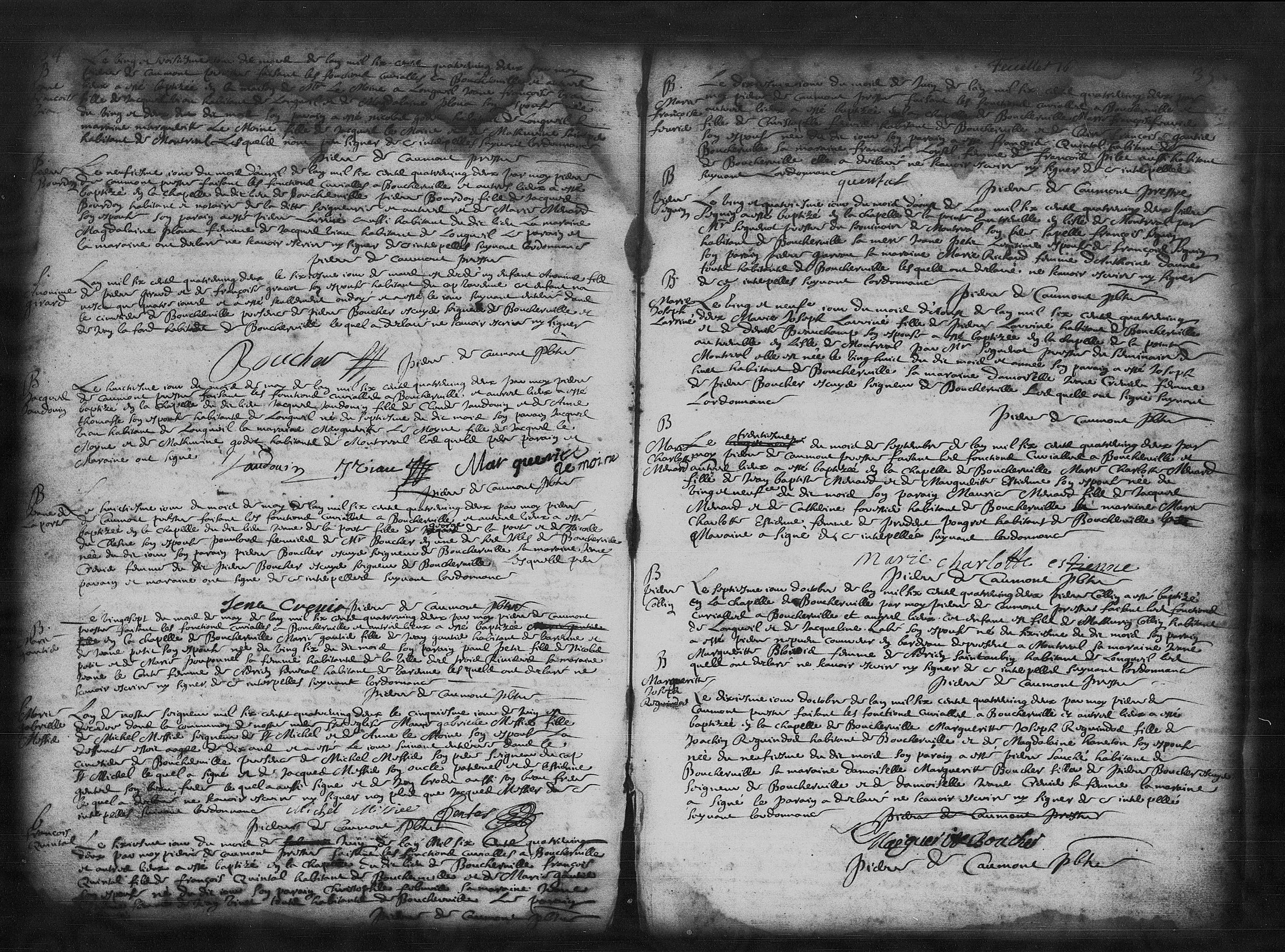
On October 31, 1672, a Carignan-Salières Regiment veteran named François Séguin dit Ladéroute married Jeanne Petit in the wooden chapel at Boucherville. He was among the earliest settlers of Pierre Boucher's seigneury on the south shore of the St. Lawrence—a soldier who traded his musket for a plough. Over the next fifty-two years, three generations of Séguins would fill the parish registers with baptisms, marriages, and burials—twenty-six documented sacraments beneath the same roof where 336 souls would eventually rest in the crypt below.
The Séguin Family at Sainte-Famille — Key Events
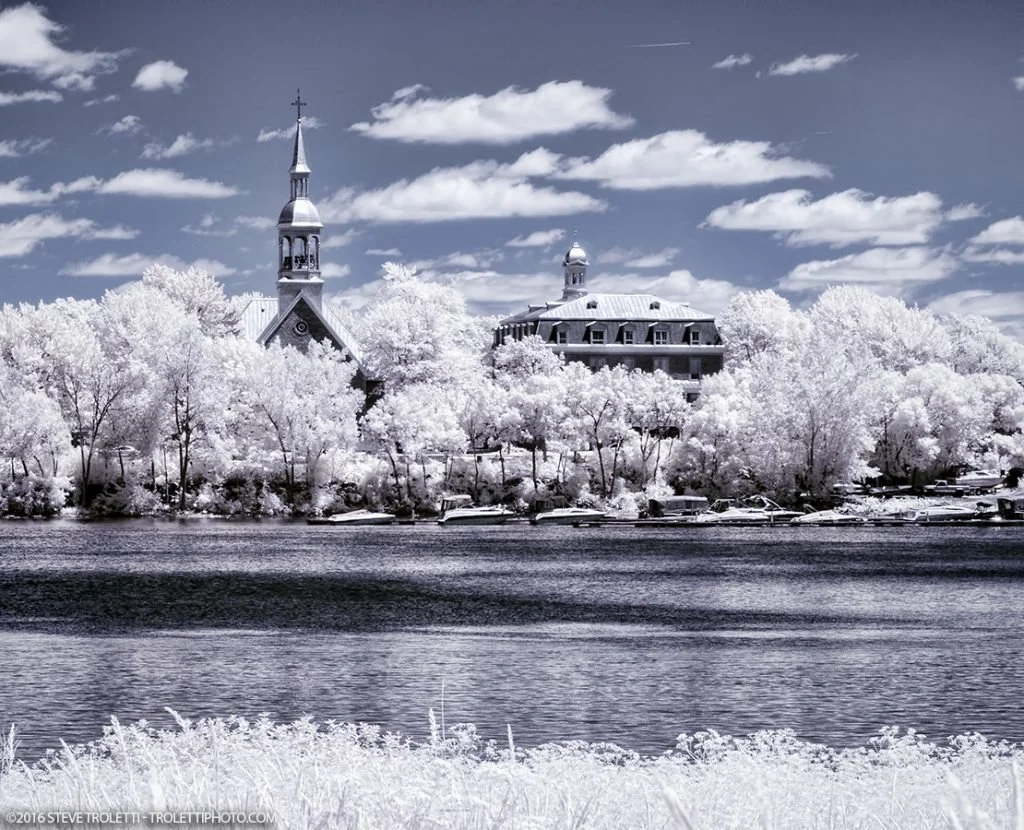
L'église Sainte-Famille et l'ancien couvent de la Congrégation de Notre-Dame, seen from the Îles-de-Boucherville National Park across the St. Lawrence River. This infrared photograph captures the visual dominance of the church and convent complex over Old Boucherville—a view that has defined this stretch of the river for over three centuries. Photo: Steve Troletti.
Sainte-Famille de Boucherville is one of the oldest parishes in Québec, founded on land donated by Pierre Boucher himself—soldier, governor of Trois-Rivières, and author of the first published description of New France. When François Séguin dit Ladéroute married Jeanne Petit in the original wooden chapel in 1672, Boucherville was barely five years old. The parish would not be formally erected by Bishop François de Laval until 1678. But the registers were already filling with the names of the soldiers, settlers, and their families who were building a new world along the south shore of the St. Lawrence.
For the Guilbault Line, Boucherville is a critical anchor point. François Séguin dit Ladéroute—a veteran of the Carignan-Salières Regiment—settled here after military service and raised his family within sight of the river. His son Jean-Baptiste, our direct ancestor, was baptized in this church on November 12, 1688, married here in 1710, and had nine more children baptized at Sainte-Famille before becoming the first settler of Vaudreuil Township. His younger brother Joseph carried the family name to Fort Pontchartrain du Détroit as a fur trader—a westward trajectory that the Guilbault voyageurs would follow a century later. The Séguin records at Sainte-Famille span three generations and fifty-two years: six marriages, seventeen baptisms, and three infant burials between 1672 and 1724. Three of the eleven children were baptized at Pointe-aux-Trembles rather than at Sainte-Famille, but all three returned to Boucherville to marry.
A Church Built on Pierre Boucher's Land
The original 1670 chapel stood on the exact site where the current stone church stands today. Pierre Boucher, who founded Boucherville in 1667, donated the land for the church. It is the third building on these premises—wooden chapel (1670), brick church (1712), stone church (1801)—and has been classified as a historical monument since 1964.
Including four of Boucherville's five hereditary seigneurs and their families, parish priests, and various parishioners. The last burial in the crypt dates to 1954. The fifth seigneur—considered anticlerical—was buried on his own land instead.
Boucherville: Pierre Boucher's Seigneury
Boucherville sits on the south shore of the St. Lawrence River, directly across from Montréal and the Îles-de-Boucherville archipelago. Founded in 1667 by Pierre Boucher—one of the most remarkable figures in early New France—the settlement grew rapidly from 179 residents in 1681 to over 400 by the early 1700s. Boucher had served as governor of Trois-Rivières and was the author of Histoire véritable et naturelle des mœurs et productions du pays de la Nouvelle-France (1664), the first published description of the colony.
The church of Sainte-Famille dominates the Place de l'église in Old Boucherville, flanked by the former convent of the Congrégation de Notre-Dame (1888, now a senior residence) and the former presbytery (1832, now the Mgr-Poissant Center). Together they form a heritage ensemble that has been the heart of the village for over three centuries.
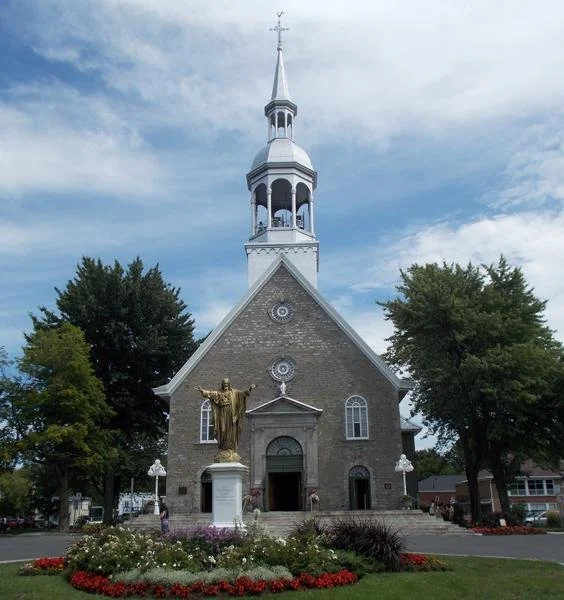
Sainte-Famille Church, Old Boucherville. The current stone structure was built in 1801, gutted by fire in 1843, and rebuilt using the original stone walls with interior designs by architect Louis-Thomas Berlinguet in 1845. The golden statue of the Sacred Heart stands before the entrance.
Three Churches, One Site
The church at Boucherville has been rebuilt twice on the same foundations, each iteration reflecting the growing ambitions of the parish. The first wooden chapel of 1670—a modest colombage or half-timbered structure typical of early New France—served the initial settlers led by Pierre Boucher. By 1712, population growth demanded a more durable brick building. And in 1801, the current monumental stone church was erected, designed by the influential priest-architect Father Pierre Conefroy—the same man whose plan was used for the church of Saint-Paul-de-Joliette where the Guilbault family baptisms took place.
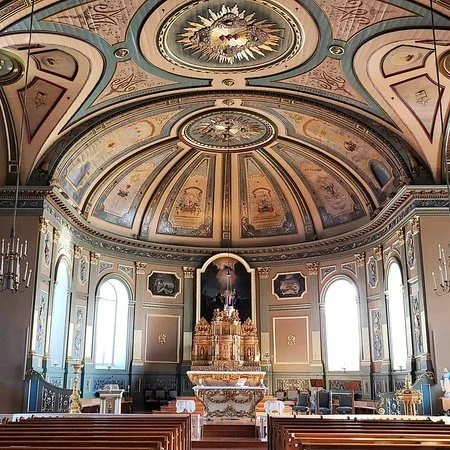
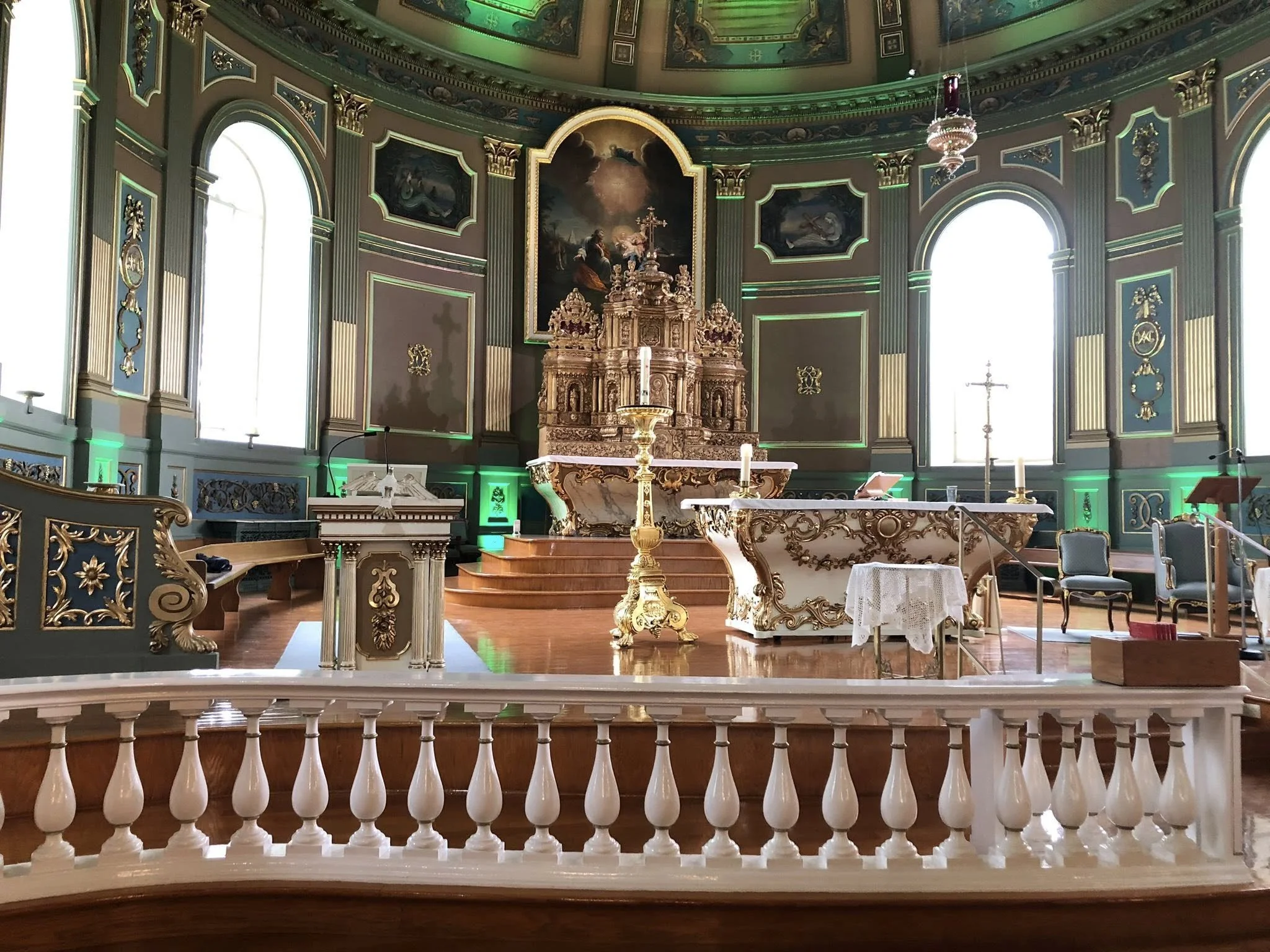
A devastating fire in 1843 gutted the interior, but the stone walls survived. The church was rebuilt in 1845 with interior designs by architect Louis-Thomas Berlinguet, whose barrel vault extending into the nave—inspired by the Louis XVI style—features double arches and moldings that evoke the excavations at Pompeii. Angel heads sculpted by Berlinguet adorn the transepts and choir, their beauty preserved for nearly two centuries.
The Organ: 1,597 Pipes and Five Tons
The organ at Sainte-Famille is one of the oldest preserved in Québec. The original instrument dates from 1847, housed in a magnificent buffet designed by Berlinguet in 1846. In 1995, a new organ was handmade by Casavant Frères of Saint-Hyacinthe—installed inside the original buffet—retaining two stops from the old instrument. The current organ weighs five tons and contains approximately 25 stops totalling nearly 1,600 pipes.
The organ buffet itself is a work of art: a monumental wooden case that was built to receive the instrument originally constructed by the Montreal factor Samuel Warren. Together, the historic case and modern mechanism represent 175 years of continuous musical heritage.
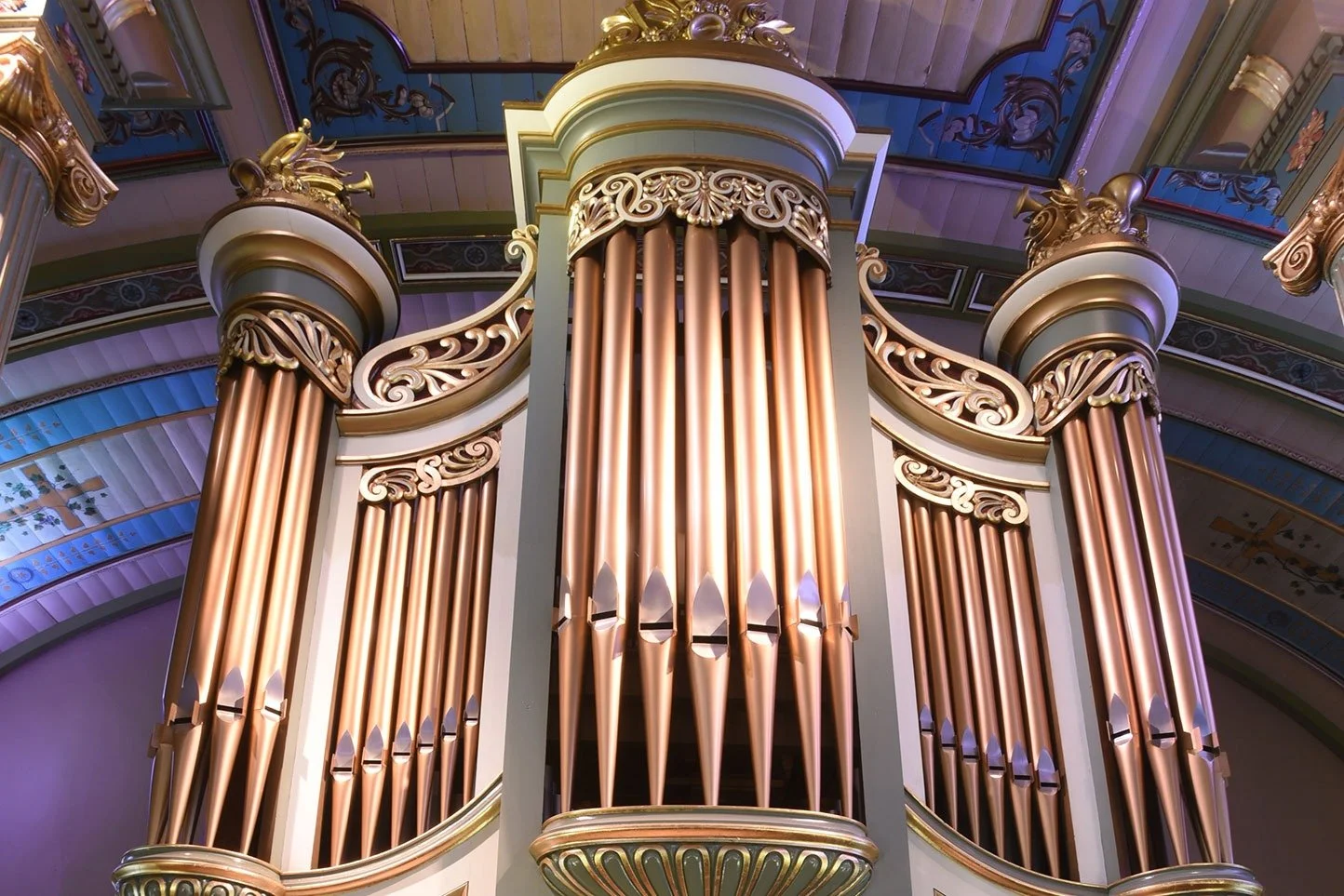
The Casavant organ pipes at Sainte-Famille, housed within the 1846 Berlinguet buffet. The instrument was handmade in 1995 by Casavant Frères of Saint-Hyacinthe and contains nearly 1,600 pipes across 25 stops, retaining two original stops from the 1847 Warren organ.
Timeline: Sainte-Famille de Boucherville
The Séguin Family at Boucherville
François Séguin dit Ladéroute arrived in New France as a soldier of the Carignan-Salières Regiment and settled at Boucherville after demobilization. His marriage to Jeanne Petit on October 31, 1672, was among the earliest recorded at the parish. Together they raised eleven children between 1674 and 1694. Eight were baptized at Sainte-Famille and three were buried here in infancy; three sons—François, Pierre and Simon—were baptized across the river at Pointe-aux-Trembles. Four of the sons later returned to marry in the same church—François in 1702, Pierre in 1704, Simon in 1706, and Jean-Baptiste in 1710—and Simon returned a second time in 1715, widowed, to marry a seventeen-year-old from New England.
François Séguin dit Ladéroute & Jeanne Petit
Location: Boucherville (Sainte-Famille)
Groom: François Séguin dit Ladéroute, veteran of the Carignan-Salières Regiment
Bride: Jeanne Petit
Children of François Séguin dit Ladéroute & Jeanne Petit
| # | Name | Born/Baptized | At Sainte-Famille | Later Life |
|---|---|---|---|---|
| 1 | Marie Françoise | 1 Nov 1674 Boucherville |
Baptism | Godmother to her infant brother Joseph, 1692. Married Charles Patenaude, Montréal, 8 Feb 1694. Died Longueuil, 19 May 1751 |
| 2 | Marie Madeleine | 16 Aug 1676 Boucherville |
Baptism | Married Antoine Marie Marier dit Sainte-Marie, 20 Nov 1700. Died Longueuil, 25 May 1753 |
| 3 | François | Bapt. 3 Jul 1678 Pointe-aux-Trembles |
Marriage 1702 | Married Marie Louise Filion here, 22 Feb 1702. Living at Lachenaie by 1705, when he was imprisoned and fined thirty livres as one of the rebelles de la côte. Died Terrebonne, 6 Feb 1727 |
| 4 | Marie Jeanne | 9 Aug 1680 Boucherville |
Baptism | Married Joseph Robidou, Longueuil, 10 Oct 1701. Died Longueuil, 20 Dec 1749 |
| 5 | Pierre | Bapt. 24 Aug 1682 Pointe-aux-Trembles |
Marriage 1704 | Married Marie Barbe Filion, widow of Jean Baptiste Lebert, here 4 Feb 1704. Ordered apprehended for questioning in the 1705 prosecution. Died Mascouche, 9 Nov 1760 |
| 6 | Simon | Bapt. 24 Sep 1684 Pointe-aux-Trembles |
Marriage 1706 Marriage 1715 |
Ordered apprehended for questioning in the 1705 prosecution. Married Marie Lalouette dite Lebeau here, 9 Nov 1706; married here again 11 Nov 1715 to Madeleine Cole of New England. Died at Boucherville, 29 Mar 1758 |
| 7 | Catherine | 19 Nov 1686 Boucherville |
Baptism 20 Nov 1686 Burial 17 Jan 1688 |
Died Boucherville, 16 Jan 1688, at fourteen months. Buried in the parish cemetery the following day |
| 8 | Jean-Baptiste OUR LINE | 10 Nov 1688 Boucherville |
Baptism 12 Nov 1688 Marriage 7 Jun 1710 Both by de la Saudrays |
Married Geneviève Barbot dite Boisdoré here; nine children baptized at Sainte-Famille; first settler of Vaudreuil Township. Died Montréal, 13 May 1728 |
| 9 | Geneviève | 9 Apr 1691 Boucherville |
Baptism 9 Apr 1691 Burial 17 Jul 1691 |
Died Boucherville, 16 Jul 1691, at three months; buried the following day |
| 10 | Joseph (first) | 10 Aug 1692 Boucherville |
Baptism 11 Aug 1692 Burial 30 Aug 1692 |
Godmother was his sister Marie Françoise, then eighteen. Died Boucherville, 30 Aug 1692, at twenty days |
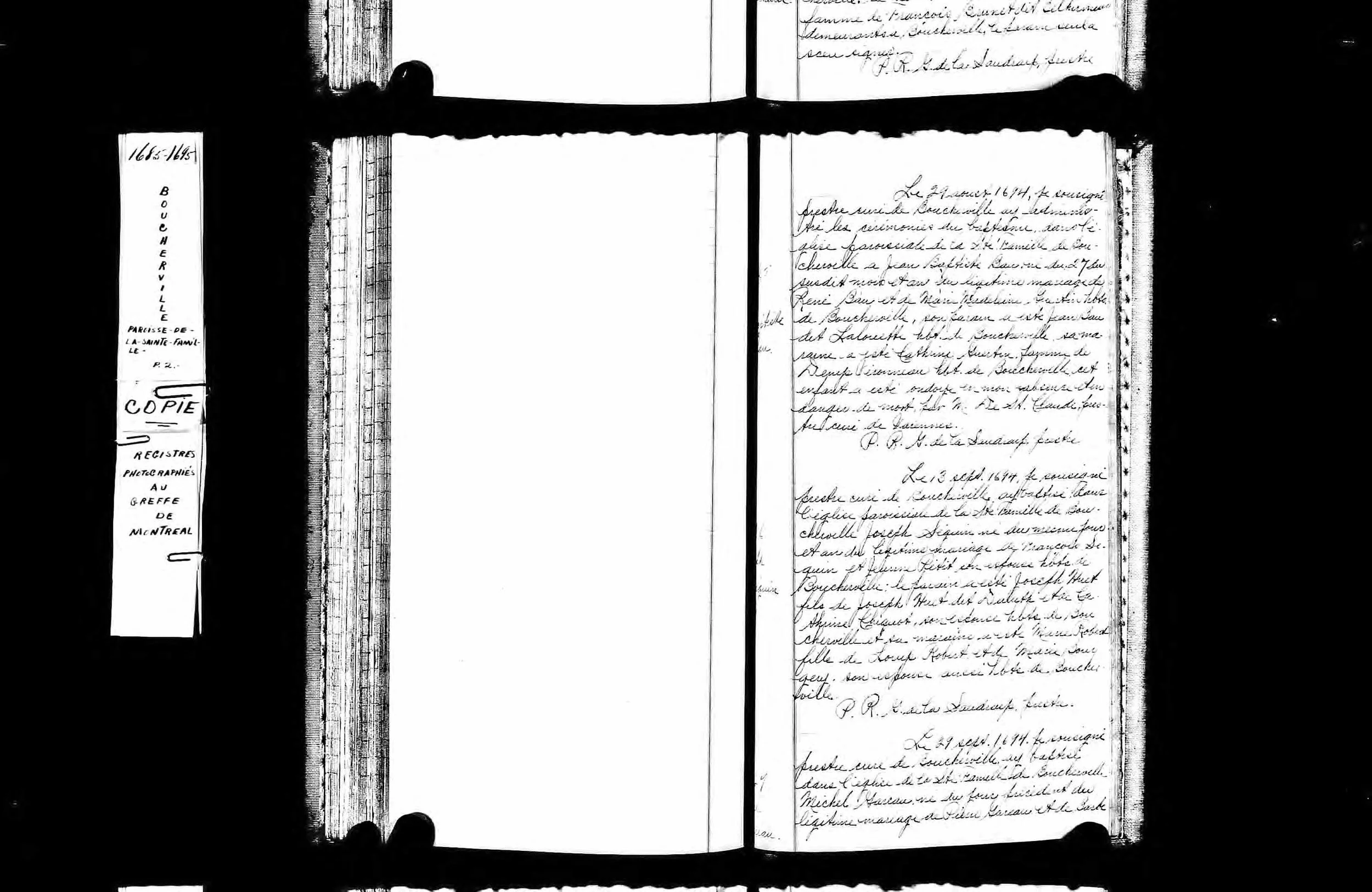
| 11 | Joseph (second) | 13 Sep 1694 Boucherville |
Baptism 13 Sep 1694 | Named for his deceased brother. Married Marie Françoise Sauvage at Ste-Anne-de-Détroit, 12 Apr 1723. Died there 29 Apr 1753 |
The Second Generation: Jean-Baptiste at Sainte-Famille
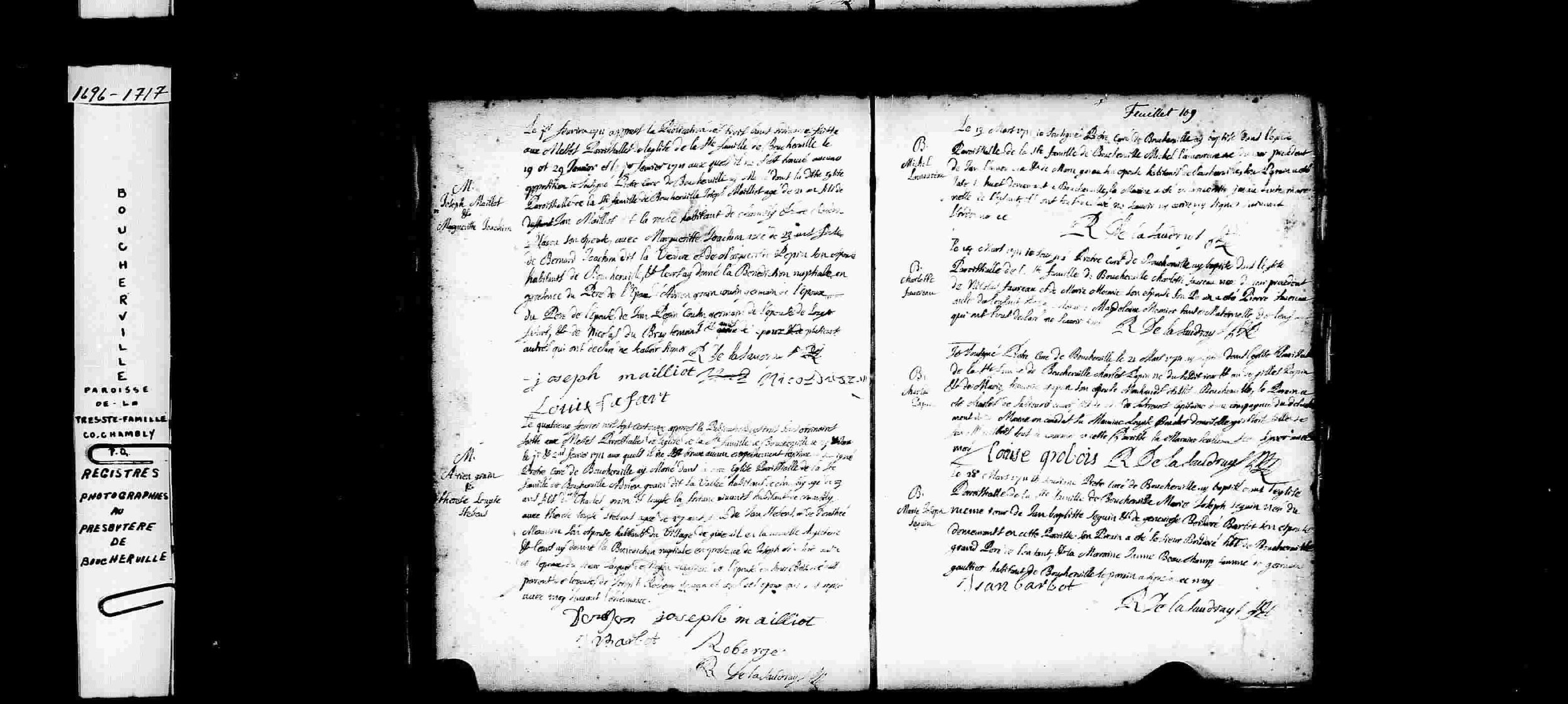
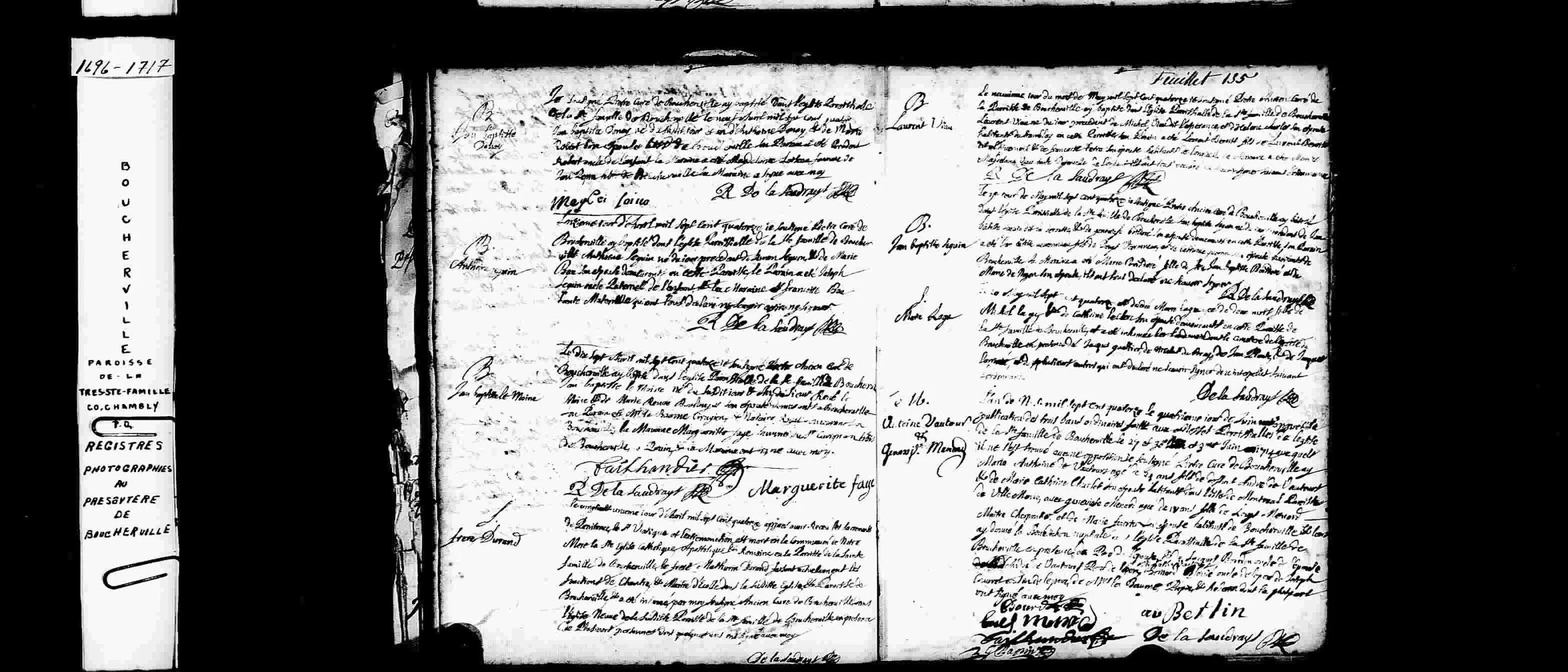
Jean-Baptiste Séguin did not follow his younger brother Joseph into the fur trade. He stayed at Boucherville and, on June 7, 1710, married Geneviève Barbot dite Boisdoré at Sainte-Famille—the same church where he had been baptized twenty-two years earlier. The marriage record notes that his father François is already "deffunt"—deceased. The ceremony was performed by Father Pierre Rodolphe Guybert de la Saudrays, the same priest who had baptized Jean-Baptiste as an infant in November 1688—weeks after arriving from the Séminaire de Saint-Sulpice to take up the cure of Boucherville, a post he still held twenty-two years later.
Jean-Baptiste Séguin & Geneviève Barbot dite Boisdoré
Location: Boucherville (Sainte-Famille)
Groom: Jean-Baptiste Séguin, age 22, son of the late François Séguin dit Ladéroute and Jeanne Petit, living at Boucherville
Bride: Geneviève Barbot dite Boisdoré, age 21, daughter of Sieur Jean Barbot dit Boisdoré and Marie de Noyon, inhabitants of Boucherville
Witnesses: Sieur Boisdoré (father of the bride), Mr. La Baume (surgeon and royal notary), Mr. Tétro (schoolmaster), Nicolas du Bray
Officiant: Father Pierre Rodolphe Guybert de la Saudrays — the same priest who baptized Jean-Baptiste at this altar on 12 November 1688
Over the next fourteen years, Jean-Baptiste and Geneviève had nine children baptized at Sainte-Famille—making the Séguin name one of the most frequently recorded in the parish registers of the early eighteenth century. By 1725, Jean-Baptiste was recorded in the first census of Vaudreuil as Concession #15 de l'Anse—the oldest family in the township. He and Geneviève moved to Chambly by 1725–1726, where their tenth and last child, Marie-Françoise-Agathe, was born and baptized at Saint-Joseph de Chambly in 1726.
In the autumn of 1705, three of Jean-Baptiste's brothers were caught up in a prosecution the intendant's clerk recorded as the trial of les rebelles de la côte. Claude de Ramezay, governor of Montréal, reported disturbances in the côtes near the city and named François Séguin dit Ladéroute—Jean-Baptiste's eldest brother, by then living at Lachenaie—as among those who had spoken most seditiously, boasting that many other habitants would follow him and urging men of other parishes to join. Ramezay had him arrested and imprisoned at Montréal.
Intendant Jacques Raudot commissioned Fleury Deschambault to try the case on 26 October 1705 and to inform against Ladéroute by name on the 31st. François was interrogated on 30 October and again on 25 November; witnesses were examined on 10 and 19 November; and on 26 November he and Jean-Baptiste Lapointe of Mille-Îles were ordered imprisoned again, while Pierre and Simon Séguin were among those to be apprehended and brought to the Montréal prisons for questioning. Nine witnesses were summoned from Boucherville, Île Jésus and Lachenaie—among them Gilles Papin, the Boucherville merchant, and René Bau dit Lalouette.
On 9 January 1706 Raudot found the two men guilty of intending to assemble to present a petition, contrary to the governor general's ordinance of December 1704, and François of imprudent speech that could incite revolt. Each was fined thirty livres. What the petition asked for is not stated in any of the surviving ordinances. Jean-Baptiste was seventeen, still at Boucherville, while three of his brothers stood accused.
Jean-Baptiste died on May 13, 1728, at the hospital in Montréal, at about age 45. He was buried the next day in the cemetery at Notre-Dame de Montréal. The burial record identifies him as "Jean Baptiste La Deroute, habitant de la paroisse de Chambly." As one of François and Jeanne's five sons who survived to adulthood, and with six sons of his own, Jean-Baptiste left the greatest number of Séguin descendants of any member of his generation—a calculation confirmed by the Association des Séguin d'Amérique.
Two Generations, One Church
Between 1672 and 1724, the Séguin family recorded twenty-six documented sacraments at Sainte-Famille de Boucherville: the marriage of François and Jeanne in 1672, eight baptisms and three infant burials among their eleven children, five marriages by four of their sons between 1702 and 1715, and nine more baptisms in the third generation. One priest, Pierre Rodolphe Guybert de la Saudrays, presided over nearly all of it—he baptized Jean-Baptiste on 12 November 1688 in his first weeks as curé, married him in the same church twenty-two years later, and was still serving Boucherville in 1715.
In August 1692, eighteen-year-old Marie Françoise Séguin stood as godmother to her infant brother Joseph in the church where she herself had been baptized. He died nineteen days later and was buried in the parish cemetery.
Two of Jean-Baptiste and Geneviève's sons married into Indigenous families at L'Annonciation d'Oka—the same mission church where Gabriel Guilbault would marry Marie Josephte Abitakijikokwe in 1801. Louis Séguin (b. 1712, Boucherville) married Marie Anne Raizenne Shoentakouani in 1736 at Oka, and Jean-Baptiste fils (b. 1714, Boucherville) married her sister Marie Catherine Raizenne Shoentakouani in 1742. Their father-in-law, Ignace Raizenne Shoentakouani, and mother-in-law, Marie Élisabeth Nimbs Touatogouach, were part of the mission community at the Lake of Two Mountains. The Séguin and Guilbault families thus share not only Sainte-Famille de Boucherville as a parish of origin but also L'Annonciation d'Oka as the church where their lines intersected with Indigenous heritage—decades apart, but in the same sacred space.
The Church Today
Sainte-Famille Church today, facing the Place de l'église in Old Boucherville. The Museum of Sacred Art, inaugurated in 2017, is housed within the church and can be visited on Thursdays, Fridays, and Sundays.
Sainte-Famille de Boucherville continues to serve as both a place of worship and a cultural center. The Museum of Sacred Art, inaugurated in March 2017, displays the parish's collection of worship objects spanning over 350 years. Modern LED lighting allows the interior to adapt for cultural events including Longueuil Symphony Orchestra performances. The Place de l'église remains the heart of Old Boucherville—as it has been since Pierre Boucher donated the land for the first chapel in 1670.
The church is part of the St. Lawrence River shrines circuit, and its heritage ensemble—church, convent, and presbytery—continues to define the visual identity of Boucherville from across the river, just as it did when François Séguin and Jeanne Petit walked through its doors more than three centuries ago.
Visiting the Site
Church Address: 560 Boulevard Marie-Victorin, Boucherville, QC J4B 1W9, Canada
Heritage Status: Classified historical monument (1964); National Heritage Award (1976)
Features: 1801 stone church (rebuilt interior 1845); Berlinguet barrel vault and sculptures; Casavant organ (1995) in 1846 buffet; 336-person crypt; Museum of Sacred Art (2017)
Museum Hours: Thursdays, Fridays, and Sundays, 1:30 PM – 4:00 PM
Architect: Father Pierre Conefroy (1801 church); Louis-Thomas Berlinguet (1845 interior)
Part of: St. Lawrence River Shrines Circuit







Questions about your own research? Begin a research inquiry.
