
The Storyline
Real families. Real discoveries. Real stories.

One Wedding, Two Lisettes
On a single winter day in 1839, two men named Joseph each married a woman named Lisette at the Willamette mission. The family trees made them one couple and gave a Shuswap woman a Chinook chief's ancestry. The register never merged them.
Part of the Storyline Genealogy series: Research Methodology
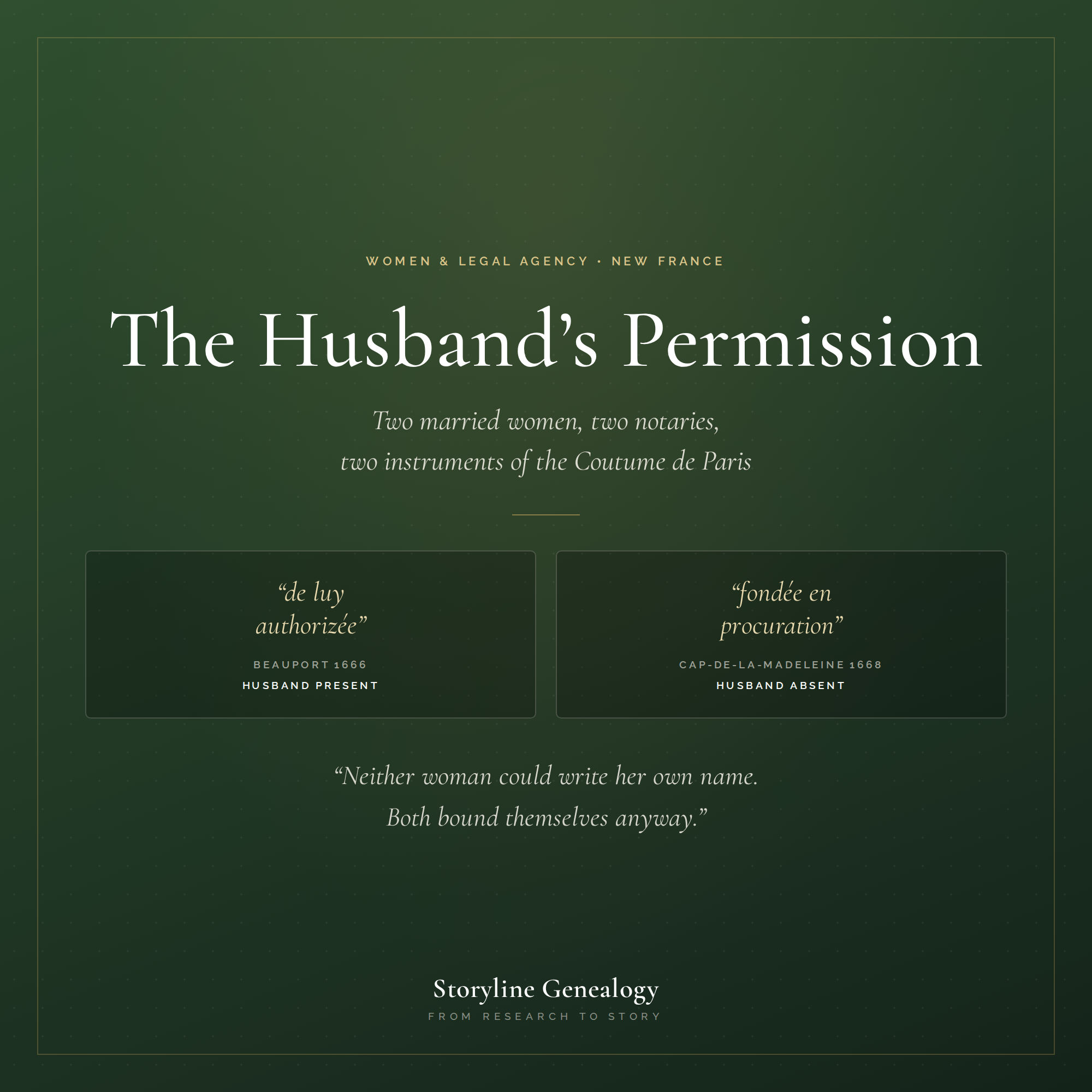
The Husband’s Permission
Every other woman in this collection is a widow — not by choice, but because a married woman could not bind herself under the Coutume de Paris, and so left far fewer records. The incapacity was never absolute. Marie Riton contracted at Beauport in 1666, authorized inside the act by the husband standing beside her. Marie Duteau contracted at Cap-de-la-Madeleine in 1668 under a power of attorney, her husband absent, and bound herself alone. Neither could write her own name.
Part of the Storyline Genealogy series: Filles du Roi & Filles à Marier — The Women Who Built New France
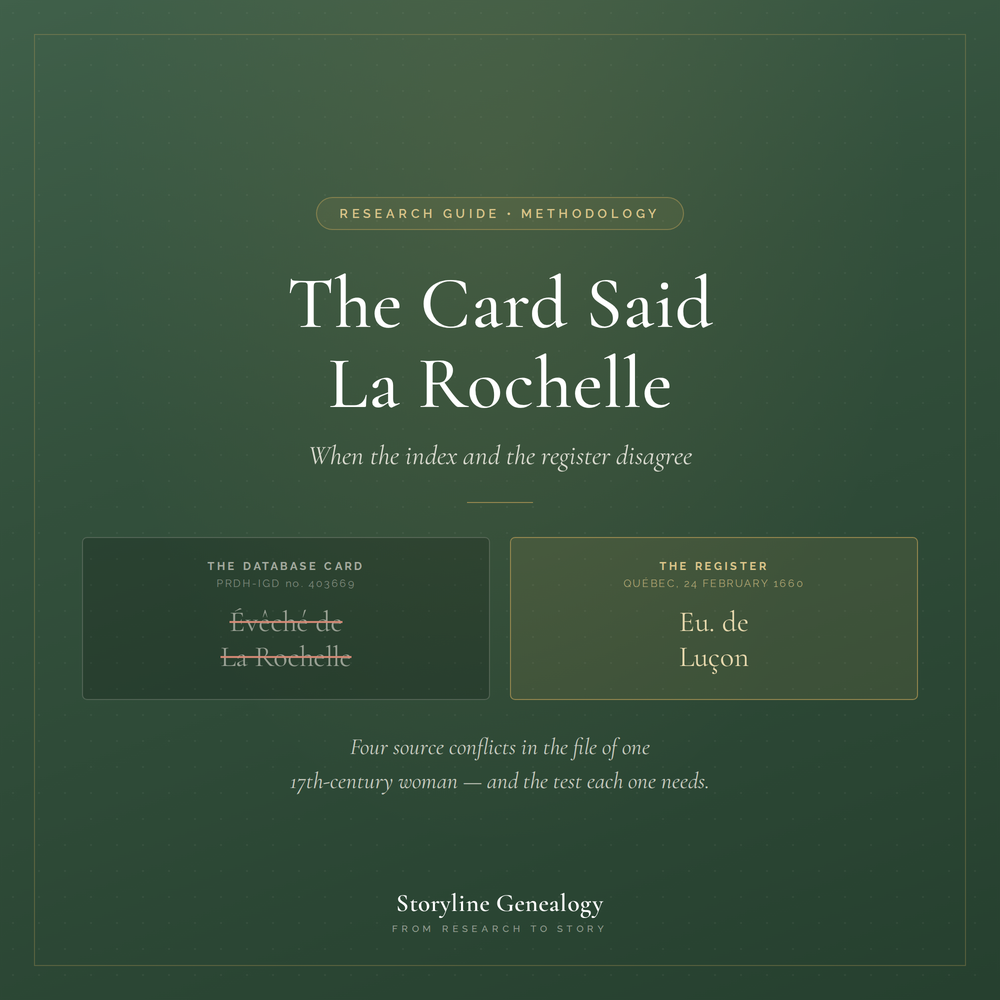
The Card Said La Rochelle
Every genealogist knows to go to the original. That is only half a rule, because it does not say what to do when the sources you have reached disagree with each other. Four worked examples from the file of one woman, and the four tests they yield.
Part of the Storyline Genealogy series: Research Methodology
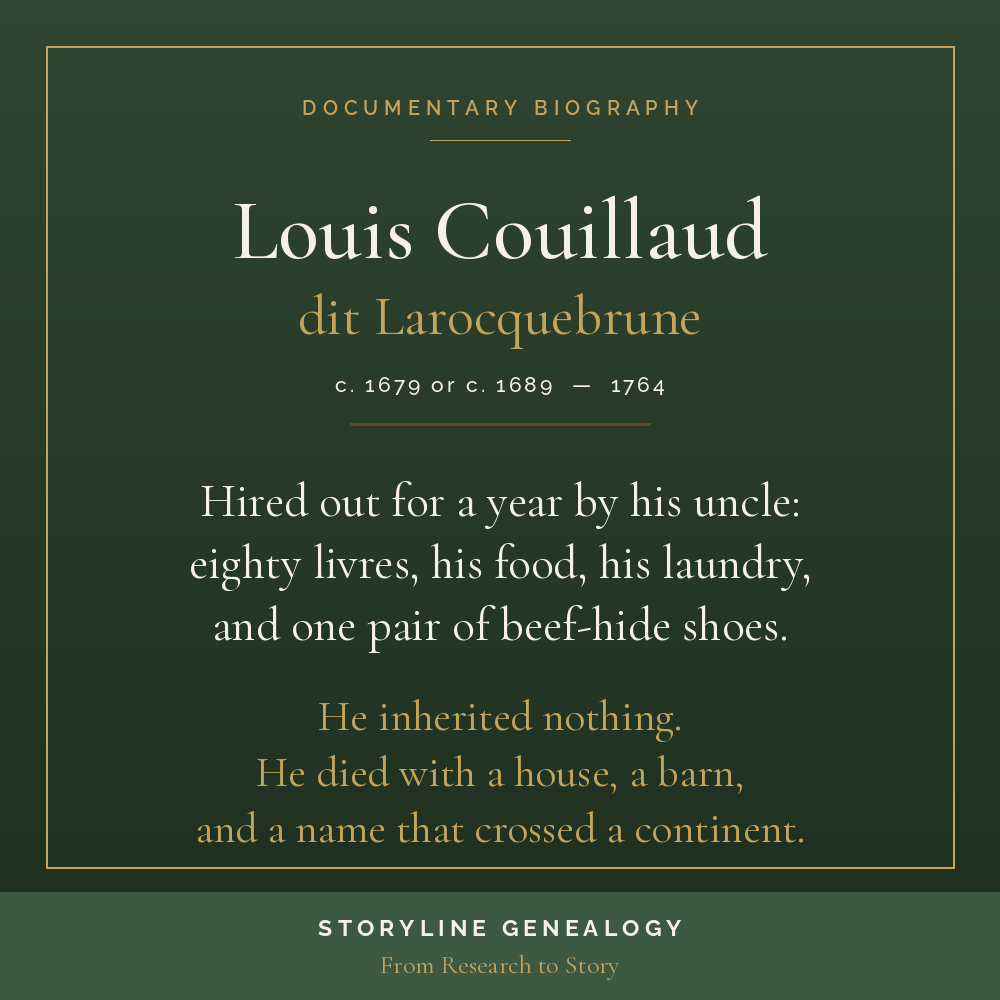
Louis Couillaud dit Larocquebrune
Two fires destroyed the Contrecoeur registers, so no record of his birth survives and genealogists still disagree over the year. His father died in debt inside that gap. His mother was sued, could not pay, and watched the crop seized. Six days after his uncle sold the land he was living on, a Montreal notary wrote down what Louis Couillaud owned: nothing. He was hired out for a year — eighty livres, his food, his laundry, and one pair of beef-hide shoes. Two years later the family concession was auctioned to his brother. By 1718 the parish registers call him a miller. By 1724 a seigneurial enumeration puts him first among the habitants on the south coast of Île Perrot, with a house, a barn, a stable and twenty arpents under the plough.
Part of the Storyline Genealogy series: From Research to Story
Pierre Morin & Catherine Lemesle
On 18 November 1706 a man of fifty-six was carried into the Hôtel-Dieu de Québec. Thirteen days later his wife was admitted too. Neither of them could write their name — and almost everything we know of Pierre Morin and Catherine Lemesle was written down by other people.
Part of the Storyline Genealogy series: From Research to Story
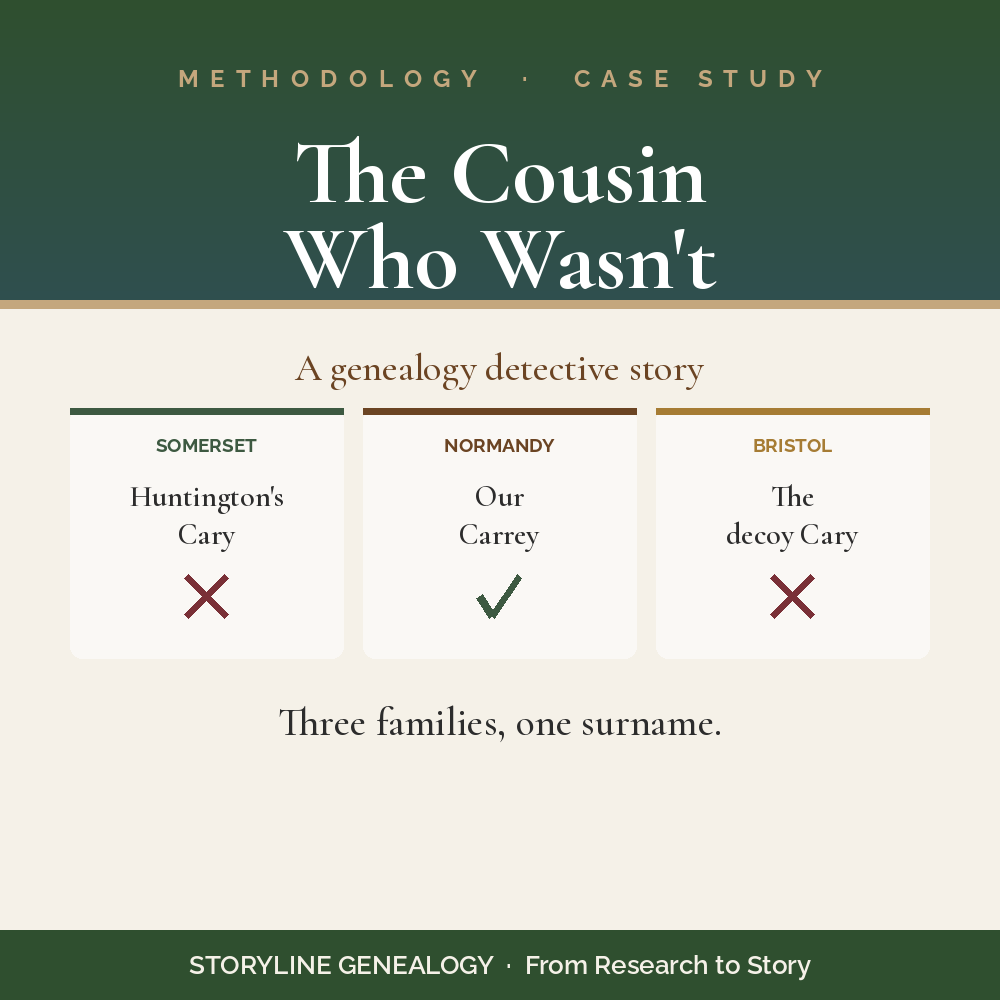
The Cousin Who Wasn’t
A family tree said we were cousins with Samuel Huntington, signer of the Declaration of Independence. The connection ran through a single surname—Cary—that appeared on both sides of the Atlantic. This is the story of how immigrant-origin records, a 1627 Norman parish register, and a 1919 genealogy pulled three families apart, and why a shared surname at the colonial-to-European transition is the most dangerous coincidence in genealogy.
Part of the Storyline Genealogy Methodology Series: How primary sources correct the family tree
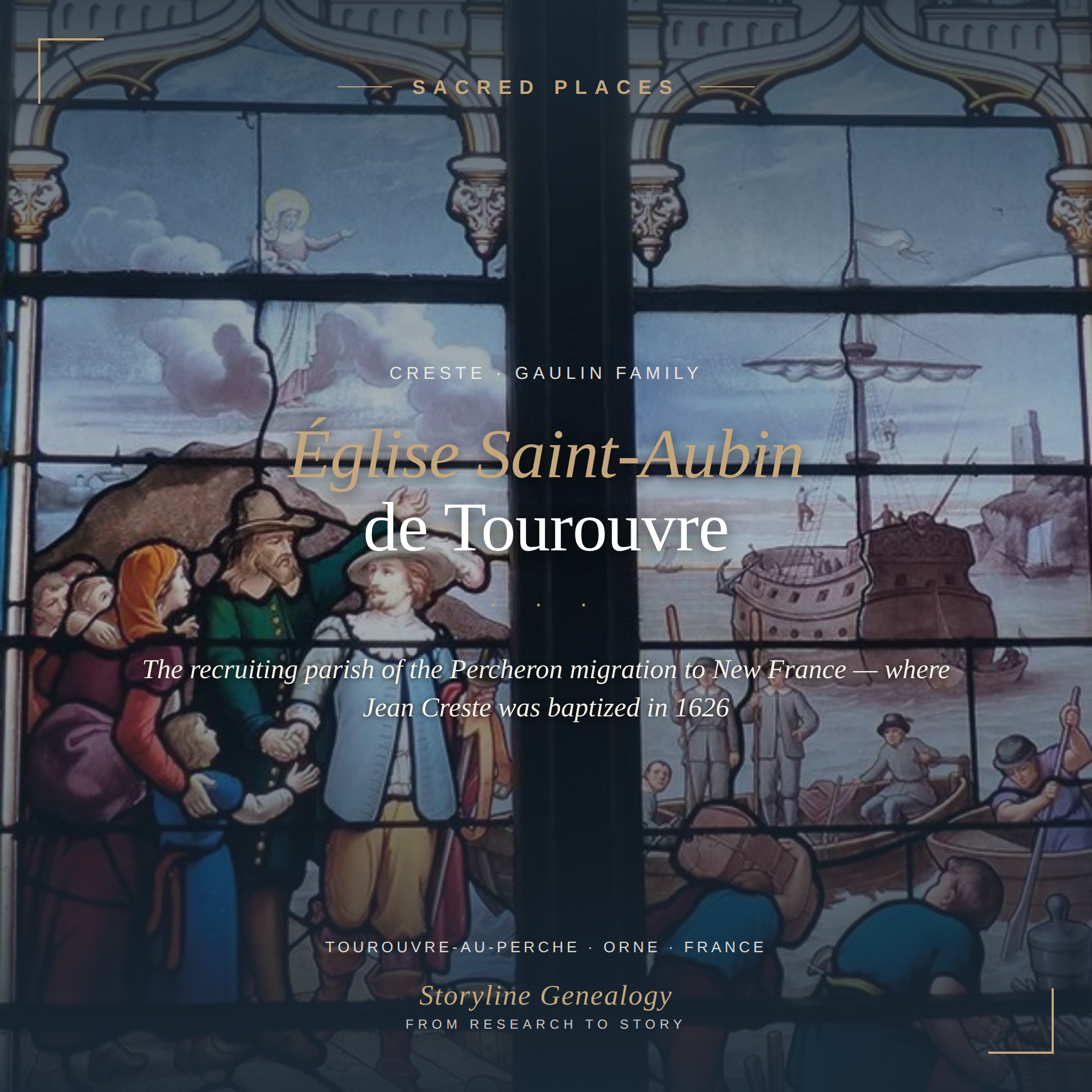
Église Saint-Aubin de Tourouvre
The eight-century Perche church that baptized Jean Creste in 1626 — and thirty-five other founding pioneers of New France whose names are recorded on a plaque inside: Juchereau, Pinguet, Guyon, Roussin, Gagnon, Giguère, Mercier, Rivard, Pelletier, Provost, and more. The Romanesque south wall dates to the twelfth century; the bell tower with its lantern campanile is Renaissance; the great baroque high altar is dated 1646; the famous Mercier emigration stained glass was installed in 1893. The building survived the burning of Tourouvre by retreating German troops on 13 August 1944, almost untouched.
Part of the Storyline Genealogy series : Sacred Places
Marie Crête: The Daughter Who Carried the Line
Notre-Dame de Québec, October 1657: a four-day-old infant carried to the font and baptized by the Sulpician Vicar Apostolic of New France. Sixty-five years later she would be buried in the same parish, a widow of three husbands. Between those two acts Marie Crête bore twelve children, sued her own brother-in-law in the Provost's Court of Quebec for twelve hundred livres, partitioned an urban Quebec property near the Hôtel-Dieu with the seigneur Saint-Simon, and paid seigneurial dues to the Crown's farmer-general. A documentary biography of the 8th great-grandmother of the Guilbault line — three marriages reconstructed from parish, notarial, judicial, and seigneurial records.
Part of the Storyline Genealogy series: From Research to Story
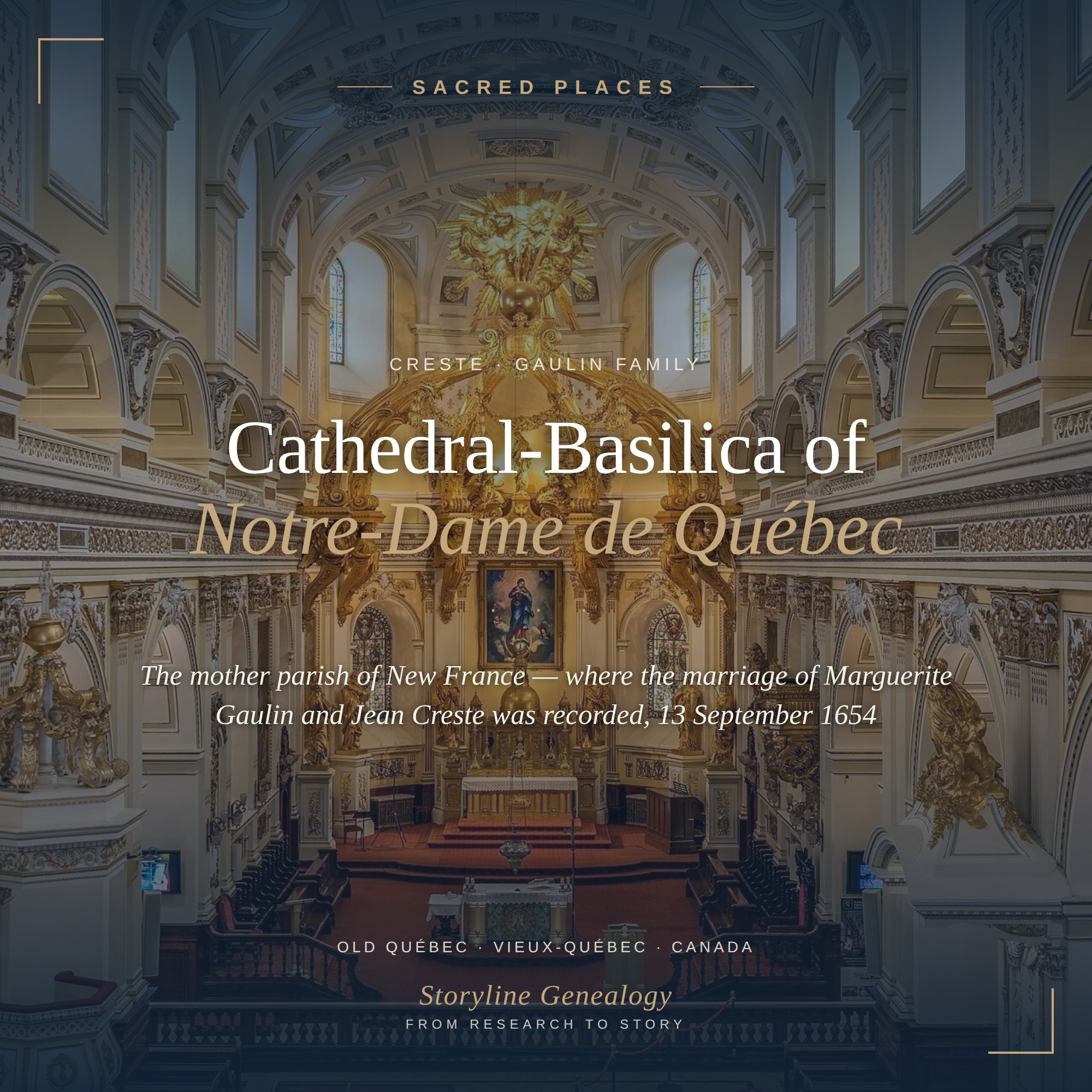
Cathedral-Basilica of Notre-Dame de Québec
In a modest 1647 stone church on the rock of Quebec, the marriage of a Norman bride and a Percheron husband was recorded on 13 September 1654. Over the next seventeen years she would return to the same parish church ten times to baptize her children at its font. Once, in the spring of 1663, to bury a six-week-old daughter. The cathedral-basilica that stands on the site today is the third major building since hers — destroyed in 1759 by British shelling, again in 1922 by fire, rebuilt stone-by-stone each time from photographs and the original Baillairgé plans.
Part of the Storyline Genealogy series : Sacred Places
The Mathematics of French-Canadian Cousinhood
When my son told me his coworker had French-Canadian background, I predicted we were probably 9th-to-10th cousins before either of us checked anything. I have made that prediction many times across my career, and the math always works. An essay on pedigree collapse and the founder effect.
Part of the Storyline Genealogy series: From Research to Story
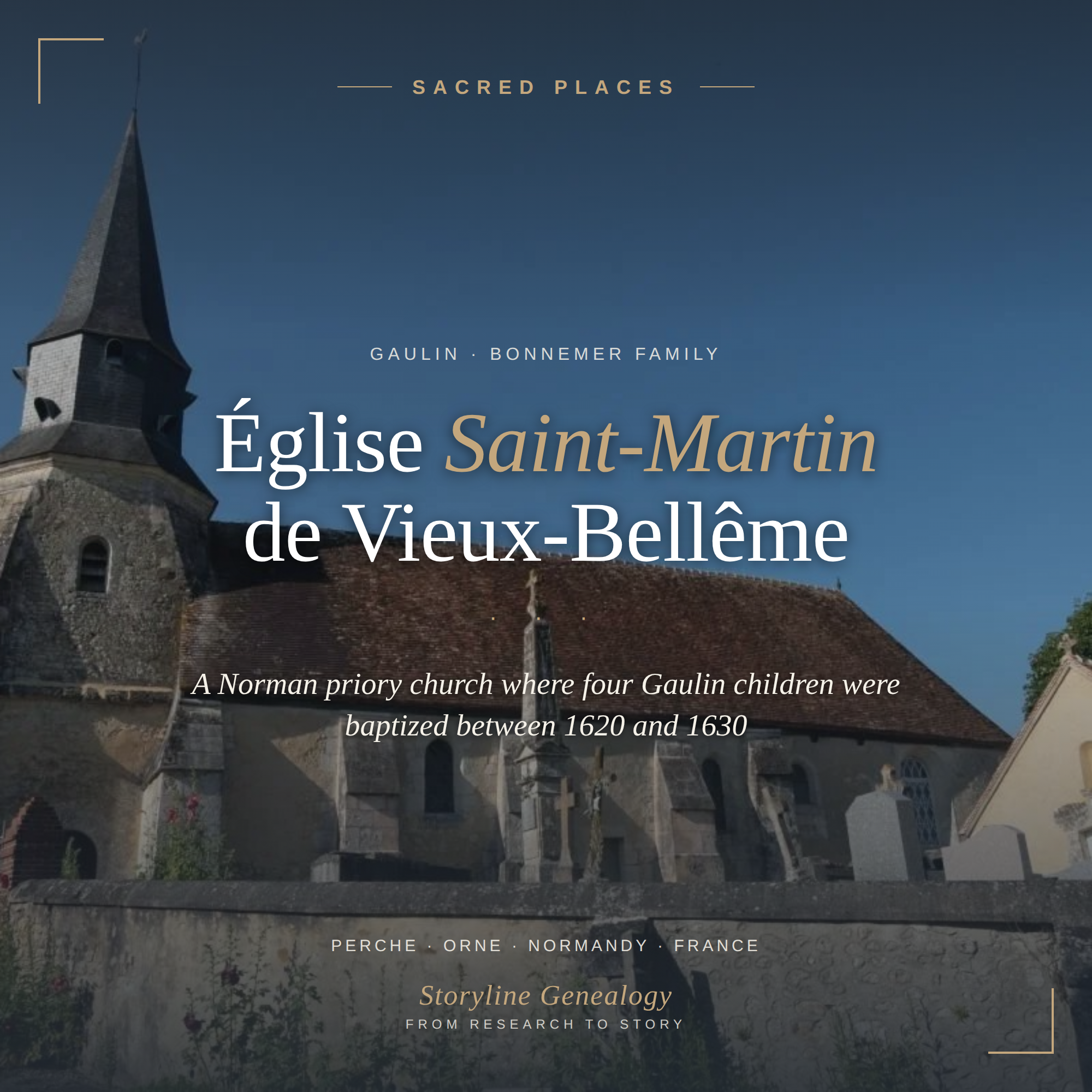
Église Saint-Martin de Vieux-Bellême
In a Norman priory church older than France itself, four children of Vincent Gaulin and Marie Bonnemer were baptized between 1620 and 1630. Two would later cross to New France.
Part of the Storyline Genealogy series : Sacred Places
Marguerite Gaulin: A Fille à Marier of the Perche
Marguerite Gaulin was baptized on 14 May 1627 in the parish of Saint-Martin-du-Vieux-Bellême, in the rolling country of the Perche west of Paris. Twenty-seven years later she crossed an ocean as a fille à marier, married Jean Crête in the manor house of Sieur Robert Giffard at Beauport, and spent the next forty-nine years raising ten children at the heart of the Giffard-Juchereau seigneurial circle. This documentary biography traces her life through twelve primary sources, three royal censuses, and the baptism register acts of every child she bore.
Part of the Storyline Genealogy series: Filles du Roi & Filles à Marier — The Women Who Built New France

What the Finding Aids Don’t Show You
Two indexes cover the same Hudson's Bay Company Archives collection and return different answers. A microfilm reel catalogued as holding a run of account books quietly redirects one of them to two other reels. And an index entry, however precise, cannot tell you which of several men who shared a name you actually found. None is a flaw in the archive. Each will cost you a conclusion.
Part of the Storyline Genealogy series : A Research Methodology Guide
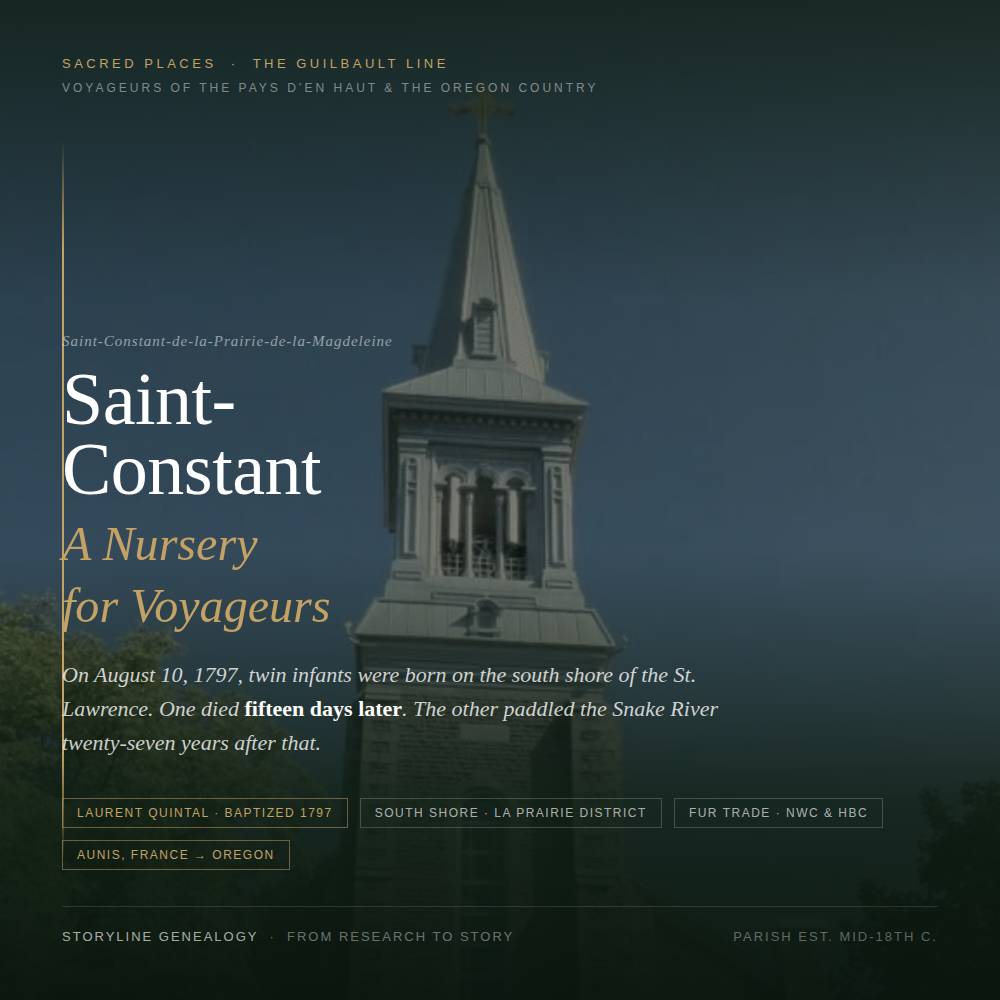
Saint-Constant-de-la-Prairie-de-la-Magdeleine
On August 11, 1797, the curé of Saint-Constant baptized two infants in a shared act — twins Laurent and Marie Suzanne Quintal, born the day before to François Quintal, fermier, and Marie Hébert. Marie Suzanne died fifteen days later. Laurent survived, grew to manhood in the La Prairie district of the south shore, and at nineteen made his mark on a North West Company contract departing Lachine for the pays d'en haut. He would not return to Saint-Constant for the rest of his life. The parish that recorded his birth was a nursery for voyageurs — and the baptism register that preserves his name is the first document in a chain that runs from Québec to the Snake River to an Oregon farm.
Part of the Storyline Genealogy series : Sacred Places
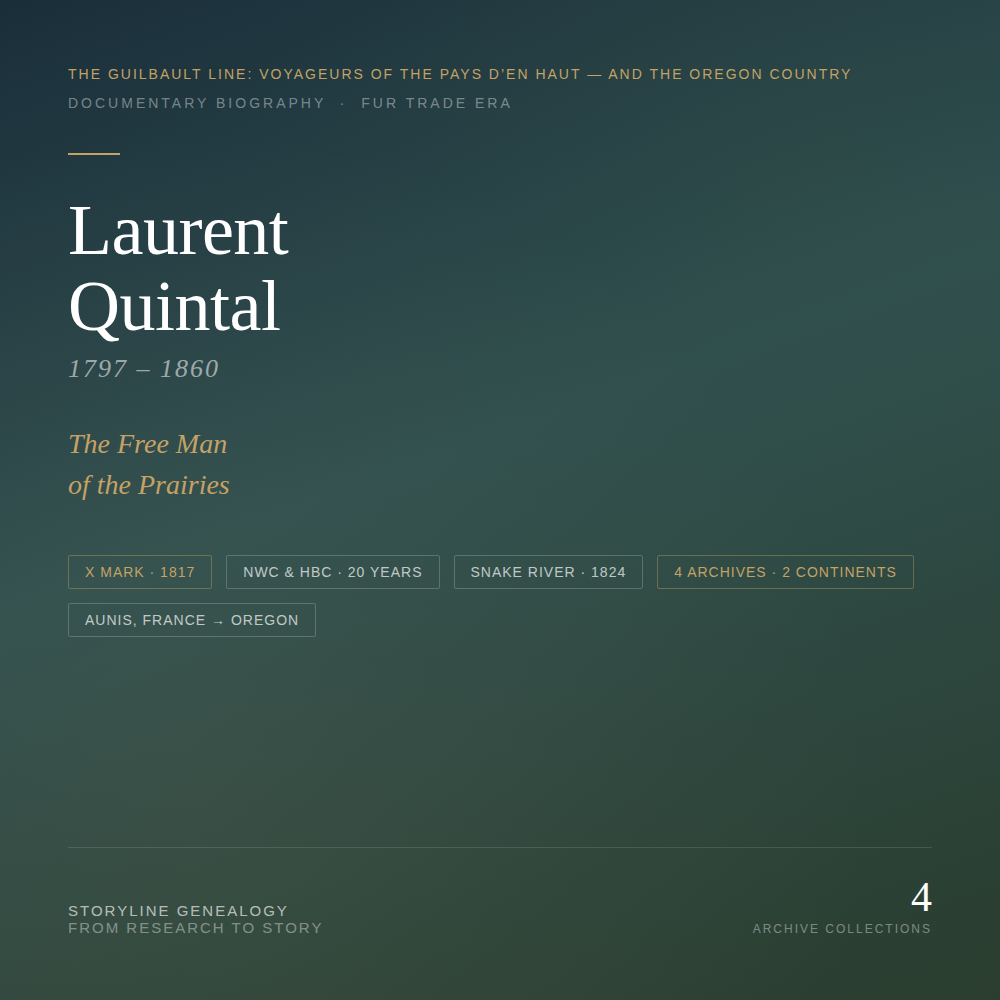
Laurent Quintal: The Free Man of the Prairies
He was born a twin on the south shore of Québec in 1797 — the fifteenth of seventeen children of a farmer who could not sign his own name. At nineteen he pressed an X to a North West Company contract and departed Lachine for the pays d'en haut. He would spend twenty years in the interior, paddle the Snake River under Alexander Ross, earn the notation Free in an HBC ledger, and die binding wheat in an Oregon field in 1860. His life is documented across four archive collections on two continents — and the primary sources correct two widely circulating errors that have corrupted this family's genealogical record for years.
Part of the Storyline Genealogy series: The Guilbault Line: Voyageurs of the Pays d'en Haut — and the Oregon Country
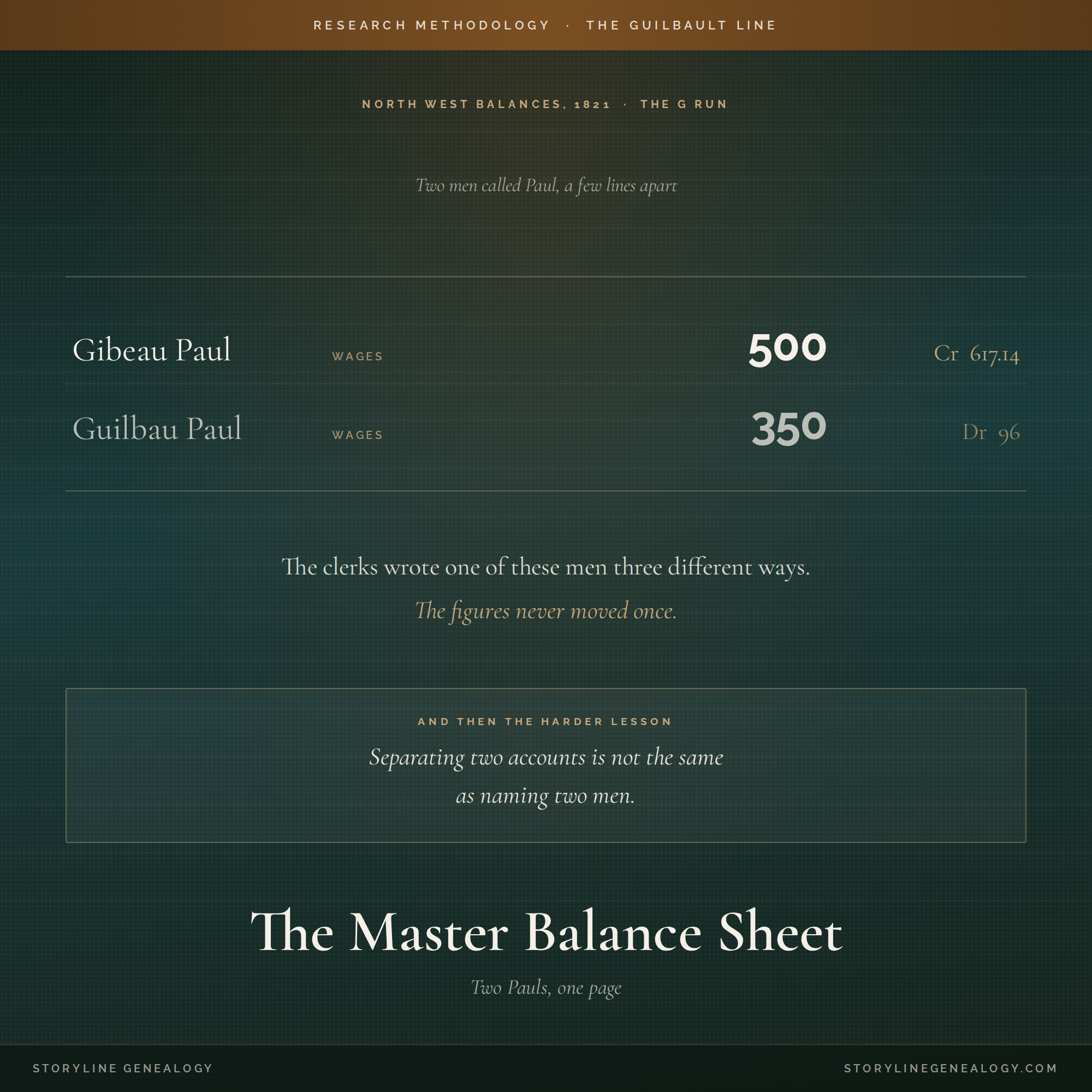
The Master Balance Sheet: Two Pauls, One Page
Two men called Paul appear in the North West Company's 1821 settlement register, in the same department, in the same season. The clerks spelled one of them three different ways, so the spelling could tell them apart from nothing. The figures could, and did — a wage of 500 against a wage of 350, holding still across every volume. What took another year to see is that separating two accounts is only half the work, and the easier half. Neither figure says who either man was.
Part of the Storyline Genealogy series: The Guilbault Line: Voyageurs of the Pays d'en Haut — and the Oregon Country
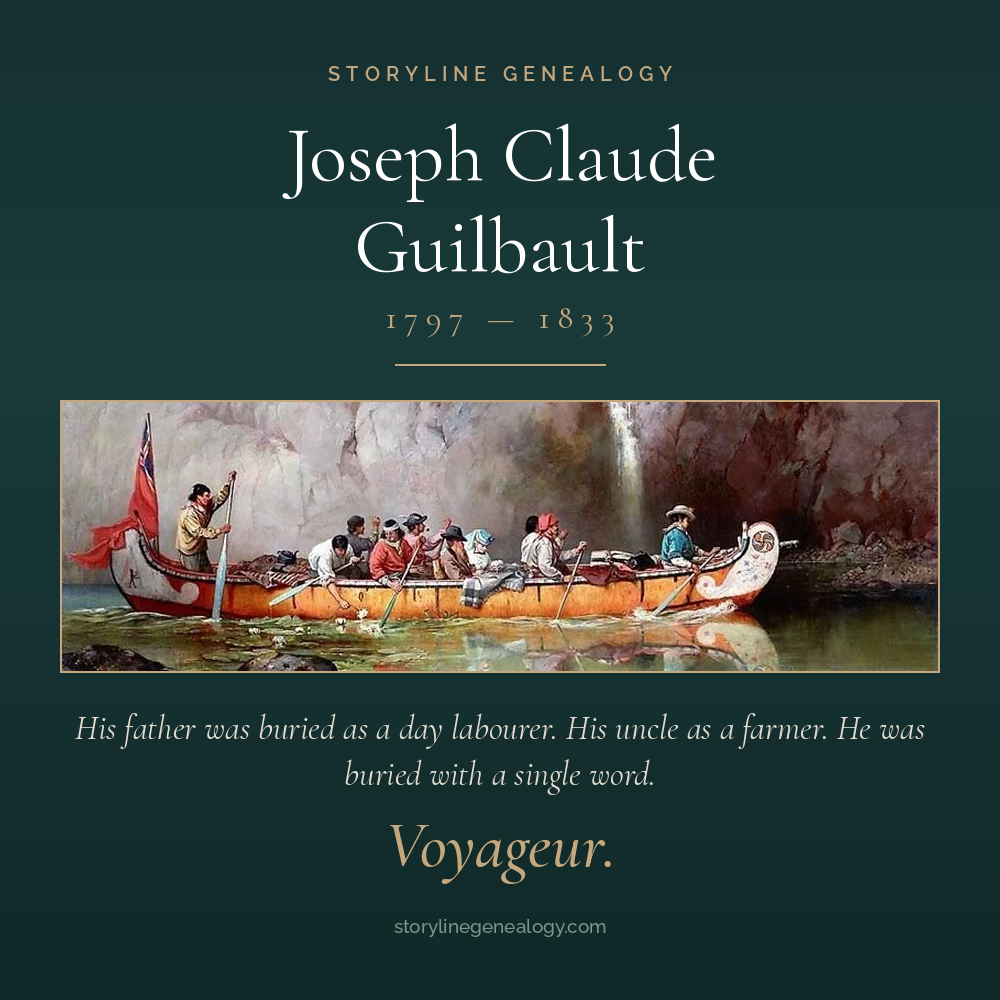
Born in the Pays d’en Haut
Joseph Claude Guilbault was born in June 1797 somewhere in the pays d'en haut, to a French-Canadian voyageur and an Anishinaabe mother from Lake Superior. He was baptized at sixteen months, named once more at four, and then disappears from the Quebec record for thirty-one years. When a man of his name was buried at Oka in 1833, the priest wrote one word for his occupation — and the Grand Chief of the Algonquins stood at the grave.
Part of the Storyline Genealogy series: The Guilbault Line: Voyageurs of the Pays d'en Haut
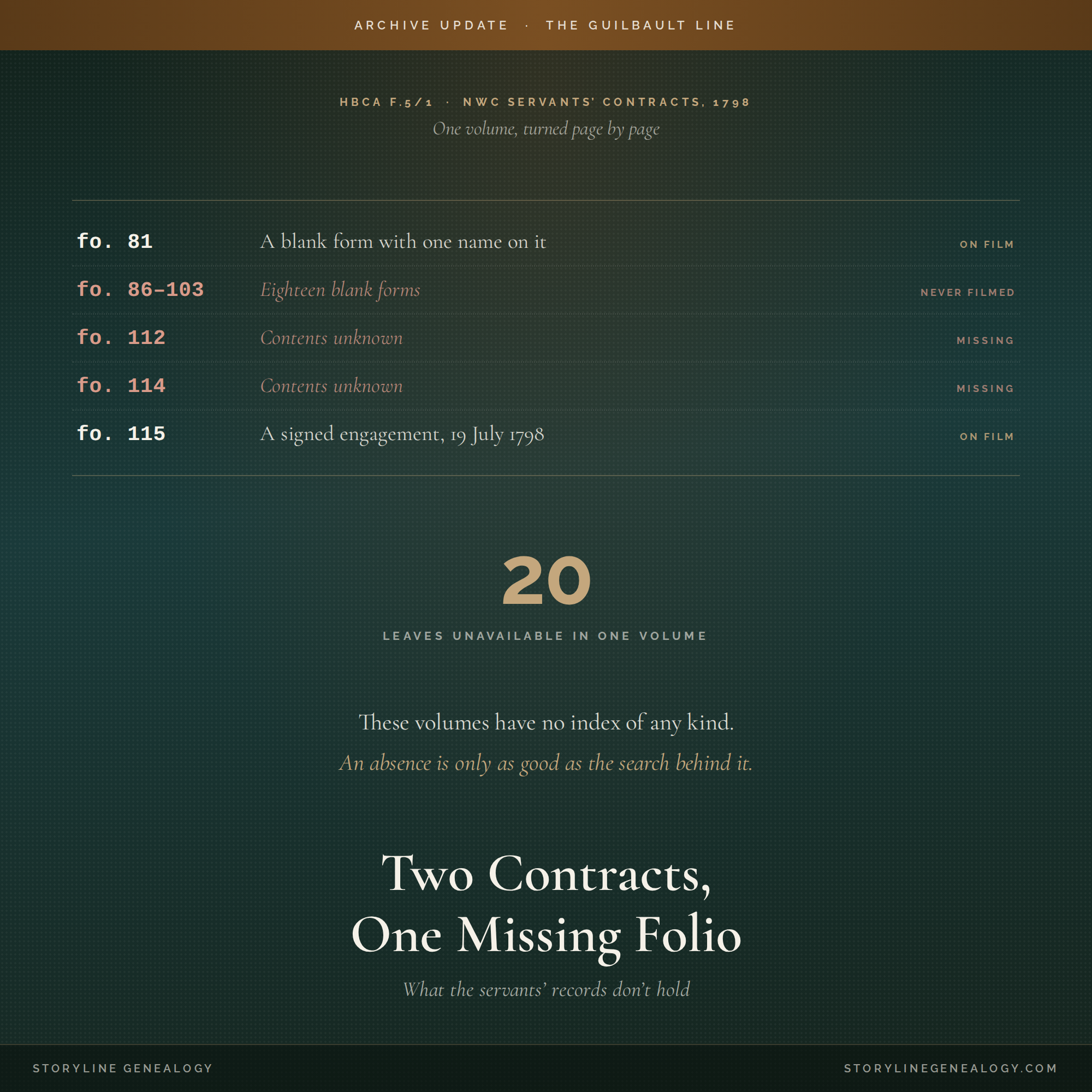
Two Contracts, One Missing Folio
The North West Company's servants' contracts are the most informative documents in the fur-trade archive and almost unusable: the volumes carry no name index of any kind, so finding a man means turning every page. Do that, and you start noticing what isn't there. In one volume alone, two folios are lost and eighteen more were never filmed — twenty leaves unavailable, any of which could hold an engagement. One man in this family has two signed contracts and no identity. Another has five years of wages and nothing signed anywhere.
Part of the Storyline Genealogy series: From Research to Story
From Death Rapids to Saint Paul Mission: Hilaire Guilbault
In September 1838, Hilaire Guilbault of Verchères, Québec, survived the worst disaster on the Columbia River brigades — the bateau capsizing at Les Dalles des Morts that killed twelve people, including the wife of Governor Sir George Simpson. He did not go home. Four years later he gave sworn testimony before James Douglas at Cowlitz Farm. Six months after that he stood godfather at Saint Paul Mission. Three documents tell the arc of a life built from the wreckage of a river crossing.
Part of the Storyline Genealogy series: The Guilbault Line: Voyageurs of the Pays d'en Haut — and the Oregon Country
French Prairie: The Western Terminus
French Prairie was not a coincidence. It was the predictable endpoint of a network that began at Oka, ran through Fort Walla Walla and New Caledonia, and ended at St. Paul, Marion County — where the same families who had lived beside each other at the Lake of Two Mountains reconstituted themselves three thousand miles west. This post documents why the HBC pipeline sent those families west, why they landed where they did, and what the three-country archive gap between Quebec and Oregon means for anyone trying to trace them.
Part of the Storyline Genealogy series: The Guilbault Line: Voyageurs of the Pays d'en Haut — and the Oregon Country