
Jean Bernardin Lesage dit Lepiedmontois
Jean Bernardin Lesage dit Lepiedmontois
Quick Facts
In September 1716 a notary at Québec wrote down what Jean Bernardin Lesage did for a living. He was there to settle his daughter's marriage, and the act names him « Jean Bernardin le Sage, Brigadier des Gardes du Castor de ce pays » — brigadier of the beaver guards. The same document calls him Sieur. He signed it.
That is not the man the family story usually describes. The soldier from the Italian foothills who married a fourteen-year-old at Neuville and farmed is the version that has come down. The record shows something else: a man who left the ranks, took a post in the town guarding the fur monopoly's stores, held it into his fifties, was styled by a title of standing, and could write his name in a colony where the woman standing godmother to his eldest child could not write hers.
This page distinguishes what a record states from what a database reports. Where a register act or a notarial minute has been read directly, the page says so and quotes it. Statements drawn from the PRDH database are identified as such, and the database's own cards are reproduced below as transcription tables rather than as images. Transcriptions marked as working readings have been taken from digital images and not collated against the originals. Where four sources give four different answers — as they do for his age — the page gives four.
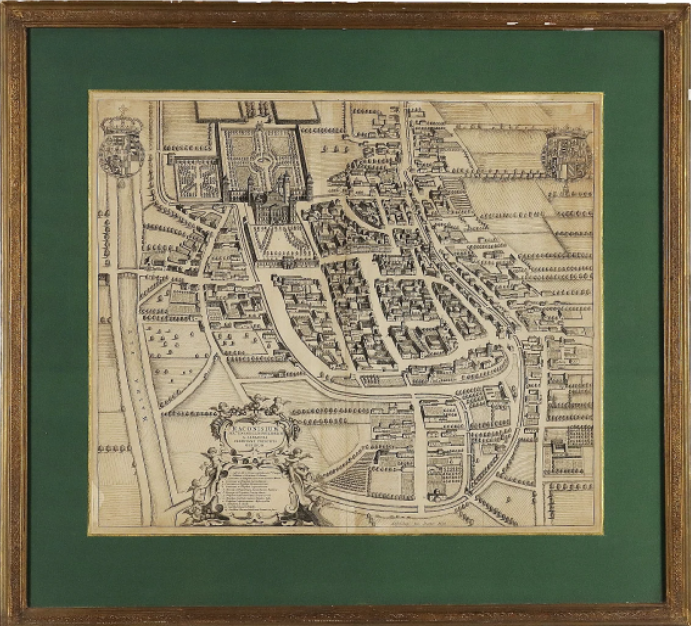
Racconigi, from the Theatrum Sabaudiae (2nd ed., 1726), etched by Ioannes Blaeu. The town lies in the Province of Cuneo, south of Turin, and is known for its castle — a residence of the House of Savoy.

Italy in 1700, showing Turin and the Duchy of Savoy. Racconigi lies south of Turin. From The Public Schools Historical Atlas, ed. C. Colbeck, 1905.
Italian settlers in New France were rare. His dit name, Lepiedmontois — the Piedmontese — marked his origin for as long as it was used, and then faded. In colonial records he appears as Lesage, Le Sage, Lesage Lepiedmontois and, in one Repentigny register, as Delâge.
How Old Was He?
Four records give four answers, and the compiler Denis Beauregard sets them out with the source behind each: about 1660 from the marriage act of 1686, 1659 from a hospital record of 1694, 1657 from the census of 1716, and 1650 from the burial act of 1748. That is a fourteen-year spread.
The earliest and most contemporaneous is the marriage act itself, which describes him as « âgé de vingt six ou vingt sept ans » — twenty-six or twenty-seven — in January 1686. That points to a birth about 1659 or 1660.
The figure that pulls hardest against it is the ninety-eight given at his burial. There is a reason to distrust it.
The same priest, Degeay, buried Jean Bernardin in 1748, his widow Marie Barbe in 1759, and their son in 1762. Two of those three ages can be checked. Marie Barbe's act gives ninety-six; her baptism of 25 April 1671 makes her eighty-seven — nine years over. Jean Bernardin's act gives ninety-eight; his own marriage act makes him about eighty-eight — ten years over. The third, in 1762, is twelve years over. This is a property of the register, not of the family, and it is why the figures on this page do not agree with each other.
Only a record at Racconigi would settle it. None has been sought.
The Soldier: Compagnies Franches de la Marine
Jean Bernardin came not with the Carignan-Salières Regiment, which had finished its work two decades earlier, but with the Troupes de la Marine — the permanent colonial infantry raised under the Ministry of the Navy. In 1683, facing renewed Haudenosaunee hostilities, Governor La Barre asked France for reinforcements, and the first Compagnies Franches were sent. Between 1683 and 1688 some thirty-five companies went to Canada, more than 1,400 men for a colony of about 10,300.
Everything this page knows about his service comes from one document: his marriage act. It names his company through three men. Joseph Caba, lieutenant of the company of M. de Muy. M. Demuy, the captain, who granted him leave to marry. And Jean Vallée, sergeant of the same company.
No muster roll, engagement, discharge or passenger list has been found. The arrival date of about 1683 to 1685 is bracketed backwards from the marriage and from the general date of the first sailings; it is an estimate, not a record. If the act names the company precisely enough, the troop rolls at the Archives nationales d'outre-mer would be searchable — that work has not been done.
Why a Piedmontese in the French service?
Seventeenth-century Piedmont belonged to the Duchy of Savoy, which kept close military and diplomatic ties with France, and Piedmontese soldiers served in French armies as a matter of course. Both were Catholic Latin cultures, and men like Jean Bernardin integrated quickly. The dit name was the only visible marker of his origin, and it did not outlast his grandchildren.
8 January 1686: Marriage at Neuville
The act is dense, and almost everything this page says about his origins comes out of it. He is given as the son of Jean Martin le Sage and Catherine Bretel, of the parish of Sainct Marie de la ville de Racconis, archêvêché de Turin en Piedmont, aged twenty-six or twenty-seven. She is Marie Barbe Silvestre, daughter of Nicolas Silvestre dit Champagne and Barbe Neveu, of that parish. She had been baptised on 25 April 1671. She was fourteen.
Two men of her family stood there. Her father Nicolas Silvestre. And Gilles Pinelle, whom the act calls son grand père — her grandfather.
Gilles Pinel was Anne Ledet's second husband and stepfather to Barbe Neveu — no blood relation to the bride at all. Twenty-nine years after he married Anne, the parish called him the family's grandfather without qualification. He died fourteen years later, in January 1700.
At the foot of the act, in his own hand: Jan bernardin Le Sage.
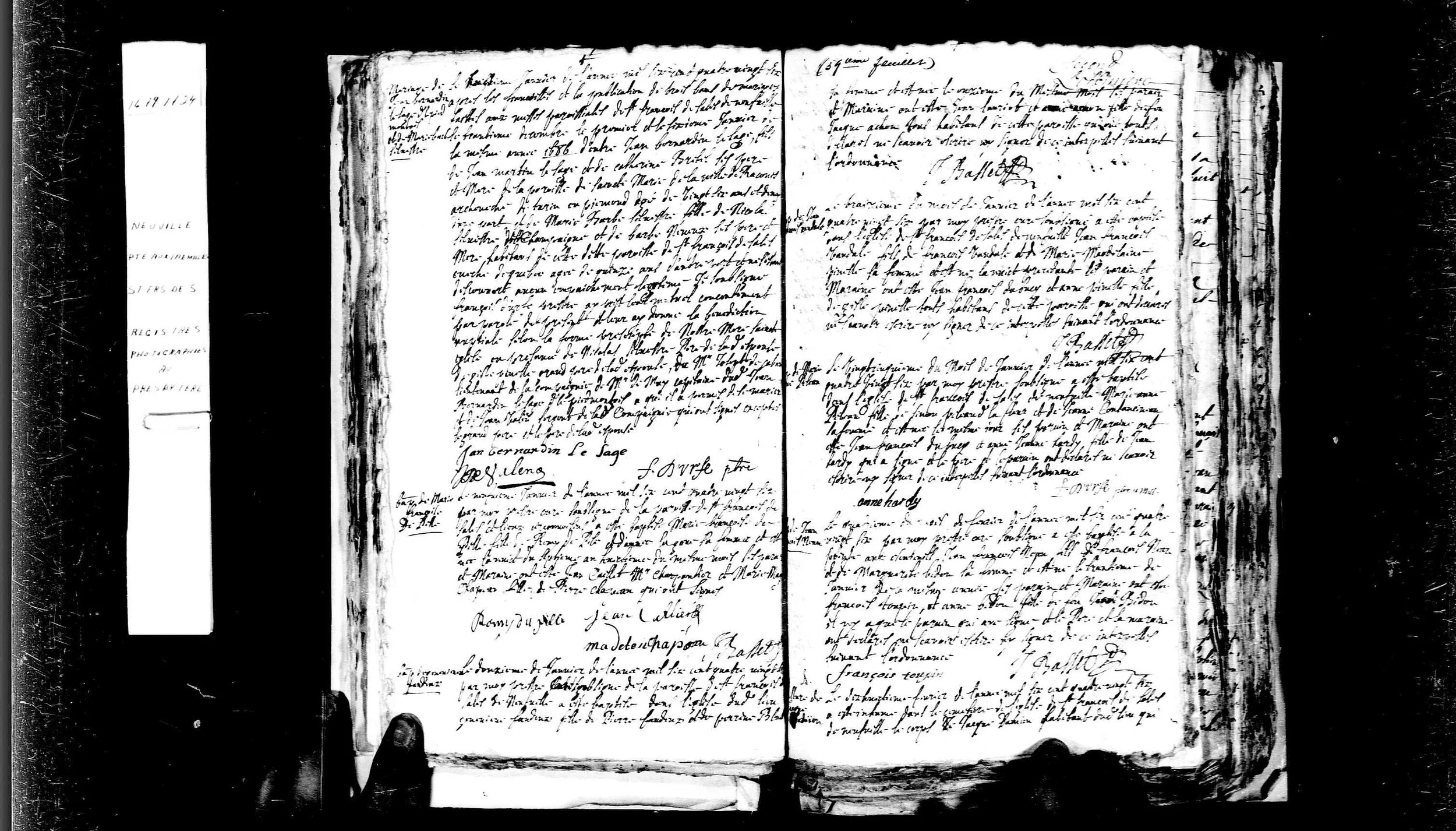
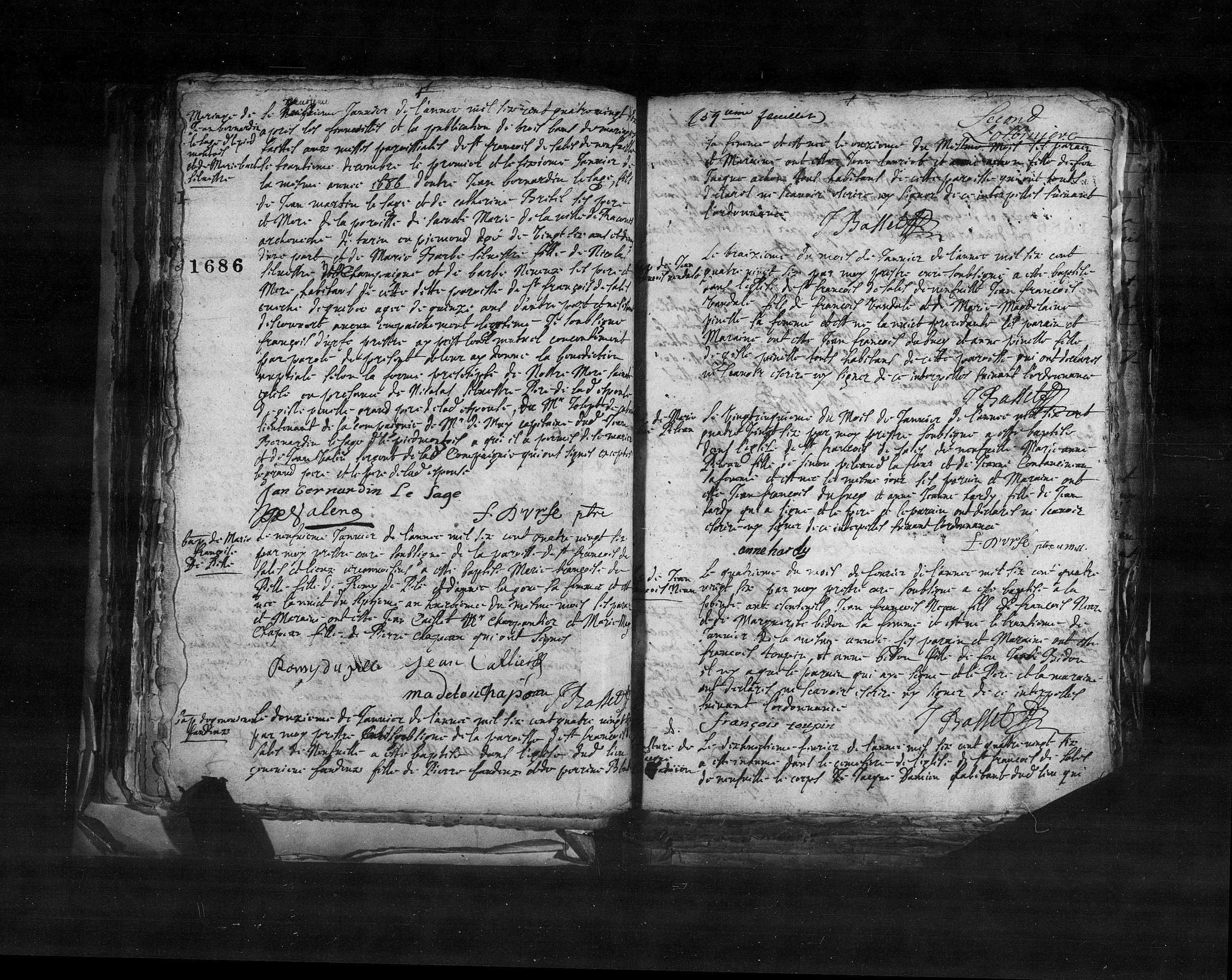
Brigadier des Gardes du Castor
Thirty years later, in the study of the notary Pierre Rivet dit Cavelier at Québec, Jean Bernardin appears with an office.
« Et led Jean Bernardin le Sage, Brigadier des Gardes du Castor de ce pays, Stipulant en cette partie pour Marie Louise le Sage sa fille aussy a ce presente et de son Consentement »
Marriage contract, 8 September 1716 — BAnQ, CN301,S240, greffe de Pierre Rivet dit Cavelier. The three pages are reproduced below.The gardes du castor guarded the beaver magazine at Québec — the stores of the fur monopoly, the colony's principal wealth. A brigadier of the guards was a supervisory post, salaried, and held in the town. In the same act he is styled Sieur, not habitant.
This is the fact that reorders the rest of his life. From 1700 his children were baptised not at Neuville but at Notre-Dame-de-Québec, and their godparents changed with them: the Sylvestre uncles and aunts of the Neuville years give way to Fontaine, Racine, Martin, Brassar, Boissy, and by 1713 the son of a conseiller. He was not drifting between parishes. He was working in the city.
The contract is the original notarial minute, read directly — the strongest document on this page. It records the office in September 1716 and says nothing about when he took it or how long he held it. No appointment, muster or pay record for the beaver guards has been sought. Those would sit in the colonial administrative papers of the Compagnie and the Domaine d'Occident, and would probably give his age a second time.
Neuville, Québec, L'Assomption
The family's movement was not a single westward migration. The baptisms interleave.
Six children were baptised at Neuville between 1690 and 1704. Six were baptised at Notre-Dame-de-Québec between 1700 and 1713. Those two runs overlap: Québec in November 1700 and February 1702, then Neuville in March 1704, with every party in the act given a residence of Neuville, then Québec again from 1706. François de Sales, baptised at Neuville in 1704, was buried at Québec fifteen months later. For at least four years the household straddled the two.
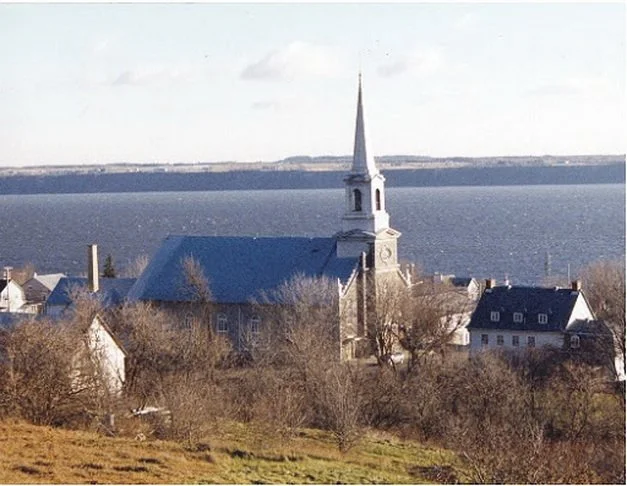
Église Saint-François-de-Sales, Neuville, above the St Lawrence. The parish where the couple married in 1686 and where six of their children were baptised.
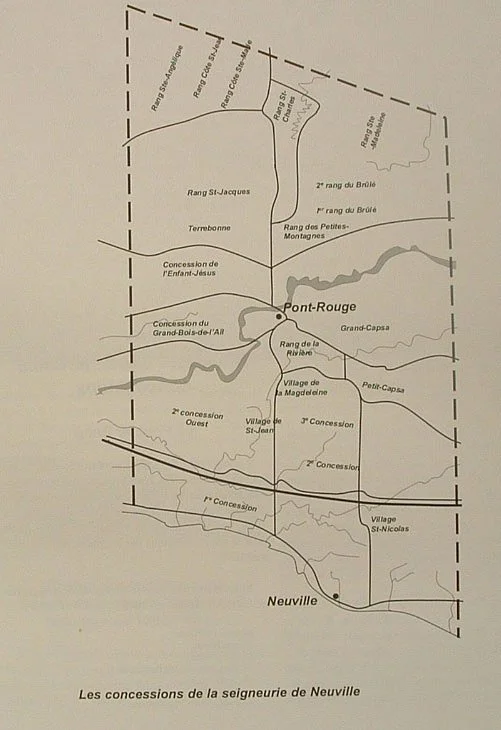
The concessions of the seigneurie de Neuville, covering the lands of modern Neuville, Pont-Rouge and parts of Saint-Basile and Cap-Santé.
The move to L'Assomption is harder to date than the page once claimed. The last Québec baptism is July 1713. In January 1721 a son is described in his own marriage act as habitant en la Rivière de L'Assomption, which is the earliest firm sign of the family in that region — though it places the son there, not the parents. Jean Bernardin himself is documented at L'Assomption only at his burial in 1748.
Beauregard derives one of his four birth estimates from a census of 1716, so the record exists. It has not been located or read for this study, and no image or citation for it appears on this page.
The Twelve Children
Twelve children between January 1690 and July 1713, six baptised at Neuville and six at Notre-Dame-de-Québec. Five died in childhood.
| Child | Birth and baptism | Burial | Marriage(s) |
|---|---|---|---|
| Marie Françoise | b. 29 Jan, bapt. 30 Jan 1690, Neuville | 12 Jan 1761, L'Assomption | Jean Paul Daveluy dit Larose, 26 Jan 1712, Québec |
| Nicolas | b. 15 Mar, bapt. 16 Mar 1692, Neuville | not established | Marie Françoise Paris, 12 Feb 1714, Québec; Marie Thérèse Lamothe, 8 Jan 1759, Cap-Santé |
| Marie Louise | b. 1 Jan, bapt. 2 Jan 1694, Neuville | 31 Jan 1757, L'Assomption | Jean Sulière dit Tranchemontagne, contract 8 Sep 1716, married 14 Sep 1716, Québec |
| Marie Catherine | b. 19 May, bapt. 20 May 1696, Neuville | d. and bur. 20 Feb 1710, Québec (Hôtel-Dieu), aged 13 | none |
| Jean Baptiste (1st of the name) | b. and bapt. 2 Nov 1698, Neuville | not established — see below | Marguerite Barette, 7 Jan 1721, Ste-Anne-de-Beaupré |
| Joseph Étienne | b. 18 Nov, bapt. 19 Nov 1700, Québec | 14 Mar 1703, Québec, aged about two | none |
| Jean Baptiste (2nd of the name) | b. and bapt. 26 Feb 1702, Québec | 17 Dec 1762, L'Assomption | Marie Madeleine Allard, 1726, L'Assomption |
| François de Sales | b. and bapt. 24 Mar 1704, Neuville | 20 Jun 1705, Québec | none |
| Marie Scholastique | b. and bapt. 15 Jun 1706, Québec | not established | Pierre Piché dit Pichet, 24 Jul 1724, Cap-Santé |
| Jean Baptiste (3rd of the name) | b. and bapt. 18 Jul 1708, Québec | d. 19 Mar, bur. 21 Mar 1782, L'Assomption | Bougie 1729 Beauport; Lamothe 1730 Québec; Gaudry Bourbonnière 1734 Repentigny |
| Marie Catherine (2nd of the name) | b. 10 Sep, bapt. 12 Sep 1711, Québec | 14 Oct 1711, Québec, aged about five weeks | none |
| Charles Jean Baptiste | b. 10 Jul, bapt. 11 Jul 1713, Québec | d. 7 Dec, bur. 8 Dec 1714, Québec | none |
Several published compilations, including Beauregard's family sheet and the online trees that follow it, merge them into one man who married Marguerite Barette in 1721 and Marie Madeleine Allard in 1726. The 1726 marriage act settles it. It describes the groom by filiation — son of Jean Bernardin Lesage and Marie Barbe Sylvestre — and not as a widower, and PRDH codes his marital status célibataire. A man remarrying after a wife's death is styled veuf in these acts. The groom of 1726 was the son born in 1702.
Which leaves a gap. The son born 1698 married in January 1721, buried an infant son and then his wife within a day of each other in April 1723 at about twenty-four, and then leaves no trace at all — no remarriage, no burial, nothing.
Godparents, and what they show
At Neuville the godparents are family: Nicolas Silvestre the uncle in 1692, Louis Silvestre the uncle in 1696, Marie Françoise Silvestre the aunt in 1698, and in 1704 Marie Jeanne Silvestre with her son Nicolas Math. At Québec from 1700 the circle is entirely different. The change tracks the family's move as clearly as the baptism places do.
| Child | Date and place | Godparents as recorded | Officiant |
|---|---|---|---|
| Marie Françoiseno. 53858 | 30 Jan 1690, Neuville | Leonard Foucher StMaurice; Barbe Neveu, grandmother | Xxxxx Basset, curé |
| Nicolasno. 53914 | 16 Mar 1692, Neuville | Nicolas Silvestre, uncle; Marie Françoise Garnier | J Basset, curé |
| Marie Catherineno. 54030 | 20 May 1696, Neuville | Louis Silvestre, uncle; Catherine Hardy | J Basset, curé |
| Jean Baptisteno. 54093 | 2 Nov 1698, Neuville | Jean Delisle; Marie Françoise Silvestre, aunt | J Basset, curé |
| Joseph Étienneno. 61923 | 19 Nov 1700, Québec | Étienne Fontaine; Marie Lessart | François Dupré, curé |
| Jean Baptisteno. 62096 | 26 Feb 1702, Québec | Pierre Racine; Marie Creste | François Dupré, curé |
| François de Salesno. 54283 | 24 Mar 1704, Neuville | Nicolas Math, cousin; Marie Jeanne Silvestre, aunt | J Basset, prêtre, curé |
| Marie Scholastiqueno. 62597 | 15 Jun 1706, Québec | Nicolas Martin, menuisier; Marie Cochon | F Dupré, prêtre |
| Jean Baptisteno. 62848 | 18 Jul 1708, Québec | Jean Baptiste Brassar; Marie Françoise Lesage, his own sister, then 18 | Nicolas Boucher, prêtre |
| Marie Catherineno. 63214 | 12 Sep 1711, Québec | Louis Boissy; Marie Catherine Lemoine | J François Buisson, prêtre |
| Charles Jean Baptisteno. 63442 | 11 Jul 1713, Québec | Charles Gaillard, son of a conseiller; Jeanne Renaut Daveine Dedesmeloises | Xxxxx Thiboult, prêtre pénitencier |
Reading the transcription tables
These tables replace the PRDH database card images that formerly appeared on this page. Where the tables carry database columns, Pr. is the presence field —p present, d deceased, — named in the act but not recorded present — and M.S. is marital status: c célibataire, m marié, v veuf or veuve. These are fields derived by the PRDH from the acts. They are not transcriptions of the acts, and they are not always right. Where a register act itself has been read, this page says so and prefers it.
This page previously stated that the grandparents Nicolas Sylvestre and Barbe Neveu were present at the Neuville baptisms. Only Barbe Neveu was. The 1690 act names the godmother as « Barbe Nepveu femme de Nicolas Silvestre et grand mere de ladite Marie Françoise », and the 1698 act names « Marie Françoise Silvestre tante maternelle dudit Jean Baptiste, fille de Nicolas Silvestre ». In both, the grandfather's name exists only to identify the woman who was actually there. The same 1690 act records Barbe Neveu declaring she could not write or sign.
Who Could Write
Jean Bernardin signed his name at least three times: at his marriage in 1686, at his son's baptism in 1698, and on the marriage contract of 1716. In a colony where most habitants could not, that is worth noticing — and the records let it be measured rather than asserted.
In the Neuville register of 1690, the child's grandmother Barbe Neveu declared she could not write or sign, questioned as the ordinance required. Her mother Anne Ledet made the same declaration before a notary in 1673 and again in 1677.
Then, in 1716, the contract for Marie Louise's marriage divides down the middle. Signing: the bride, her sister Marie Françoise, their father, the two witnesses and the notary. Declaring they could not write or sign: the groom Jean Suyer, his father Nicolas, his mother Marguerite Le Blanc, and his brother Nicolas.
Literacy in this line arrives with the Piedmontese soldier and passes to his daughters. Marie Scholastique's signature appears on her brother's marriage act at Ste-Anne-de-Beaupré in 1721.
Marie Louise Lesage and the Contract of 1716
Marie Louise was the third child, born 1 January 1694 and baptised the next day at Neuville. On 8 September 1716, six days before the church wedding at Notre-Dame-de-Québec, the two families met in Pierre Rivet's study.
Appearing: Nicolas Suyer dit Tranchemontagne, living in the town, and Marguerite Le Blanc his wife, whom he authorises, stipulating for their son Jean Suyer, present and consenting. And Jean Bernardin le Sage, brigadier of the beaver guards, stipulating for his daughter, present and consenting. Assembled as kin: Nicolas Suyer, brother of the groom, and Marie Françoise le Sage, sister of the bride.
Community of moveables and acquests under the Coutume de Paris. A douaire of the customary kind or eight hundred livres préfix, paid once, at the bride's choice. A préciput of one hundred and fifty livres, equal and reciprocal. A mutual donation of usufruct to the survivor, void if there are children. Done at Québec, in the notary's study, after midday, before Sieurs Jacques Pinguet de Vaucour and Jean Mossion.
Beauregard's family sheet gives Jean Sulière's parents as probably Nicolas Sustier or Lesoutier or Sulière dit Tranchemontagne and Marguerite Leblanc, marked presumed by convergence. The 1716 contract names them outright and puts both of them in the room, the father authorising his wife. The act also gives the terms of the settlement, which no compiled source carries.
Marie Louise and Jean Sulière settled on the Rivière L'Assomption. Their eldest son, baptised at Québec on 21 May 1717, was named Jean Bernardin Sulière for his grandfather. She was buried at L'Assomption on 31 January 1757.
The Soulière Line connection
Marie Louise Lesage carries the Italian soldier's descent into the Soulière family. Her marriage is traced through the Tranchemontagne Documentary Biography Series, generation by generation, to Janvier Soulière (1806–1899).
1726: The Bishop's Dispensation
Early in 1726, at L'Assomption, the son born in 1702 married Marie Madeleine Allard. The act carries a clause that reaches back three generations.
« …sans qu'il se soit trouvé aucun autre empeschement de Mariage que celui du troisième degré de parenté dont ils ont esté dispensés par Monseigneur Nostre Evesque »
Marriage register, L'Assomption, 1726 — working reading from the imageThe bride and groom were kin in the third degree, and the bishop had to dispense it before they could marry. The kinship runs back to one woman.
Marie Madeleine Allard was the daughter of Pierre Allard and Marie Madeleine Pinel — a daughter of Anne Ledet by her second marriage. The groom was Anne Ledet's great-grandson through her first: Anne Ledet, then Barbe Neveu, then Marie Barbe Sylvestre, then Jean Baptiste Lesage. Third degree touching second, which is exactly what the act dispenses.
Twenty-six years after Anne Ledet was buried at Neuville, the two halves of her family — the children of the marriage annulled for bigamy and the children of the marriage that followed it — met again on the Rivière L'Assomption and needed the Church's permission to marry.
| Rank | Name and role as printed | M.S. | Pr. |
|---|---|---|---|
| 01 | Jean Baptiste LESAGESpouse of 02 · Residence: L'Assomption | c | p |
| 02 | Marie Madeleine HALARESpouse of 01 · Residence: Île Jésus · Origin: Ste-Anne | c | p |
| 03 | Jean Bernardin LESAGEFather of 01 | — | — |
| 04 | Marie Barbe SILVESTREMother of 01 | — | — |
| 05 | Pierre HALAREFather of 02 — buried 19 September 1703 | — | — |
| 06 | Marie Madeleine NEVEUXMother of 02 — buried 5 May 1715 | — | — |
| 07–10 | Pierre Doucet, Paul Davigni, Pierre Omier, Etienne MonabertThe register calls them parents et temoins — kin and witnesses | — | p |
| 11 | Xxxxx POULINPrêtre · Residence: Île Jésus — he certified the banns in his own parish and never came | c | — |
| 12 | P LESUEURPrêtre — officiated | c | p |
The couple had thirteen children between 1726 and 1744, eleven of them at L'Assomption and two at Cap-Santé. The groom was buried at L'Assomption on 17 December 1762, described as an habitant of L'Achigan and husband of Marie Madeleine Allard. Two men stood at the grave: Louis Lesage, his son, and Jean Michel dit Saint-Léger, his son-in-law.
The Final Years
Jean Bernardin Lesage dit Lepiedmontois died on 13 April 1748 at L'Assomption and was buried two days later. Present at the burial were Jean Sulière, his son-in-law, and Jean Baptiste Lesage, his son. The priest was Degeay. The act states his age as ninety-eight, which — measured against the same priest's practice elsewhere in the same register — more likely means about eighty-eight.
Marie Barbe Sylvestre outlived him by eleven years. She was buried at L'Assomption on 6 April 1759, entered in the register as « Veuve Lesage », with Claude Panneton and François Cochard present and Degeay again officiating. Her act gives ninety-six; her baptism gives eighty-seven.
| Deceased | Date | Age stated | Age from other records | Present at the burial |
|---|---|---|---|---|
| Jean Bernardin Lesageno. 129158 · died 13 April | 15 Apr 1748 | 98 | about 88, from his 1686 marriage act | Jean Sulière (son-in-law); Jean Baptiste Lesage (son); Degeay, prêtre |
| Marie Barbe Silvestreno. 287165 · card note: Veuve Lesage | 6 Apr 1759 | 96 | 87, from her baptism of 25 April 1671 | Claude Panneton; François Cochard; Degeay, prêtre |
| Jean Lesageno. 287437 · the son born 1702 · of L'Achigan | 17 Dec 1762 | 72 | 60, from his baptism of 26 February 1702 | Louis Lesage (son); Jean Michel St Léger (son-in-law); Degeay, prêtre |
He had crossed the Alps and the Atlantic, served in a colonial company, married into a Neuville family whose women could not write, kept a post in the town guarding the beaver stores, and died on the Rivière L'Assomption with a son and a son-in-law at his grave.
Key Dates
Connection to The Soulière Line
Original Documents
Marriage and contract

The marriage contract of 1716


Baptisms of the children


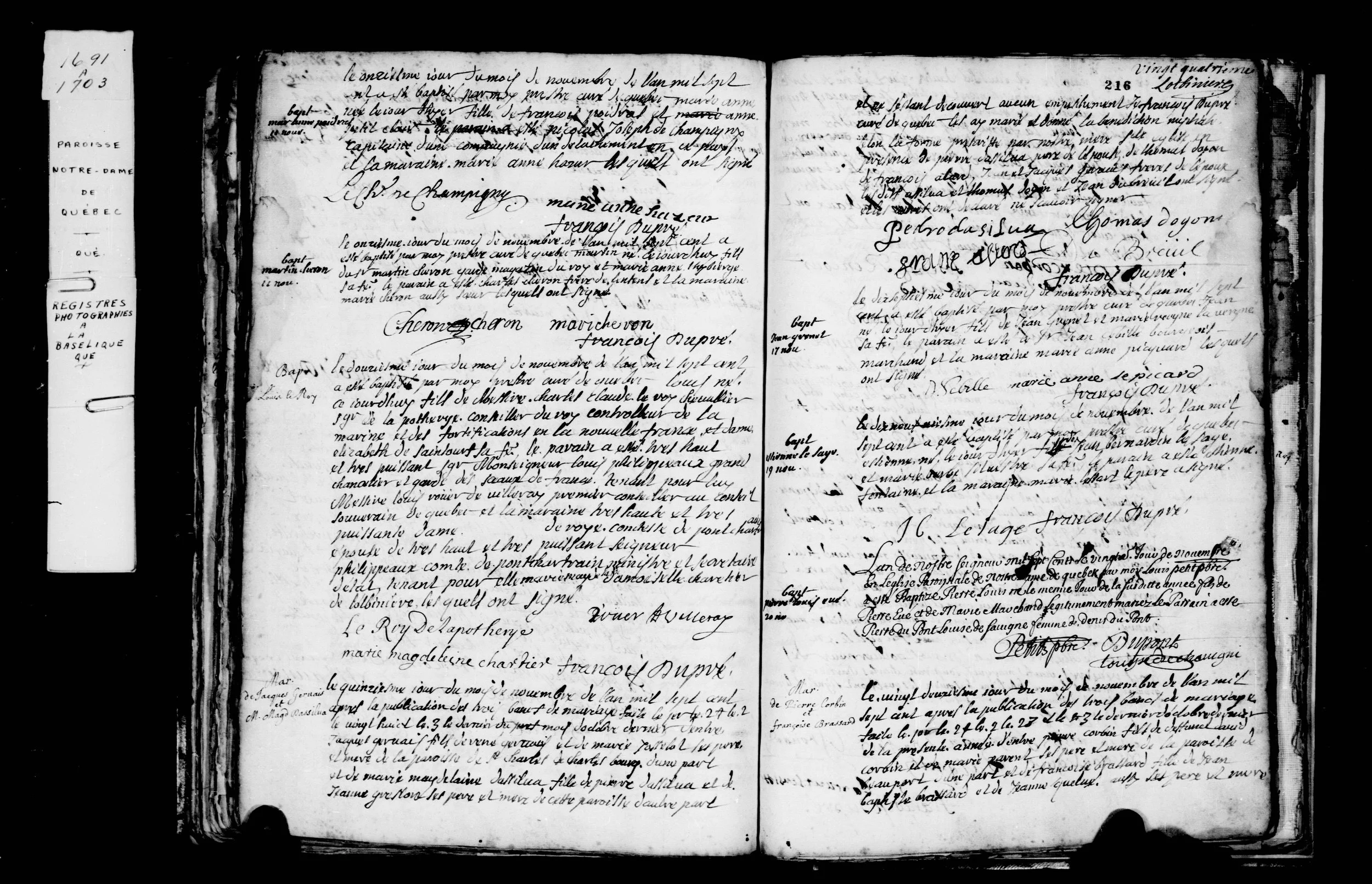


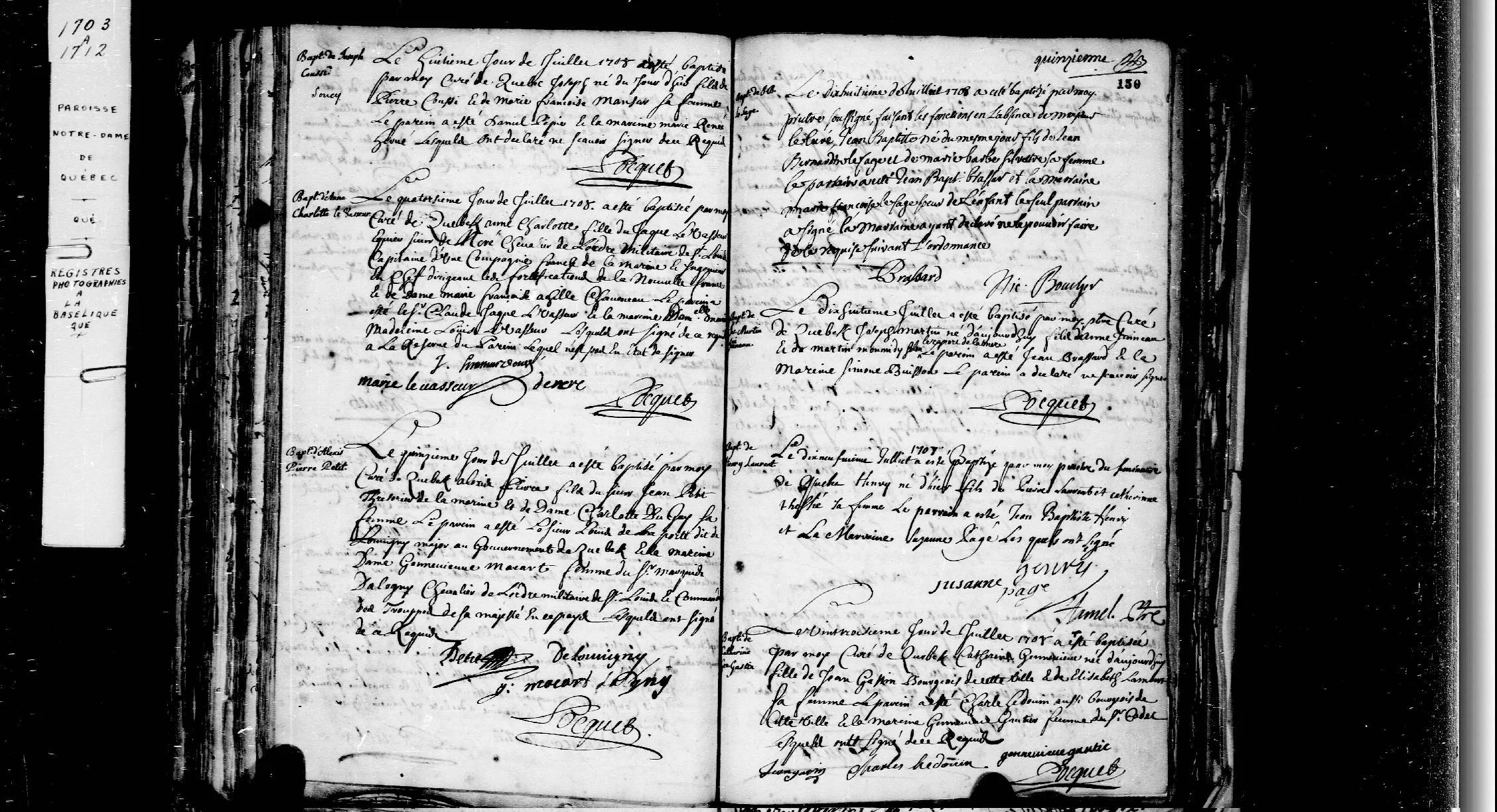
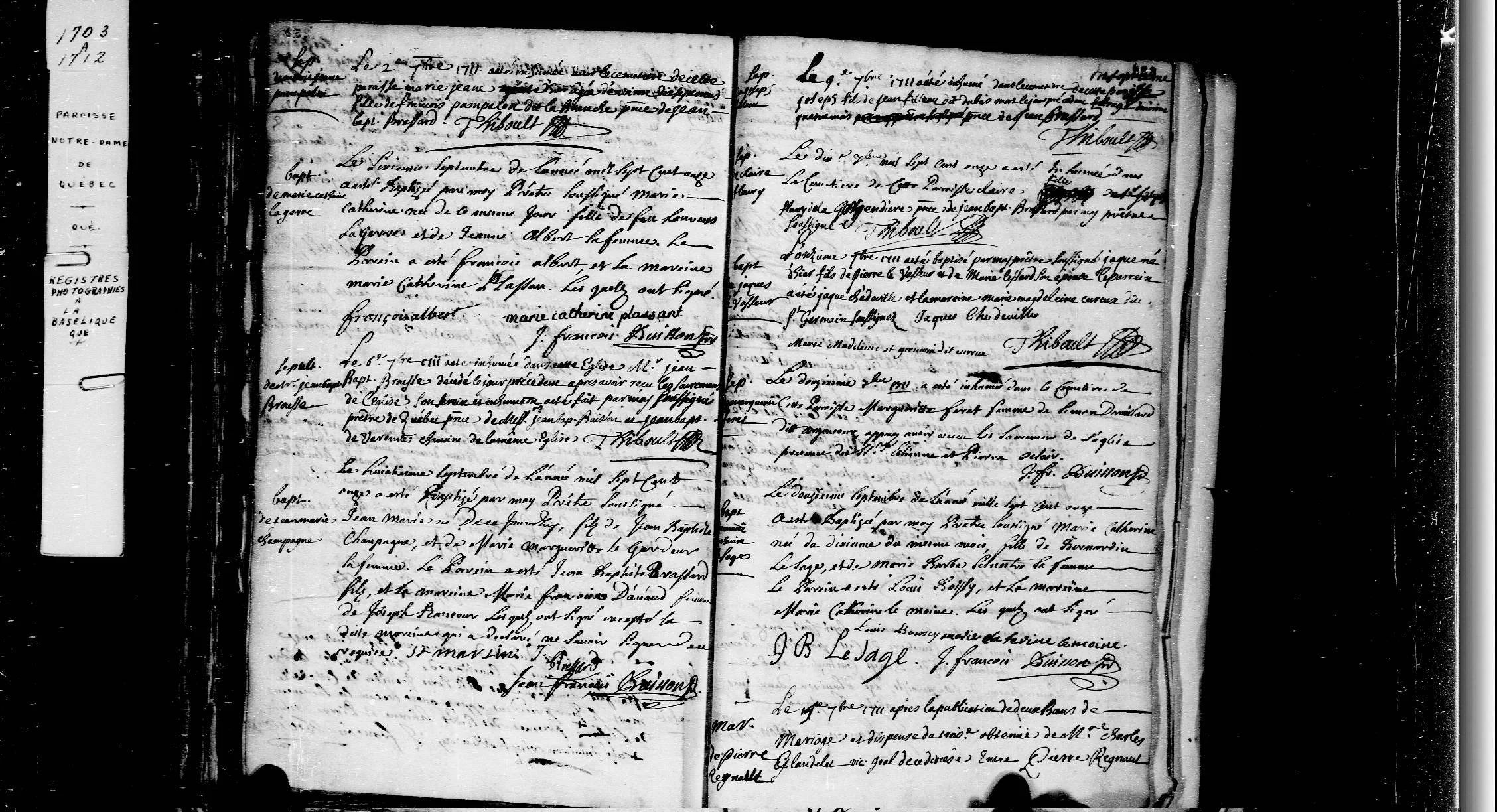

Burial

Sources
Notarial minute
- Marriage contract, Jean Suyer dit Tranchemontagne and Marie Louise Lesage, 8 September 1716, before Me Pierre Rivet dit Cavelier, notaire royal en la prévôté de Québec. Bibliothèque et Archives nationales du Québec, CN301,S240, greffe de Pierre Rivet dit Cavelier. Three pages, read from the original minute.
Register acts read for this study
- Marriage, 8 January 1686 — Neuville (St-François-de-Sales), BMS 1679–1752. FamilySearch; Archives nationales du Québec.
- Baptism, Marie Françoise Lesage, 30 January 1690 — Neuville.
- Baptism, Jean Baptiste Lesage, 2 November 1698 — Neuville.
- Marriage, Jean Baptiste Lesage and Marguerite Barette, 7 January 1721 — Ste-Anne-de-Beaupré.
- Burials of Marguerite Barette and her infant son, 18 and 19 April 1723 — Repentigny (La-Purification), folio 98.
- Marriage, Jean Baptiste Lesage and Marie Madeleine Allard, 1726 — L'Assomption, image 304 of 539. The act omits the day and the month.
- Burial, Jean Lesage, 17 December 1762 — L'Assomption.
Register images published above but not yet collated
- The banns of 1686; the baptism of Marie Barbe Sylvestre, 25 April 1671; the baptisms of Nicolas (1692), Marie Louise (1694), Marie Catherine (1696), Joseph Étienne (1700), Jean Baptiste (1702), François de Sales (1704), Marie Scholastique (1706), Jean Baptiste (1708), Marie Catherine (1711) and Charles Jean Baptiste (1713); and the burial of Jean Bernardin Lesage, 15 April 1748.
Databases and compiled sources
- PRDH-IGD, Université de Montréal — thirty-four cards, transcribed in the tables above. Database fields are not transcriptions of acts.
- Denis Beauregard, Généalogie des Français d'Amérique du Nord, family sheets [5630] and [15560]. The source of the four birth estimates and of the occupation maître tailleur attributed to the son born 1708. Note: sheet [5630] merges the two sons named Jean Baptiste into one man; the 1726 marriage act shows they were two.
- René Jetté, Dictionnaire généalogique des familles du Québec, 1983 — not consulted directly for this revision.
Not located
- Any record at Racconigi. The census of 1716. The Hôtel-Dieu de Québec register of 1694. Any appointment, muster or pay record for the gardes du castor. Any notarial act for Jean Bernardin himself beyond the 1716 contract. The 1720 land concession from the Seminary of Montreal. The baptism of Jean Bernardin Sulière, 21 May 1717.
Research note. This page was rebuilt in September 2026 against thirty-four PRDH cards, seven collated register acts and one notarial minute. Where earlier versions stated something the record does not support, the statement has been corrected here; corrections are tracked in the research log for this family rather than annotated on the page.
Every Family Has a Story Worth Telling
Whether you're just beginning your research or ready to transform years of work into a narrative your family will treasure, I'd love to hear your story.
BEGIN YOUR RESEARCH INQUIRY