
Case Studies in Historical Genealogy
When Family Stories Meet Documentary Evidence
These case studies demonstrate the rigorous methodology behind transforming family legends and fragmented records into documented history. Each investigation reveals how careful analysis of primary sources—from 17th-century court documents to 20th-century newspaper archives—can validate stories, resolve mysteries, and bring ancestors to life through the power of historical research.
Women of New France
Filles du Roi, filles à marier, and habitant widows of the seventeenth-century St. Lawrence valley — reconstructed from parish registers, notarial minutes, seigneurial records, and the criminal and civil files of colonial justice.
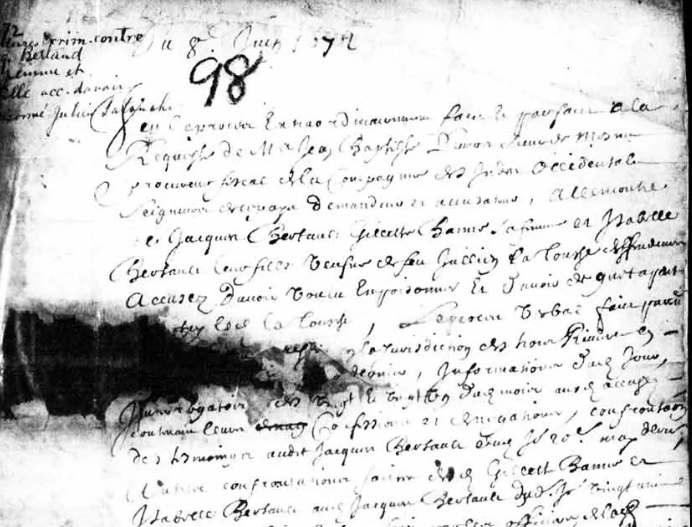
The Bertault–Banne Trial
Reading a 1672 Colonial Murder File as Documentary Biography
Trois-Rivières and Québec, 1672: a habitant family is tried for the murder of a son-in-law, and a criminal file of sixty-three images — thirty-five leaves — becomes the fullest surviving record of a seventeenth-century habitant woman's life. The dossier is bound partly in reverse, its opening proceedings carrying the highest folio stamps, and its stamps run one per leaf while the scans run one per side. Rebuilt from the datelines and catchwords inside it, the interrogations, confrontations, sentence, and appeal yield Gillette Banne's age, birthplace, trade of her husband, and voice under oath — and correct a forename, a birth year, a murder weapon, and a daughter's sentence that decades of secondary accounts had gotten wrong. A companion methodology page and downloadable research file transcribe the complete dossier.
View Case Study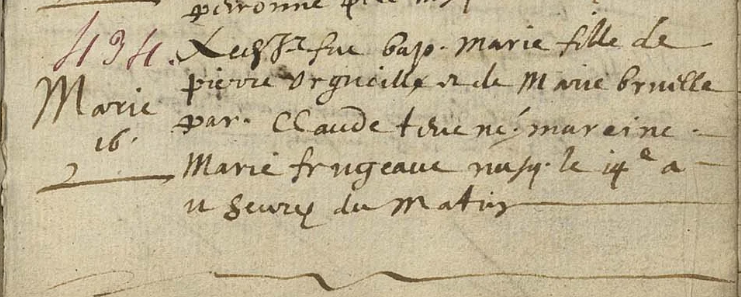
520 Livres for a Murdered Husband
A Widow's Legal Standing, Read from a Single Deed
Montréal, 1690: a Marine officer runs a habitant farmer through with a sword and flees, and his fifty-six-year-old widow is left with a right she cannot afford to use — the right to sue him. Twenty-seven days later, Marie Lorgueil sells it, ceding the family's rights of action to the merchant Charles de Couagne for 520 livres, cash. Read carelessly, the deed is a surrender; read with discipline, it is the clearest surviving proof that colonial law granted a habitant widow legal standing against a nobleman — even as colonial power ensured she could not win. The case corrects an inherited account that misdated the act to 1691, miscast it as a post-suit settlement, and named the wrong parties. A companion methodology page transcribes the act folio by folio, and a research note traces the Couagne relationship back to a 1688 mortgage on the family's land.
View Case Study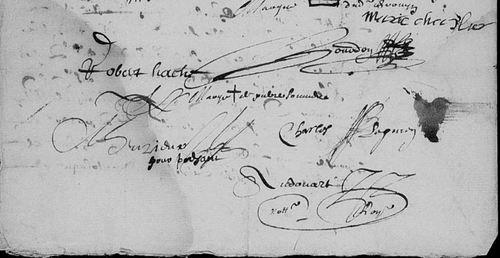
The Donation Dispute
Unraveling a 330-Year Old Family Lawsuit Through Primary Sources
When a stack of court victories appeared in an ancestor's file with no explanation, systematic research through Sovereign Council judgments, notarial records, and legal terminology revealed a 71-year-old literate widow who fought her stepdaughter and son-in-law and won every judgment across five judicial levels.
View Case Study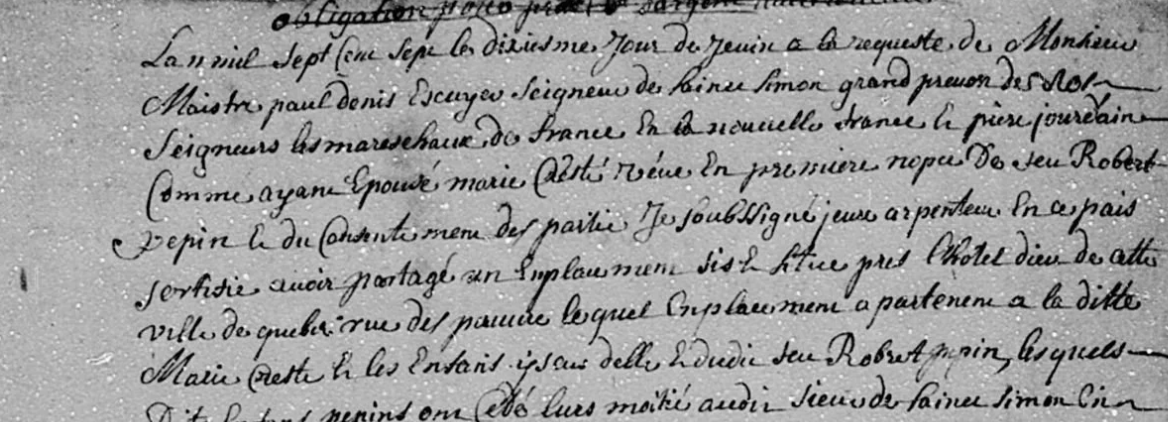
One Parcel, Three Households
How Parish, Notarial, Judicial, and Crown Records Reconstructed a Twice-Widowed Wife of Seventeenth-Century New France
Québec, 1705: a marriage contract scribed by notary Louis Chambalon recorded Marie Crête's third husband under a surname some readers transcribed as "Soudain." Two later Crown records — bearing the man's own signature — told a different story. Pierre Jourdain signed his name "Jourdain" on the 1707 partition of the Hôtel-Dieu parcel and again on the 1712 lots-et-ventes receipt; PRDH, the parish register, and Lebel/Laforest concur. Read across parish, notarial, judicial, seigneurial, and Crown-taxation series, the documents reconstruct a twice-widowed wife who carried one parcel through three marriages, four surnames, and sixty-five years.
View Case Study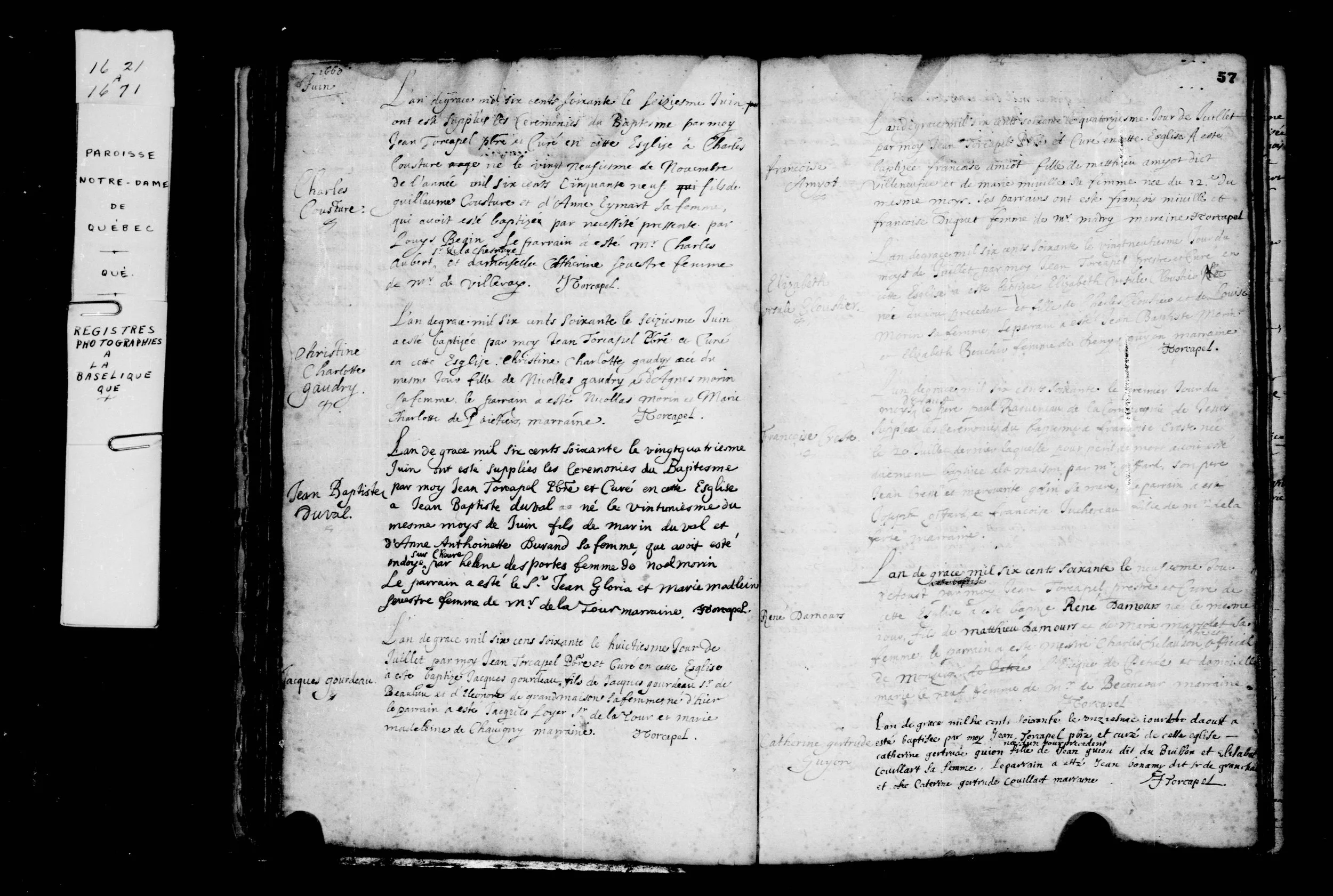
Around the Font
How Ten Baptism Registers Revealed a Fille à Marier's Place in the Seigneurial Circle
Beauport, 1666: the royal census presents the Crête household as one entry among the habitants. Fifteen years of recovered baptism registers told a different story. Robert Giffard had personally emergency-baptized her newborn daughter, his son and granddaughter standing as godparents; the Grand Vicar of Bishop Laval officiated at the baptism of the son who took the seigneur's name. Read across ten baptisms and three royal censuses, the documents reframe Marguerite Gaulin's household from patron-client to quasi-familial.
View Case Study
The Françoise Baiselat Inheritance
Three Marriages, Three Estates, Twelve Years of Colonial Justice
When a Fille du Roi died in childbirth leaving children from three marriages — to two soldiers of the Carignan-Salières and one of the Compagnies franches de la Marine — colonial New France mobilized every level of authority to protect her children's inheritance. A chain of notarial acts and three ordonnances of the Intendant, spanning twelve years, shows how notaries, the curé, a tutor and Jacques Raudot himself untangled three estates for twelve children.
View Case Study
The Louise Senécal Guilbault Case Study
Reconstructing a Fille du Roi from the Records Others Wrote About Her
She never signed her name. Her story rests on a baptism in Rouen, a marriage contract with the names of her kin left blank, one line recording her separation in 1679, and a 1697 court order in which a judge wrote "aversion." It is also a case study in correction: the widely repeated date of her death came from an index, not a record.
View Case Study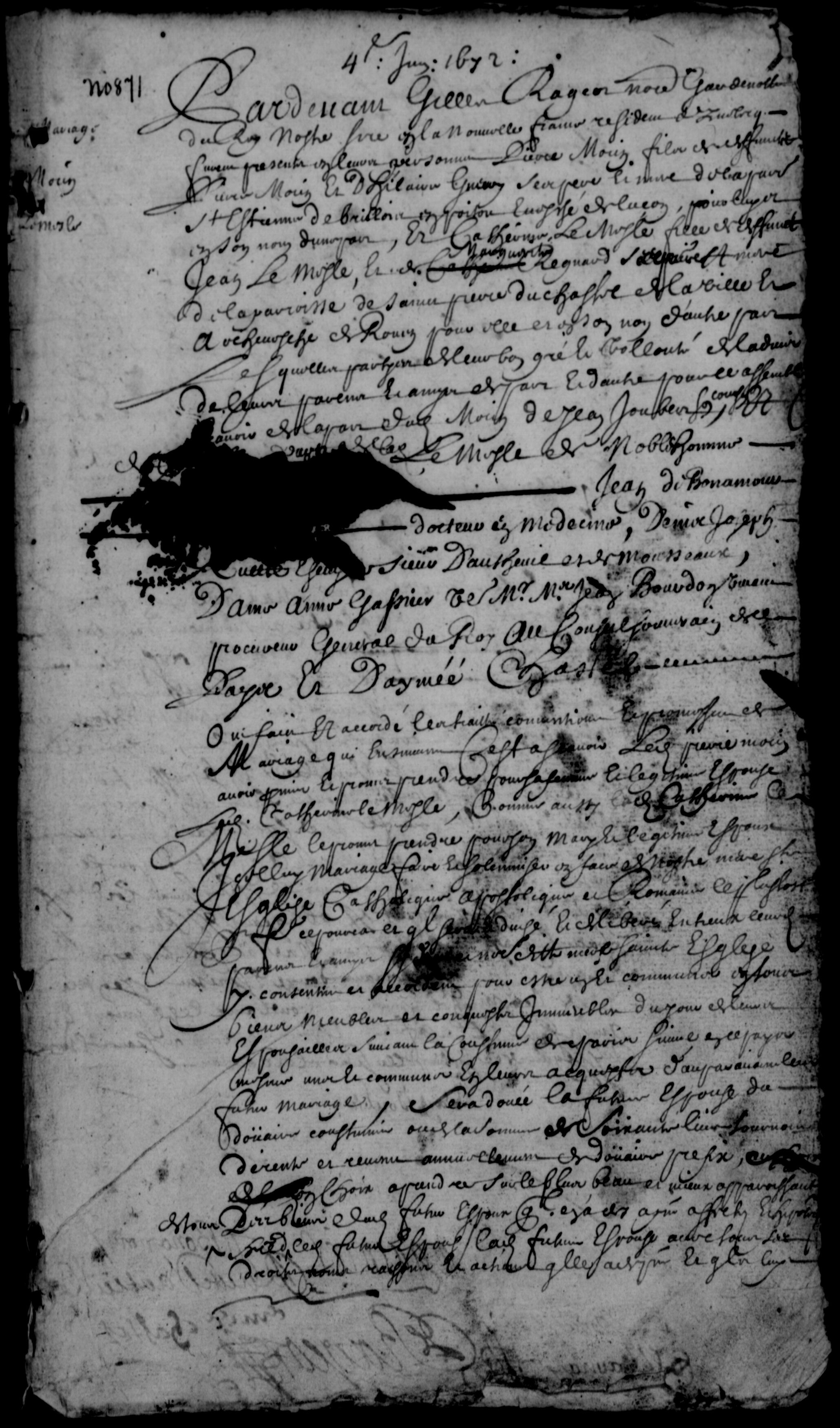
The Catherine Lemesle Case Study
When One Ancestor Appears Twice: Tracing a Fille du Roi Through Two Family Lines
From Norman merchant's daughter to double great-grandmother—how tracing two children's descendants across 85 years revealed that a 1757 marriage reunited family lines that began with a single Fille du Roi in 1672. A documentary exploration of pedigree collapse in colonial Quebec.
View Case StudyCorrecting the Published Record
Errors that entered print and propagated — a birth year taken from the wrong source, a death date belonging to another man, a kinship built on a shared surname. Each study returns to the original document and shows the work.

Resolving Conflicting Age Evidence
When Three Primary Sources Disagree on Birth Year, Which Do You Trust?
Québec, 1672: a woman stands before the Prévôté court and states under oath that she is "aagée de quarante cinq ans Environ." Eight years earlier, she had given her age as thirty-eight at confirmation. Yet the major genealogical databases — and Peter J. Gagné's authoritative monograph on the Filles à marier — record her birth as c. 1636, based solely on a 1666 census that listed her as thirty. She cannot have been thirty-eight in 1664 and thirty in 1666. Read across confirmation register, census enumeration, and criminal trial record, the documents demonstrate why self-stated ages under oath outweigh third-party estimates — and why a ten-year error persisted uncorrected through multiple published sources.
View Case Study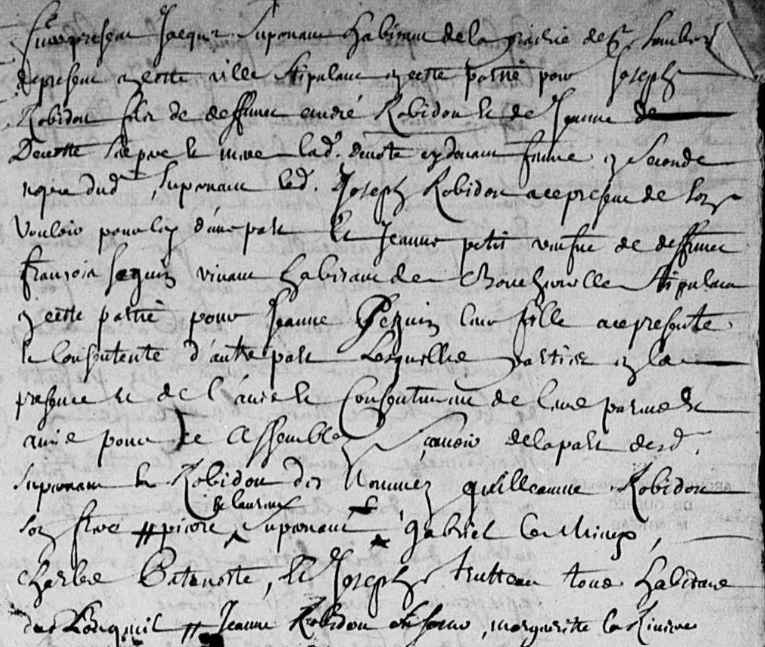
The Death That Never Was
A Misattributed Burial and the Documentary Case for 1701
PRDH-IGD and the Dictionnaire généalogique des familles du Québec record François Séguin dit Ladéroute as dying on 9 May 1704. Two marriage contracts drawn by notary Pierre Raimbault place his death earlier: in November 1700 his wife acts for him while he lies ill, and by October 1701 she acts as his widow. The 1704 burial names a different man. This study returns to the acts themselves and to the register entry that was mistaken for his.
In preparation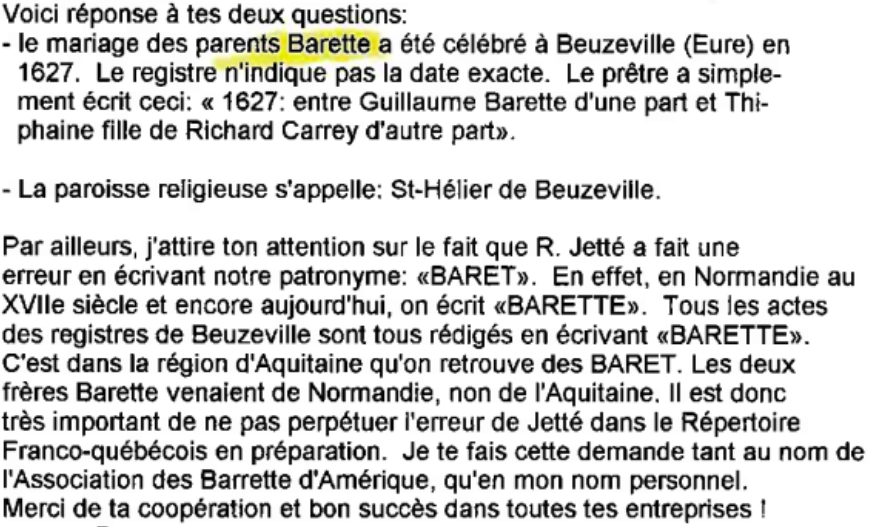
The Cousin Who Wasn't
How Primary Sources Disentangled Three Cary Families Joined by a Single Surname
A FamilySearch chart named Samuel Huntington — signer of the Declaration of Independence — a fourth cousin, nine times removed. The bridge was a single surname: Cary. Following each Cary to its documented origin split one name into three unrelated families — a Somerset "Carew" who became Huntington's Plymouth ancestor, our own Norman "Carrey" of Beuzeville, and the Bristol merchants of The Virginia Carys. The kinship collapsed. The same records confirmed the true Norman origin of the Soulière line.
View Case Study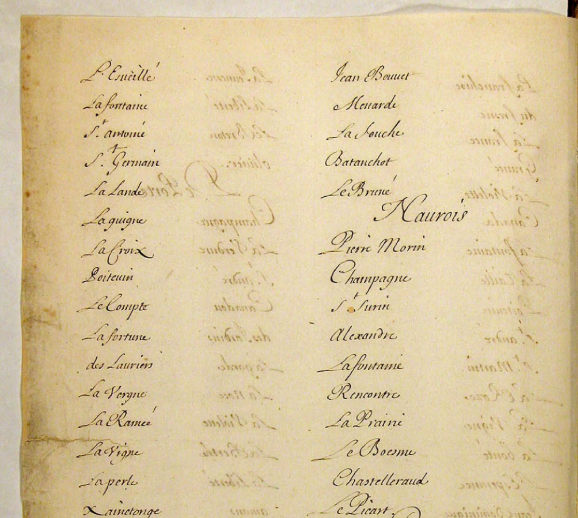
Four Men Named Morin
A Carignan-Salières Disambiguation — Unresolved
Four soldiers of that surname served in one regiment. Two specialists now read the same muster roll line in opposite directions, and no document names the man on it. This case study withdraws a claim this practice published for a year, and sets out what happens when a list of citations is mistaken for a count of witnesses.
View Case Study
Philibert Couillaud dit Roquebrune
The X Mark That Became a Surname: Ancestor of 420,000–840,000 Larocques
He arrived as a soldier, could not read or write, and left no birth record, no marriage record, and no death record. Seven years of research across a 14.5-year documentary void reconstructed the life of the man whose dit name Roquebrune became Larocque across a continent.
View Case StudyThe Fur Trade West
Voyageurs, Métis families, and Indigenous women from the Lake of Two Mountains to the Columbia District — documented through Hudson's Bay Company account books and post journals, North West Company engagement contracts, mission registers, and segment-level DNA.

Born in the Pays d'en Haut
Joseph Claude Guilbault, son of Gabriel and Marie Josephte Abitakijikokwe and the limits of what the records will carry
Two parish registers, thirty-four years apart, are the whole of the documentary life of a man born in the interior fur trade country to an Ojibwe mother. Between them lies the working career the archives ought to hold — and this case study is the account of why the fur trade records that were once thought to fill that gap do not belong to him, and what remains when they are taken out.
View Case Study
The Free Man of the Prairies
Laurent Quintal and Marie Anne Nipissing — A Columbia River Marriage, 1839
Two errors in the public genealogical record — neither sourced to a single primary document — have quietly corrupted every generation above and below this Columbia River couple. Correcting them required four archive collections, two Catholic sacramental registers naming the same father on consecutive days, an HBC expedition party list placing Laurent Quintal sixth on the Snake River in February 1824, and a retrieved NWC engagement contract signed with an X mark in 1817. His ancestry traces to an immigrant from Aunis, France, who married in Québec City in 1678. Her Nipissing and Chinook heritage is documented and her father is named — twice, independently, on consecutive days in 1839.
View Case Study
Two Families the Trees Merged
Joseph Delard and Lisette Souchouabe — and the Chinook Family Mistaken for Theirs
On a single January day in 1839, at the Willamette mission, two French-Canadian men named Joseph each married an Indigenous woman named Lisette. One bride was Shuswap, the other Chinook. The public trees collapsed the two couples into one and handed the Shuswap wife a Chinook chief's ancestry that belonged to her namesake. The register never merged them: separate marriage entries, separate baptisms for each bride and each set of children, two deaths ten years apart, and an 1843 marriage entry naming Joseph the widower of "Elizabeth Shoushwab." Joseph's own line runs back through Sorel to a parish in the diocese of Cahors, France — and forward to his son Augustin's 1857 marriage to Zoé Quintal.
View Case Study
The Other Joseph
Joseph Frédéric dit Despard — The Second Groom of 21 January 1839, from Rivière-Ouelle to French Prairie
The published index files him under two headings. A compiled genealogy gives him the wrong father. The online trees marry him to the wrong Lisette. Read in full, the records describe one man: Joseph Toussaint Despar, baptized at Rivière-Ouelle in 1793, the only Joseph in his parents' family; a North West Company middleman whose account in two different ledgers agrees to the sol; a Hudson's Bay Company servant whose age the clerks recorded exactly, with his family's name, "Fréd.," written on his own line; and a French Prairie settler whose land claim divides his farm with "the heirs at law of Lisette Despard his late wife." His Chinook wife, and any connection to a Chinook chief, belong to this family, not to Joseph Delard's.
View Case Study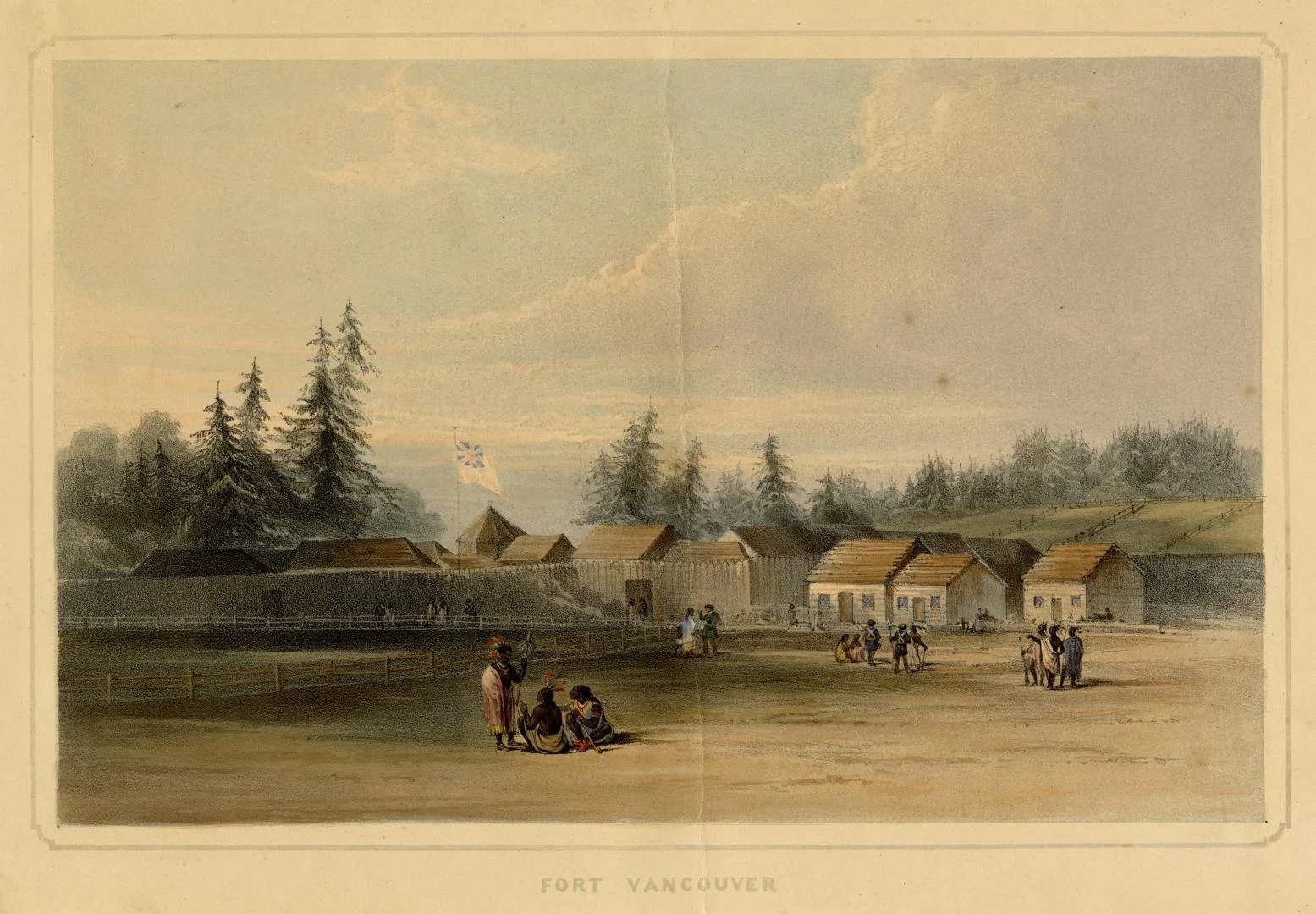
The Steersman's Ledger
Joseph Delard of Sorel — A Fur-Trade Career Rebuilt from the Account Books, 1813–1836
An archivist's summary gave Joseph Delard's fur-trade career in a handful of lines. This study goes beneath it to nineteen North West Company and Hudson's Bay Company volumes, read one outfit at a time, and to the Montreal notarial act they point to: "Joseph Delard de Sorel," engaged in January 1817 as steersman out of Lachine and middleman in the North, who made his mark. Sixteen consecutive years of Columbia servants' accounts — age and service rising by exactly one each year, Sorel written on his own line, another Joseph on the line below — prove one continuous man, trace his rise from middleman to end man to steersman, and show the debt that outlasted his service. What the records do not yet state, the study says plainly.
View Case Study
The Segment That Pointed Two Ways
Proving an Indigenous Triangulated Group on Chromosome 8 — One Confirmed Segment, Two Documented Ojibwe Arms
A chromosome painting colored one stretch of DNA as Indigenous American — a hypothesis, not an ancestor. Direct member-to-member triangulation across three platforms confirmed the segment was real and paternal, and led two ways: to a Saulteaux woman named "Sauteuse" in a 1798 Quebec baptism, and to a Mille Lacs Band Ojibwe family in Minnesota. Both arms documented Ojibwe; the named common ancestor between them remains, honestly, the open question.
View Case Study
The Abitakijikokwe Discovery
Uncovering an Ojibwe Ancestor in Quebec Parish Records
For 200 years, she was nameless—listed only as "Sauvagesse" in family records. Through systematic research across five Quebec parishes and the discovery of a single marriage record preserving her Ojibwe name, Marie Josephte Abitakijikokwe emerged as one of the best-documented Indigenous women in colonial records.
View Case Study
The War Chief's Wife
Identifying Geneviève Abitakijikokwe Across Ten Name Variants at Oka Mission, 1786–1805
She appears in eleven primary records under eleven different spellings, recorded by three priests across nineteen years. Identifying Geneviève Abitakijikokwe — wife of the Algonquin war chief Kitchiwabisi — required tracing one name through three conflicting documentary layers, examining a published transcription that contradicted its own manuscript photograph, and returning to the original register to resolve the discrepancy. Her records are also the foundation for understanding the family origins of Marie Josephte Abitakijikokwe.
View Case Study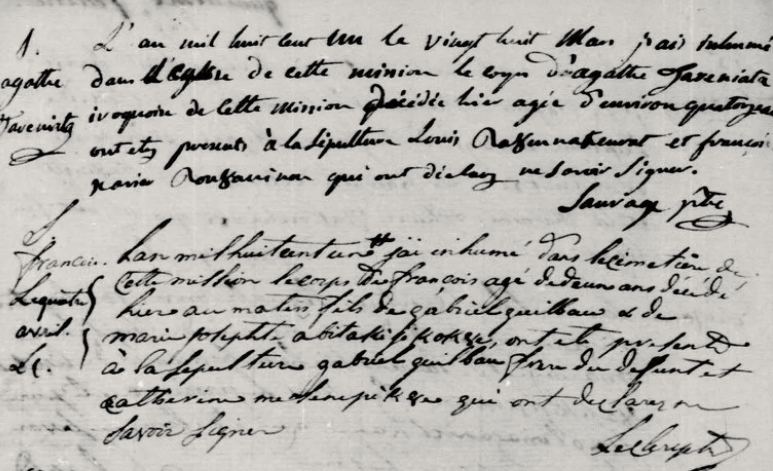
The Woman at the Grave
Identifying Catherine Messinabikwe Across Five Colonial Spellings
When two-year-old François Guilbault was buried at the Oka mission in 1801, a woman named "Catherine Nesepik8e" stood witness. No one had identified her. By tracing one Algonquian name through the ears and pens of two different priests — from Mador to Messinebik8e to Missinebi8e to Nesepik8e — this case study reveals an Ottawa woman from Michilimackinac and connects two Indigenous families sharing grief at the same small mission.
View Case Study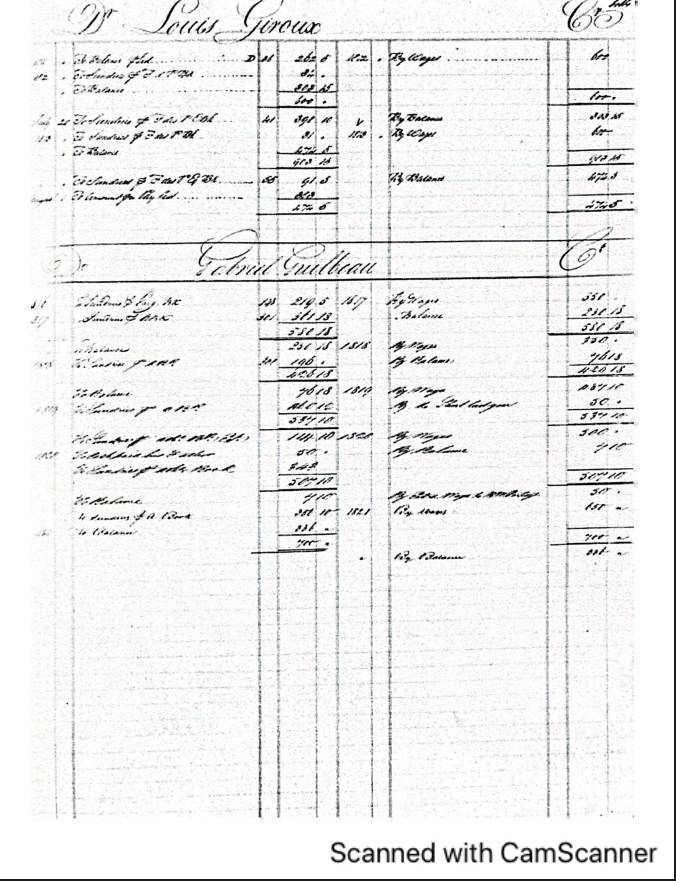
The Voyageur Years
Three Men of One Family Named Gabriel Guilbault, One North West Company Ledger Account, and How You Determine Which — and What Stays Undetermined
The account at HBCA F.4/32 folio 414 gives a name, five annual wages and a closing balance. It gives no age, no parish, no father's name. Three men of one direct line carried that name across three generations, and cousins carried it beside them. This study works the identification the long way: figures rather than spelling in the ledgers, the wife's name rather than the trade in the registers, and presence credited only where the priest wrote it down. One candidate is excluded on direct evidence. Two remain, and two wage years carry no evidence in either direction — which the study says plainly rather than reaching.
View Case Study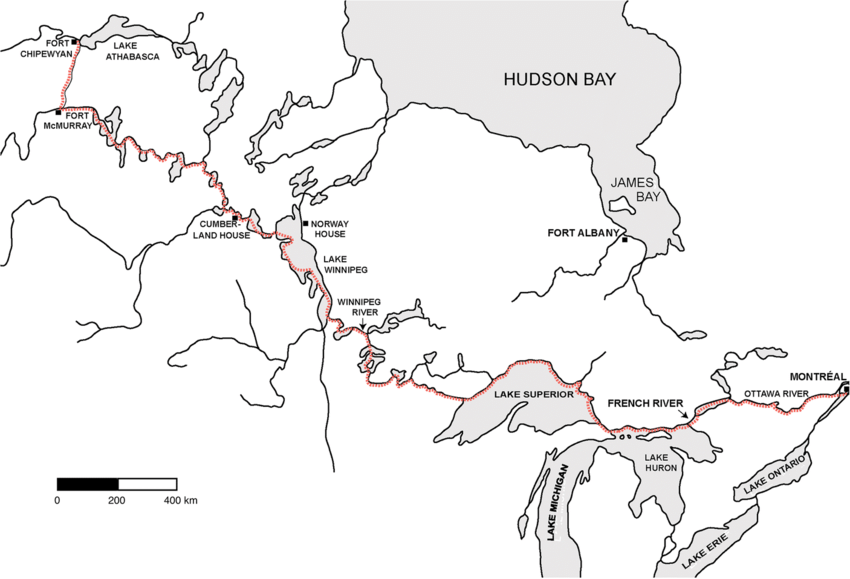
Who Was Paul Gibeau?
A North West Company Career Documented Across Three Volumes — and a Man Nobody Has Identified
For ten consecutive years the North West Company credited wages to a man its clerks wrote down as Paul Gibeau — and Gibeault, and Gebeault. He signed two engagements by mark, twenty-three years apart, wintered at Great Slave Lake and in the Athabasca, and settled at 617 livres 14 sols when the company dissolved. The general ledger, the post blotter and the settlement register agree to the sol. What none of them records is a parish, a parentage, or an age. This case study sets out a fur-trade career documented in more detail than most voyageurs ever receive, explains why the man who held it was wrongly identified for years, and shows what defeated that identification: three ordinary Quebec documents, none of them gathered for the purpose.
View Case Study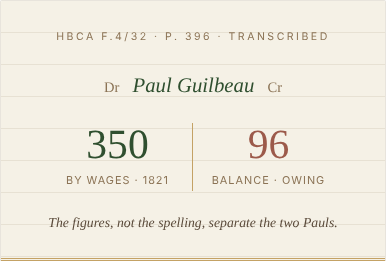
The Canadian
Paul Guilbault of Lavaltrie — From Fort Walla Walla to French Prairie, 1821–1849
He left Quebec in 1821 and never came back. A governor's 1828 journal names him in the mountains of New Caledonia, leading four Indigenous carriers across a mountain portage. The Catholic Church Records of the Pacific Northwest found him at Fort Vancouver — married to a Walla Walla woman, a father of six, a godfather on fifteen register pages — until his death ca. 1849 at French Prairie, Oregon.
View Case Study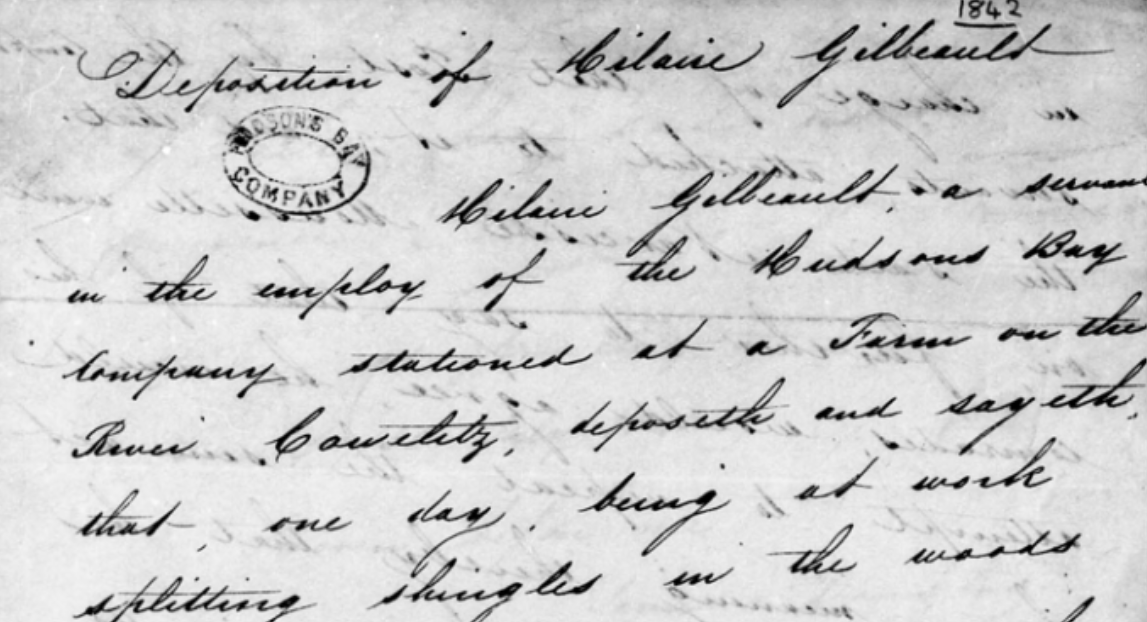
The Survivor
Hilaire Guilbault of Verchères — From Death Rapids to French Prairie, 1838–1849
He survived the 1838 Dalles des Morts bateau disaster that killed twelve people on the Columbia River brigade. Four years later he gave sworn testimony before James Douglas at Cowlitz Farm — the only primary HBCA document in his name. Six months after that he stood godfather at Saint Paul Mission, binding his family to his cousin Paul Guilbault's through Catholic godparentage. This case study traces a life documented across three archive groups, with one deposition at its center and no HBC contract yet found.
View Case StudyIrish Emigration
County Monaghan and County Clare to Chicago, Brooklyn, and the Midwest — identity establishment, relationship proof across disruption, and DNA evidence at segment level. The two Hamall studies below run as a pair, Part I and Part II of four generations across 157 years.

The Owen Hamall Mystery
Seven Years to Solve One Census Entry
In 1880 a Chicago census taker listed “Thornton Hammil” as Owen Hamall’s brother. Seven years of research across Ireland, Canada and the United States identified him as William Thornton, Owen’s younger half-brother, born after their widowed mother remarried in Montreal. The records behind that one line reveal a blended family, parallel tragedies, and the Irish immigrant experience.
Explore the Mystery
The Three Thomas Hamalls
Three Generations, One Cottage
Owen’s son, grandson and great-grandson, all named Thomas, and one cottage in Riverside, Illinois. A Supreme Court opinion, a corrected draft card and a village tax roll trace the cottage from 1911 to 1949, through two divorces and a move to Miami, and test a son’s memories of Saturday visits against the record.
Explore the Legacy
The Donaghmoyne Network
Four Couples, One Genetic Network
Between 1841 and 1858 four couples married in Donaghmoyne parish, County Monaghan, each with a Hamill spouse. Their families scattered to Montreal and Chicago, Wisconsin and Joliet. To test whether the four were kin, the research rebuilt a father’s paternal DNA from his children’s kits. The segment evidence places all four families in one closely intermarried parish.
Explore the Network
The O'Brien Legacy
From One Probate Record to a 150-Year Family Reunion
How a single line in an 1874 document—"Uncle Patrick O'Brien in Newport, Kentucky"—launched a seven-year investigation combining traditional genealogical methods with modern DNA science, ultimately reuniting families separated since the Great Famine.
View Case Study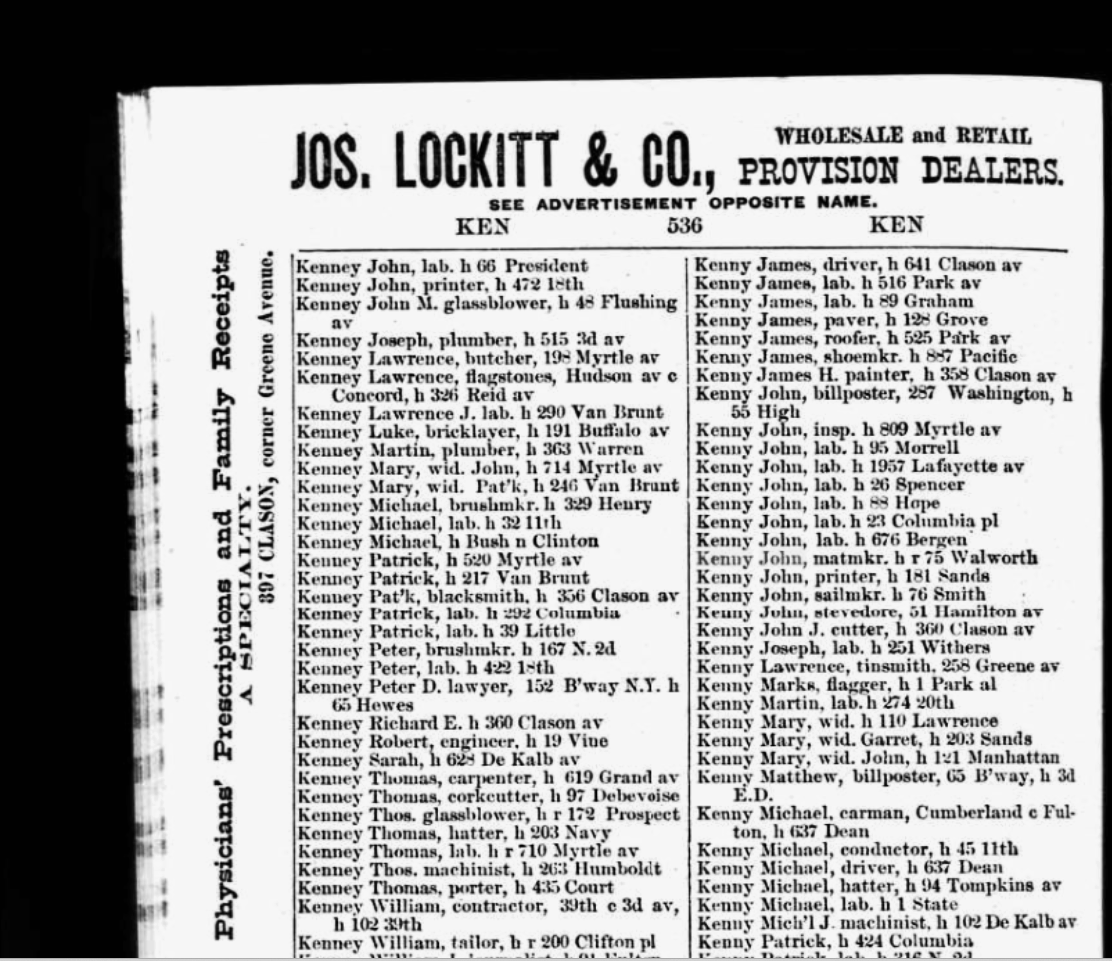
The Brooklyn Mat Maker
Surname Confusion to Breakthrough
Seven years of research. Dozens of John Kennys. One occupational progression that unlocked a complete Irish immigrant family story spanning three generations.
View Case Study
Three Names, One Life
Proving the Identity of Elizabeth Kenny, Lillian Marie Kenny, and Elizabeth Corbett — Brooklyn, 1879–1950
She used three names across her lifetime, served twelve days in the U.S. Navy before the Armistice ended the war she’d enlisted for, and was appointed by the Essex County Surrogate’s Court to administer her sister’s estate after Mary Agnes Robertson died in the twelve-day catastrophe of January 1924. Proving all three names belonged to the same woman required a decade of research and thirteen record sets — one government card that put both names on a single line, and one 1924 probate file (retrieved from the New Jersey State Archives in September 2026) that upgraded her role in the Robertson children’s lives from family tradition to court record.
View Case Study
Five Deaths, One Family, Seventy-Two Years
Tuberculosis and the McKenny–Kenny–Robertson Line — 1870–1942
Five deaths of one disease across three generations of one Brooklyn Irish family. Five death certificates now obtained: four through standard channels, and the fifth — Helen Verhoek’s 1942 New Jersey certificate, blocked for four years by a missing state death index and a non-lineal-descendant records restriction — released by the New Jersey State Archives on September 22, 2026 after a targeted paper request. The cause-of-death field read in parallel across seventy-two years — phthisis pulmonalis to pulmonary consumption to pulmonary phthisis to pulmonary tuberculosis to advanced pulmonary T.B. — documents one disease named five different ways as medical understanding shifted around it. Helen, the last of the line, lived with active tuberculosis for the entire decade of her surviving children’s early lives and died one year before streptomycin was isolated at Rutgers.
View Case Study
The Kenny Family Case Study
When Family Stories Meet Historical Documentation
From family legend to documented history—how contemporary newspaper coverage and fire department records validated a century-old story about Captain Thomas Patrick Kenny's heroic role in the 1909 Cherry Mine disaster, one of America's most famous industrial rescues.
View Case StudyScotland
Perthshire and the Clyde — old parish registers, statutory records, and census enumerations worked against American sources to prove migration and identity in a country where the commonest surnames defeat ordinary methods.

The Tide That Turned Both Ways
Proving a Brooklyn Family's Return Migration to Glasgow, 1875–1878 — Without a Single Passenger List
A Brooklyn stone cutter's family vanished from American records after 1874 and reappeared in 1880 at the same address — with a new Scottish-born son. No migration record documents the journey; the United Kingdom kept no inward passenger lists before 1878, so none was ever created. The proof was assembled from record systems on two sides of the Atlantic: Scotland's statutory birth registers citing the same 1866 Dundee marriage in three registration districts across eleven years, Brooklyn directory brackets enclosing the gap, and census immigration columns where the parents answer 1870 and their Scottish-born son answers 1878. Eighteen sources, three crossings, zero migration records — and a documented match to the return-migration wave the Panic of 1873 sent up the Clyde.
View Case Study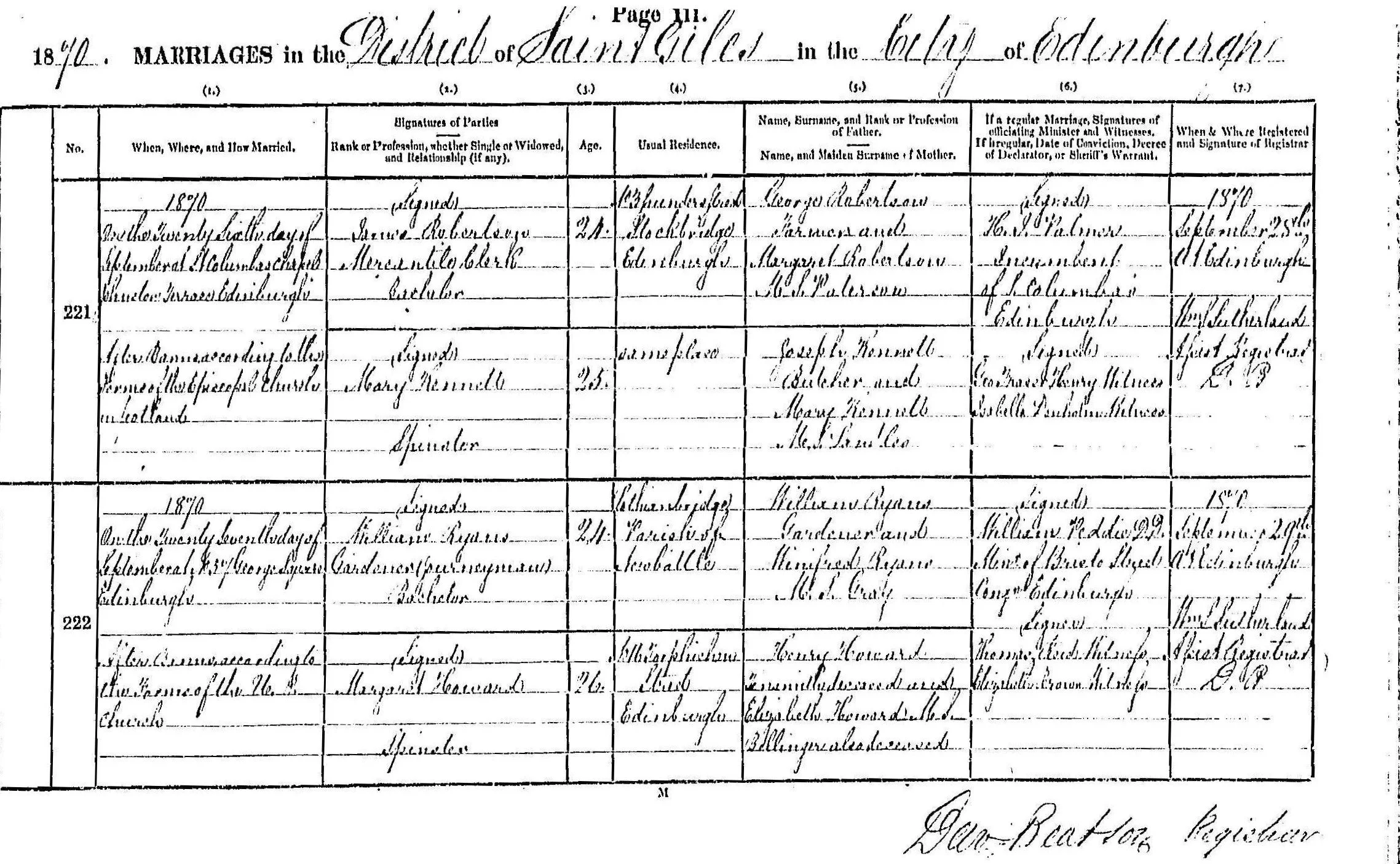
One Name, Three Men
Telling Apart the James Robertsons — and Proving Which One Belonged to Blairgowrie, 1841–1930
A son vanishes from his Perthshire family after the 1861 census, lost in one of Scotland's most common names. A gamekeeper of the same name surfaces in Liverpool; an ocean away, a James P. Robertson dies in Brooklyn. Which records belong to one life, and which to strangers? The proof turns on a peculiarity of Scottish law: a statutory marriage names both parties' parents. The 1870 Edinburgh register names the groom's father and mother as the exact pair from the 1841 Blairgowrie baptism — converting a shared surname into a documented identity. Five evidentiary devices follow: the father named across three decades and two continents, an unbroken gamekeeper trade, the vital-record arithmetic separating three same-named sons, a death bracketed on three sides, and the disciplined exclusion of the Brooklyn watchman who shared the name and nothing else.
View Case StudyPhilippine Research
Aklan and the Visayas — parish baptisms, civil registration, and land records worked through FamilySearch Full-Text Search, the tool that has made Philippine genealogy tractable for the first time.

The Daughter Remembered as Tonang
A Philippine Genealogy Case Study
A family remembered the matriarch only by a nickname — "Tonang Quimpo" — that no register could hold. By triangulating the grandparents named across three generations of Kalibo parish baptisms, this case study identifies her as Petrona Quimpo, mother of Mamerto Morales.
View Case Study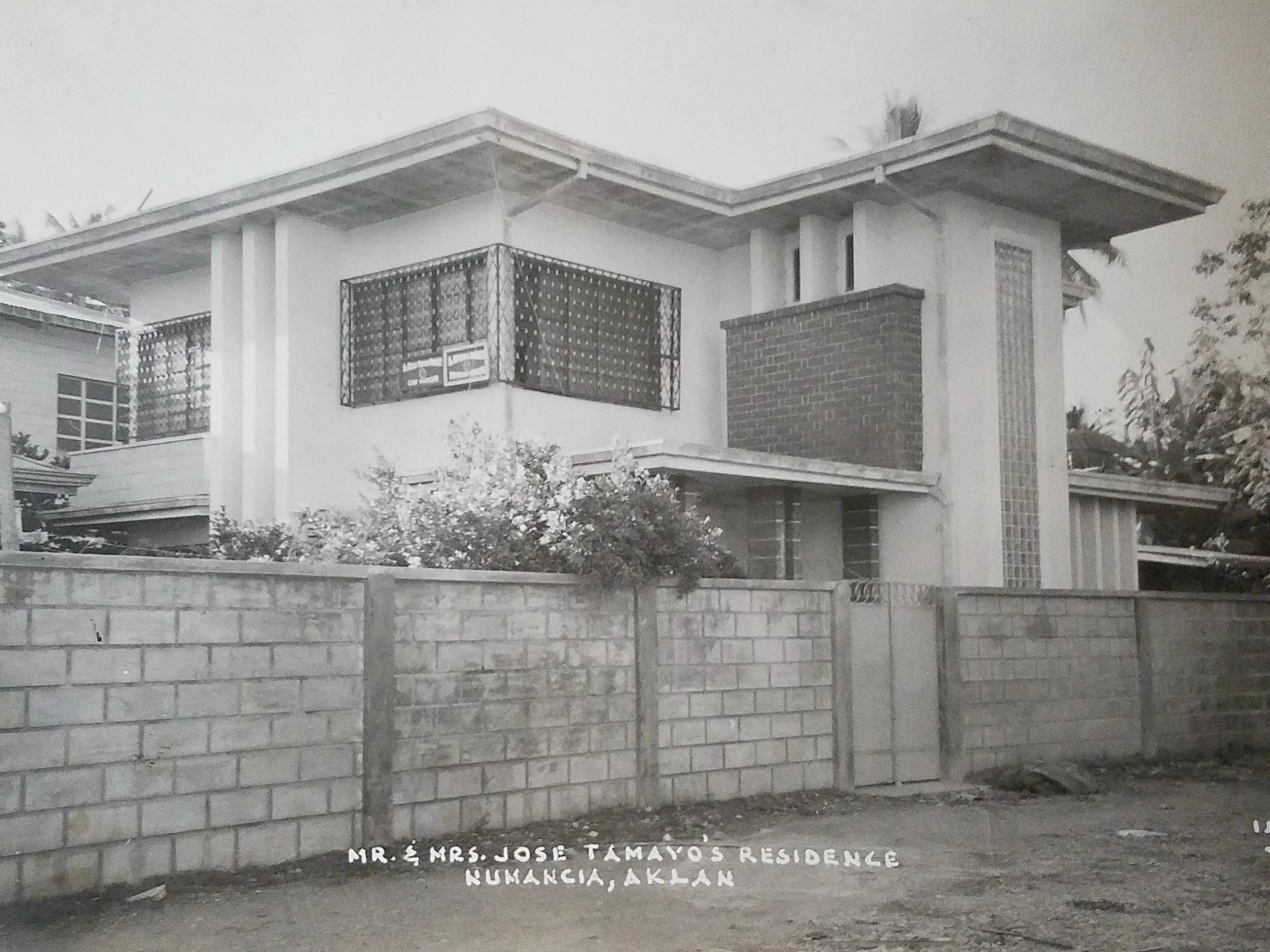
The Tamayo Family
A Philippine Genealogy Case Study
How FamilySearch's revolutionary Full Text Search uncovered a 26-year family saga of struggle and recovery in rural Philippines — proving that seemingly impossible Philippine genealogy breakthroughs are now possible.
View Case StudyReady to Document Your Family's Story?
These case studies represent the same rigorous methodology available for your family research. From mystery-solving to documentary biography, every ancestor deserves to be remembered.