
Jean-Baptiste Séguin dit Ladéroute
Jean-Baptiste Séguin dit Ladéroute
Quick Facts
Jean-Baptiste Séguin dit Ladéroute was born on 10 November 1688 around four o'clock in the afternoon at Boucherville—the eighth child of François Séguin dit Ladéroute, a former soldier of the Carignan-Salières Regiment, and Jeanne Petit, a Fille du Roi from La Rochelle. Two days later, on 12 November, the infant was carried to Sainte-Famille and baptized by the Abbé Pierre Rodolphe Guybert de la Saudrays, who had arrived from the Séminaire de Saint-Sulpice only weeks earlier to take up the cure of Boucherville. His godfather was Jean-Baptiste Ménard, a habitant of neighbouring Longueuil; his godmother was Catherine Ménard of the Sainte-Famille parish.

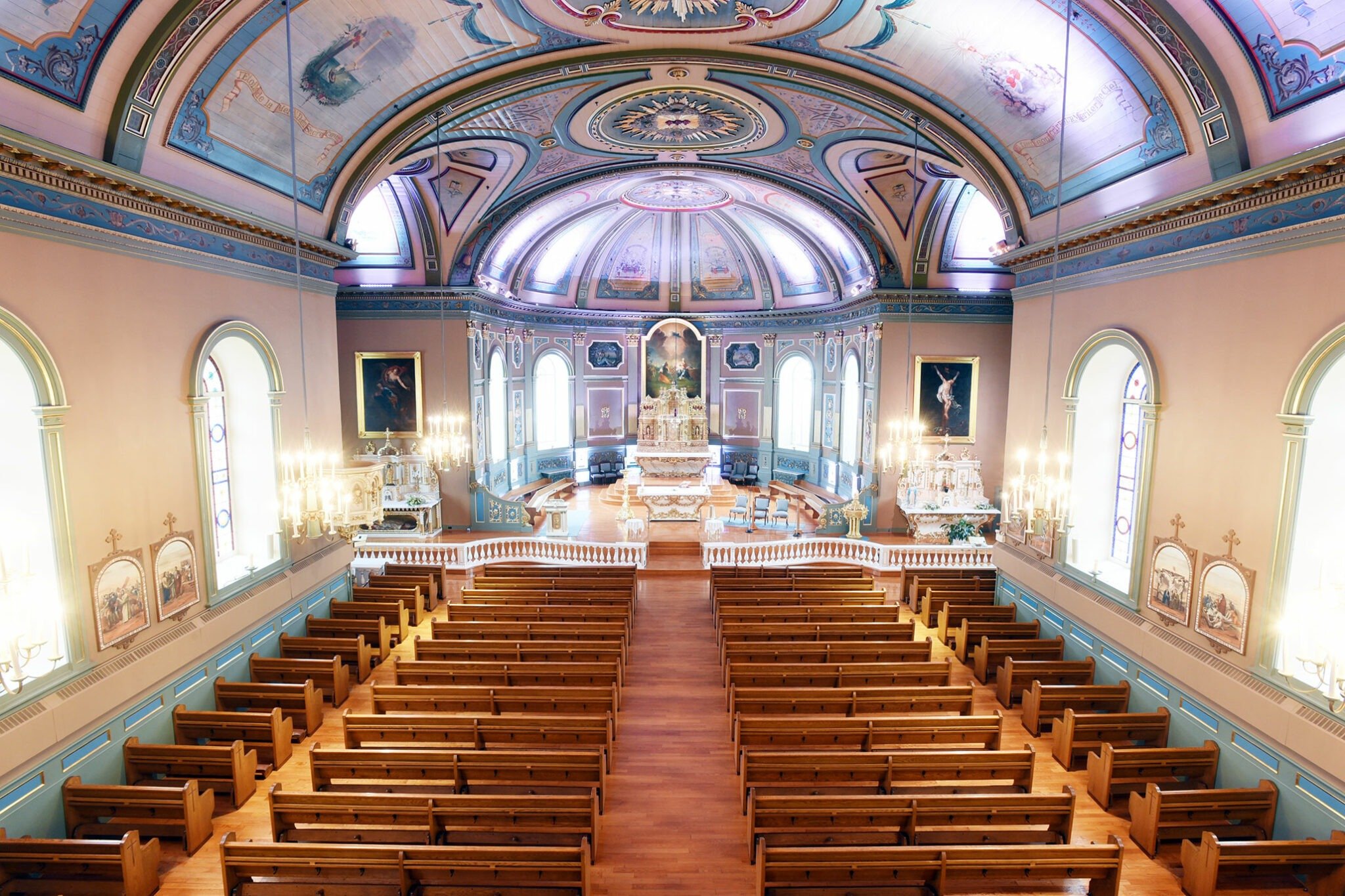
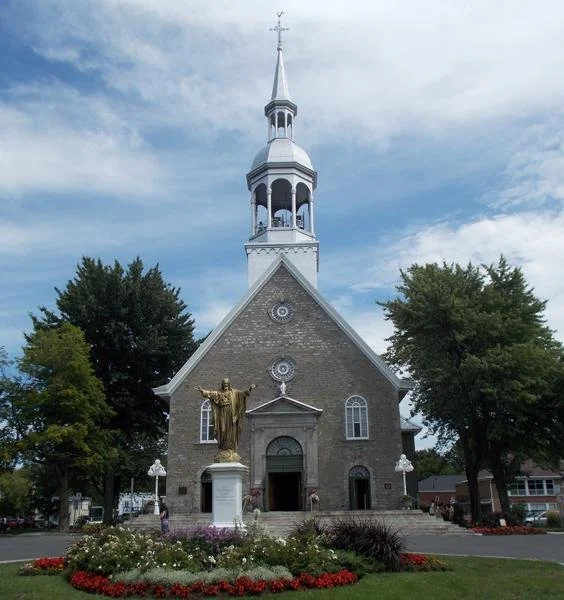
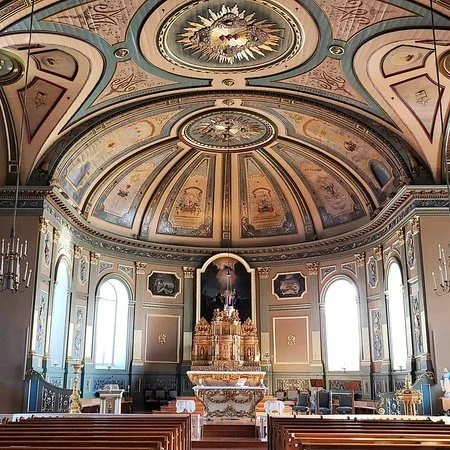
The church where Jean-Baptiste received the sacrament of baptism was not the stone building that stands at Boucherville today. In 1688 the parish still worshipped in the wooden chapel raised in 1670 on land Pierre Boucher had given—a modest colombage structure that served the settlement for more than forty years. A brick church replaced it in 1712, and the present stone church was not built until 1801. His father François had worshipped in that chapel, had married there, and had seen four older children baptized within its walls. The entry in the register, preserved in the Abbé de la Saudrays' careful hand, records the presence of his father, his godfather, and the witness Julien Beaussault—all of whom signed alongside the priest.
Jean-Baptiste grew up in the world his father had helped build. François had arrived in New France as a young soldier in 1665, served through the Mohawk campaigns of 1666, and chose to stay when the regiment disbanded. By the time Jean-Baptiste was old enough to understand the rhythms of seigneurial life, Boucherville was a thriving parish on the south shore of the St. Lawrence, its farms reaching back from the riverbank in narrow ribbons. François worked his fifty arpents of land, wove cloth on his loom, and raised a large family—five sons who lived to adulthood, a testament to both Jeanne Petit's endurance and the family's relative stability.
His father did not live to see him grown. François Séguin died between 20 November 1700 and 9 October 1701; Jean-Baptiste was twelve.
The Rebels of the Côte, 1705–1706
In the autumn of 1705 Jean-Baptiste was seventeen, living at Boucherville, and three of his brothers were caught up in a prosecution the intendant's clerk recorded in his register as le procez aux rebelles de la coste—the trial of the rebels of the côte.
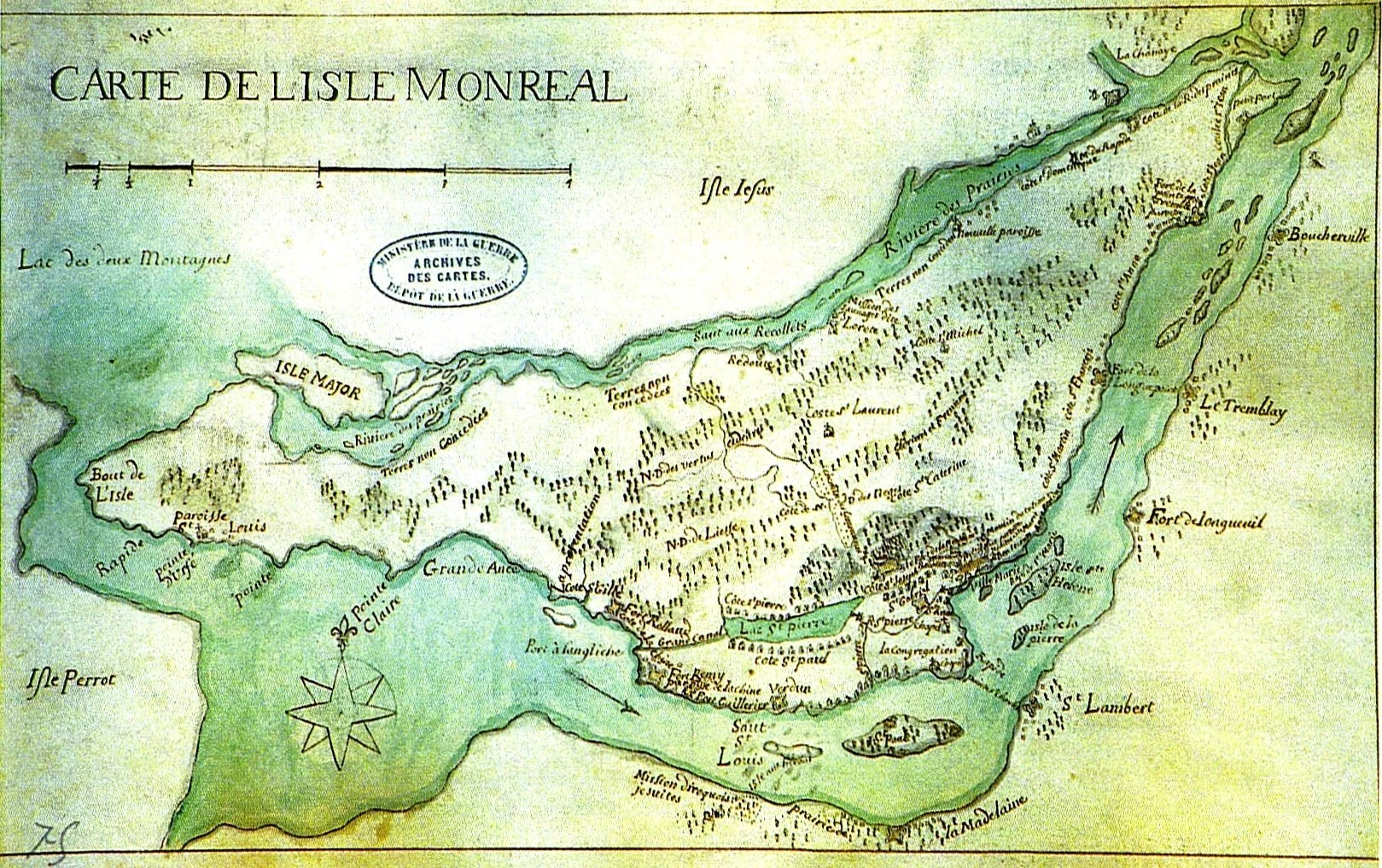
The affair has a prehistory. In 1704 a crisis over the price of salt—essential for preserving meat and fish through the winter—brought a crowd to the door of a Montréal wholesaler believed to be hoarding reserves. A petition was presented asking that authorities fix a fair price, shift taxation to other imported goods, and punish profiteers. Claude de Ramezay, governor of Montréal, negotiated with the merchants for more reasonable pricing; Governor General Philippe de Rigaud de Vaudreuil, learning of it, rebuked Ramezay for exceeding his authority and revoked the price regulation. On 12 December 1704 Vaudreuil issued an ordinance forbidding all inhabitants of the government of Montréal from assembling under any pretext whatever.
That ordinance is the law François Séguin was later found to have broken. What the assembly of 1705 was actually about, the surviving records do not say.
Nearly a year after the ordinance, Ramezay reported to Intendant Jacques Raudot that there had been quelques mouvements dans les costes proche de cette Ville—disturbances in the côtes near the city. He named François Séguin dit Ladéroute, Jean-Baptiste's eldest brother, then twenty-seven and living at Lachenaie, as among those who had held the most seditious discourse: boasting that he would be followed by many other habitants, urging the men of other parishes to join him, and threatening that any who would not adhere to his designs would be ransacked by him and his confederates. Ramezay had him arrested and taken to the prisons of Montréal.
On 26 October 1705 Raudot commissioned Jacques-Alexis Fleury Deschambault, lieutenant general at Montréal, as his subdélégué to conduct and complete the trial of the rebels of the côte. François was interrogated on 30 October. The following day Raudot issued a second commission authorizing Deschambault to inform against him by name, ordering that he be held under écrou meanwhile. Witnesses were examined on 10 and 19 November, and François was interrogated a second time on 25 November, the same day Jean-Baptiste Lapointe of Mille-Îles was first questioned.
On 26 November the intendant ordered the whole procedure communicated to the King's attorney, directed that both accused be imprisoned again, and further ordered that Pierre Ladéroute and Simon Ladéroute—Jean-Baptiste's brothers, then twenty-three and twenty-one—together with Jacques Levert fils and three men named de Bourhis, Gauthier and Masta, be taken, apprehended and brought to the prisons of Montréal for interrogation. They were pursued as accomplices, not summoned as witnesses.
On 8 December the witnesses already heard were ordered to come to Québec for récolement and confrontation with the accused. On 4 January 1706 nine were named: Gilles Papin, merchant, René Bau dit Lalouette, Joseph Véronneau and Jacques Meunier dit Lapierre, all of Boucherville; Jean Berlouin dit Nantel, militia captain of the Lachenaie coast, then residing on Île Jésus; Antoine Duquet dit Madry and Guillaume Forget dit Despatis of Lachenaie; and René Cholet dit Saint-Paul and Audin dit Saint-Amour of Île Jésus.
Judgment came on 9 January 1706. Both men were found guilty of having intended to assemble to present a petition, contrary to the ordinance of December 1704, and François additionally of having imprudently made seditious speeches capable of inciting those who heard them to revolt. Each was fined thirty livres and forbidden to repeat the offence on pain of being punished as seditious and a disturber of the public peace.
By contemporary standards the penalty was light. Under Frontenac such offences might have brought a sentence to the king's galleys. François had left behind at Lachenaie a daughter of eighteen months and a wife four months pregnant; their second child was baptized on Île Jésus in April 1706, a few months after the judgment.
Whether François was a troublemaker or a man willing to risk his liberty for his neighbours, the record does not settle. What it does establish is that in the winter Jean-Baptiste turned seventeen, three of his brothers stood accused before the intendant, two of them ordered arrested out of Boucherville itself, and nine men of the surrounding parishes were called to Québec to testify against them.
Six ordinances of Intendant Raudot survive for this affair, all in the register of his commissions and ordinances (BAnQ, E1,S1,D1, pieces P21, P22, P38, P47, P53 and P54). They recite four documents that have not been located: the interrogatoires of 30 October and 25 November 1705, the informations of 10 and 19 November, and the écrou of 26 November.
Because the case was tried by special commission of the intendant rather than by the ordinary court, those working papers were never dossiers of the Juridiction royale de Montréal. Searched without result: E1,S1,D1 pieces P6 through P67; the Montréal registre des procès-verbaux d'audience (TL4,S11,D3) across the audiences of 23 and 30 October, 24 November and 11 December 1705; and the TL4 series of exploits d'huissier and ordonnances.
Marriage at Sainte-Famille: 7 June 1710
Four years after his brother's trial, Jean-Baptiste stood in the same chapel where he had been baptized—this time to be married. On 7 June 1710 he wed Geneviève Barbot dite Boisdoré, aged twenty-one, daughter of Jean Barbot dit Boisdoré and Marie Denoyon. The ceremony was performed by the Abbé Pierre Rodolphe de la Saudrays, the same priest who had baptized Jean-Baptiste in 1688 and Geneviève in 1689, and who was still curé of Boucherville—as he would be in 1715, when Jean-Baptiste's brother Simon returned to the same church to remarry.

Geneviève had been born on 20 July 1689 and baptized the following day—also at Sainte-Famille de Boucherville. Her godfather was Jean Lafons, the Capitaine de la Côte de Boucherville, a sign of her family's standing in the community. She and Jean-Baptiste had grown up within the same parish, attended the same church, been baptized by the same priest. Their union was as rooted in this place as any marriage could be.
The marriage register reveals several important details. Jean-Baptiste's father François is identified as "deffunt"—deceased—and his mother Jeanne Petit as living and residing at Boucherville. The couple had obtained a dispensation from the banns from the Vicar General of the Bishop of Québec. Among the witnesses were "le Sieur Boisdoré père de l'épouse" (the bride's father), "Monsieur La Baume chirurgien et notaire royal" (a surgeon and royal notary), "Monsieur Tétro maître d'école" (the schoolmaster), and Nicolas Dubray—friends and associates of both families who signed alongside the priest.
One detail in the act does not agree with the register that recorded his birth. The priest gives Jean-Baptiste's age as twenty-two; born in November 1688, he was twenty-one in June 1710. Stated ages in this family are approximate more often than not, and the discrepancy is noted here rather than corrected.
A Growing Family at Boucherville (1711–1724)
Over the next fourteen years, Jean-Baptiste and Geneviève built their family within the parish boundaries of Boucherville. Nine children were born and baptized at Sainte-Famille between 1711 and 1724—a steady rhythm of births that speaks to both the couple's rootedness in this community and the priest's diligent recording. From 1712 those baptisms took place in the new brick church that had replaced the old wooden chapel.
Their first child, Marie Josèphe, was born and baptized on 28 March 1711. She did not survive her first year, dying on 22 April 1712 and buried the following day at Boucherville. A son, Louis, was born just weeks before Marie Josèphe's death—on 8 April 1712—as if the household could not pause between grief and new life. Then came Jean-Baptiste fils in May 1714, Pierre in January 1716, Joseph in November 1717, Marie Louise in September 1719, Jean in March 1722, our ancestor Marie Charlotte in March 1723, and a second Jean-Baptiste in November 1724.
The baptism records reveal the web of relationships that sustained this family. At Joseph's baptism in 1717, the register notes Jean-Baptiste as "Fermier de Giasson"—a tenant farmer working the Giasson concession—and names his godfather as his uncle Joseph Séguin dit Ladéroute, the youngest of François's sons and a fur trader. When Marie Louise was baptized in September 1719, her godfather was Pierre Deboucherville, Écuyer—a member of the founding seigneurial family itself. Pierre's baptism in January 1716 was performed not by the curé but by Bouffandeau, who stepped in during the priest's absence.
First Settler of Vaudreuil Township
The 1725 Census of Vaudreuil
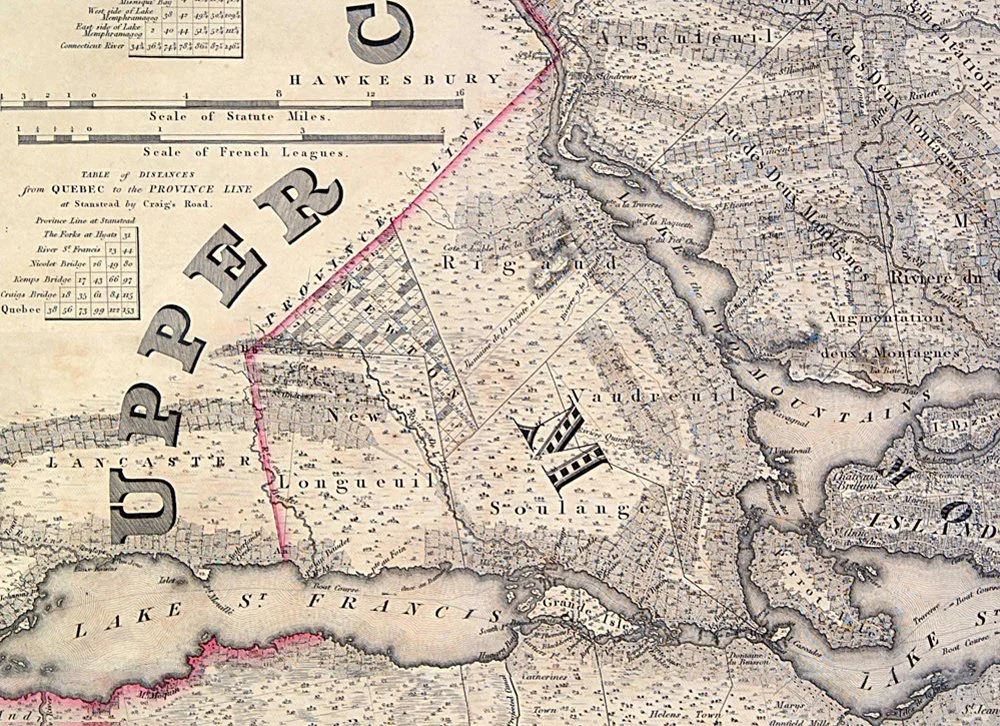
On 25 March 1725, the first census of Vaudreuil, conducted by Philippe de Rigaud, Marquis de Vaudreuil, counted 38 families in the newly organized township. Eight never settled to work the land. Thirty families established themselves on their concessions. Jean-Baptiste Séguin was among them—and the date of his possession of Concession #15 de l'Anse predated that of the Léger and Poirier families, making his the oldest settled family in the seigneurie.
At some point between 1724 and 1725, Jean-Baptiste and Geneviève left the parish where both had been born, married, and raised nine children, and relocated westward to the new seigneurie of Vaudreuil. The reasons for this move are not recorded, but the timing suggests a family seeking fresh land as the older concessions at Boucherville became crowded. By the 1725 census, Jean-Baptiste had already established himself as a farmer—the earliest documented settler of what would become one of the most important townships in the Montréal region.
This was the same Vaudreuil whose seigneur, Philippe de Rigaud, had issued the ordinance under which Jean-Baptiste's brother François was convicted two decades earlier. Whether Jean-Baptiste reflected on this as he cleared his new concession is unknown, but the connection underscores how small and interconnected the colonial world remained.
In 1783—more than half a century after Jean-Baptiste's death—a telling record survives. William Atkinson of Nova Scotia purchased Lot #15 above Pointe Cavagnol from the heirs of Jean-Baptiste Séguin for his daughter Elizabeth, who was married to John Mark Crank. The Cranks settled on the land in 1789. The concession Jean-Baptiste had first cleared remained identified with his name even generations later.
Move to Chambly and Final Days
The family did not remain at Vaudreuil. By 1726, Jean-Baptiste and Geneviève had moved again—this time east to Chambly, on the Richelieu River. The evidence comes from their tenth and last child: Marie Françoise Agathe, born 17 June 1726 and baptized at St-Joseph de Chambly. She was the only one of their ten children not baptized at Boucherville. The reason for this second relocation is unknown, but the Richelieu River corridor held its own significance—it was along this same river that Jean-Baptiste's father François had served as a young soldier in the Carignan-Salières Regiment sixty years earlier.
Jean-Baptiste did not live long in Chambly. On 13 May 1728, he died at the Hôtel-Dieu in Montréal, the colony's hospital. He was thirty-nine—though the burial record estimated his age at forty-five. The register names him simply as "Jean Baptiste La Deroute, habitant de la paroisse de Chambly," confirming his Chambly residence. He was buried the following day, 14 May 1728, in the cemetery of Notre-Dame de Montréal.

The burial entry is stark in its economy. No family members are named as witnesses—only a fellow priest, M. Falcoz, and the beadle Simon Monginos. He had died "d'hier à l'hôpital de cette ville"—yesterday, at the hospital of this city. He was buried "dans le cimetière hors de la ville"—in the cemetery outside the city walls. Whatever illness had brought him to the Hôtel-Dieu, it had taken him far from his family at Chambly.
He left behind Geneviève, age thirty-eight, with nine surviving children ranging from the two-year-old Agathe to the sixteen-year-old Louis. The eldest sons—Louis, Jean-Baptiste fils, and Pierre—were approaching adulthood, but the younger children still needed years of care. Geneviève would prove more than equal to the task.
Geneviève: Three Marriages and Eighty-Four Years
Geneviève Barbot dite Boisdoré did not remain a widow long. On 18 April 1730—less than two years after Jean-Baptiste's death—she married Philippe Charles Rolland at Notre-Dame de Montréal. When Rolland too passed, she married a third time: Jean Bénard Beausoleil, on 3 February 1744, again at Notre-Dame. Three marriages across thirty-four years, each marking a new chapter in an extraordinarily long colonial life.
Geneviève died on 22 August 1773 at the mission church of L'Annonciation at Oka (Lac-des-Deux-Montagnes), at the remarkable age of eighty-four. She had been baptized in the same small Boucherville chapel as the man she first married, and she had outlived him by forty-five years.
At her burial, three of her Séguin sons were present: Jean-Baptiste fils, Pierre, and Jean. That they came to Oka for her funeral speaks to the enduring bonds of this family. Oka, the mission of Lac-des-Deux-Montagnes, was the same church where two of her sons had married Raizenne Shoentakouani sisters decades earlier, and where our ancestor Marie Charlotte had married Jean-Baptiste Larocque Rocbrune in 1744.
Two Brothers and the Raizenne Shoentakouani Sisters
Among the most striking details in the family record is the marriage of two of Jean-Baptiste's sons to sisters from the same Indigenous-French family. Louis, the eldest surviving son, married Marie Anne Raizenne Shoentakouani on 8 April 1736 at the Oka mission. Six years later, on 22 July 1742, Jean-Baptiste fils married her sister Marie Catherine. The place of that second marriage is not established: PRDH records it as lieu indéterminé (au Québec), and no parish act for it has been located.
Their wives were daughters of Ignace Raizenne Shoentakouani and Marie Élisabeth Nimbs Touatogouach—a family that bridged the Indigenous and French worlds at the Lake of Two Mountains mission. These marriages connected the Séguin family to the same mission community where, generations later, Gabriel Guilbault would marry Marie Josephte Abitakijikokwe in 1801—our 4th-great-grandmother whose discovery is documented in the Abitakijikokwe Case Study.
The Oka mission church of L'Annonciation appears repeatedly in the Séguin family records: as the site of these marriages, as the place where Geneviève was buried in 1773 with her sons in attendance, and as a crossroads where French, Algonquin, and Haudenosaunee communities converged.
Joseph at Ste-Anne-de-Détroit
While most of Jean-Baptiste's children settled in the corridor between Boucherville, Vaudreuil, and Oka, one son ventured much farther west. Joseph, born 23 November 1717, eventually made his way to Fort Pontchartrain du Détroit, where he married Marie Thérèse Tremblay on 7 January 1751 at Ste-Anne-de-Détroit. He died there on 16 February 1795, at the age of seventy-seven.
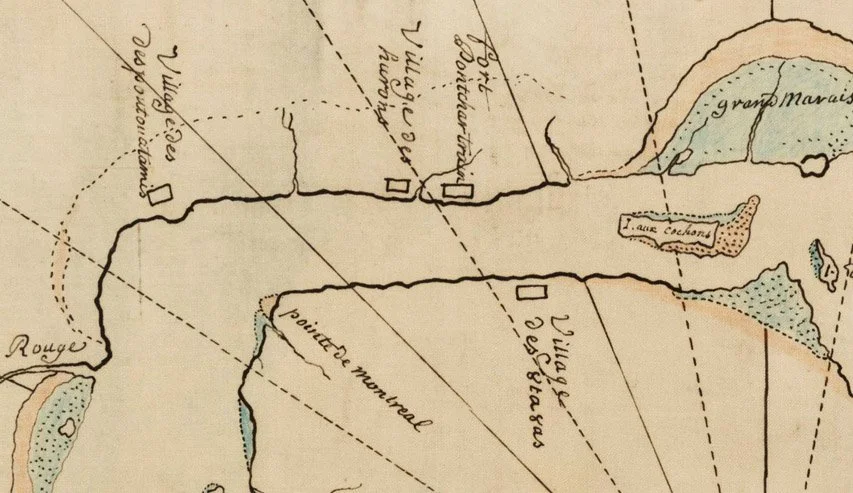
Joseph was not the first Séguin at Detroit. His uncle—also named Joseph, the youngest child of François Séguin and Jeanne Petit, born in 1694—had married Marie Françoise Sauvage at Ste-Anne-de-Détroit in 1723 and was buried there in 1753. Two generations of Séguins at Detroit, uncle and nephew, extending the family's reach from the St. Lawrence deep into the pays d'en haut.
Marie Charlotte Séguin: Our Ancestor ★
Marie Charlotte Séguin was born on 5 March 1723 at Boucherville and baptized the following day at Sainte-Famille—the eighth of Jean-Baptiste and Geneviève's ten children. She was five years old when her father died at the Hôtel-Dieu in Montréal.

On 27 January 1744, at age twenty, Marie Charlotte married Jean-Baptiste Larocque Rocbrune at the mission church of L'Annonciation at Oka. Her husband's mother was Marie Madeleine Sabourin—connecting to yet another surname in the broader Guilbault Line. Marie Charlotte died on 5 December 1796 and was buried at St-Michel de Vaudreuil, the same parish where several of her siblings also found their final rest.
Through Marie Charlotte, the Séguin bloodline passed to Joseph "Thomas" Couillaud Larocque, then to Marie Madeleine Rocbrunes Laroque, and finally to Evangeliste Guilbault—the journalier of St-André-Est whose story closes The Guilbault Line series.
The Ten Children of Jean-Baptiste Séguin & Geneviève Barbot
| # | Name | Born | Baptized | Marriage | Spouse | Death |
|---|---|---|---|---|---|---|
| 1 | Marie Josèphe | 28 Mar 1711 | 28 Mar 1711 Boucherville |
— | 22 Apr 1712 buried 23 Apr, Boucherville |
|
| 2 | Louis | 8 Apr 1712 | 9 Apr 1712 Boucherville |
8 Apr 1736, Oka | Marie Anne Raizenne Shoentakouani | 13 Jul 1763, Oka |
| 3 | Jean-Baptiste (fils) | 14 May 1714 | 15 May 1714 Boucherville |
22 Jul 1742 place not established |
Marie Catherine Raizenne Shoentakouani; 2nd m. 1749 M.J. Lamagdeleine Ladouceur | 24 Jul 1786, Vaudreuil |
| 4 | Pierre | 2 Jan 1716 | 2 Jan 1716 Boucherville |
3 Feb 1739, Ste-Anne-de-Bellevue | Marie Josèphe Mallet; 2nd m. 1761 M.C. André Stamand | 25 Aug 1788, Vaudreuil |
| 5 | Joseph | 23 Nov 1717 | 24 Nov 1717 Boucherville |
7 Jan 1751, Ste-Anne-de-Détroit | Marie Thérèse Tremblay | 16 Feb 1795, Détroit |
| 6 | Marie Louise | 22 Sep 1719 | 24 Sep 1719 Boucherville |
29 Feb 1740, Ste-Anne-de-Bellevue | René Fortin Lagrandeur | — |
| 7 | Jean | 13 Mar 1722 | 14 Mar 1722 Boucherville |
No further records found | — | |
| 8 | Marie Charlotte ★ OUR ANCESTOR | 5 Mar 1723 | 6 Mar 1723 Boucherville |
27 Jan 1744, Oka | Jean-Baptiste Larocque Rocbrune | 5 Dec 1796, Vaudreuil |
| 9 | Jean-Baptiste (le jeune) | 28 Nov 1724 | 29 Nov 1724 Boucherville |
16 May 1749 / 6 Nov 1752, Oka | Marie Amable Mallet / Marguerite Tourangeau Godin | 1 Nov 1779, Oka |
| 10 | Marie Françoise Agathe | 17 Jun 1726 | 17 Jun 1726 Chambly |
25 Nov 1743, Montréal | Étienne Guérin Stétienne | 14 Dec 1781, Vaudreuil |
Birth dates are as recorded in the baptismal acts, which normally state the day of birth separately from the day of baptism. Marie Louise's birth of 22 September 1719 is confirmed; her baptism date has been given elsewhere as 24 September, two days later where every other child in this family was baptized the day after birth, and that figure awaits verification against the act. PRDH records consulted for this page were read in the French interface: the English rendering returns "Rock" for Pierre and "Jeans" for Jean.
Key Dates
Connection to The Guilbault Line
Primary Source Documents
Jean-Baptiste Séguin dit Ladéroute — Life Records
Geneviève Barbot dite Boisdoré — Life Records

Children — Baptismal Registers
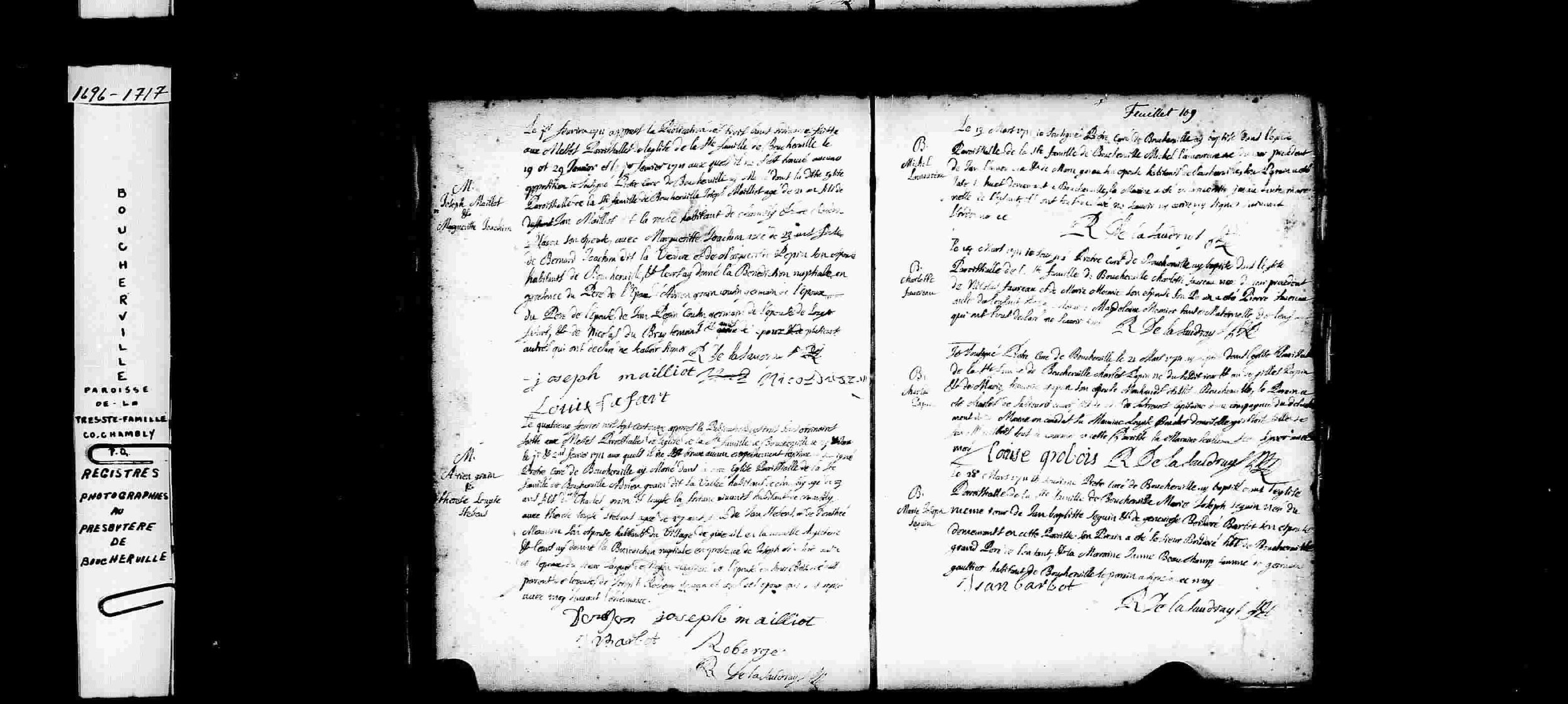

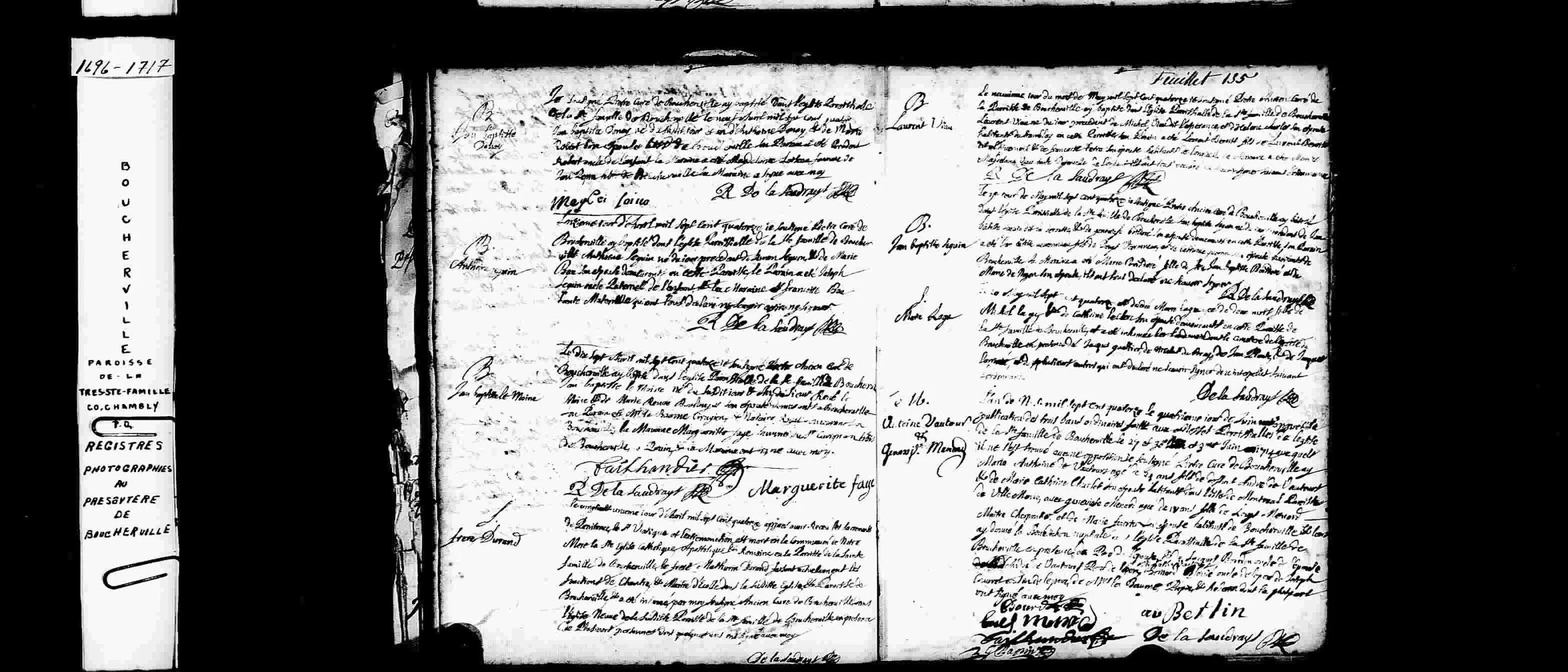


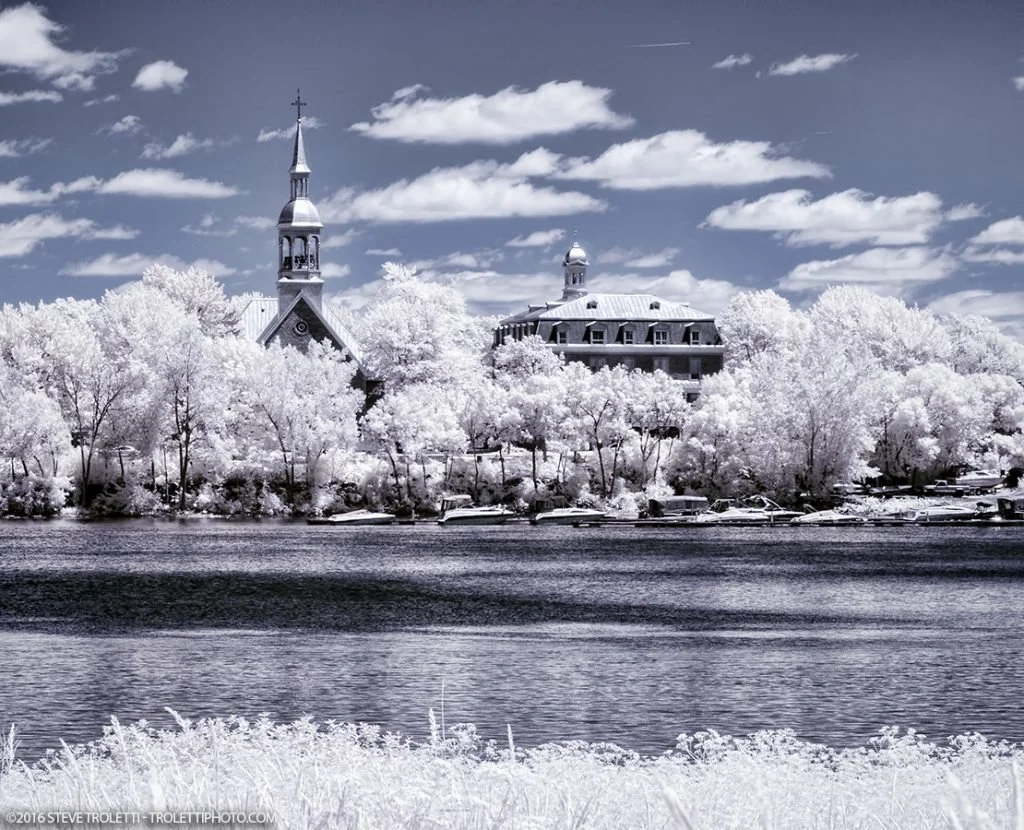
Sainte-Famille de Boucherville
Sources & Citations
Primary Sources
- Baptism (1688): Boucherville (Sainte-Famille) Parish Register, 12 November 1688. Priest: P.R. Guybert de la Saudrays.
- Marriage (1710): Boucherville (Sainte-Famille) Parish Register, 7 June 1710. Dispensation from banns by Vicar General of Québec.
- Burial (1728): Notre-Dame de Montréal Parish Register, 14 May 1728. Priest: Jullien.
- Baptism of Geneviève Barbot (1689): Boucherville (Sainte-Famille) Parish Register, 21 July 1689.
- Burial of Geneviève (1773): L'Annonciation, Oka Parish Register, 22 August 1773.
- Children's Baptisms (1711–1724): Boucherville (Sainte-Famille) Parish Registers.
- Baptism of Marie Françoise Agathe (1726): St-Joseph de Chambly Parish Register, 17 June 1726.
- Judicial proceedings (1705–1706): BAnQ, Fonds Intendants, E1,S1,D1, pièces P21 (26 Oct 1705), P22 (31 Oct 1705), P38 (26 Nov 1705), P47 (8 Dec 1705), P53 (4 Jan 1706), P54 (9 Jan 1706).
- Vaudreuil Census (1725): Census conducted by Philippe de Rigaud, Marquis de Vaudreuil, 25 March 1725.
Negative Searches
- BAnQ, E1,S1,D1 (Cahier 1, Raudot, 7 Sept 1705 – 18 Nov 1707), pièces P6–P67 examined; six pieces relate to the prosecution; the register contains no interrogatoire, information or écrou.
- BAnQ, TL4,S11,D3, Registre des procès-verbaux d'audience 1702–1706, images 1350–1381, covering the audiences of 23 and 30 October, 24 November and 11 December 1705; no entry for Séguin, Ladéroute or Lapointe.
- BAnQ, TL4, séries des exploits d'huissier and des ordonnances: no result for this affair.
Derivative Compilations and Secondary Sources
- PRDH-IGD. Family #10660; individuals #8313, #68314, #93872, #123862, #89486, #27022, #104109, #40823, #118218, #145402, #117695. Université de Montréal.
- Laforest, Thomas J. Our French Canadian Ancestors. LISI Press. Source of the 1704 salt-crisis narrative; the surviving ordinances do not name the subject of the 1705 assembly.
- Séguin-Pharand, Yolande. François Séguin ou L'impossible défi. Association des Séguin d'Amérique, 1992.
- Gagné, Peter J. From Soldiers to Settlers: The Carignan-Salières Regiment in Canada, 1665–1668, vol. 2, 2025.
Every Family Has a Story Worth Telling
Whether you're just beginning your research or ready to transform years of work into a narrative your family will treasure, I'd love to hear your story.
BEGIN YOUR RESEARCH INQUIRY