
Marie Duteau dite Perrin
Marie Duteau
One of the Brave 262
Before the King's Daughters. Before royal dowries and organized recruitment. Before the colony had a plan to populate itself with marriageable women. There were the Filles à marier—the marriageable girls who crossed the Atlantic on their own terms, signing contracts of indenture, leaving everything they knew for a wilderness they could scarcely imagine.
Marie Duteau was one of approximately 262 such women. She arrived in 1658, five years before the official Filles du roi program would begin. She received no dowry from the Crown. She enjoyed no royal protection. What she carried across the ocean was something more valuable: the courage to start over in a world where French was spoken but France was very far away.
She also carried something that made her unusual among New France's founding mothers: a Protestant baptism from the Huguenot stronghold of La Rochelle. And in 1668, she did something rarer still—she bound herself in a contract, in her own name, before a notary.
A note on her name. This page called her "Marie-Michelle Duteau dite Perrin" until September 2026. It now calls her Marie, because that is what the records call her. The temple register, the four engagement contracts, the marriage act, both censuses, every notarial act and every database entry give her one forename. The only "Marie Michelle" anywhere in this file is Michelle Ouinville—the woman Michel Lemay married after Marie's death. Her surname appears as Dutaut, Duteau, Dutost, Dutos, Dutaud and Dutault; the spelling is the clerk's, and it varies from act to act.
La Rochelle: A Huguenot Stronghold
Marie was born on 21 August 1639 into a Protestant family in one of France's most famous Huguenot cities. La Rochelle had been the last great stronghold of French Protestantism, besieged by Cardinal Richelieu just eleven years before Marie's birth. The city's walls had fallen in 1628, but its Calvinist temples still stood—for now.
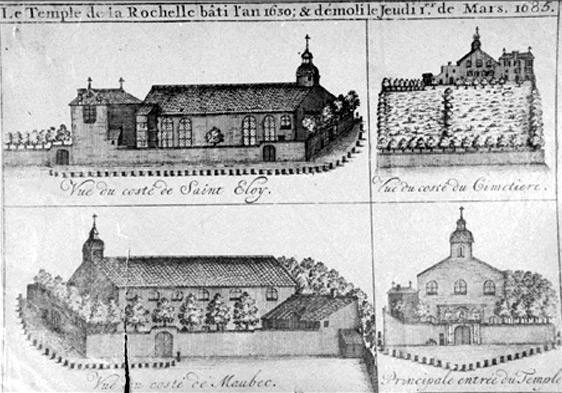
Four days later, on Thursday 25 August, she was presented for baptism at the Temple de la Villeneuve. This was not the grand temple that had once dominated the city's skyline, but one of the smaller meeting houses that survived the siege. It would stand until 1685, when Louis XIV's Revocation of the Edict of Nantes brought its demolition—by which time Marie had been a decade dead on the far side of the Atlantic.

| Register | Archives départementales de la Charente-Maritime, cote I 171-173, La Rochelle, Protestant register 1632-1648, view 255/645, folio 133 |
| Session heading | Du Jeudy 25e d'aoust [1639] … ont esté batizés |
| The act | Marie fille de pierre Duteau et de Jeanne perrin. P. Abraham [Gousault]. M. Marie Dutau. elle est née le 21 de ce mois. le dit père n'a sceu signer. |
| Born | 21 August 1639 |
| Baptized | 25 August 1639, Temple de la Villeneuve |
| Parents | Pierre Duteau and Jeanne Perrin |
| Godparents | Abraham [Gousault]; Marie Dutau |
| Note in the act | The said father did not know how to sign |
The register checks itself. An earlier heading on the same opening reads "Du Dimanche après midy 21e aoust 1639"—so if the 21st was a Sunday, the 25th was a Thursday, which is exactly what the later heading says. Note that the PRDH-IGD card for Marie, no. 24206, gives a single date, 1639-08-21, and shows the temple as the place. The baptism date is not in the database; it is only in the register.
A Religious Minority
Marie was one of the few Protestant women among the Filles à marier. Her marriage in New France would require conformity to Catholicism—the only religion permitted in the colony. Her Huguenot origins, once a mark of community and identity, would be subsumed into the Catholic records that document the rest of her life. Everything we know about her first nineteen years survives only in France.
The Duteau Family of the Saint-Nicolas Quarter
Marie's father was baptized Jean-Pierre Doutteau on 2 April 1607 in the temple neuf of the place du Château, four days after his birth on 29 March, the son of Mathelin Duteau and Jeanne Pouvreau. He went by Pierre.
He was a portefaix—a porter on the docks of La Rochelle—and he lived near the water, in the Saint-Nicolas quarter beneath the tower that guarded the harbour mouth. That detail is not decoration. For years, Pierre Duteau had been unloading cargoes arriving from Canada. He knew the ships, and he very likely knew their captains and crews. When the moment came to send his family somewhere safer, he did not choose at random; he chose the place at the other end of the ropes he handled every day.
Two Marriages, Eight Children, Five Small Graves
Jeanne Perrin was Pierre's second wife. Around 1632 he had married Marthe Renaudin, daughter of Jean Renaudin, a boatman, and Marie Robineau. They had three children, and all three died small: a Pierre born in 1633 and buried in 1645; a Marie born in April 1636 who died soon after; and a daughter buried in August 1637. Marthe herself was buried in the Temple de la Villeneuve on 20 August 1637, days after that last child.
There had already been a Marie Duteau. Our Marie was named for a half-sister she never met.
Pierre then married Jeanne Perrin, herself born 26 May 1615 and presented at the temple Saint-Yon on the last day of that month, the daughter of David Perrin and Jeanne Danieau. They had five children, all presented in the Temple de la Villeneuve:
| Child | Born | Presented | What became of them |
|---|---|---|---|
| Marie | 21 Aug 1639 | 25 Aug 1639 | Emigrated 1658; married Michel Lemay at Trois-Rivières |
| Charles | 15 Dec 1641 | 22 Dec 1641 | Emigrated 1658; married Jeanne Rivard at Champlain; died 1717 |
| Pierre | 6 Mar 1644 | 13 Mar 1644 | Buried 4 December 1652, La Rochelle |
| Nicolas | c. June 1646 | — | Buried at fourteen months, 25 August 1647 |
| Madeleine | 5 Jul 1649 | 13 Jul 1649 | Emigrated 1658 at nine; married Nicolas Leblanc dit Labrie |
Count them across both marriages and the arithmetic is bleak: of Pierre Duteau's eight children, five were buried in the Temple de la Villeneuve before the family ever sailed. Only Marie, Charles and Madeleine lived to see Canada.
In November 1651, when Marie was twelve and Charles ten, royal troops retook La Rochelle from the comte du Daugnon. His lieutenant Besse blew up part of the tour de la Chaîne; his men were thrown from the top of the tour Saint-Nicolas and surrendered. This happened at the end of the Duteaus' street.
From that moment, the city was no longer safe for Huguenots.April 1658: A Family Divided
In the spring of 1658 Pierre Duteau, sensing his own end—he would be dead before the year was out—decided to put his family beyond reach. On the afternoon of Tuesday 16 April he walked to the house of the notary Pierre Teuleron in the rue des Trois Marchands, with his wife and children.
Two contracts were passed that afternoon, and a third the following morning. They are not four separate engagements on equal terms, as this page previously described them:
| Date | Who | To whom | Terms |
|---|---|---|---|
| 16 April 1658 | Jeanne Perrin and Madeleine (aged 9), together, as servantes | Sieur Jacques de La Poterie, demeurant à Québec | Five years; fed by him; 50 livres a year for the two of them |
| 16 April 1658 | Charles (aged 16) | The same sieur de La Poterie, "pour toutes choses qu'il lui commandera" | Three years; 30 livres at the end of the engagement |
| 17 April 1658 | Marie (aged 19), as servante | Pierre Denys, habitant of Québec | Three years' service at Québec; 30 livres a year |
Pierre Denys signed the 16 April contracts as representative of Jacques de La Poterie, who was his father-in-law; the next morning he engaged Marie for himself. Throughout the transactions Denys was lodging at the auberge du Gallion, in the same street, directly opposite the notary's door, kept by Ozée Jourdain, master pastrycook.
One clause in the first contract is worth pausing over. The act specifies that Pierre Duteau authorizes his wife to pass the contract.
A married woman in seventeenth-century France could not bind herself without her husband's authorization. Jeanne Perrin's engagement had to be enabled by Pierre, in the act itself. Ten years later, on the other side of the Atlantic, her daughter would do the same thing by another route.
The terms are poor—strikingly so for five years of a woman's labour and a child's. That is itself the evidence of what this was. Pierre Duteau was not selling his family's work at a good price. He was buying them passage, and the wages were what it cost.
The Father Who Stayed Behind
Pierre signed nothing for himself. Some time after the contracts, his wife and children boarded Le Prince Guillaume and he stayed on the quay of the Huguenot city. He was buried in the Temple de la Villeneuve on 12 December 1658, some eight months later.
He would be named once more, and it is worth knowing where. At his daughter's wedding in Trois-Rivières on 15 June 1659, the priest wrote down the bride's parents as the form required: Pierre Dutost and Jeanne Peirrin. He had then been six months in a grave four thousand kilometres away. A name in a record is not a person in a room.
The Mother Whose Crossing Cannot Be Proved
And Jeanne Perrin? She signed the longest contract of the three—five years—and brought her youngest daughter under it. After that, nothing.
This page used to say that she crossed the Atlantic with her three children and then disappeared. That is more than the records will bear. Jean-François Paboul, whose study of this family is the fullest there is, narrates the embarkation and then writes, in his own next paragraph, that "Jeanne Perrin est citée aux mariages de ses enfants mais aucun document n'affirme sa présence." Denis Beauregard's GFNA is blunter still: Jeanne Perrin, dead after 16 April 1658, in France or Québec.
She is named in her children's marriage records in 1659, 1664 and 1669—but so was her husband, who was certainly dead in France. Filiation clauses name parents; they do not place them.
So the honest shape of her story is not that she vanished in Canada. It is that we do not know whether she ever left La Rochelle. She may have died in the weeks between the contract and the sailing. She may have crossed and died on the water. She may have lived for years in the colony under a name no clerk wrote down. The mother who arranged this emigration is the one member of the family the archives will not place anywhere at all.
Two Sisters
Marie was not the only daughter of this household to marry in New France. Her younger sister Madeleine—the nine-year-old engaged under her mother's contract—grew up at Cap-de-la-Madeleine and passed her own marriage contract on 2 November 1664, before the notary Jacques de Latouche, with Nicolas Leblanc dit Labrie of Chennevières-sur-Marne.
The Duteau Sisters
| Marie | Madeleine | |
|---|---|---|
| Born | 21 August 1639 | 5 July 1649 |
| Baptized | 25 August 1639, Temple de la Villeneuve | 13 July 1649, Temple de la Villeneuve |
| Age at emigration | 19 | 9 |
| Married | Michel Lemay, 15 June 1659, Trois-Rivières | Nicolas Leblanc dit Labrie, contract 2 November 1664 |
| Children | Ten born, nine surviving | Seven |
| Died | Between 1672 and 12 April 1677 | Cap-de-la-Madeleine, before 7 November 1694 |
Is Madeleine a Fille à marier or a Fille du roi? This page used to say that the Duteau household produced two of the 262. That claim is contested and should be flagged rather than asserted. Dumas counts Madeleine among the King's Daughters; GFNA notes against her name that she was "enrolled in 1658 with her family," which would place her outside the royal programme entirely. She was nine years old in 1658 and did not marry until 1664. The question turns on whether the 1658 engagement or the later marriage governs her classification, and it is not settled here.
Their brother Charles settled at Champlain. On 22 April 1669 he contracted marriage before Jacques de Latouche with Jeanne Rivard, daughter of Nicolas Rivard of Tourouvre in the Perche and Catherine de Saint-Père of Saint-Jean-d'Angély, baptized at Trois-Rivières on 24 August 1656. They had thirteen children. At the census of 1681 Charles held a musket, four head of cattle and eighteen arpents of land. Jeanne Rivard died on 25 November 1698; Charles followed on 12 June 1717.
On 3 February 1685, Charles Duteau was made subrogate guardian to his sister Marie's children.
15 June 1659: A New Beginning
Less than a year after arriving, Marie stood before Father René Ménard, S.J., at Trois-Rivières. Beside her was Michel Lemay, a colonist of twenty-eight who had been in the country at least five years.
| Record | Trois-Rivières (Immaculée-Conception); PRDH-IGD no. 89045 |
| Groom | Michel Lemay, of the bourg de Chesne-Hutte, diocese of Angers |
| Groom's parents | François Lemay and Marie Gaschet |
| Bride | Marie Dutost, of the diocese of La Rochelle |
| Bride's parents | Pierre Dutost and Jeanne Peirrin — the father then six months dead at La Rochelle |
| Others named | Pierre Gaultier; Julien Trotier; René Ménard, Jesuit |
Names as the record gives them. The register places the marriage at Trois-Rivières (Immaculée-Conception); an earlier version of this page gave the chapel at La Magdeleine, which the act does not support.
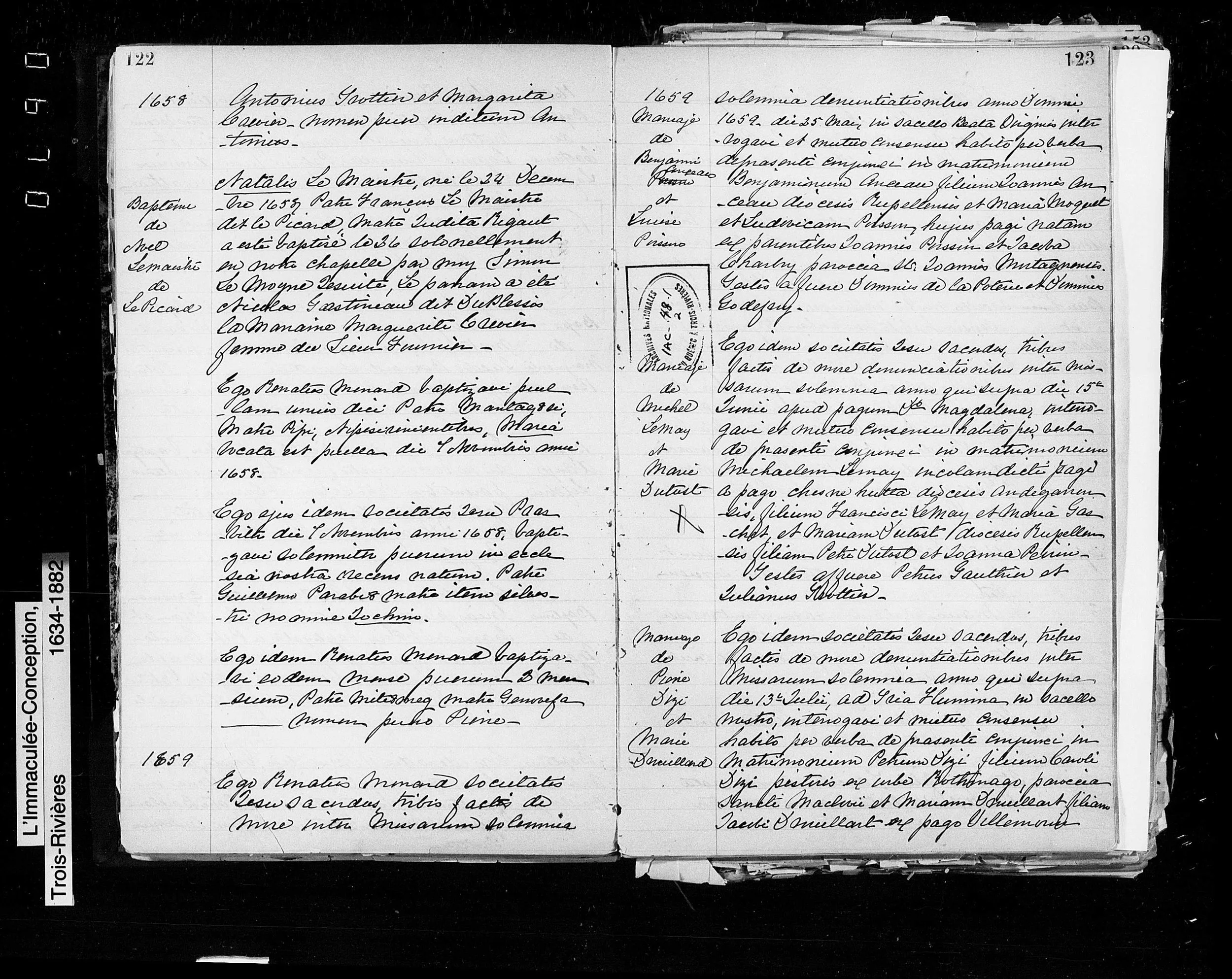
No Canadian record refers to the faith she was baptized in. The Protestant girl from La Rochelle became a Catholic wife in the wilderness, and the only documents that say otherwise stayed in France.
Pioneer Wife: 1659-1677
The marriage lasted between thirteen and eighteen years—the records will not fix it closer—and in that time the family moved three times, each move a little further into the frontier.
Cap-de-la-Madeleine
For their first dozen years Marie and Michel lived at Cap-de-la-Madeleine, where Michel worked as a carpenter and builder. In partnership with Élie Bourbeau he constructed a chapel for Pierre Boucher—"of 20 feet in length by 20 feet in width"—and later moved it to Fort Saint-François to serve the fortifications against Iroquois attack.
| The household at the two enumerations | |
|---|---|
| 1666 PRDH-IGD no. 96158, Trois-Rivières (Immaculée-Conception) |
Michel Lemey 36, habitant; Marie Dutost 26; Charles 6; Joseph 5; Marie 4; Ignace 1; Jacques Dutost 23, brother of Marie; Pierre [surname blank] 20, domestique |
| 1667 PRDH-IGD no. 97080, same parish |
Michel Lemai 38, habitant; Marie Dutau 27; Michel 9; Joseph 6; Marie 4; Ignace 2; Jeanne 1 |
Two corrections belong here. The brother living in the household in 1666 is Jacques, not Charles, who was twenty-four or twenty-five that year and does not appear on the card at all — and no Jacques Duteau is known among Pierre Duteau's eight children. He remains unidentified. Separately, the "four head of cattle and eighteen arpents" this page formerly attributed to this household in 1666 belong to Charles Duteau at the census of 1681 — a different man, a different farm, fifteen years later.
The eldest son is also worth a second look. Charles appears aged six in 1666 and is gone by 1667, while Michel appears aged nine in 1667 and is absent in 1666. The explanation is not a clerk's error: Charles died between the two enumerations, and Michel, the true eldest, was simply missed the first time.
Batiscan
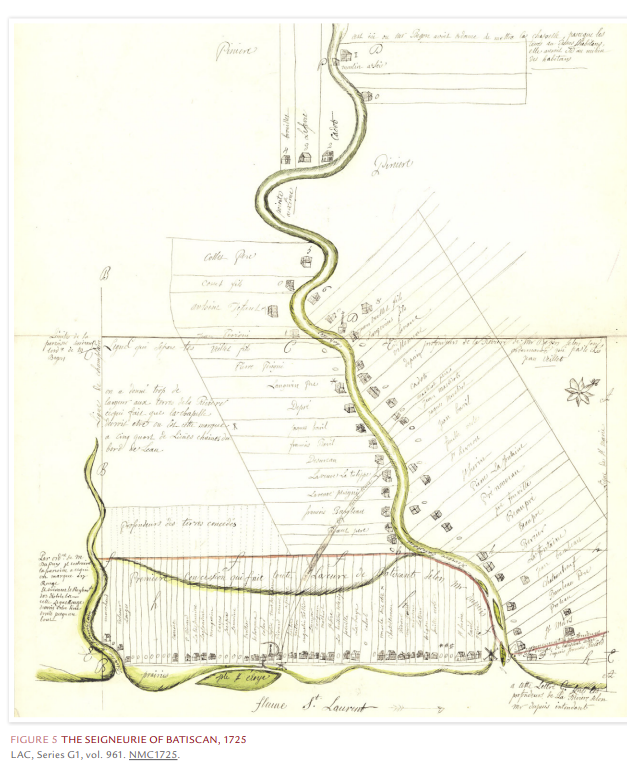
In 1669 the family moved to Batiscan, where the Jesuits offered Michel a concession. Marie's brother Charles was nearby, married to Jeanne Rivard and establishing his own family. The two who had crossed together as young adults were building parallel lives within a few miles of each other.
Lotbinière
The last move came in 1672, when René-Louis Chartier received the Seigneurie of Lotbinière from the Intendant Jean Talon. Michel obtained nine arpents of prime river frontage, and the Lemay family became the first to establish a home at Saint-Louis de Lotbinière. Michel had taken up eel fishing—a lucrative business that in a good season would eventually yield sixty to seventy thousand eels.
22 March 1668: Marie Binds Herself
On a March afternoon at Cap-de-la-Madeleine, nine years into her marriage and with five small children at home, Marie Duteau went before the notary of the seigneury and made a bargain in her own name.
"L'an mil six cent soixante et huict le [vingt deuxiesme] jour de mars après midy, pardevant nous notaire en la juridiction seigneurie et prévosté du Cap de la Magdeleine et témoins soubzsignés, fut présent de sa personne noble François Hartel escuyer sieur de la Fresnière, et Marie Dutos femme de [Michel Lemay] … fondée en procuration dudit Lemay son mari, laquelle s'oblige…"
— Bibliothèque et Archives nationales du Québec, P1000,S3,D970The other party was François Hertel de la Frenière, the soldier and seigneur whose name runs through the history of Trois-Rivières. The bargain was a bail à cheptel: a cow taken on shares, running three years from the preceding 7 January, the increase to be divided moitié par moitié—half and half—with clauses for what should happen if the animal died and how the hide was to be returned.
It is an ordinary agricultural contract, and that is exactly why it matters. Marie is not a mother named in a filiation clause here, nor a wife mentioned in passing. She is a contracting party. The verb is singular and feminine: laquelle s'oblige—she binds herself.
Two women, two mechanisms
Under the Coutume de Paris a married woman could not bind herself alone. There were two ordinary ways around it, and this practice now holds a document for each.
Marie Riton, at Beauport in December 1666, contracted for her daughter's marriage alongside her husband, "de luy authorizée pour l'effet des présentes"—authorized by him, in the act, in his presence.
Marie Duteau, at Cap-de-la-Madeleine in March 1668, contracted "fondée en procuration dudit Lemay son mari"—under a written power of attorney, which is the instrument a woman uses when her husband is not there.
Her mother had needed the same permission at La Rochelle in 1658, written into the engagement contract by the notary Teuleron. Three women, three acts, one legal problem, ten years and an ocean apart.
The Death That Will Not Fix Itself
Marie died somewhere in the years after 1672. That is as close as the documents come, and this page no longer pretends otherwise.
| Source | What it says |
|---|---|
| Thomas J. Laforest, Our French Canadian Ancestors, vol. II | "around 1675"; reports an inventory of her effects dated 30 November 1675 |
| Jean-François Paboul | Between the birth of her last daughter in 1672 and her husband's remarriage on 12 April 1677 |
| Fichier Origine, fiche no. 241443 | Trois-Rivières, before 12 April 1677 |
No burial act has been found. The 12 April 1677 end of the bracket is firm, because it is the date Michel Lemay contracted his second marriage before the notary Antoine Adhémar at Montréal, and a man does not do that while his wife lives. The 1675 date rests on Laforest's report of an inventory that has not yet been seen. If that act exists and is correctly dated, it closes the question; until it is produced, the bracket stands.
One loose thread, recorded here so it is not mistaken for a finding. The PRDH card for her son Joseph's marriage contract of 4 June 1686 marks Michel Lemée deceased and gives Marie Dutault a residence at Lotbinière, with no deceased marker. Michel's remarriage in 1677 makes that impossible on its face, so it is almost certainly an artefact of how the database records a filiation. It is flagged rather than repeated, and the original contract should be read before anyone cites it.
She was somewhere between thirty-three and thirty-eight. Her youngest children were small. Her eldest was not yet twenty.
Michel's Second Marriage
On 12 April 1677, before the notary Antoine Adhémar at Montréal, Michel Lemay contracted marriage with Michelle Ouinville, widow of Nicolas Barabé. Michelle, daughter of Pierre Ouinville and Antoinette Bonnard of Paris, had come to Canada in 1668 as a fille du roi, bringing goods valued at 400 livres. She and Michel had two children: Antoinette, later the wife of François Girard, and Louis-François, who died at twelve.
Michel died at the end of 1684. Michelle Ouinville married a third time, to Louis Montenu, on 5 November 1685, and died around 1700. The children of both marriages grew up together at Lotbinière.
The World Marie Knew
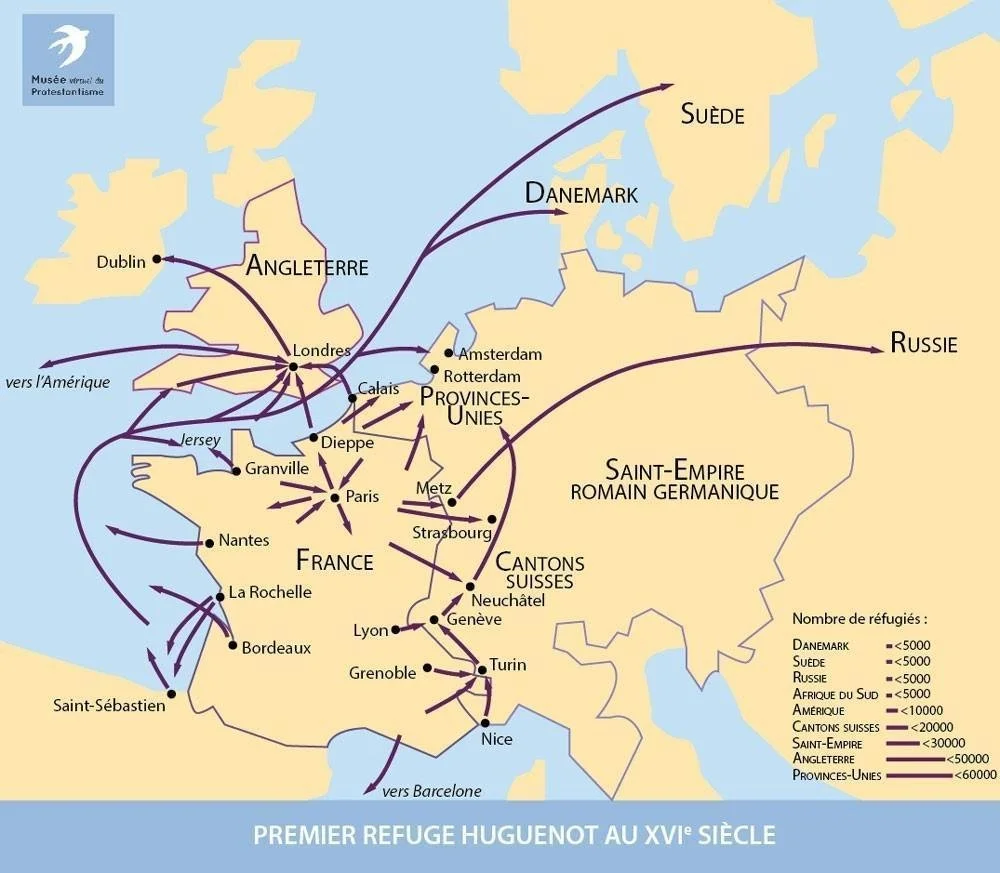
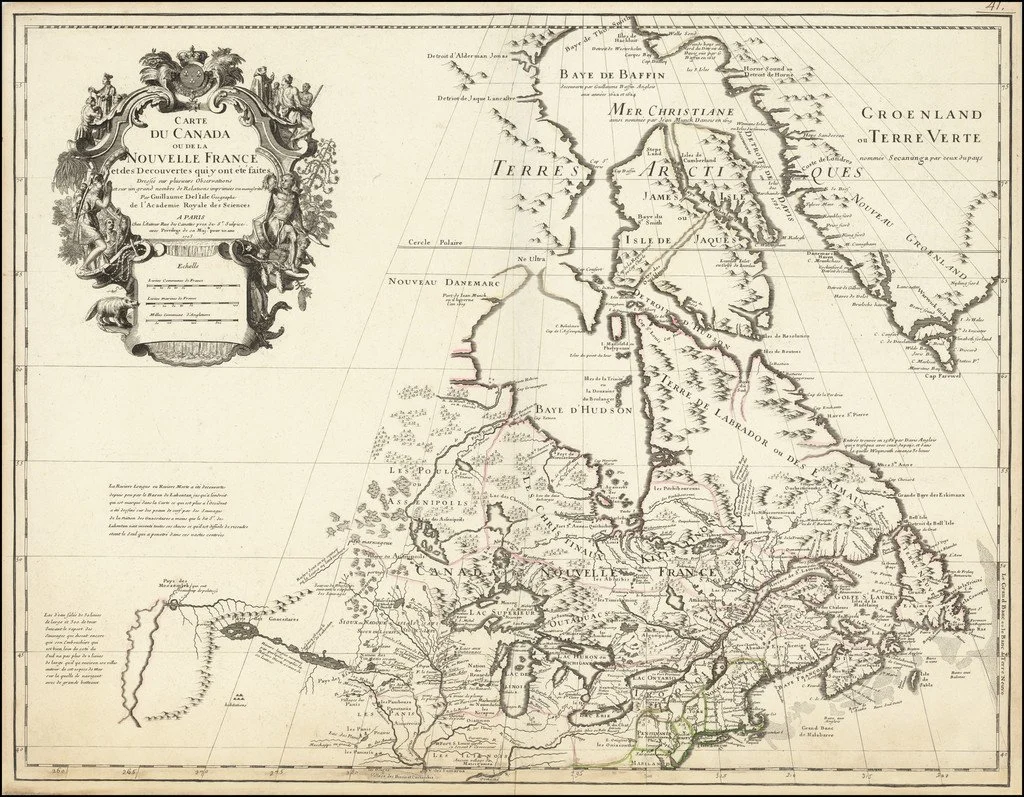
Marie's journey took her from the Protestant stronghold of La Rochelle across the Atlantic to the frontier settlements along the St. Lawrence. These maps help us understand the world she inhabited.

A Mother of Millions
Marie bore ten children between about 1659 and about 1674. One, a Charles born about 1660, died in infancy between the enumerations of 1666 and 1667. The other nine lived to marry.
| Child | Born (census-derived) | Married | Spouse |
|---|---|---|---|
| Michel | c. 1658–1660 | Champlain, 22 April 1686 | Catherine Jobin |
| Charles | c. 1660 | Died before the census of 1667 | |
| Joseph, dit Delorme | c. 1661–1667 | Québec, 1686 | Agnès Madeleine Gaudry |
| Marie, or Marie Madeleine | c. 1662–1665 | Lotbinière, about 1685 | Louis Houde |
| Ignace, dit Poudrier | c. 1665–1667 | Charlesbourg, 24 November 1687 | Anne Girard |
| Marie Jeanne | c. 1666 | Lotbinière, about 1686 | Étienne Denevers |
| Charles | c. 1669 | Neuville, 26 May 1691 | Louise Houde |
| Pierre | c. 1671 | Cap-Santé, 7 February 1695 | Anne Germain |
| Jean | c. 1673 | Saint-Nicolas (?), about 1700 | Marie Hélène Boucher |
| François, dit Poudrier | c. 1674 | Mobile (?), Alabama, before 1704 | Angela Orsseau |
Birth years are derived from the censuses of 1666, 1667 and 1681, which frequently disagree with one another by two or three years; ranges are given where they do. The identity of the youngest child is unresolved: Paboul names a last daughter, Marie-Madeleine, born 1672, while GFNA's list ends with François about 1674. Both cannot be the last.
The Numbers
Denis Beauregard's GFNA database estimates the descendants of Michel Lemay and Marie Duteau at between 2,030,000 and 2,450,000 Quebecers across thirteen generations. That figure measures how completely a founding population propagates; it is not a statement about inherited DNA, since at thirteen generations' remove most descendants carry no measurable segment from any one ancestor. Her mitochondrial line is the exception, and the haplogroup predicted for it is J1c1b1a.
One of those descendants is the singer Lynda Lemay.
Michel Lemay dit Poudrier
Marie's husband deserves his own recognition. He was baptized on 13 March 1631 at Chênehutte, in Anjou—a village on the Loire known for its chalk quarries—the son of François Lemay and Marie Gaschet. He was in Canada by 1654 at the latest: on 9 March 1655, before the Trois-Rivières notary Séverin Ameau, the Compagnie de Jésus conceded the île Saint-Christophe to him and to Christophe Crevier de Lameslée, Jacques Bertaut, Jacques Brisset, Jean Pacault and Pierre Dandonneau dit La Jeunesse. He earned his sobriquet "le Poudrier"—the powder-man—as a militiaman defending Trois-Rivières.

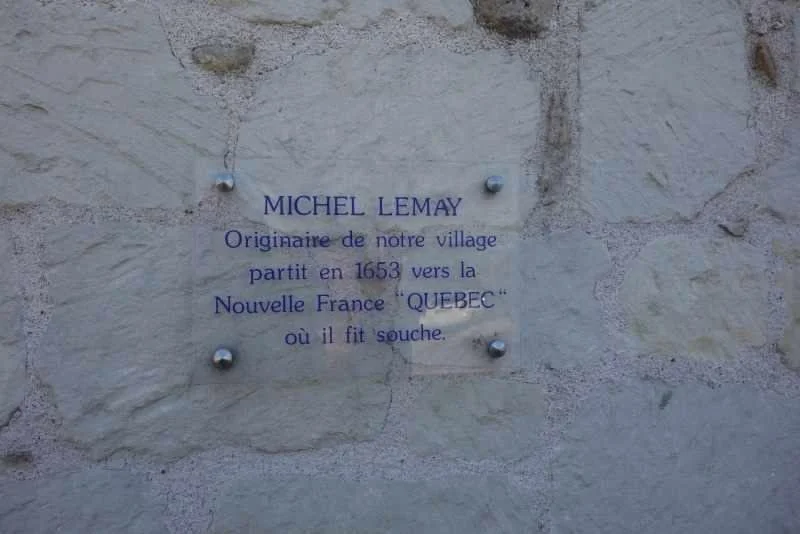
Today, in his home village of Chênehutte-les-Tuffeaux, a memorial plaque commemorates his journey:
"MICHEL LEMAY
Originaire de notre village
partit en 1653 vers la
Nouvelle France 'QUEBEC'
où il fit souche."
Filles à Marier and Filles du Roi
Marie is often grouped with the Filles du roi, the King's Daughters who arrived between 1663 and 1673. She was not one of them, and the distinction matters.
The Filles du roi travelled under royal sponsorship. Their passage was paid. They received dowries of fifty to a hundred livres. They were recruited, organized and chaperoned. Michel Lemay's second wife was one of them, and she arrived with goods worth 400 livres.
The Filles à marier had none of that. They signed contracts of indenture, promising years of labour in exchange for passage. They travelled with their families or alone. Marie's own contract bought her three years of service at Québec for thirty livres a year—and her mother's bought five years of two people's work for fifty.
They were, in many ways, braver. They were certainly rarer. And Marie was rarer still: a Protestant among the founding mothers of a Catholic colony.
Document Gallery


Sources and Further Reading
Original records
- Baptism of Marie Duteau, 25 August 1639 — Archives départementales de la Charente-Maritime, cote I 171-173, La Rochelle, Protestant register 1632-1648, view 255 of 645, folio 133; digital images, Archinoë.
- Engagement contracts, 16 and 17 April 1658 — Archives départementales de la Charente-Maritime, greffe de Me Pierre Teuleron, La Rochelle.
- Marriage of Michel Lemay and Marie Duteau, 15 June 1659 — Trois-Rivières (Immaculée-Conception).
- Marché between François Hertel de la Frenière and Marie Dutost, 22 March 1668 — Bibliothèque et Archives nationales du Québec, Archives nationales à Québec, Collection Centre d'archives de Québec, P1000,S3,D970.
- Marriage contract of Michel Lemay and Michelle Ouinville, 12 April 1677 — Antoine Adhémar dit Saint-Martin, greffe 1668-1714, Bibliothèque et Archives nationales du Québec, Fonds Cour supérieure, district judiciaire de Montréal, 06M,CN601,S2; BAnQ numérique document 4236655, images 224-227.
- Censuses of 1666, 1667 and 1681 — Trois-Rivières and Champlain.
Compiled sources and databases
- Jean-François Paboul, "Jeanne Perrin et ses enfants Marie, Charles et Madeleine Duteau" — the fullest study of this family, with reproductions of the La Rochelle register acts. Note that GFNA's Duteau data cites Paboul; the two are one source string, not two witnesses.
- GFNA — Genealogy of the French in North America, Denis Beauregard, entries [422] Lemay & Duteau and [2312] Duteau & Perrin.
- Fichier Origine, fiches nos. 241443 (Marie Duteau), 241438 (Charles Duteau) and the Madeleine Duteau fiche; researchers Archange Godbout and Lise Dandeneau.
- PRDH-IGD (Université de Montréal) — records nos. 24206, 24204, 402947-402950, 89045, 94239, 94356, 96158, 97080, 5869, 94739, 46750 and Famille no. 328. Consulted in the French interface; card images are not reproduced on this site.
- Thomas J. Laforest, Our French Canadian Ancestors, Vol. II.
- Peter J. Gagné, Before the King's Daughters: The Filles à Marier, 1634-1662.
Research note. This page was rebuilt in September 2026 against the original registers and notarial acts. Twelve claims carried by the earlier version have been withdrawn and are recorded, with reasons and dates, in the project's research log rather than silently removed. Three questions remain genuinely open and are marked where they arise: the identity of Jacques Dutost in the 1666 census, the date and place of Marie's death, and whether Madeleine Duteau belongs among the Filles à marier or the Filles du roi.
Every Family Has a Story Worth Telling
Whether you're just beginning your research or ready to transform years of work into a narrative your family will treasure, I'd love to hear your story.
BEGIN YOUR RESEARCH INQUIRY