
The Storyline
Real families. Real discoveries. Real stories.
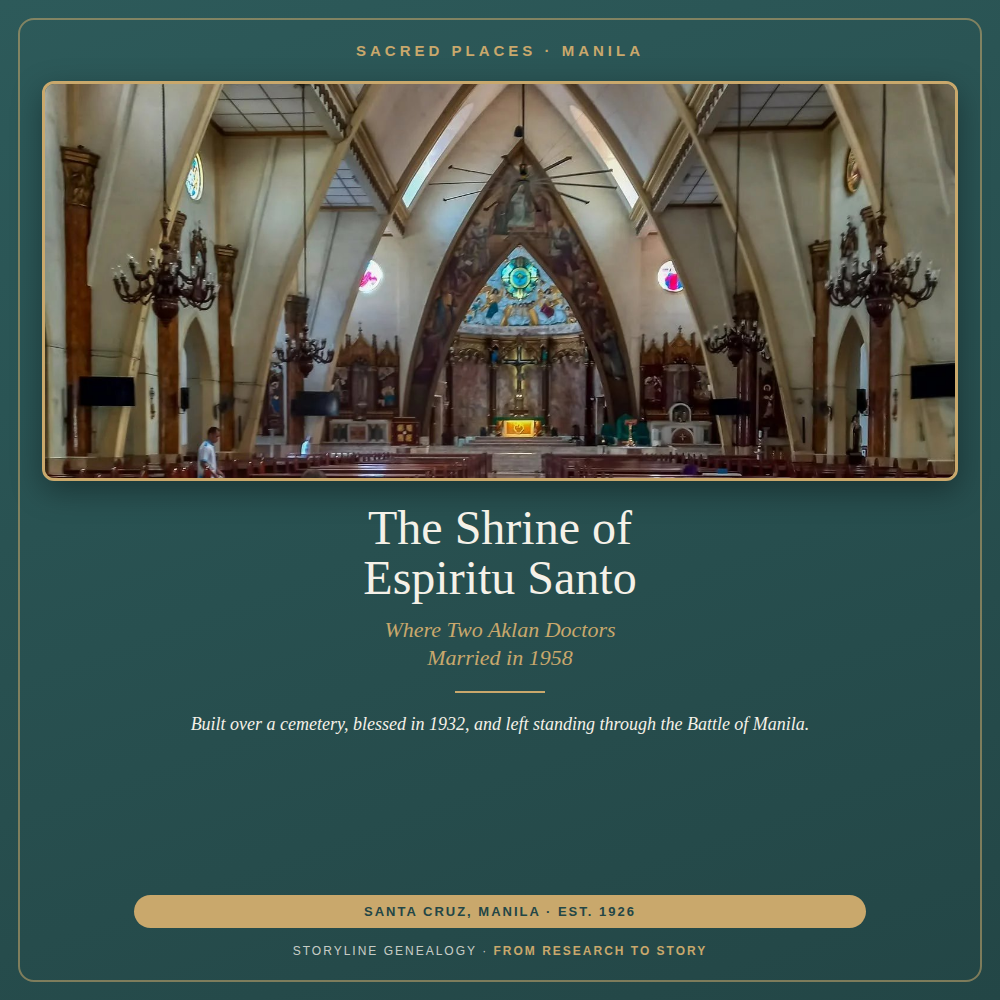
Archdiocesan Shrine of Espiritu Santo
On Rizal Avenue in Santa Cruz, Manila stands a church that rose over a closed cemetery, was blessed by the Divine Word Fathers in 1932, and came through the Battle of Manila unscathed when much of the city around it burned. On January 22, 1958, it became part of one family's story: the church where two young physicians from the Aklan town of Numancia, Romulo G. Morales and Hally R. Tamayo, were married. More than half a century later, it was raised to the dignity of an Archdiocesan Shrine.
Part of the Storyline Genealogy series: Sacred Places
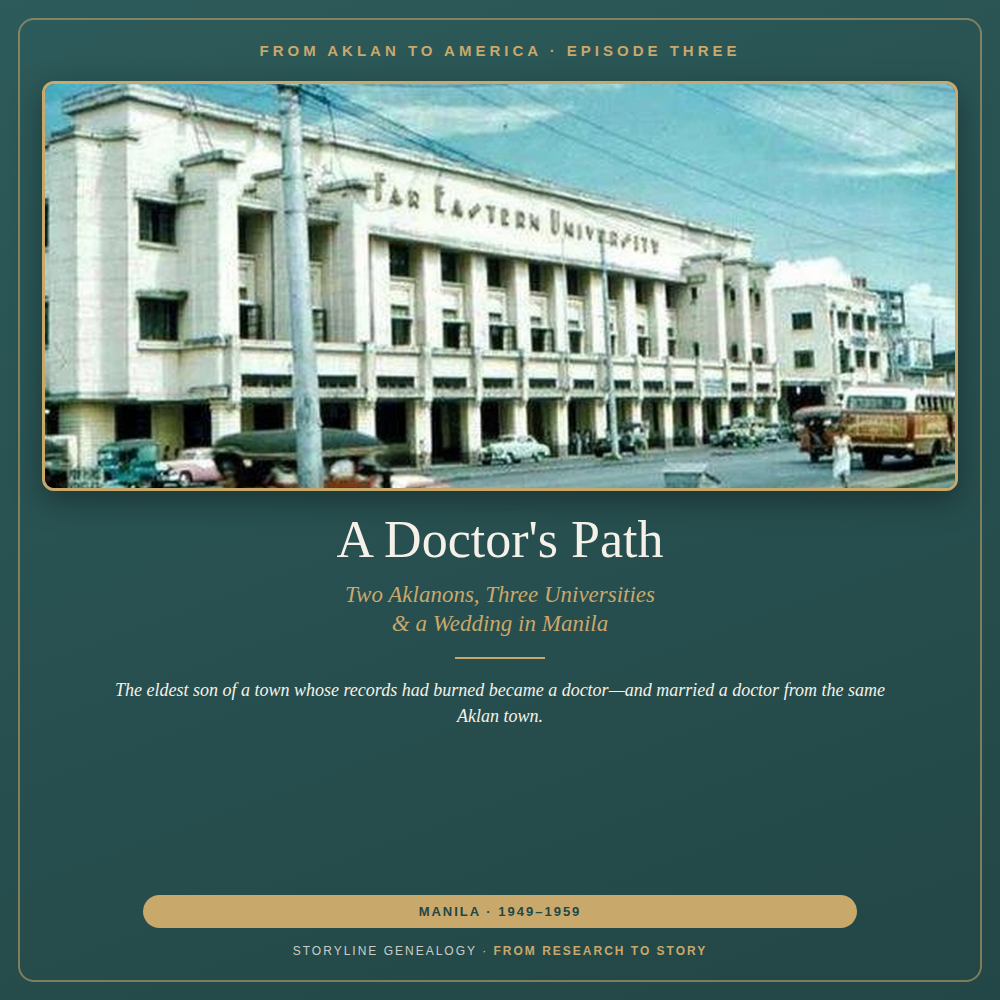
From Aklan to America: A Doctor’s Path
Out of a town whose records had burned, the eldest son of Mamerto Morales set out to do something Numancia had rarely seen — to leave the rice fields for Manila and become a doctor. He would not walk that road alone. A doctor's daughter from the same town, Hally Tamayo, was making the same journey. Episode 3 follows two hard-won medical degrees through the universities of the capital to the 1958 wedding at Espiritu Santo Church that finally joined the Morales and Tamayo lines.
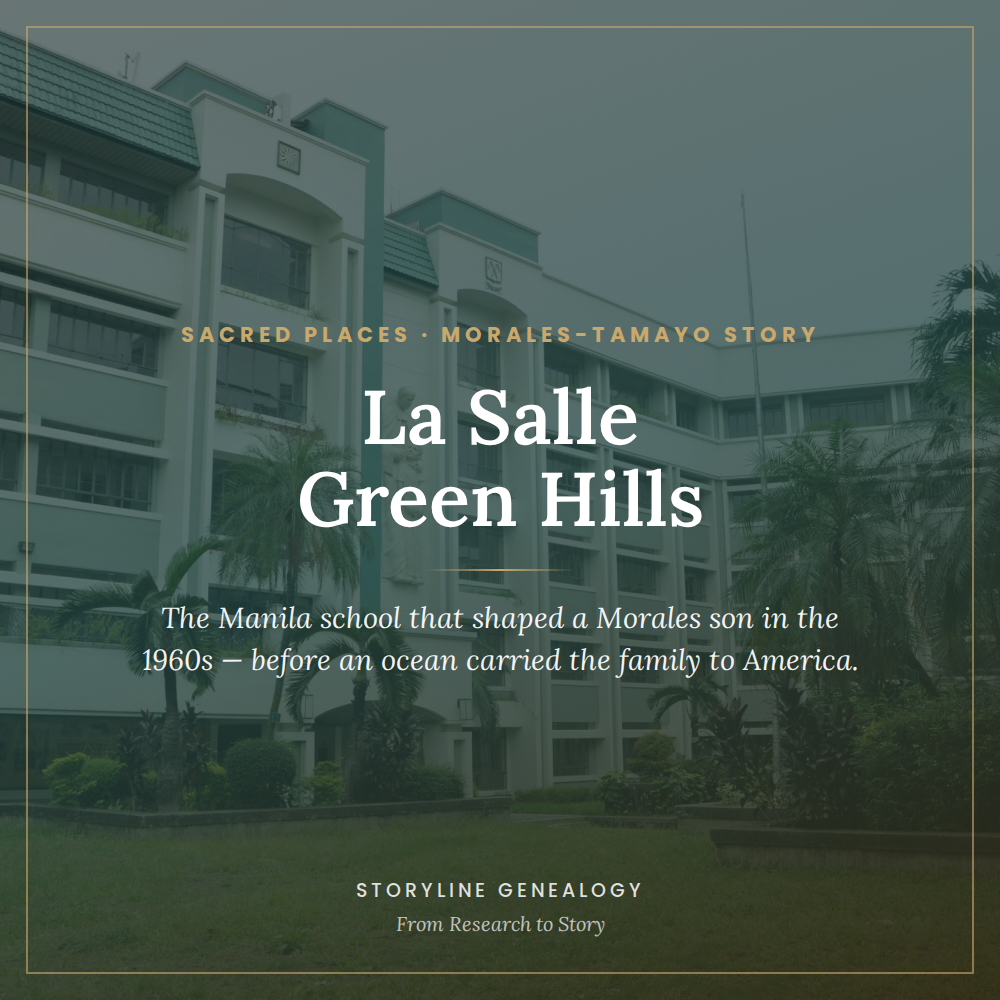
LaSalle Green Hills
The elite Catholic school on Ortigas Avenue, founded by the De La Salle Brothers in 1959 — the same year Romulo Tamayo Morales was born. For the years of his boyhood in the 1960s, before his father's medicine carried the family to Ohio, this was the daily shape of his world: green-and-white uniforms, a great domed gym that would one day count the nation's votes, and a cohort of classmates whose names would fill the country's newspapers.
Part of the Storyline Genealogy series: From Aklan to America | From Research to Story
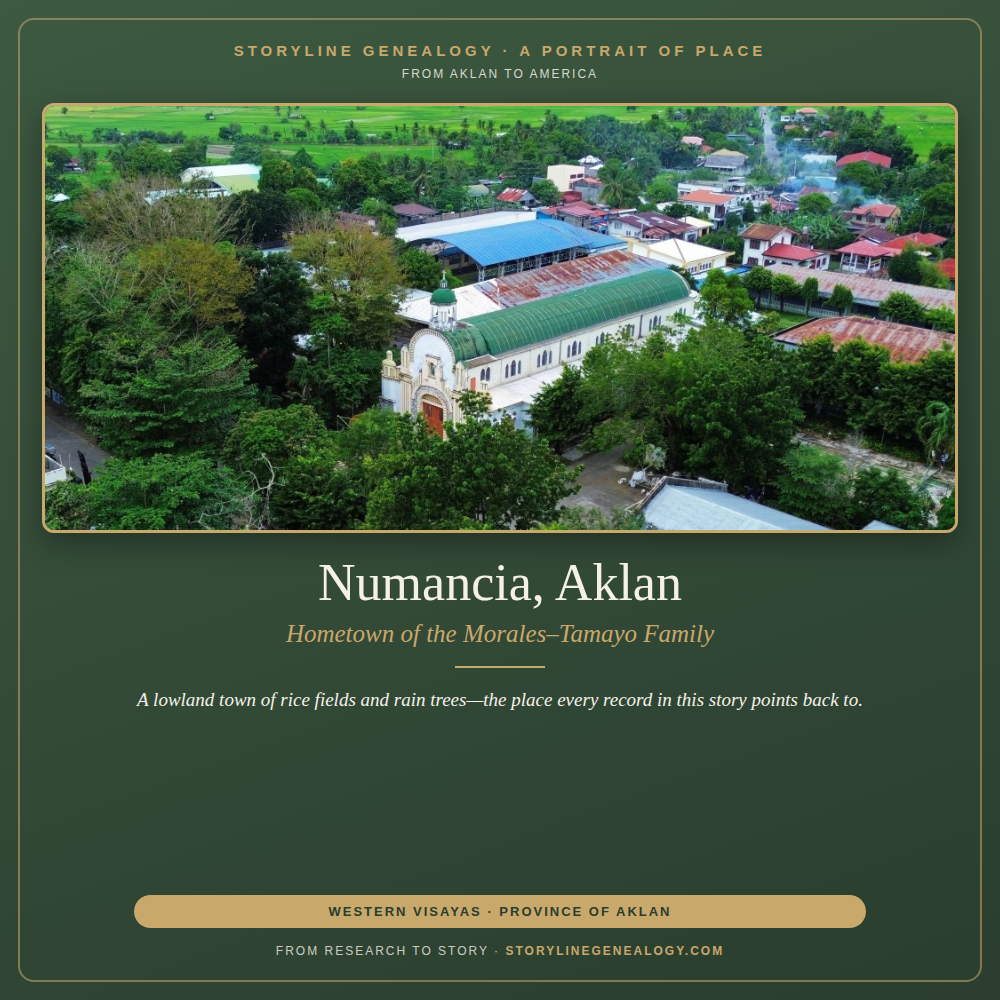
Numancia, Aklan: A Portrait of Place
Every family history begins in a place. For the Morales and Tamayo families, that place is Numancia—a hill-less, rice-ringed town in the Western Visayas, beside the provincial capital of Kalibo. Lechon capital and pasalubong stop, home to the century-old "leafy sentinels" of Albasan and a parish at its heart, Numancia is the small town that every record in this series ultimately points back to. A portrait of the hometown the family left, and never quite left behind.
Part of the Storyline Genealogy series: From Aklan to America | From Research to Story
Petrona Quimpo: The Woman Remembered as Tonang
A family kept the mother of Mamerto Morales only as a nickname — "Tonang Quimpo" — that no register could hold. This is the story of recovering her: a girl in the Quimpo house, a widow who held her land, a grandmother named across three generations of Kalibo baptisms, and how a family's memory and a century-old register were finally made to agree.
Part of the Storyline Genealogy series: From Aklan to America | From Research to Story
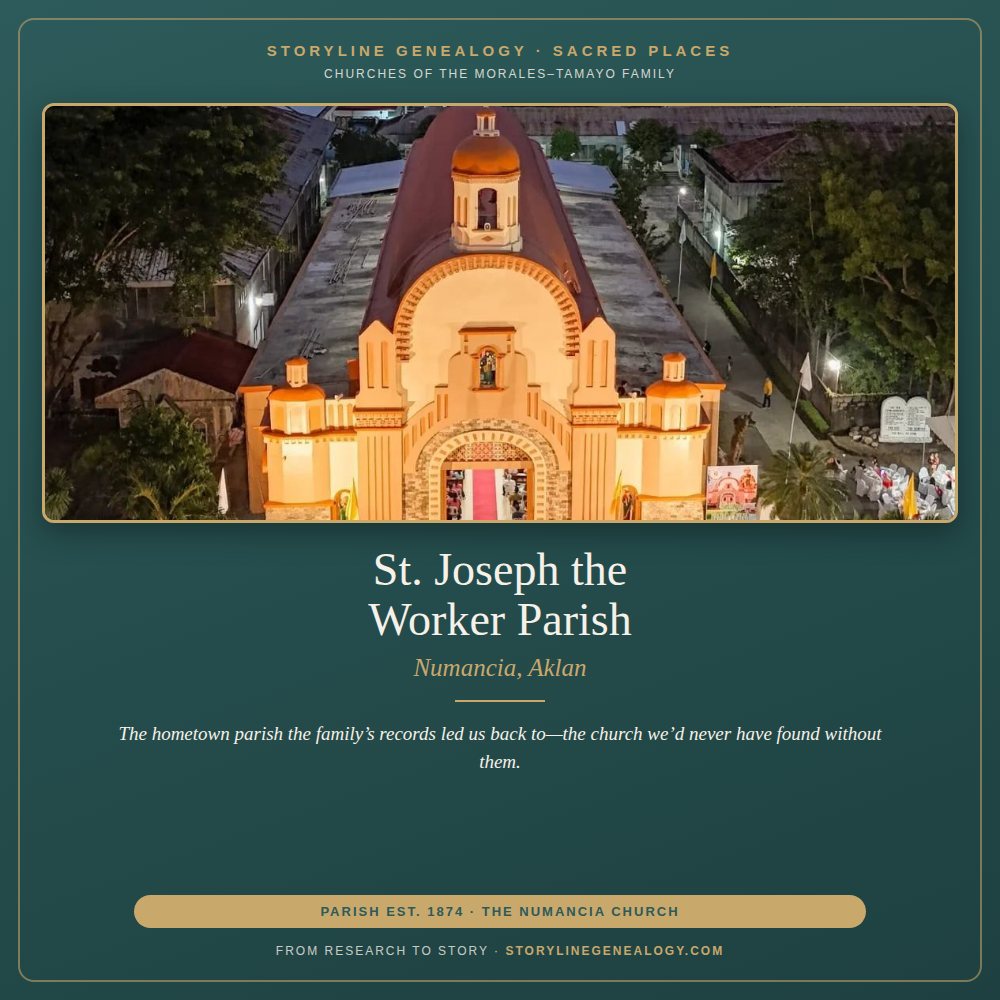
St. Joseph the Worker Parish
Some churches you find on a map; this one we found in a sentence, buried in a wartime certificate. When Numancia's records burned in 1944, the sworn substitutes the family gathered all named one parish—St. Joseph the Worker—where Jose Tamayo married Corazon Roldan in 1931 and where Romulo, Hally, and Virgilio were born. This Sacred Places article tells the story of the Numancia Church and the documents that led us home to it.
Part of the Storyline Genealogy series: Sacred Places
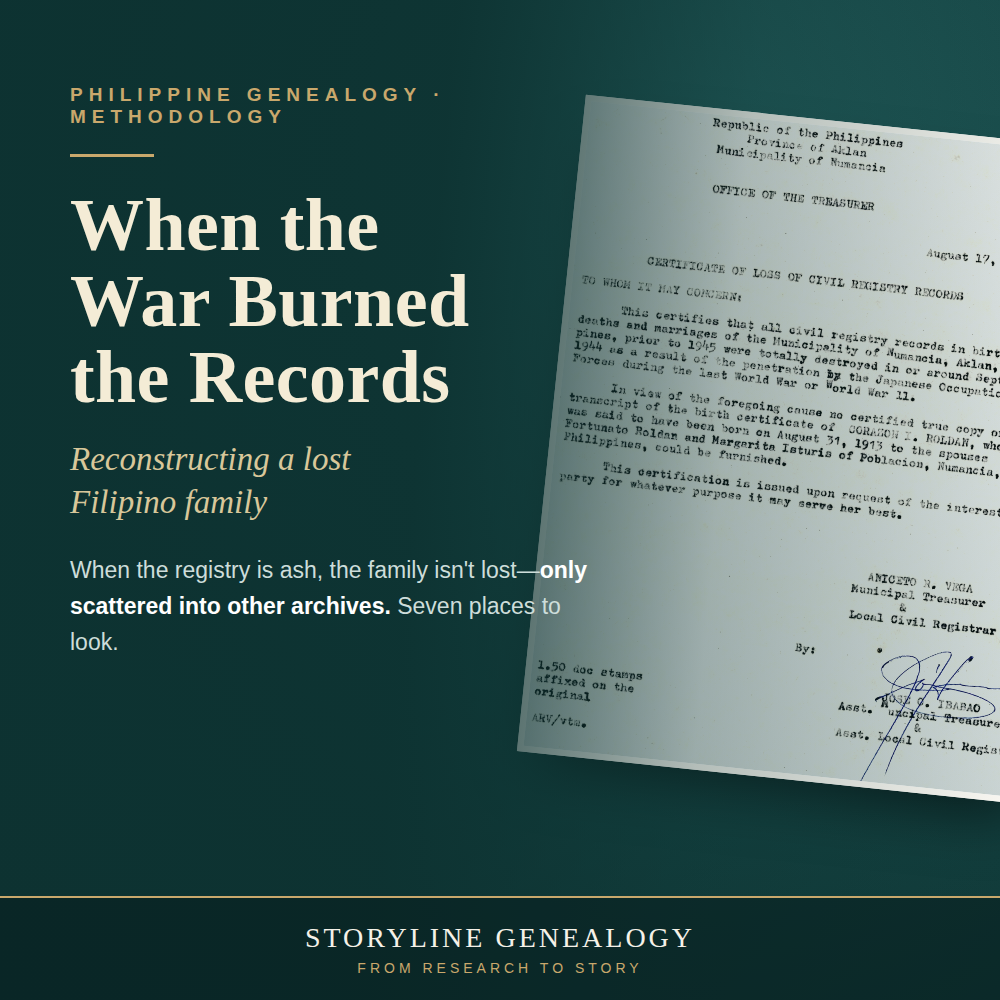
When the War Burned the Records
In much of the Philippines, the record you most want to see was burned in World War II. Drawing on the Morales-Tamayo case, this field guide shows how to reconstruct a lost Filipino family from what survived — church salvage books, notarial registers, delayed registrations, the immigration papers of relatives who emigrated, and DNA — and how to request the two U.S. records, the SS-5 and the A-File, that so often hold the answers.
Part of the Storyline Genealogy series: From Aklan to America | From Research to Story
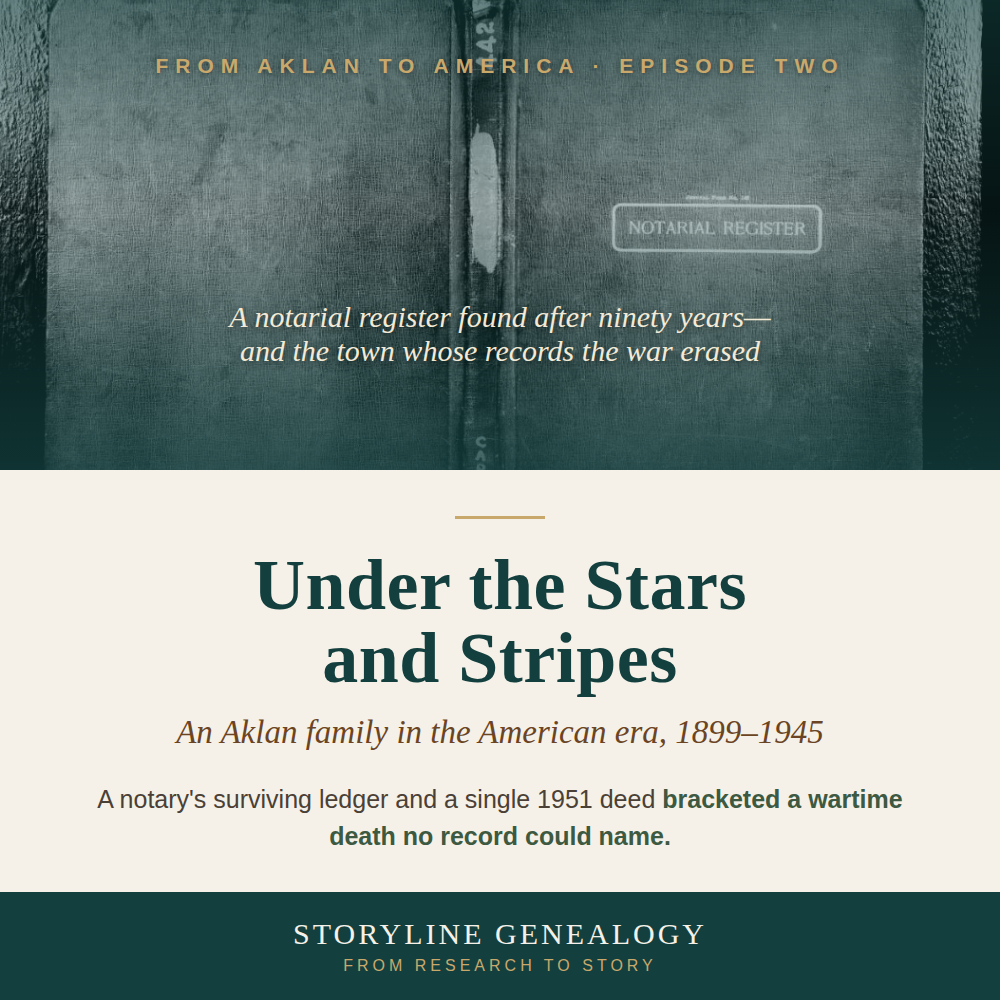
From Aklan to America: Under the Stars and Stripes
When American forces landed on Panay in 1899, the Spanish world of Numancia was already passing. This second episode of From Aklan to America follows the Morales and Tamayo families through the Commonwealth years and the Japanese occupation — a notary's surviving register, a 1931 wedding at St. Joseph's, and a wartime death the records can only bracket, never quite name.
Part of the Storyline Genealogy series: From Aklan to America | From Research to Story
Cathedral of St. John the Baptist
In the coastal town of Numancia, Aklan, two families—the Morales and the Tamayo—raised their children within the spiritual orbit of the oldest church in the province. Founded as an Augustinian mission in 1581 and elevated to a parish in 1680, the Cathedral of St. John the Baptist in Kalibo survived Moro pirate raids, the great fire of 1885, World War II, and a 7.1 earthquake to stand today as the spiritual heart of the Ati-Atihan Festival. This Sacred Places article traces four centuries of faith and resilience—and the ancestral parish where the Morales and Tamayo families worshipped before their journey to Manila and, eventually, to America.
Part of the Storyline Genealogy series : Sacred Places
From Aklan to America: Four Families, One Province
In the 1830s, on the island of Panay in the Western Visayas, four children were born who would become the founding ancestors of interconnected family lines—Gonzales, Morales, Martelino-Roldan, and Isturis. They never knew one another, yet they farmed the same fertile plains, worshipped in the same colonial churches, and lived through the same upheaval as the Philippines moved from Spanish colony to revolutionary republic. A century later, their descendants would converge in a single family. This first episode traces those four lines through parish registers and property records, set against the encomienda system, the 19 Martyrs of Aklan, and the fall of Spanish Kalibo in 1898.
Part of the Storyline Genealogy series: From Aklan to America | From Research to Story
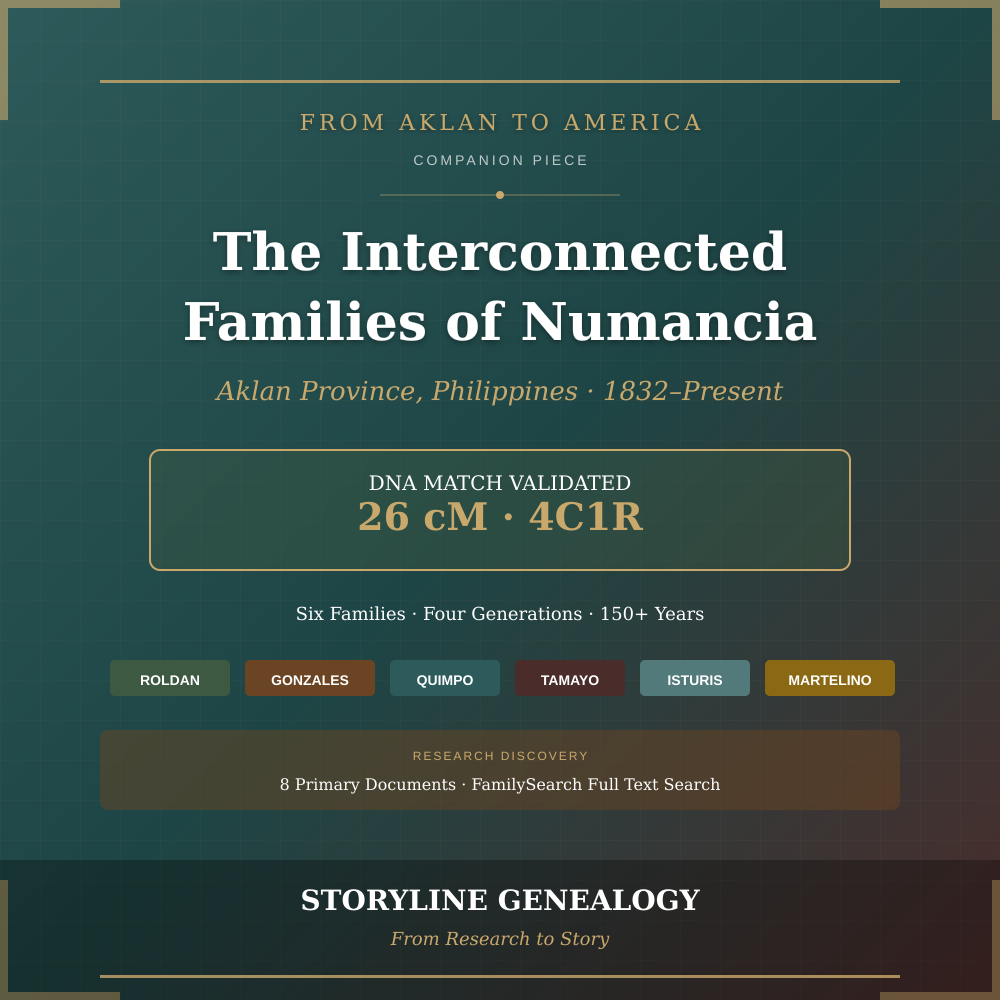
The Interconnected Families of Numancia
A distant cousin DNA match led to common ancestors through the Martelino line, launching an investigation that revealed six interconnected families in Numancia, Aklan Province. Using FamilySearch Full Text Search—a 2024 technology breakthrough that reads actual document text—eight primary documents spanning 35 years (1927–1962) documented the Roldan, Gonzales, Quimpo, Tamayo, Isturis, and Martelino families. The June 1927 Pacto de Retro sale provided the first proof that Fortunato Roldan was married to Margarita Isturis—a discovery that unlocked generations of family connections. This companion piece demonstrates professional Philippine genealogy research methodology.
Part of the Storyline Genealogy series: Documentary Biographies From Research to Story
From Aklan to America : A La Salle Boy
In the rolling hills east of Manila, a young boy from Aklan joined the second generation of students at one of the Philippines' most prestigious Catholic schools. Among his schoolmates was Ferdinand "Bongbong" Marcos Jr., son of the senator who would become president—and whose own son now leads the nation. This episode follows Romulo Himler Morales through kindergarten to fourth grade at La Salle Green Hills, featuring original class photos, his First Holy Communion, and a school dance with his cousin Margarita. When his father's medical career called the family to America in 1969, Romulo's Philippine childhood came to an end.
Part of the Storyline Genealogy series: Documentary Biographies From Research to Story
Our Lady of Lourdes Parish
A church risen from the ashes of World War II, where two generations of the Morales family celebrated life's most sacred moments—a Christmas baptism in 1959 and a wedding covered by Manila's newspapers in 1968. This Sacred Places article traces the history of the National Shrine of Our Lady of Lourdes from its origins in Intramuros through its destruction in the Battle of Manila to its resurrection in Quezon City, featuring original parish records, family photographs, and the remarkable story of Bishop Miguel Olano, the former Bishop of Guam who survived the war to confirm an infant on Christmas morning.
Part of the Storyline Genealogy series: Sacred Spaces
From Aklan to America: Christmas Day, 1959
In the autumn of 1959, Manila was a city still rebuilding. Fourteen years after the devastating Battle of Manila, a young couple awaited the birth of their first surviving child. On Christmas morning, their seven-week-old son received both baptism and confirmation at Our Lady of Lourdes Parish—an extraordinary occurrence made possible by the presence of Bishop Miguel Olano, the former Bishop of Guam who had survived World War II. This documentary biography traces the birth, sacraments, and family connections of Jose Romulo Himler Morales through original certificates and parish records.
Part of the Storyline Genealogy series: Documentary Biographies | From Research to Story
The Damaged Graduation Portrait
You know that box—the one with the damaged photos, cracked and creased and faded, faces that stared death in the face and lived to tell about it. For years I looked at one in particular: a man in graduation robes I first took to be about thirty-nine, with a steady gaze and quiet dignity. The family said it was "Lolo Mamerto," from his graduation, and we long dated it to 1939. But how could we be certain, when the man died fleeing Japanese soldiers in 1942 and so many records were lost? This is the detective work of photo identification—how photographic technology, academic regalia, apparent age, a wartime damage pattern, family memory, and one decisive record reset the date: because a notary had to be a lawyer, his law degree had to predate his 1933 commission, placing the portrait in the early 1930s, about a decade before his death.
Part of the Storyline Genealogy Series: From Research to Story—transforming fragmented memories into complete family narratives
Hidden in Plain Sight: Philippine Research Barriers
Have you ever hit a brick wall researching your Filipino heritage? For years, the Tamayo family of Aklan was a classic dead end—a marriage, an immigration trail to the United States, and almost nothing else. Then, in 2024, FamilySearch launched Full Text Search, a tool that reads the actual text inside digitized documents rather than just indexed names. A single query—"Tamayo" + "Aklan, Philippines"—surfaced a multi-generational paper trail that had been invisible for decades: a patriarch's 1936 residence certificate, the 1938 deeds that settled his estate and named his widow and children, and the property his son and daughter-in-law accumulated into the 1960s. This is how modern technology is making "impossible" Philippine genealogy possible.
Part of the Storyline Genealogy series: From Aklan to America | From Research to Story
From Agtawagon Hill to Hollywood: Three Generations of the Morales Family
There's a photograph from 1968 that captures pure joy: a young lawyer and his dietician bride at their wedding reception. But what it doesn't show is the weight this man carried—the memory of a father who disappeared on a Philippine mountainside in 1942, carrying rice. This is the story of three generations of the Morales family, spanning from wartime Aklan to the stages of Paris Fashion Week.
Part of the Storyline Genealogy series: From Aklan to America | From Research to Story
The Story of Mamerto Morales and Agtawagon Hill
Picture a young man in 1939, standing proudly in graduation robes, his eyes bright with the promise of a future that would never come. This is Mamerto Morales—a notary public in Kalibo, Aklan, trusted by his neighbors with their most important transactions. Three years later, when the Japanese invaded the Philippines, educated men like him became targets. In 1942, fleeing into the steep mountains of Balete toward Agtawagon Hill, Mamerto carried a heavy sack of rice to feed his children—and on those brutal slopes, his back gave out. His sons preserved every detail of that day for over seventy years. This is the story of how one family's tragedy reveals the hidden connections between individual lives and the sweeping currents of Philippine history.
Part of the Storyline Genealogy series: From Aklan to America | From Research to Story
Captain Lucas: The Land Builder
Discover how Captain Lucas Gonzales built a lasting family legacy in colonial Philippines through strategic land acquisition, surviving Spanish rule, revolution, and American occupation from 1835-1928.
Part of the Storyline Genealogy series. When historical titles hint at broader stories, comprehensive research reveals how military leaders transformed their service into community building and economic development.