
Finding an Italian Ancestor in French-Canadian Research
Finding an Italian Ancestor in French-Canadian Research
When you're deep in French-Canadian genealogy—scrolling through parish registers written in faded brown ink, tracing Sylvestres and Lesages through the seigneuries of the St. Lawrence—the last thing you expect to find is an Italian. But that's exactly what happened when I followed the Soulière line back to its origins in the late 1600s and discovered a soldier whose dit name, Lepiedmontois, was not a geographic marker of a French province. It was a flag planted in the record by a man from Racconigi, a small town in the Piedmont region of Italy, south of Turin, in the shadow of the Alps.
His name was Jean Bernardin Lesage. He arrived as a soldier, married into a Neuville family, raised twelve children—and ended his working life holding a salaried post at Québec, guarding the colony's beaver stores. His story is an anomaly in French-Canadian research, and a reminder that the founding population of New France was never as homogeneous as the standard histories suggest.
How Rare Is an Italian Ancestor in New France?
The short answer: extraordinarily rare. Of the roughly 10,000 founding immigrants who settled permanently in New France before 1760, historians estimate that the great majority—something above ninety-five percent—came from France, and chiefly from the northwestern provinces: Normandy, Brittany, Poitou, the Île-de-France. The remainder included a scattering of individuals from the British Isles, the German states, the Low Countries, Spain, Portugal and the Italian peninsula.
Most Italians who appear in colonial records were passing through. Enrico Tonti—Henri de Tonty—the officer born in the Kingdom of Naples who became La Salle's chief lieutenant and is remembered as the "Father of Arkansas." Francesco Giuseppe Bressani, the Jesuit who reached New France in 1642. Cardinal Mazarin, who shaped colonial policy from Paris and never crossed. These men left a mark on the history. They did not marry local women, clear land, or raise families on the St. Lawrence.
Jean Bernardin Lesage did all of those things. He married, fathered twelve children, settled at Neuville and later on the Rivière L'Assomption, took an office in the town of Québec, and died in the colony in 1748. He was not a visitor. He was a Canadien—one of the rarest kind.
What the Dit Name Tells Us
In French-Canadian genealogy, the dit name is one of the most revealing tools a researcher has. Short for "called" or "said," it was a nickname or alias that became legally interchangeable with the original surname. For soldiers, these noms de guerre served a practical purpose: when a company is full of Jean-Baptistes and Pierres, you need another way to tell them apart.
Geographic dit names were among the most common. A soldier from Champagne became "Champagne." A man from Berry became "Berry." The system was pervasive enough that many Québécois families whose surnames are provincial names—Champagne, Picard, Languedoc—owe them not to geography but to a seventeenth-century roll call.
Jean Bernardin's was Lepiedmontois: "the Piedmontese." Not a French province at all. His marriage record of 1686, written at Neuville, gives his origin explicitly: the parish of Santa Maria, in the town of Racconigi, archdiocese of Turin, Piedmont.
« Paroisse de Sancti-Maria, de la ville de Raconis, Archêvêché de Turin, Piémont »
For a genealogist this density of detail in a colonial record is gold. It gives not just a country but a parish, a town and a religious jurisdiction—the seventeenth-century equivalent of a dropped pin.
One caution on the geography
Archêvêché de Turin is an ecclesiastical unit, not a civil one. Racconigi sits in the modern Province of Cuneo; the archdiocese of Turin is the diocese it belonged to. Records of this period routinely give the diocese rather than the province, and reading one as the other will send you to the wrong archive.
How a Piedmontese Soldier Ended Up in New France
Jean Bernardin did not arrive with the Carignan-Salières Regiment—that force had come and gone two decades earlier, in 1665. He came with the Troupes de la Marine, the Compagnies Franches de la Marine, which represented a shift in French colonial strategy.
The Carignan-Salières had been a temporary expeditionary regiment sent to fight a particular war against the Haudenosaunee. When the campaign ended the regiment was disbanded; roughly 400 of its 1,200 men stayed as settlers and the rest went home. The Troupes de la Marine were permanent colonial regulars, answerable to the Ministry of the Navy rather than the Ministry of War, sent from 1683 to hold New France on an ongoing basis. Between 1683 and 1688 some thirty-five companies—over 1,400 men—were dispatched to a colony of about 10,300.
Recruiting a Piedmontese was not unusual. Seventeenth-century European armies were multinational by nature, and the French crown drew routinely on allied and neighbouring territories: the Swiss cantons, the German states, the Spanish Netherlands, and—crucially here—the Duchy of Savoy, which then controlled Piedmont. Savoy kept close military and diplomatic ties with France, and Piedmontese soldiers served in French units as a matter of course.
The 1686 marriage record places him in the company of Monsieur de Muy, and names three men of it: Joseph Caba, lieutenant; M. Demuy, the captain, who granted him leave to marry; and Jean Vallée, the company's sergeant. In the French service a soldier needed his commanding officer's consent to wed, and that consent is recorded here in the act itself.
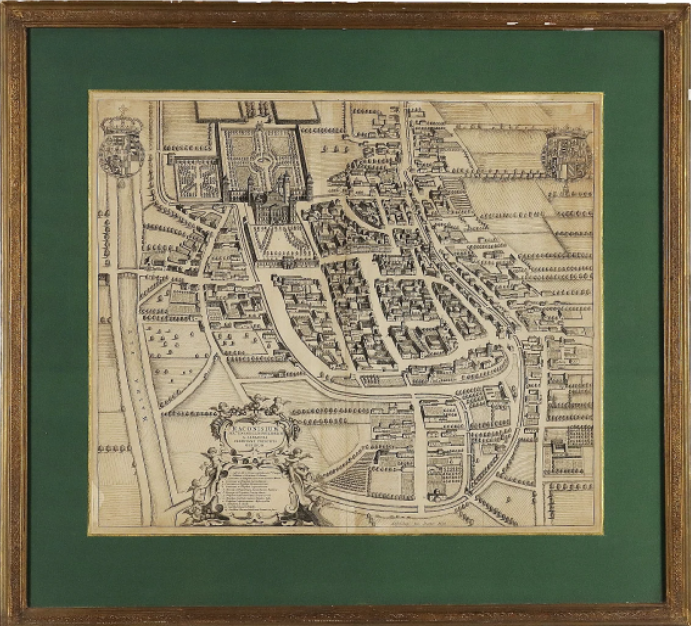
Racconigi, from the Theatrum Sabaudiae (2nd ed., 1726). Jean Bernardin's home town in the Province of Cuneo, known for its Savoy royal castle.

Italy in 1700. Racconigi lies just south of Turin in the Duchy of Savoy. From The Public Schools Historical Atlas, ed. C. Colbeck, 1905.
Why Integration Was Seamless—and How Far It Went
Because France and Piedmont were both Catholic Latin cultures, the religious and linguistic barriers that might have isolated a Protestant German or an English-speaking settler simply were not there. Piedmontese is a Gallo-Italic language, closer to French than standard Italian is, and a soldier with a good ear would have been functionally bilingual within a few years of service. In a colony desperate for population, any man willing to marry, clear land and raise children was welcome wherever he came from.
But the strongest evidence of how completely he integrated is not the fading of a name. It is a notarial act.
On 8 September 1716, settling his daughter's marriage in the study of the notary Pierre Rivet dit Cavelier at Québec, Jean Bernardin is described by an office:
« Et led Jean Bernardin le Sage, Brigadier des Gardes du Castor de ce pays, Stipulant en cette partie pour Marie Louise le Sage sa fille »
The gardes du castor guarded the beaver magazine at Québec—the stores of the fur monopoly, which is to say the colony's principal wealth. A brigadier of the guards held a supervisory post, salaried, in the town. In the same act he is styled Sieur, and he signed it in his own hand.
Think about what that means for a man born at Racconigi. Thirty years after landing as a private soldier in a colonial company, a foreign-born immigrant was holding an office of trust over the furs on which the colony's economy rested, and being addressed with a title of standing. That is a fuller measure of integration than any dit name fading out of the registers.
And fade it did. In some records he appears as "Lesage Lepiedmontois," in others as "Lesage dit Piedmontois," in others simply as "Jean Bernardin Le Sage." One Repentigny register writes the family name as Delâge. By the time his grandchildren were being baptised the Piedmontese connection was a footnote.
This is exactly why Italian ancestors in French-Canadian records are invisible unless you know what to look for. Without the dit name, Jean Bernardin would sit in every database as another Lesage—French by assumption, lost among common surnames. The dit name is the thread that, pulled, unravels the assumption of a purely French founding population.
The "Champagne" Bride
On 8 January 1686 Jean Bernardin married Marie Barbe Sylvestre at Neuville, the parish of her father Nicolas Sylvestre dit Champagne, a veteran of the Carignan-Salières Regiment. The marriage joined two military lineages: the father a Carignan soldier from the French province of Champagne, the groom a Marine soldier from the Italian region of Piedmont.
Marie Barbe was fourteen—young by modern standards, not unusual in a colony where population growth was a matter of policy. Her mother was Barbe Neveu, and Barbe Neveu was the daughter of Anne Ledet, a fille à marier who had crossed to New France about 1652 without royal sponsorship. Three generations stood in that church: the immigrant grandmother's daughter, her granddaughter the bride, and the soldier's family into which the bride was marrying.
Anne Ledet's own second husband, Gilles Pinelle, was there too. The act calls him the bride's grand père—though he was in fact her step-grandfather, no blood relation at all. Twenty-nine years after he married Anne, the parish made no distinction.
Jean Bernardin and Marie Barbe had twelve children between 1690 and 1713—six baptised at Neuville, six at Notre-Dame-de-Québec. Later the family moved west to the Rivière L'Assomption, establishing the Lesage presence in the Lanaudière region that continues today.
A correction worth passing on
An earlier version of this post said the grandparents Nicolas Sylvestre and Barbe Neveu were often present as witnesses at the Neuville baptisms. Reading the acts themselves shows otherwise. The 1690 act names the godmother as « Barbe Nepveu femme de Nicolas Silvestre et grand mere de ladite Marie Françoise ». Nicolas Silvestre's name is there for one purpose only: to identify which Barbe Nepveu. He was named, not present. The same construction appears in the act of 1698. It is a distinction worth carrying into your own research—a name in a filiation clause is not an attendee, and databases that flag presence will usually tell you so if you read the field.
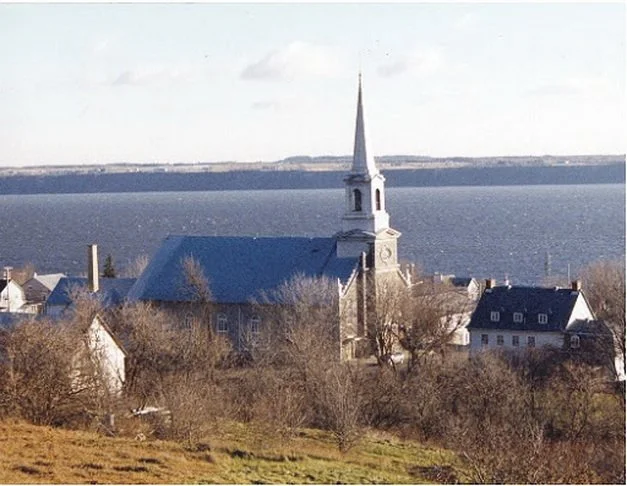
Église Saint-François-de-Sales, Neuville. The parish where Jean Bernardin married Marie Barbe Sylvestre in 1686.
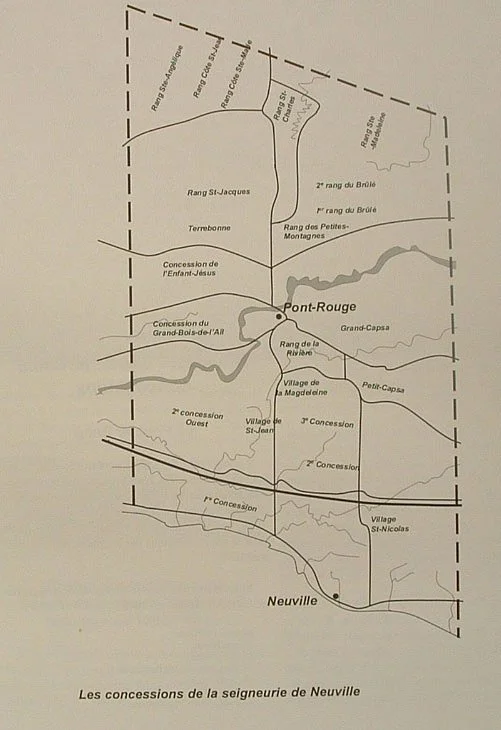
Les concessions de la seigneurie de Neuville. The Sylvestre farm lay in the first row of lots along the St. Lawrence.
What This Means for Your Research
If you are researching French-Canadian ancestry and you meet a dit name that matches no French province, pay attention. The system was built for military convenience, and it preserved almost accidentally the origins of men who would otherwise have been absorbed into the undifferentiated mass of "French" settlers.
Marriage records are the richest source. In New France they typically give the groom's place of origin, his parents' names, his military company and the officer who granted him leave to marry. This one act gave Racconigi, the archdiocese of Turin, the company of de Muy, three named soldiers of it, the bride's parents and step-grandfather, the groom's stated age, and his signature. No other single document comes close.
The dit name is your signal. "Champagne," "Picard" and "Languedoc" point to French provinces. "Piedmontois," "Flamand," "Langlois" and "Lallemand" point outside France. Those are your anomalies, and anomalies are where the stories are.
Don't assume French. The founding population included men recruited from across Europe—Savoy, the Swiss cantons, the German states, the Spanish Netherlands. A thoroughly French-looking surname in a Quebec record may mask Italian, Swiss, German or Flemish origins.
Notarial acts carry what registers do not. It was a marriage contract, not a parish register, that recorded Jean Bernardin's office. Land grants, sales, inventories, marriage contracts and estate settlements name occupations, styles, addresses and relationships that never reach a baptismal entry. BAnQ has digitised a great many notarial greffes, and they are searchable by notary and year.
Use the PRDH—and read its fields carefully. The Programme de recherche en démographie historique at the Université de Montréal is the standard reference for French-Canadian research. Its cards are not transcriptions, though: they are the database's rendering of an act. An event card reproduces what a record says; an individual or family card reproduces whom the database has identified. When two cards seem to disagree, that difference is usually the reason.
The documentary biography
Jean Bernardin's full story—the register acts, the 1716 notarial minute, the maps, and the whole narrative from Racconigi to L'Assomption—is told in our documentary biography, part of The Soulière Line series.
The Piedmontese Legacy
Jean Bernardin Lesage dit Lepiedmontois died on 13 April 1748 at L'Assomption and was buried two days later, his son and his son-in-law at the grave. His burial act gives his age as ninety-eight—a figure to treat with care. His own marriage act of 1686 described him as twenty-six or twenty-seven, which would make him about eighty-eight at death; and the priest who buried him recorded ages elsewhere in the same register that run nine to twelve years high. Four separate records give four different birth years, from 1650 to 1660. He was an old man. Precisely how old, nobody can say.
Marie Barbe Sylvestre outlived him by eleven years. She was buried at L'Assomption on 6 April 1759 and entered in the register as « Veuve Lesage »—Widow Lesage.
Today many Lesage families in the Lanaudière region trace their descent from this one Italian soldier and his "Champagne" bride. The compiler Denis Beauregard estimates their descendants at between 630,000 and 1,050,000 Québécois—an entire branch of the family tree rooted in a town most of them have never heard of, in a country most of them would never think to search.
He had crossed the Alps and the Atlantic, served in a colonial company, married into a Neuville family, kept the beaver stores at Québec, and died on the Rivière L'Assomption more than sixty years after he first stepped ashore.
And it all started with a dit name.
Every Family Has a Story Worth Telling
Whether you're just beginning your research or ready to transform years of work into a narrative your family will treasure, I'd love to hear your story.
BEGIN YOUR RESEARCH INQUIRY