
The Storyline
Real families. Real discoveries. Real stories.
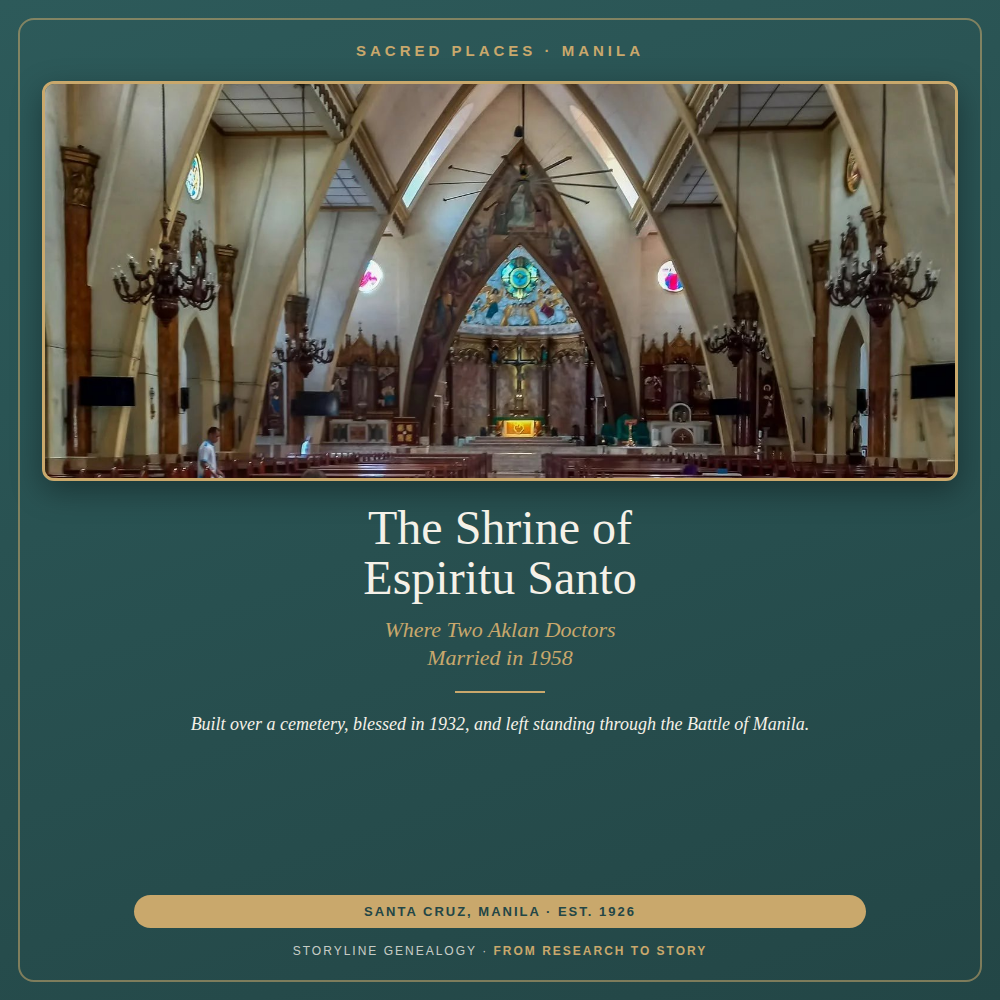
Archdiocesan Shrine of Espiritu Santo
On Rizal Avenue in Santa Cruz, Manila stands a church that rose over a closed cemetery, was blessed by the Divine Word Fathers in 1932, and came through the Battle of Manila unscathed when much of the city around it burned. On January 22, 1958, it became part of one family's story: the church where two young physicians from the Aklan town of Numancia, Romulo G. Morales and Hally R. Tamayo, were married. More than half a century later, it was raised to the dignity of an Archdiocesan Shrine.
Part of the Storyline Genealogy series: Sacred Places
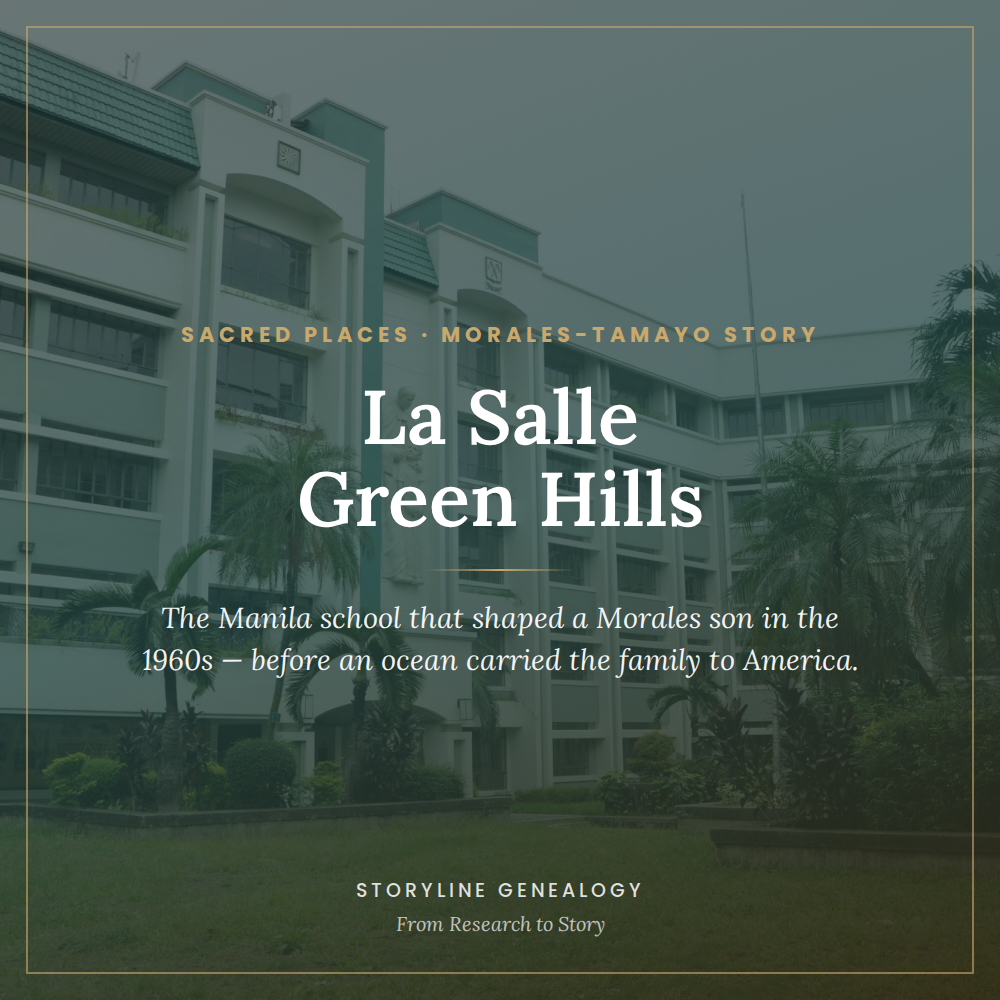
LaSalle Green Hills
The elite Catholic school on Ortigas Avenue, founded by the De La Salle Brothers in 1959 — the same year Romulo Tamayo Morales was born. For the years of his boyhood in the 1960s, before his father's medicine carried the family to Ohio, this was the daily shape of his world: green-and-white uniforms, a great domed gym that would one day count the nation's votes, and a cohort of classmates whose names would fill the country's newspapers.
Part of the Storyline Genealogy series: From Aklan to America | From Research to Story
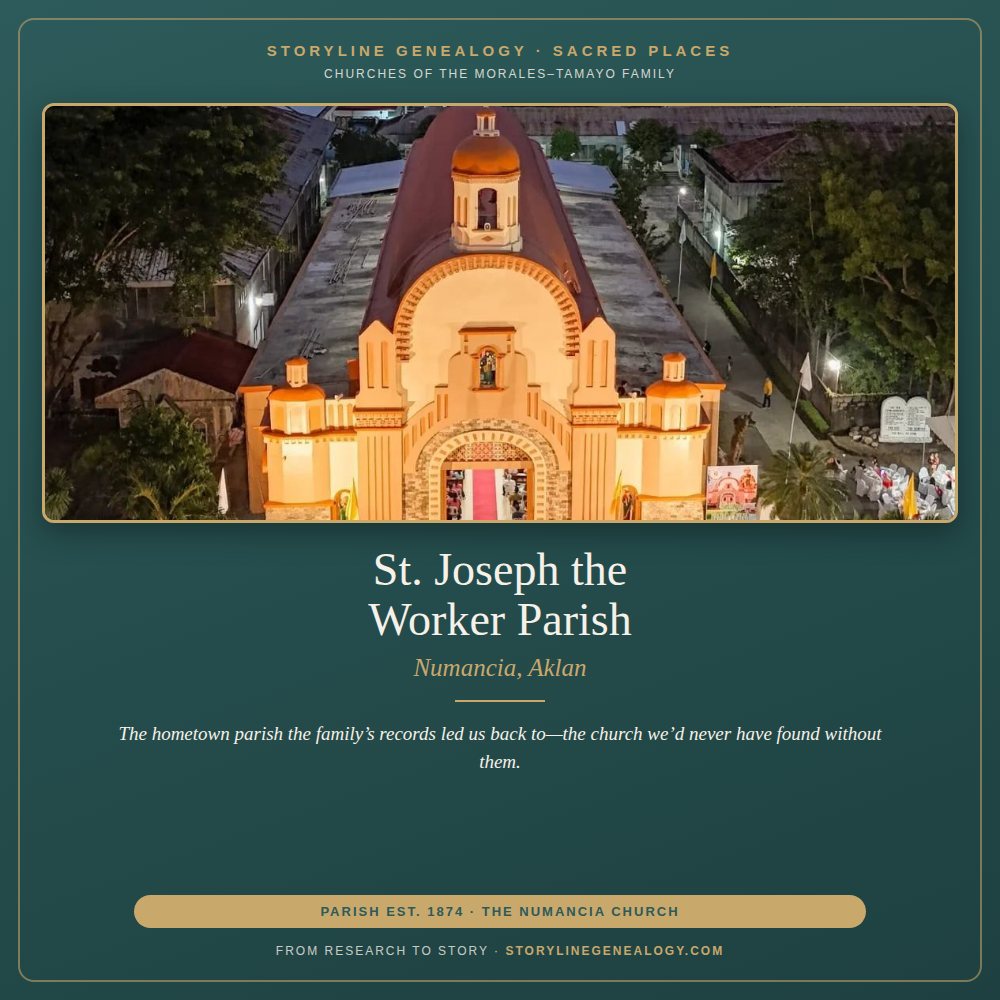
St. Joseph the Worker Parish
Some churches you find on a map; this one we found in a sentence, buried in a wartime certificate. When Numancia's records burned in 1944, the sworn substitutes the family gathered all named one parish—St. Joseph the Worker—where Jose Tamayo married Corazon Roldan in 1931 and where Romulo, Hally, and Virgilio were born. This Sacred Places article tells the story of the Numancia Church and the documents that led us home to it.
Part of the Storyline Genealogy series: Sacred Places
Cathedral of St. John the Baptist
In the coastal town of Numancia, Aklan, two families—the Morales and the Tamayo—raised their children within the spiritual orbit of the oldest church in the province. Founded as an Augustinian mission in 1581 and elevated to a parish in 1680, the Cathedral of St. John the Baptist in Kalibo survived Moro pirate raids, the great fire of 1885, World War II, and a 7.1 earthquake to stand today as the spiritual heart of the Ati-Atihan Festival. This Sacred Places article traces four centuries of faith and resilience—and the ancestral parish where the Morales and Tamayo families worshipped before their journey to Manila and, eventually, to America.
Part of the Storyline Genealogy series : Sacred Places
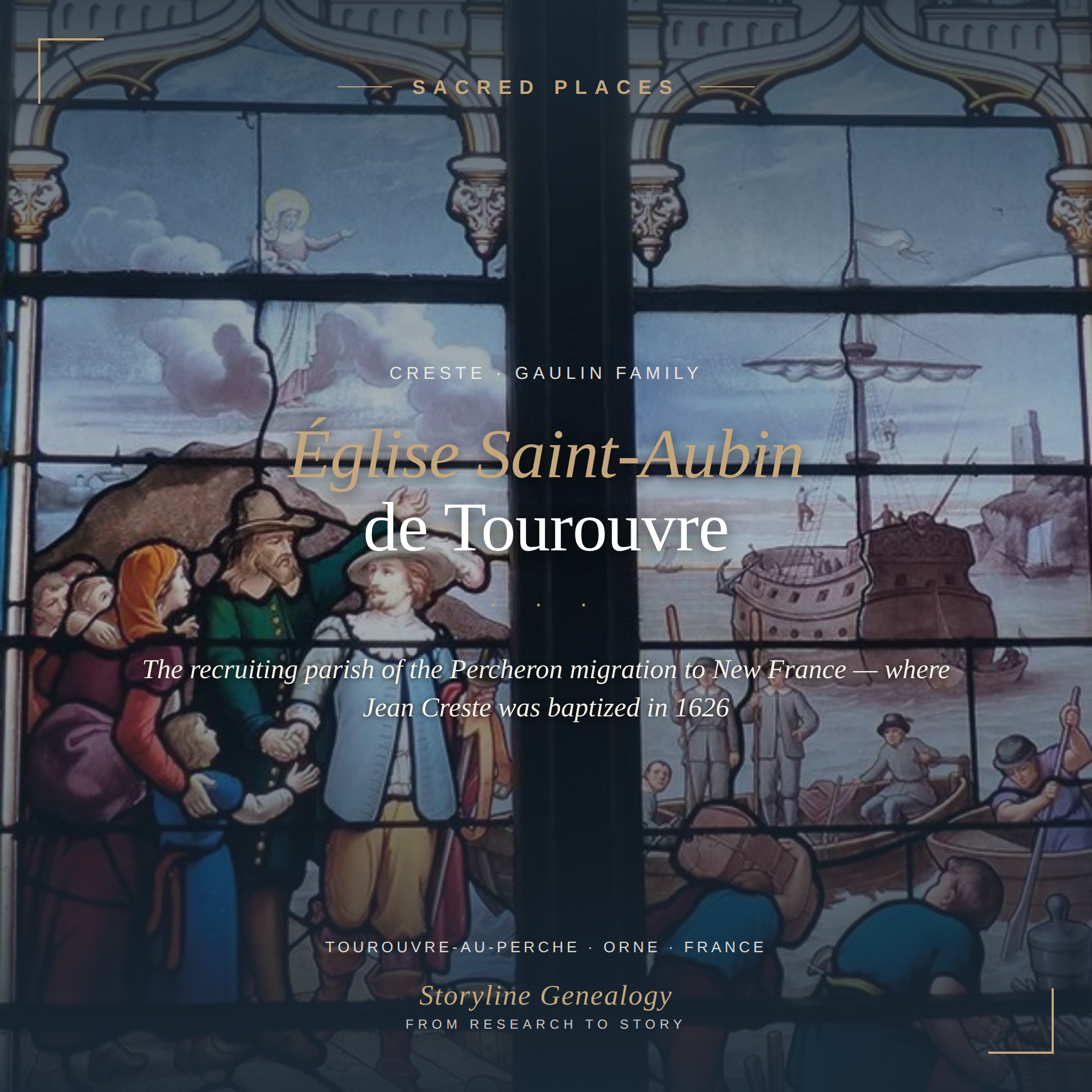
Église Saint-Aubin de Tourouvre
The eight-century Perche church that baptized Jean Creste in 1626 — and thirty-five other founding pioneers of New France whose names are recorded on a plaque inside: Juchereau, Pinguet, Guyon, Roussin, Gagnon, Giguère, Mercier, Rivard, Pelletier, Provost, and more. The Romanesque south wall dates to the twelfth century; the bell tower with its lantern campanile is Renaissance; the great baroque high altar is dated 1646; the famous Mercier emigration stained glass was installed in 1893. The building survived the burning of Tourouvre by retreating German troops on 13 August 1944, almost untouched.
Part of the Storyline Genealogy series : Sacred Places
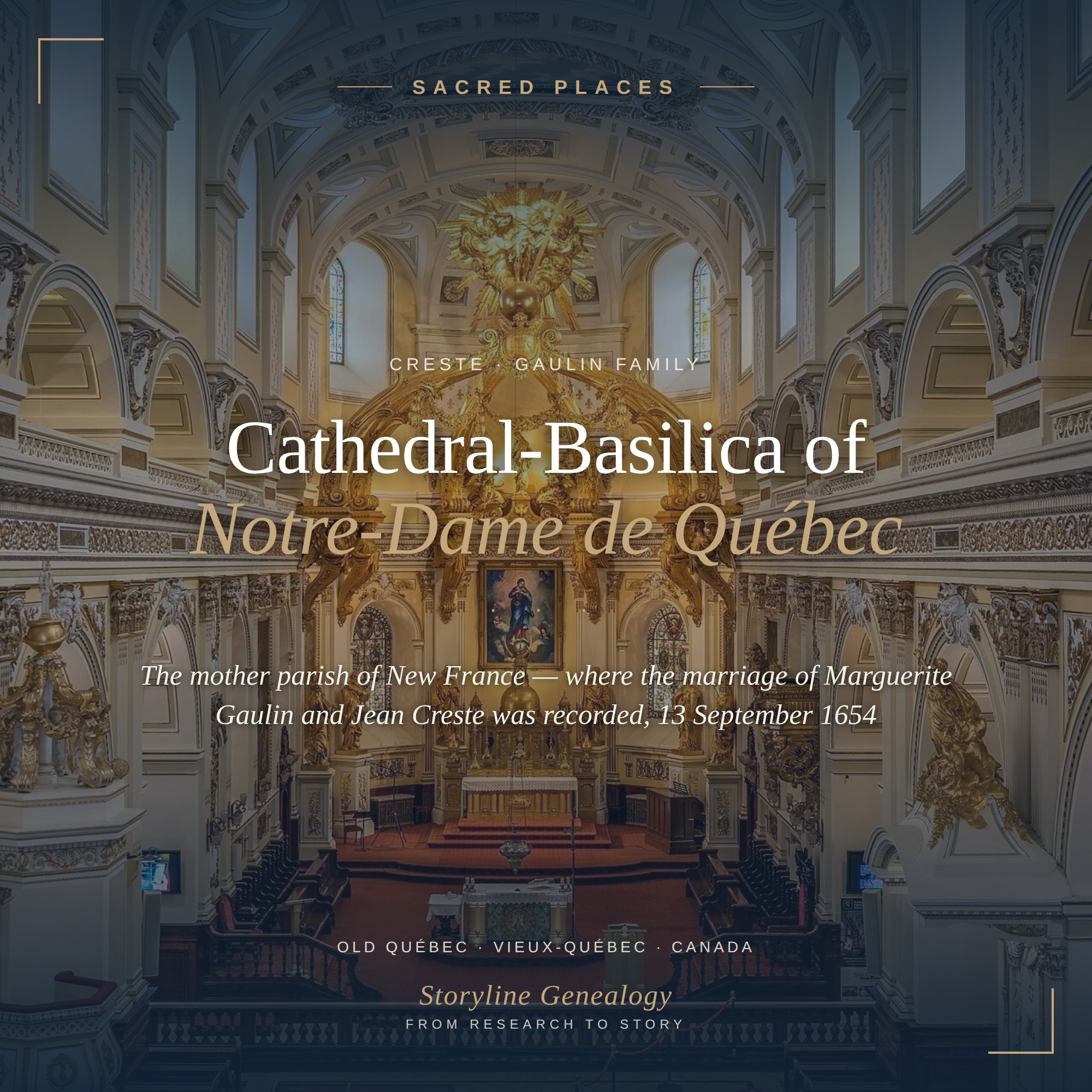
Cathedral-Basilica of Notre-Dame de Québec
In a modest 1647 stone church on the rock of Quebec, the marriage of a Norman bride and a Percheron husband was recorded on 13 September 1654. Over the next seventeen years she would return to the same parish church ten times to baptize her children at its font. Once, in the spring of 1663, to bury a six-week-old daughter. The cathedral-basilica that stands on the site today is the third major building since hers — destroyed in 1759 by British shelling, again in 1922 by fire, rebuilt stone-by-stone each time from photographs and the original Baillairgé plans.
Part of the Storyline Genealogy series : Sacred Places
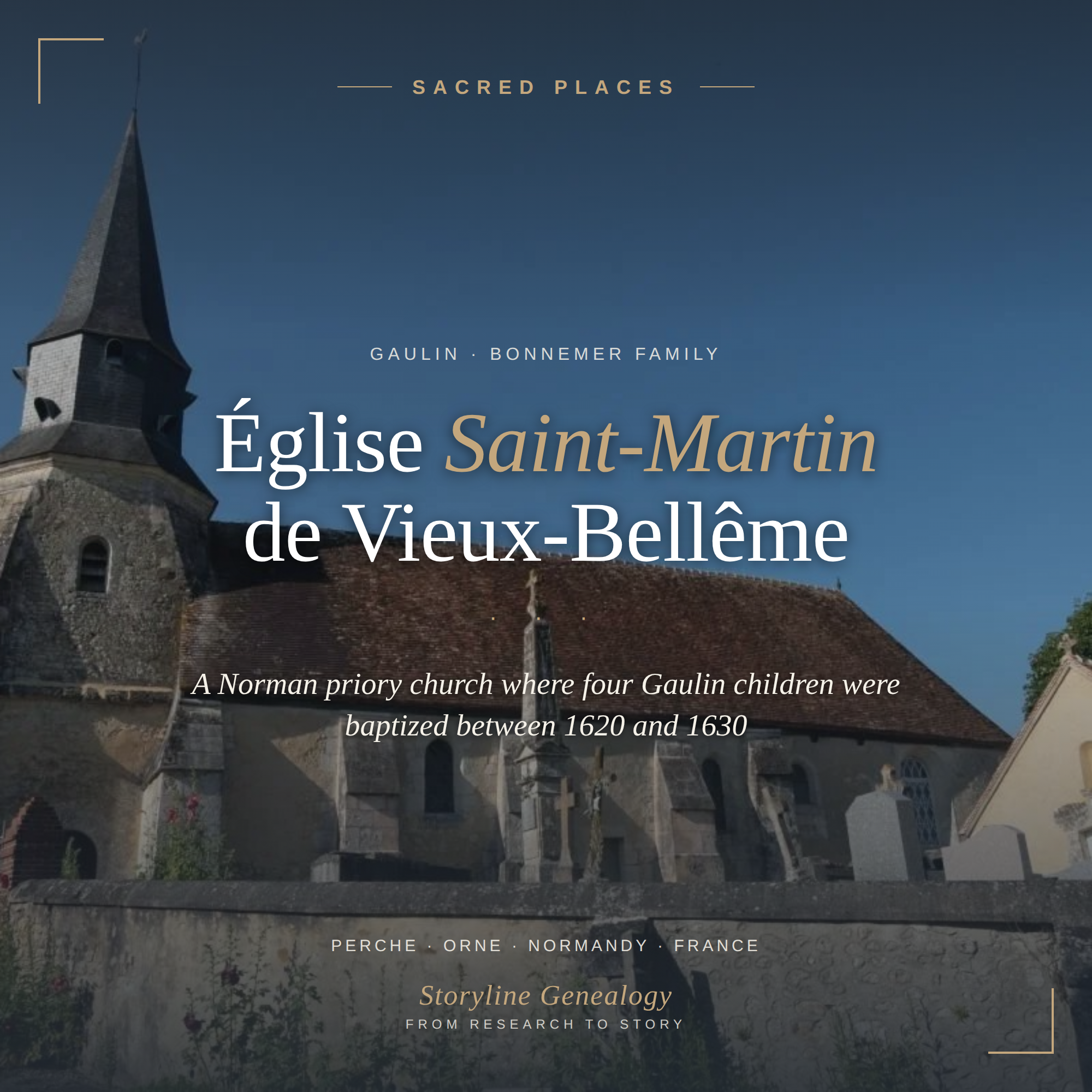
Église Saint-Martin de Vieux-Bellême
In a Norman priory church older than France itself, four children of Vincent Gaulin and Marie Bonnemer were baptized between 1620 and 1630. Two would later cross to New France.
Part of the Storyline Genealogy series : Sacred Places
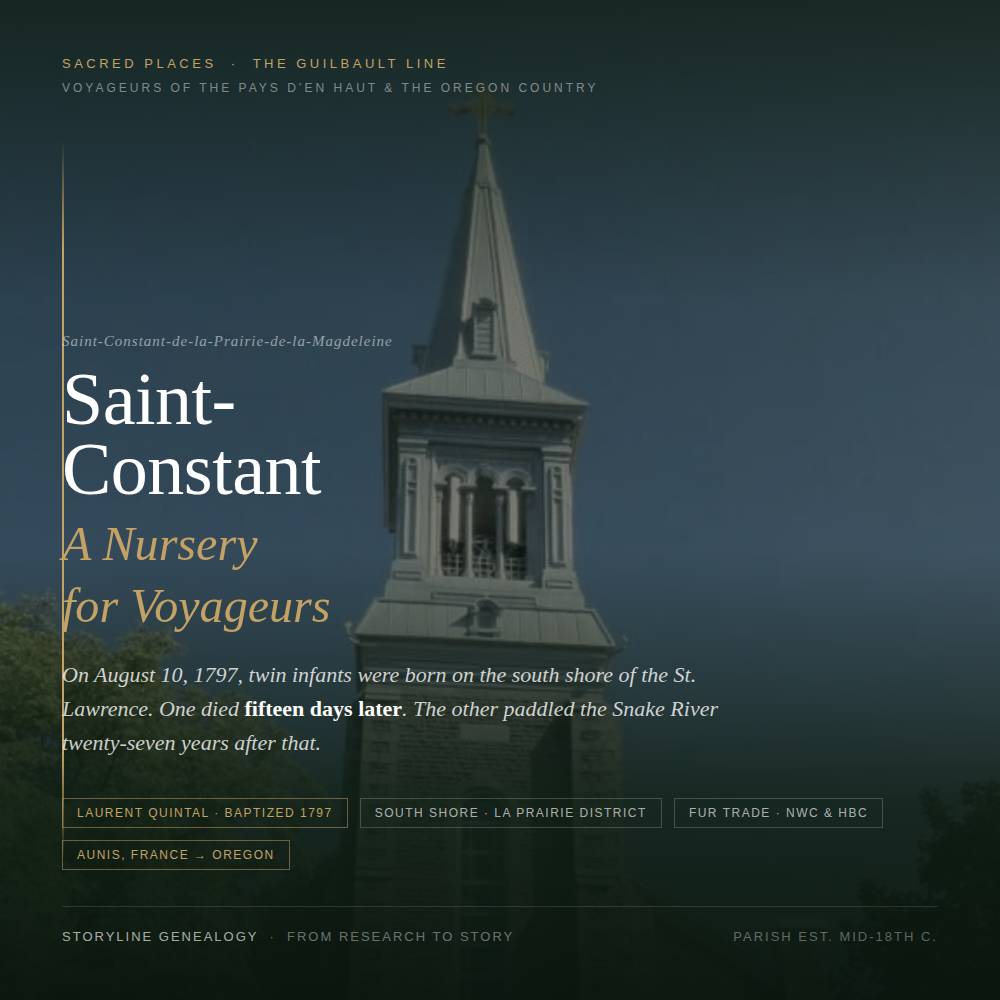
Saint-Constant-de-la-Prairie-de-la-Magdeleine
On August 11, 1797, the curé of Saint-Constant baptized two infants in a shared act — twins Laurent and Marie Suzanne Quintal, born the day before to François Quintal, fermier, and Marie Hébert. Marie Suzanne died fifteen days later. Laurent survived, grew to manhood in the La Prairie district of the south shore, and at nineteen made his mark on a North West Company contract departing Lachine for the pays d'en haut. He would not return to Saint-Constant for the rest of his life. The parish that recorded his birth was a nursery for voyageurs — and the baptism register that preserves his name is the first document in a chain that runs from Québec to the Snake River to an Oregon farm.
Part of the Storyline Genealogy series : Sacred Places
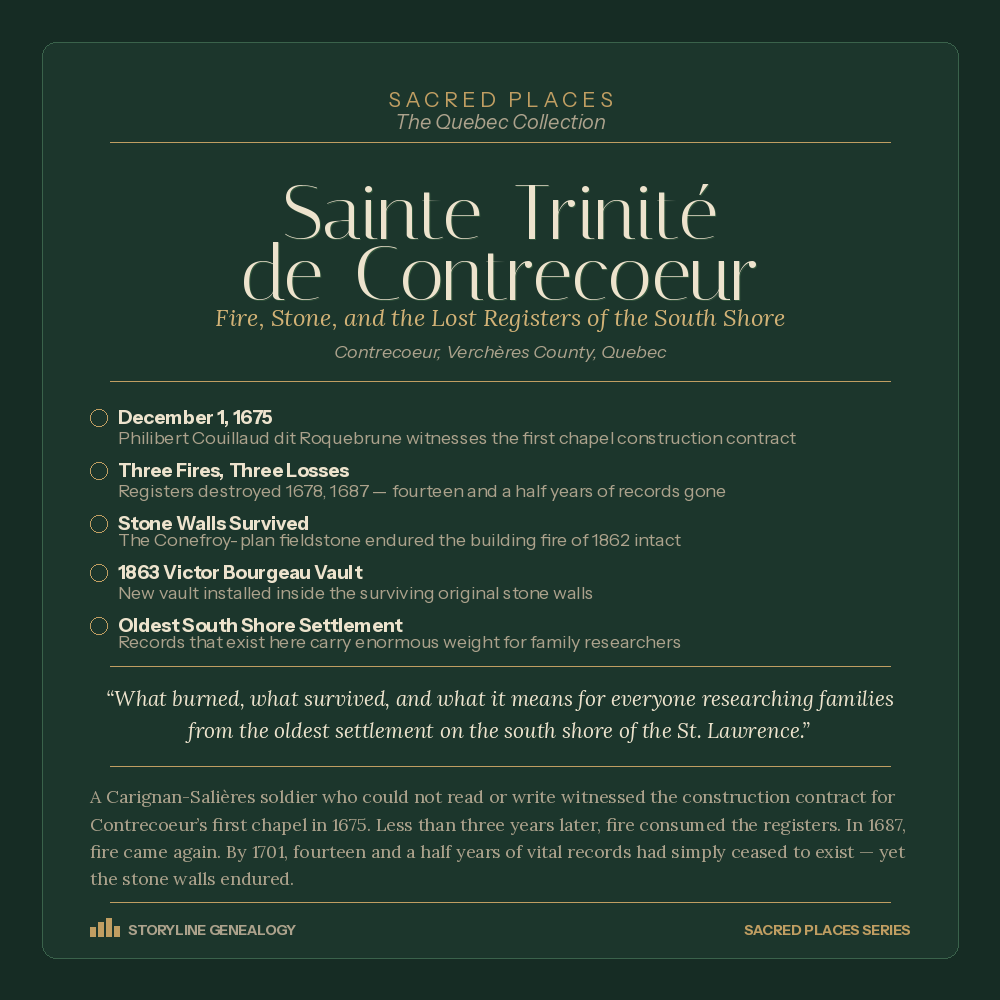
Sainte-Trinité-de-Contrecoeur: The Parish That Burned — and What Survived
On December 1, 1675, Philibert Couillaud dit Roquebrune — a former Carignan-Salières soldier who could not read or write — stood before a notary in Contrecoeur and witnessed the construction contract for the community's first chapel. Less than three years later, fire consumed the parish registers kept in a surgeon's house. In 1687, fire consumed them again. By 1701, fourteen and a half years of baptisms, marriages, and burials had simply ceased to exist. But the stone walls built according to the Conefroy plan — thick fieldstone, engineered to survive — held through the building fire of 1862, and were rebuilt around a new Victor Bourgeau vault in 1863. This is the story of Sainte-Trinité-de-Contrecoeur: what burned, what survived, and what it means for everyone researching families from the oldest settlement on the south shore of the St. Lawrence.
Part of the Storyline Genealogy series : Sacred Places
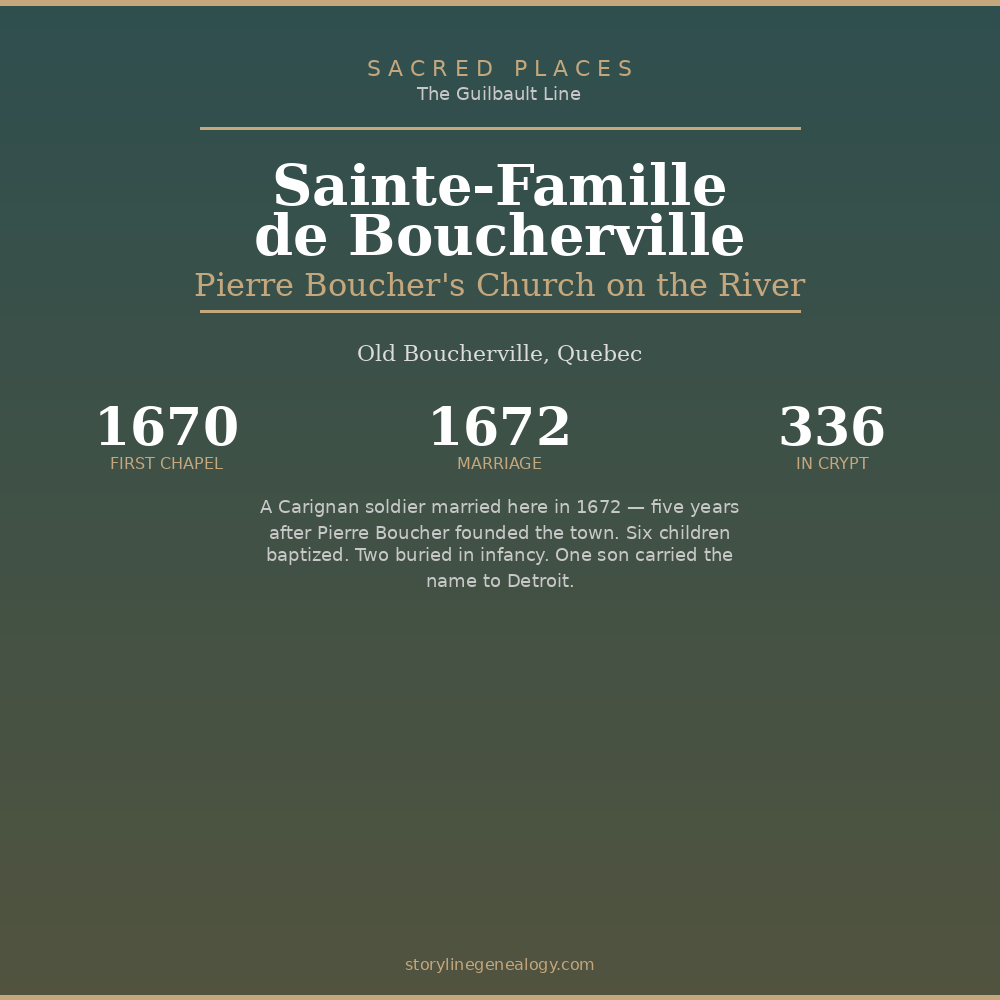
Sainte-Famille de Boucherville: Pierre Boucher's Church on the River
Sainte-Famille de Boucherville stands on land donated by Pierre Boucher himself — one of the most remarkable figures in early New France. On October 31, 1672, Carignan-Salières Regiment veteran François Séguin dit Ladéroute married Jeanne Petit in the original wooden chapel, just five years after the town was founded. Over the next two decades, the Séguin family filled the parish registers with baptisms and burials. Their son Jean-Baptiste, our direct ancestor, would carry the family name westward to the fur trade at Detroit.
Part of the Storyline Genealogy series : Sacred Places
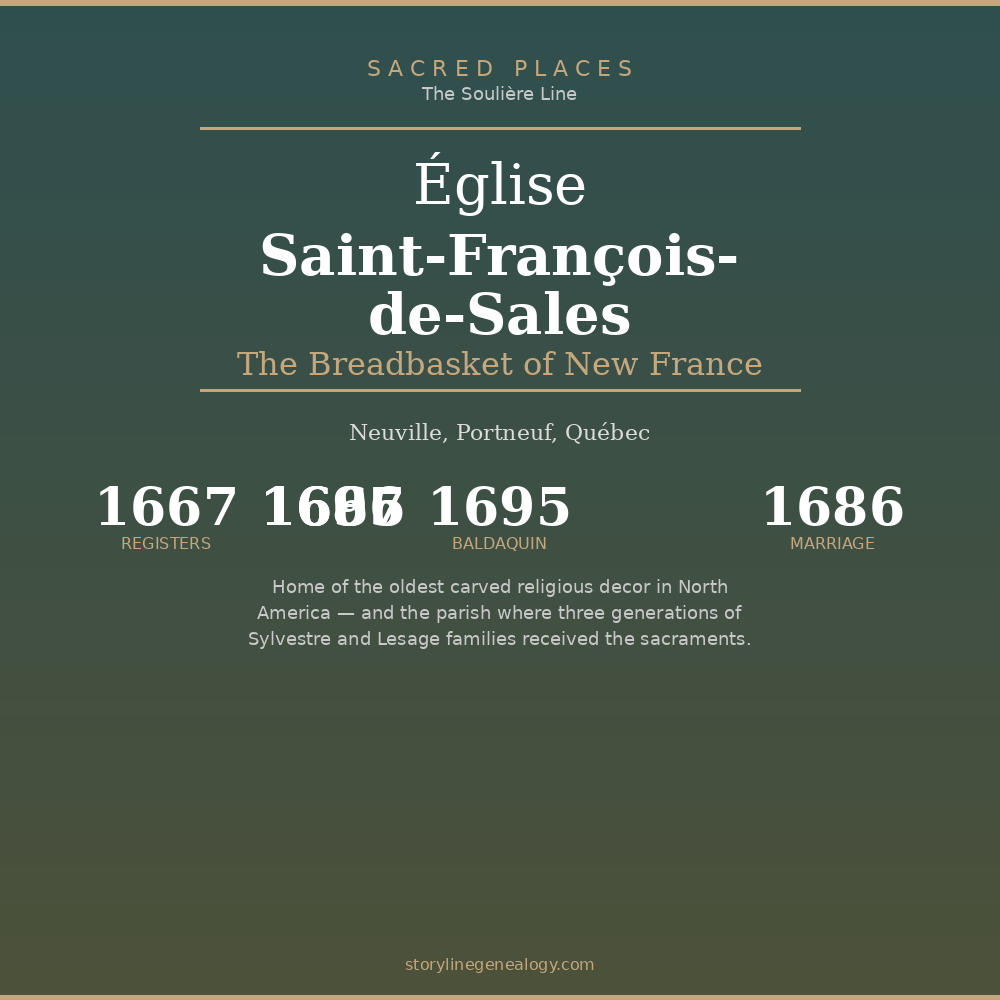
Église Saint-François-de-Sales
The church of Saint-François-de-Sales in Neuville, Quebec, houses the oldest carved religious decor in North America and the parish registers that anchor the Soulière Line to the very beginnings of New France. In 1686, Marie Barbe Sylvestre — daughter of founding father and soldat Nicolas Sylvestre dit Champagne — married Jean Bernardin Lesage dit Lepiedmontois, an Italian soldier from Racconigi, Piedmont. Their story begins here, in the breadbasket of New France.
Part of the Storyline Genealogy series : Sacred Places
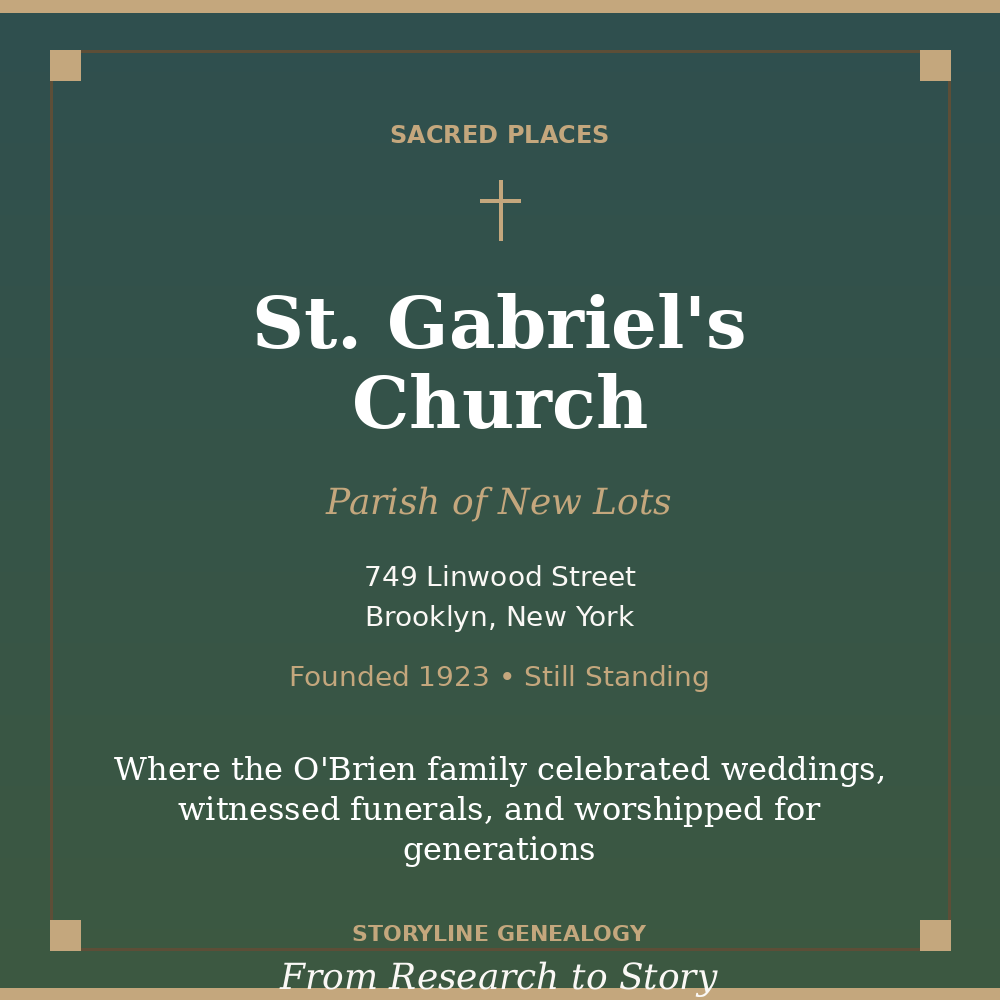
St. Gabriel’s Church : Parish of New Lots
In the working-class streets of East New York, St. Gabriel's Church served as the spiritual anchor for the O'Brien family of Brooklyn. From James H. O'Brien's 1902 wedding to his brother's 1930 requiem Mass, three generations of sacraments were celebrated within these walls at 749 Linwood Street—a parish that still stands today, celebrating its centennial in 2024-2025.
Part of the Storyline Genealogy series: Sacred Places
St. Aloysius Church: Mother Church of West Essex
For over a century, St. Aloysius Church has stood at the corner of Bloomfield Avenue in Caldwell, New Jersey—the only Catholic church in America located next door to a presidential birthplace. Within these French Gothic walls, four generations of the O'Brien and Robertson families celebrated life's sacred moments: from Mary Agnes Robertson's requiem Mass in 1924 to the weddings of all three O'Brien daughters in the 1950s, to the golden jubilee Mass where Miles and Lillian renewed their vows surrounded by 17 grandchildren and a great-granddaughter.
Part of the Storyline Genealogy series: Sacred Places
Notre-Dame de Granby
For seven years, the identity of "Hammil, Thornton" in Owen Hamall's 1880 Chicago household remained a mystery. The answer came from Notre-Dame de Granby in Quebec's Eastern Townships—where William Thornton's 1881 marriage record named his mother as "défunte Mary McMahon." Twelve words in French proved William was Owen's half-brother.
Part of the Storyline Genealogy series : Sacred Places
The Sailors’ Church: Notre-Dame-de-Bon-Secours
Thomas Patrick Kenny was six or seven years old when his widowed mother gathered her children for the long journey from Prince Edward Island to Chicago. Decades later, he still remembered stopping at a church in Quebec where tiny ships hung from the ceiling, floating in the candlelit air like prayers made visible. The church was Notre-Dame-de-Bon-Secours—the "Sailors' Church."
Part of the Storyline Genealogy series: Sacred Places
St. Mary’s Church, Inniskeen
On January 1, 1841, Henry Hamill and Mary McMahon were married somewhere in the parishes of Inniskeen or Donaghmoyne. The presence of 44 Hamill burials in St. Mary's graveyard suggests this was their family's church. Today St. Mary's stands as a literary shrine to poet Patrick Kavanagh—but its graveyard still holds generations of Hamills who never left this land.
Part of the Storyline Genealogy series: Sacred Places
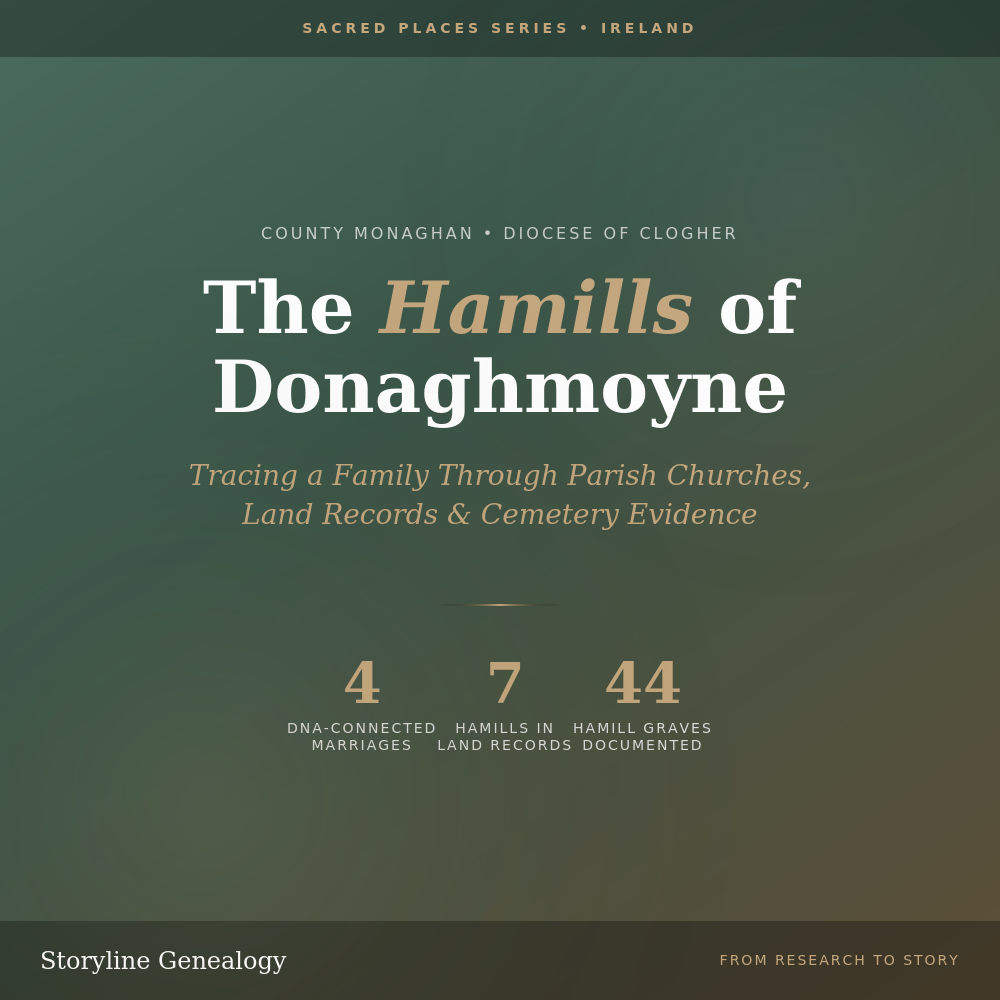
Parish Churches of County Monaghan
Four marriages. Four DNA connections. One parish name on every record: Donaghmoyne. This comprehensive guide explores the overlapping parishes, surviving records, and cemetery evidence that help trace the Hamill families of south Monaghan—from the townlands of Dian, Drumaconvern, and Edengilrevy to descendants scattered across two continents.
Part of the Storyline Genealogy series : Sacred Places
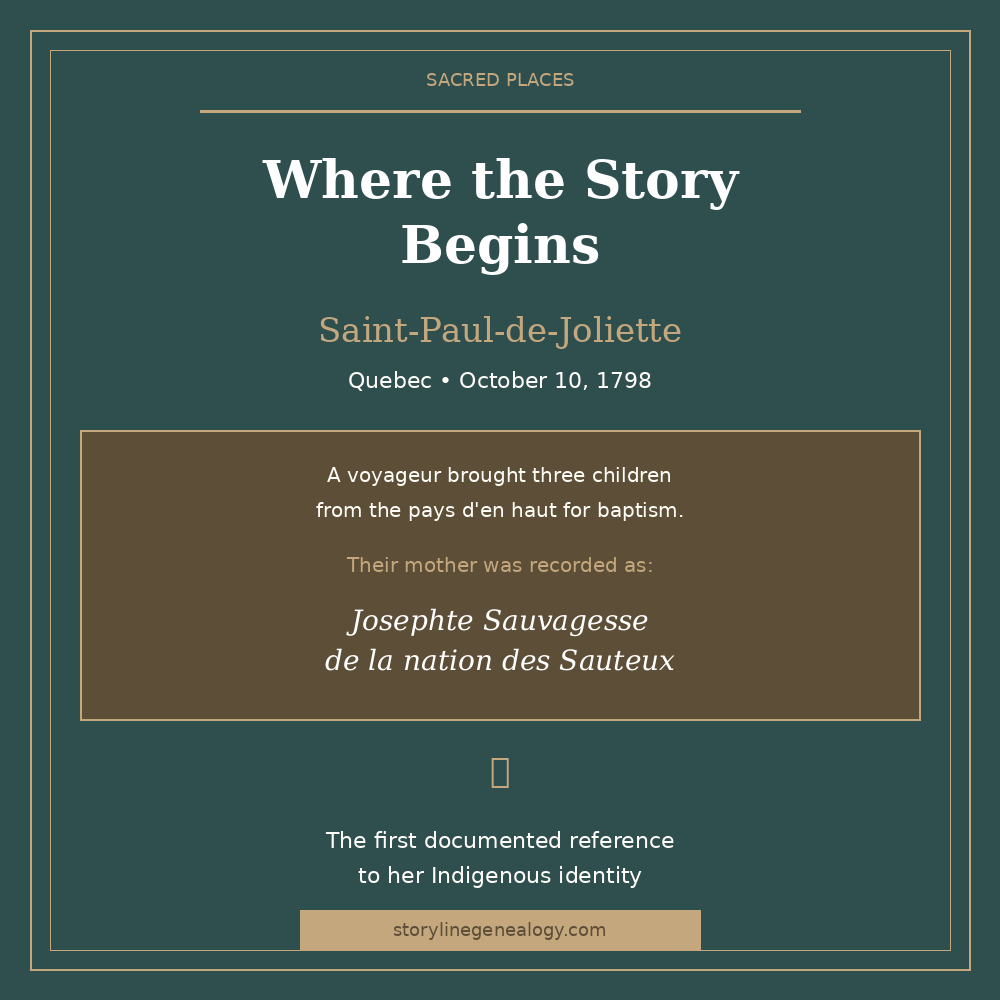
Saint-Paul-de-Joliette : Where the Story Begins
On October 10, 1798, a voyageur named Gabriel Guilbault brought three children to Saint-Paul-de-Joliette for baptism. They had been born and "ondoyé" (emergency baptized) in the pays d'en haut—the upper country of the fur trade. Their mother was identified as "Josephte Sauvagesse de la nation des Sauteux"—the first documented reference to her Indigenous identity. The story of Marie Josephte Abitakijikokwe begins here.
Part of the Storyline Genealogy series : Sacred Places
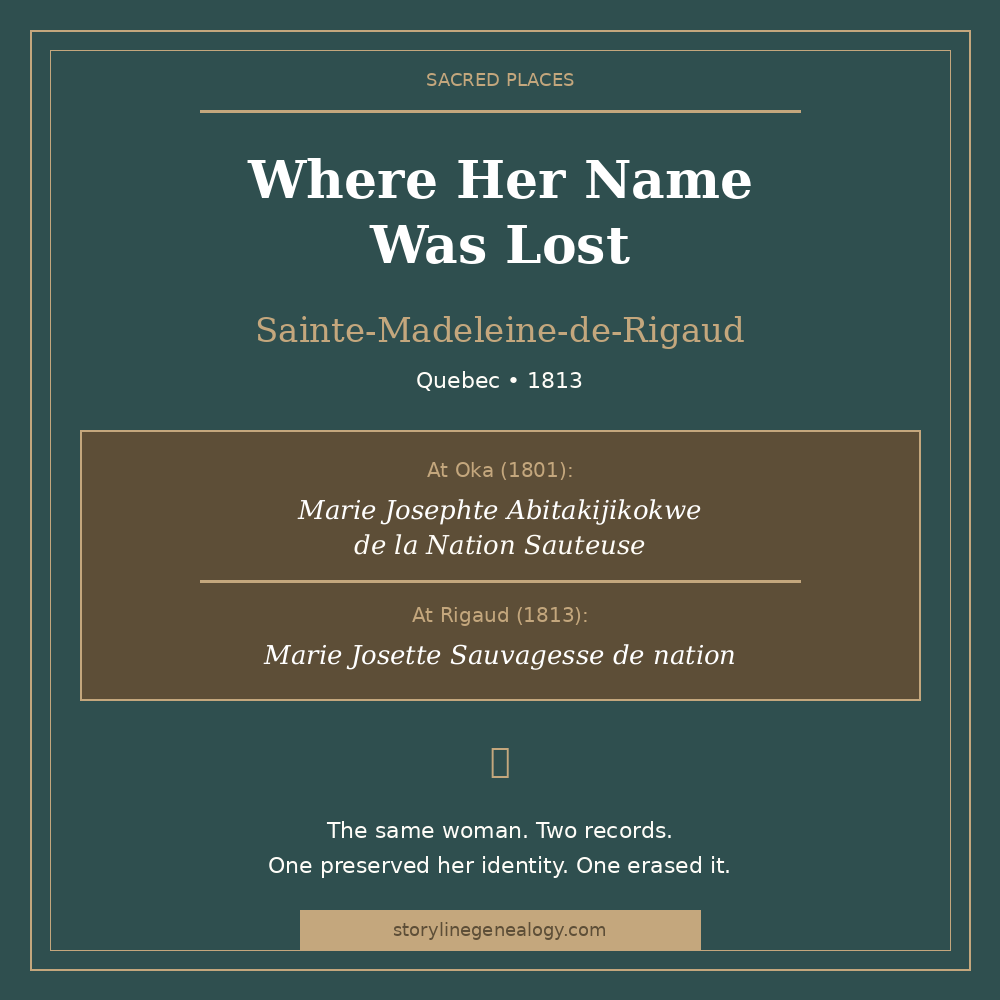
Sainte-Madeleine-de-Rigaud : Where Her Name Was Lost
In 1801, Father Leclerc at Oka carefully recorded her full Ojibwe name: Marie Josephte Abitakijikokwe de la Nation Sauteuse. Twelve years later, when she was buried at Rigaud, she had become simply "Marie Josette Sauvagesse de nation"—an Indigenous woman, unnamed. The contrast tells the story of colonial record-keeping and the erasure of Indigenous identity.
Part of the Storyline Genealogy series : Sacred Spaces
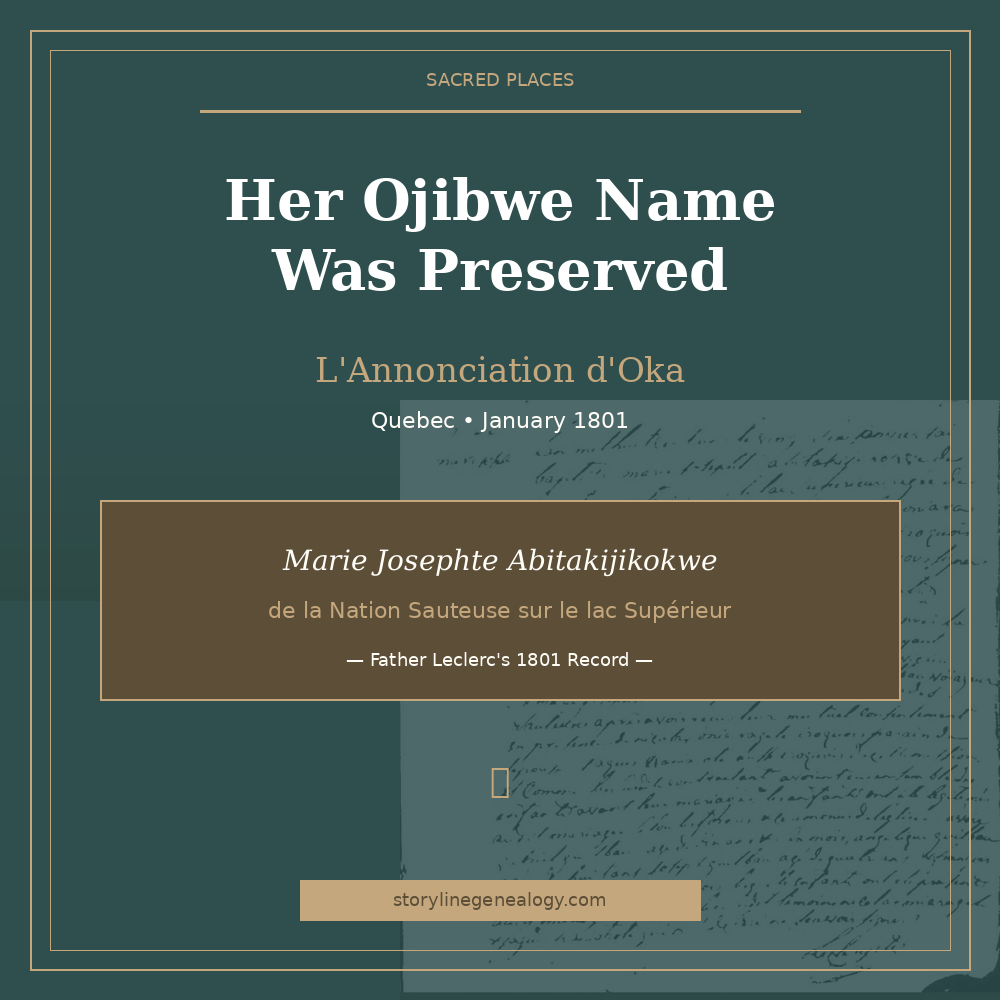
L’Annonciation d’Oka : Mission of the Lake of Two Mountains
For three centuries, this Sulpician mission has stood at the confluence of Indigenous and French Canadian cultures. Here, on January 27, 1801, Father Leclerc did something extraordinary: he recorded the full Ojibwe name of an Indigenous bride—Marie Josephte Abitakijikokwe de la Nation Sauteuse sur le lac Supérieur—preserving her identity when most priests simply wrote "Sauvagesse."
Part of the Storyline Genealogy series : Sacred Spaces