
Jeanne Petit: Orphan in La Rochelle
Jeanne Petit
Quick Facts
Jeanne Petit came to New France among the King's Daughters, part of the contingent of 125 women sent in 1671, nineteen of whom settled in the region of Montréal. No ships of filles du roi arrived in 1672. Where and how she passed the intervening months is not recorded—only that by the autumn of 1672 she had met François Séguin dit Ladéroute, a Carignan-Salières veteran twelve years her senior, and that on 21 September they signed a marriage contract.

Born about 1656 in the parish of Sainte-Marguerite in La Rochelle, Aunis, Jeanne was the daughter of Jean Petit and Jeanne Gaudreau. La Rochelle in the mid-seventeenth century was a city of religious upheaval and maritime ambition—a fortified port that had been a Huguenot stronghold until its surrender to Cardinal Richelieu in 1628. By the time Jeanne was born, the city had returned to Catholic governance, though the scars of the siege remained visible in its architecture and its people.
Her origin and parentage are known from a single source: the marriage act of 1672, which names the parish and both parents. No baptismal record has been located, and both parents were dead before she sailed. She was about sixteen when she crossed the Atlantic—a young woman alone, with the king's dowry and whatever hopes she carried for a land she had never seen.
Laforest places Jeanne among the 125 filles du roi of 1671 and also states that she left for Canada in 1672; Peter Gagné gives 1672. The two dates cannot both be right, and no passenger record naming her has been located. The 1671 contingent is the better-attested crossing, and 1672 saw no arrivals under the programme—but the point is left open here rather than resolved by preference.
La Rochelle: City of Departures

The Sainte-Marguerite parish where Jeanne was baptized was a modest church with a turbulent history. Originally founded as a convent for the "Sœurs Blanches" (White Sisters), the Chapelle Sainte-Marguerite had survived the 1568 destruction of Catholic churches by Huguenots and served multiple roles over the centuries—parish church, military hospital, even an artillery store. Its survival through La Rochelle's religious wars made it a fitting birthplace for a girl who would herself survive a transatlantic crossing and decades of frontier life.
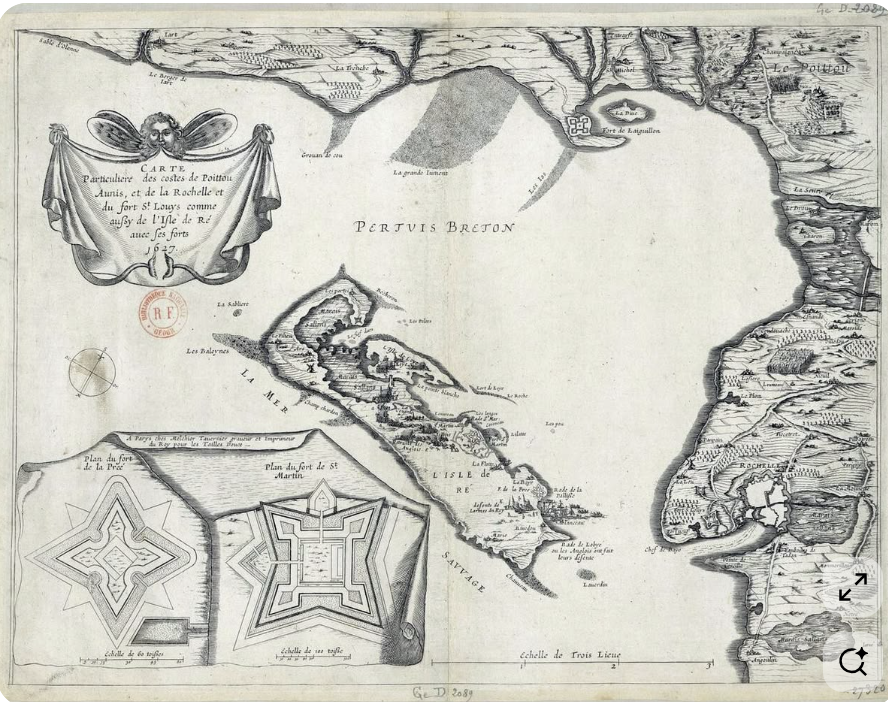
Parish registers for Sainte-Marguerite include Catholic baptisms and marriages dating from 1598 to 1666, documenting the alternating religious use of the site during the Wars of Religion. A birth about 1656 falls within that range, so her baptismal act should survive; it has not yet been located, and the Charente-Maritime departmental archives remain to be searched for it.
The Marriage Contract
On Wednesday, 21 September 1672, a marriage contract was drawn before notary Thomas Frérot between Jeanne, born at Sainte-Marguerite de La Rochelle to Jean Petit and Jeanne Gaudreau, and François Séguin dit Ladéroute. Both spouses signed it—an unusual thing in a colony where most habitants declared they could not write, and the earliest evidence that Jeanne was literate. The witnesses speak to the importance of the occasion: Pierre Boucher himself, seigneur of Boucherville, and his wife Jeanne Crevier attended, along with Captain Pierre de Saint-Ours, François's former commander, who gave a gift of 50 livres. Fifteen other local people witnessed the ceremony.
At sixteen Jeanne was already an orphan. The presence of such distinguished witnesses—the seigneur himself and the captain of her husband's old company—suggests that the community recognized the significance of these marriages. Each union represented not just a personal commitment but an investment in the colony's future.
Pierre De Caumont, the first priest to reside at Boucherville, joined François and Jeanne in bonds of matrimony on Monday, 31 October 1672. This was the seventh wedding celebrated in this place. The priest failed to record the names of the witnesses—an omission genealogists have lamented for three centuries—but the marriage itself was duly entered.
And so began the family life of François and Jeanne, a union which would last for more than a third of a century.
Boucherville
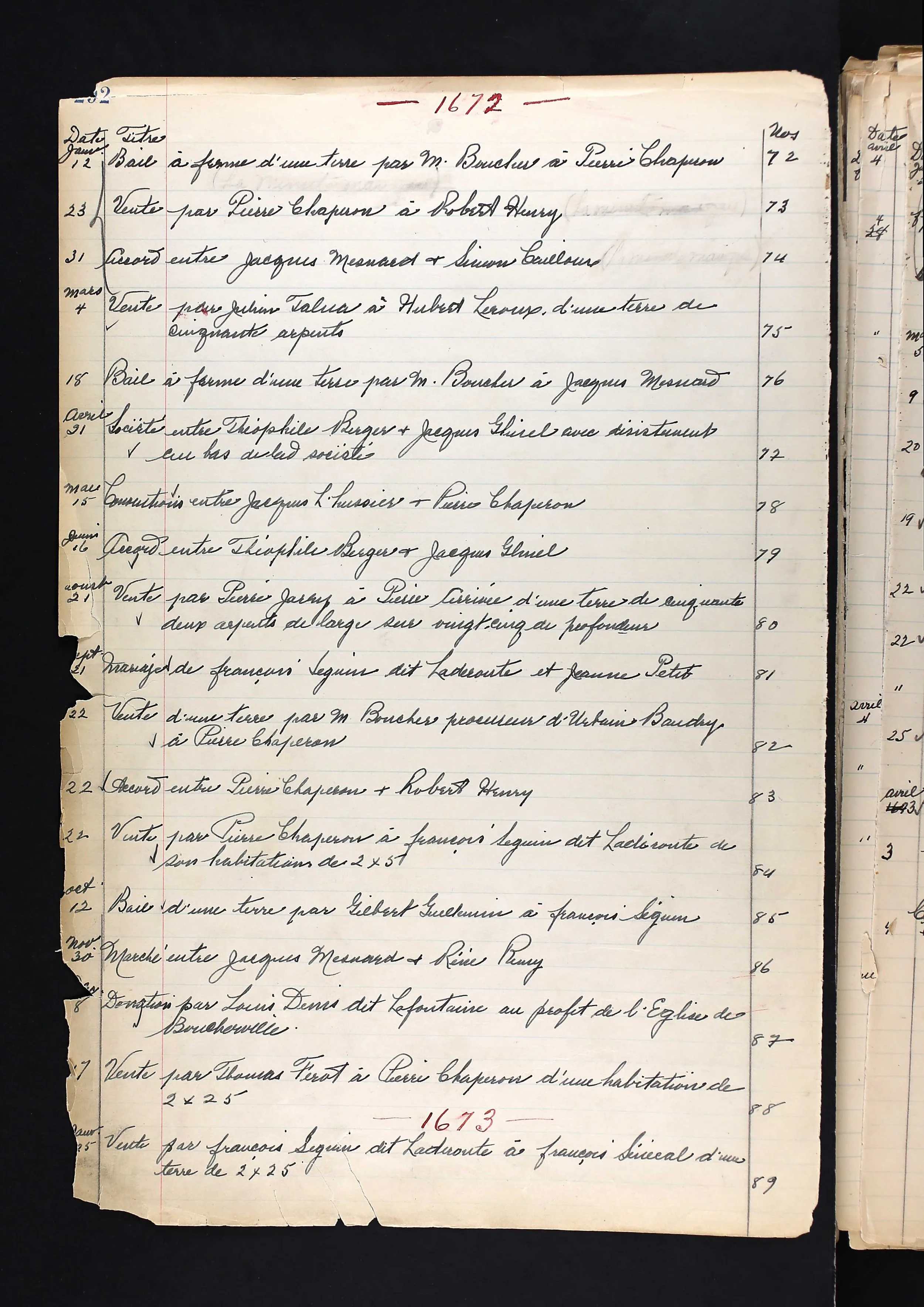
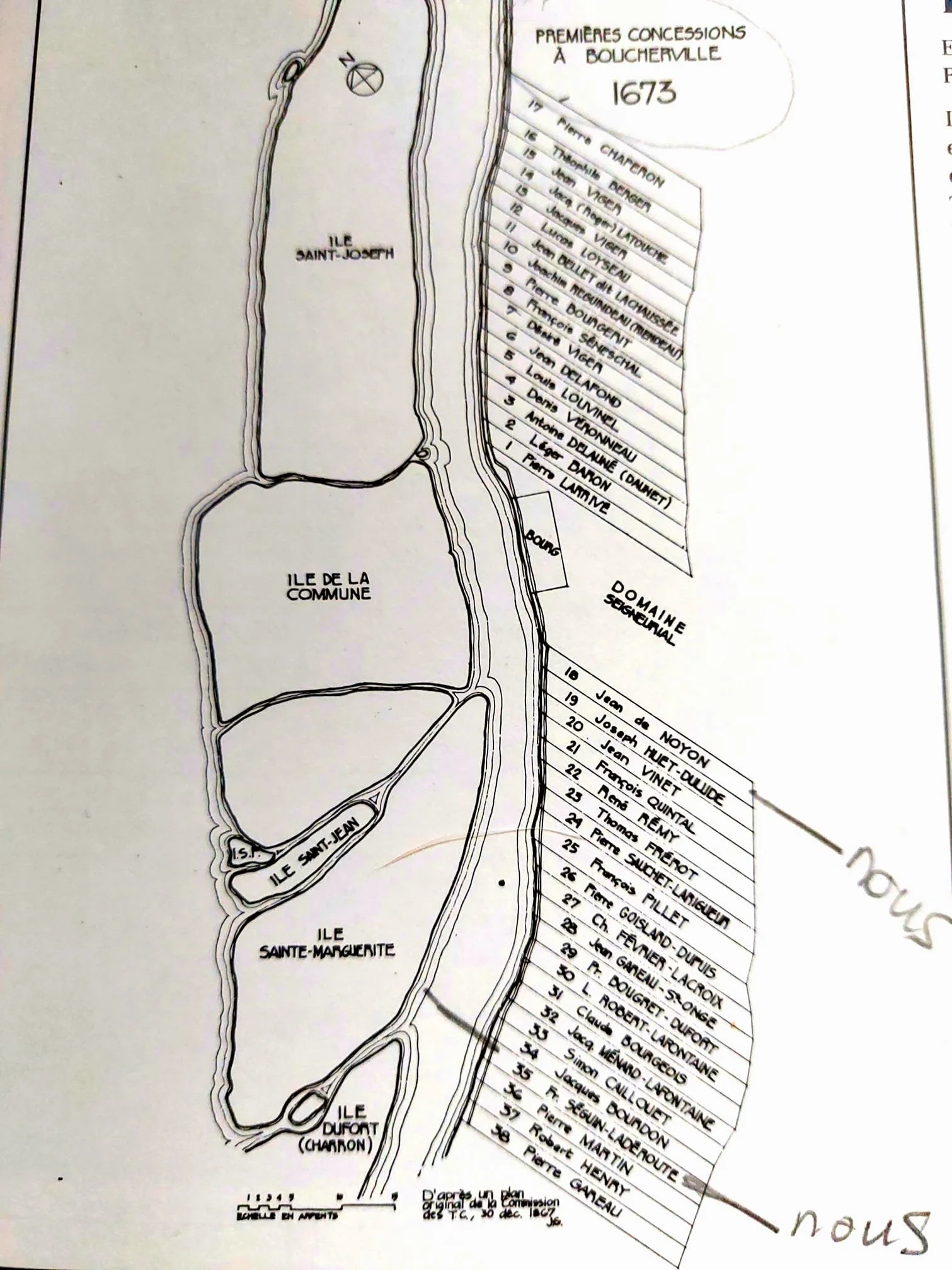
Immediately after his marriage contract, on 22 September 1672, François Séguin bought a homestead from Pierre Chaperon consisting of 2 arpents in frontage by 25 deep, located in the seigneury of Boucherville. It bordered the property of Pierre Bourgery and Gilbert Guilleman dit Duvillars, former surgeon and soldier in the Company of Saint-Ours, in the Carignan Regiment. Four square arpents of this farm had already been cleared. On the same occasion, François acquired a lot of one square half-arpent in the village of Boucherville "with the barn which is found built there". Price: 85 livres.
Here Jeanne would build her life. Here she would bear eleven children, bury three of them in infancy, and watch the others grow to establish families of their own. The land at Boucherville became the foundation of everything that followed.
On 4 April 1673, with 37 other concessionaires, François obtained his plot of land from seigneur Pierre Boucher—50 arpents, 2 by 25. The neighbours, also censitaires of the seigneur, were Pierre Martin, husband of Anne Poitron, and Ménard. In the census of 1681, François gave his trade as tisserand—weaver. In the early days of New France, weaving was a man's trade, wrote Robert-Lionel Séguin. Had François learned it in France? Probably. Weaving occupied him more than clearing land. He had only one head of cattle, a cow which would not last forever.
The Séguin Children
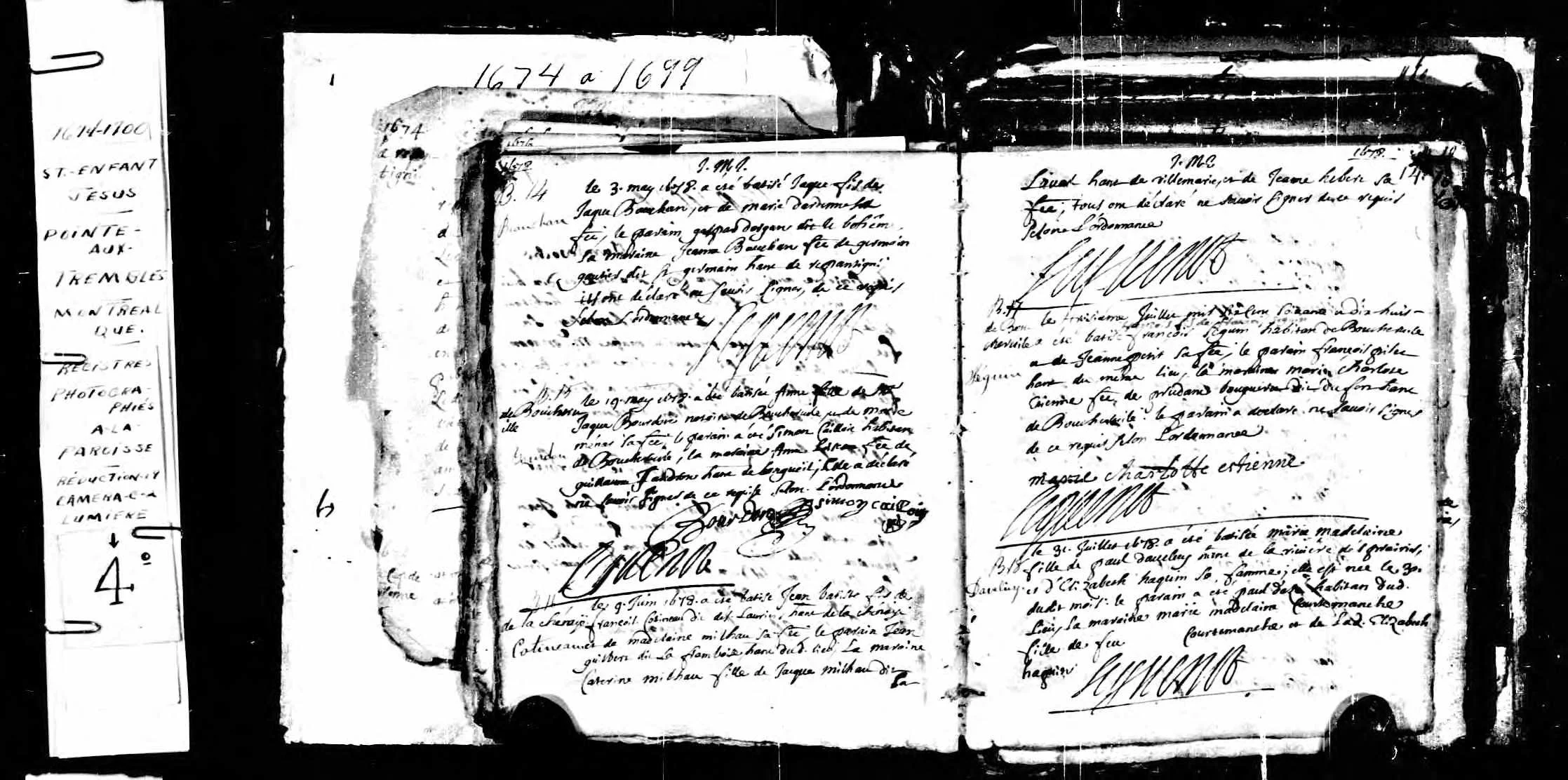
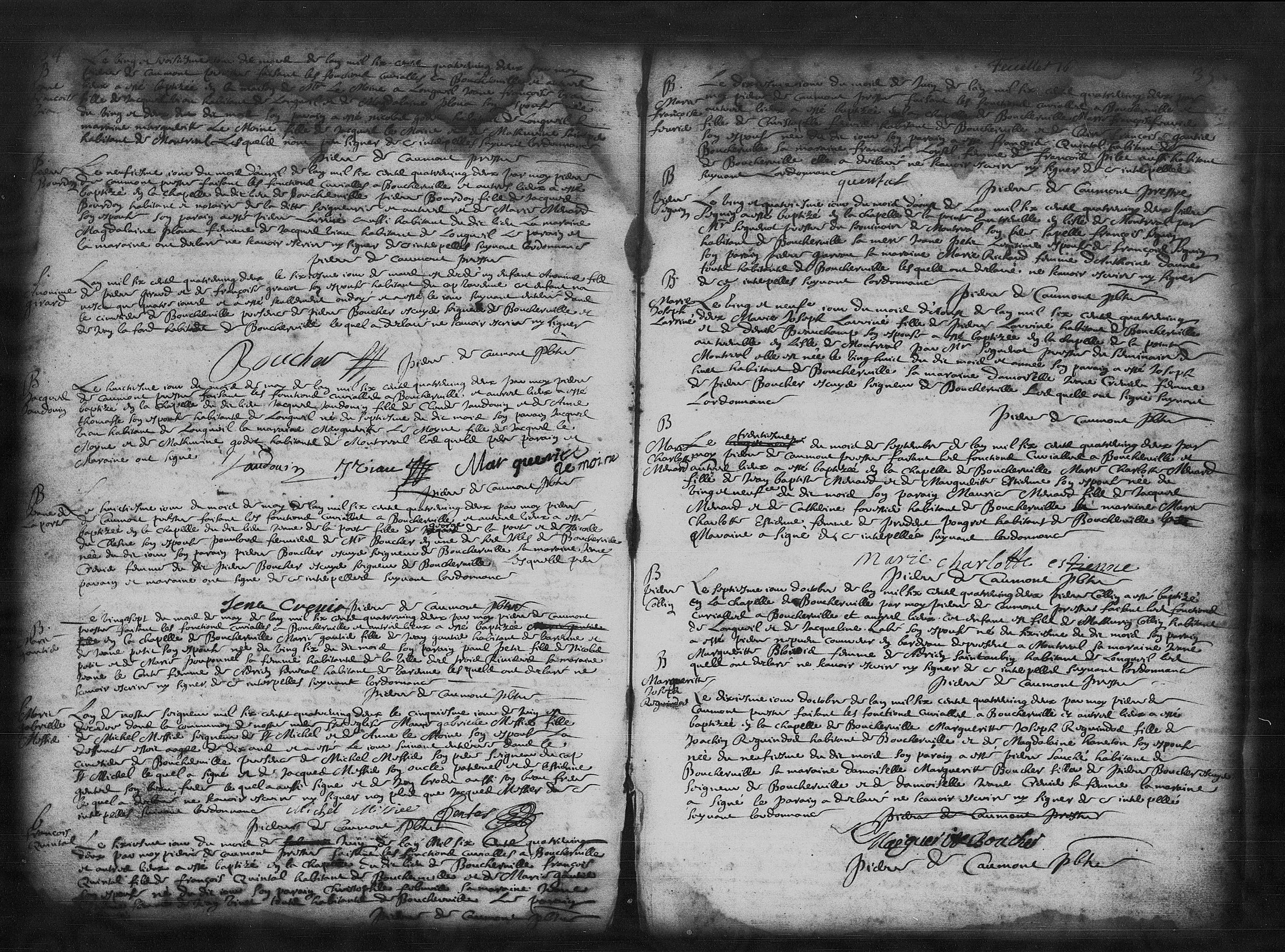
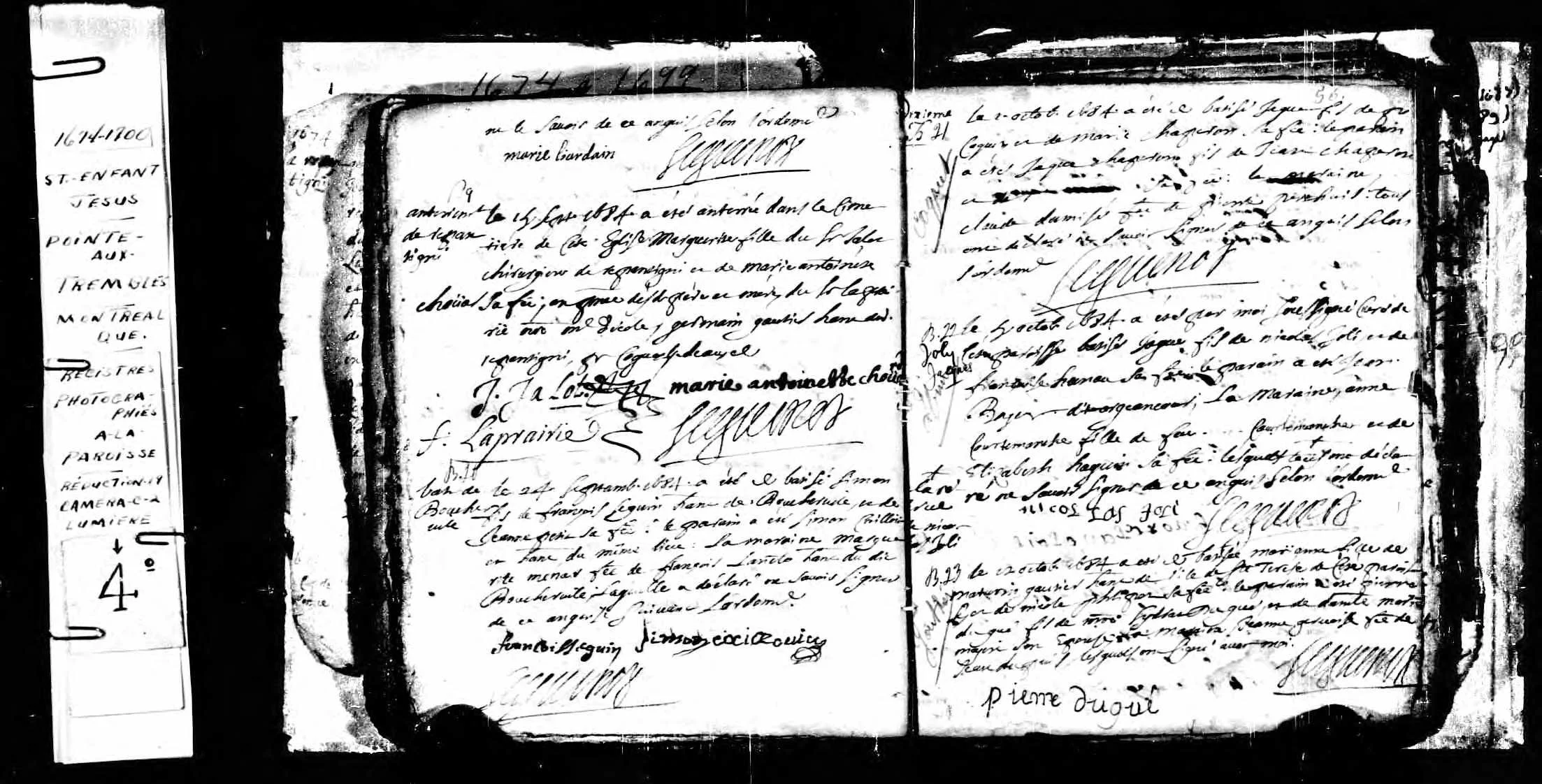
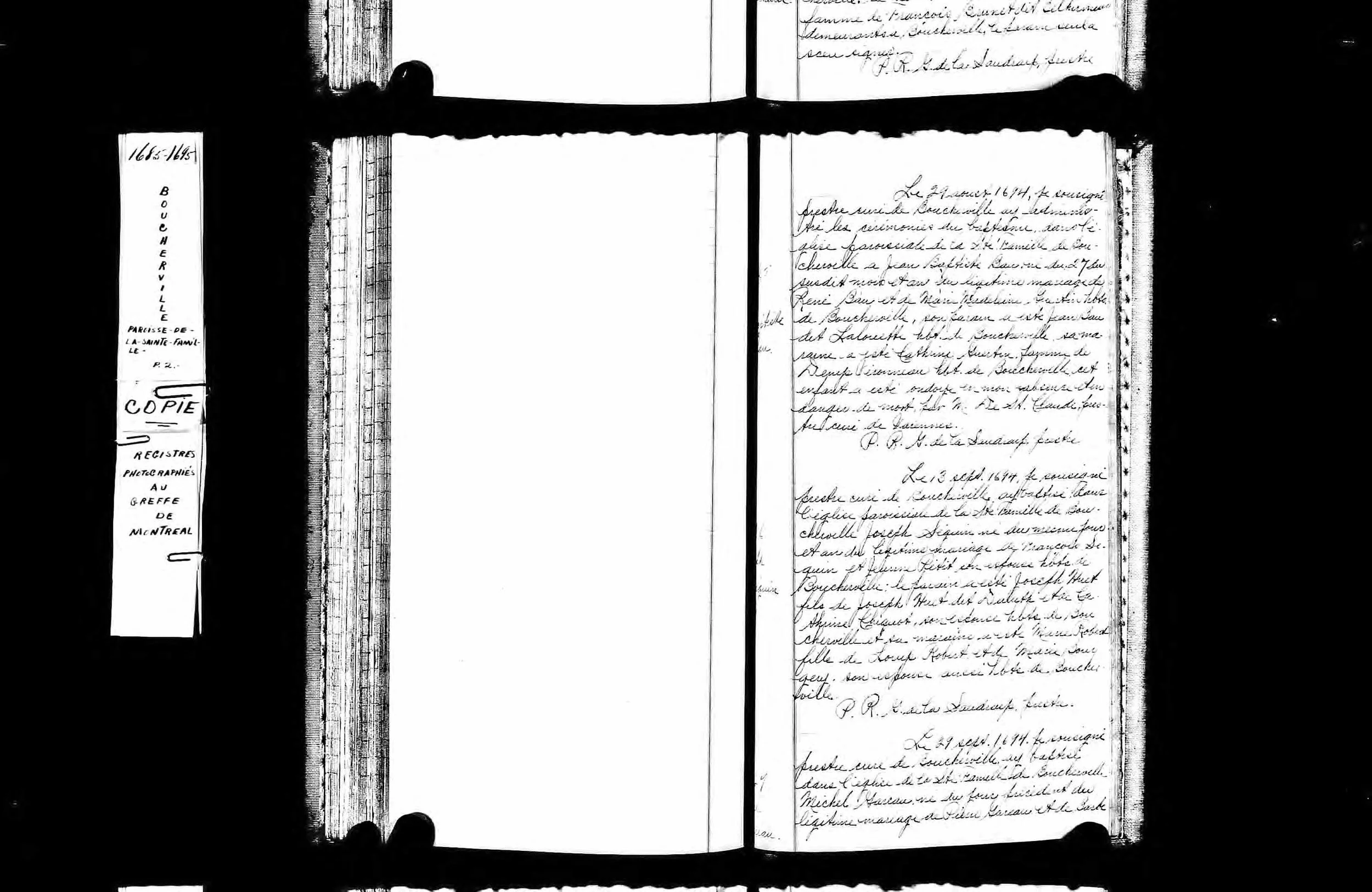
Jeanne and François settled at Boucherville, where daughter Marie Françoise was baptized on the first of November 1674, followed by Marie Madeleine dite Marie (16 August 1676) and Marie Jeanne (11 August 1680). Three sons were baptized across the river at Pointe-aux-Trembles: François (3 July 1678), Pierre (24 August 1682) and Simon (24 September 1684). Catherine was baptized at Boucherville on 20 November 1686 and buried there on 17 January 1688. Jean-Baptiste was baptized 12 November 1688, followed by Geneviève (baptized 9 April 1691, died 16 July, buried 17 July), Joseph (baptized 11 August 1692, buried 30 August), and a second Joseph (13 September 1694).
Three small graves in the Boucherville cemetery—Catherine, Geneviève, and the first Joseph—marked the sorrows that punctuated Jeanne's years of childbearing. But eight children survived, and they would go on to remarkable lives:
1. Marie Françoise, goddaughter of Françoise Loisel on the first of November 1674 at Boucherville, married Charles Patenaude in 1694. Mother of ten children, she was buried on 20 May 1751 at Longueuil. In August 1692, aged eighteen, she stood as godmother to her infant brother Joseph.
2. Marie Madeleine first joined her life to Antoine Marie dit Sainte-Marie, on 20 November 1700. There were no descendants. At Longueuil, on 7 January 1704, she was remarried to François Achin dit Saint-André, who gave her six children.
3. Marie Jeanne and Joseph Robidou were responsible for a family of eleven members, almost all born at Laprairie. Jeanne was buried in the cemetery of Longueuil on 21 December 1749.
4. François, the eldest of the sons, baptized at Pointe-aux-Trembles on 3 July 1678, married at Boucherville on 22 February 1702 to Marie Louise Feuillon. By 1705 the family was at Lachenaie, and by 1706 on the Île Jésus, where their later children were baptized at Saint-François-de-Sales. In the winter of 1705–1706 he was imprisoned and fined thirty livres as one of the rebelles de la côte; his brothers Pierre and Simon were ordered apprehended in the same proceeding. He was buried at Terrebonne in February 1727.
5. Pierre married on 4 February 1704 Barbe Filion, widow of Jean-Baptiste Leber and mother of Marie-Jeanne and Maurice Leber. They had six daughters and three sons, all baptized at Saint-François on the Île Jésus. Pierre was buried at Saint-Henri de Mascouche on 9 November 1760, at the time of the Conquest.
6. Simon, godson of the bachelor Simon Caillouet, married first on 9 November 1706 Marie Bau dite Lalouette, with whom he had a son; and second, on 11 November 1715 at Boucherville, Madeleine Cole, whose origin the marriage act gives as New England and whose occupation it gives as servant to the merchant Papin of Boucherville. Laforest identifies her as a prisoner of war taken on 19 October 1698 and a native of Beverly, Massachusetts—a claim that rests on his account rather than on the marriage act. Their family counted nine members, all raised at Boucherville.
7. Jean-Baptiste—our direct ancestor—married Geneviève Barbot dite Boisdoré on 7 June 1710 at Boucherville and brought ten children into the world, the last at Chambly. He died at the hospital in Montréal on 13 May 1728 and was buried the following day at Notre-Dame. His widow married twice more.
8. Joseph, godson of Joseph Huet dit Dulude, baptized 13 September 1694, earned his living from the fur trade and supplied boats leaving for Detroit. On 9 September 1728 the notary Joseph-Charles Raimbault recorded his acknowledgement of a debt of 5,075 livres, 6 sols, 3 deniers to Charles Nolan, merchant of Montréal, for trading merchandise, as he made ready to leave for Detroit. He married on 12 April 1723 in the church of Sainte-Anne de Détroit to Marie Françoise Sauvage, daughter of Jacques and Catherine Vien of the parish of Champlain. His ten children were born at Detroit. He was buried at Sainte-Anne on 29 April 1753.
The Séguin family counted 76 members in the third generation and seems to have enjoyed the gift of longevity.
Widow on Île Grosbois
On 24 November 1698, François sold his concession to Jean-Baptiste Lamoureux, habitant of the Île Sainte-Marguerite, for 850 livres. For his 50 arpents of land "with a poor building built upon it", located between Jacques Ménard and his brother Louis, he received 400 in playing card money, 200 in various merchandise, and 60 in 20 minots of wheat. The remaining 190 were to be paid on the next Saint-Jean-Baptiste day, 24 June 1699.
With the consent of Seigneur Pierre Boucher, on 15 April 1700, Marie-Anne Margane, widow of Ignace Boucher, Sieur de Grosbois, ceded to François Séguin dit Ladéroute and Jeanne Petit, for them and during their lifetime only, a strip of wooded land on the Île Grosbois. Width: 2 arpents; depth: "as far as the tip of the island, across from l'île aux Raisins". François, in addition to giving two work days each autumn, was committed to taking care of the donor's two cows.

François's health declined rapidly. He died between 20 November 1700—when he was unable to attend the marriage contract of his daughter Marie Madeleine and was noted as "absnt pour son indisposition"—and 9 October 1701, when Jeanne appears before the same notary as "veufue de deffunct françois Seguin", widow of the late François Séguin, acting for their daughter Marie Jeanne. A Boucherville parish act of 11 November 1715 independently records him as deceased, with Jeanne present in the church.
No burial record for François has been located at Sainte-Famille de Boucherville. The date of 9 May 1704 carried by PRDH-IGD and Fichier Origine belongs to a burial at Notre-Dame-de-Montréal naming a different man, recorded in the register as Pierre Séguin dit La Deroute. A 2025 study of the regiment maintains that the 1704 burial is François's, entered under an erroneous given name; the notarial acts bearing on that reading are under examination.
Jeanne was a widow at about forty-five, living on an island grant that was hers for her lifetime only.
The Brave Ancestress
On 19 March 1713, after thirteen years on the island—twelve of them as a widow—Jeanne returned to Marie-Anne Margane the concession on the Île Grosbois she had received in April 1700. She went to live with the family of her eldest son François, by then settled on the Île Jésus; the household did not reach Lachenaie until the 1720s.
She died on Sunday, 29 March 1733, and was buried the next day at Saint-Antoine-de-Padoue in Longueuil by the curé J. Ysambart. Present were family spanning three generations: her daughter Marie Jeanne Séguin; a grandson bearing the surname Patenotre, from Marie Françoise's marriage to Charles Patenaude; and her son-in-law François Achin dit Saint-André, who had married Marie Madeleine in 1704. Two other men, Charles Varri and Charles Truto, also attended. After more than sixty years in New France, Jeanne was laid to rest surrounded by the family she had built.
The act of 30 March 1733 records the deceased as Françoise Petit, aged ninety, widow. It does not name her husband, describing him only as Séguin Ladéroute, deceased, spouse of the deceased woman.
The identification of this woman as Jeanne Petit rests on the mourners rather than on the name: her daughter Jeanne Séguin, a Patenotre grandson, and François Achin as son-in-law together fix the family beyond reasonable doubt. Whether the curé confused her with her eldest daughter Marie Françoise, or whether Jeanne bore both given names, cannot be recovered from the record. The variance is preserved here rather than corrected silently.
The stated age of ninety implies a birth about 1643, against the about 1656 implied by the 1681 census and by her stated age of sixteen at marriage. Denis Beauregard carries both figures, giving her birth as "about 1656 (census 1681) or 1643 (burial 1733)." Ages of the very old are frequently overstated in colonial burial acts, and the earlier figure is the better supported—but the conflict is real and is not resolved here.
In the sixty-one years since she had arrived in New France as an orphaned girl of sixteen, Jeanne had seen a frontier settlement become an established colony. She raised eight children to adulthood, saw them marry and establish families of their own, and lived to know a third generation that Laforest counted at seventy-six. Her descendants spread from Boucherville to Detroit, from the Île Jésus to Chambly.
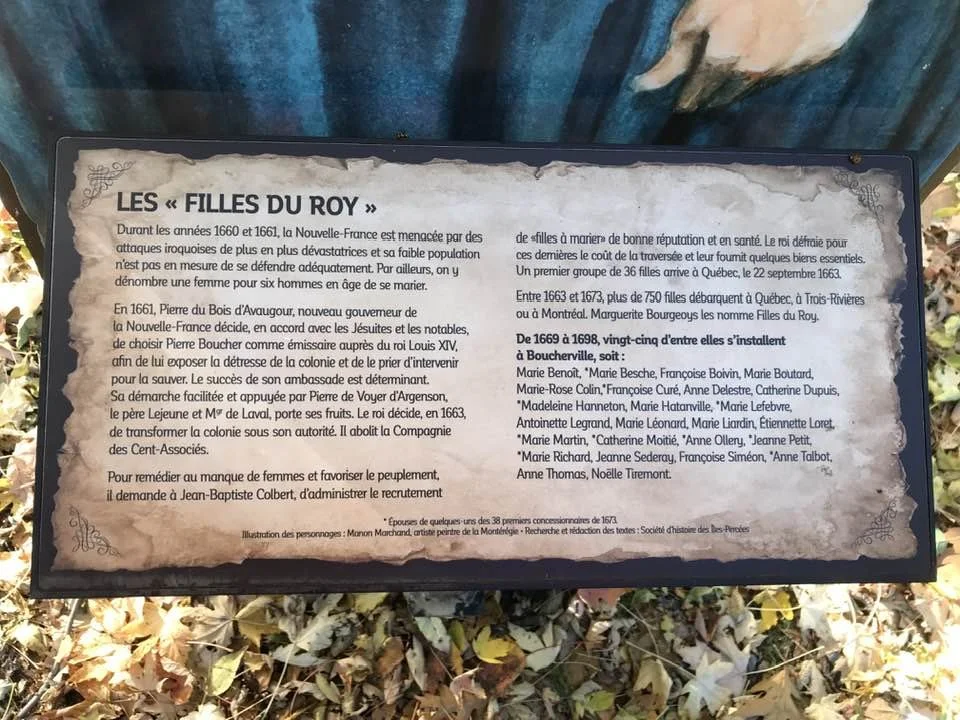
Today a commemorative plaque in Boucherville lists the twenty-five Filles du Roi who settled there between 1669 and 1698. Jeanne Petit's name appears among them, marked with an asterisk indicating she was one of the wives of the first thirty-eight concessionaires of 1673. Nearby, another plaque honours the twenty-two soldiers of the Carignan-Salières Regiment who settled in Boucherville—including François Séguin dit Ladéroute. Together, these markers commemorate the union of soldier and King's Daughter.
François and Jeanne, that which you have desired, you saw; that which you hoped for, you held; you are now together in Paradise with all those whom you loved in France and in New-France, with all your descendants who carry today in their veins your pure and generous blood.
Denis Beauregard's compilation estimates the descendants of François and Jeanne at between 1,890,000 and 2,310,000 Quebecers. That teenage orphan from La Rochelle became a founding mother whose legacy stretches across centuries and continents.
Key Dates
Connection to The Guilbault Line
Primary Source Documents
Marriage Documents


Census Record

Boucherville Settlement

Children's Baptism Records


La Rochelle: Place of Origin

Boucherville Commemorative Plaques


Database Records: Transcriptions
| Father | Jean PETIT |
| Mother | Jeanne GAUDREAU |
| Birth | Vers 1656 — ste-marguerite, v. et ev. la rochelle, aunis (ar. la rochelle, charente-maritime) |
| Death | 29 March 1733 |
| Burial | 30 March 1733 — Longueuil (St-Antoine-de-Padoue) |
| First marriage | 31 October 1672 — Boucherville (Ste-Famille), with François SEGUIN LADEROUTE, son of Laurent Seguin and Marie Mossieu |
On the birth. The date and parish are derived from the origin clause of the 1672 marriage act, not from a baptismal record. No act of baptism has been located.
| Rank | Name and role | Age | M.S. | Pr. |
|---|---|---|---|---|
| 01 | Francoise PETIT — the deceased | 90 | v | d |
| 02 | SEGUIN LADEROUTE — spouse of 01; given name not recorded | — | m | d |
| 03 | Jeanne SEGUIN — daughter of 01 | — | — | p |
| 04 | PATENOTRE — grandson of 01; given name not recorded | — | — | p |
| 05 | Francois ACHIN — son-in-law or stepson of 01 | — | — | p |
| 06 | Charles VARRI | — | — | p |
| 07 | Charles TRUTO | — | — | p |
| 08 | J YSAMBART — curé, Longueuil (St-Antoine-de-Padoue) | — | c | p |
Legend. M.S. = marital status (c = single, m = married, v = widowed). Pr. = presence at the act (p = present, d = deceased, em dash = not stated).
The highlighted rows. The act names the deceased as Françoise Petit, not Jeanne, and records her husband only by surname. The identification as Jeanne Petit rests on ranks 03 to 05: her daughter, a Patenaude grandson, and François Achin, who married her daughter Marie Madeleine in 1704.
| Rank | Name and role | M.S. | Pr. |
|---|---|---|---|
| 01 | Francois SEGUIN — spouse of 02; occupation habitant; residence Boucherville; origin Dombre, évêché de Beauvais, Picardie | c | p |
| 02 | Jeanne PETIT — spouse of 01; origin Ste-Marguerite, ville et évêché de La Rochelle | c | p |
| 03 | Laurent SEGUIN — father of 01, spouse of 04 | m | — |
| 04 | Marie MOSSIEU — mother of 01, spouse of 03 | m | — |
| 05 | Jean PETIT — father of 02, spouse of 06 | m | — |
| 06 | Jeanne GAUDRAU — mother of 02, spouse of 05 | m | — |
| 07 | Pierre DECAUMONT — prêtre, curé; residence Boucherville | c | p |
All four parents are absent. They are named in the filiation clause only; none was in the colony. Jeanne's parents were both dead by 1672.
Two spellings to note. François's mother appears here as Mossieu; the 1644 baptismal act at Saint-Aubin-en-Bray names her Marie Massieu. The origin given for François as "Dombre" does not match his baptismal parish of Saint-Aubin-en-Bray, though both lie in the diocese of Beauvais.
| Marriage | Before 1656 |
| Married child | Jeanne, married 31 October 1672 at Boucherville to François Séguin Ladéroute |
A reconstruction, not a record. Jean Petit and Jeanne Gaudreau never came to New France. This entry exists because their names appear in their daughter's marriage act; the marriage date of "before 1656" is inferred from her birth. No French record for the couple has been located.
| Jeanne Petit | Daughter of Jean Petit and Jeanne Gaudreau [entry 4483]; King's daughter, citing Landry 355 and Dumas 310 |
| Birth | About 1656 per the 1681 census, or 1643 per the 1733 burial; La Rochelle (Sainte-Marguerite), Charente-Maritime 17300 |
| Death | 29 March 1733, buried 30 March 1733, Longueuil |
| Marriage | 31 October 1672, Boucherville; contract 21 September 1672, depositary Thomas Frérot |
| Descendants | Estimated 1,890,000 to 2,310,000 Quebecers |
| mtDNA | Haplogroup T2b2b, computed from Jeanne's female-line progeny. A reconstruction from documented descent, not a tested result |
Source. Denis Beauregard, Genealogy of the French in North America, entry [1732]. © Denis Beauregard, 2005–2026. Data transcribed and rearranged; the compilation's own text is not reproduced.
On the two birth years. Beauregard preserves both rather than choosing, which is the honest treatment: the census and the burial act cannot both be right, and neither is a birth record.
Sources & Citations
Primary Sources
- Marriage Contract (1672): Notary Thomas Frérot, 21 September 1672. BAnQ. Both spouses signed.
- Marriage Record (1672): Boucherville (Ste-Famille) Parish, 31 October 1672. Officiant Pierre de Caumont.
- Census (1681): Recensement de la Nouvelle-France, Seigneurie de Boucherville. LAC.
- Marriage Contract, Marie Madeleine (1700): Notary Pierre Raimbault, Act 402. BAnQ.
- Marriage Contract, Marie Jeanne (1701): Notary Pierre Raimbault, Act 527. BAnQ.
- Children's Baptisms (1674–1694): Boucherville (Ste-Famille) and Pointe-aux-Trembles Parish Registers.
- Burial (1733): Saint-Antoine-de-Padoue, Longueuil, 30 March 1733; PRDH act no. 106863. The act names the deceased Françoise Petit.
Not Located
- Baptismal act of Jeanne Petit, Sainte-Marguerite de La Rochelle, c. 1656. The surviving Catholic registers for that parish run 1598–1666 and have not been searched at the Archives départementales de la Charente-Maritime.
- Any passenger or embarkation record naming Jeanne Petit among the filles du roi.
- Any French record of the marriage of Jean Petit and Jeanne Gaudreau.
Derivative Compilations
- PRDH-IGD. Individual #63689; burial #106863; couples #3764 and #4016; family #4015. Université de Montréal. Records consulted in the French interface.
- Beauregard, Denis. "Genealogy of the French in North America." Family Sheet [1732]. © 2005–2026.
Secondary Sources
- Laforest, Thomas J. Our French Canadian Ancestors, Volume 18. LISI Press, 1990. Source of the Madeleine Cole captivity account and of the 1671 arrival.
- Gagné, Peter J. King's Daughters and Founding Mothers: The Filles du Roi, 1663–1673. Quintin Publications, 2001.
- Gagné, Peter J. From Soldiers to Settlers: The Carignan-Salières Regiment in Canada, 1665–1668, vol. 2, 2025. Gives 1672 for Jeanne's arrival.
- Séguin-Pharand, Yolande. François Séguin ou L'impossible défi. Association des Séguin d'Amérique, 1992.
Related Pages
Every Family Has a Story Worth Telling
Whether you're just beginning your research or ready to transform years of work into a narrative your family will treasure, I'd love to help.
BEGIN YOUR RESEARCH INQUIRY