
The Storyline
Real families. Real discoveries. Real stories.

Pierre Morin & Catherine Lemesle
On 18 November 1706 a man of fifty-six was carried into the Hôtel-Dieu de Québec. Thirteen days later his wife was admitted too. Neither of them could write their name — and almost everything we know of Pierre Morin and Catherine Lemesle was written down by other people.
Part of the Storyline Genealogy series: From Research to Story
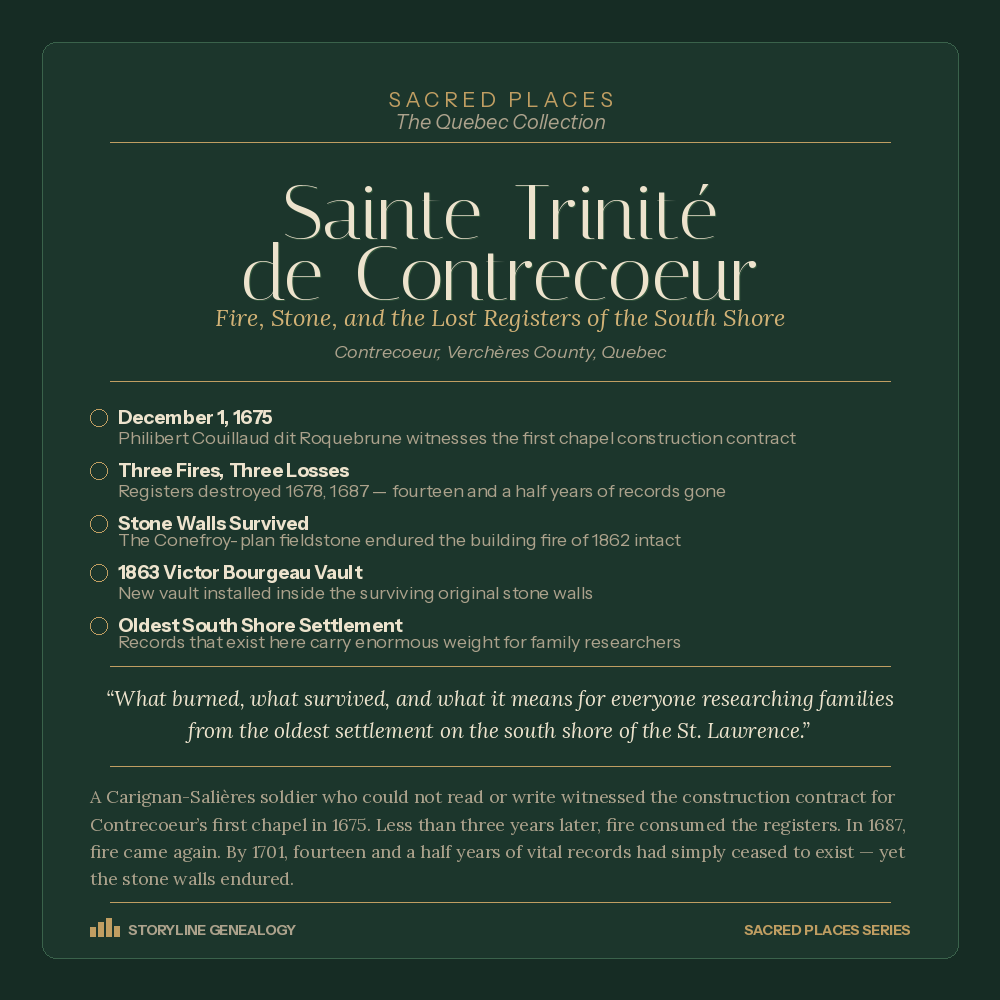
Sainte-Trinité-de-Contrecoeur: The Parish That Burned — and What Survived
On December 1, 1675, Philibert Couillaud dit Roquebrune — a former Carignan-Salières soldier who could not read or write — stood before a notary in Contrecoeur and witnessed the construction contract for the community's first chapel. Less than three years later, fire consumed the parish registers kept in a surgeon's house. In 1687, fire consumed them again. By 1701, fourteen and a half years of baptisms, marriages, and burials had simply ceased to exist. But the stone walls built according to the Conefroy plan — thick fieldstone, engineered to survive — held through the building fire of 1862, and were rebuilt around a new Victor Bourgeau vault in 1863. This is the story of Sainte-Trinité-de-Contrecoeur: what burned, what survived, and what it means for everyone researching families from the oldest settlement on the south shore of the St. Lawrence.
Part of the Storyline Genealogy series : Sacred Places
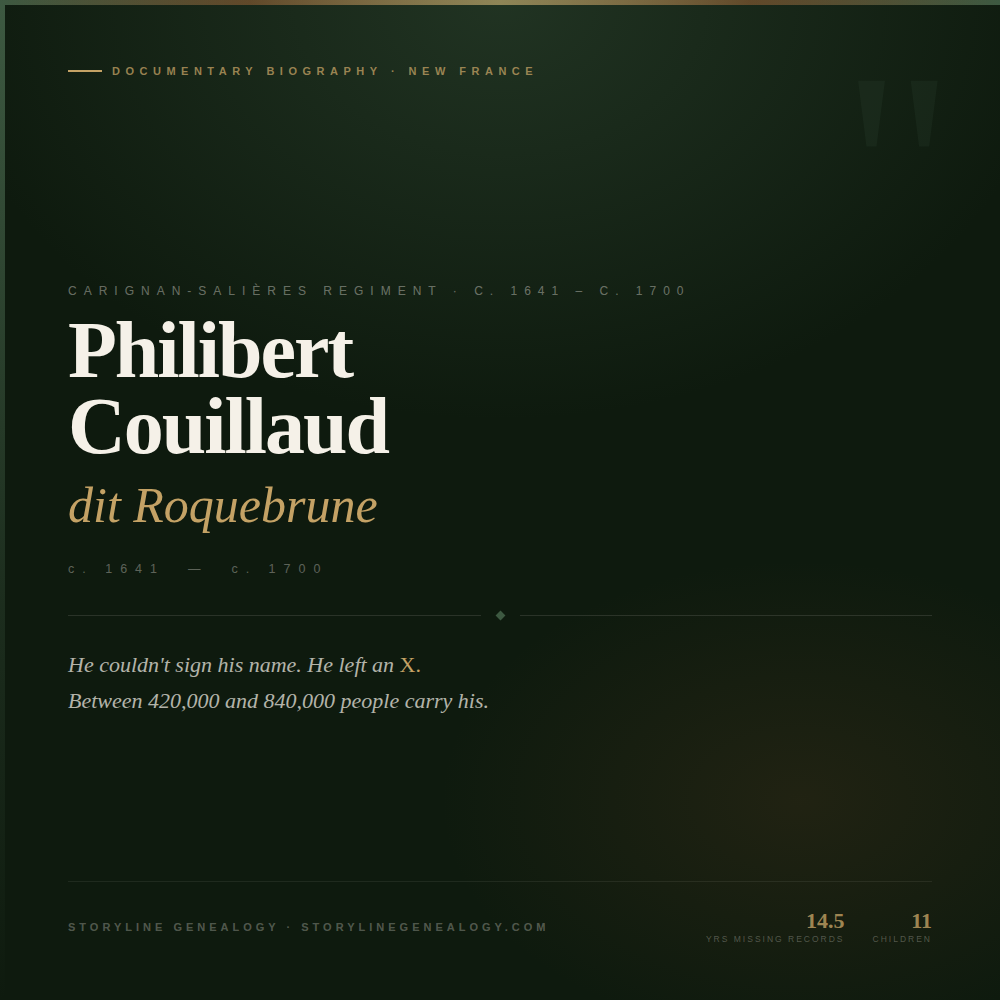
Philibert Couillaud dit Roquebrune: The Soldier from Nevers
He could not read or write. No birth record survives. No marriage record. No death record. What survives is an X on a debt ledger, a name in a bishop's register, six acts before four named notaries, and a cascade of lawsuits filed by the widow he left behind. From these fragments — a life emerges.
Part of the Storyline Genealogy series: Carignan-Salières — From Soldiers to Settlers
Antoine Leblanc dit Jolicoeur & Elisabeth Roy
In December 1687, a thirty-eight-year-old soldier called "Cheerful Heart" was buried at Saint-Jean, Île d'Orléans. Antoine Leblanc dit Jolicoeur had crossed the Atlantic as a teenager in the Carignan-Salières Regiment, married a Fille du Roi from Senlis, raised five children, and buried two of them in a single grave. Through parish registers, notarial acts, census records, and military rosters, this documentary biography reconstructs eighteen years of life on an island in the St. Lawrence — from 63 primary source documents with Evidence Explained citations.
Part of the Storyline Genealogy series: Carignan-Salières — From Soldiers to Settlers

The Other Pierre Morin
There is a second Pierre Morin in the Carignan-Salières Regiment. He was born about 1643 in the diocese of Saintes, he was confirmed at Fort Chambly in May 1668, and by 1681 he was working a Sulpician domain at Lachine. He never married in the colony and left no descendants. Here is his record set out in his own right: one confirmation, one database reconstitution, and a great deal that has been attributed to him rather than documented.
Part of the Storyline Genealogy series: From Research to Story
How to Prove Carignan-Salières Service — and How to Know When You Haven't
You've traced your line to a man who married a Fille du Roi, and half a dozen trees call him a Carignan-Salières soldier. The sources aren't there. Here's the framework I use — and the citation-counting failure in my own published work that took a year and a new book to notice.
Part of the Storyline Genealogy series: From Research to Story

André Corbeil dit Tranchemontagne
In 1684, a young soldier from Saintonge stepped off a ship at Québec carrying a name that would outlive him by centuries. "Tranchemontagne" — the Mountain-Slasher — was not a family name. It was a declaration. Here is the story of André Corbeil and the military nickname culture that transformed European recruits into something entirely new.
Part of the Storyline Genealogy series: Uncovering the stories behind the names that built New France.
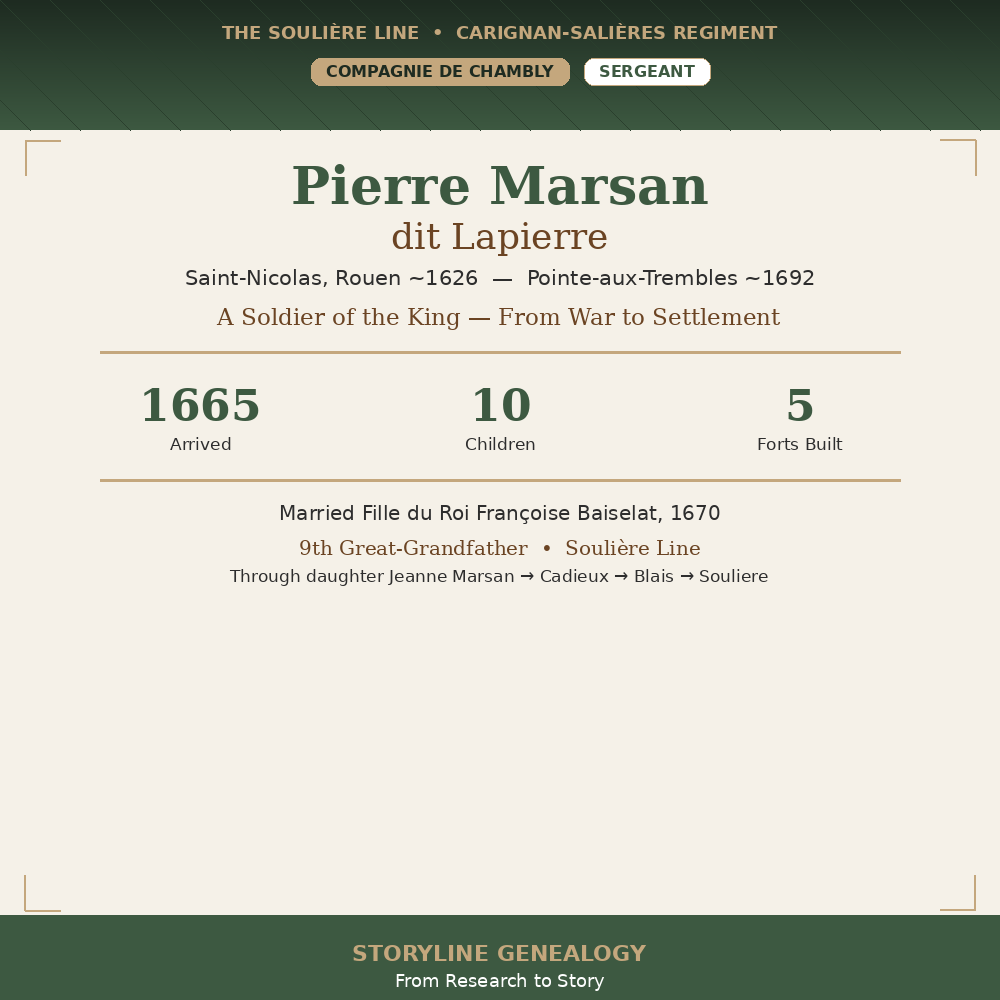
Pierre Marsan dit Lapierre: Carignan-Salières Regiment
Long before he became a husband, father, and ancestor rooted in Canadian soil, Pierre Marsan dit Lapierre was a soldier shaped by discipline and uncertainty. When he embarked from La Rochelle in April 1665 aboard the Vieux Siméon, he joined hundreds of men bound for a distant colony few in France could imagine. As a sergeant in the Company of Captain Jacques de Chambly, Pierre arrived not as a settler seeking fortune, but as part of a royal strategy: the deployment of professional troops to stabilize New France and secure it against the Iroquois nations whose raids had long threatened its survival. His rank set him apart—older, experienced, and entrusted with the daily weight of command. Part of the Storyline Genealogy series: Documentary Biographies From Research to Story
Part of the Storyline Genealogy series: Carignan-Salières — From Soldiers to Settlers
Finding an Italian Ancestor in French-Canadian Research
When you're deep in French-Canadian genealogy, the last thing you expect to find is an Italian. But a dit name—Lepiedmontois, "the Piedmontese"—revealed a soldier from Racconigi, Italy, hiding in plain sight among 10,000 French settlers. Out of the founding immigrants of New France, over 95 percent were French. Italian permanent settlers were among the rarest of the rare. This is the story of how one dit name unraveled the assumption of a purely French founding population—and what it means for your research.
Part of the Storyline Genealogy series: French-Canadian Genealogy — From Research to Story
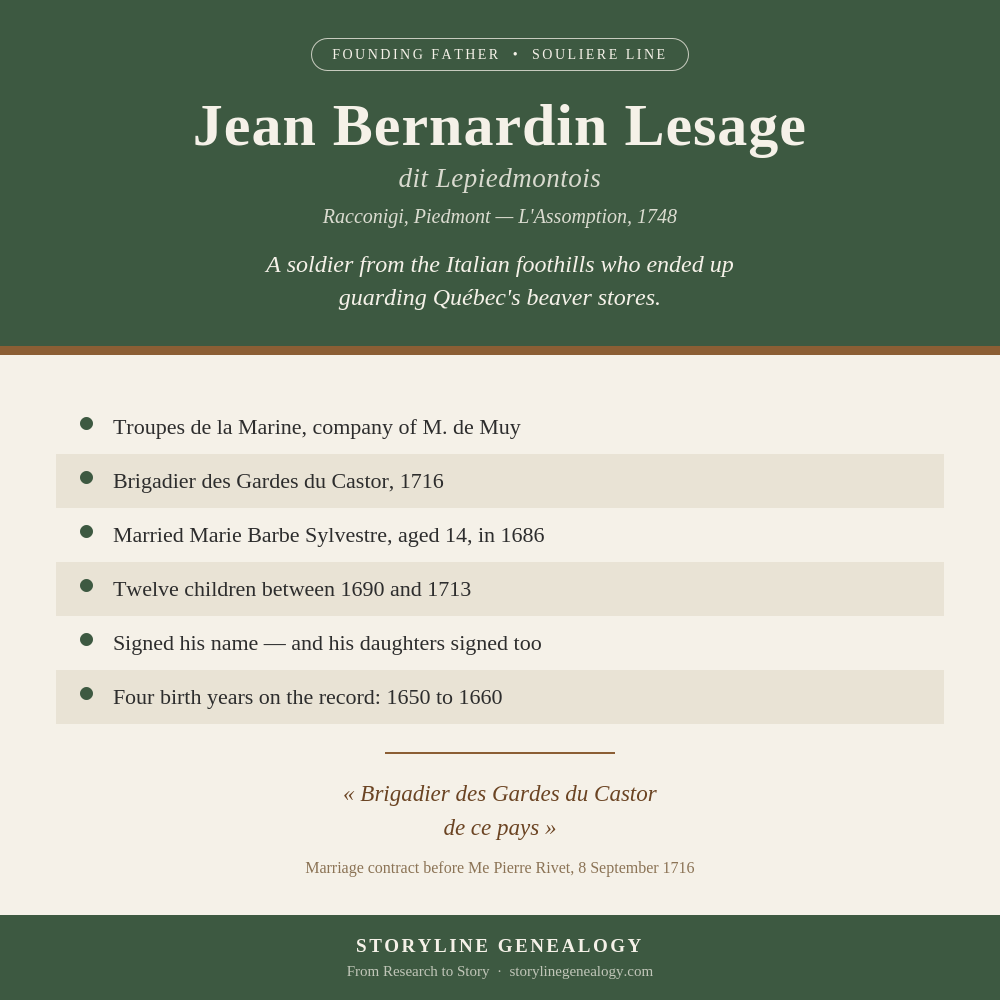
Jean Bernardin Lesage dit Lepiedmontois
In September 1716 a notary at Québec wrote down Jean Bernardin Lesage's occupation: brigadier of the beaver guards. The Piedmontese soldier who had married a fourteen-year-old at Neuville thirty years earlier had left the ranks for a post in the town — and he signed the contract, in a colony where his wife's own mother could not sign hers. Twelve children, four different birth years on the record, and a bishop's dispensation two generations on.
Part of the Storyline Genealogy series: From Soldier of the Troupes de la Marine to Settler.
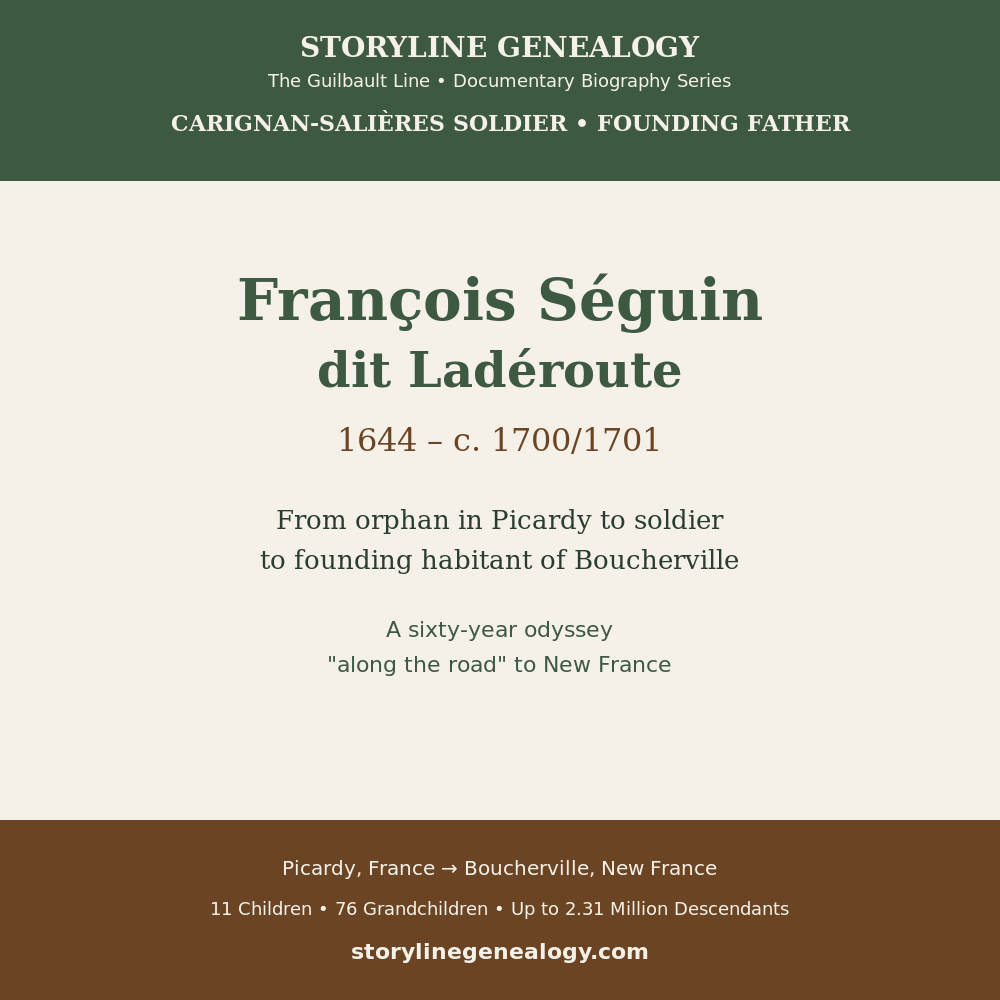
François Séguin dit Ladéroute: Carignan Soldier, Weaver, and Settler of Boucherville
François Séguin dit Ladéroute came from the region of Bray, west of Beauvais, in the former province of Picardy. Orphaned at age six when his mother Marie Massieu died, he enlisted in the Carignan-Salières Regiment and arrived in New France aboard the Saint-Sébastien on September 12, 1665. After marrying Fille du Roi Jeanne Petit in 1672, he settled at Boucherville as a weaver, raising 11 children. Today, his descendants number between 1.89 and 2.31 million people.
Part of the Storyline Genealogy series: Carignan-Salières — From Soldiers to Settlers