
The Storyline
Real families. Real discoveries. Real stories.
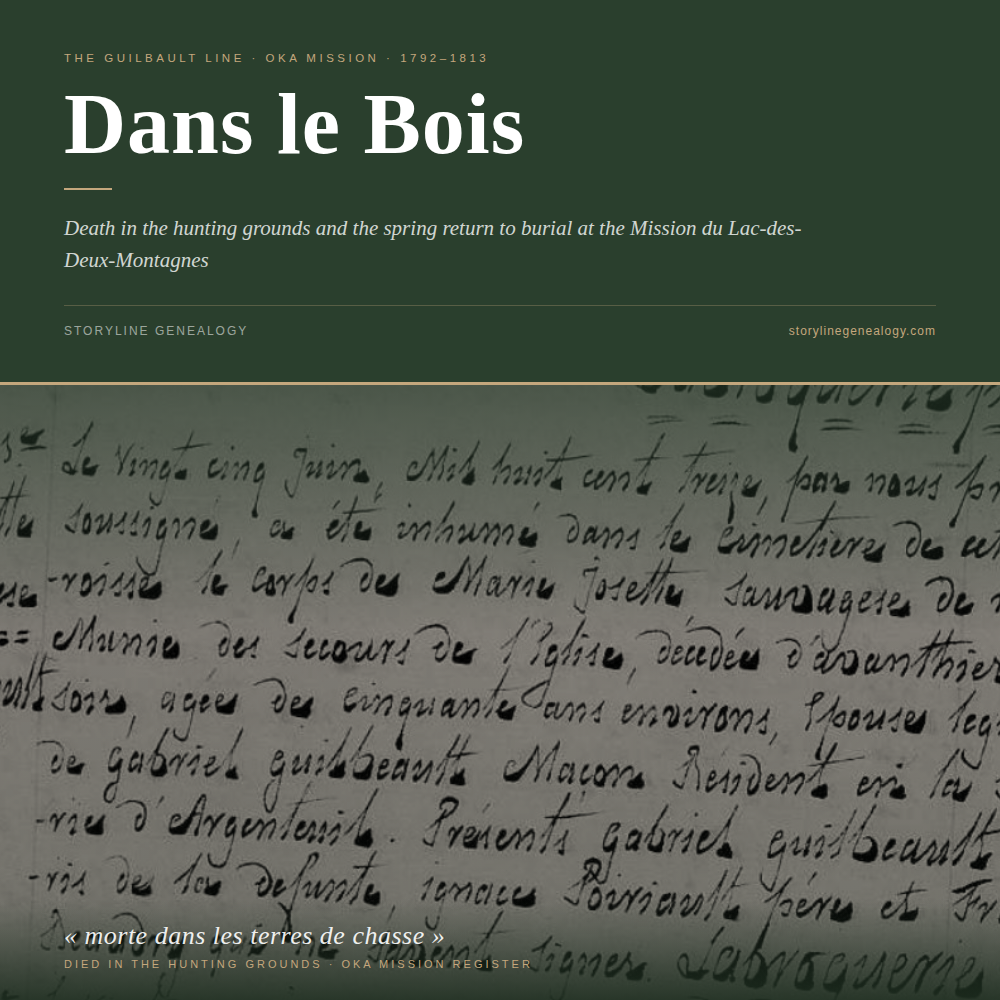
Dans le Bois: Death in the Hunting Grounds
Scattered through the Oka Mission parish registers, in the handwriting of three different priests across three decades, a phrase appears and reappears: mort dans le bois. Died in the woods. Décédée dans les terres de chasse. Died in the hunting grounds. These are not euphemisms. They are geographic facts — and once a researcher understands what they mean, the burial records of the Mission du Lac-des-Deux-Montagnes open up in an entirely different way.
Part of the Storyline Genealogy series: The Guilbault Line: At the Lake of Two Mountains
A Name Written in Cedar and Sky
On 27 May 1786, a priest at the Oka Mission wrote down two names on the same register page, one above the other, and did not remark on what they shared. Both women bore the root kijik — cedar, sky, day, medicine — in their names. Over the next ninety-eight years, fifty-five individuals across five Anishinaabe nations would carry that root through the registers of the Lake of Two Mountains mission. This piece traces where the name came from, who carried it, and how a single act of godparenthood preserved it for generations.
Part of the Storyline Genealogy series: The Guilbault Line: At the Lake of Two Mountains
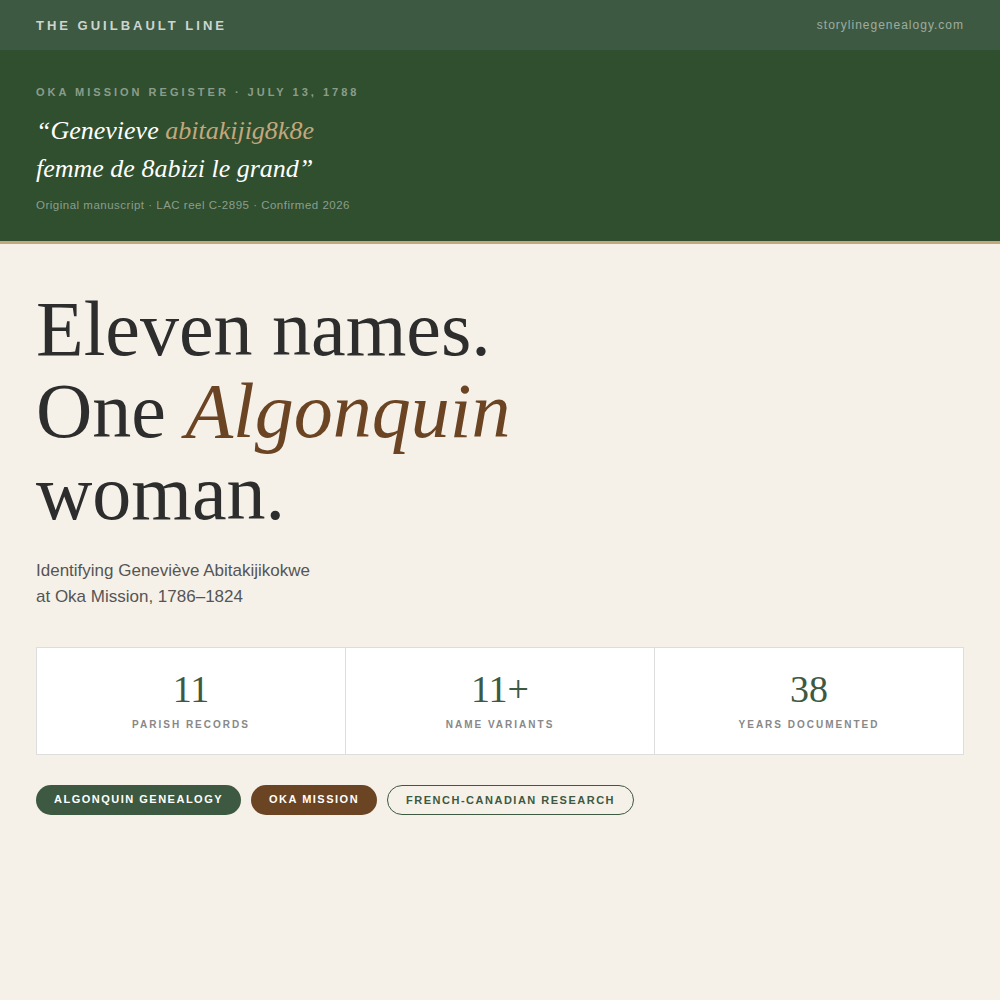
Geneviève Abitakijikokwe: Eleven Name Variants
Her name was written ten different ways across thirty-eight years of Oka Mission registers. The woman behind those names — Geneviève Abitakijikokwe, wife of the Algonquin war chief Kitchiwabisi — appears in eleven primary records between 1786 and 1824. Identifying her required going beyond the published indexes to the original manuscript. What I found there changed the entire shape of the problem.
Part of the Storyline Genealogy series: The Guilbault Line: At the Lake of Two Mountains
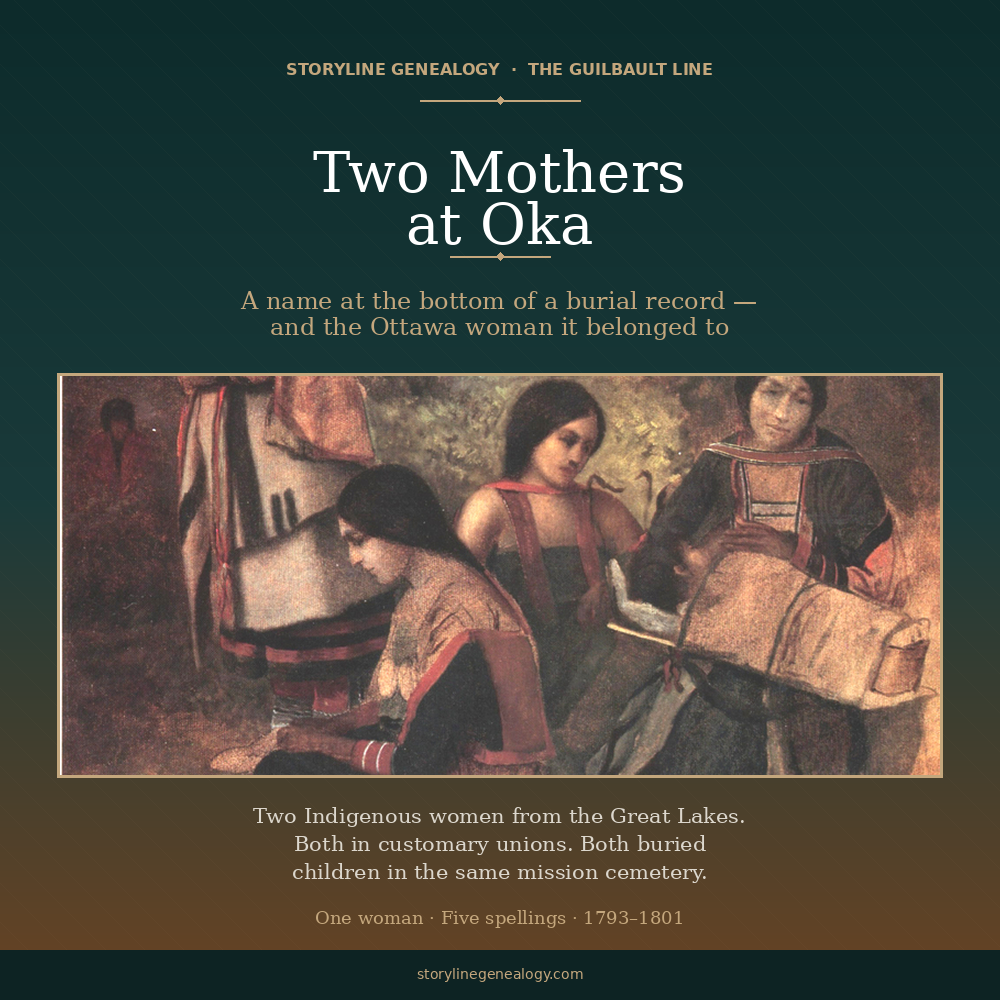
Two Mothers at Oka: Identifying Catherine Messinabikwe
On April 4, 1801, a priest at the Oka mission buried a two-year-old boy named François. Two witnesses were present: the boy's ten-year-old brother, and a woman the priest recorded as Catherine mesepik8e. She was not identified as a relative. She was simply there. Tracing her Algonquian name across five colonial spellings — Mador, Mabre, Missinebi8e, mesepik8e, Messinabikwe — revealed an Ottawa woman from Michilimackinac who had buried her own daughter in the same cemetery two years earlier.
Part of the Storyline Genealogy series: The Guilbault Line: At the Lake of Two Mountains
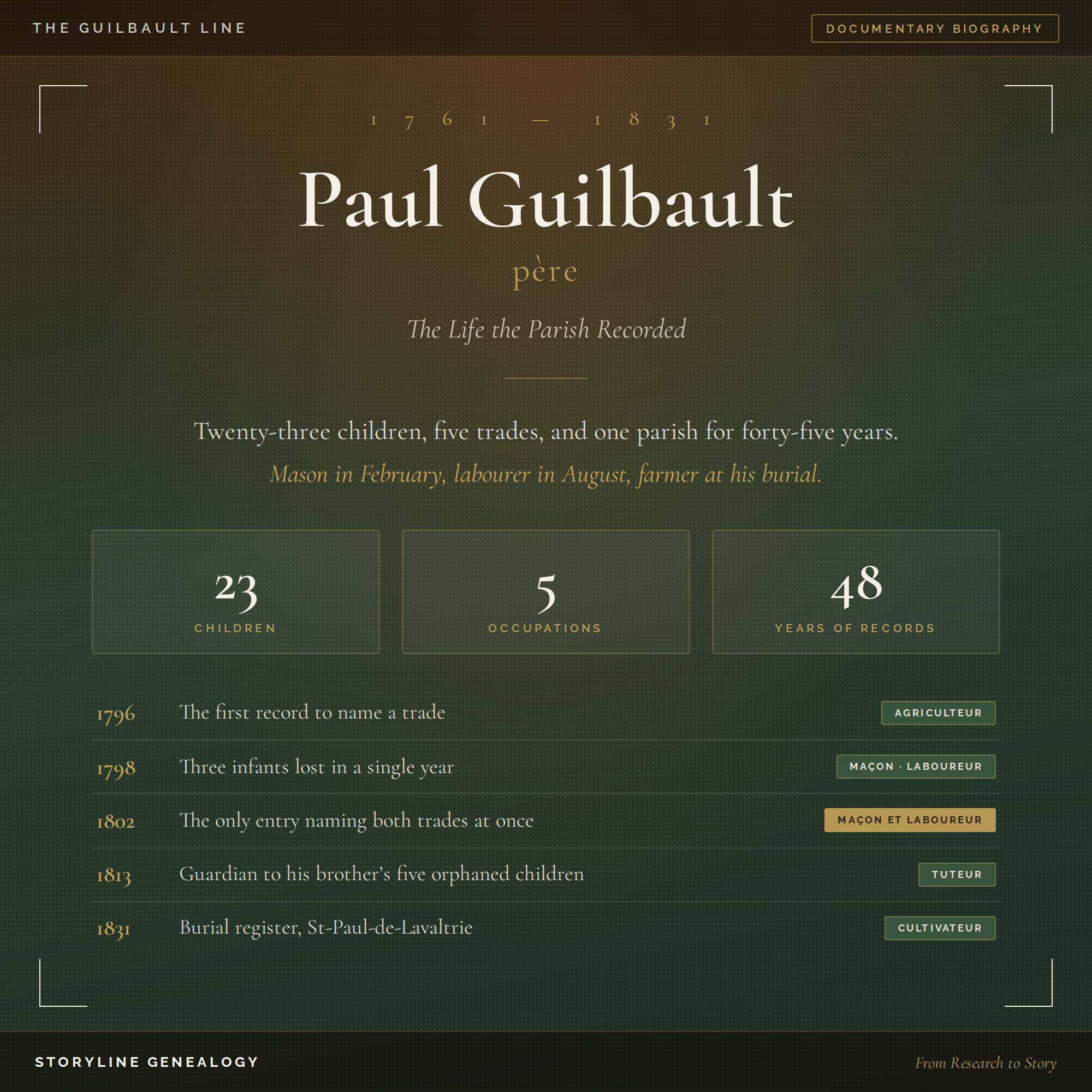
Paul Guilbault père
For forty-five years the priests of St-Paul-de-Lavaltrie wrote down what Paul Guilbault was, every time something happened to him or to one of his twenty-three children. In February 1810 he was a mason. By August he was a labourer. At his burial in 1831 he was a farmer, and fourteen months after his death a priest wrote him down as a farmer again. This is the documentary biography of a man whose parish record is so complete it can be used to test claims made about him elsewhere.
Part of the Storyline Genealogy series: The Guilbault Line
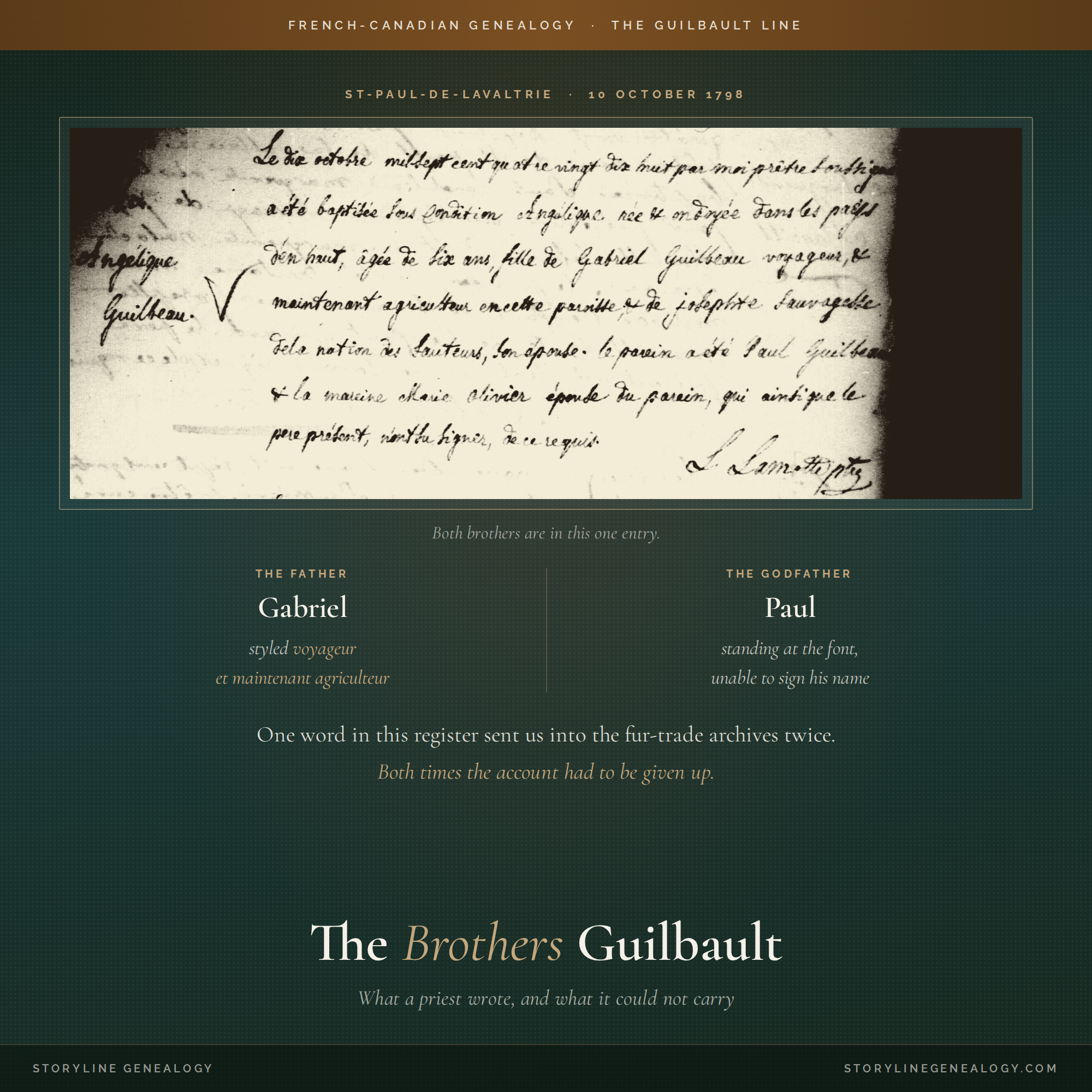
The Brothers Guilbault
On 10 October 1798, a priest at St-Paul-de-Lavaltrie baptized a six-year-old girl born in the pays d'en haut. In the same entry he named her father Gabriel Guilbault a voyageur, and her godfather Paul Guilbault — Gabriel's brother — as a man who could not sign his name. That one word sent this research into the Hudson's Bay Company Archives twice, once for each brother. Both times an account was found. Both times it had to be given up.
Part of the Storyline Genealogy series: The Guilbault Line
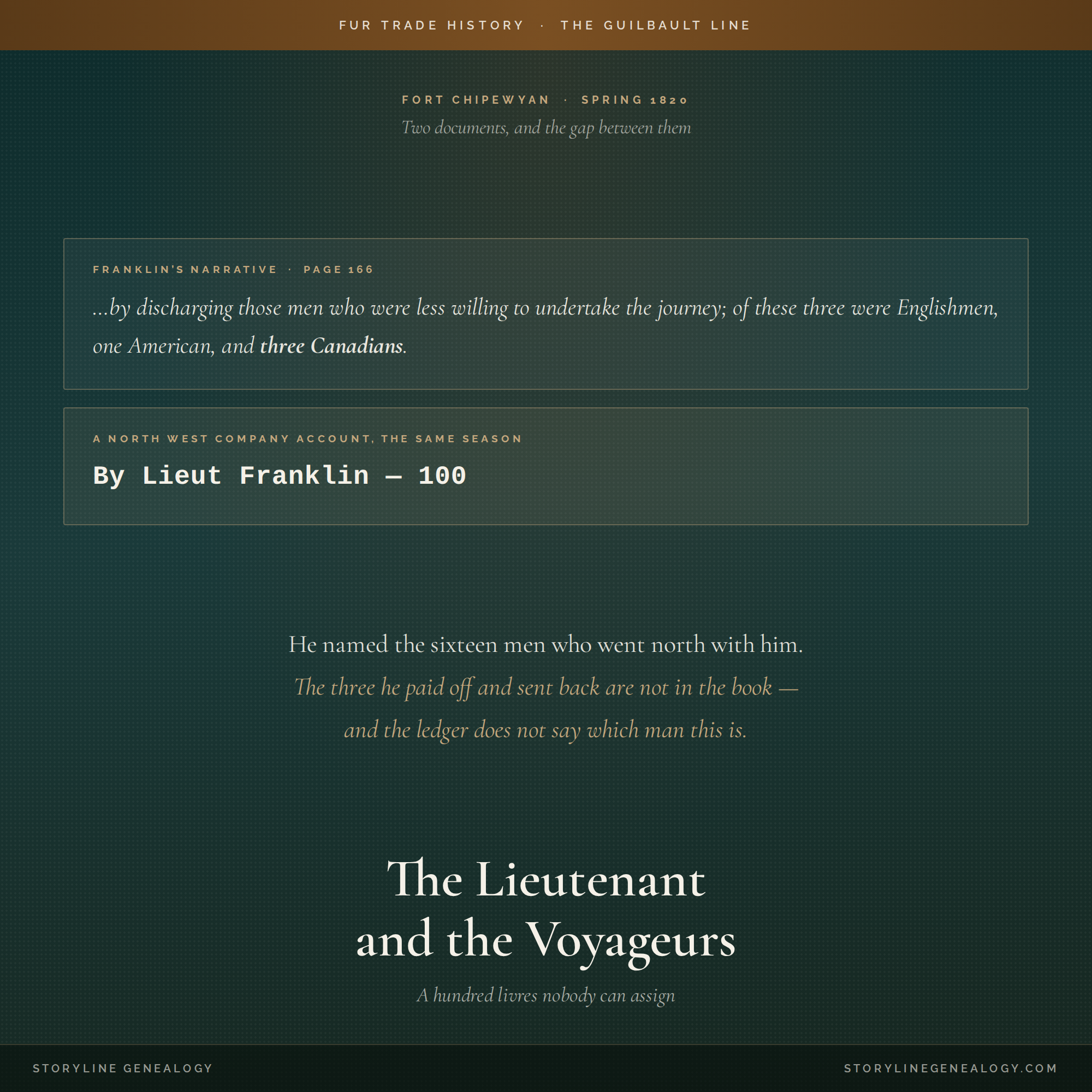
The Lieutenant and the Voyageurs
In the spring of 1820, Lieutenant John Franklin spent four months at Fort Chipewyan trying to hire French-Canadian voyageurs willing to paddle him toward an unmapped Arctic coast. Some agreed. Some refused — sensibly, since a North West Company crew had recently been killed in the same country. And in July, before the party went north, Franklin discharged three Canadians and paid them off. He named the sixteen who went. He did not name the three who didn't, and one line in a company ledger may be all that survives of one of them.
Part of the Storyline Genealogy series: From Research to Story
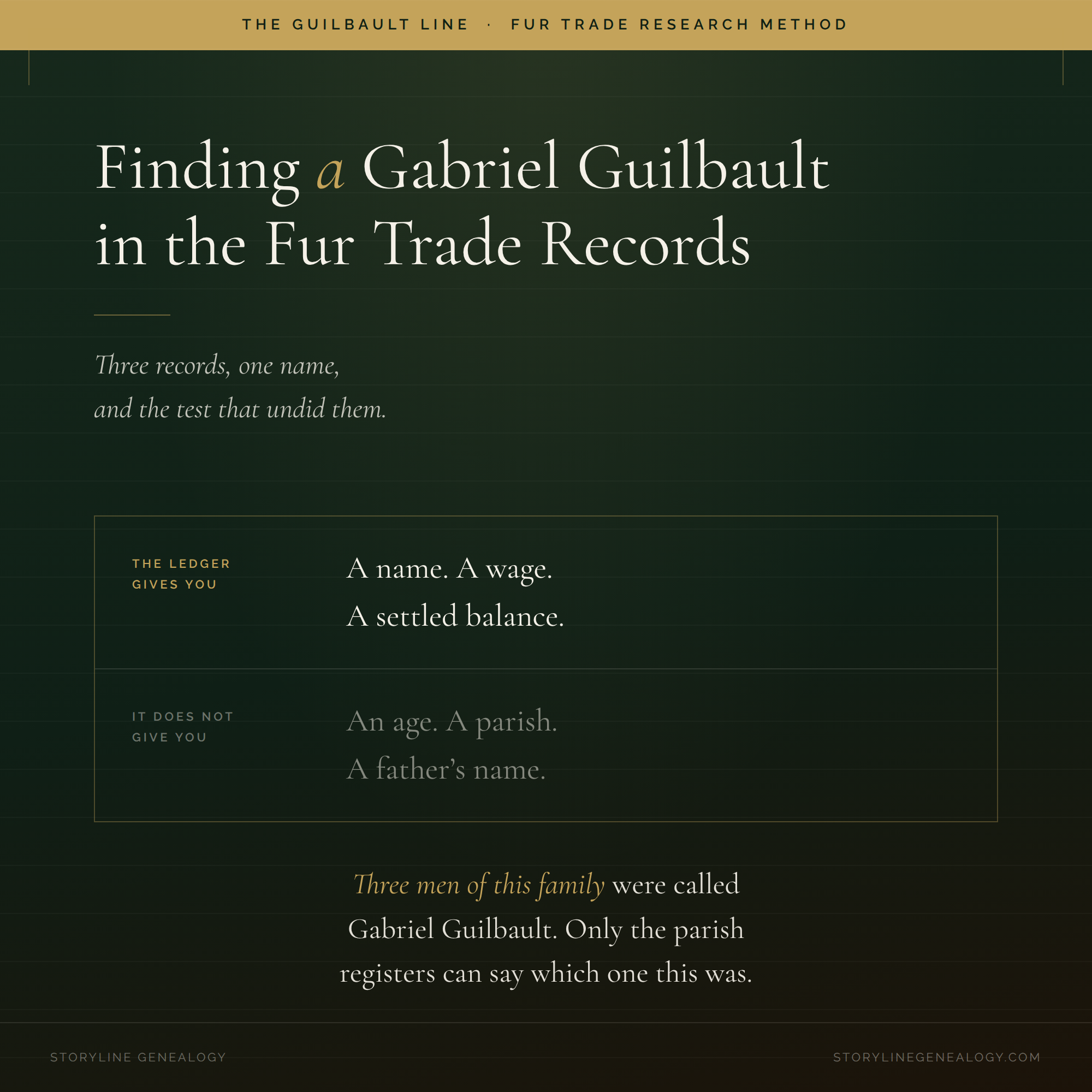
Finding a Gabriel Guilbault in the North West Company Records
A fur trade account book gives you a name and a number. No age, no parish, no father's name. This is how I found Gabriel Guilbault in the North West Company records — three volumes, a cross-post balance, an account marked settled — and how the parish registers later showed the man I had found was not the man I thought. The search method still works. It's the sixth step that decides it.
Part of the Storyline Genealogy series : A Research Journey From the Index to the Account Book
Sainte-Trinité-de-Contrecoeur: The Parish That Burned — and What Survived
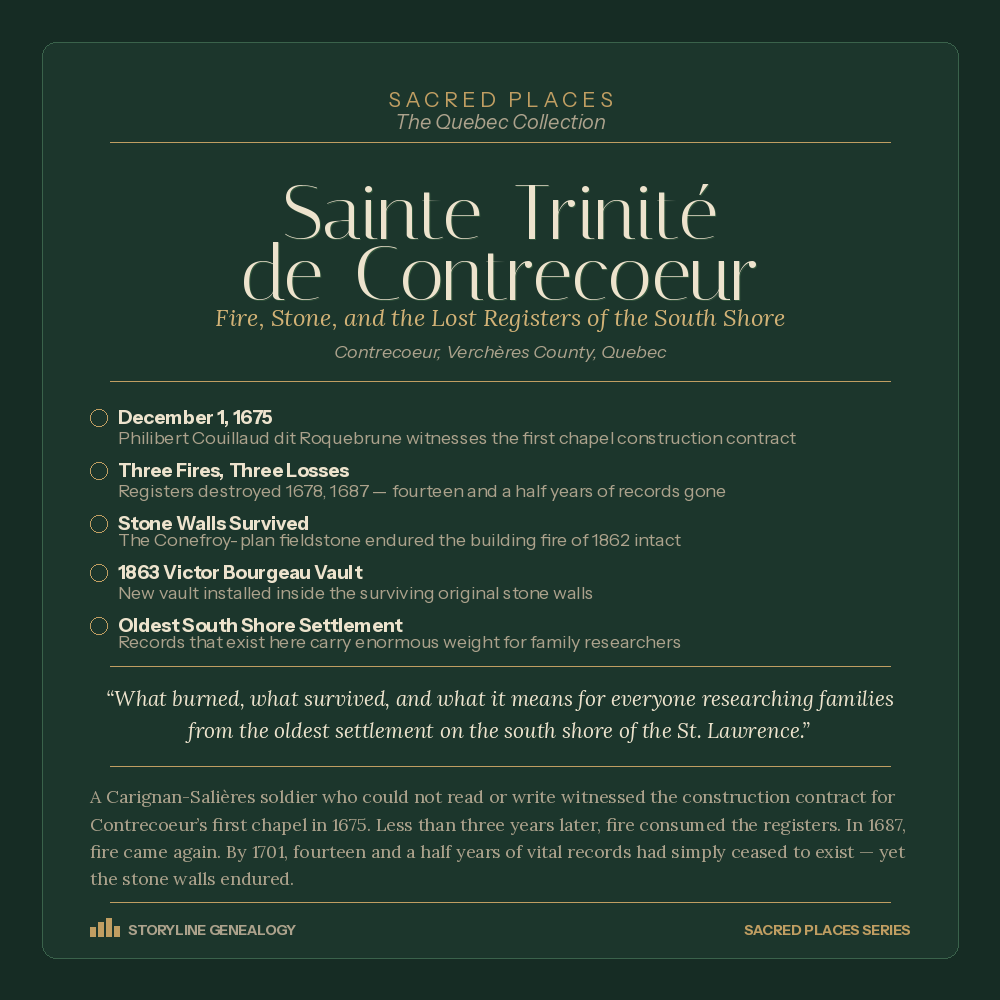
On December 1, 1675, Philibert Couillaud dit Roquebrune — a former Carignan-Salières soldier who could not read or write — stood before a notary in Contrecoeur and witnessed the construction contract for the community's first chapel. Less than three years later, fire consumed the parish registers kept in a surgeon's house. In 1687, fire consumed them again. By 1701, fourteen and a half years of baptisms, marriages, and burials had simply ceased to exist. But the stone walls built according to the Conefroy plan — thick fieldstone, engineered to survive — held through the building fire of 1862, and were rebuilt around a new Victor Bourgeau vault in 1863. This is the story of Sainte-Trinité-de-Contrecoeur: what burned, what survived, and what it means for everyone researching families from the oldest settlement on the south shore of the St. Lawrence.
Part of the Storyline Genealogy series : Sacred Places
Philibert Couillaud dit Roquebrune: The Soldier from Nevers
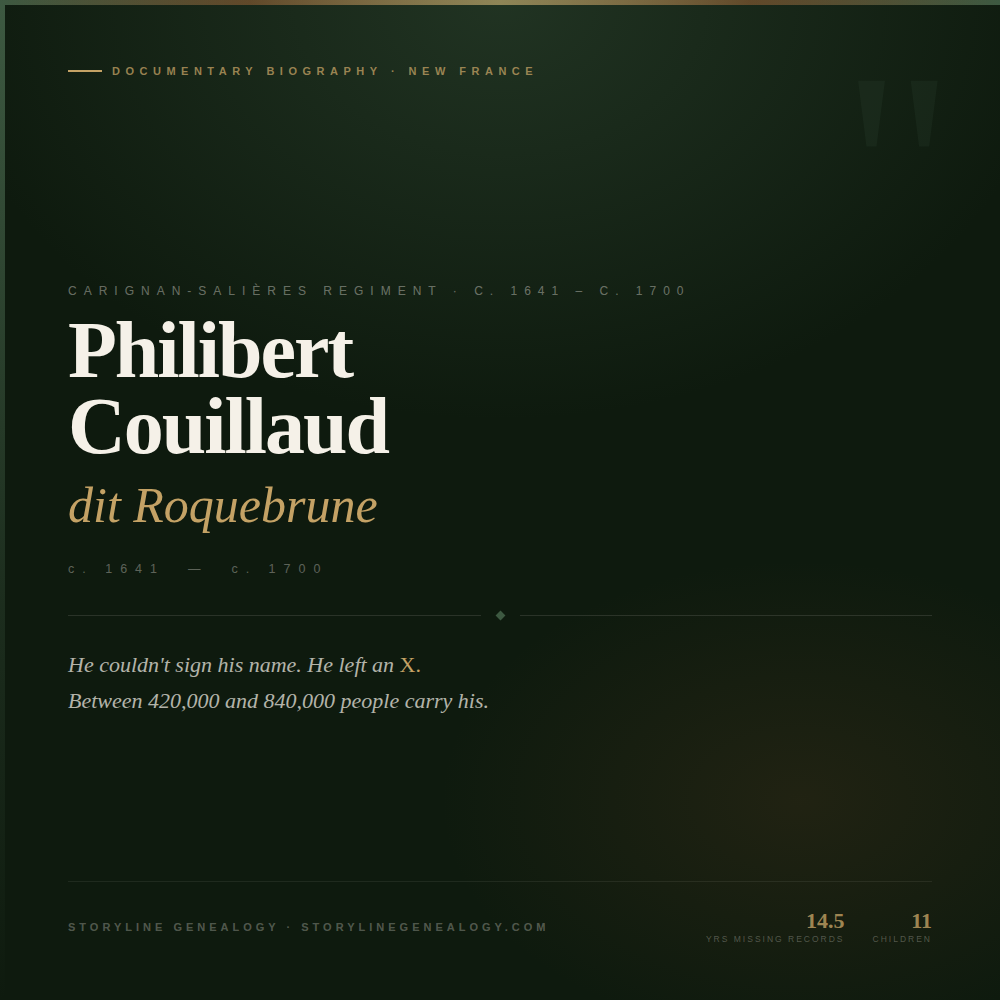
He arrived in New France in 1665 as a soldier who could not read or write, settled in the Seigneurie de Contrecoeur, and died sometime before 1701 — leaving no birth record, no marriage record, and no death record. Two parish fires destroyed fourteen and a half years of documentation. A fraudulent noble pedigree confused researchers for generations. What survived was an X on a debt ledger, five baptism entries scattered across four parishes, a handful of notarial obligations, and a cascade of lawsuits filed by the widow he left behind. This is his story — in twelve chapters, from the regiment's arrival to the 1728 legal document that recovered the last known terms of the marriage contract that no longer exists.
Part of the Storyline Genealogy series: Carignan-Salières — From Soldiers to Settlers
Élisabeth Roy (Le Roy): Fille du Roi with Three Marriages
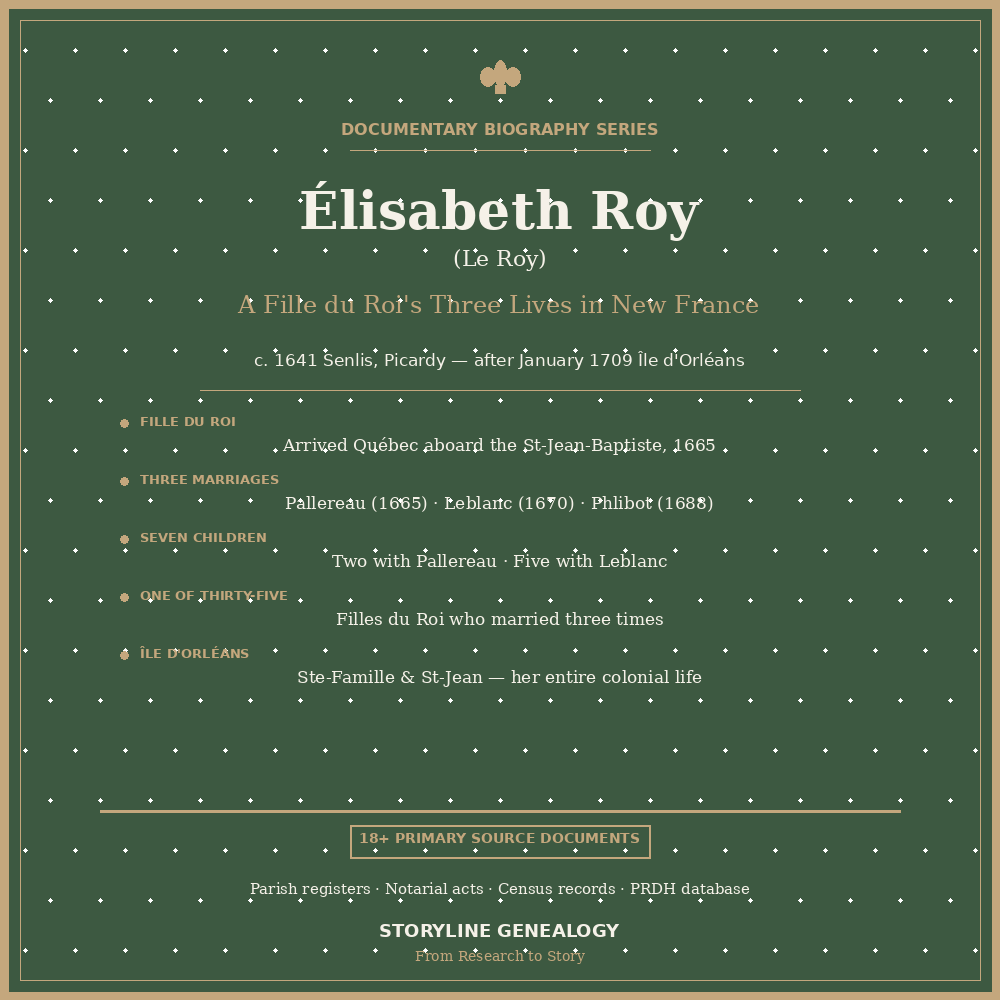
In the spring of 1665, an orphaned young woman from Senlis in Picardy boarded a ship called the St-Jean-Baptiste and sailed for a colony she had never seen. Élisabeth Roy was one of approximately 800 Filles du Roi sent to New France — and one of only thirty-five who would marry three times. Through parish registers, notarial acts, census records, and the PRDH database, this documentary biography follows her from the walled medieval town of her birth to the parishes of Île d'Orléans, where she buried two husbands, lost two sons on the same day, raised seven children across three marriages, and lived to nearly seventy — a founding mother of French Canada.
Part of the Storyline Genealogy series: Filles du Roi & Filles à Marier — The Women Who Built New France
Antoine Leblanc dit Jolicoeur & Elisabeth Roy
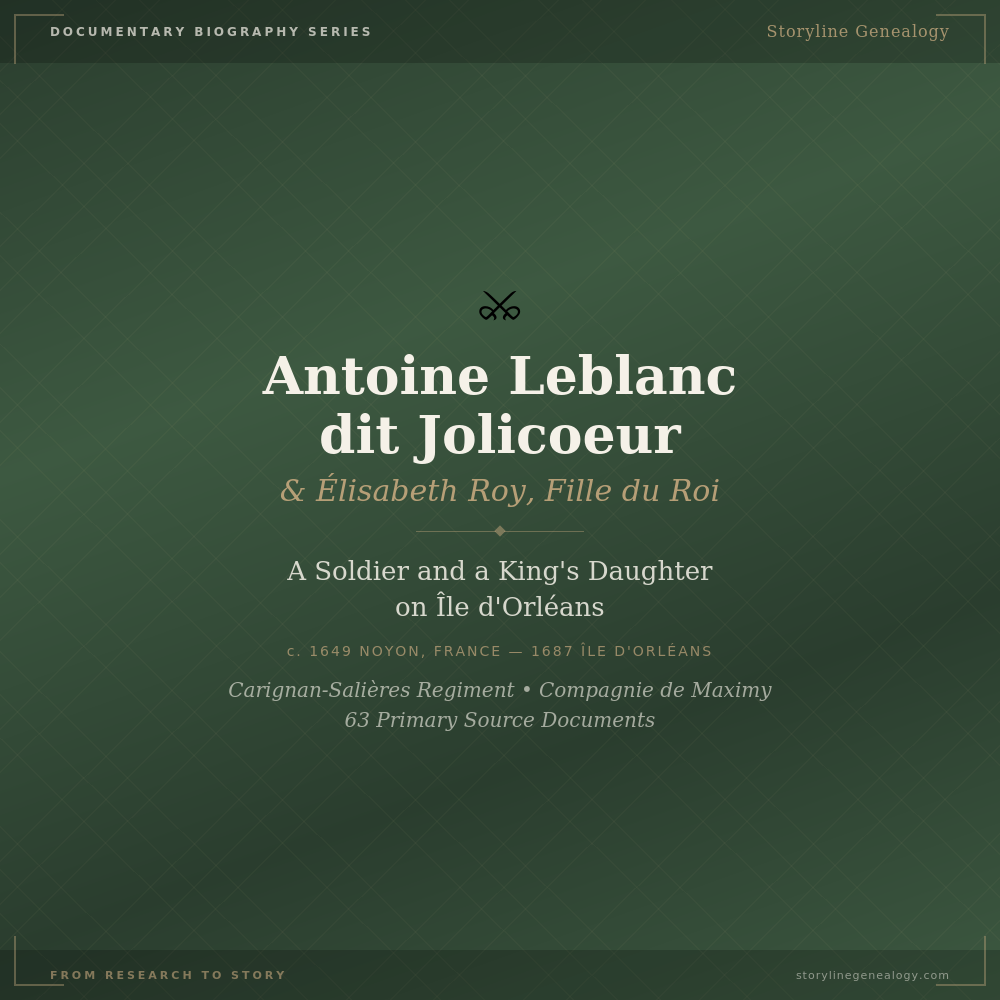
In December 1687, a thirty-eight-year-old soldier called "Cheerful Heart" was buried at Saint-Jean, Île d'Orléans. Antoine Leblanc dit Jolicoeur had crossed the Atlantic as a teenager in the Carignan-Salières Regiment, married a Fille du Roi from Senlis, raised five children, and buried two of them in a single grave. Through parish registers, notarial acts, census records, and military rosters, this documentary biography reconstructs eighteen years of life on an island in the St. Lawrence — from 63 primary source documents with Evidence Explained citations.
Part of the Storyline Genealogy series: Carignan-Salières — From Soldiers to Settlers

The Other Pierre Morin
There is a second Pierre Morin in the Carignan-Salières Regiment. He was born about 1643 in the diocese of Saintes, he was confirmed at Fort Chambly in May 1668, and by 1681 he was working a Sulpician domain at Lachine. He never married in the colony and left no descendants. Here is his record set out in his own right: one confirmation, one database reconstitution, and a great deal that has been attributed to him rather than documented.
Part of the Storyline Genealogy series: From Research to Story
How to Prove Carignan-Salières Service — and How to Know When You Haven't
You've traced your line to a man who married a Fille du Roi, and half a dozen trees call him a Carignan-Salières soldier. The sources aren't there. Here's the framework I use — and the citation-counting failure in my own published work that took a year and a new book to notice.
Part of the Storyline Genealogy series: From Research to Story
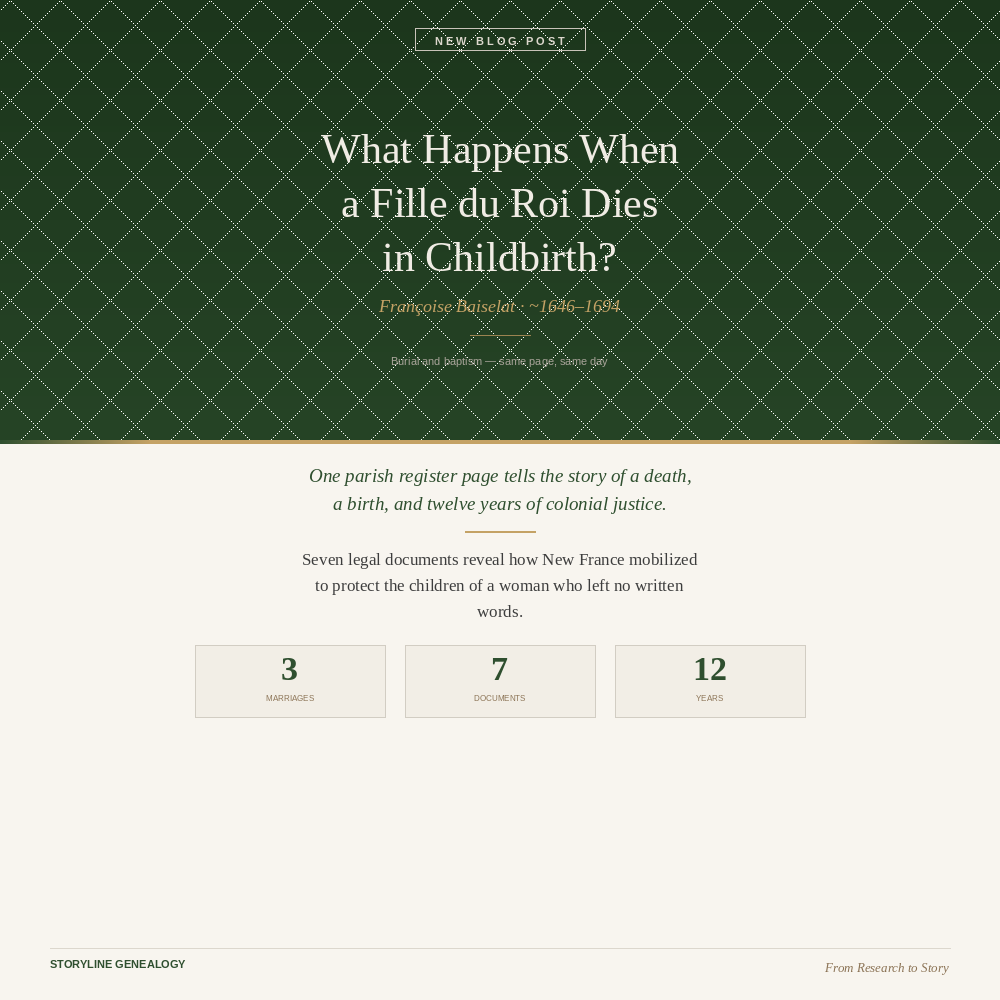
What Happens When A Fille du Roi Dies in Childbirth?
On May 30, 1694, a curé recorded a burial and a baptism on the same page of a parish register. What followed was twelve years of colonial justice — seven legal documents that reveal how New France protected the children of a woman who left no written words.
Part of the Storyline Genealogy series: From Research to Story

André Corbeil dit Tranchemontagne
In 1684, a young soldier from Saintonge stepped off a ship at Québec carrying a name that would outlive him by centuries. "Tranchemontagne" — the Mountain-Slasher — was not a family name. It was a declaration. Here is the story of André Corbeil and the military nickname culture that transformed European recruits into something entirely new.
Part of the Storyline Genealogy series: Uncovering the stories behind the names that built New France.
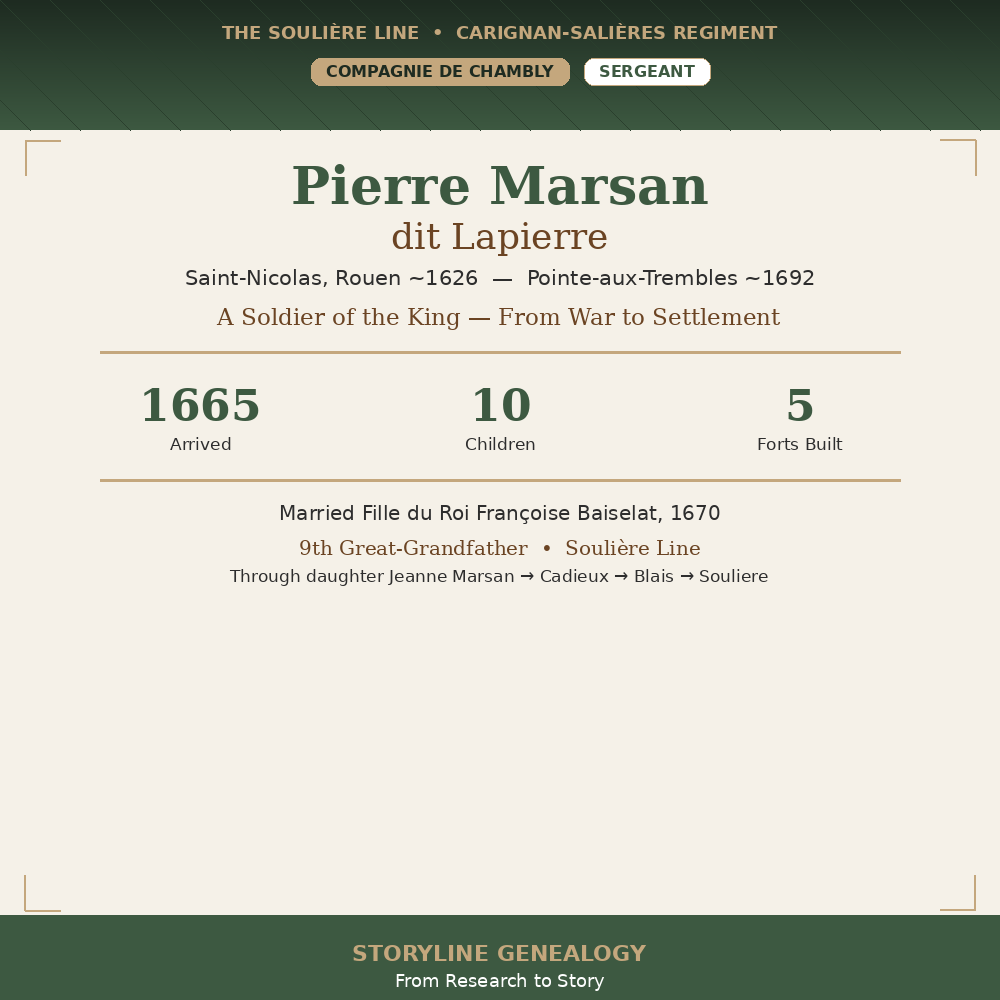
Pierre Marsan dit Lapierre: Carignan-Salières Regiment
Long before he became a husband, father, and ancestor rooted in Canadian soil, Pierre Marsan dit Lapierre was a soldier shaped by discipline and uncertainty. When he embarked from La Rochelle in April 1665 aboard the Vieux Siméon, he joined hundreds of men bound for a distant colony few in France could imagine. As a sergeant in the Company of Captain Jacques de Chambly, Pierre arrived not as a settler seeking fortune, but as part of a royal strategy: the deployment of professional troops to stabilize New France and secure it against the Iroquois nations whose raids had long threatened its survival. His rank set him apart—older, experienced, and entrusted with the daily weight of command. Part of the Storyline Genealogy series: Documentary Biographies From Research to Story
Part of the Storyline Genealogy series: Carignan-Salières — From Soldiers to Settlers
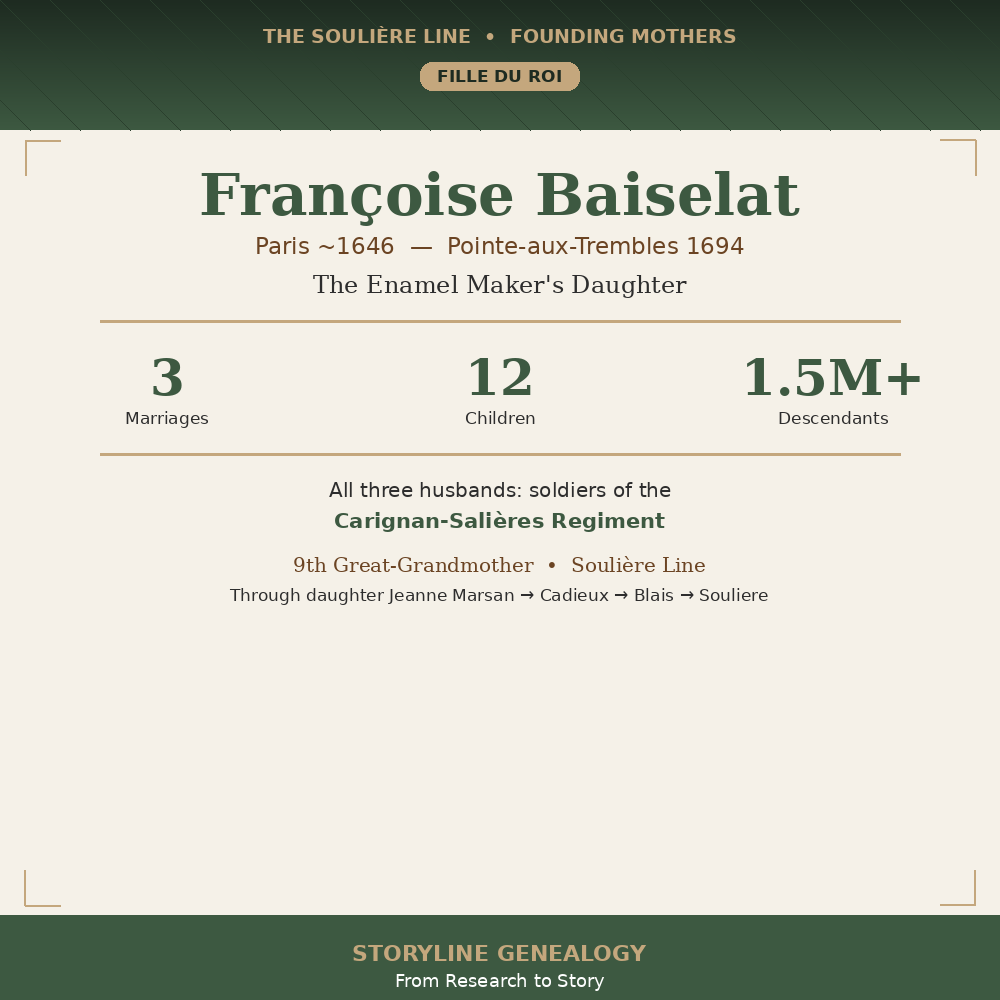
Françoise Baiselat: Wife of a Carignan-Salières
Françoise Baiselat was born about 1646 in the Rue Saint-Sauveur, Paris—the daughter of Benjamin Baiselat, a master enamel maker, and Claude Prou. In 1668, she left everything she knew and crossed the Atlantic as a Fille du Roi, carrying goods worth 300 livres for her dowry. What followed was a life shaped by the rhythms of the colony—three marriages, all to soldiers of the Carignan-Salières Regiment, twelve children across two families, and a quarter century at Pointe-aux-Trembles on Montreal Island. Today, between 1.1 and 1.5 million Quebecers descend through her Marsan line alone.
Part of the Storyline Genealogy series: Filles du Roi & Filles à Marier — The Women Who Built New France
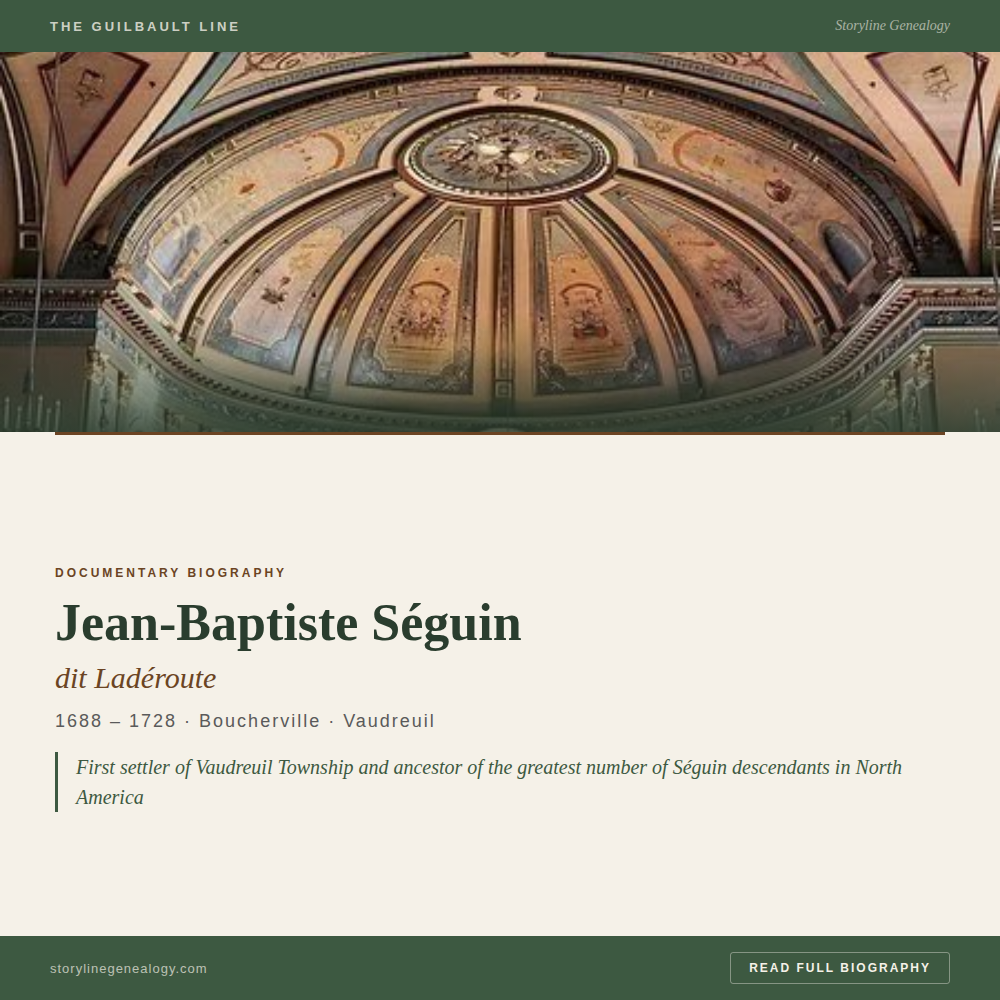
Jean-Baptiste Séguin dit Ladéroute
Born in the same Boucherville church where his father married a King's Daughter, Jean-Baptiste Séguin dit Ladéroute (1688–1728) became the first settler of Vaudreuil Township and left the greatest number of Séguin descendants in North America. This documentary biography traces his life through 53+ primary source documents — from the salt protest that tore his family apart to the mission church at Oka where his children built new lives.
Part of the Storyline Genealogy series: Documentary Biographies — From Research to Story
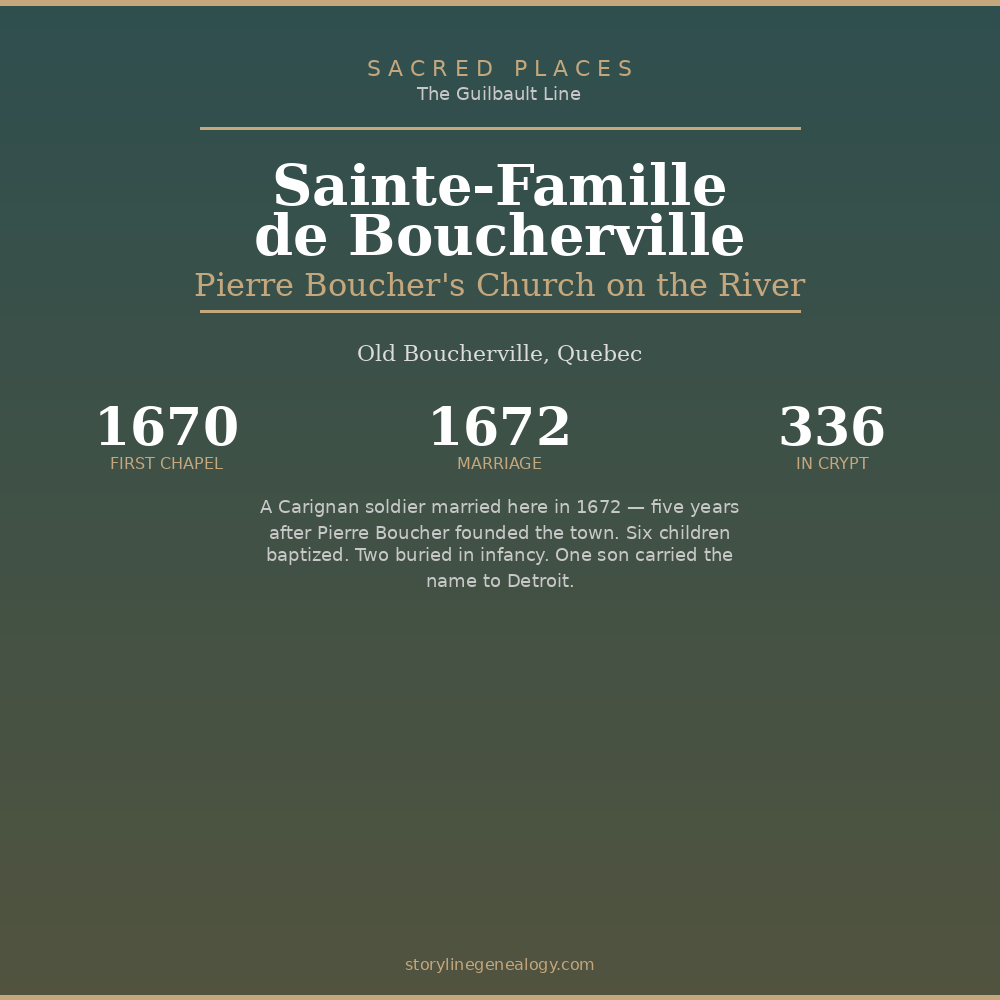
Sainte-Famille de Boucherville: Pierre Boucher's Church on the River
Sainte-Famille de Boucherville stands on land donated by Pierre Boucher himself — one of the most remarkable figures in early New France. On October 31, 1672, Carignan-Salières Regiment veteran François Séguin dit Ladéroute married Jeanne Petit in the original wooden chapel, just five years after the town was founded. Over the next two decades, the Séguin family filled the parish registers with baptisms and burials. Their son Jean-Baptiste, our direct ancestor, would carry the family name westward to the fur trade at Detroit.
Part of the Storyline Genealogy series : Sacred Places