
The Brothers Guilbault
The Brothers Guilbault
A priest at St-Paul-de-Lavaltrie wrote voyageur beside one brother’s name and nothing beside the other’s. That single word sent this research into the Hudson’s Bay Company Archives twice — once for each brother — and both times it came back with an account that had to be given up. This is what that cost, and what it taught.
Paul Guilbault was baptized at Notre-Dame-de-Montréal on 23 April 1761. His brother Gabriel arrived fourteen months later. Same parents — Gabriel Guilbault and Marie Charlotte Morin of L’Assomption. Same north shore of the St. Lawrence. Same world of farms and rivers and parish churches where a priest wrote down what you were every time something happened to you or your children.
On 10 October 1798, in one entry in one register, a priest wrote down that Gabriel was a voyageur. He never wrote it about Paul. Not once, in any document, across either man’s whole life.
That asymmetry looked, for a long time, like the beginning of a good story: one brother whose trade the records preserved, one whose they erased. It turned out to be the beginning of two mistakes.
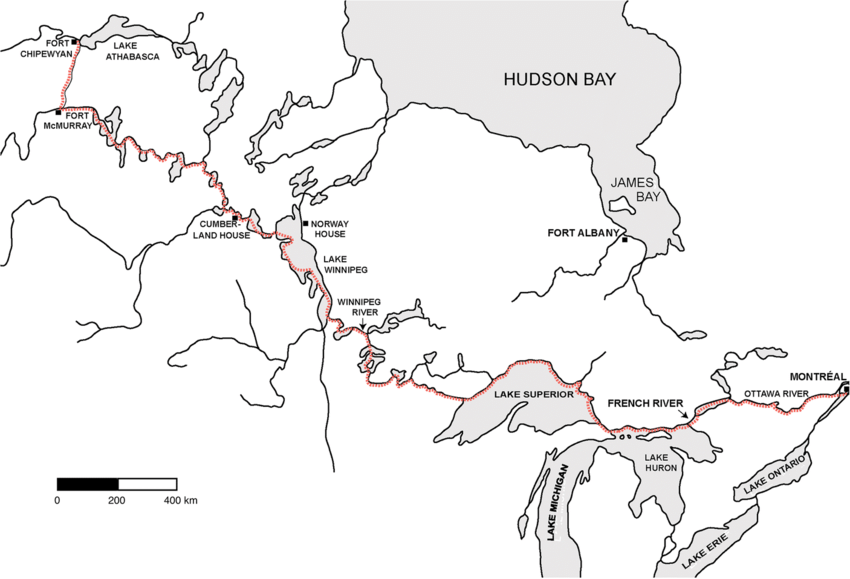
The voyageurs’ highway: over 3,000 miles of canoe route from Montreal to Fort Chipewyan on Lake Athabasca. Gabriel Guilbault worked the interior in the 1790s — three of his children were born in the pays d’en haut. How far up this route he went, and whether his brother Paul ever travelled it at all, are questions the records do not answer.
The Word Itself
10 October 1798, St-Paul-de-LavaltrieGabriel came down from the interior that autumn with three children who had been born there and given emergency baptism on the spot. The ceremonies were supplied conditionally at the parish church — Gabriel fils at eight years, Joseph Claude at sixteen months, and Angélique at six. The priest recorded their father in a phrase that has done more work in this research than any other five words.
…a été baptisée sous condition Angélique, née et ondoyée dans les pays d’en haut, âgée de six ans, fille de Gabriel Guilbeau voyageur, & maintenant agriculteur en cette paroisse, & de Josephte Sauvagesse de la nation des hauteurs, son épouse. Le parrain a été Paul Guilbeau & la marraine Marie Olivier épouse du parrain, qui ainsi que le père présent, n’ont su signer, de ce requis.
Read it again and notice that both brothers are in it. Gabriel is the father, described as a voyageur and now a farmer. Paul is the godfather, standing beside his wife at the font, and neither of them could write their name.
One entry, two brothers, and in the end it would be used against both of them.
Two Searches, Two Withdrawals
What the company archives gave, and what the parish registers took backThe word voyageur sent this research to the Hudson’s Bay Company Archives looking for Gabriel. Finding an account under his name there felt like confirmation. Paul’s complete silence in the Quebec record then suggested the opposite kind of search — a hidden career the parish system had failed to notice — and an account turned up for him too.
Both accounts have since been given up, and for the same reason in different clothes.
Named a Voyageur, and Excluded From the Ledger
His interior career is real. Three of his children were born in the pays d’en haut, the eldest around 1790, and his wife is described in the registers as de la nation des hauteurs. That is documented by where his family came from, not by any company book.
A ledger account at folio 414 was attributed to him: five annual wages, 1817 to 1821, closing at 336. The parish registers took it away. They place Gabriel père at Rigaud in June 1819 and declaring in person at Saint-Eustache in February 1821 — both inside the account’s own wage years. He could not have been in the interior drawing those wages. Who held folio 414 remains unknown; two candidates are still open.
Never Named a Voyageur, and Never One
Five occupation designations appear across nearly fifty years of Quebec records — maçon, laboureur, agriculteur, cultivateur, and once maçon et laboureur together. The word voyageur appears in none of them.
That silence was read as concealment, and a North West Company career was attached to him: two engagements, an Athabasca account, a settlement of 617 livres 14 sols. None of it was his. Three Quebec documents place him at home inside the account’s own years — the 1798 godparent clause above, a guardianship account rendered before a notary in July 1820, and a witness clause at his daughter’s wedding in October 1821. The silence meant what it said.
The Same Error Twice, in Mirror Image
Gabriel was placed in a ledger because a parish record called him a voyageur. Paul was placed in one because no parish record called him anything of the kind. Opposite reasoning, identical failure: in both cases a name in a company index was treated as a man.
And in both cases the correction came from the same place — ordinary Quebec documents recording where a man physically stood on a named day. Not new fur-trade records. Not a better index. Parish registers and notarial acts, read for presence rather than for occupation.
What Paul Actually Did
A mason, a farmer, a guardian, a lender — and twenty-three childrenStrip away the career that was never his and what remains is not thin. It is one of the fullest parish records in this family.
Paul Guilbault père — Occupation Record, Quebec Sources (Selected)
Over thirty parish and notarial entries examined across twenty-three children’s records, marriage registers, notarial acts and the burial register. Five occupation designations appear. Highlighted rows are the entries that place him somewhere on a named day — the rest name him without locating him. Full inventory in the documentary biography.
1828 Two life annuities before Notary Jean-Olivier Leblanc — 228 livres to Joseph Lorion, 200 livres to Pierre Lorion. Both parties to the 1828 act made their marks.
In May 1813 Paul’s youngest brother Louis died at St-Roch-de-l’Achigan; his wife Josephte Déziel dit Labrèche had died five days earlier. They left five children, and Paul took the guardianship.
He held it for seven years. The account he rendered at the end runs to an auction of the moveables at 636 livres 2 sols, a grain sale at 106 livres 1 sol, the sale of the land to Joseph Landry at 700, less the passive debts and the seigneur’s arrears — leaving 1,049 livres 1 sol divided five ways. He even charged the wards a quarter of his own travel costs: seventeen livres fourteen sols.
The act closes on the afternoon of 22 July 1820, and Marguerite — the eldest, now of age — and her uncle both made their marks after it was read aloud. That afternoon is the reason the fur-trade attribution failed. A man rendering guardianship accounts before a notary at Industry is not wintering on Lake Athabasca.
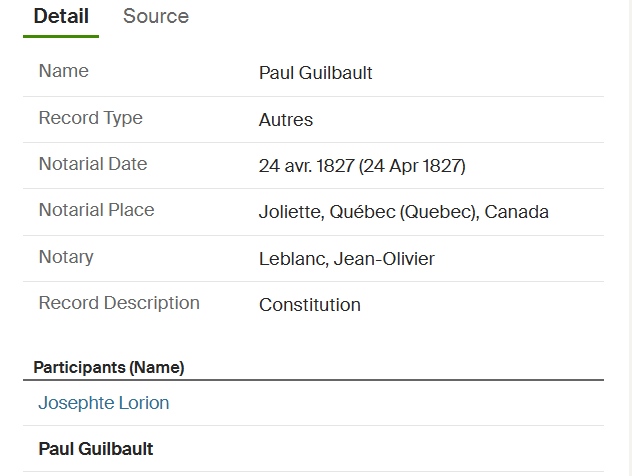
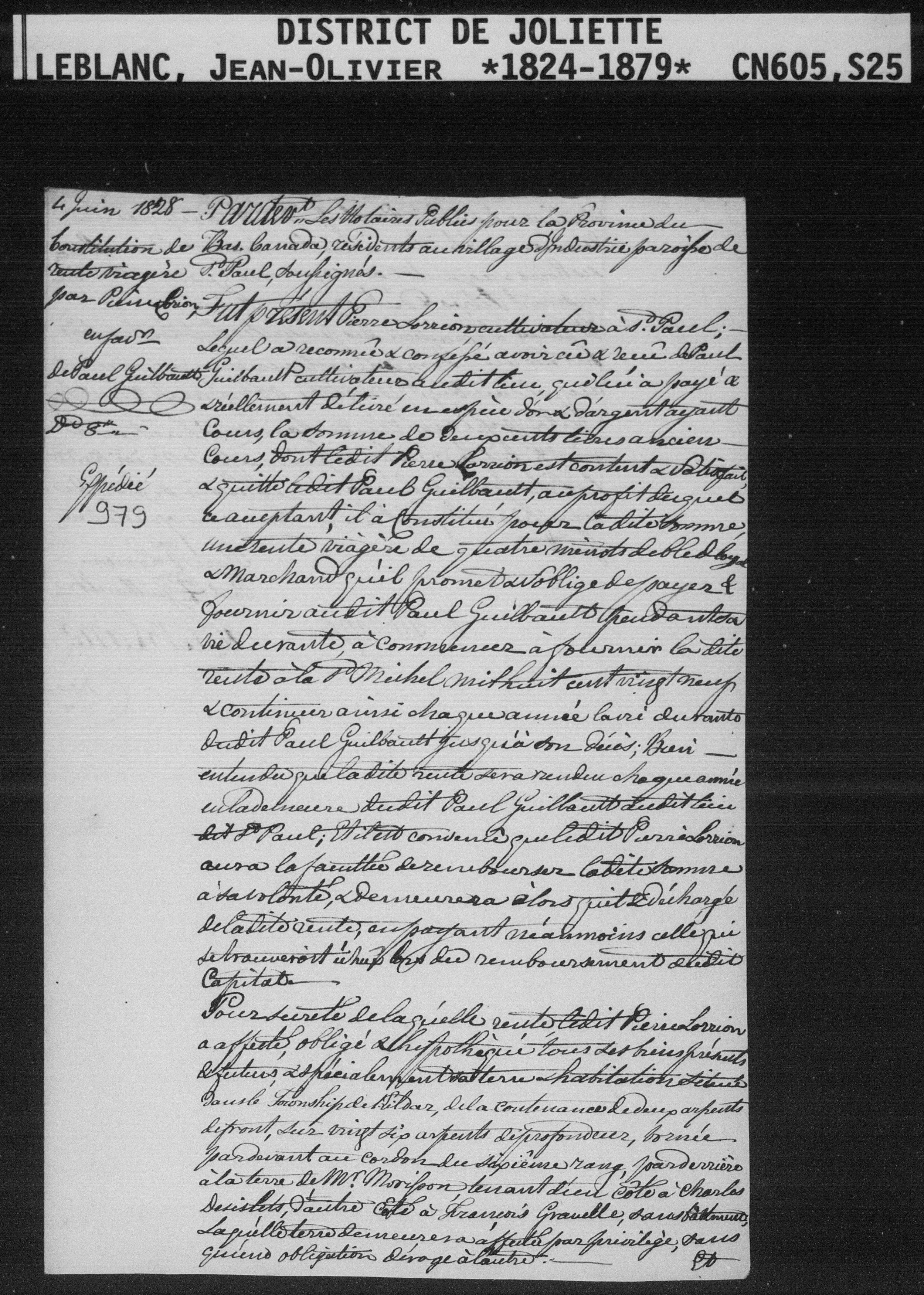
Where that money came from is now an open question. It was explained for years as fur-trade wages, and that explanation is withdrawn along with the career. What can be said is smaller and better founded: a man of sixty-six with a farm, grown children and no dependants had 428 livres to lend, and lent it to neighbours — one of whom had stood at his youngest child’s burial sixteen years earlier.
either brother’s account his own
two ledger accounts away
and Marie Geneviève, 1783–1811
What this post used to say
An earlier version of this article argued that Paul was the better-documented voyageur of the two brothers — that the one whose parish record never used the word had left two signed North West Company contracts and a settled Athabasca account, while the one it named had left comparatively little. That reading is withdrawn.
The company documents attributed to Paul spell their man Gibeau, Gibeault and Gebeault, and name no parish, no parents and no age. The identification rested on a given name and a phonetic surname. Three Quebec documents defeated it. That man’s career is real and remains unattached to anyone — the subject of a case study of its own.
Two smaller corrections while the file was open. The 1798 engagement was passed at Lac la Pluie, not at Montreal — which matters, because a Montreal contract would have named a home parish and the whole identification problem would not exist. And the notarial act of July 1832, described here as Paul fils discharging the Lorion capital, is nothing of the kind: it is a fresh life annuity constituted by Dominique Rivet and his wife, with no Lorion party to it.
What the Two Failures Teach
Why an occupation in a register is weaker evidence than a witness clauseThe instinct that produced both errors is a good one. Occupations in parish registers are genuinely useful, and voyageur et maintenant agriculteur genuinely is a thread worth pulling. The mistake was in what the thread was asked to carry.
An occupation designation tells you what a priest understood a man to be on the day he wrote. It does not tell you where the man was. A silence tells you even less. But a witness clause, a godparent asked to sign, a party appearing before a notary — those place a man on a date, and a date is the only thing that can be tested against a ledger.
The Implication for Every French-Canadian Genealogist
Cultivateur in a burial register is not proof a man never paddled to the Athabasca. It is proof he was recorded as a farmer on the day he died. Those remain different things, and the fur trade really is invisible to the parish system.
But the reverse holds just as hard, and it is the lesson this family taught twice. A name in a company index is not proof he did. The Hudson’s Bay Company Archives hold more than 3,700 names in the North West Company account books index alone, spelled by clerks writing what they heard. Before you attach one of them to your ancestor, find out where your ancestor was standing.
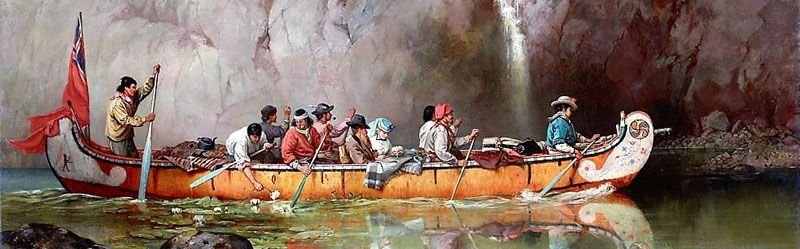
Frances Anne Hopkins, Voyageurs, 1869. Hopkins travelled the canoe routes herself and painted what she witnessed. Brigades like this one carried thousands of men whose names survive only as figures in a company ledger — and the work of genealogy is deciding, carefully, which of those figures belongs to which man. Library and Archives Canada.
Two brothers, born fourteen months apart, in one entry of one register on one October afternoon. One of them a voyageur by the priest’s own word; the other holding a child at the font, unable to sign his name. Neither of them, it turns out, the man in the ledger.
The word was worth following. It just wasn’t worth trusting.
Are You Connected to the Guilbault Line?
If you descend from the Guilbault (Guilbeau, Guilbeault) family of Charlesbourg and the Quebec parishes, from the children of Marie Josephte Abitakijikokwe, or from the founding families of the line — Senécal, Séguin dit Ladéroute, Morin, Couillaud dit Roquebrune, Gaulin — I’d like to compare notes. Documented trees, DNA matches, family papers, and even half-remembered stories have all moved this research forward.
Get in Touch About This FamilyCousin connections are informal and reciprocal — no fee, no obligation, just shared work on shared ancestry.
Every Family Has a Story Worth Telling
Whether you're just beginning your research or ready to transform years of work into a narrative your family will treasure, I'd love to help.
LET'S TALK ABOUT YOUR FAMILY