
Two Mothers at Oka: Identifying Catherine Messinabikwe
Two Mothers at Oka
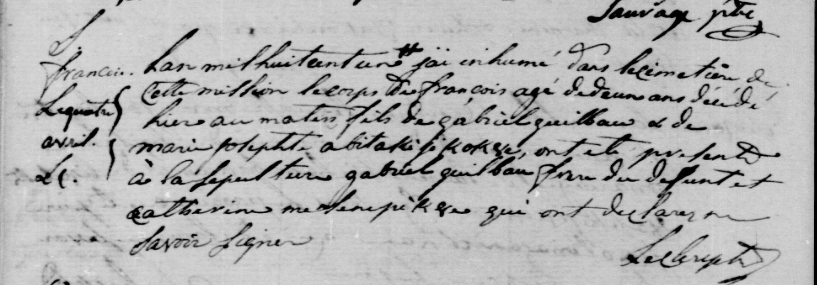
On April 4, 1801, a priest at the mission of L'Annonciation at Oka buried a two-year-old boy named François. Two people were present: the boy's ten-year-old brother Gabriel, and a woman the priest recorded as Catherine messenepik8e. She was not identified as a relative. She was simply there. Who was she — and why was she standing at this child's grave?
The burial entry for François Guilbault is brief, as entries for small children usually are. He had died the previous morning. He was the son of Gabriel Guilbault and Marie Josephte Abitakijikokwe. The priest — Father Leclercq — recorded the two witnesses who were present, noting that neither could sign. The brother's name is clear: Gabriel Guilbau. The woman's name is harder to read: catherine messenepik8e.
The "8" is not a number. In the missionary orthography used to render Algonquian languages into French script, it represents the sound ou or w. Her name, spoken aloud, would have sounded something like Messenepikwe. Her name marks her as an Indigenous woman, standing at the grave of someone else's child, in a small mission cemetery on the Lake of Two Mountains.
She had no individual PRDH record. Searching her name returned nothing. She appeared once, in a single register entry, and vanished.
But I had the ending of her name.

The Family at the Grave
Marie Josephte Abitakijikokwe and the son she buried at OkaMarie Josephte Abitakijikokwe was my fourth-great-grandmother, a Saulteaux (Anishinaabe) woman from Lake Superior. When Father Leclercq baptized her at Oka on 26 January 1801, he recorded her Anishinaabe name — Abitakijikok8e, Mid-Sky Woman — and her nation: de la nation Sauteuse sur le lac supérieur. (The meaning of the name was explained to me by Deliris López Tiwari.) Her story — how she emerged from two centuries of archival silence, and what her name reveals about her origins — is told in full in Abitakijikokwe — The Woman Behind the Name.
She and Gabriel Guilbault, a French-Canadian man from the voyageur family documented in The Guilbault Line, had been raising children together for more than a decade before their church marriage at Oka in January 1801, in what the French called a mariage à la façon du pays — a customary union blending Indigenous and European traditions, common across the fur trade world. Their relationship and its legal implications are explored in Marriage à la façon du pays.
Their son François was born on September 10, 1799, and baptized at St-Paul-de-Lavaltrie. He lived nineteen months. His PRDH individual record — number 4347434 — lists his birth, his baptism, and his burial at Oka. That is the entirety of his documented life.
But it was the woman at his burial who opened a door I hadn't expected.
A Name in Many Spellings
Missionary orthography and the challenge of identifying Indigenous women in colonial recordsThe challenge of identifying Indigenous women in colonial Quebec records is not that they are absent. It is that they are present under a different name every time a priest picked up a pen. Missionaries transliterated Indigenous names by ear, filtered through French phonetics, often abbreviating or guessing. The same woman could appear in five records under five unrecognizable spellings — and be indexed by PRDH as five separate people, or not indexed at all.
Catherine messenepik8e had no individual PRDH record. But I had the ending of her name: -pik8e, or phonetically, -pikwe. In Algonquian languages, the suffix -ikwe means "woman." The element before it — whatever messene- or missine- represented — was being heard and written differently by different priests. If I could find other women at Oka whose names ended in a similar sound, recorded by other hands in other years, I might find her.
I found her two years earlier, in the same cemetery.
Marie Charlotte Gruet, 1799
A ten-year-old girl, buried at Oka — and the name the priest wrote clearlyOn May 8, 1799, a ten-year-old girl named Marie Charlotte was buried at the Oka mission. The PRDH burial record — number 773817 — identifies her father as James Gruet and her mother as Catherine. The priest who wrote this entry was Malard, and in the register he spelled her name clearly: Missinebik8e.
The priest who wrote François Guilbault's burial in 1801 was Leclercq. He wrote: messenepik8e.
Two different priests. Two different attempts at the same name. The consistent element — the -bik8e ending, phonetically -bikwe — survived both renderings. The opening syllables are close as well: Missine- and Messene- are the same sound written by a different ear and a different hand.

Oka mission register, May 8, 1799. Middle entry: burial of Marie Charlotte, fille naturelle de Jame Gruet et de Catherine Missinebik8e, deceased the previous day, age ten. Witnesses: Williams Gruet and Michel Mekasa. Priest: Malard. The entry above is for Pascal Poirier; below, the burial of Genevieve Pachitabanok8e, age approximately forty-eight. BAnQ, Oka parish registers.
The register entry reads: "Marie Charlotte fille naturelle de Jame Gruet et de Catherine Missinebik8e décédée hier agée de dix ans." The witnesses were Williams Gruet and Michel Mekasa.
The word naturelle is significant. It means Marie Charlotte was born outside of a church marriage — born, that is, of a customary union. Like Marie Josephte and Gabriel, James Gruet and Catherine were living in a mariage à la façon du pays.
The register page containing Marie Charlotte's entry is itself a document of Oka's multiethnic world. Directly below her burial is the entry for Genevieve Pachitabanok8e, an Indigenous woman who died at approximately forty-eight, with witnesses Basile Charlebois and Jacques Chibanakko. Above is the burial of Pascal Poirier, son of a habitant from Grand'Ourse — a French-Canadian farming family. Three entries, three worlds, on a single page.
Genevieve Pachitabanok8e is not the Geneviève Abitakijikokwe who was the wife of the war chief Kitchiwabisi; that Geneviève was still living at Oka in the 1820s. Her story is told in The War Chief's Wife.
Catherine Emerges
Longue-Pointe, 1793 — two baptisms and a French surname that wasn't hersOnce the Gruet connection was established, the documents began to surface.
In 1793, at the parish of St-François-d'Assise at Longue-Pointe near Montreal, two children of Jacques Gruet and Catherine were baptized. Both entries name the mother as Catherine madore. Both children were listed as fils naturel and fille naturelle — born of an unsolemnized union. Guillaume was five, born on 13 January 1789 dans le ouisconsin — in the Wisconsin country. The daughter, Anne Marie Catherine, was already six years old at baptism, meaning she had been born around 1787, and she too was recorded as born dans le ouisconsin. The family had come from the far west of the Great Lakes.

Parish register, St-François-d'Assise, Longue-Pointe, October 1793. Two entries for children of Jacques Gruette and Catherine: Guillaume (fils naturel, age five, godparents Bazile la Chapelle and Marie Hennery) and Anne Marie Catherine (fille naturelle, age six, baptized 27 October). Both are recorded as born dans le ouisconsin. Priest: Girouard. The fils/fille naturel(le) designation confirms a customary union — no church marriage on record. Drouin Collection.
"Madore" is not an Indigenous name. It is a French surname, written in place of an Algonquian name the priest could not parse — a common practice when missionaries couldn't follow what they were hearing. It is also the name that stuck in family tradition: Madore.
In 1798, another child — Antoine — was baptized at Oka, with Catherine as his mother.
And in genealogical records compiled by descendants, Catherine's identity crystallized: Catherine Messinabikwe, also known as Madore. Ottawa (Odawa). Born approximately 1767 at Michilimackinac — the great fur trade crossroads at the Straits of Mackinac, where Lake Michigan meets Lake Huron.
One Woman, Many Spellings — The Documentary Trail
| Date | Parish | Name as Recorded | Event | Priest |
|---|---|---|---|---|
| October 1793 | Longue-Pointe | Catherine madore | Baptism of Guillaume (fils naturel of Jacques Gruet) | Girouard |
| October 1793 | Longue-Pointe | Catherine madore | Baptism of Anne Marie Catherine (fille naturelle, age 6) | Girouard |
| February 14, 1798 | Oka | Catherine Messinebik8e | Baptism of Antoine Hyacinthe Gruet | Malard |
| May 8, 1799 | Oka | Catherine Missinebik8e | Burial of Marie Charlotte Gruet (PRDH #773817) | Malard |
| April 4, 1801 | Oka | Catherine messenepik8e | Witness at burial of François Guilbault (PRDH #2752515) | Leclercq |
In Algonquian languages, the suffix -ikwe (rendered as -ik8e, -ikwe, or -ikoue by French missionaries) means "woman." The "8" in missionary orthography represents the sound ou or w. The root element — Missin-, Messin-, Messen- — varies because each priest heard and transcribed the opening syllables differently, filtered through French phonetics. The consistent -bik8e/-bikwe/-bikoue ending across multiple renderings, combined with the identical family context (wife of Jacques Gruet, mother of the same children), confirms a single Algonquian name: Messinabikwe.
The full methodology behind this identification is documented in the companion case study: The Woman at the Grave: Identifying Catherine Messinabikwe →
Two Mothers
What the documents do not say — and what we can read between them
Eastman Johnson, Ojibwe Women at Grand Portage, 1856–57. Four Anishinaabe women wearing strap dresses; the woman at right nurses a baby in a cradleboard (tikinagan). In the background, a gathering on a ridge — possibly at the old Ojibwe cemetery. Johnson painted from life at Grand Portage, Minnesota, documenting the Anishinaabe world Catherine Messinabikwe and Marie Josephte Abitakijikokwe both came from. St. Louis County Historical Society / Tweed Museum of Art. Creative Commons 4.0.
What the documents do not say — what no parish register ever says — is what Catherine was doing at that burial on April 4, 1801.
She was not listed as a godmother. She was not identified as a relative of the Guilbault family. The priest recorded her only as present. But in a mission community as small as Oka, her presence was not accidental.
Consider what these two women shared.
Catherine was Ottawa (Odawa), from Michilimackinac. Marie Josephte was Saulteaux (Anishinaabe), from Lake Superior. Both were Indigenous women from the Great Lakes world — the vast network of waterways, trading posts, and kinship connections that stretched from Montreal to the pays d'en haut. Both had entered into customary unions with French-Canadian men. Both brought children of mixed heritage before the priests at the same Catholic mission. Both were navigating a world where their names were written differently every time a priest recorded them, where their children were marked naturel rather than legitimate, and where their identities as Odawa or Saulteaux women were sometimes recorded with care and often compressed into the single word sauvagesse.
And both had buried children in the same cemetery.
Catherine's daughter Marie Charlotte had died on May 7, 1799, at ten years old. She was buried the next day. Less than two years later, on April 3, 1801, Marie Josephte's son François died at nineteen months. He was buried the next day. Catherine was there.
I do not know what drew Catherine to that burial. Perhaps she and Marie Josephte were close — two Indigenous women in similar circumstances, supporting each other in a community where they were simultaneously essential and marginal. Perhaps she was simply a neighbor, doing what neighbors do when a child dies. Perhaps the connections ran deeper, through kinship networks or trade relationships linking the Ottawa and Saulteaux worlds that we can no longer trace.
What I know is that she was there. And that she had buried her own child in the same ground.
What Came After
From Oka to the Red River — the Grouette family in Western CanadaCatherine Messinabikwe and James Gruet's surviving children carried their family westward. Their descendants became part of the great migration of Métis families from the St. Lawrence valley to the Red River Settlement. The Grouette name (as Gruet became in family tradition) appears in the founding records of Manitoba's Métis communities. Their descendants — the Grouettes of Ste-Anne-des-Chênes, of St. Boniface, of the prairies — are among the recognized Métis families of Western Canada.
An Ottawa woman from Michilimackinac, known in the colonial records as Madore, Messinebik8e, Missinebik8e, and messenepik8e, became the matriarch of a Western Canadian Métis family line. None of those spellings are quite right. Her name was Messinabikwe.
One Name — Many Renderings — One Woman
She stood at a child's grave on April 4, 1801, and the priest wrote her name one more time, one more way, at the bottom of the page.
It was enough.
The Full Identification — Case Study
The identification of Catherine Messinabikwe across her colonial spellings, including the paleographic analysis, PRDH cross-referencing, and Algonquian linguistic evidence, is documented in full in the companion case study.
The Woman at the Grave: Identifying Catherine Messinabikwe →
This blog post tells the story. The case study shows the evidence.
Questions about your own research? Begin a research inquiry.
