
Dans le Bois: Death in the Hunting Grounds
Dans le Bois
Scattered through the Oka Mission parish registers, in the handwriting of three different priests across three decades, a phrase appears and reappears: mort dans le bois. Died in the woods. Décédée dans les terres de chasse. Died in the hunting grounds. Décédé dans le bois. Dead in the forest.
These are not euphemisms. They are geographic facts — and once a researcher understands what they mean, the burial records of the Mission du Lac-des-Deux-Montagnes open up in an entirely different way.
The Algonquin, Nipissing, and Ojibwe families who gathered at the Oka Mission spent only part of each year there. Every autumn, after the Calvaire pilgrimage and the harvest festivals, the larger community broke into smaller family units and dispersed into the vast hunting territories of the Ottawa Valley watershed — hundreds of miles of forest, river, and lake country stretching north and west toward Lake Nipissing and beyond. They would not return until the ice broke in May.
When someone died in those territories during the winter months, they could not immediately be brought home. The ground was frozen. The rivers were locked. The journey itself, even under spring conditions, might take weeks by canoe down the Ottawa River to reach the lake.
And so, when the registers record mort dans le bois, they are recording something precise: a person who died far from the mission, whose body was held through the winter, and who was carried home to the mission cemetery by their family in the spring — sometimes months after death.
Three of these records have become central to research on the Guilbault Line and the broader Abitakijikokwe family network at Oka. They are presented here together — not as isolated genealogical data points, but as evidence of a practice that shaped the entire documentary record of this community.
Three Records, One Pattern
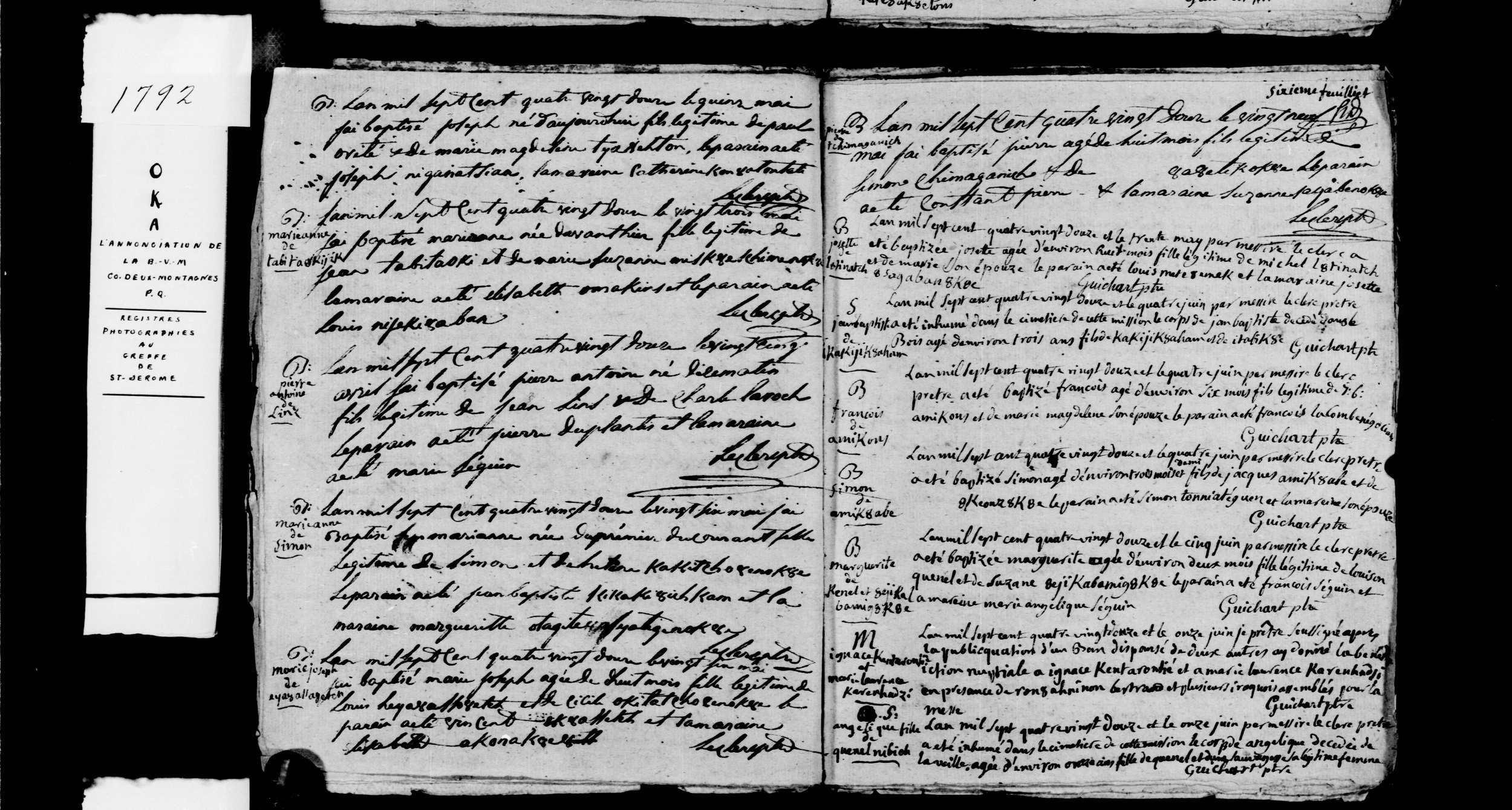
The records below were created at three different moments — 1792, 1795, and 1795 again — by two different priests. What connects them is not family relationship but circumstance: each person died away from the mission, during the winter hunt, and was brought back for burial in the parish cemetery when travel became possible.
Together, these three entries document the same phenomenon across a span of three years and two priests. The phrasing shifts — dans le bois, dans les terres de chasse — but the meaning is consistent. Death occurred away from the mission, in winter territory. The body was returned to the mission for burial, sometimes weeks, sometimes months, after the date of death.
Catherine Abitakizik8k8e, 1795
The burial of Catherine Abitakizik8k8e on May 18, 1795 is the most significant of these three records for research on the Guilbault Line. Her name — in the variant spelling Father Malard used that day — belongs to the same Abitakijik- family root documented across the Oka registers from 1786 onward. The relationship between Catherine and the other Abitakijikokwe individuals in the registers is one of the open questions driving ongoing research.
What the record establishes with precision is this: she was approximately sixty years old at death, placing her birth around 1735. She died on February 2, 1795 — Candlemas — in the hunting grounds. Her son Michel Ilini was present at the May burial. A second witness, François R8ahninon, attended with him. Neither man could sign.
Three and a half months passed between her death and her burial at the mission. During that time, her body was held — likely in the cold of the winter forest, as the traditional Anishinaabe practice allowed, or in a storage place near a winter encampment — until the ice broke on the Ottawa River and the family could make the journey home.


The Cadieux typed transcription of this entry, prepared in 1938 from the same register, records the name as Cath. Abitakizik. in the margin and gives the full form in the entry body. It is the same record — two generations of researchers, the same manuscript, the same careful reading of a name that resisted easy transcription.
— Pauline Cadieux, typed transcription of Oka Mission registers 1786–1806, p. 127 (Public Archives of Canada copy, F.K. 8, G 21, volume 2)Jean Baptiste Kakijik, 1792
The earlier of the two 1792 records — a child, not an elder — illustrates that the dans le bois practice was not confined to adults or to any particular season. Jean Baptiste was approximately three years old when he died in the forest. His father was Kakijik8aham; his mother, Itabik8e. Father Guichart buried him at the mission cemetery on June 4, 1792.
The child's name in the margin — J.Bte Kakijik. — preserves the family name. It is a name that appears elsewhere in the Oka registers, carried by individuals who belong to the same community documented across the Abitakijikokwe research. Like Catherine's record three years later, this entry is evidence of a family making the spring journey back to the mission, carrying a child they had held through the winter.

The Seasonal Cycle That Made This Necessary
To understand why these burial records look the way they do, it is necessary to understand the world the Oka Mission community actually inhabited — which was not confined to the mission itself.
The Mission du Lac-des-Deux-Montagnes sat at the confluence of the Ottawa River and the Lake of Two Mountains, near Montreal. It was a gathering place, a religious center, a trade hub. But for the Algonquin, Nipissing, and Ojibwe families who called it home, it was only one point in a much larger seasonal world. The mission was a summer and autumn place. Winter belonged to the hunting grounds.
OCT
The Autumn Gathering
Families returned to the mission in late summer and early autumn for trade, religious festivals, and the Calvaire Hill pilgrimage. This was the season of reunion — the time when the community was most fully assembled. The registers show clusters of baptisms and marriages in these months, reflecting the presence of families who had been dispersed through the winter and spring.
APR
The Winter Dispersal
Every autumn, large groups broke into smaller family units and traveled north and west into the Ottawa Valley watershed — up the Ottawa River and its tributaries, the Gatineau, the Madawaska, the Bonnechere, the Petawawa. Individual families held specific tracts. They hunted moose, deer, beaver, and bear, living in peaked winter lodges deep in the forest. The dispersal was not flight. It was the necessary management of a vast territory that could not support concentrated populations through the winter months.
JUN
The Spring Return
When the ice broke on the Ottawa River, families loaded their birchbark canoes and made the long journey back to the mission. The spring return was a major community event. It was also, in the parish registers, the season of dans le bois burials — the season when families arrived carrying their dead, ready at last to inter them in the consecrated ground of the mission cemetery.
The Oka parish registers from this era frequently show clusters of burials in May and June. These entries often note that the person died months earlier in the woods or in the hunting grounds, confirming that the bodies were held and transported once travel became possible. The late spring was not only the season of planting and fishing. It was also, regularly, the season of completing the burial rites that winter had interrupted.
— Pattern documented across the Mission du Lac-des-Deux-Montagnes registers, 1786–1806, LAC reel C-2895The Long Journey Home
How did a family transport a person who had died in February from a hunting ground perhaps two hundred miles up the Ottawa River to the mission at Oka?
The Anishinaabe tradition, before and alongside Christian influence, involved placing the deceased on elevated scaffolds or in trees — protecting the body from scavengers while preserving it through the cold months until burial was possible. As families at the mission embraced Catholic practice, there was a growing desire to bring loved ones back to the parish cemetery for interment. The two impulses were compatible: winter scaffolding or cold storage served the same practical function, holding the deceased until the spring journey could be made.
The journey itself, once the ice broke, was by canoe — the birchbark canoe that was already the primary technology of movement through the roadless watershed. The route followed the Ottawa River downstream to the Lake of Two Mountains. For families coming from the upper Gatineau or the Madawaska tributaries, this was a journey of many days, navigating the same waterways they had used for generations as hunting corridors.
It is worth pausing on what this required of a family. Catherine Abitakizik8k8e died on February 2. Her son Michel Ilini stood at her burial on May 18, three and a half months later. Between those two dates, he had kept vigil over his mother's body through the remainder of winter, waited for the spring thaw, made a canoe journey of unknown length down the Ottawa River, arrived at the mission, arranged the burial with Father Malard, and stood as a witness to the record. He could not sign his name. He made his mark. He had brought his mother home.
The Sulpician missionaries who kept these records understood that dans le bois meant all of this, even when they wrote it in two words. The priests knew the community. They had watched this pattern year after year. When Father Malard wrote morte dans les terres de chasse le second février dernier, he was not recording an anomaly. He was recording a regularity — the ordinary consequence of a life lived across a vast territory rather than within the walls of a colonial settlement.
What These Records Tell a Researcher
For genealogical research on families from the Oka Mission, the dans le bois pattern has several important implications.
On Dates of Death
A burial date in the Oka registers is not the date of death. When a record notes that a person died in the woods or in the hunting grounds, it will sometimes give the date of death explicitly — as Catherine's record does, noting February 2nd. More often it does not, and the researcher is left with only the burial date and a phrase indicating the person died at some earlier point during the winter. The date of death and the date of burial may be separated by weeks or months.
On Witnesses
The witnesses named at a dans le bois burial are the people who made the journey home with the deceased. They are, in most cases, close family members — children, siblings, spouses. This makes witness names at these burials particularly valuable for establishing family relationships in a community where marriage records are incomplete and many individuals appear in only one or two documents over their lifetimes.
On Names
Because the body arrived at the mission months after death, the priest recording the burial had to rely on the information provided by the witnesses. He could not consult an earlier baptismal record on the spot, or verify a spelling against a prior entry. This may account for some of the name variation seen in dans le bois burials — the priest heard the name from a witness, perhaps in a language he did not fully command, and wrote what he heard.
On Negative Evidence
The absence of a winter burial record in the Oka registers cannot be interpreted as evidence that a person survived the winter. It may simply mean they died away from the mission, or that their family did not make the spring journey that year — whether because of hardship, distance, or circumstances the record cannot tell us.
The full Mission du Lac-des-Deux-Montagnes register series (LAC reels C-2895 and C-2896) is the primary source for all Oka Mission research. Pauline Cadieux's 1938 typed transcription (Public Archives of Canada, F.K. 8, G 21, volumes 1–2) provides a useful secondary index. Neither source substitutes for working directly from the original manuscript images, particularly for the transcription of Anishinaabe names, where the phonetic complexity routinely exceeds what any secondary source fully captures.
Connection to the Guilbault Line
The three burial records documented here are relevant to the Guilbault Line research in two ways.
First, Catherine Abitakizik8k8e carries a name variant in the same Abitakijik- family root documented across the Oka registers beginning in 1786 — the same root carried by Geneviève Abitakijikokwe, by Marie Angélique Abitakigikokhe, and by Marie Josephte Abitakijikokwe, who married voyageur Gabriel Guilbault at the mission in January 1801. Whether Catherine was a member of the same extended family — a mother, an aunt, an elder of the same kin group — remains an open research question. The name alone is not proof of relationship. But it is evidence that the Abitakijik- root was present in this community before Marie Josephte's earliest known record, attached to an older woman who died in the hunting grounds in the winter of 1795.
Second, these records establish the documentary context in which Gabriel and Marie Josephte's family lived. The seasonal pattern they document — autumn gathering, winter dispersal, spring return — was not background color. It was the structure of daily life. Gabriel Guilbault spent his working years as a voyageur traveling the same river systems that the Algonquin and Ojibwe families used for their winter hunts. Marie Josephte was a Saulteaux woman from the Lake Superior watershed, identified in the 1801 marriage record as having come east — via exactly the Ottawa River route — to the mission at Oka. The dans le bois practice documented in these registers is not separate from her world. It is part of it.
A Question Worth Asking: January at the Mission
The seasonal pattern documented in these burial records raises a natural question about the 1801 marriage itself. If winter was the time of dispersal to the hunting grounds — if families left the mission every autumn and did not return until the ice broke in May — why were Gabriel and Marie Josephte at Oka in January 1801 to be married, and to have their children legitimized?
The answer lies in the difference between two kinds of seasonal life. The winter dispersal documented in the dans le bois burials was the pattern of the Algonquin, Nipissing, and Ojibwe hunting families — people whose winter survival depended on dispersing into the forest territories. Gabriel Guilbault was a voyageur. His working calendar ran in the opposite direction: departure in May for the summer brigades into the pays d'en haut, return to the St. Lawrence settlements in autumn. January was not his season of absence. It was his season of presence — the middle of the long winter interval between the end of one trading season and the preparations for the next.
Marie Josephte's January presence is a more complex question. She was Saulteaux, from Lake Superior country, and had traveled east into the Oka community. By 1801, the couple had been together long enough to have several children — this was a mariage à la façon du pays being formalized in the Church, not a new union. Where the family wintered in the years before 1801 is not established by any record yet found. But the January date almost certainly reflects Gabriel's calendar, not the Algonquin hunting grounds pattern: this was when he was home, when a church marriage was logistically possible, and when the Sulpician priest was available to solemnize what the couple had already been living.
Marie Josephte herself died on June 23, 1813, and was buried two days later on June 25. By this date, the family was living in the Seigneury of Argenteuil — south shore of the Ottawa River, Côte du Midi, the same river corridor that connected Oka to the hunting grounds and the pays d'en haut. A 1827 notarial record confirms Gabriel Guilbault as landowner there: 68 acres with river frontage, his neighbor on one side a Joseph Ménard almost certainly related to the man who had married Marie Angélique Abitakijikokwe twelve years earlier. The Abitakijikokwe family network and the Guilbault family were living side by side on the Ottawa River. Marie Josephte's burial record notes that she died au bois — in the woods — near their residence. This is not the winter hunting grounds pattern. She died locally in summer and was buried within two days. The phrase au bois here means the forested land near their home. Gabriel Guilbeault, her husband, was present at the burial. She was approximately fifty years old.
— Burial register, Paroisse Sainte-Madeleine de Rigaud, Comté de Vaudreuil, June 25, 1813; Registres photographiés au Greffe de Montréal. Residence stated as Seigneury of Argenteuil — south shore of the Ottawa River, confirmed by notarial record (Arnoldi collection, 1827). Confirmed from original manuscript.

Continue at the Lake of Two Mountains
This piece is a companion to the larger research presented in two related pages on this site. The naming research that frames Catherine Abitakizik8k8e within the broader Abitakijikokwe family network is documented in the Geneviève post and case study. The history of the mission community itself — its geography, its seasonal rhythms, its complex social structure — is the subject of the At the Lake of Two Mountains series.
If you are researching families from the Oka Mission — the Abitakijikokwe network, the Wabisi family, or related Algonquin and Nipissing lines — feel free to reach out: [mary@storylinegenealogy.com]
The Guilbault Line
← Return to The Guilbault Line · At the Lake of Two Mountains →
✦ Free Download: Five Signs of Indigenous Ancestry in Quebec Parish Records
Learn the phrases, naming patterns, and record clues that reveal Indigenous ancestors hidden in Quebec parish records—the same methodology that identified Marie Josephte Abitakijikokwe. Includes FamilySearch Full Text Search strategies.
Get Your Free GuideEvery Family Has a Story Worth Telling
Whether you're just beginning your research or ready to transform years of work into a narrative your family will treasure, I'd love to help.
LET'S TALK ABOUT YOUR FAMILY