
The Storyline
Real families. Real discoveries. Real stories.
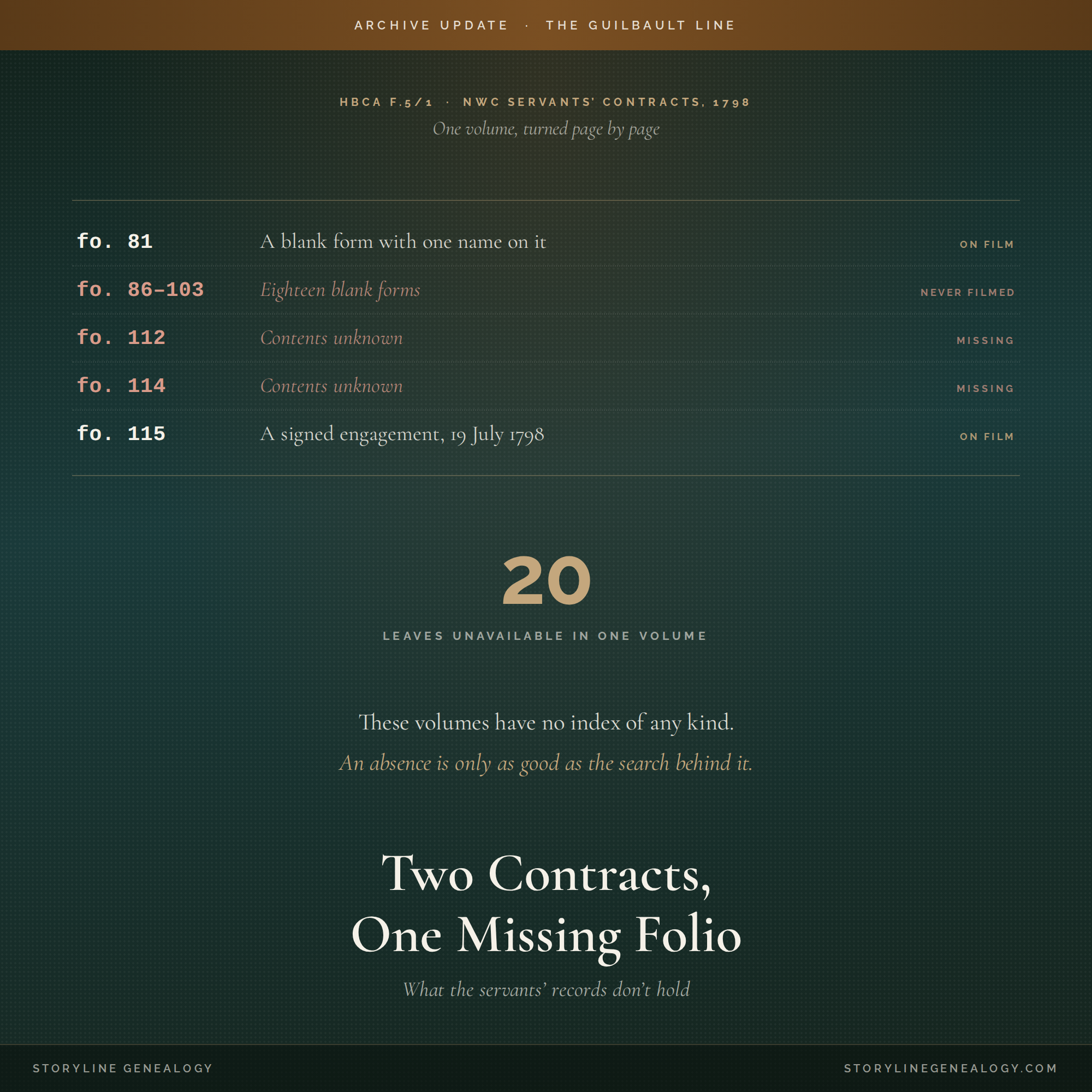
Two Contracts, One Missing Folio
The North West Company's servants' contracts are the most informative documents in the fur-trade archive and almost unusable: the volumes carry no name index of any kind, so finding a man means turning every page. Do that, and you start noticing what isn't there. In one volume alone, two folios are lost and eighteen more were never filmed — twenty leaves unavailable, any of which could hold an engagement. One man in this family has two signed contracts and no identity. Another has five years of wages and nothing signed anywhere.
Part of the Storyline Genealogy series: From Research to Story
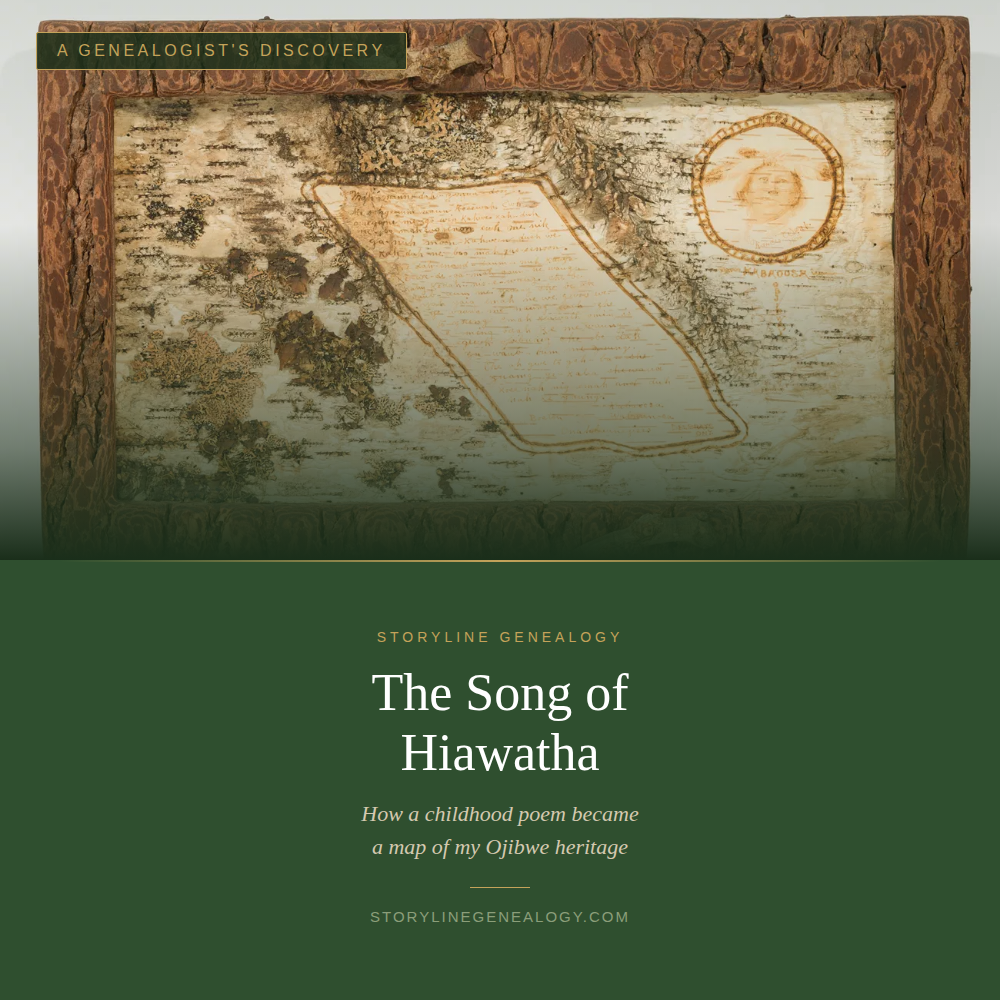
The Song of Hiawatha: A Genealogist’s Discovery
When I rediscovered two old copies of The Song of Hiawatha while sorting my office, they sat beside my Munising maple bowls—hand-painted pieces I had collected for years, drawn to them without knowing why. That same day, I discovered why: Munising, Michigan, sits at the gateway to Pictured Rocks National Lakeshore—the heart of Hiawatha country, the homeland of my Ojibwe 4th great-grandmother, Marie Josephte Abitakijikokwe.
Part of the Storyline Genealogy series: From Research to Story
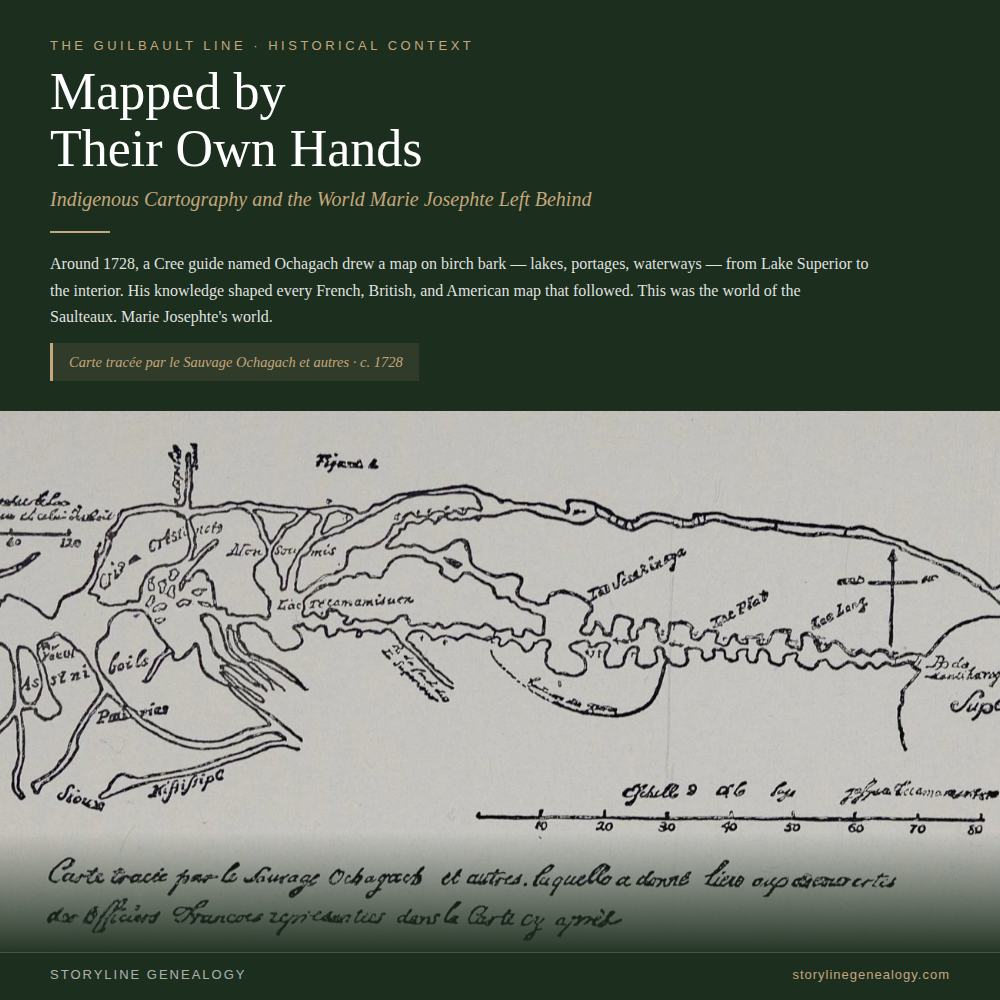
Mapped by Their Own Hands
Around 1728, a Cree guide named Ochagach drew a map on birch bark. It showed the water route from Lake Superior westward through the lakes and portages to Lake Winnipeg — every node, every connection, every carrying-place documented in a cartographic language that European mapmakers would spend the next fifty years trying to translate. The French officer who received it sent it to Paris. A Parisian geographer engraved it onto copper. The same portage chain appears on British and American maps a generation later. The original knowledge was Anishinaabe. So was Marie Josephte Abitakijikokwe's world.
Part of the Storyline Genealogy series: The Guilbault Line: At the Lake of Two Mountains
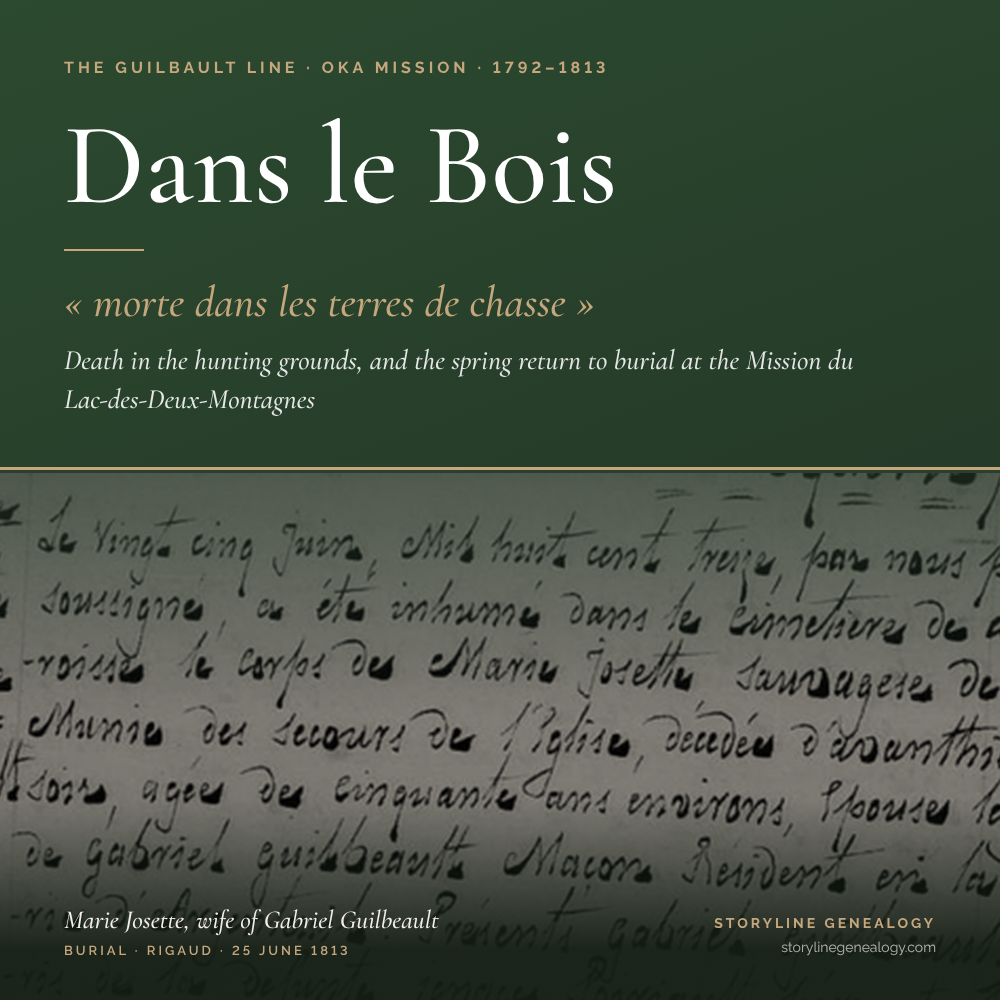
Dans le Bois: Death in the Hunting Grounds
Morte dans les terres de chasse”: died in the hunting grounds. Three burials at the Oka mission record people who died far away during the winter hunt and were carried home in the spring, sometimes months later. Here is what that pattern means for reading burial dates, witnesses and names in the Oka registers.
Part of the Storyline Genealogy series: The Guilbault Line: At the Lake of Two Mountains
A Name Written in Cedar and Sky
In 1786 the Oka mission register recorded two women whose names shared the root kijik. Over the next 127 years, more than fifty people across five nations carried it. This essay follows that root from Geneviève Abitakijikokwe to Marie Josephte Abitakijikokwe, Mid-Sky Woman, and to the two women who carried it into the twentieth century.
Part of the Storyline Genealogy series: The Guilbault Line: At the Lake of Two Mountains
Geneviève Abitakijikokwe at Oka Mission
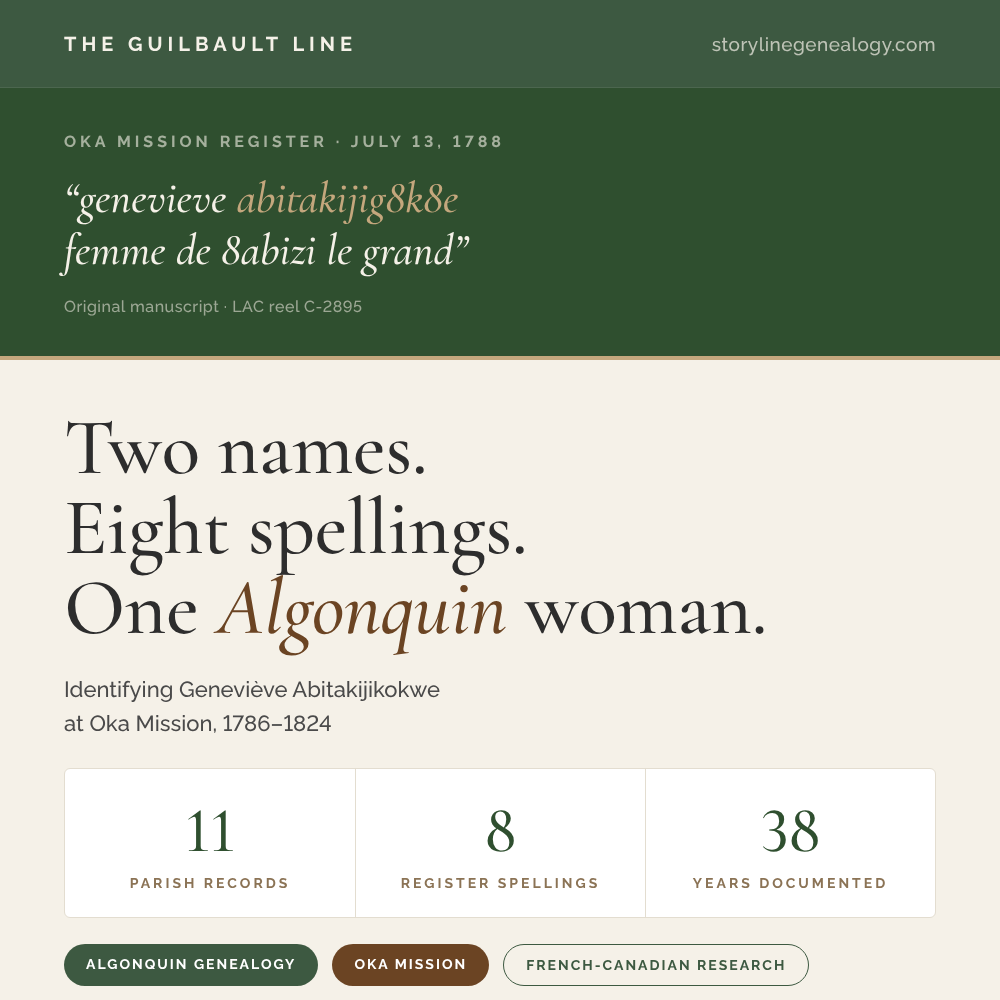
She appears in eleven Oka mission records between 1786 and 1824, under two names and eight spellings, written by three priests. This is how those records were tied to one woman: Geneviève Abitakijikokwe, wife of the Algonquin war chief Kitchiwabisi.
Part of the Storyline Genealogy series: The Guilbault Line: At the Lake of Two Mountains
Two Mothers at Oka: Identifying Catherine Messinabikwe
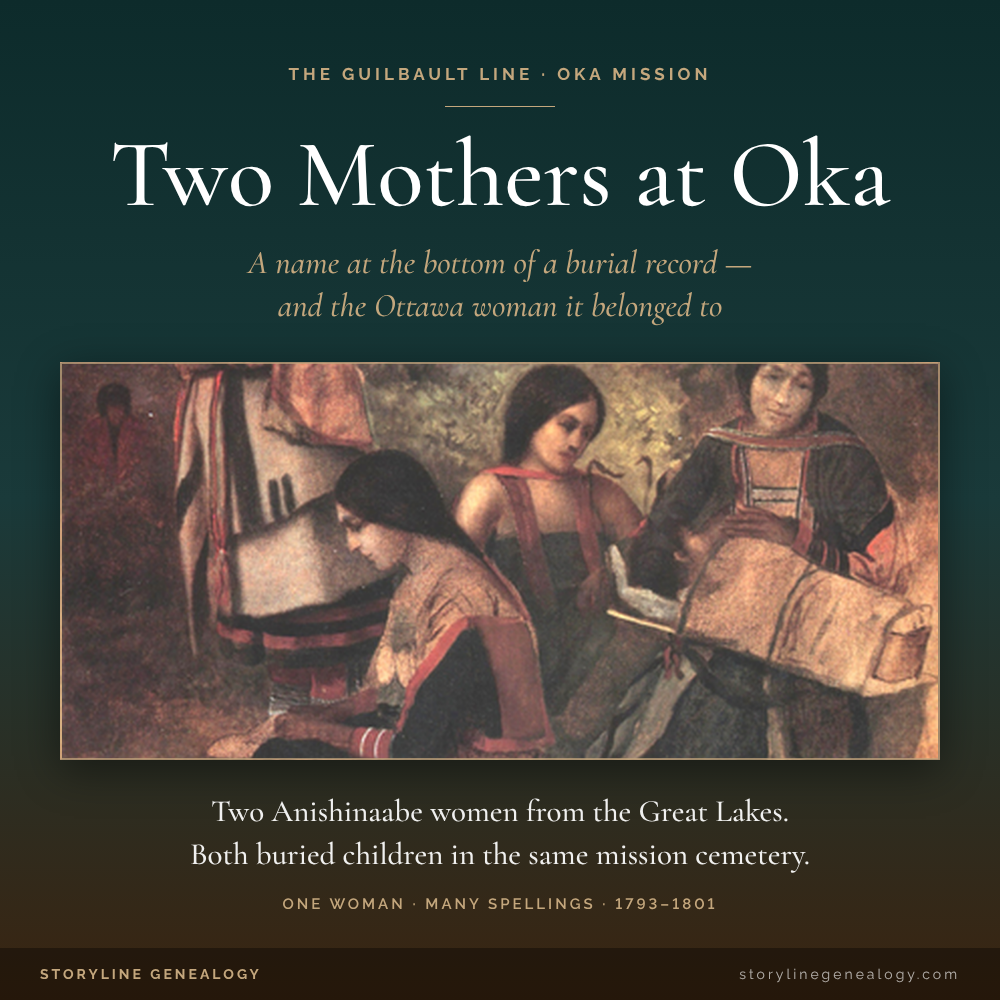
In April 1801 a priest at Oka buried two-year-old François Guilbault, son of Marie Josephte Abitakijikokwe. One witness was a woman he wrote as “catherine messenepik8e”. She had no PRDH record of her own. Following the ending of her name led to a Longue-Pointe baptism, a burial at Oka two years earlier, and an Ottawa woman from Michilimackinac.
Part of the Storyline Genealogy series: The Guilbault Line: At the Lake of Two Mountains
Saint-Paul-de-Lavaltrie
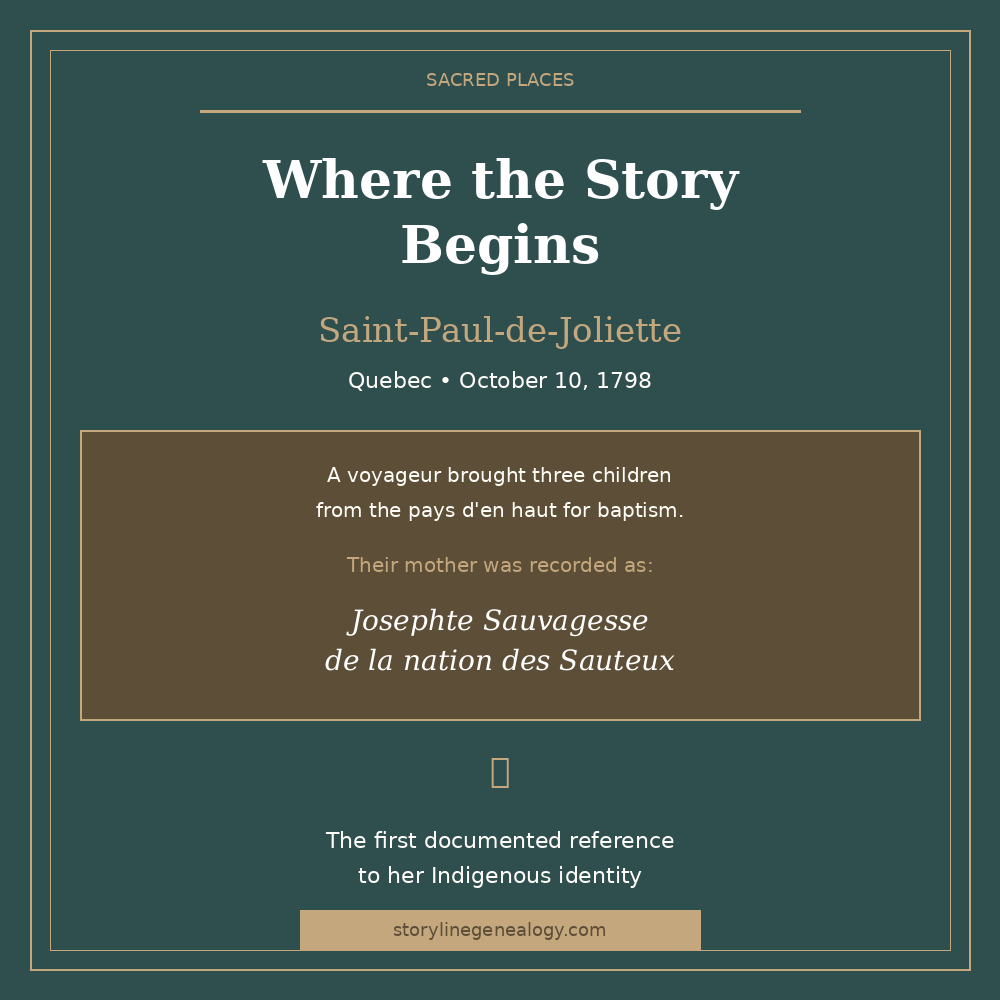
On October 10, 1798, a voyageur named Gabriel Guilbault brought three children to Saint-Paul-de-Joliette for baptism. They had been born and "ondoyé" (emergency baptized) in the pays d'en haut—the upper country of the fur trade. Their mother was identified as "Josephte Sauvagesse de la nation des Sauteux"—the first documented reference to her Indigenous identity. The story of Marie Josephte Abitakijikokwe begins here.
Part of the Storyline Genealogy series : Sacred Places
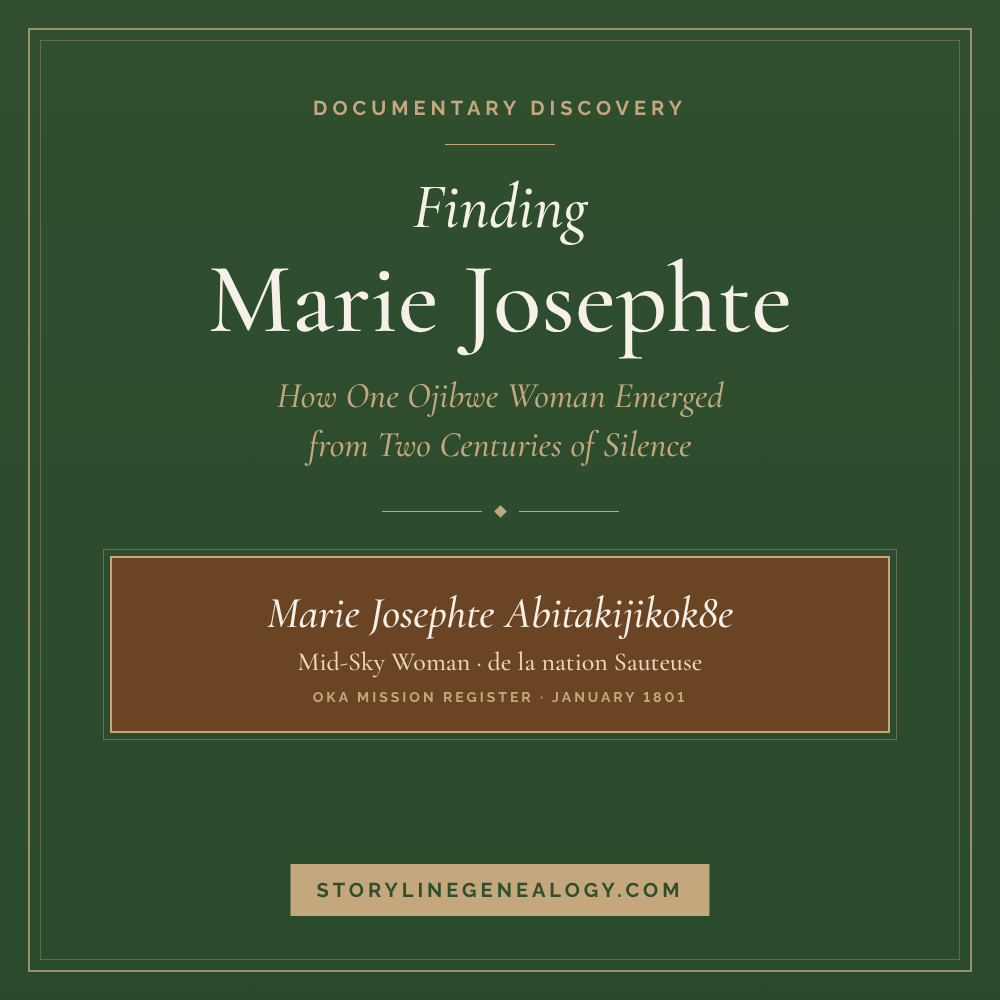
Finding Marie Josephte Abitakijikokwe
For generations she was only “Sauvagesse,” the wife of Gabriel Guilbault. FamilySearch’s Full Text Search found her: first as “Sauteuse” at a triple baptism in 1798, then at Oka in 1801, where her own baptism and marriage give her name, Abitakijikokwe, and her homeland on Lake Superior. This post traces how she was found, and what any researcher can learn from it.
Part of the Storyline Genealogy series: At the Lake of Two Mountains