
A Name Written in Cedar and Sky
The Guilbault Line · At the Lake of Two Mountains
A Name Written in Cedar and Sky
The Kijik Naming Tradition at Oka Mission, 1786–1913
The Question the Register Asks
The Oka Mission register opens in 1786.
The first entry on the page dated 27 May of that year records the baptism of a baby girl — Geneviève, daughter of Joseph Kakijik8aham and his wife. Her godmother is listed as Geneviève Abitakijikokwe. Immediately below it, a second baptism: Cécile, daughter of Nicolas Chigoudjak and his wife, whose name the priest records as Hélène 8takami kijik8ke. Two entries, one above the other, same morning, same priest, same page. Two women bearing the same root in their names — kijik — one as godmother, one as mother.
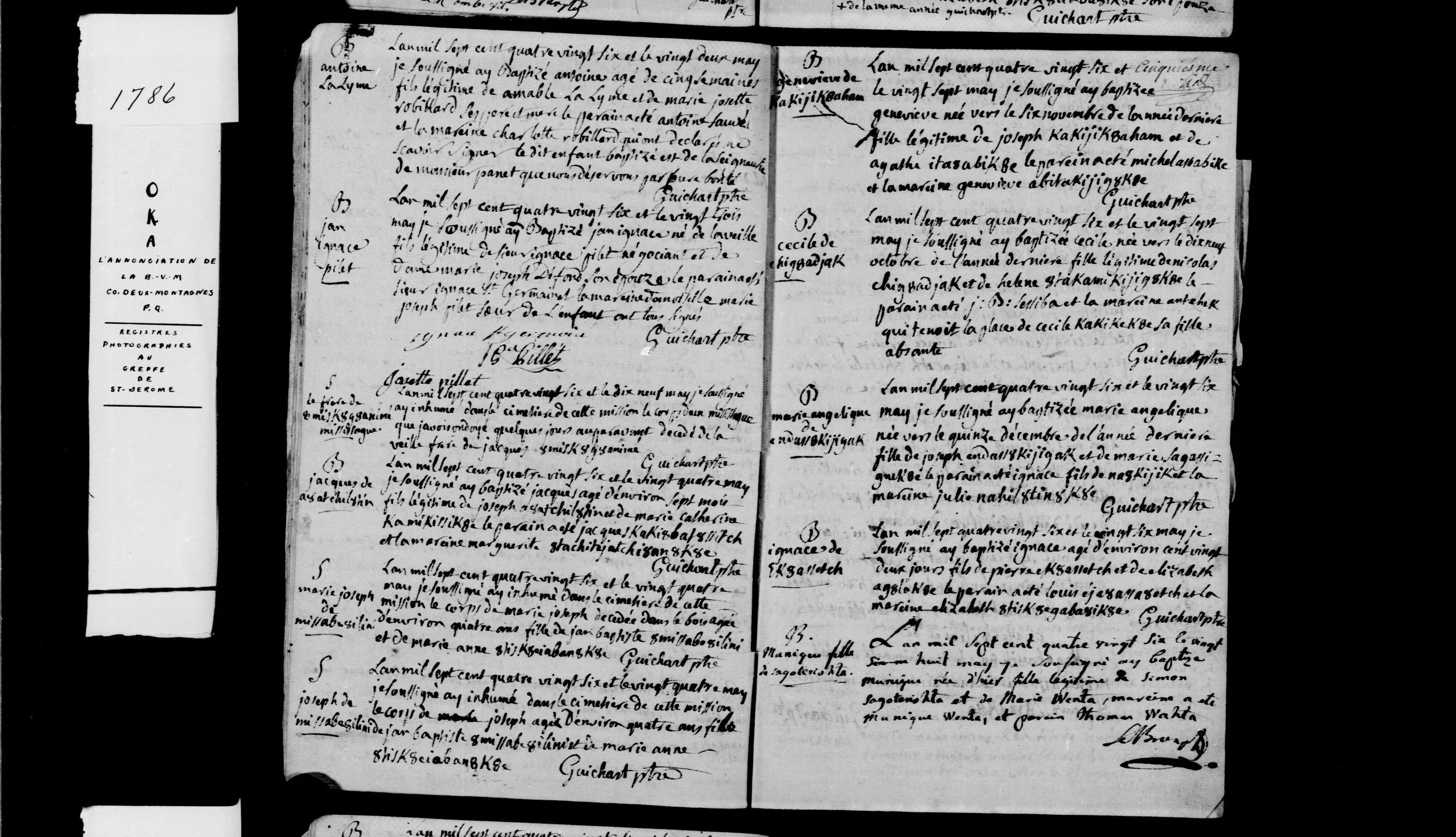
Oka Mission Register, 27 May 1786 (F.M. 8, G 21). Upper entry: baptism of Geneviève, with Geneviève Abitakijikokwe as godmother. Below it: baptism of Cécile, mother listed as Hélène 8takami kijik8ke. Sequential entries, same page, same priest, same morning. Archives publiques du Canada.
The register does not explain them. It simply records them, already formed, already named, already present in a community at the foot of the Laurentian hills where Algonquin, Nipissing, Saulteaux, Ottawa, and Tête de Boule families had gathered at the Lake of Two Mountains mission for generations.
Over the next hundred and twenty-seven years — from that morning in 1786 to the death of the last confirmed kijik-root name bearer in 1913 — more than fifty-five individuals bearing some form of this name would pass through the registers of the Annonciation de la Bienheureuse-Vierge-Marie de Oka and the communities that grew from it. Men and women. Algonquin and Nipissing and Ojibwe and Ottawa and Tête de Boule. Grand chiefs and their wives, godparents and godchildren, community elders and infants who did not survive their first winter. Across five nations, across four generations, across a century of colonial disruption and mission life and seasonal migration to the hunting grounds, the kijik root persisted — and two women carried it out of Oka entirely, traveling with their names into the Ottawa Valley and the upper Gatineau until the tradition outlived the mission that had documented it.
It begins with a word.
The Name
What does kijik mean, and who was carrying it?
Cedar and Sky
The Catholic priests at Oka wrote what they heard. The orthography in the mission registers is the orthography of French ears encountering Algonquin and Nipissing and Ojibwe sounds for the first time, and then again in every generation as new priests arrived and new families came to the mission. Kijik appears as kijik, kijig, kigig, kijik8, qijiq, kijic, and half a dozen other variants across the registers. The spelling changes. The root does not.
Jean-André Cuoq, the Sulpician missionary and linguist who published his Lexique de la Langue Algonquine in 1886, is the primary lexicographic authority for what the root means. He gives it two definitions on page 159, presented side by side as though neither one is sufficient alone.
The first: jour, journée — day, the time the sun is above the horizon. The time of light.
The second: cèdre — cedar. Thuia occidentalis, the eastern white cedar that lines the shores of the Lake of Two Mountains. Cuoq notes its medicinal applications directly: the leaves were used to treat wounds, the gum for toothache, the smoke of the bark to stanch nosebleeds. Cedar was not merely a tree in this community. It was medicine.
But Cuoq's own footnote on the same page adds a third. He observes that in certain dialects — specifically those of the Sauteux and the Ottawa — the word kijik carries an additional meaning: ciel, firmament, séjour des Bienheureux. Sky. Heaven. The dwelling place of the blessed. The locative form, he notes, is kijikong — used in the Pater Noster to render qui es in caelis. The sky-sense was not a metaphor layered onto the cedar-sense; it was a parallel meaning, present in the same root, available to speakers of those dialects simultaneously with the other two.
And beneath all three meanings runs a deeper semantic field. The related root KIJ—, documented across pages 156 and 157 of the Lexique, carries the idea of heat — the warmth of the sun — and of perfection, of work brought to its completed form. Cuoq's own example: ka mitci kijinindang wakwi gaie aki — he who from nothing made the earth and the sky. And a third sense within the same root: ripeness. The fruit brought to fullness under the sun. Day. Cedar. Sky. Heat. Completion. Ripeness. All of these radiate from the same solar image — the sun traveling its full arc from horizon to horizon, warming the earth to fullness, completing its perfect circuit, under which grows the cedar and above which lies the heaven.
All of these meanings were present in the word simultaneously. A name built on the kijik root could carry any of them, or all — day-woman, cedar-woman, sky-woman, medicine-woman, woman of the completed day — and there is no reason to choose between them. Anishinaabe naming practice did not operate by the logic of singular European definitions. A name was a carrier. The word kijik carried what the community understood it to carry. The priests wrote it down in their orthography. The families went on using it in their own.
The Forms
Kijik was not a single name. It was a vocabulary.
The root combined with prefixes to generate distinct names for distinct people across every generation. The female form ended in -okwe or -kokwe: woman of the kijik. The male form ended in -o8ich or simply kijik alone. The prefix carried the individual while the kijik root placed each bearer within a shared naming identity that stretched across families, across nations, across the century.
The prefixes were not interchangeable ornaments. Each belonged to a distinct semantic category — a deliberate choice about what aspect of a person's relationship to the cedar-sky the name would express. Six categories are confirmed across the fifty-five documented individuals in this catalog:
Wassekijik: the shining cedar-sky. Awasikijikokwe: the woman beyond the cedar-sky horizon. Wakakijik: the companion of the cedar-sky. Kijekijik: the morally great cedar-sky. Naokijik: the cedar-sky at the center. Each name was unique. Each was also recognizable as part of the same tradition — the same root, differently approached, differently oriented toward the cedar and the sky and the day.
The fifty-five documented individuals in this catalog are not fifty-five instances of the same name. They are fifty-five distinct names, each unique, each carrying its prefix and its bearer's specific identity — and each anchored to the same root, the same concept, the same community vocabulary. The tradition was generative: it produced new names continuously, across generations and nations, without exhausting itself or repeating.
This is the first thing to understand about the kijik tradition at Oka: it was not a family name in the European sense, passed from parent to child through a single line. It was closer to what linguists call a naming vocabulary — a shared stock of meaningful elements from which new names were generated, recognized across community lines, and understood to signal something about the person bearing them.
The Earliest Bearers
Before the registers open, the tradition already existed.
The earliest documented bearer is Catherine Abitakizik8k8e, born approximately 1735. When her burial was recorded by Father Malard in May 1795 — she had died in the hunting grounds, and the community carried her back to Oka for interment — she was approximately sixty years old. She left no other record in the surviving registers. She appears at her death, already old, with a name that compresses the abita and kijik roots into a single sound. She had been carrying that name since before the mission's written record began.
Approximately seventeen years younger — born around 1752 — was a woman named Geneviève Abitakijikokwe, wife of the Algonquin war chief Kitchiwabisi. Her name appears in the registers across thirty-eight years, from 1786 to 1824, under two names as different priests rendered what they heard: Abitakijikokwe, in many spellings, until 1803, and then Nizik8e in 1805 and Ninzikwe at her burial in 1824 — the same woman, refracted through the orthographic habits of a succession of Sulpician missionaries. She was the godmother on the first page of the register in 1786. She was buried at Oka in February 1824, aged seventy-two.
About eight years younger still — born around 1760 — was Marie Josephte Abitakijikokwe, who arrived at Oka on 26 January 1801 from the shores of Lake Superior, from the Saulteaux nation. She came to be baptized. The next day she was married. Her name was recorded in the register in full: Marie Josephte Abitakijikokwe, de la Nation Sauteuse sur le lac Supérieur. She brought her name with her from a nation and a geography far from the Lake of Two Mountains — and she bore a name that the Oka community already knew. She was not an outsider arriving with an unfamiliar identity. She was a woman whose name placed her immediately within a tradition the community recognized.
And the Saulteux dialect, Cuoq's own footnote confirms, was precisely the dialect that carried the sky-sense of kijik. When Marie Josephte arrived at Oka with her name, she arrived carrying not just the cedar-sense and the day-sense but the third meaning — the firmament, the dwelling place of the blessed. She may not have known that the Algonquin families at Oka used the word differently. She carried all of it.
Deliris López Tiwari, who has shared cultural context about Marie Josephte, reads her name the same way. Abitakijikokwe, she explains, was not a surname but Marie Josephte's primary Anishinaabe name, which the priests recorded as a surname after her baptismal name. In Anishinaabemowin, Abitakijik means "Half-sky" or "Mid-sky" — the position of the sun at midday — and -okwe means "woman." Her name is Mid-Sky Woman: the sun at the top of its arc.
The naming tradition did not pass, in this generation, through blood descent in the direct line. It passed through community — through the act of naming, through the choices made at baptism fonts and beside cradles in winter camps, through the recognition that a name built on kijik meant something worth giving to a child.
The Network
How far did the name travel, and through whose lives?
The Chiefly Family at the Center
At the center of the kijik network at Oka, in the last decade of the eighteenth century, stood three brothers.
The eldest was Joseph Inini — chief of the Algonquin community at Oka, a man whose life was documented across a span of decades in the mission registers as a godfather, a witness, a husband, and a leader. The middle brother was Jacques Amikwabe — a senior community figure, last documented as a godfather in 1808, a steady presence in the register across thirty years of baptisms and burials and marriages. The youngest was Guillaume Abitakijiko8ich, who bore the Abitakijik root in his own name, married at Oka in July 1795, fathered a daughter who survived him, and died in July 1800 from a knife wound at the age of twenty-three.
Their family was not incidental to the kijik tradition. It was the tradition's most documented center.
On 26 July 1790, Joseph Inini married Hélène Otakamikijikokwe at Oka in what the register records as a public ceremony attended by members of three communities. Hélène was the daughter of Paul Patoy, the Nipissing chief, and the sister of Paul Takabe, who would himself become a Nipissing chief and who would marry, across three marriages, women bearing kijik-root names on every side. The marriage of Joseph and Hélène was not only a union between two people. It was documented as a political alliance between nations — and it joined two kijik-root name bearers at its center.
Guillaume's daughter Marie Catherine was born in December 1798. She was baptized on 27 May 1799 with a godfather whose identity is itself a marker of the community's chiefly network: Ignace Saganeogomotch, whose own son Joseph Kobat would become an Algonquin chief in the next generation. Marie Catherine Abitakijikokwe grew up, married a Nipissing man named Jacques Kedjitaketch in 1823, and carried her name across the Algonquin-Nipissing boundary — the same boundary her uncle Joseph had crossed in 1790.
The Grand Chief's Name
The kijik root was not carried only by women in their spirit names. It entered the chiefly title system of the Nipissing nation directly — not as a suffix appended to a personal name, but as the core of a political identity.
Jean-Baptiste Kijikomanito was grand chief of the Nipissing at Oka from 1829, when he succeeded Laurent Kisensik, until at least 1849. His name appears in eight separate political documents across that span — petitions, censuses, reports, letters to colonial administrators — in spellings that range from Kijikomanito to Kichigomanito to Keejicomanitos, each rendering reflecting a different English or French ear. The name itself is KIJIKO + MANITO: the Spirit of the Cedar-Sky, or the Cedar-Sky Spirit. Not a description of a person's relationship to the sky, but a claim about what the sky itself embodied — the great spirit within it.
A place was named after him in his lifetime. The 1861 census record places his family au Kijiko manito Sakaiganing — at the lake of Kijikomanito. A landscape bearing his name. A geography shaped by the kijik root.
His children carried the compound into a third generation: four daughters — Marie Charlotte, Marguerite, Véronique, and Marie Josette — each baptized with the KIJIKOMANITO name, three of them dying in early childhood in the years 1812 through 1815. The name was given to each of them regardless of whether they were expected to survive infancy. Identity first. The rest was in the hands of the Great Spirit.
His son Jacques bore a variant — KIJIAMANITO — and his daughter Marie Anne Angélique received the most complex compound of the family: KIJIABANOKWE, cedar-sky dawn woman. She was born at Oka in May 1816. She died in Osceola, Renfrew County, on 7 June 1908 — having carried the kijik root for ninety-two years, from the mission on the Lake of Two Mountains to the Ottawa Valley, where the tradition outlived the Oka registers entirely.
Alongside the grand chief's line, the war-chief naming system used kijik differently. Jean-Baptiste Makwa — his personal name meaning bear — held the war-chief title OTISKWEKIJIK: the feathered cedar-sky, or the kijik of the wing. His dual-name structure is significant: a personal name in one tradition, a chiefly title in another, both documented in the mission register. Kijik here was not a spiritual designation but a political one — a suffix that marked the holder's role within the community's leadership structure.
The tradition, in other words, was not women's alone. It crossed gender, it crossed function — spirit names and chiefly titles and war-chief designations and place names — sustained by the same root across every register that survived.
Five Nations
The Algonquin and Nipissing communities at Oka were the tradition's most densely documented carriers. But they were not alone.
When Marie Josephte Abitakijikokwe arrived from Lake Superior in January 1801, she brought the kijik root from the Saulteaux — the Ojibwe-speaking people of the Great Lakes who had no obvious genealogical connection to the Algonquin families documented at Oka across the previous fifteen years. She was not adopting a name from the community she was entering. She arrived with a name she had been carrying all her life. The kijik vocabulary was not an Oka invention. It was an Anishinaabe inheritance, shared across nations whose territories stretched from the Ottawa River to the shores of Lake Superior.
In 1819, a man named Michel Tabitakijiko was baptized as an adult at Oka. The register identifies his nation as Ottawa. His name carried the kijik root. He settled at Oka. He raised a daughter. In 1844, that daughter married Thomas Kakekapan — the son of an Algonquin man whose own name was Abitakijik. The Ottawa kijik line and the Algonquin kijik line met in a single marriage at Oka, two generations after their fathers' nations had first appeared in the same mission register.
The fifth nation arrived in the register almost invisibly. In the marriage record of a Nipissing man named William Okiniwikijik, his mother is identified as Catherine Wabimangokwe, Tête de Boule — and her parents are named: Okiwanini and Okiwaninikijikokwe. A grandmother, never personally present in the Oka register, named with the kijik root. She appears only as an ancestor, two generations back, recorded at the margins of a marriage entry. But she was there.
Five nations. The kijik naming vocabulary at Oka was not a local tradition that happened to spread. It was evidence of a shared Anishinaabe conceptual inheritance that the Lake of Two Mountains mission happened to document, in fragments, across nearly a century.
The Women the Register Almost Lost
Most of the kijik-root name bearers at Oka appear in the register only once.
Thérèse Naokijikokwe
Naw– · kijik · okwe · In the middle of the cedar-sky
Godmother at Louis Chawen's baptism, 1794. One entry. Her name-root connects to Ignace Naokijik, 1849, and Geneviève Naokwekijikokwe, 1825 — the same positional root across three bearers, two genders, fifty-five years.
Marie Élisabeth Nibinekijikokwe
Nibine · kijik · okwe · Summer cedar-sky
Second wife of Nipissing chief Paul Takabe. Mother of Dominique Patwe. Died February 1811, aged twenty-seven, in the hunting grounds. Her name did not pass to her descendants.
Élisabeth Wassekijikokwe
Wasse · kijik · okwe · Shining cedar-sky
Known only as the mother of a chief's first wife. Her husband was Laurent Pikissanakochkam. Born perhaps in the 1770s. Her own fiche contains four kijik women across three generations appearing as godmothers and witnesses — a social network in a single record.
Marie Josephe Kijikokwe
Kijik · okwe · The pure form
The simplest form yet documented — no prefix, only the root. Orphaned at three. Died 1821, aged twenty-seven. First wife of Bernard Abitakijik.
Geneviève Naokwekijikokwe
Naw– · kwe · kijik · okwe
Godmother at a baptism in 1825. Wife of Luc Antoine Pakinawatik. One entry. Her positional root — in the middle — appears also in Thérèse Naokijikokwe (1794) and Ignace Naokijik (1849): the same root, cross-gender, across fifty-five years.
Okiwaninikijikokwe
Okiwanini · kijik · okwe · Tête de Boule
Known only as a grandmother. Her nation is Tête de Boule. She appears in a marriage record two generations after her own life. That is all.
Within the family record of Élisabeth Wassekijikokwe alone — a single Paquin fiche for a woman who died in 1835 — four kijik women appear across three generations as godmothers and witnesses, none of them in the same direct family line. They are there to stand for other people's children, to witness other people's most important days. That network of appearance and witness — women calling one another to baptism fonts, choosing one another as spiritual sponsors — is the tradition's connective tissue. It was not sustained by blood alone. It was sustained by every act of recognition, every moment a woman bearing the kijik root chose to stand beside another.
They are not footnotes to the tradition. They are the tradition. The kijik vocabulary at Oka was not sustained by the chiefly families alone. It was sustained by every person who received or gave that name — the godmother at a baptism font in 1794 whose name was written down by a priest who would never learn her full story, the young woman who died in winter at twenty-seven and whose son grew up to be a community witness in Maniwaki thirty years later.
The tradition was community-wide precisely because it was carried by people whose individual lives were, to the colonial record, mostly invisible. The register almost lost them. Almost.
The Transmission
How did the name survive, and what does that survival mean?
Geneviève — The Woman Behind the Name
She appears in the register on 27 May 1786 as a godmother, and leaves it on 25 February 1824, when Father Malard buried her at seventy-two. Between those two dates, across thirty-eight years of mission life, the register preserves her in fragments: a godmother here, a witness there, a mother whose children's baptisms were recorded, a widow whose husband's burial was noted. Until her burial, she is never the subject of any single extended entry. She exists in the margins of other people's most important days.
Her name in the register takes two forms across those thirty-eight years, refracted through the orthographic habits of three different priests. From 1786 to 1803 she is Abitakijikokwe, in six different spellings — abitakijig8k8e, ontakijikok8e, abitakigikok8e, and more. In 1805, at her daughter Marie Angélique's wedding, Father Malard calls her Nizik8e — a shorter name on a different root, as though the priest that day heard another name entirely. In 1818, when she stands as a godmother, and again in 1824 at her burial, the same priest writes Ninzikwe. Two names, one woman.
Her husband was Kitchiwabisi. Kitch — great, in the sense of moral greatness. Wabisi — swan, the white bird, confirmed in Cuoq's lexicon: cygne, littéralement l'oiseau blanc. He was the Great Swan, the Algonquin war chief, about forty-three years old, whose death in the hunting grounds that spring — he was buried at Oka on 21 April 1794 — left Geneviève a widow at about forty-two. The register records his burial without ceremony — a date, a name, a priest's signature. What the community felt at his death, and what Geneviève carried in the years after it, the register does not say.
What it does say is that she kept appearing. She was the mother of a son, Joseph, baptized in 1796. She was a godmother in September 1803, and a month later she was named as the mother of her daughter Thérèse, buried at twelve. She was present at her daughter Marie Angélique's wedding in 1805, named as the mother of the bride. Eleven years after her husband's death, she was still there — still a recognized presence, still a woman whose name mattered enough to record. In June 1818 she stood at the font again, as godmother to an infant named Bernard. In February 1824 she died at about seventy-two, and Father Malard wrote her name down one last time.
Her documented children are Marie Janne, baptized in 1787 as the daughter of Kichi8abizi; Thérèse, baptized in 1793; Joseph, baptized in 1796; and Marie Angélique Abitakigikok8e, who married in 1805 — the root carried into the next generation by name. Jean-Guy Paquin's genealogy adds a son, Bernard, who would become a war chief. And somewhere behind them stands the older woman whose burial in 1795 opens the record: Catherine Abitakizik8k8e, born approximately 1735, who died in the hunting grounds at sixty and was carried back to Oka for burial. Whether Catherine was Geneviève's mother, sister, or aunt, the register does not say. That she carried the same root is certain.
Her husband's family had a younger war chief. His name was Bernard Wabisi — 8abizi le jeune, the younger Swan, to Kitchiwabisi's 8abizi le grand. Paquin records him as Geneviève's son. No surviving record says so, and the ages the registers give at death make it hard to fit, so he is best described as of Kitchiwabisi's family. He appears in the register in 1802 and again in 1803, standing as godfather at the baptisms of infants in two different families. He was a recognized community figure, a man to whom other families entrusted the spiritual patronage of their children. Geneviève was still alive when he stood at those baptism fonts — still present in the community, the woman whose name was Abitakijikokwe.
Bernard Wabisi — The Younger Swan
On 14 July 1795, at the Oka Mission, a priest recorded the baptism of two children on the same day. They were not siblings by the same father. But they shared a mother — Hélène Pitago, a woman born around 1759 who would outlive nearly everyone in this story, dying in 1847 at approximately eighty-eight years old, remembered in Cuoq's own grammar as la vieille Pitago — old Pitago, the woman who used to dance when she was young.
The first child baptized that day was Michel, born 8 July 1795 — six days old. The second was Bernard, born in 1793 — two years old. Both were listed as natural sons of a man named Kakapan and Hélène Pitago. Two children, different birthdates, the same parents, brought to the font together on the same summer morning.
The priest recorded the godparents for each child. For Michel: Michel Sabike and Marie Josette Ka8iskomok8e. For Bernard: Bernard 8abissy and Agathe Ikwesens, his wife.
Bernard 8abissy. Written with the 8 — the French Jesuit convention for the bilabial w-sound in Algonquin. Bernard Wabisi. 8abizi le jeune, of the household of Kitchiwabisi and Geneviève Abitakijikokwe.
He stood as godfather to a two-year-old boy named Bernard, son of Kakapan and old Pitago, on a July morning in 1795. In the Catholic tradition, the godfather was responsible for the child's spiritual formation. And in the Anishinaabe tradition that ran alongside and beneath the Catholic ceremony, the godfather's name was often given to the child — or the child was named to honor the godfather's identity.
The boy grew up. The register does not record his childhood. It records only what he did as an adult: he married twice, both times to women bearing kijik-root names. He had children. He named his son Thomas Kakekapan — his biological father's name carried forward into the next generation. He was known in the community as Bernard Abitakijik, Bernard Agatcinj, Bernard Kadjens — the French-contact names accreting around him like shells over the Algonquin core.
But the core was Abitakijik. The name of the woman at the center of his godfather's family. The name that Geneviève had carried since before the register opened.
The Revelation
How the name was transmitted
Geneviève Abitakijikokwe bore the Abitakijik name as her own identity from at least 1786 onward. Bernard Wabisi, of her husband's family, stood as godfather at the baptism of a two-year-old boy named Bernard in July 1795. That boy's mother bore no kijik-root name. His father bore no kijik-root name. But his godfather came from the household of a woman named Abitakijikokwe. And the boy grew up as Bernard Abitakijik — carrying that name as his own identity for the rest of his life.
Here is what the research has established, stated plainly.
Geneviève Abitakijikokwe bore the Abitakijik name as her own identity from at least 1786 onward. Bernard Wabisi, of her husband's family, was a recognized community figure who stood as godfather at baptisms in the early 1800s. And in 1795, seven years before his earliest documented godfather appearance in the register, Bernard Wabisi stood at the baptism font and became the spiritual patron of a two-year-old boy named Bernard, son of Kakapan and Hélène Pitago.
That boy's Anishinaabe name was Abitakijik.
His mother Hélène Pitago did not carry a kijik-root name. His father Kakapan did not carry a kijik-root name. The Abitakijik identity did not come to Bernard through his blood parents. It came through his godfather — through the act of a man from Geneviève Abitakijikokwe's household choosing to give his godson her name.
The consequences of that act extended across the next fifty years of Oka records. Bernard Abitakijik married Marie Josephe Kijikokwe — a woman whose name was the purest form of the kijik root yet documented. He married, after her death, Marie Angélique Kiwitakijikokwe. Both his wives bore the tradition he himself carried. His son Thomas Kakekapan married first a daughter of the Algonquin chief Joseph Kobat, then a daughter of the Ottawa man Michel Tabitakijiko — joining the Algonquin and Ottawa kijik lines in a single household in 1844. Bernard's half-sister married the Algonquin chief of Maniwaki. The Pitago family, invisible in most genealogical accounts of the period, was connected to the chiefly Wabisi network, the Naokijik network, and the Maniwaki succession — all traceable through a woman who used to dance when she was young.
Twenty-three years after that baptism, the two families were still standing beside each other. On 22 June 1818, Father Malard baptized an infant named Bernard, son of Elizabeth Ikwessens — Bernard Wabisi's daughter, by Paquin's account — and wrote the godmother's name as Geneviève Ninzikwe. Eighteen days later he buried a four-day-old daughter of Bernard Abitakijik and his wife Marie Josephe, and among the witnesses was françois Mik8anabe, whom Paquin records as Bernard Wabisi's son.
Geneviève Abitakijikokwe did not know, in 1795, that the younger war chief of her household was standing godfather to a child who would grow up to bear her name. Or perhaps she did — perhaps she was present that morning, in the mission church or outside it, as the ceremony was performed. The register records the godfather. It does not record who else was watching.
What Marie Josephte Carried
On 26 January 1801, Marie Josephte Abitakijikokwe arrived at Oka from the shores of Lake Superior. The register records her nation: Sauteuse, the Saulteaux, the Ojibwe-speaking people of the Great Lakes. She came to be baptized. The next morning she was married to Gabriel Guilbault, a French-Canadian voyageur whose own family traced its roots across seven generations of the fur trade. Their four children were legitimized at the ceremony. The priest signed the record. The register moved on.
She was approximately forty years old when she arrived. She had been carrying her name — Abitakijikokwe — for forty years, across a territory that stretched from Lake Superior to the Ottawa River mission where she now stood.
What the record does say is that she arrived into a community that already knew her name.
Geneviève Abitakijikokwe was still alive in 1801. Guillaume Abitakijiko8ich, the youngest of the Amikwabe brothers who had borne the Abitakijik root in his own name, had died the previous July. Bernard Wabisi, of Geneviève's household, was somewhere in the community, a man of about thirty-eight, who had stood godfather six years earlier to a child who would carry her name.
Marie Josephte was not an outsider arriving with an unfamiliar name in an unfamiliar place. She was a woman whose name placed her immediately within a living tradition — a tradition that had been sustained, at Oka, since before the register opened, by women and men from five nations who shared a mission community and, apparently, a common understanding of what the kijik root meant to carry.
She is the 4th-great-grandmother of the author of this piece. Her name — Abitakijikokwe, Mid-Sky Woman, the woman of the sun at its height — was not incidental to who she was. It was her identity in the Anishinaabe world that formed her, carried with her across the Great Lakes to a hillside mission above the Ottawa River, recorded by a French-Canadian priest who wrote what he heard and moved on to the next entry.
The register on the morning of 27 May 1786 recorded two women with kijik-root names on the same page and did not remark on it. It was not remarkable. It was simply the community, naming its children in the way that communities do — carrying forward what matters, giving it to the next generation, trusting that the root will hold.
That root held longer than the register could record. Two women born at Oka carried the kijik tradition into the twentieth century — not as a memory of the mission, but as their living names.
Daughter of grand chief Jean-Baptiste Kijikomanito. She carried the kijik root from the Lake of Two Mountains mission to the Ottawa Valley, where she lived and died at ninety-two years old. Cedar-sky dawn woman. Ninety-two years.
Daughter of Ignace Pejikweiasitch, wife of Joseph Pekamikijik. She carried the kijik root to Maniwaki, where she died at ninety years old, a year before the First World War. Ninety years. The last confirmed bearer.
Two women, born within six years of each other at the same mission. One traveled west into the Ottawa Valley. One traveled north to the Gatineau. Together they extended the documented tradition of the kijik root by nearly three decades beyond the last Oka register entry — carrying it not as a historical artifact but as what it had always been: a name, a living identity, a word written in cedar and sky.
Cedar and sky. Day and medicine. The time the sun is above the horizon. More than a century of names, written down in French orthography by priests who could not always spell what they heard, preserved in registers that survived fires and floods and the slow erosion of colonial archives, carried now into this account.
The names held.
Prologue & Act One
Act Two
Act Three & Epilogue
All Paquin fiche material: weskarini.ca © Jean-Guy Paquin · Oka Mission Register: F.M. 8, G 21, Public Archives Canada / Archives publiques du Canada · Research: Mary Hamall Morales, Storyline Genealogy · storylinegenealogy.com
Questions about your own research? Begin a research inquiry.
