
Philibert Couillaud dit Roquebrune: The Soldier from Nevers
Philibert Couillaud dit Roquebrune
The Soldier from Nevers
He was born around 1641 in the diocese of Nevers, in the old province of Nivernais — a landlocked corner of central France known for its river crossings, its ironworks, and its distance from everything maritime. He would spend the last thirty-five years of his life on the edge of a continent he could not have imagined from Nevers.
Nothing survives from his French years. No baptism record has been located. His parents are unknown. His early life before the army is a complete blank. What the documents establish is this: by 1665, he was a soldier — a member of the Carignan-Salières Regiment, Company of Contrecoeur — and he was sailing for New France.
The Carignan-Salières Regiment was the largest organized military force France had ever sent to the colony. More than eleven hundred men in twenty companies arrived in the summer and fall of 1665, dispatched by Louis XIV to put an end to the Iroquois raids that had paralyzed French settlement for a generation. The regiment's mission was to build forts up the Richelieu River, establish a line of defense, and force the Iroquois to the treaty table.

The harbour of La Rochelle, ca. 1700. La Rochelle was the principal Atlantic port of embarkation for companies of the Carignan-Salières Regiment in 1665. The vessel Philibert sailed on, and the dates of his crossing, have not been established from the surviving record.
Engraving by Auline, ca. 1700 · Public domain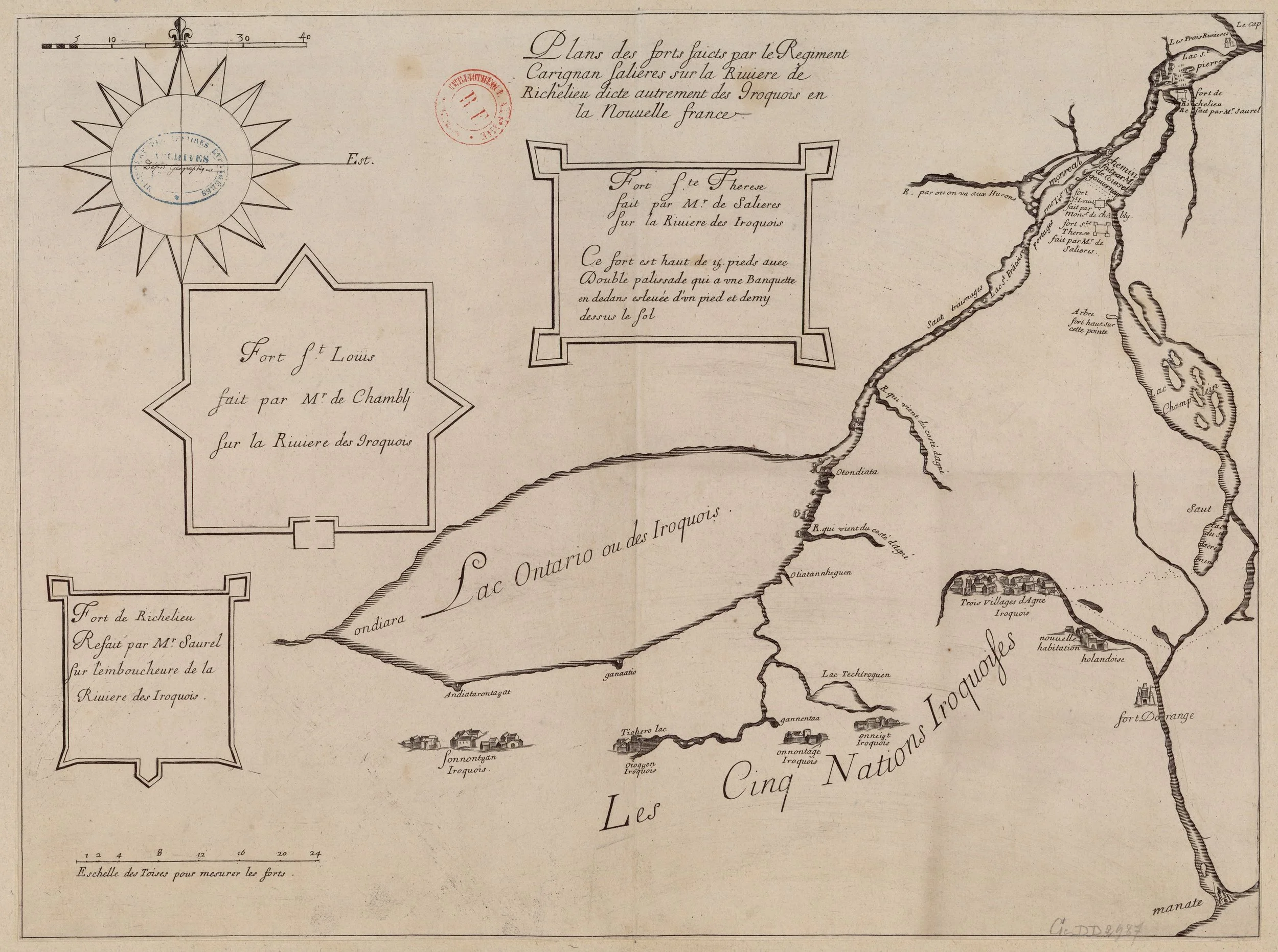
Plan des forts faicts par le Régiment Carignan Salières. The map records the chain of forts the regiment raised along the Richelieu in 1665–1666. Philibert served in the Company of Contrecoeur; no surviving document assigns him to work on a particular fort.
Bibliothèque nationale de France · Public domainPhilibert Couillaud — or Couillaut, or Couillat, or Coulleau, depending on which clerk was writing — sailed in the company of Contrecoeur. He was perhaps twenty-four years old. He could not read. He could not write.
The regiment's campaigns against the Iroquois were swift but largely inconclusive. What proved more consequential than the military campaigns was the policy that followed. The colonial administration of those years — Lieutenant-General de Tracy and Governor Rémy de Courcelle, with Intendant Jean Talon — offered land grants and incentives to soldiers who would remain in the colony after their discharge. Roughly a third of the regiment did. Philibert was among them.
Confirmed by a Bishop
The most important line ever written about Philibert Couillaud contains four words: "Philbert Couilliau de Nevers" — and it was written not by a notary taking down a debt, not by a court clerk recording a lawsuit, but by a bishop's secretary registering a confirmation. It is the only document in the entire research file that identifies his origin in a contemporary hand, written while he was alive, by someone who had his word for it.
On 21 May 1669 — four years after his arrival in New France, three years after the forts were built, two years after his first appearance in the Montreal archives — Philibert stood before Bishop François de Montmorency-Laval in the chapel of Fort Chambly and received the sacrament of confirmation alongside seven other soldiers of the Carignan-Salières Regiment.
The register entry is brief and precise. Eight men are listed, each with the place he came from — Angoulême, Rouen, Xaintes, Chartres, Rennes, Cornouailles, Périgueux. Fifth in the column stands Philbert Couilliau de Nevers. Diocese of Nevers. Nivernais. Central France.
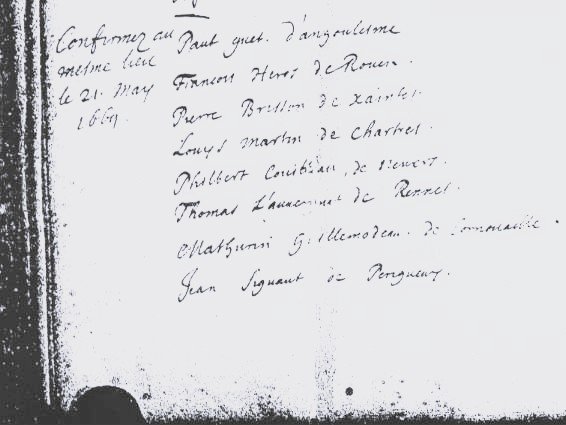
Confirmation register, Saint-Joseph de Chambly, 21 May 1669. The entry "Philbert Couilliau de Nevers" stands fifth in the list. Each man is given with his origin, and he is the only one from the diocese of Nevers.
PRDH-IGD, record #403509 · Saint-Joseph de ChamblyPRDH-IGD Confirmation Record #403509
| Record type | Confirmation |
|---|---|
| Date | 21 May 1669 |
| Parish | Saint-Joseph de Chambly |
| Name as recorded | Philbert Couilliau |
| Origin | Nevers |
| Rank in entry | 05 of 9 confirmed |
| Region | MRC La Vallée-du-Richelieu, Montérégie |
This record carries extraordinary evidentiary weight precisely because it was made in his own era, by an institutional authority, in a context that had no reason to misrepresent his origins. The bishop's secretary asked where each man was from. Philibert said Nevers. It was written down. That is the record.
It is also the record that definitively silences the fraudulent noble pedigree that has confused researchers for generations. For decades, some genealogical sources — and too many online databases — have placed Philibert as a son of one Bernard de Laroque, connecting him to a southern French noble family and an entirely fabricated aristocratic lineage. This fiction was invented by Robert de Roquebrune, a twentieth-century novelist and archivist who constructed a pedigree for his own family without evidentiary foundation.
The fabricated lineage — Bernard de Laroque and Marie de Marsilly — has no primary document to support it. Robert de Roquebrune published it in the review Nova Francia in 1929 under the pseudonym Pierre Gauthier, which let an account of his own ancestry circulate as though written by a disinterested third party. It persists in online databases and has been copied from tree to tree. The 1669 confirmation register contradicts it directly. A man confirmed at Chambly in 1669 as "de Nevers" did not come from southern French nobility. His origins are plain: diocese of Nevers, parents unknown. The research stops there. Inventing a connection to satisfy the appetite for aristocratic descent is genealogical fiction.
The First Document: Rocbrune
Two years after his arrival — before the confirmation at Chambly, before his settlement at Contrecoeur, before any of the story that follows — a land sale before Royal Notary Bénigne Basset at Ville-Marie names a soldier called Rocbrune. The date is 1667. If that man is Philibert Couillaud, this is the earliest surviving use of the name his descendants would carry.
The document records the transfer of a property on the Côte-Saint-Martin between several parties, grouping a cluster of Carignan-Salières soldiers as a collective unit. Page two contains the line that enters the research file as the earliest evidence of the dit name: "Aux Nommés Rocbrune, le Vallon" — meaning the named men Rocbrune and le Vallon, two soldiers identified by their dit names rather than their given surnames.
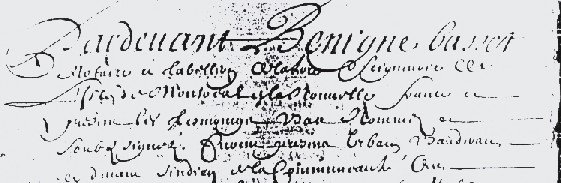
Opening page of the 1667 land sale, notary Bénigne Basset, Côte-Saint-Martin, Île de Montréal. Among the Carignan soldiers named in the transaction.
BAnQ, Greffe Bénigne Basset · 1667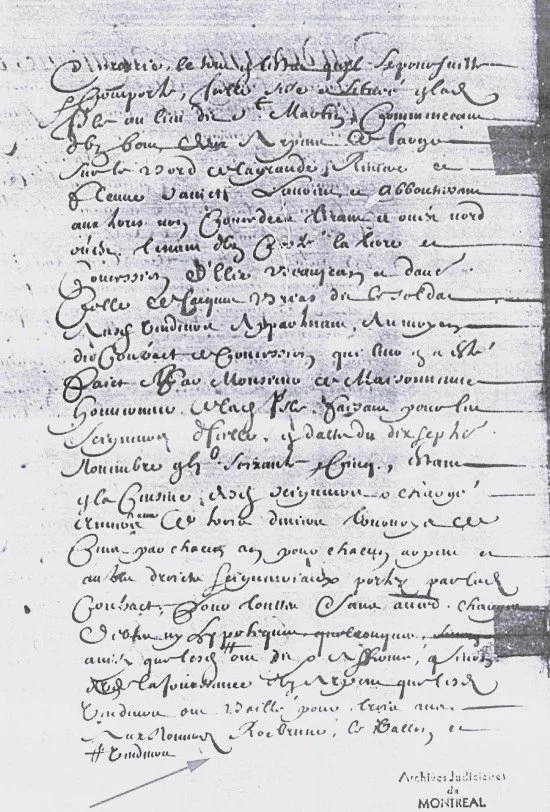
"Aux Nommés Rocbrune, le Vallon" — the earliest surviving use of the dit name, written in 1667 by Royal Notary Bénigne Basset, eight years before Philibert's marriage.
BAnQ, Greffe Bénigne Basset · 1667
Payment terms: 470 livres tournois. The document places the named soldiers alongside other men of the Company of Contrecoeur, two years before the confirmation at Chambly.
BAnQ, Greffe Bénigne Basset · 1667The 1667 act names Rocbrune, not Couillaud. No given name appears with it, and the two names are not joined in any single document until later. The identification of this Rocbrune as Philibert Couillaud rests on the company grouping in the act, the absence of a competing bearer of the name so far encountered in the Montreal notarial records of the period, and the continuous later use of Roquebrune as Philibert's dit name.
This is an inference, not a documented equivalence. It is carried in the research file pending a negative search of stated extent across the Basset and contemporary Montreal greffes for other men called Rocbrune. Until that search is completed and logged, the 1667 act should be read as the earliest surviving use of the name — not as proof of Philibert's own presence at Ville-Marie in 1667.
The dit name Rocbrune — from roc brun, a brown or dark rock — is toponymic in form, the kind of nickname assigned to men from places with a recognizable landscape feature, or to men whose bearing or coloring suggested it. Whether it referred to somewhere in Nivernais, or whether it was an informal name given to him in the regiment, cannot be determined from the surviving record.
What the documents do establish is the sequence. The name would appear as Roquebrune in formal documents, in its abbreviated form Laroque on the 1680 concession deed, and then as Larocque in the generation that followed — before becoming Larock, Rock, Roque, and a dozen other variants as the surname traveled west and south across a continent. But it starts here, in 1667, spelled Rocbrune, on a land sale on the Côte-Saint-Martin of Île de Montréal.
A Man Takes Root
At some point between 1669 and 1675, Philibert Couillaud moved from the military zone of the lower Richelieu to the Seigneurie de Contrecoeur, on the south shore of the St. Lawrence River. He did not come alone to this empty country — he came as one of a cluster of veterans who took up land grants in the seigneury after their discharge. The seigneur was Anthoine de Pecaudy de Contrecoeur, the same man from whom Philibert would later purchase his own concession. The community was small, new, and heavily dependent on the mutual labor of neighbors who had recently been soldiers together.
The document that proves his presence in Contrecoeur by 1675 is not a land grant or a tax record. It is a construction contract for a chapel.
On 1 December 1675, a master carpenter named Jean Duval and Antoine Emery dit Coderre contracted before a notary for the construction of Contrecoeur's first parish chapel. Emery had crossed in the same Company of Contrecoeur in which Philibert served; ten years after the regiment disbanded, the men who had soldiered together were building a church. The contract specifies dimensions, materials, and payment. And among the witnesses whose presence validates the legal transaction is: Philibert Couillaud dit Roquebrune.
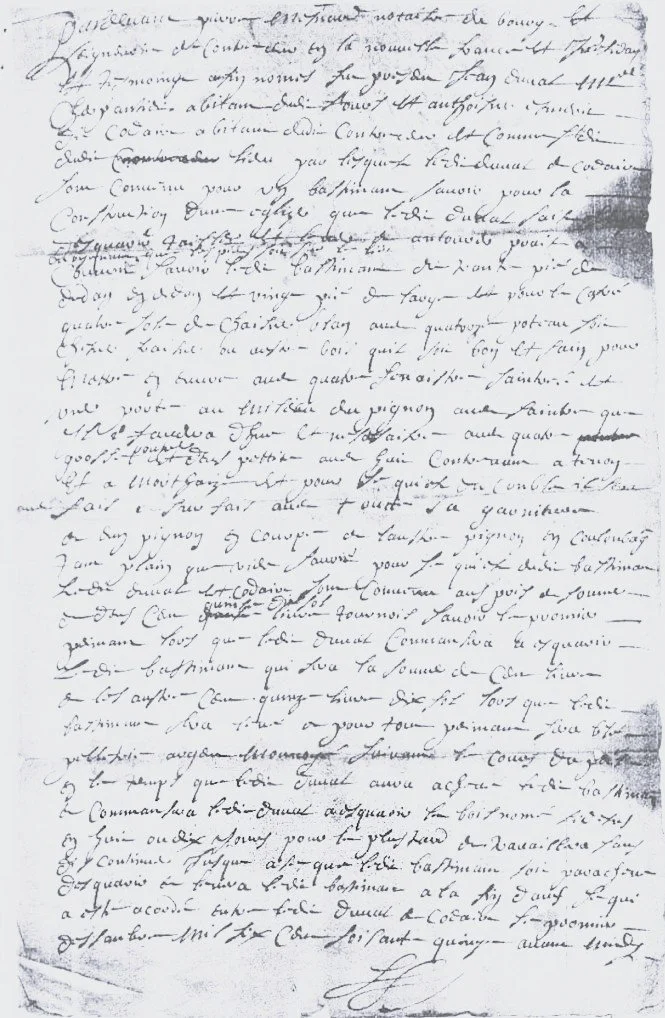
Church construction contract, Contrecoeur, 1 December 1675 — Philibert Couillaud as witness. The chapel contracted here is almost certainly the chapel in which he married Catherine Laporte in the same period. The same community that built the chapel performed the marriages it would house.
BAnQ, notarial records · Contrecoeur, 1 December 1675The timing is not coincidental. The same document that places Philibert in Contrecoeur on 1 December 1675 almost certainly places him there at precisely the moment his marriage to Catherine Laporte was being arranged. Catholic canon law of the period established twelve as the canonical age for a girl's marriage. Catherine Laporte dit Saint-Georges had been baptized on 12 October 1663 at Notre-Dame-de-Montréal. She turned twelve on 12 October 1675 — seven weeks before the chapel contract was signed. The fall of 1675 is the earliest moment the marriage could have occurred. The chapel they witnessed being contracted in December 1675 is almost certainly the chapel where their marriage was performed.
No marriage contract has ever been found. No marriage register entry survives. But the chapel contract is evidence of a kind: it places Philibert in the right place, at the right time, in the right company, to begin the life the 1681 census will document six years later.

Baptism of Catherine Laporte dit Saint-Georges, 12 October 1663, Notre-Dame-de-Montréal. She turned twelve — the canonical age for marriage — on 12 October 1675, seven weeks before Philibert witnessed the chapel construction contract.
Boucherville parish register · PRDH-IGDPRDH-IGD Baptism Record — Catherine Laporte dit Saint-Georges
| Record type | Baptism |
|---|---|
| Date | 12 October 1663 |
| Parish | Notre-Dame-de-Montréal |
| Child | Catherine Laporte dit Saint-Georges |
| Father | Jacques de Laporte dit Saint-Georges |
| Mother | Nicole Duchesne |
Catherine's parents are given as Jacques de Laporte dit Saint-Georges and Nicole Duchesne. The 1683 Boucherville baptism of her son Antoine names as godparents Antoine and Angélique Laporte, recorded there as children of Georges Laporte and Nicole Duchesne — the same mother's name. And the 1688 obligation, describing the land Philibert mortgaged, places it between the holdings of "Sr george" and Louis Laporte, giving the first man no surname at all.
The likeliest reading is that these are one family and one father. Saint-Georges is the Laporte dit name; a notary writing Sieur George beside Louis Laporte may simply be distinguishing two men of the same house, one by his dit and one by his given name. If that holds, Antoine and Angélique Laporte are Catherine's own brother and sister, which would answer the question this chapter's neighbour raises — why the family travelled to Boucherville in 1683 to have a child baptised.
It is documented. The inventory of Jacques Laporte's estate, made at the fort of Contrecoeur on 16 July 1698 and registered on 12 August, lists those present and names "paul Laporte fils, et philibert Couliaux gendre" — Philibert Couillaud, son-in-law. Catherine's father was Jacques Laporte dit Saint-Georges, and the relationship is stated in words in a notarial act. The same inventory describes Jacques's own concession at Contrecoeur as bounded "du costé du sudouest a Celle de Philibert Coulliaux" — adjoining Philibert's land on the southwest.
The brother is documented as well: an engagement of 24 March 1709 records Philibert's son Louis as living with Louis Laporte Saint-George, son oncle.
And "Sr george" in the 1688 obligation is Jacques himself. Catherine's own baptism entry of 1663 calls her father "Georges De la Porte dit St Georges"; her son's 1683 baptism calls him Georges; Maugue calls him Sieur George in 1688. Three clerks across twenty-five years wrote the same man's dit name where his given name should have stood. He had a son called Georges, baptized in 1662, but that son was twenty-six and unmarried in 1688 and it is the father's land the inventory places against Philibert's.
The 1698 inventory sets out the order of the concessions along the river: the land Jacques and Nicole had given their daughter Suzanne, married to the notary Pierre Mesnard, then Jacques's own, then Philibert's on the southwest. A donation by the widowed Nicole Duchesne in September 1702 repeats it, describing her concession as lying between Mesnard's and that of "sa fille Catherine de Laporte, la veuve de Philibert Couillaud."
A Community of Witnesses
In the space of five months, between September 1679 and February 1680, Philibert Couillaud appears in three separate notarial acts before two different notaries — as a witness, as a buyer, and as a witness again. These documents, discovered after years of research, reveal something the later obligations and census could only imply: by 1679, more than a year before the first surviving census, Philibert was an established, trusted, and legally recognized member of the Contrecoeur community.
To serve as a notarial witness was not a casual matter. It required that you be known and identifiable — an adult male settler of established residence, whose signature (or mark) would bind a document in law. The notary called you specifically. You came. You witnessed.
Philibert was called twice in five months by notary Pierre Mesnard. Between those two witness appearances, he appeared before Royal Notary Antoine Adhémar to make the most consequential transaction of his life.

Annulment of a prior sale contract between Nicolas Bonnain dit St-Martin and Louis Jean dit Lafontaine, before notary Pierre Mesnard, Contrecoeur, 8 September 1679. Philibert Couillaud dit Roquebrune appears as a formal witness alongside Claude Jaudoin. The document notes that neither the parties nor the witnesses could write or sign: "ni lesdites parties ne savoir écrire ni signé." Philibert marks with an X — the same mark that will appear on the 1688 obligation, nearly nine years later.
Pierre Mesnard notarial records, Seigneurie de Contrecoeur · BAnQ · 8 September 1679Five months after witnessing that annulment, in February 1680, Philibert went to see Royal Notary Antoine Adhémar on a matter of his own. He was buying land. On 12 February 1680, Philibert Couillaud dit Roquebrune purchased a concession of sixty arpents from the Seigneur de Contrecoeur himself — Anthoine de Pecaudy, Escuyer — for thirty livres payable at Christmas. The concession measured two arpents of river frontage by thirty arpents in depth, fronting the St. Lawrence.
This document resolves a question that had been listed as open research for years: where did Philibert's land come from? The 1681 census records him with five arpents under cultivation. Five arpents cleared in thirteen months, from sixty arpents of raw concession purchased in February 1680, is exactly right.

Certified transcription of the land concession, Adhémar No. 481, certified by Prothonotary É.Z. Massicotte, 8 January 1942. Philibert Couillaud dit Roquebrune purchases 60 arpents from Seigneur de Contrecoeur for 30 livres. Bordered by Pierre Favro dit Dulaurier. Neither Philibert nor co-witness Jean Mazo dit St-Martin could sign.
Adhémar notarial records, No. 481 · BAnQ · 12 February 1680
The original handwritten concession deed, Adhémar No. 481. An arrow points to the word Laroque — written in the hand of notary Antoine Adhémar. This is the earliest known instance of the abbreviated form of the dit name that would become the permanent family surname. Larocque did not emerge only in the next generation: it appears in official notarial usage in Philibert's own lifetime, on his own concession deed, in 1680.
Adhémar notarial records, No. 481, original manuscript · BAnQ · 12 February 1680"Laroque" — written in the hand of notary Adhémar, on the deed by which Philibert Couillaud purchased his land from the Seigneur de Contrecoeur. The earliest known instance of the name his children would carry across a continent.Adhémar No. 481, 12 February 1680 · BAnQ
Two days later — forty-eight hours after purchasing his concession — Philibert appeared before Pierre Mesnard again, this time as a witness to a transport of one hundred livres between Louis Jean dit Lafontaine and Julien Brousseau dit Laverdure. He signed with his mark. The document notes: "la marque dudit Couillaud."
Lafontaine is the same man whose 1679 annulment Philibert had witnessed. The community was small. The same men encountered each other before the same notaries in the same seigneury, year after year. Philibert was embedded in it.

Transport of 100 livres, Louis Jean dit Lafontaine to Julien Brousseau dit Laverdure, before notary Pierre Mesnard, 14 February 1680 — two days after Philibert's concession purchase. Philibert appears as witness. Illiteracy noted: "la marque dudit Couillaud." Decipherment: Guy Perron, paleographer.
Pierre Mesnard notarial records, Contrecoeur · BAnQ · 14 February 1680Three acts in five months. Two notaries. One buyer, twice a witness. Contrecoeur in the winter of 1679–1680 was a community of perhaps thirty households, and Philibert Couillaud was one of its established members — illiterate, yes, but trusted enough to be called as witness, creditworthy enough to buy land, present enough to be there twice in forty-eight hours when Mesnard needed a name for his documents.
The Family on the Census
In 1681, Intendant Duchesneau ordered a census of the entire colony of New France. Every household was to be recorded: head of family, wife, children, livestock, firearms, and arpents under cultivation. The census survives. The original manuscript page for the Seigneurie de Contrecoeur is one of the most legible pages in the entire document. And there, third household after the seigneur's entry, is Philibert Couillaud's family.
What the Census Says
The original manuscript entry reads, in the hand of the census-taker:
Philibert Couillaut — 40 ans
Catherine Laporte sa femme — 17
Enfants: Jean — 5, Baptiste — 3, Jean François Gazail — 1
1 fusil — 5 bêtes à cornes — 5 arpents en valeur
He is forty years old, which places his birth around 1641 — consistent with his service record. His wife is seventeen, consistent with her 1663 baptism. Two sons are entered beneath them: Jean, five, and Baptiste, three — the Jean-Baptiste baptized at Sorel in 1677.
A third boy closes the household, and he is not theirs. Entered under a different surname and with no filiation, he is François Gazaille, born about 1680, son of Jean Gazaille dit Saint-Germain and Jeanne Touze, who farmed alongside them. His father had been a corporal in the same company Philibert served in. The Gazaille household was enumerated separately that year with three daughters and no small son; the boy was counted here instead. He lived to marry in 1711 and was buried at St-Denis-sur-Richelieu in 1760.
Someone else is missing. On PRDH's dating Louis was born about 1679 and should stand here at two years old. He does not appear. That absence is the strongest evidence for the later birth year proposed by Michel Larocque — though Bertrand Desjardins, whose reconstruction underlies the PRDH record, reads the entry for Baptiste as Louis himself, and on that reading the absence dissolves. The methodology sets out both.
One musket. Five cattle. Five arpents under cultivation — exactly what you would expect from a man who purchased sixty arpents of raw land thirteen months earlier and spent those thirteen months clearing it.
Research analyst Michel Larocque, who has studied the family's birth intervals extensively, reads the Contrecoeur entries as also including a child of five — which would indicate a son Jean, born c. 1676, distinct from Jean-Baptiste and possibly the first child of the marriage. The transcription above records two children only. The discrepancy between the two readings of the manuscript has not been resolved, and the Jean hypothesis is carried in the research file as unconfirmed.

Original manuscript, 1681 Census of New France, Seigneurie de Contrecoeur. Third household in the seigneury after the seigneur Pécaudy.
Library and Archives Canada · 1681 Census of New FranceThe PRDH download version of the census provides a cleaner transcription, useful for verification, but the original manuscript is the primary document — and it is remarkably clear. The census-taker moved through the seigneury household by household, and Philibert's family is the third entered after the seigneur Pécaudy. Enumeration order records the route the census-taker walked, not the standing of the households along it. The sequence places Philibert among the seigneur's near neighbours and establishes nothing further about his rank within the community.
The Children
Between roughly 1676 and about 1700, Catherine Laporte bore Philibert Couillaud eleven children. Five have surviving baptism records. Four were born during a fourteen-and-a-half-year gap in the Contrecoeur parish registers and can only be documented through later records: marriage acts, burial entries, their own children's baptisms. The gap, as we will see, was caused by fire.
PRDH-IGD Family Record #4480 documents eleven children of this union. That enumeration is followed here. A competing analysis by research analyst Michel Larocque proposes thirteen, adding two unnamed children — one in the first register loss of 1678–1681, one in the second — and moving Louis's birth from c. 1679 to c. 1689 to close what he considers an implausible eight-year interval. Neither count can be settled from surviving records, and the difference is set out in the research file rather than resolved here.
| # | Name | Birth / Baptism | Parish | Record Status |
|---|---|---|---|---|
| 1 | Jean (existence open) | c. 1676 | Contrecoeur (no record) | Listed age 5 in the 1681 census · No baptism, marriage or burial · Desjardins reads that entry as Jean-Baptiste, which would leave no separate Jean |
| 2 | Jean-Baptiste | b. 15 Oct 1677 / bap. 20 Oct 1677 | Sorel (St-Pierre-de-Sorel) | Register + PRDH #38748 |
| 3 | Louis | c. 1679 (PRDH displayed) · c. 1689 (argued) | Contrecoeur (first register loss) | No baptism record · PRDH #38856 · Birth year disputed |
| 4 | Marie-Anne | b. 3 Oct 1681 / bap. 4 Oct 1681 | Contrecoeur | Register + PRDH #89942 |
| 5 | Antoine | b. 6 Nov 1683 / bap. 7 Nov 1683 | Boucherville (Ste-Famille) | Register + PRDH #2223 |
| 6 | Catherine | b. and bap. 12 Jan 1685 | Contrecoeur | Register + PRDH #90008 |
| 7 | François | b. 3 Dec 1686 / bap. 6 Dec 1686 | Contrecoeur | Register + PRDH #90038 · Last entry before the lacune |
| 8 | Michel | c. 1694 | Contrecoeur (register gap) | Born during the 14.5-year lacune · Age from 1718 marriage act |
| 9 | Marie Hilaire | c. 1696 | Contrecoeur (register gap) | Born during the 14.5-year lacune · PRDH #38859 |
| 10 | Philibert fils | c. 1697 | Contrecoeur (register gap) | Born during the 14.5-year lacune · PRDH #38858 |
| 11 | Marie Barbe | c. 1700 | Contrecoeur (register gap) | Born during the 14.5-year lacune · PRDH #74820 |
Numbering follows PRDH Family Record #4480 in estimated birth order. Jean is documented only by the 1681 census, which lists a son of five in the household; no baptism or later record for him has been found. Louis's birth year is given in both readings — PRDH's displayed c. 1679 places him in the first register loss, the argued c. 1689 in the second; PRDH's own note allows a baptism after December 1686. Birth years for the four children born inside the 14.5-year lacune are estimates derived from ages stated in adult records, which are unreliable for this period.
Five baptism records survive — each from a different moment in the family's story. The earliest, Jean-Baptiste, was baptized not at Contrecoeur but at Sorel, in October 1677: the chapel at Contrecoeur had been contracted in December 1675, but perhaps was not yet serving the full sacramental calendar, or perhaps the family was briefly elsewhere. Marie-Anne appears in the first Contrecoeur register. Antoine was baptized at Boucherville — a significant detour from Contrecoeur, raising the open question of why the family traveled there when their own chapel was operational, and pointing toward the Laporte family connection at Boucherville set out in Chapter IV.

Jean-Baptiste Couillaud, born 15 October, baptized 20 October 1677, Sorel (St-Pierre-de-Sorel). Godfather: Jean Coittou dit StJean. Godmother: Catherine Platte, wife of Pierre Charron.
St-Pierre-de-Sorel parish register · FamilySearch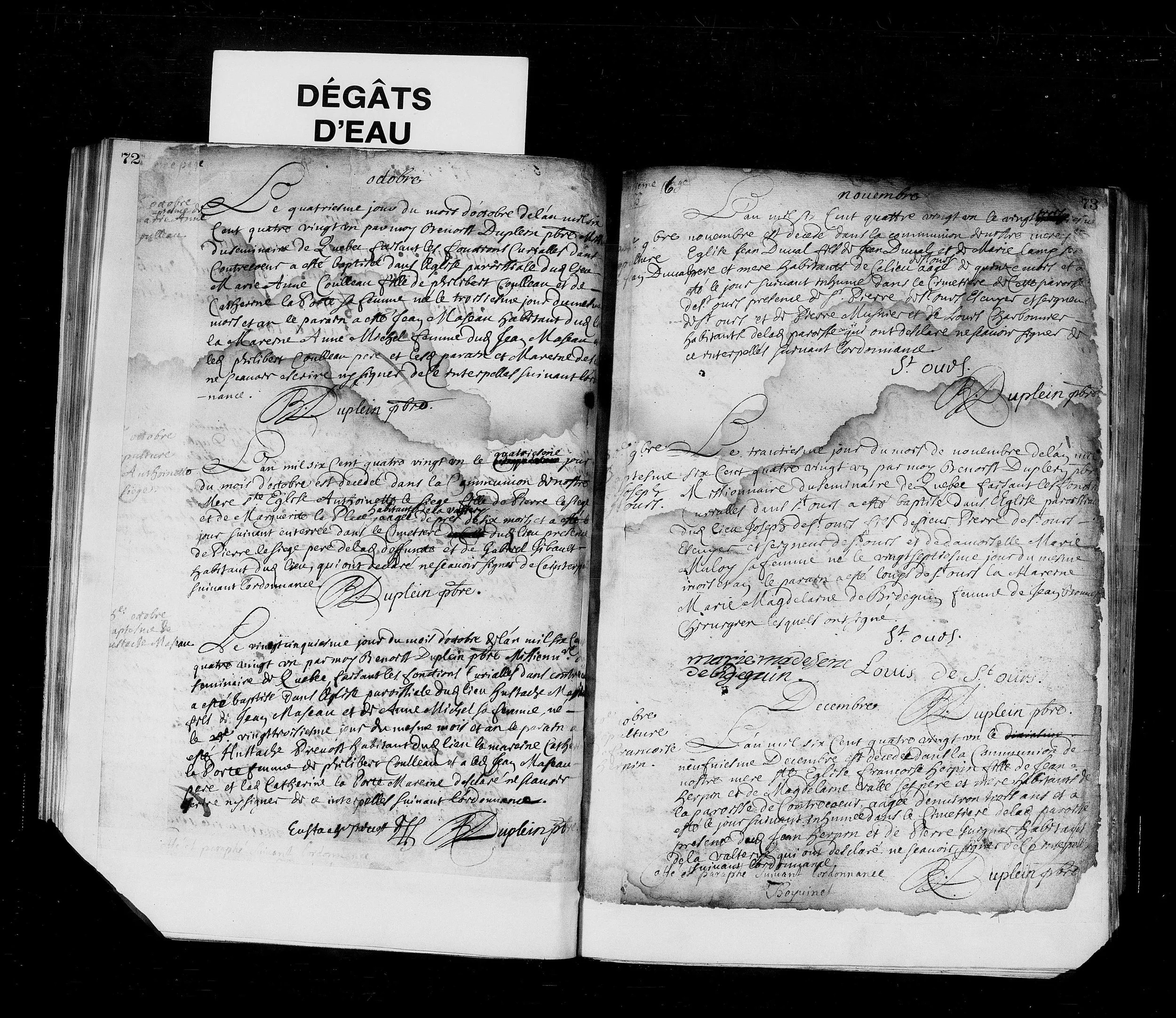
Marie-Anne Couilleau, baptized 4 October 1681, Contrecoeur. First child documented in the Contrecoeur register. Marie-Anne would later be tried in absentia, in 1702, for the murder of her husband — the most dramatic chapter in the family's post-Philibert history.
Contrecoeur parish register · FamilySearch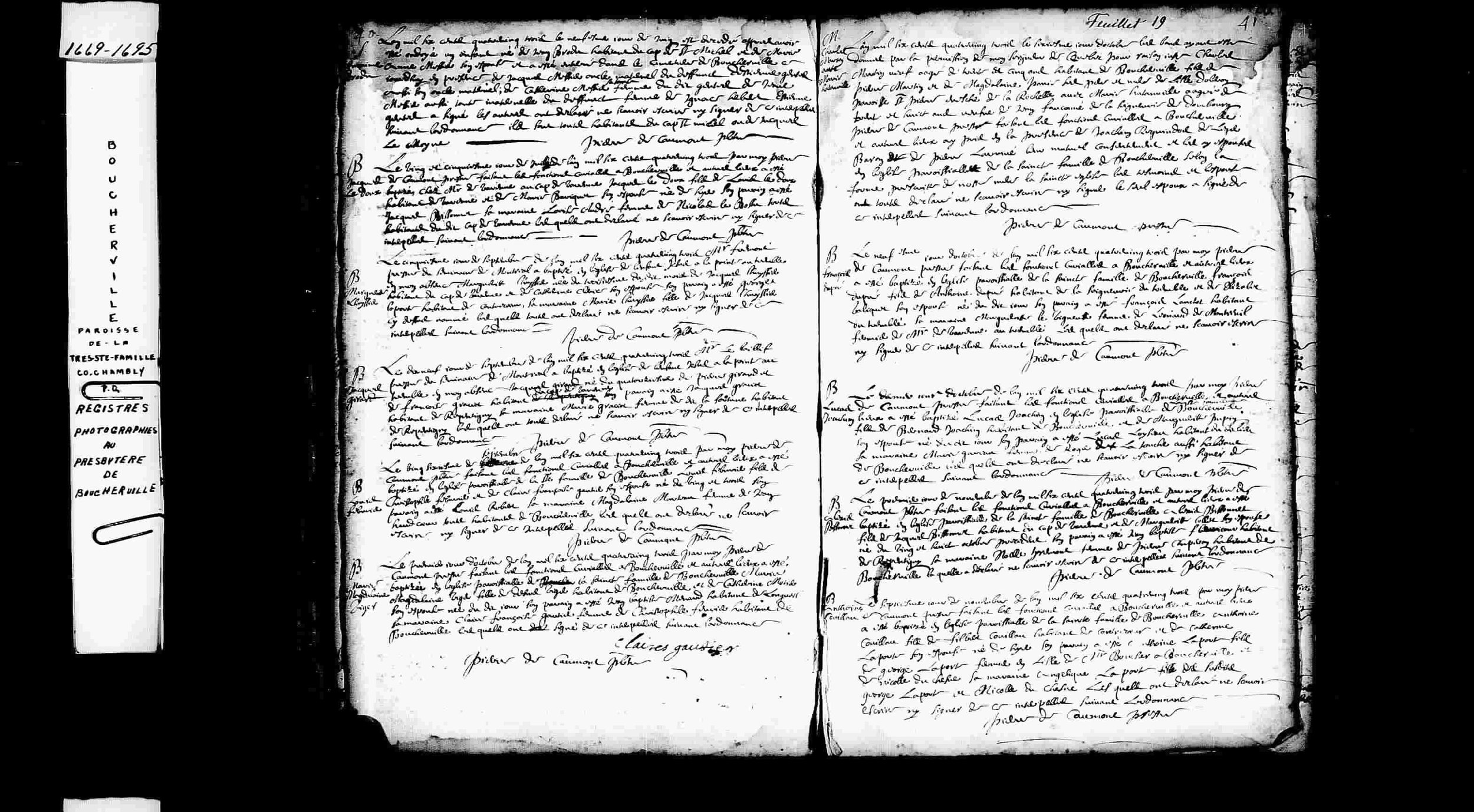
Antoine Couillau, born 6 November, baptized 7 November 1683, Boucherville (Très-Sainte-Famille), feuillet 19. Family residence: Contrecoeur. Godfather: Antoine Laporte; Godmother: Angélique Laporte, recorded as children of Georges Laporte & Nicole Duchesne, Boucherville. Open question: why Boucherville when the Contrecoeur chapel was operational?
Paroisse de la Très-Sainte-Famille, Boucherville · BAnQ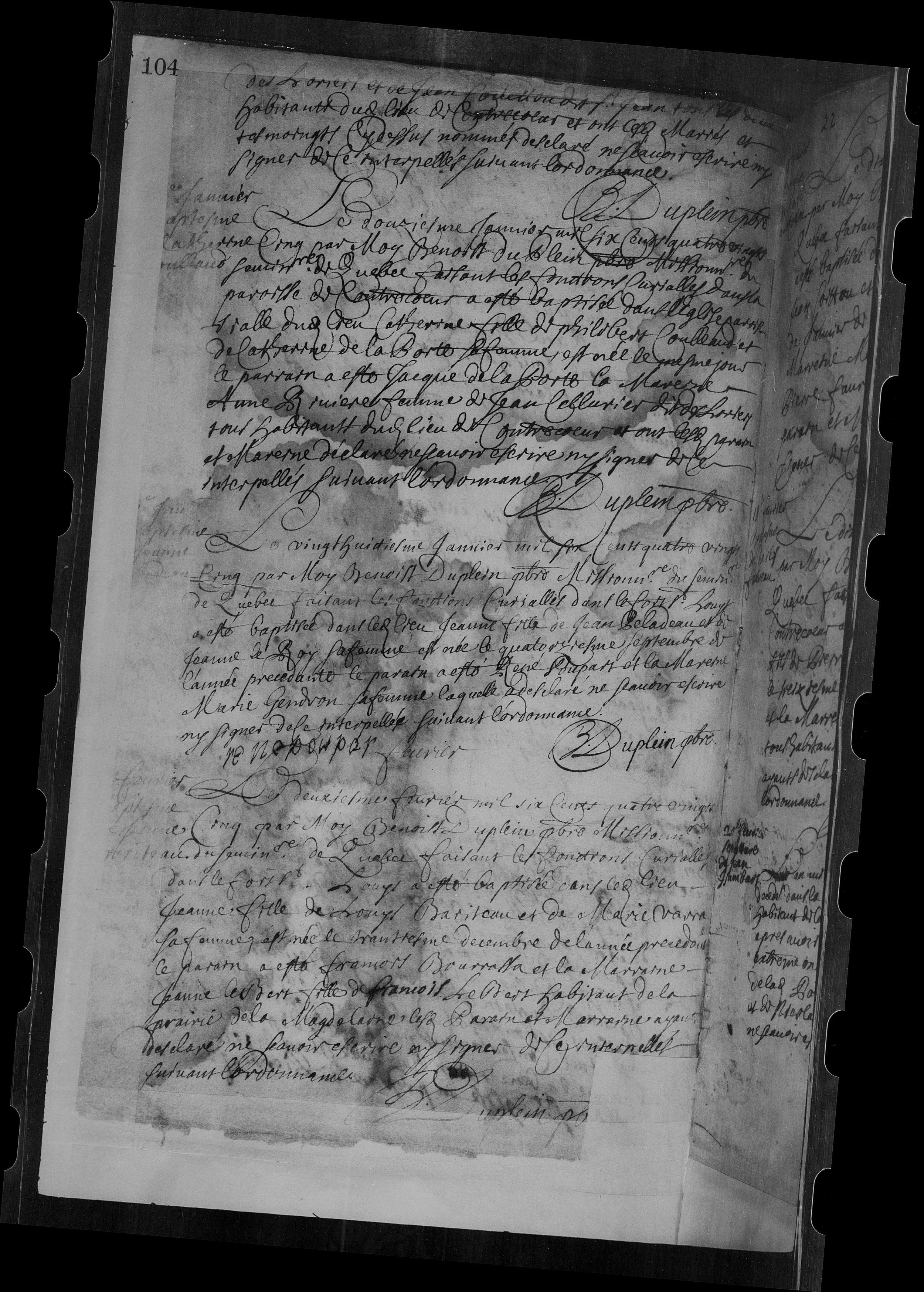
Catherine Couillaud, baptized 12 January 1685, Contrecoeur. The last two children with surviving baptism records — Catherine (1685) and François (1686) — were born just before the second devastating fire closed the register for fourteen and a half years.
Contrecoeur parish register · FamilySearchThe Debt Ledger: The X
The richest single document in the Philibert Couillaud research file is not a birth record or a marriage entry. It is a debt. On 18 May 1688, Philibert Couillaud dit Roquebrune borrowed 118 livres 18 sols from Montréal merchant Charles de Couagne, before Royal Notary Claude Maugue. In the course of recording that transaction, the document yields three distinct findings — all of them from this one act, and therefore corroborating one another only insofar as a single witness can — that together contain more biographical information about Philibert than the rest of the file combined.
It tells us where his land was. The act describes "l'habitation à luy appartenant… au lieu de Contrecoeur" as lying between the holdings of "Sr george" and, on the other side, Louis Laporte. The family geography is pinned precisely and the seigneury layout becomes legible — but the words are worth reading exactly. Maugue gives the first neighbour no surname and neither man a stated relationship to Philibert. That they were his wife's father and brother is this research file's reading of the family, set out in Chapter IV, and not something the notary wrote down.
It tells us who his acquaintances were: François Bailly, physician, and Nicolas Droissy, pastry baker — both Montréal men, witnesses to the transaction, whose presence suggests that Philibert had commercial connections reaching beyond the Contrecoeur seigneury into the colonial capital.
It tells us he had debt: one hundred and eighteen livres eighteen sols, a sum that would take years to repay, borrowed from one of the most prominent merchants in the colony. By 1688, Philibert was raising a large family on a cleared concession, managing livestock, and carrying debt — the ordinary condition of a colonial habitant.
And it tells us, in the most direct and intimate way possible, that he could not read or write.

The phrase "ne sçavoir écrire ny signer suivant l'ordonnance" — did not know how to write or sign according to the ordinance — was the standard legal formula for illiteracy in New France notarial practice. It was not a judgment. It was a fact, entered into the record, followed by the mark of the party: an X.
That X is the most intimate evidence Philibert Couillaud ever left in any archive. Every other document was written by someone else about him — a census-taker recording his age, a notary writing down his name, a bishop's secretary noting his origin. The X is the only thing in the entire research file that came from his own hand.
The same illiteracy formula appears in the 1679 Mesnard witness act, the 1680 concession purchase, and the 1680 transport. It will appear again in the final obligation. Philibert never learned to write. In 1688, he was roughly forty-seven years old, had been in New France for twenty-three years, and had raised at least seven children. The X was his signature throughout.

Notarial obligation, Philibert Couillaud dit Roquebrune to Charles de Couagne, 118 livres 18 sols 10 deniers, before Royal Notary Claude Maugue, 18 May 1688. The mortgaged land is placed at Contrecoeur between the holdings of "Sr george" and Louis Laporte; the act states no relationship between either man and Philibert. Witnesses: François Bailly (physician) and Nicolas Droissy (master pastry baker), both of Montréal.
ANQ Montréal, Greffe Claude Maugue · 18 May 1688The Years of Silence
After François was baptized on 6 December 1686 — the last baptism in the Contrecoeur register before the fire — the documentary record for Philibert Couillaud's family goes silent for fourteen and a half years. This is not a silence of inactivity. Between 1687 and 1701, Catherine bore at least four more children, Philibert incurred at least two more debts, and life in the seigneury continued in every measurable way. What ended was the parish register.
Contrecoeur is one of very few Quebec parishes to lose its registers twice. The first fire — at the home of surgeon Jean Bouvet dit Lachambre, who housed the visiting missionary priest and apparently kept the registers with him — destroyed two and a half years of records (roughly June 1678 through January 1681). A compiler's note in the surviving volume documents the loss explicitly.
The second fire was more catastrophic. Sometime in 1687, the registers were lost again. The volume cover of the surviving Contrecoeur register records the years it contains and the years it does not. The index, compiled later by a church archivist, records the lacune in plain language: "1687 en partie... 1688 à 1701 manquent." Fourteen and a half years. Missing.

Cover of the surviving Contrecoeur parish register, documenting the years present and absent. The notation of missing leaves records the two fire losses explicitly.
ANQ · Contrecoeur parish records
Compiler's note documenting the first fire: "perdus ou détruits par le feu" — lost or destroyed by fire. The note identifies surgeon Jean Bouvet dit Lachambre's home as the location where the registers were kept when the fire occurred.
ANQ · Contrecoeur parish records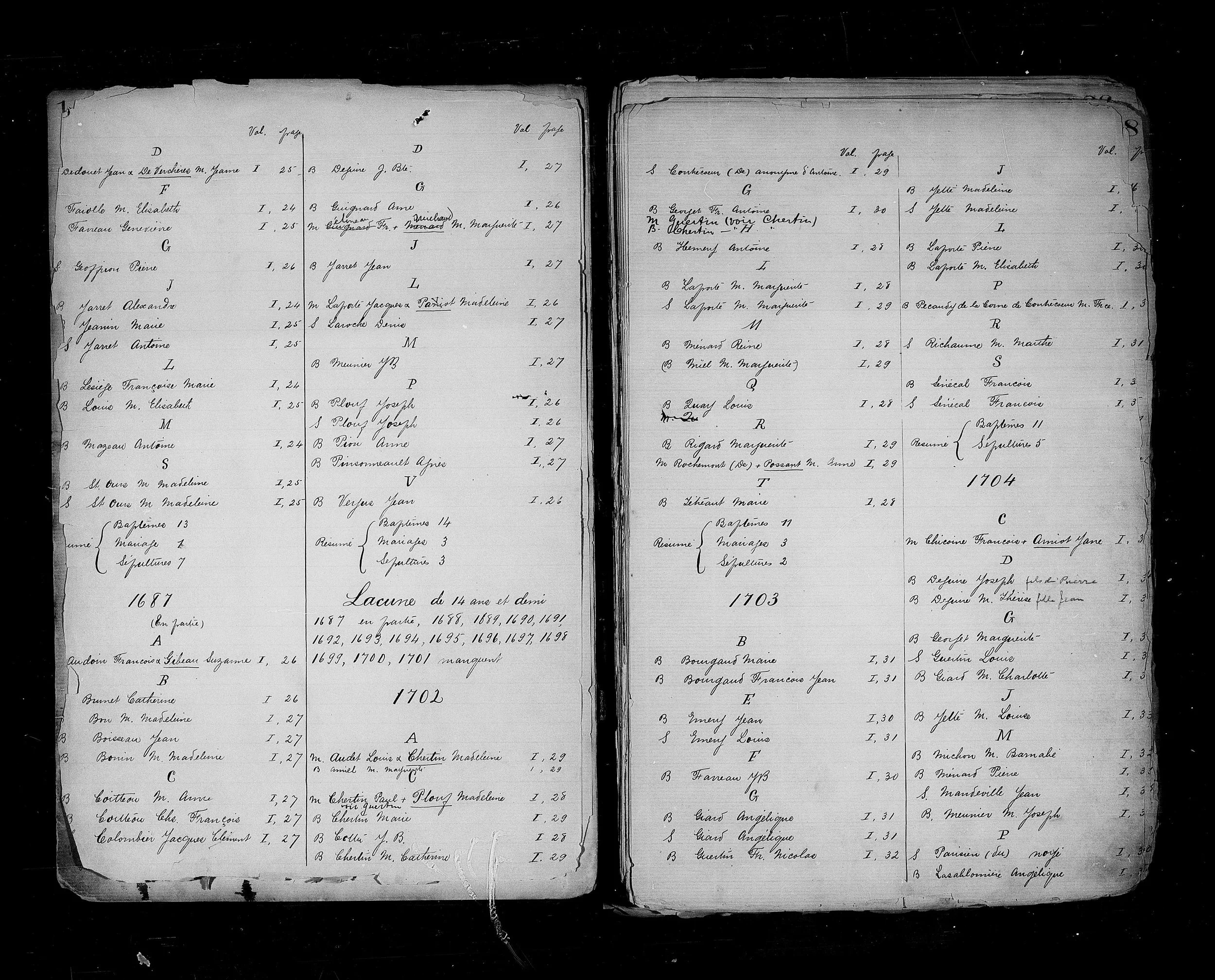
The register index records the second and far more devastating loss: "1687 en partie... 1688 à 1701 manquent." Fourteen and a half years. The baptisms of four of Philibert's children were entered in these lost registers and do not survive.
ANQ · Contrecoeur parish register indexThe gap swallowed the baptisms of Michel, Marie Hilaire, Philibert fils and Marie Barbe — four children born between roughly 1694 and 1700. Louis, born c. 1679 on the PRDH reading, falls instead inside the earlier loss of 1678–1681; the same fires account for both. Their births can only be estimated from the evidence that surrounds the gaps: ages stated at marriage, the children they had, the records that document them as adults. The gap is not a failure of research. It is a documented historical fact. The registers burned. The children's baptisms went with them.
During this same period, Philibert continued to incur debt. A notarial index from 1701 documents an obligation to Marguerite Sédillot for 150 livres, incurred in 1687 — the same year the register gap began. A final obligation, No. 3063, also survives from the late obligation period. The debts were accumulating. The family was growing. The register was gone. Philibert himself, sometime around 1699 or 1700, died.
The Widow's Fight
Philibert Couillaud's death left no burial record. He did not die in the parish register. He died in his debts — and it was his creditors, not his priest, who made the record. The first document to record his death names him "deffunt Philibert Couillau dit Rocquebrune" — the late Philibert Couillaud dit Roquebrune. It is a lawsuit. The date is 8 March 1701.
Joseph Aubuchon came before Jacques Alexis de Fleury Deschambault, Lieutenant Général of the Royal Jurisdiction of the Island of Montréal, acting for himself and for his brothers and sisters as heirs of their late mother, Marguerite Sédillot. He was represented by Antoine Adhémar, royal notary — the same man who, twenty-one years earlier, had drawn the deed by which Philibert bought his land from the seigneur. What Aubuchon asked was narrow: that a debt of 150 livres, contracted before the notary Maugue on 25 February 1687 by "deffunt Philibert Couillau dit Roquebrune vivant habitant de Contrecoeur," be declared enforceable against the widow.
Catherine was named in two capacities: in her own name, for the community of goods she had held with her husband, and as mother and natural guardian of their minor children. The suit establishes a hard terminus — Philibert was dead before 8 March 1701. How long before, the documents do not say. The register gap means no death record exists to narrow it further.
She answered in person, and her answer survives. Her husband had made several payments against the debt, she said; she offered to prove them and consented to pay whatever remained. Then the line that gives the case its shape: comme elle n'est pas en état de payer — since she is not in a position to pay — she offered to pay the interest instead.
The court ruled the same day. The 1687 obligation was declared executory against her. She was to pay 150 livres, less whatever she could prove had already been paid, with interest running from 27 February and costs. The judgment was sealed that afternoon; the red wax is still on the page.
The following day, 9 March 1701, Catherine went before Antoine Adhémar — the same notary who had just argued against her — and borrowed again. The act survives only as a line in an index of notarial minutes: an obligation from Catherine De Laporte, veuve de Philibert Couillaud dit Roquebrune, à Charles de Couagne. The index does not record the sum. Twenty-four hours after telling the court she could not pay one debt, she had taken on another.

Opening page of BAnQ TL4,S1,D480: Aubuchon / Sédillot heirs vs. Catherine Laporte, "veuve de deffunt Philibert Couillau dit Rocquebrune." The first document to record Philibert's death — a debt collection, not a burial register.
BAnQ TL4,S1,D480 · Royal Jurisdiction of Montréal · 1701–1707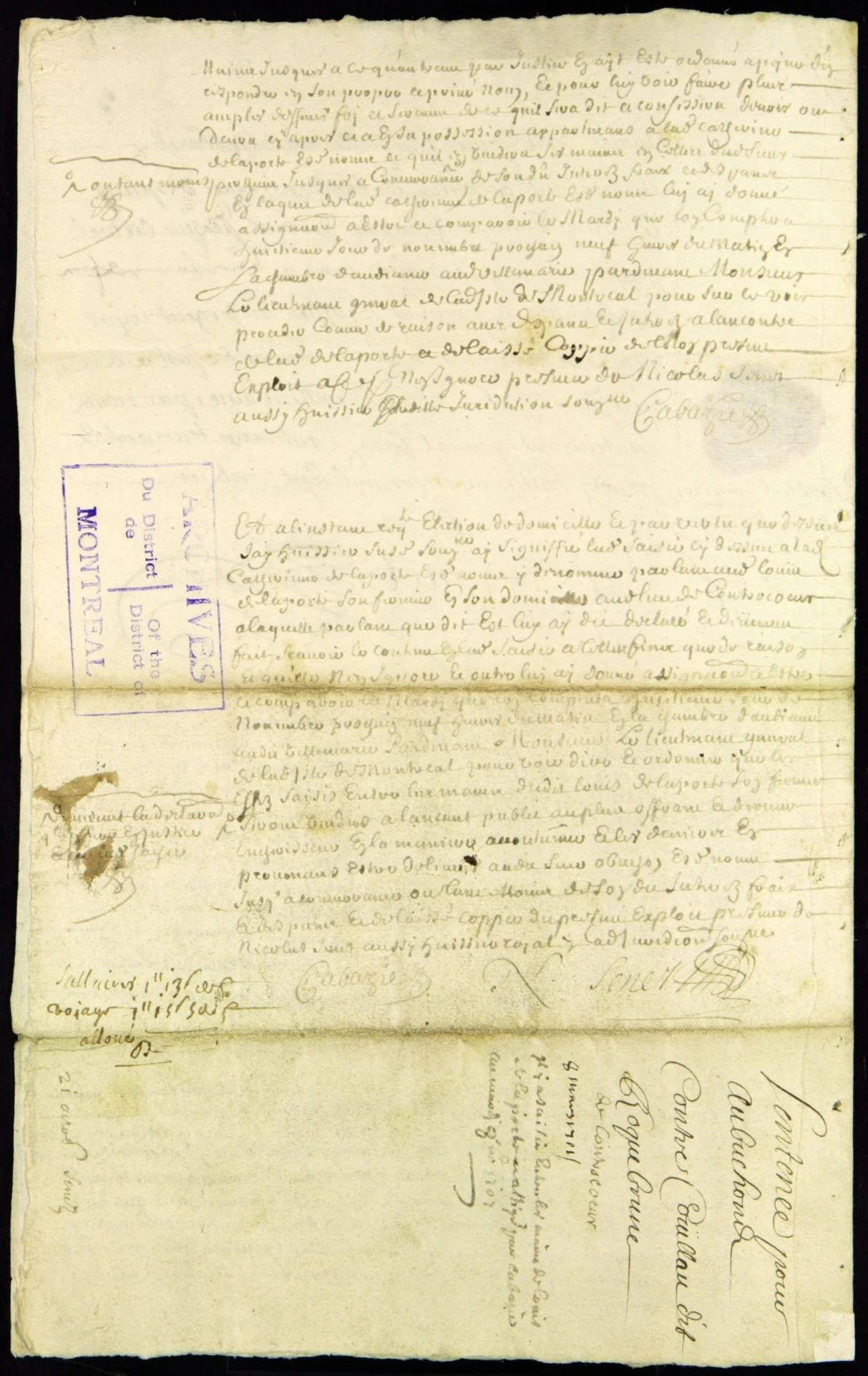
The enforcement, six years later. Money, wheat, peas and oats belonging to Catherine are seized "sous la main du Roy" in the hands of Louis Delaporte, her tenant at Contrecoeur, with a request that they be sold at public auction to the highest bidder. She is summoned for Tuesday 9 November. Signed by the royal huissiers Cabazié and Nicolas Senet; the margin notes their fees at 1 livre 12 sols and 1 livre 15 sols.
BAnQ TL4,S1,D480 · Royal Jurisdiction of MontréalThen six years pass with nothing in the file. In that silence Catherine remarried — Jean Charpentier, at Varennes, on 9 October 1706.
In October 1707 the huissier Cabazié came to Contrecoeur to enforce the judgment. He served her as "veuve de Philibert Couillau dit Roquebrune, habitante de Contrecoeur, y demeurant" — still a widow, still resident there, a full year after her second marriage; the court's paperwork had not caught up with her life. She was not at home. He spoke instead to Louis Delaporte, son fermier, the man farming her land. The grain was seized into the King's hand — money, wheat, peas, oats, whatever stood in the barn — and Aubuchon asked that it be sold at auction. Catherine was summoned to appear on Tuesday 9 November at nine in the morning.
The file ends there. Four pages, a summons, and no answer. Whether the grain was sold, whether she appeared that November, whether the Sédillot heirs ever saw their 150 livres — none of it is recorded. What the surrounding documents show is only what came afterward.
By 1711 the concession was legally abandoned. The seigneur, Antoine Pécaudy, petitioned the court to have it sold, complaining that the neighbours were carrying the ditch maintenance the heirs were not doing. The permission to sell was read aloud at the church door at Contrecoeur on 29 March 1711; notices went up at Notre-Dame in Montréal on 17, 24 and 30 May. At the auction, son Antoine Couillaud bid 214 livres on his father's land, then formally opposed the sale by invoking the douaire préfix from his parents' marriage contract — the clause securing his mother's dower. The opposition raised the final adjudication to 278 livres, and Antoine took the land. It did not leave the family there: the heirs held it until 1735, when it was finally sold outside the line. The marriage contract itself is lost; this auction is the first place its dower clause can be seen at all.

Philibert Couilleau fils appears before Michel Le Pailleur, substitut of the King's Procurator, sitting in the absence of the Lieutenant Général, and presents for registration a deed of "donnation pure, simple et irrevocable entre vifs" passed before Dubreuil, royal notary at Québec, on 10 April 1728 — a gift to him from Jean Charpentier and Catherine Laporte, his mother, of the rente of her dower, "qui luy est deub depuis trente ans, à raison de quinze livres par année, suivant le contrait de mariage."
Archives du District de Montréal · 15 October 1728The last act is not a quarrel. On 10 April 1728, at Québec, Catherine and her second husband signed a deed before the notary Dubreuil giving her son Philibert the rente of her dower. On 15 October he carried it into the Montréal court and had it entered on the record. She was sixty-four. Fifty-three years had passed since the marriage the rente came from.
The wording repays attention. The rente is described as owed her depuis trente ans — these thirty years past — at fifteen livres a year. That is a statement of arrears, not of a contract's term, and the pages of this research file that once read it the other way have been corrected. If the arrears genuinely run from Philibert's death, they would begin around 1698 and narrow a terminus the register gap has otherwise left fourteen years wide. The figure is the kind of round number a legal recital often approximates, so it is carried here as a possibility rather than a finding.
One thing does not yet reconcile. Antoine invoked the same dower at the 1711 auction, and the raised price is understood to have satisfied it. Why a rente on that dower was still owed in 1728, and owed for thirty years, is an open question in this research file. It may be that 1711 secured the capital and 1728 concerns the annual rente; it may be that the opposition preserved the right without discharging it. The documents as they stand support the question, not the answer.
The marriage contract itself has never been found. Its terms survive only in the 1711 opposition and this 1728 deed — one clause, glimpsed twice, in documents that had nothing to do with recording Philibert's life.
Catherine After Philibert
Catherine Laporte dit Saint-Georges outlived her first husband by thirty-six years. She managed his debts, raised their remaining children, survived the seizure of her wheat crop, and eventually remarried — to a man whose priest got her first husband's name wrong. She died on 11 April 1737 in Varennes, approximately seventy-three years old. Her story does not end with Philibert's death. It continues, at length, and with considerable resourcefulness.
The years after the judgment were hard, but she was not idle in them. She kept the Contrecoeur land in production, leasing it to a tenant, and was still drawing a crop from it in 1707 when the huissier came to seize it. The Aubuchon file names her throughout as veuve — widow — and went on doing so a year after she had remarried. She held the concession until the seigneur had it auctioned in 1711, and her son bought it back.
On 9 October 1706, Catherine Laporte remarried in Varennes. Her second husband was Jean Charpentier. The parish register entry records her as "veuve de feu Jean Couillault." Two years earlier, in the same parish, her son Jean-Baptiste had married with his father entered as Jean Couillaut as well. Twice in two years, at Varennes, Philibert is written down as Jean. That is not a slip of one priest's pen; it is how he was known or recorded there, and it has confused researchers for generations.

Catherine Laporte remarries Jean Charpentier at Varennes, 9 October 1706. The register records her as "veuve de feu Jean Couillault" — Jean for Philibert, as in her son's 1704 marriage entry in the same parish. Two instances two years apart suggest a local usage rather than a clerical slip. Catherine was approximately forty-three years old.
Varennes parish register · 9 October 1706Catherine lived another thirty-one years after her second marriage. She died on 11 April 1737 in Varennes. The burial act gives her age as about eighty; she was seventy-three. It was sixty-two years after the fall of 1675 when she had stood in that new chapel in Contrecoeur — twelve years old, the daughter of an established Laporte family of the seigneury — and married a soldier from Nevers who could not sign his name.
A Note on Marie-Anne
L'Affaire Lachaume
Among Philibert and Catherine's children, one story stands entirely apart from the rest. Their daughter Marie-Anne — baptized at Contrecoeur on 4 October 1681, the family's first child documented in the Contrecoeur register — was accused of the murder of her husband Léonard Girault Lachaume in February 1702. She fled with her lover to New England, was reportedly tried in absentia by the Royal Jurisdiction of Montréal, condemned to death, and executed in effigy — a judicial act that would be recorded in the Jugements et délibérations du Conseil souverain or the Montréal registers, and which this research file has not yet located.
The trial transcript survives. All 128 pages. The interrogation at Deschambault, the arrest warrant issued by huissier Petit, the testimony of neighbors, the flight, the condemnation. It is one of the most complete surviving records of a colonial New France criminal proceeding — and, because she was never present to answer it, a record of what the court concluded rather than of what was proved before her.
Marie-Anne was nineteen when her father died. She was twenty when her husband was killed. The 128-page trial that followed is a future case study in its own right.
L'Affaire Lachaume — Coming Soon →
The interrogation at Deschambault, from the 128-page trial transcript of Marie-Anne Couillaud. She was the fourth of Philibert and Catherine's eleven children, baptized in the same year the census recorded the family at Contrecoeur.
Royal Jurisdiction of Montréal, 1702 · BAnQThe Name He Left Behind
Philibert Couillaud arrived in New France as a soldier and left it as a surname. The name Rocbrune — first written in 1667, used in the Contrecoeur acts from 1679, appearing in its abbreviated form Laroque on the 1680 concession deed, and written Roquebrune in the 1688 obligation — underwent its final transformation in the generation after his death.
His children chose the simplified form. Larocque — a Gallicized derivative of la roque, the rock — became the dominant spelling by the early eighteenth century. As the descendants moved west and south, English orthography carried it further.
Eleven children of record reached the eighteenth century carrying the name in one form or another. How many people descend from them has not been calculated on any basis this research file can vouch for, and the figures that circulate online are not sourced. What the documents support is narrower and sturdier: a single documented line of descent, traced act by act, from the soldier at Chambly to the researcher who assembled this file.
All trace, through the evidence chain built across this research file, to one man who could not sign his name — who left an X on a notarial act in Contrecoeur in 1679, on a concession purchase in 1680, on a transport witnessed two days after, and on a debt ledger in Montréal in 1688 — and whose descendants carry the echo of that name, in a dozen spellings, across a continent.
Every Family Has a Story Worth Telling
Whether you're just beginning your research or ready to transform years of work into a narrative your family will treasure, I'd love to hear your story.
BEGIN YOUR RESEARCH INQUIRY