
Finding a Gabriel Guilbault in the North West Company Records
Finding a Gabriel Guilbault in the
North West Company Records
A fur trade account book gives you a name and a number. No age, no parish, no father’s name. This is how I found Gabriel Guilbault in the North West Company account books — and how the parish registers of Lower Canada later showed that the man I had found was not the man I thought.
When this post first went up, it presented three account book records as documenting Gabriel Guilbault père’s return to the fur trade in his fifties. That identification has been withdrawn. The parish registers place him in Lower Canada during the account’s Athabasca year, and several figures reported here were wrong from the plate.
A second identification has since gone the same way. The fur-trade career this research attributed to Gabriel’s brother Paul is also withdrawn, and the closing sections have been rewritten.
The search method is unchanged and still works — it is the most useful part of this post, and it is why the post stays up. What has changed is what the search proved. Corrections are marked in place rather than quietly removed.
Research Subject
When I searched the North West Company Account Books Name Index for “guilb,” I wasn’t sure what I’d find. Gabriel Guilbault père had married Marie Josephte Abitakijikokwe at Oka in 1801, legitimating children born during their years together in the pays d’en haut. A baptism of 1798 called him voyageur et maintenant agriculteur. So when the index returned his name in three volumes, the conclusion seemed to write itself. Testing it properly took another two years, and produced a different answer.
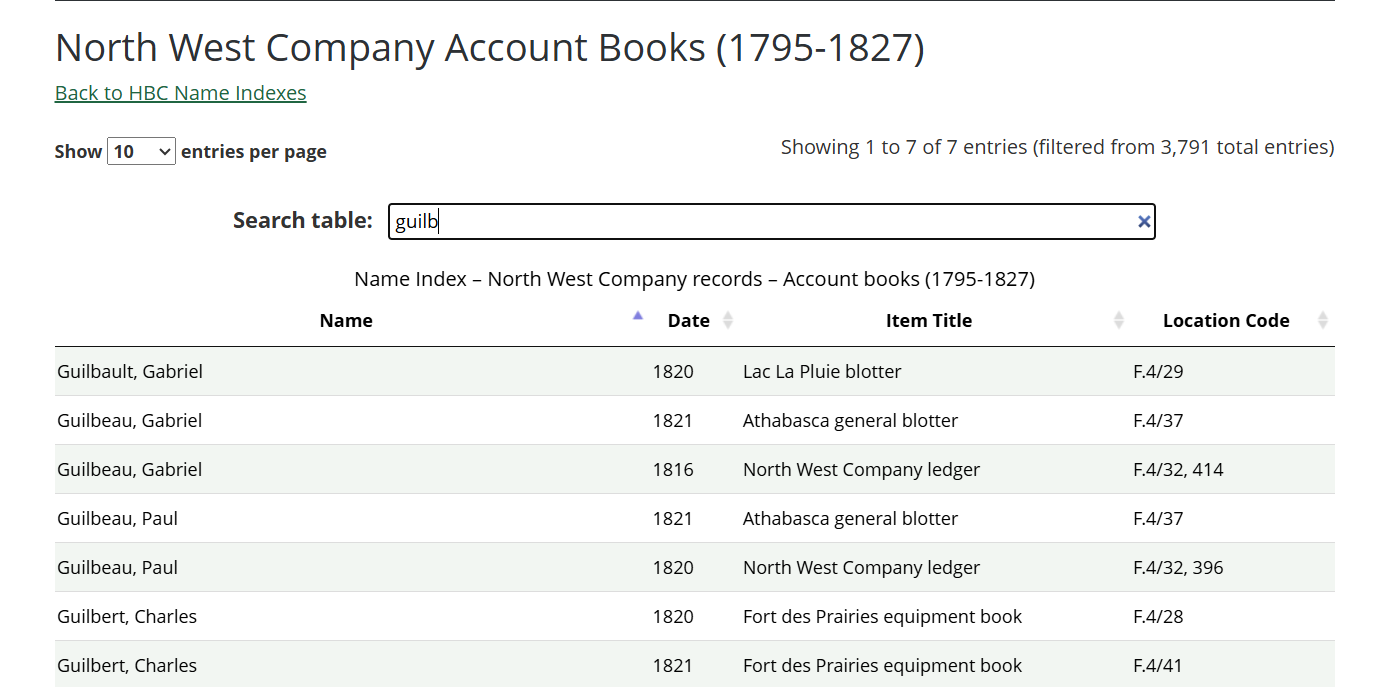
The North West Company Account Books Name Index (1795–1827) at the Archives of Manitoba. A search for “guilb” returns seven entries from 3,791 — a Gabriel in three volumes and a Paul in two. Note the dates against each entry: they describe the volume or the index record, not the man’s service. That distinction turns out to matter a great deal.
The Hudson’s Bay Company Archives plates carry a printed prohibition on reproduction. The manuscript pages discussed below are therefore transcribed here rather than displayed, with full references so any reader may order the images from the Archives of Manitoba directly.
The screenshot above is different in kind: it is output from a searchable database, not a photograph of a record, and it is retained for that reason.
What the Index Returns
Three records, three document types, three spellingsGabriel in the NWC Account Books
| Index date | Name as recorded | Record type | Location | Reference |
|---|---|---|---|---|
| 1816 | Guilbeau, Gabriel | NWC general ledger | Company-wide, folio 414 | F.4/32 |
| 1820 | Guilbault, Gabriel | Lac La Pluie blotter | Rainy Lake district | F.4/29 |
| 1821 | Gilbian Gabriel | Athabasca general blotter | Athabasca district | F.4/37 |
Three records, three document types, three spellings — Guilbault, Guilbeau, Gilbian. French-Canadian names were rendered phonetically by whichever clerk held the pen, and no two agree. That much is ordinary.
What is not ordinary, and what took two years to see, is the first column. Those are index dates. They describe the volume, or the entry in the finding aid. They are not statements about when the man worked — and the 1816 against folio 414 is the reason this post originally described a five-year career that the account itself does not show.
The Actual Records
What each plate says when you read it rather than the indexRecord 1: A Day’s Purchases at Rainy Lake
Reference: F.4/29, reference 35
Document type: A blotter — a daily rough ledger recording transactions as they happened at one post.
Gigains Ignace ........... 34
Grandbois Michel ......... 34
Gayazon Pierre ........... 35
Guilbault Gabriel ........ 35
Goulait Jacque ........... 36
Common cotton shirt ............. 12
Half-pound soap ................. 6
Cold thread ..................... 4
Horn comb ....................... 1
Six needles and six flints ...... 2.10
1½ yards fine calico .......... 24
Large black silk handkerchief ... 12
One portage sling ............... 6
Trunk and three cords ........... 6
Two pints rum ................... 20
FOOTING 133
The earlier version of this post captioned this leaf as an account closing at 188 livres with a transfer notation reading “To Atha—.” Read at full resolution, it carries neither. It is a dated outfit purchase footing at 133.
The 188 is real, but it lives on the receiving side — entered in the Athabasca blotter as a debit reading To Sundries at Lac la Pluie — 188. The link between the two posts stands, and stands on a specific non-round figure. It was simply being cited from the wrong book.
What the record shows: a man outfitting himself for the interior in late July 1820, on credit, at a post store.
Record 2: The Account That Foots
Reference: F.4/37, reference 100. Section F, Class 4, Piece 37 — North West Company account book, 1819–1821.
Document type: A general blotter, aggregating accounts across the Athabasca district.
Gilbian Gabriel .......... 100
Guilbian Paul ............ 104
1821 By Wages ...................... 650
692.10
To Sundries at Lac la Pluie ... 188
To post purchases, net ......... 168.10
To Balance .................... 336
692.10 SETTLED
The 188 — what it proves, and what it doesn’t
A balance of 188 livres carried out of Lac La Pluie and into an Athabasca account is not a round number, not a standard wage, and not a figure that recurs by chance. It ties the two posts to one man, and that link has held through every subsequent correction.
What it does not do is say which man. A cross-reference proves that two records describe the same person. It says nothing about who that person was.
Record 3: The Ledger Account, Read From the Plate
Reference: F.4/32, folio 414. Specially scanned by the Archives of Manitoba, February 2026.
1818 ... To Sundries ...... By Wages ... 330
1819 ... To Sundries ...... By Wages ... 687.10
By Mr Paul Guilbeau ... 50
1820 ... To Sundries ...... By Wages ... 500
1821 ... To Sundries ...... By Wages ... 650
To Balance ... 336
The first line of the folio is a wage credit — To Sundries against By Wages 551 — with no balance brought forward from an earlier folio. The 1816 in the finding aid describes the volume, not the man.
That single distinction retired a five-year career, an age, and a narrative. An index date is a fact about a record; it is never a fact about a life.
One entry worth noting: in the 1819 credit column, By Mr Paul Guilbeau — 50. Two accounts transacting with each other is real evidence of a working relationship. It does not say which Gabriel, or which Paul — and as it turns out, neither Paul account has yet been tied to a named man with a parish.
The Account at Close, 1821
Whoever held this account ended his NWC service with the company owing him 336 livres, not the other way around. Many fur trade workers finished in debt, caught between goods bought on credit and wages that never quite covered them. This man did not. He walked away with money owed to him and the account marked settled at the 1821 merger.
That is a real finding about a real person. It is simply not yet a finding about a named person.
The Test That Undid It
What the parish registers say about the account’s own wage yearsThe identification rested on an argument that seemed obvious: Gabriel père was a documented voyageur, and here was a voyageur’s account under his name. To test it, every appearance of his name in the Quebec registers was read for one thing only — whether the act says he was there.
That distinction is the whole of it. A baptism naming a man as father asserts the child’s legitimacy; it is not an observation that he stood in the church. Presence is credited only where the act carries the clause — ainsi que le père présent — or records him acting as a party.
18 June 1819, Rigaud. At the baptism of his son Joseph: lesquels, ainsi que le père présent, ont déclaré ne savoir signer. 23 June 1819, Rigaud. Godfather at another baptism, present again. 20 February 1821, Saint-Eustache. At the baptism of his son Charles, declaring in person.
The account’s closing wage of 650 is the Athabasca year. Athabasca is a wintering department — it cannot be worked seasonally, and the brigades left Lachine in May. A man declaring at Saint-Eustache in February 1821 was not at Fort Chipewyan that winter. The two statements cannot describe one person.
Two wage years, 1817 and 1818, carry no evidence for anyone in either direction. That is the honest residual, and the case study states it as one.
Losing the account does not cost Gabriel père his trade. It is documented, and by better evidence than an account book — three children baptized at Saint-Paul-de-Lavaltrie on 10 October 1798, each entry stating the child was born and privately baptized dans les pays d’en haut. Three interior births across eight years is a hivernant’s record: a wintering voyageur who lived where he worked. His voyageur decade was the 1790s. It was simply never the 1820s.
The Paul Question
One half resolved in the parish registers, one half now open in a way it wasn’t beforeA second name recurs alongside Gabriel’s in these volumes — Paul Guilbeau, also written Gibault, Gibeault, Guilbian. Two separate questions hide inside it, and the answers have moved since this post first ran.
Paul Guilbault was baptized 23 April 1761 at Notre-Dame-de-Montréal, son of Charles Gabriel Guilbault (1731–1784) and Marie Charlotte Morin — the same parents as Gabriel, baptized at L’Assomption the following year. The 1783 Varennes marriage register names Paul “fils de Gabriel Guilbeau et de Charlotte Morin” and places Gabriel Guilbeau as a witness at the wedding: the one Quebec document putting both brothers in one place at one time.
That much is unaffected by anything below.
This post previously stated that Paul’s own career was documented by two signed engagements — 19 July 1798 under Rod. McKenzie, and 22 May 1821 under Samuel Black — and that he contracted at 500 livres and settled at 617.14. That is withdrawn. Those documents spell their man Gibeau, Gibeault and Gebeault, and record no parish, no parentage and no age.
Three Quebec documents place Paul Guilbault père at home inside the years those company books pay their man: a godparent clause at Lavaltrie on 10 October 1798 — the same sitting at which his brother’s three children were baptized — a guardianship account rendered in person before a notary on 22 July 1820, and a witness clause at his daughter’s marriage on 16 October 1821.
And the ledger settled it from the other side. This post once said Paul père’s ledger account was p.389 and had not yet been read. It has now been read: ten consecutive years of wages, 1811 to 1821, opening on a balance carried from an earlier ledger. That is a career servant permanently in the country, not a mason from Lavaltrie with twenty-three children baptized there.
Two accounts held under the name Paul Guilbault run in these volumes. The clerks write Gibeau, Gibault and Guilbeau for both, so spelling assigns nothing. The wage figures do: one account contracted at 500 and settled at 617.14; the other ran at 350 with a balance of 96, and each set matches that account’s own documents elsewhere.
The earlier version gave folio 396 as Paul père’s ledger account. It carries 350 and 96 and belongs to the second account — probably Paul Guilbault “the Canadian,” born 1798 and later of Oregon, on a join that rests on name and period and is held to the same standard as any other.
The man behind the account at 500 has never been identified. Which of the two held the Lac La Pluie account at reference 33 has never been established either.
The account at 500 carries a credit reading By Lieut Franklin — 100. Franklin’s published Narrative confirms he was at Fort Chipewyan from late March 1820, requisitioning company men and paying through company establishments rather than in cash — the mechanism that produces a credit of exactly this form.
But the two accounts pull in opposite directions. The credit sits on the account at 500. The account whose charges trace the Franklin corridor in order — in from Fort William, then Fort Chipewyan, then Slave Lake, then sundries at Fort Providence, in the season Franklin travelled it — is the one at 350. Fort Providence was an ordinary company post as well as the expedition’s rendezvous. The documents do not choose, and the entry is now logged as unresolved rather than probable.
The Geography of a Voyageur’s Life
Where the records place this family, and where they don’tFour Thousand Miles of Canoe Routes
From the rapids where Gabriel père met Marie Josephte, to the mission at Oka where they married, to the posts named in an account book whose holder is still unidentified.
Sault Ste. Marie sat on the network connecting the interior to Montreal, and voyageurs travelled these routes on a seasonal rhythm — out in spring, home in autumn. The journey from the St. Mary’s Rapids to Oka followed established water: across Lake Huron, up the French River, across Lake Nipissing, down the Ottawa to the Montreal region. Several hundred miles, weeks by canoe, and a route a working voyageur would have known by heart.
Country marriages were recognised within fur trade communities, but Catholic traders often sought a church ceremony to give their families standing in colonial records — legal recognition, inheritance rights, a place in French-Canadian society. The 1801 ceremony at Oka was not unusual. It was part of the rhythm of a life lived between the pays d’en haut and the settlements.
Placing the Records in Context
Gabriel Guilbault père — and the account beside him
Parish register
–1797
Ages stated at their 1798 baptisms
Parish register
Parish register
Parish register
Parish register
Parish register
–1821
HBCA F.4/32
Parish register
Parish register
Parish register
How to Research Your Own Ancestor
The search still works — this is the part of the post that has not changedEverything below is unaffected by the withdrawals above, and it is the most useful thing on this page. The method found the records. What it could not do on its own was identify the man — which is why there is now a sixth step.
Step by Step
Search the NWC name index
Archives of Manitoba → HBCA Resources → Name Indexes → North West Company Account Books, 1795–1827. Search the surname and every spelling variation you can think of, then search the given name alone. The database holds 3,791 entries. Try a partial string — searching gib as well as guilb returned six further entries in this family that a surname search missed.
Record the reference codes — and treat the dates as suspect
Note the class marks (F.4/29, F.4/32) and any folio numbers; you need them to order anything. But write the index date down as the index’s date, not your ancestor’s. It describes the volume or the entry. Confirming it against the plate is step three for a reason.
Check for digitised records — and check the microfilm structure
Search the Keystone descriptive database on the reference codes. Many volumes are online. Watch for substitution cards: reel 5M6 is catalogued as North West Company account books 1817–1821, but at image 420 it carries a card reading “For F.4/32 see Reels 5M7 & 5M8.” A researcher working 5M6 in order would conclude the ledger had been searched.
Request research assistance
For anything not digitised, contact the Archives of Manitoba directly — folio 414 was scanned and sent within days. The Manitoba Genealogical Society and the Archives’ researchers-for-hire list are both good routes. Note that the plates carry a printed prohibition on reproduction, so plan to transcribe rather than publish the images.
Make the page foot
Before you quote a wage, add the column. An account that balances tells you your reading is right; one that doesn’t tells you something is misread. A wage of 450 was reported here for two years because nobody totalled a page that only closes at 650. Figures, not spellings, are what distinguish men in these books — two accounts under one name are told apart by their wage column every time.
Then go home and test it against the parish registers
An account book gives a name and a number. It gives no age, no parish, no father. If your family recycled given names — and most did — finding the record is the easy half. Build a presence ledger: go through every parish act naming your man and credit presence only where the act says so, in its own words. Then set those dates against the account’s wage years. That is the step that decides it, and it is the step that undid this post twice.
Why This Research Still Matters
Three account books, a cross-post balance, and a settled account: all of it real, all of it still in the file. What changed is the name attached to it — and then, a week later, the name attached to a second account in the same volumes.
That is not a failure of the method. It is the method working — slowly, and against the answer I wanted. Every fur trade family that reused its given names presents this same problem, and the account books alone will never solve it. The parish registers decide, or nothing does.
The Full Case Study
The Voyageur Years: One Ledger Account, Three Gabriels →
The complete argument with the presence ledger entry by entry, the evidence controls, and every retraction shown beside the document that overturned it.
Related in This Series
The North West Company: A Genealogist’s Guide →
Historical overview of the NWC, the Pemmican War, the Battle of Seven Oaks, and how to reach fur trade records.
Related Reading
Who Was Paul Gibeau? →
The account at 500: ten years of wages, two signed engagements, three volumes that interlock — and a man nobody has identified.
Paul Guilbault père, 1761–1831 →
Gabriel’s brother: twenty-three children, five trades, a seven-year guardianship and two annuities. The life the parish recorded.
The Brothers Guilbault →
One word in a 1798 baptism, and two men it led us to wrongly.
The Abitakijikokwe Discovery →
Marie Josephte, named in full in 1801 and absent from her own burial twelve years later.
The Guilbault Line →
The documentary biography series tracing the family from Quebec forward.
Parish registers: L’Assomption; Saint-Paul-de-Lavaltrie; L’Annonciation d’Oka; Sainte-Madeleine-de-Rigaud; Saint-Eustache; Saint-Benoît. Consulted via BAnQ and the Drouin Collection.
Notarial: BAnQ, CN605,S24, Notary Barthélémy Joliette, 22 July 1820.
Published: Franklin, John. Narrative of a Journey to the Shores of the Polar Sea, London: John Murray, 1823.
Finding a Gabriel Guilbault in the North West Company Records
Part of The Guilbault Line documentary biography
Storyline Genealogy • From Research to Story
Are You Connected to the Guilbault Line?
If you descend from the Guilbault (Guilbeau, Guilbeault) family of Charlesbourg and the Quebec parishes, from the children of Marie Josephte Abitakijikokwe, or from the founding families of the line — Senécal, Séguin dit Ladéroute, Morin, Couillaud dit Roquebrune, Gaulin — I’d like to compare notes. Documented trees, DNA matches, family papers, and even half-remembered stories have all moved this research forward.
Get in Touch About This FamilyCousin connections are informal and reciprocal — no fee, no obligation, just shared work on shared ancestry.
Every Family Has a Story Worth Telling
Whether you're just beginning your research or ready to transform years of work into a narrative your family will treasure, I'd love to help.
LET'S TALK ABOUT YOUR FAMILY