
Geneviève Abitakijikokwe at Oka Mission
The Woman at the Edge of the Record
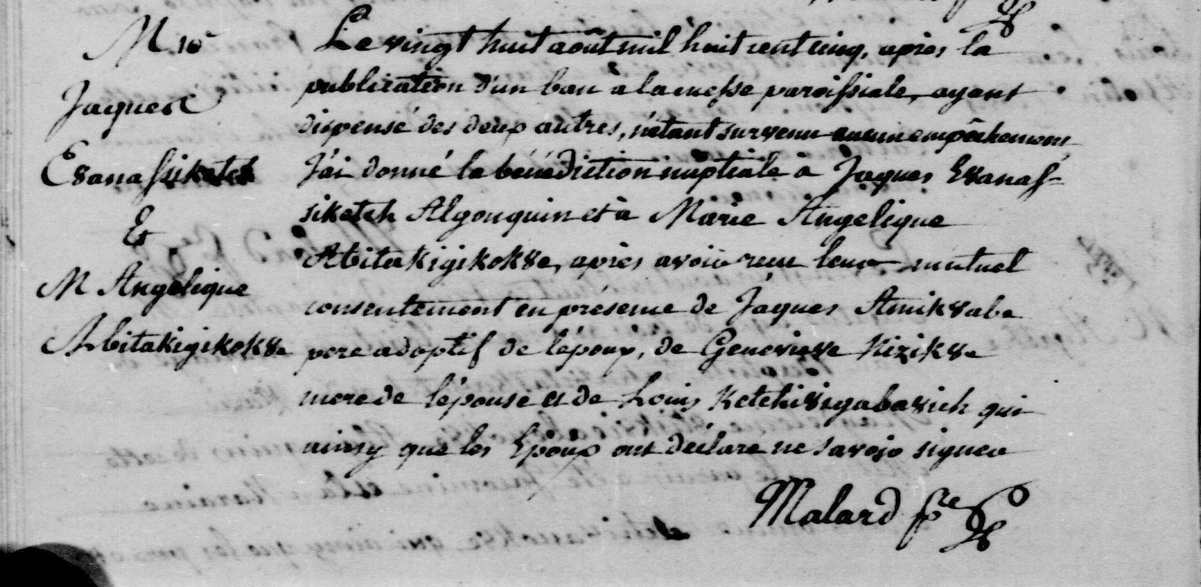
On August 28, 1805, in the mission church at Oka, an Algonquin woman stood witness at her daughter’s wedding. The priest, Father Malard, recorded her name as he heard it: Geneviève Nizik8e, mère de l’épouse — mother of the bride. She declared she could not sign, and the record moved on.
For a long time, I believed that was the last time she appeared in any document I could find. I was wrong.
What comes before 1805 is nineteen years of parish records. What comes after, it turns out, is nineteen more. In February 2026, working through the continuation register on LAC reel C-2896, I found her burial: February 25, 1824, at the same Oka mission where she had first appeared in 1786. She was recorded as Ninzikwe Algonquine, aged seventy-two. She had outlived her husband by thirty years.
Thirty-eight years of records. Eleven documents that name her, written by three priests, under two naming systems and eight different spellings. It is one of the most complex identification problems I have encountered in any of my research lines, and it matters directly to this series: the woman I have been researching, Marie Josephte Abitakijikokwe — wife of voyageur Gabriel Guilbault — carried the same distinctive family name as Geneviève.
Before I could understand Marie Josephte, I had to understand Geneviève.
Who Was Geneviève?
Geneviève was the wife of Kitchiwabisi — 8abizi le grand, the Great Swan — an Algonquin war chief at the Mission du Lac-des-Deux-Montagnes at Oka. The mission sat at the confluence of the Ottawa River and the Lake of Two Mountains, a place where Algonquin, Iroquois, and Nipissing families had gathered under the Sulpician seigneury since the early eighteenth century.
She appears first on May 27, 1786, standing as godmother at a baptism — Geneviève Abitakijig8k8e, in Father Guichart’s careful hand. She was already an adult woman, already associated with the mission community, already known to the priest by name. This is not her arrival. It is simply the first time a record survives to tell us she was there.
Over the next thirty-eight years, she would be named as godmother, as mother, as wife, as widow, and finally as witness. She buried a husband and at least one child. She had a relationship after widowhood that the Church recorded without judgment: a fils naturel in 1796. She watched her daughter Marie Angélique marry in 1805. And she lived on for nineteen more years — standing as a godmother once more in 1818, and dying on February 23, 1824, at approximately seventy-two years of age, at the same mission where she had first appeared in the records nearly four decades earlier.
Bernard Wabisi — 8abizi le jeune, of Kitchiwabisi’s family — became a war chief himself, leading Algonquin warriors well into the nineteenth century. Jean-Guy Paquin’s genealogy records him as Geneviève’s son; no surviving record says so, and the ages the registers give make it hard to fit, but she was bound to his family. In 1818 she stood godmother to his grandson. His September 1824 burial record names him Chef de guerre Algonquin, sixty-one years old. He died seven months after she did.
Two Names, Eight Spellings, One Woman
The challenge was this: across thirty-eight years and three priests, her name was almost never spelled the same way twice. The eight vowel at the center of it — the Ojibwe 8, representing a rounded sound between O and W — defied French orthography, and every priest found his own solution. The root itself, Abitakijik-, was a long compound that shifted under each pen.
Here are the variants as recorded, in order:
The key to reading these as a single woman rather than ten different people is the spousal anchor. Once a record identifies her as the wife of Kitchiwabisi — the same man who appears as father in the children’s records — the chain locks. The name variants are a documentation problem. The person is the same. And now the chain is closed at both ends: her first record, May 1786; her burial, February 1824.
There was also, in the secondary literature, a variant: Kijig8k8e — ascribed to the 1787 baptism record of her daughter Marie Janne. That variant would complicate everything, until the original manuscript resolved it.
The Record That Made It Possible
Every identification chain needs an anchor — a record that connects name to person unambiguously. For Geneviève, it is the July 13, 1788 baptism of an infant named Geneviève, daughter of Charles 8cha8en and Helene.
Geneviève abitakijig8k8e appears as the godmother. And beside her name, Father Leclercq — writing the entry for a baptism Father Guichard performed — added the phrase that makes everything work:
“femme de 8abizi le grand”
— Original register, Oka Mission, July 13, 1788 · confirmed from manuscriptWife of 8abizi the Great. Wife of Kitchiwabisi.
This is the record I spent the most time with. It is the record that allows every other variant to be anchored to a specific woman with a specific husband at a specific mission. Without it, the name variants remain separate threads. With it, they converge.

A Researcher’s Own Photograph Against His Own Text
I want to take a moment here and talk about sources — because this research ran into something I had not expected, and the resolution of it changed the entire shape of the problem.
For the Oka Mission records, there are three layers of evidence available to a researcher in 2025:
| Layer | Source | What It Provides |
|---|---|---|
| Layer 1 | Original manuscript register (LAC reels C-2895 and C-2896) | The actual handwritten record as the priest wrote it |
| Layer 2 | Cadieux typed transcription, 1938 | A typed copy prepared by Pauline Cadieux, with a preface noting spelling is preserved throughout. Covers both C-2895 (Vol. 2) and C-2896 (Vol. 3). |
| Layer 3 | Pouliot-Thisdale published index, 2015 | A modern published index with manuscript photographs and commentary |
In the normal course of things, you expect all three layers to agree on facts, with the original manuscript being authoritative when they diverge. What I found for the April 17, 1787 baptism of Geneviève’s daughter — recorded in the register as Marie Janne, not Marie Jeanne — was something more specific: Cadieux (Layer 2) read the mother’s name as abitakijig8k8e. Pouliot-Thisdale (Layer 3) read the same entry as Kijig8k8e. A genuine discrepancy between a 1938 transcription and a 2015 publication, for the same manuscript record.
One of them was right. This mattered, because if Pouliot-Thisdale was correct, the 1787 record would be the earliest appearance of a second naming system — and the entire interpretation of the name variant pattern would need to be revised.
The Resolution
I went to the original register.
The manuscript image for C-2895 Image 480 — the April 17, 1787 baptism — is clear. The word written in the register is abita kijig8k8e, with a visible space between the two components. The Cadieux transcription is correct.
But here is where the story becomes genuinely strange. Pouliot-Thisdale’s own published book contains a photograph of this manuscript page. His photograph shows abita kijig8k8e — the same reading as Cadieux. His transcription of that same page reads only Kijig8k8e. His image contradicts his text.

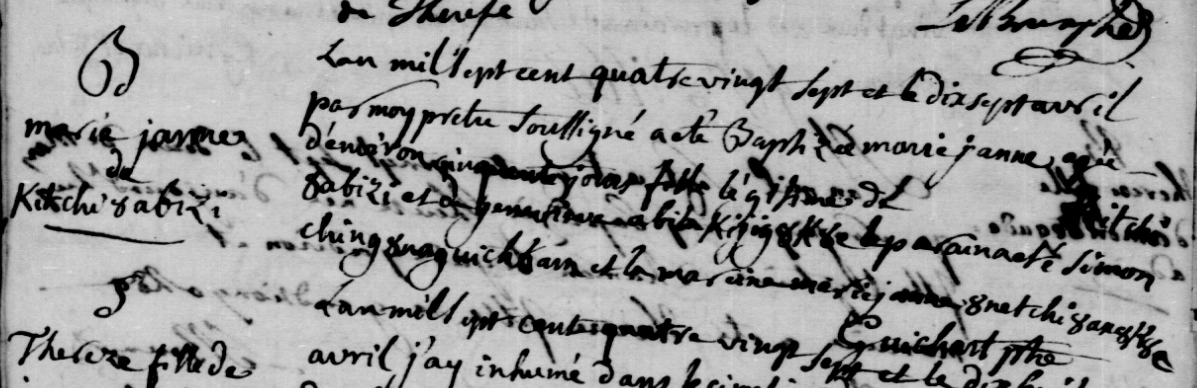
The lesson for any researcher working with Indigenous names in colonial registers: always try to get to the original manuscript, and when secondary sources include manuscript images, compare those images carefully against the transcriptions. The image is primary evidence. The transcription is interpretation.
The consequence of this resolution was significant. The Abitakijik- name system runs continuously from 1786 through 1803 — under three different priests, across eight records. The second personal name, Nizik8e, appears for the first time in the original register in 1805, confirmed. It becomes Ninzikwe in the February 1824 burial record — the same root, the same priest (Malard), a minor -n- insertion. Two names for one woman, across four decades. Not a contradiction. A portrait.
1805 Was Not the End
The 1805 marriage of Marie Angélique is the record I had returned to most often — because for a long time I believed it was the last one. The groom’s family is accounted for. The bride’s mother — Geneviève Nizik8e — is listed as a witness. She declares she cannot sign.
That record does two things at once. It confirms that she was alive — and physically present — on August 28, 1805. And it passes her name forward: her daughter Marie Angélique is recorded in the marriage register as Abitakigikok8e, the name still intact in the next generation.
What the continuation register on C-2896 reveals is what came after. Working through Volume 3 of the Oka registers this month, I found the burial I had been looking for.

She outlived her husband by thirty years. She outlived her daughter Thérèse, whom she had buried in 1803. She lived to see Bernard Wabisi take his place as war chief, and in 1818 she stood godmother to his grandson. Bernard died seven months after she did.
The name Ninzikwe is the same System 2 root as Nizik8e in 1805 — the same priest, the same mission, the same woman, nineteen years further on. The chain that began with a godmother’s name in May 1786 closes with a burial in February 1824.
Her daughter Marie Angélique Abitakijikokwe — whose name carries the same root — went on to marry a second time. The family name appears in records well into the nineteenth century. Geneviève did not vanish. She continued through her children.
Why This Research Belongs Here
Geneviève Abitakijikokwe is not a direct ancestor of the Guilbault Line. Marie Josephte Abitakijikokwe is — Gabriel Guilbault’s wife, found through his records as the Ojibwe woman he married at Oka in January 1801. She was identified long before the research for Geneviève began.
What Geneviève’s research offers is something different: the possibility of understanding where Marie Josephte came from.
The two women share a distinctive name. The Abitakijik- root appears across the Oka registers from 1786 onward, carried by multiple individuals — male and female, across generations.
Deliris López Tiwari, who has shared cultural context about Marie Josephte, explains that Abitakijikokwe was her primary Anishinaabe (Ojibwe/Saulteaux) name, not a surname. The priests recorded it as a surname after her baptismal name, a common colonial practice. In Anishinaabemowin, Abitakijik means “Half-sky” or “Mid-sky,” the position of the sun at midday, and -okwe means “woman.” Her name is Mid-Sky Woman.
Because it was a personal name, sharing it does not by itself make two women kin. But the same name, at the same small mission, in the same years, is a thread worth following. Geneviève is now documented across thirty-eight years at this mission, in the same registers where Marie Josephte appears. If the Abitakijik- network can be mapped — if the relationships between Geneviève, Marie Josephte, and the others who carried this name can be established — it becomes possible to trace Marie Josephte’s family origins in a way that no single record yet permits.
The exact kinship between the two women remains open. Were they sisters? Aunt and niece? Related through a matrilineal clan? That question is what drives the next phase of this research. This post, and the full case study and methodology pages now live on this site, document the foundation. What comes next — an examination of all the Abitakijikokwe connections uncovered in the course of this work — builds on it.
The Full Research
This post is a summary of a much larger body of work. The full documentation is now live on this site:
Case Study
Full identification argument tracing the eleven records that name her, eight spellings across two name systems, the spousal anchor chain, and the kinship evidence.
Read the Case Study →Research Methodology
Complete source analysis across three documentary layers — original register, Cadieux 1938, and Pouliot-Thisdale 2015 — with document gallery, negative evidence log, and open research questions, through her February 1824 burial (D-012, C-2896).
Read the Methodology →If you are researching the Abitakijik- family network at Oka, the Wabisi family, or Algonquin records at the Mission du Lac-des-Deux-Montagnes, feel free to reach out at mary@storylinegenealogy.com.
Continue the Series
← Return to The Guilbault Line · All Documentary Biographies →
Questions about your own research? Begin a research inquiry.
