
Sainte-Trinité-de-Contrecoeur: The Parish That Burned — and What Survived
Sainte-Trinité-de-Contrecoeur
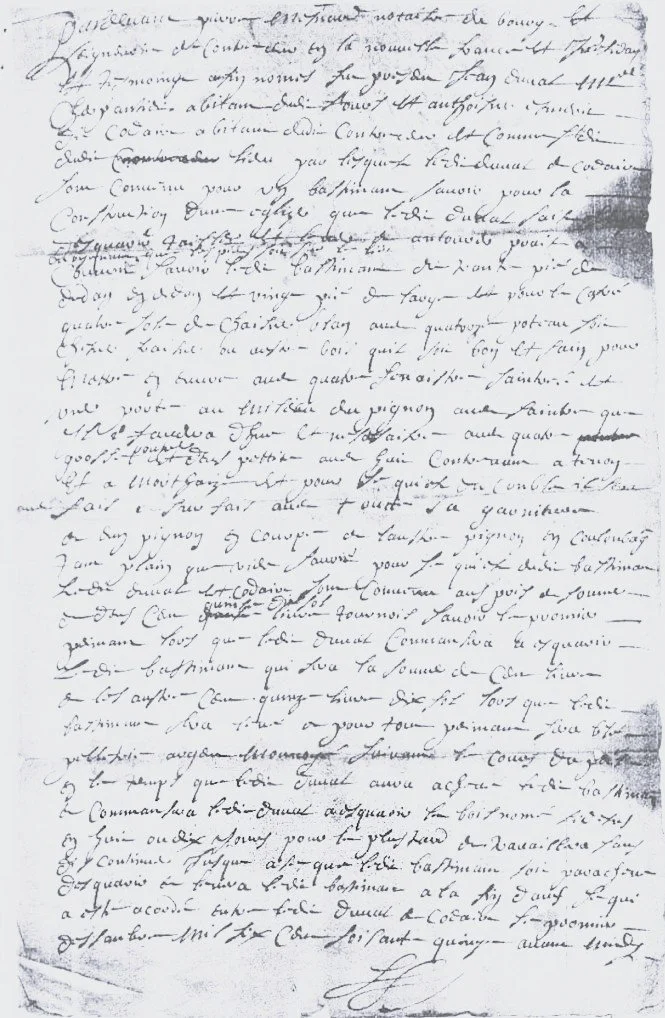
On December 1, 1675, Philibert Couillaud dit Roquebrune — a soldier who could not read or write — stood before a notary in Contrecoeur and witnessed the contract for the construction of the community's first chapel. Less than three years later, fire consumed the parish registers kept in a surgeon's house. In 1687, fire consumed them again. By 1701, fourteen and a half years of the community's documented life had vanished. What survived — the stone walls, the notarial records, the 1681 census, and six scattered baptism entries — is the story of this parish.
The Couillaud Family at Sainte-Trinité-de-Contrecoeur
Witness: Philibert Couillaud dit Roquebrune
Contractor: Jean Duval (master carpenter) & Antoine Emery dit Coderre
Significance: Philibert was present at the legal founding of the parish's physical life — and almost certainly married Catherine Laporte in this same chapel within weeks of witnessing its construction contract.
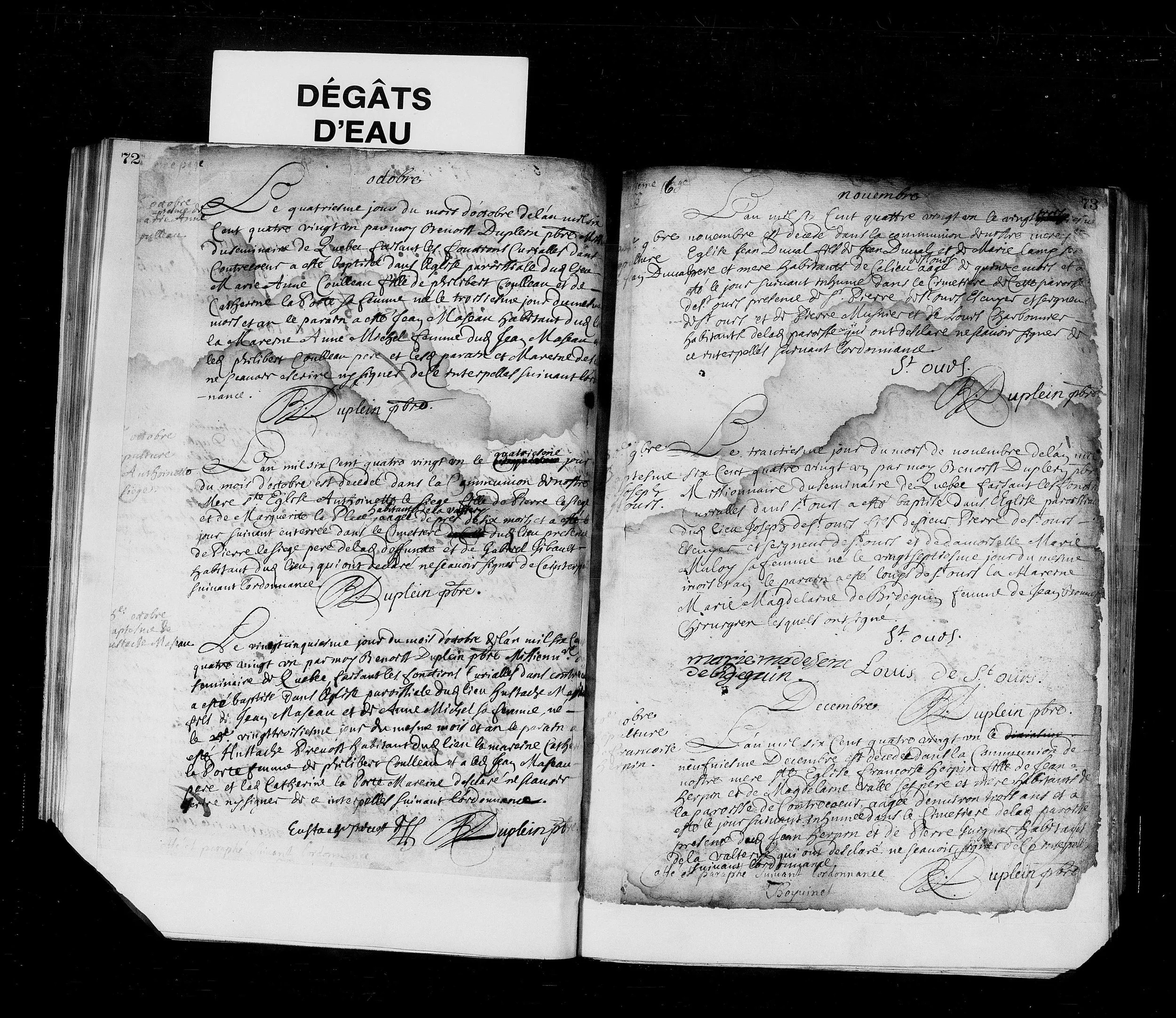
Marie-Anne — baptized 4 Oct 1681, Contrecoeur (survived Fire I)
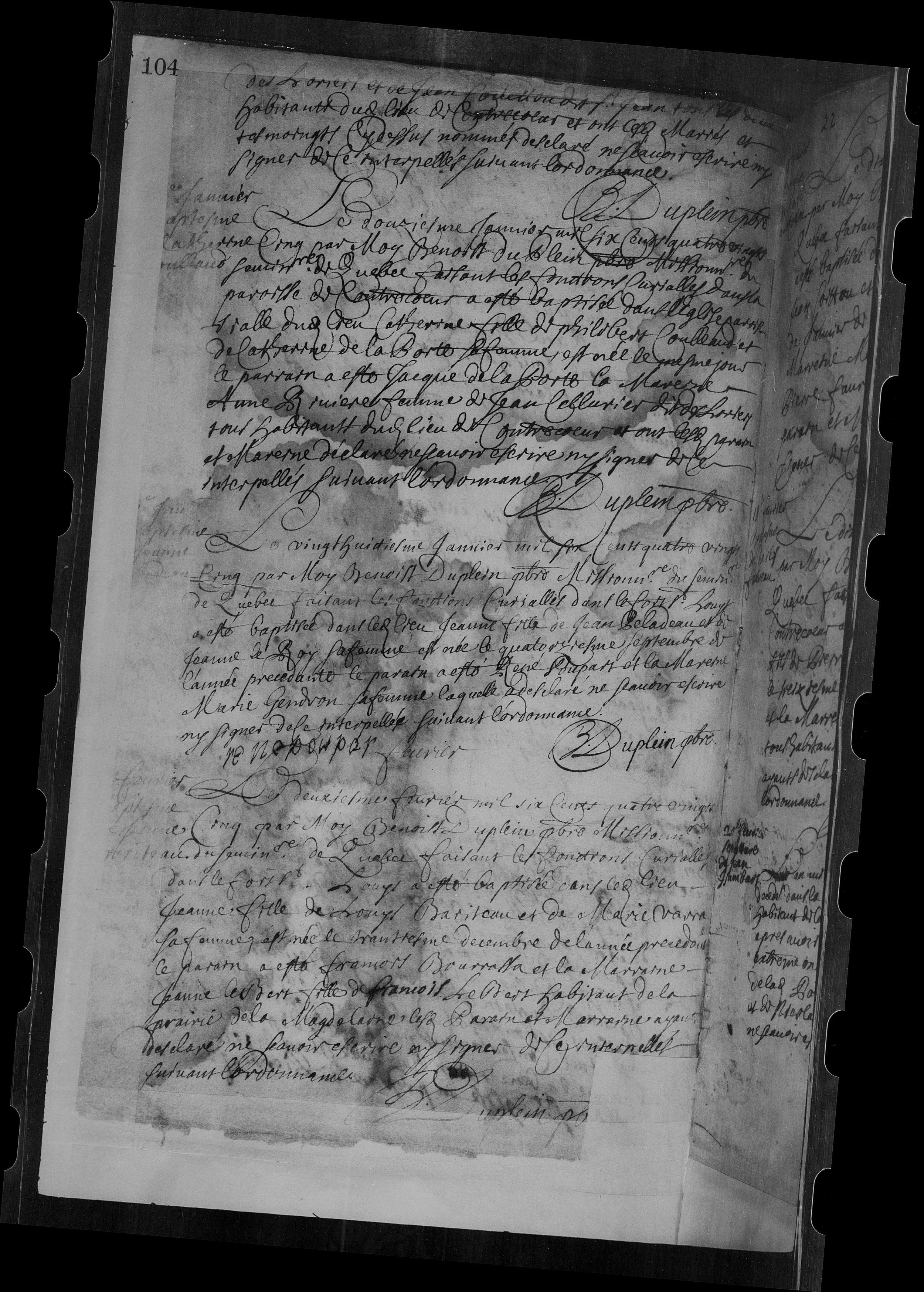
Catherine — baptized 12 Jan 1685, Contrecoeur
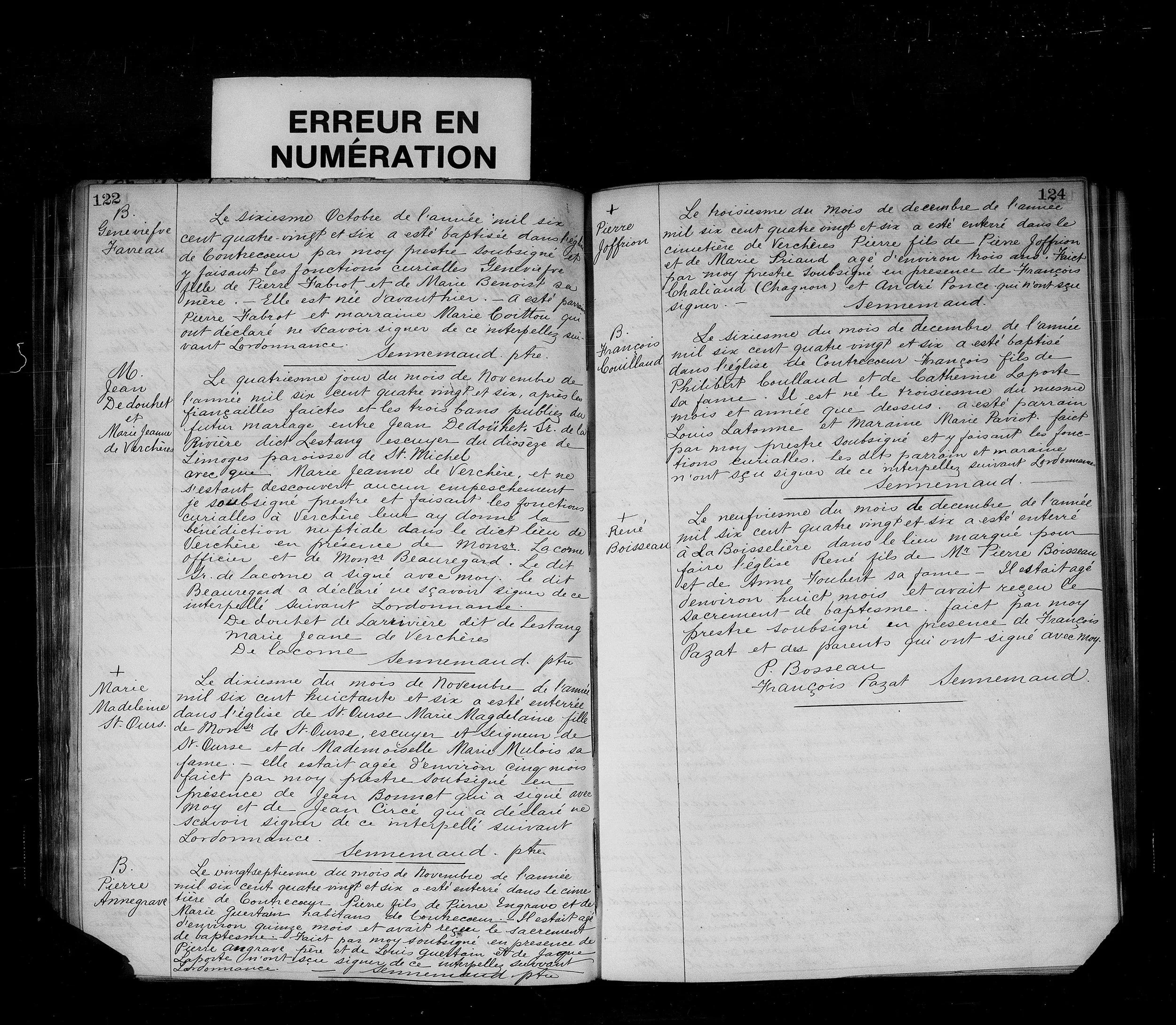
François — baptized 6 Dec 1686, Contrecoeur (last before Fire II)
Five more children — Louis, Michel, Marie Hilaire, Philibert fils, Marie Barbe — were born during the 14.5-year lacune. Their baptisms do not exist.
Catherine Laporte sa femme: 17 ans
Enfants: Jean-Baptiste (4), Jean-François Juzoil (1)
1 fusil · 5 bêtes à cornes · 5 arpents en valeur
Listed third after the seigneur himself — an indicator of Philibert's established place in this tiny community of thirty households.
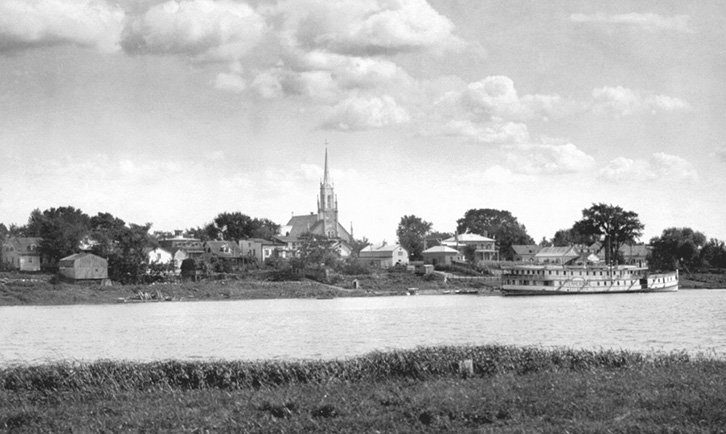
Le village de Contrecoeur vers 1915, photographié depuis l'île devant l'église Sainte-Trinité. Le bateau à vapeur Terrebonne est accosté au quai. The church's spire — rebuilt after the 1862 fire — dominates the same shoreline where Philibert Couillaud dit Roquebrune felled trees and cleared arpents in 1680.
The Seigneurie de Contrecoeur was barely eight years old when its first chapel went up in 1675. The community it served was small — fewer than thirty households along the south shore of the St. Lawrence, forty-five kilometers northeast of Montréal, most of them former soldiers of the Carignan-Salières Regiment who had followed their captain, Antoine Pécaudy de Contrecoeur, into the wilderness rather than sail home to France. They cleared land, built houses, planted arpents of wheat, and eventually built a church.
For most Quebec parishes, the story of the registers is the story of what survived. For Sainte-Trinité-de-Contrecoeur, it is the story of what burned — twice — during the most precarious decades of New France.
The Seigneurie de Contrecoeur: Founded 1667
The Seigneurie de Contrecoeur was granted in 1667 to Captain Antoine Pécaudy de Contrecoeur (1596–1688), commanding officer of the Company of Contrecoeur in the Carignan-Salières Regiment. Pécaudy had arrived in New France in 1665 with the regiment's mission to build forts along the Richelieu River and force the Iroquois to peace terms. When the regiment disbanded in 1668, he chose to remain — and the land grant along the south shore of the St. Lawrence became the focus of the rest of his life.
Under the seigneurial system, Pécaudy — the seigneur — received the land from the King and distributed long, narrow strip plots (censives) extending back from the river to tenant farmers called habitants or censitaires. In return for their concessions, tenants paid annual rents in cash or produce, ground their grain at the seigneur's mill (paying a tax called banalités), and owed a certain number of days of annual labor. The strip plots running perpendicular to the river — still visible in modern Quebec's landscape — created an agricultural pattern unique to New France. The 1681 census recorded 69 inhabitants in the seigneurie. By 1765, the population had grown to 371.
The soldiers who settled were bound to Pécaudy by military loyalty as much as legal obligation. Philibert Couillaud dit Roquebrune had served in Pécaudy's own company. When he purchased his sixty-arpent concession in February 1680 — paying thirty livres to the seigneur himself — he was buying land from the man he had once taken orders from in the field. The notarial act records Pécaudy as "Anthoine de Pecaudy, Escuyer, Seigneur de Contrecoeur" and Philibert as his former soldier-turned-habitant. The social distance was real, but so was the bond.
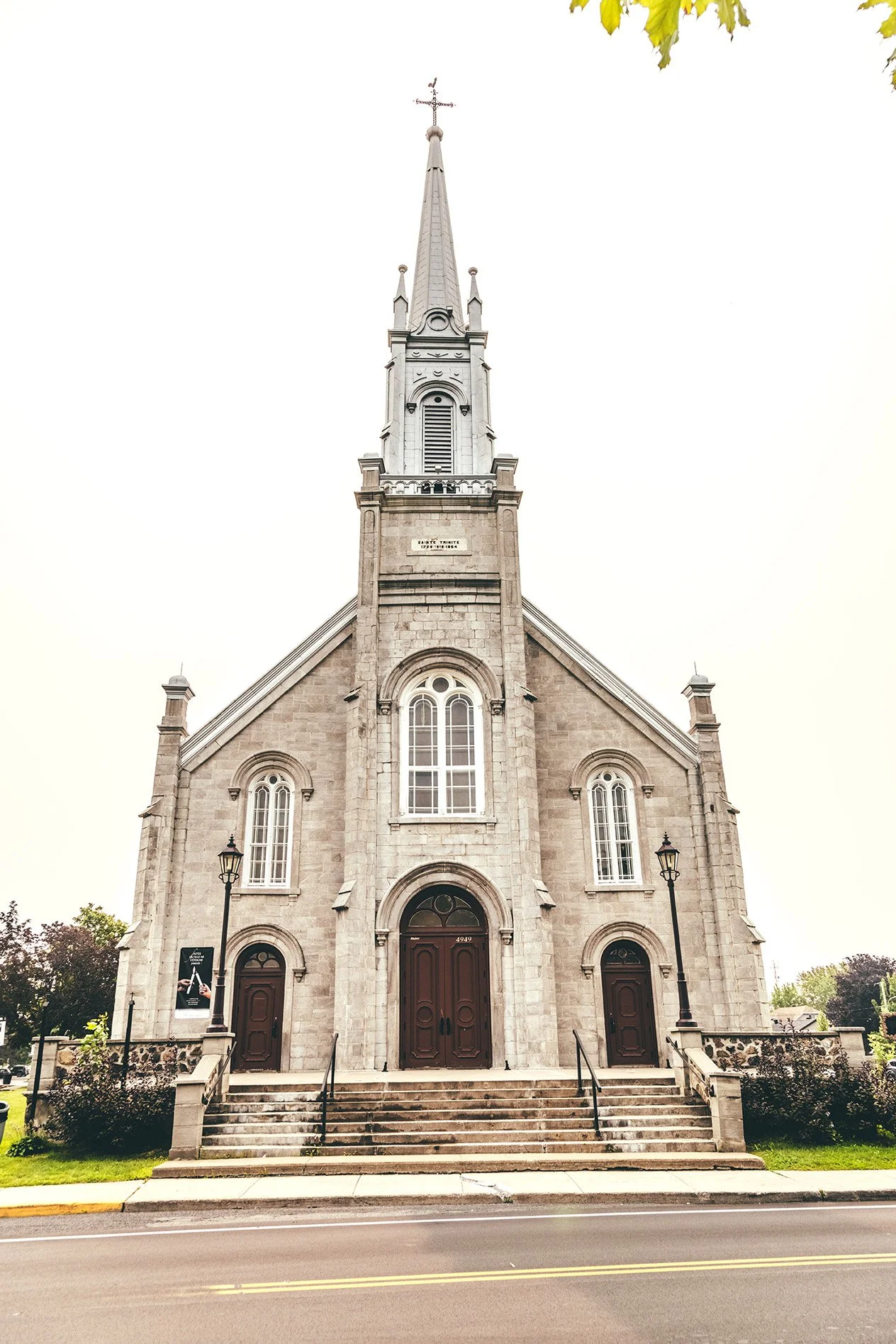
Église Sainte-Trinité-de-Contrecoeur today — the fourth building on this site. The plaque above the central entrance reads SAINTE TRINITÉ · 1724 · 1818 · 1864, recording the three predecessors whose histories are embedded in the stone walls that survived the 1862 fire. The address, 4949 Marie-Victorin Blvd, sits on the same riverfront where the first wooden chapel was raised in 1675.
Four Churches on the Same Ground: 1675–1863
The plaque above the central door of the current church — SAINTE TRINITÉ · 1724 · 1818 · 1864 — records three dates, not four. It commemorates the stone churches of 1724, 1818, and the 1864 reconstruction. It does not record 1675 — the date of the first wooden chapel, contracted by master carpenter Jean Duval, witnessed by Philibert Couillaud, built of logs from the forest the settlers were still clearing. That chapel is too old for the plaque's memory. It belongs to the founding generation's own documents.
The construction contract of December 1, 1675, before a notary at Contrecoeur, engaged Jean Duval (master carpenter) and Antoine Emery dit Coderre to build a wooden chapel for the settlers of the seigneurie. Philibert Couillaud dit Roquebrune appeared as a formal legal witness — meaning he was an established adult male settler of recognized standing in the community, called specifically to validate the transaction. The chapel's dimensions were modest. It was likely pièce-sur-pièce log construction — the standard method for early Quebec religious buildings. Its fate was not fire but growth: the community expanded too quickly for a small log chapel, and it was replaced by the first stone building in 1724. No disaster; simply obsolescence.
The 1724 stone church served the parish for nearly a century. By the early nineteenth century, it too had grown inadequate. A third building — the one that would eventually face the 1862 fire — was contracted in 1817 and opened for worship in 1823. This was the church built according to the Plan Conefroy.
The First Chapel — Philibert Couillaud as Witness
Contract: Construction of a chapel for the settlers of the Seigneurie de Contrecoeur
Contractor: Jean Duval, master carpenter; Antoine Emery dit Coderre
Witnesses: Philibert Couillaud dit Roquebrune; other settlers of the seigneurie
Context: The contract predates Philibert's 1680 land purchase by five years, and likely postdates his marriage to Catherine Laporte by only weeks — she turned twelve (canonical marriageable age) on October 12, 1675, and the earliest possible marriage was fall 1675.
The Conefroy Plan: Built to Survive
The third church of Sainte-Trinité (1817–1823) was designed according to the Plan Conefroy — the most durable architectural standard available to Quebec rural parishes in the early nineteenth century. Developed by Abbé Pierre Conefroy (1752–1816), a priest and architect, the plan brought structural discipline to an era when Quebec churches were routinely lost to collapse, rot, and fire.
Conefroy's design featured a Latin cross layout with a circular apse and a monumental facade. Its defining characteristic was structural: thick fieldstone walls — often three to four feet deep — built with a specific masonry technique calibrated to withstand Quebec winters, spring flooding, and the differential stress of freeze-thaw cycles. The plan prioritized the exterior shell as a load-bearing fortress, with a steeply pitched roof engineered to shed snow, and acoustics designed to carry the liturgy through a dense stone interior. It was, in the words of a later architectural historian, "the tank of its era."
| Feature | The 1817 Shell (Conefroy Plan) | The 1863 Interior (Reconstruction) |
|---|---|---|
| Material | Heavy local fieldstone, 3–4 ft walls | Finely carved wood, plaster, ornamental stone |
| Style | French Colonial / traditional Quebec | Neoclassical / Victorian |
| Focus | Structural durability, thermal resilience | Ornamentation, acoustic refinement, aesthetic beauty |
| Architect | Conefroy plan (1817–1823 construction) | Victor Bourgeau (vault); Zéphirin Perrault (interior) |
| Status Today | Perimeter walls still standing | Interior as rebuilt 1863, still intact |
The test of the Conefroy walls came in 1862.
The Fire of 1862: Walls That Would Not Fall
In 1862 — thirty-nine years after the third church opened — fire swept through the interior of Sainte-Trinité. The dry wooden pews, the ornate altars, the timber roof frame: all became fuel. The interior became an inferno. The roof collapsed.
The Conefroy Walls Hold
When the embers cooled, the Contrecoeur community found that Conefroy's massive fieldstone perimeter — the same walls contracted in 1817 and built through 1823 — stood perfectly upright and structurally sound. The masonry had acted like a furnace wall, containing the fire without failing. The interior was gutted. The walls were intact.
The decision was not to clear the site and begin again. The community cleaned the smoke-stained stones, secured the existing footprint, and contracted a new interior. This reuse of walls was rare. Most Quebec churches that burned in the era were leveled to make way for larger Gothic Revival structures. Contrecoeur chose to rebuild inside its own surviving bones.
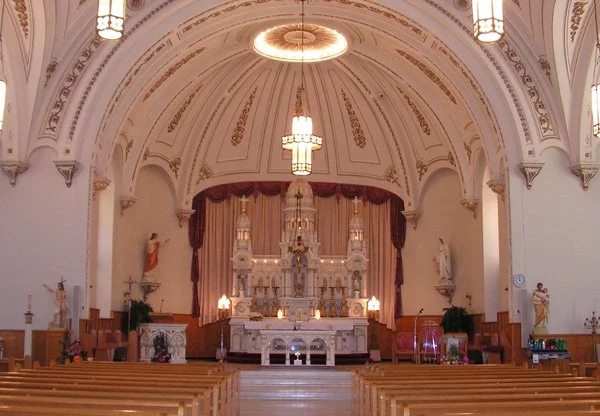
Victor Bourgeau — whose other commissions included the interior of Notre-Dame Basilica in Montréal and Mary, Queen of the World Cathedral — designed the vault. Sculptor and architect Zéphirin Perrault (1834–1906) completed the interior. The rebuilt church was consecrated in 1864. What stands today at 4949 Marie-Victorin Blvd is a hybrid: a Victorian interior and rebuilt roof inside a shell that is, in its walls, the 1817 Conefroy building.
The Registers That Burned: Two Fires, 14.5 Years Lost
The building stood through its trials. The records were less fortunate. Sainte-Trinité-de-Contrecoeur suffered two archival catastrophes in the pioneer era — long before the better-known parish fires of the mid-nineteenth century. Together they constitute one of the most significant archival losses in the Richelieu Valley.
The Archival Black Holes
First Fire (1678–1681): Two and a half years of records consumed at the home of surgeon Jean Bouvet dit Lachambre, where the itinerant missionary priest kept the registers. The compiler's note in the surviving volume documents the loss explicitly.
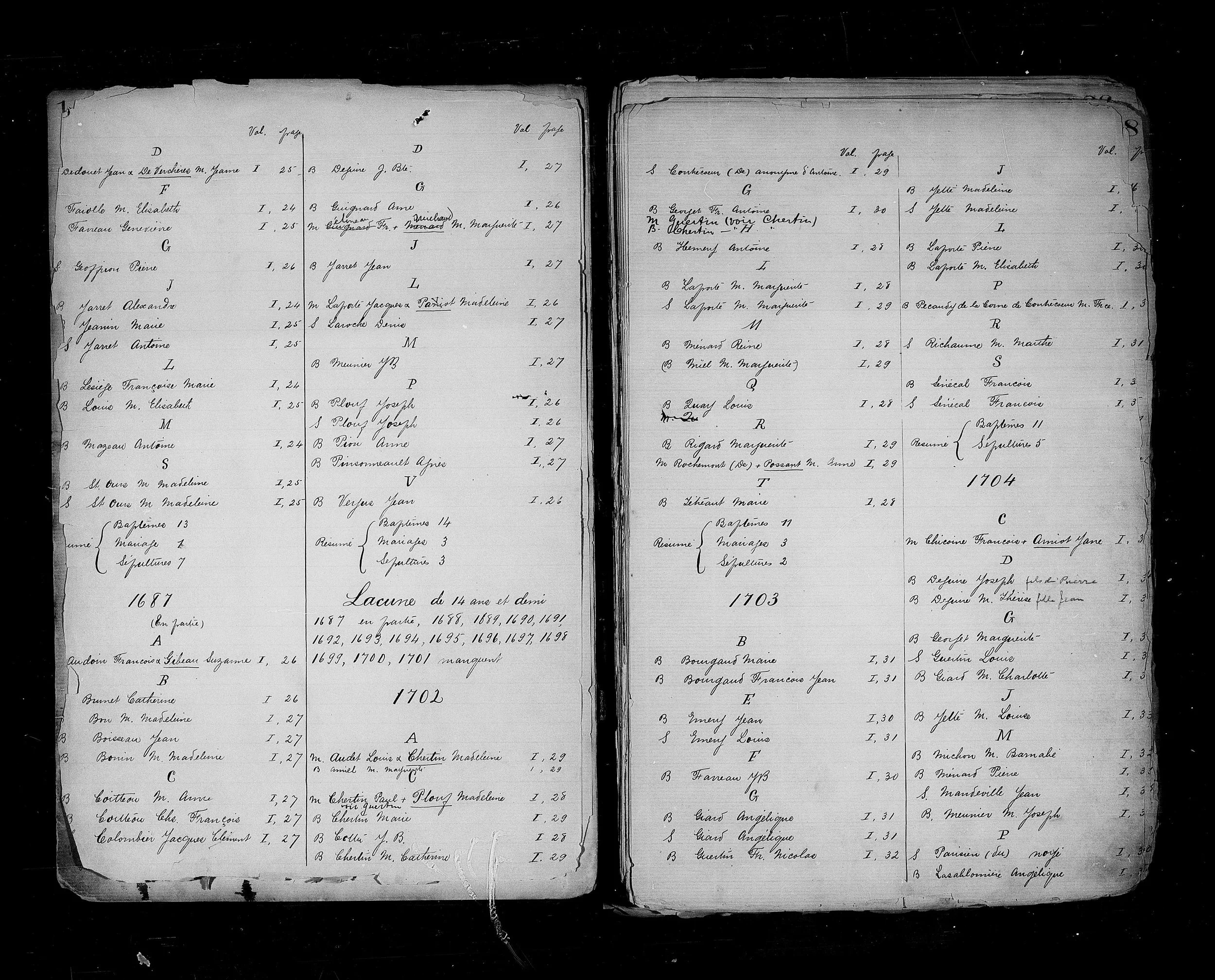
Second Fire (1687–1701): Fourteen and a half years of records vanished during the height of the Iroquois Wars. The register index records the loss in plain French:
Together, these two fires erased the documentary evidence of an entire generation of Contrecoeur families — including five of Philibert and Catherine's eleven children, whose baptisms were recorded and subsequently lost.
The Surgeon's House — and the Records That Lived There
Location: Home of Jean Bouvet dit Lachambre, surgeon, Seigneurie de Contrecoeur
Cause: Fire at the surgeon's residence
Why the registers were there: In the early decades of the parish, there was no permanent resident priest. Missionary priests traveled between parishes, boarding with prominent local citizens. Bouvet — the community's surgeon and a man of standing — housed these visiting clergy. The registers, having no stone presbytery to protect them, stayed in his wooden home.
Records lost: Approximately two and a half years — all baptisms, marriages, and burials from roughly June 1678 through January 1681
Evidence: The surviving register volume contains a compiler's note in which the priest explains the gap to future record-keepers and, by extension, to future generations of researchers.
The Great Lacune: An Entire Generation Undocumented
Period: 1687 (in part) through 1701 — fourteen and a half years
Historical context: 1687 was a turning point in the French-Iroquois Wars. Governor Denonville's July 1687 expedition against the Seneca villages backfired catastrophically: the Iroquois launched a devastating counter-offensive throughout 1687 and 1688, forcing the population of settlements above Trois-Rivières to retreat into hastily built stockade forts. Fields were abandoned. Settlements were pillaged. The fragile custody of parish registers — still housed in wooden buildings without permanent stone presbyteries — could not survive the chaos.
Records lost: All baptisms, marriages, and burials from 1688 through 1701. The gap does not close until after the Great Peace of 1701, signed between the French and 39 Indigenous nations, when stable record-keeping could finally resume.
Archival documentation: A later church archivist, organizing the fragmented history of the parish, recorded the damage on the register's cover and index: "1687 en partie... 1688 à 1701 manquent." This terse notation — eleven words — is a permanent scar on the documentary evidence of the Contrecoeur community.
"Most Quebec parishes have lost records to the great fire era of 1840–1920. Contrecoeur is unique because it suffered its archival tragedies during the pioneer phase — when the registers were most fragile, when there was no stone presbytery to protect them, when the community itself was barely holding on."
Genealogical Significance: What the Archive Holds
Despite the two fires, Sainte-Trinité-de-Contrecoeur's surviving records are among the most carefully maintained in the Montérégie region. The parish registers from 1668 to 1876 are fully digitized and accessible through multiple platforms. What exists is remarkably complete for the periods it covers. What is absent is precisely documented — the compiler's note, the register index notation, the cover page — so researchers are never left wondering whether a record might exist somewhere unfound. The fires are on the record.
FamilySearch (Free): Hosts digitized microfilms of Registres paroissiaux, 1668–1876. Collection: Quebec, Catholic Parish Registers, 1621–1979. Browse Contrecoeur by year. The compiler's note and register gap index are visible in the surviving volumes.
Genealogy Quebec / Drouin Institute (Subscription): LAFRANCE database — indexed (searchable by name) baptisms, marriages, and burials to 1861. High-resolution scans of the Drouin Collection microfilm.
Ancestry (Subscription): Quebec, Canada, Vital and Church Records (Drouin Collection), 1621–1968.
BAnQ (Bibliothèque et Archives nationales du Québec): Original registers and notarial acts. For the period covered by the fires, notarial acts from Sorel and Montréal notaries are the primary reconstruction source.
For the Couillaud dit Roquebrune / Larocque family, the surviving baptism records — four entries across two parishes — are among the most significant documents in the entire research file. Each one demonstrates a slightly different aspect of where the family was and who their community connections were:
Jean-Baptiste (1677, Sorel) shows the family was mobile in the early years — the Contrecoeur chapel was contracted but perhaps not yet serving a full sacramental calendar, or Philibert was working briefly in the Sorel area. Marie-Anne (1681, Contrecoeur) is the first baptism in the surviving register — the community's documented life resuming after the first fire. Catherine and François (1685, 1686, both Contrecoeur) are the last two records before the second fire closed the register for fourteen years. Antoine's 1683 baptism at Boucherville — when Contrecoeur's chapel was fully operational — points toward a Laporte family connection in Boucherville that remains an open research question.
The Church Today — Still Standing
Église Sainte-Trinité-de-Contrecoeur stands today at 4949 Marie-Victorin Blvd, at the same riverfront address that has been the parish's center since 1675. The current building — a hybrid of the 1817 Conefroy shell and the 1863 Bourgeau/Perrault interior — is recognized in the Répertoire du patrimoine culturel du Québec for its historical and architectural significance to the Montérégie region.
The church is listed in the Répertoire du patrimoine culturel du Québec, which recognizes its dual significance: as an architectural artifact (the surviving Conefroy walls, the Bourgeau vault, the Perrault interior) and as a historical site. It is the fourth church on a site that has been continuously used for religious purposes since 1675 — 350 years on the same St. Lawrence shoreline.
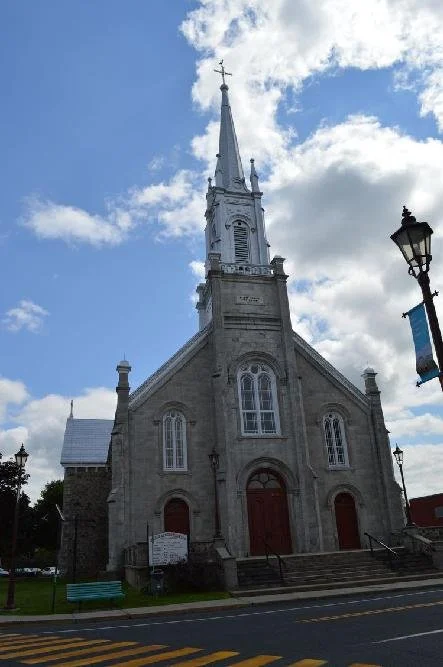
The full facade of Sainte-Trinité-de-Contrecoeur. The three dates on the plaque — 1724, 1818, 1864 — record the stone churches. The fourth date, unwritten but embedded in the stone itself, is 1675: the year of the wooden chapel that Philibert Couillaud witnessed being built.
Visiting the Site
Address: 4949 Marie-Victorin Blvd (Route 132), Contrecoeur, QC J0L 1C0
Setting: Located directly on the south shore of the St. Lawrence River, 45 km northeast of Montréal. The church faces the river — the same orientation it has had since 1675, facing the water route that connected Contrecoeur to Montréal, Sorel, and the wider colony.
Heritage status: Recognized in the Répertoire du patrimoine culturel du Québec. The current structure is the fourth building on the site; the stone shell dates to 1817–1823 (Conefroy plan); the interior to 1863 (Bourgeau vault, Perrault decoration).
For researchers: The church office maintains records and can assist with access to the surviving registers. For the gap periods (1678–1681 and 1687–1701), researchers should consult BAnQ's notarial collections and the Sorel and Montréal registers, which contain reconstruction evidence for Contrecoeur families.
Document Gallery
Primary sources connecting the Couillaud dit Roquebrune / Larocque family to Sainte-Trinité-de-Contrecoeur




Questions about your own research? Begin a research inquiry.
