
Élisabeth Roy (Le Roy)
Élisabeth Roy (Le Roy)
1. Senlis — Where She Began
Sometime around 1641, in the walled town of Senlis in Picardy, a girl named Élisabeth was born to Antoine Le Roy and Simone Gaultier. We know almost nothing about her first twenty-four years — no baptismal record has been found, no family documents survive. What we know comes from later records in New France: her marriage contracts, census returns, and parish registers. Her first marriage contract, in 1665, names both of her parents as already dead.
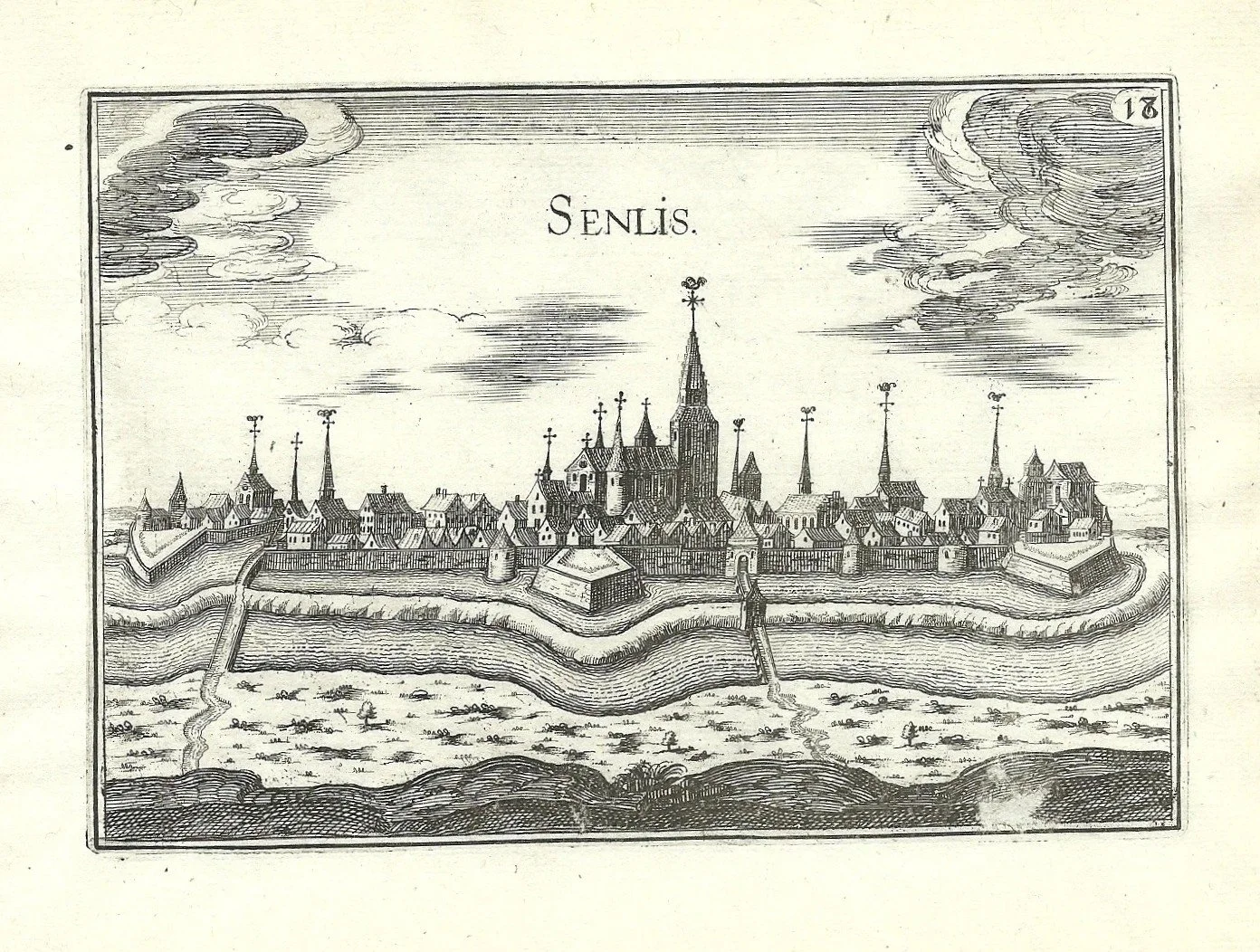
Senlis as Élisabeth would have known it: Christophe Tassin's 1634 engraving from Les plans et profils de toutes les principales villes et lieux considerables de France, showing the fortified town with its cathedral spire rising above the medieval roofline.
But Senlis itself tells us something. In the seventeenth century it was a well-established administrative and religious center — seat of a bishopric, ringed by medieval ramparts, dominated by the Gothic spire of Notre-Dame de Senlis. The town functioned as a regional market center, known for trades in leather, wool, and fur. The proximity to the Chantilly Forest and the nearby Château de Chantilly ensured that Senlis remained a frequented stop for the French nobility, even as the Royal Castle had begun its slow decline.
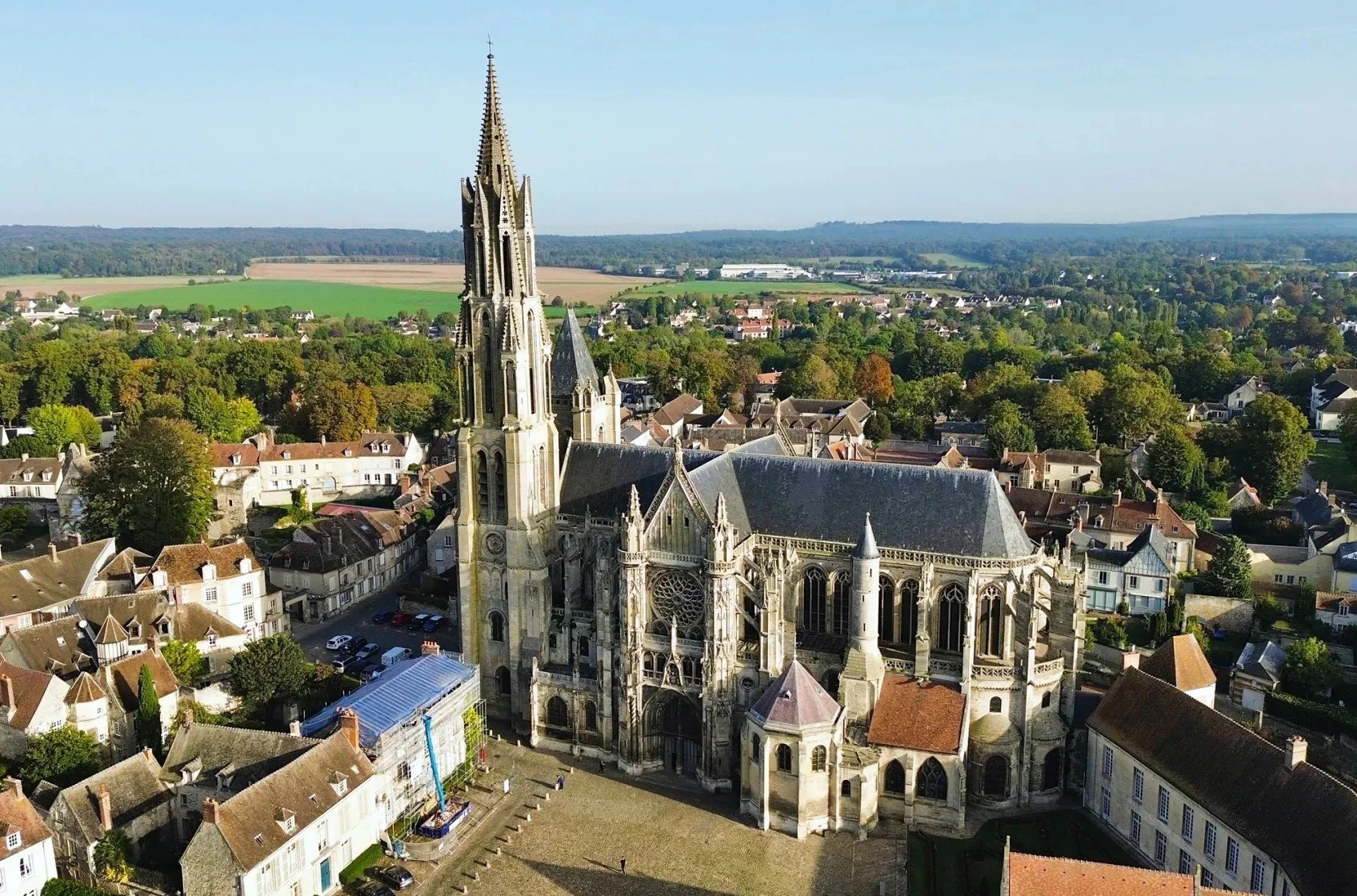
Notre-Dame de Senlis today. The Gothic cathedral that dominated Élisabeth's childhood skyline still stands, its spire visible for miles across the Picardy plains.
Élisabeth grew up in a town where stone walls meant something — protection, permanence, belonging. The narrow cobblestone streets, the dense cluster of churches and chapels, the ramparts that had defended Senlis since the thirteenth century: all of this was the world she knew before she left it forever. By 1665, orphaned and alone, she would trade these ancient walls for the wooden palisades of a colony three thousand miles across the Atlantic.
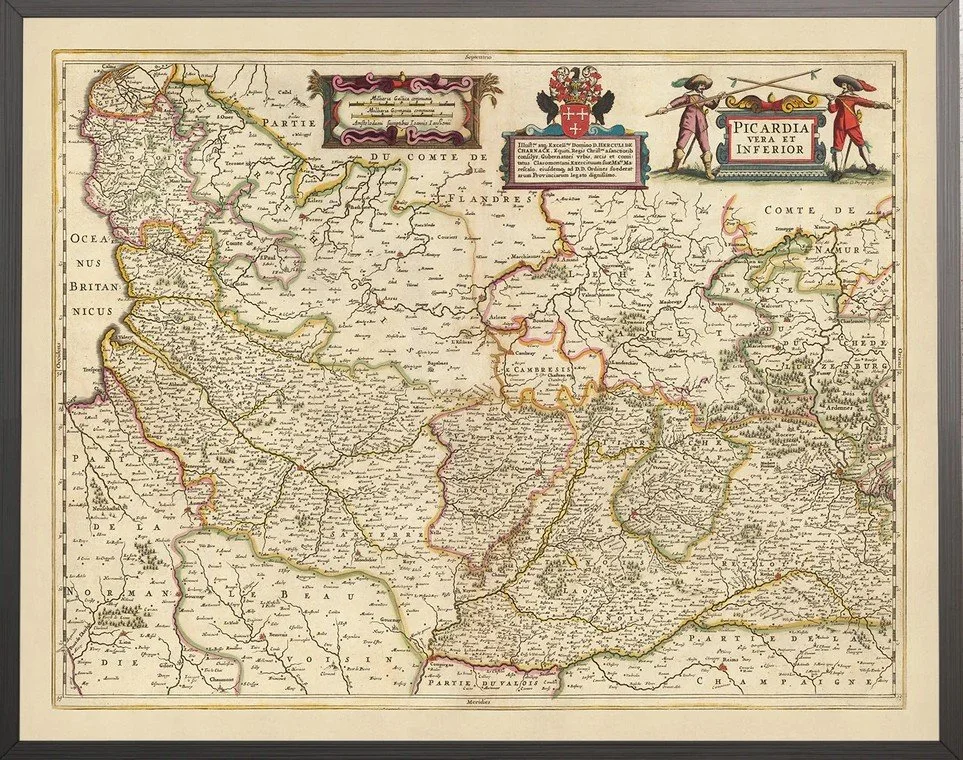
Picardia vera et inferior by Nicolaes Visscher II (1690), showing the broader Picardy region. Senlis appears as a key hub between Paris and Amiens — the world Élisabeth left behind.
2. The Crossing — Fille du Roi, 1665
In the spring of 1665, Élisabeth Le Roy — about twenty-four years old, both parents dead, unable to sign her name — became one of the Filles du Roi bound for New France. She boarded the St-Jean-Baptiste at Dieppe. Her ship carried ninety Filles du Roi and thirty contracted workers. After weeks at sea, she arrived in Québec City on June 18, 1665.
What compelled an orphaned young woman from Picardy to cross the Atlantic? We cannot know her private reasons, but the public ones are well documented. Louis XIV's minister Jean-Baptiste Colbert had determined that New France would never become a viable colony without women. The gender imbalance was severe, with men far outnumbering women across the settlements. The Crown offered passage, a small trousseau, and a dowry to any woman willing to make the journey. For an orphan with no prospects in Senlis, the offer must have been compelling: a chance at land, a husband, and a new beginning.
Peter Gagné, in King's Daughters and Founding Mothers: The Filles du Roi, 1663–1673, records that Élisabeth arrived at about age twenty-three, having lost both parents before departing. Within four months of her arrival, her life in the New World would begin in earnest.
3. First Marriage — Pierre Pallereau
Once in the new world, little time was wasted in helping the young women find husbands. In the case of Élisabeth, a contract of marriage was drawn up before the notary Pierre Duquet on October 12, 1665, less than four months after her arrival. The religious marriage record itself has not survived — she married Pierre Pallereau, whose name the notary spells Pallereau in the body of the act and whose wrapper is endorsed, in the same hand that filed it away, Contract de Mariage / Pierre Paillereau et Isabelle le Roy / 12e 8bre 1665.

Contrat de mariage de Pierre Pallereau et Isabelle Le Roy, 12 octobre 1665, act no. 153, first leaf. Greffe de Pierre Duquet de la Chesnaye, 1663–1687, Fonds Cour supérieure, District judiciaire de Québec, Greffes de notaires (03Q,CN301,S95), Archives nationales à Québec.
The act opens by naming all four parents at once: Pierre Pallereau, "fils de feu Pierre Pallereau et de deffuncte Françoise Micou ses père et mère, de la paroisse de Villedoux, évesché de La Rochelle"; and "Isabelle Le Roy, fille de deffunct Anthoine Le Roy et de deffuncte Simonne Gaultier ses père et mère, de la ville de Senlis en Picardye, évesché de Senlis." Four parents, four times defunct. Between them the bride and groom had not one living relative on either side of the Atlantic that the notary thought worth naming.
A small thing in the writing is worth pausing over. In the appearance clause the notary calls her Isabelle; a few lines later, in the promise itself, he calls the same woman Élisabeth — "Pierre Pallereau a promis et promect prendre ladite Élisabeth Le Roy pour sa femme et légitime espouse." Both names, for one woman, in one document, in one hand, on one afternoon. The variation that runs through every later record of her life is already there in the first.
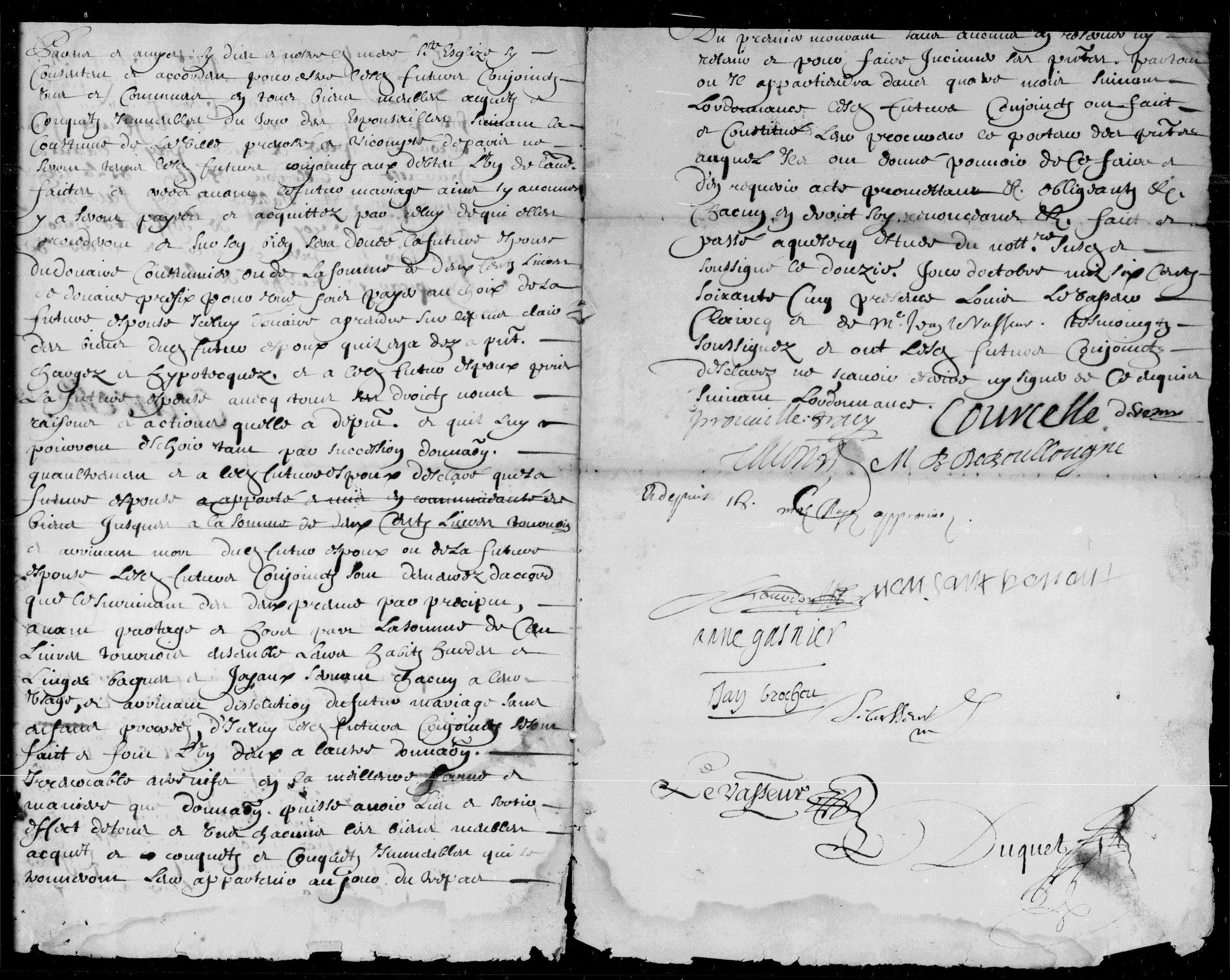
The second leaf: the property terms in the left column, the closing and signatures in the right.
Community of property under the Coutume de la ville, prévôté et vicomté de Paris, from the day of the wedding.
Prior debts stay with whoever incurred them, payable out of that person's own goods.
Douaire — the widow's portion — set at the douaire coutumier or 200 livres préfix, once paid, at the future wife's choice, secured on the clearest of Pierre's goods.
Préciput of 100 livres tournois to whichever of them survived, taken before any division, for clothes, linen, rings and jewels.
Mutual irrevocable donation of all goods and acquests should the marriage end without children.
Passed at Québec, in the notary's study, before Louis Le Vasseur, clerk, and Me Jean Le Vasseur, witnesses. Both bride and groom declared they could not write or sign.
That last line is the ordinary formula, and it is the first of three times Élisabeth's illiteracy is recorded across forty-four years. What is not ordinary is what follows it on the page. Beneath the notary's closing, the act carries a cluster of signatures, and among them are Prouville Tracy — Alexandre de Prouville, marquis de Tracy, lieutenant-general of the Americas — and Courcelle, Daniel de Rémy de Courcelle, newly arrived as governor a month earlier. Beside them signs M. B. de Boullongne, Marie-Barbe de Boullongne, widow of the former governor Louis d'Ailleboust; and beneath, in a plain upright hand, Anne Gasnier — the woman charged with receiving the King's daughters at Québec and seeing them settled.
An orphan from Senlis who could not write her own name was married under the signatures of the two most powerful men in New France and the two women who had charge of her. It is worth being precise about what that means: attendance of this kind at a Fille du Roi's contract was a matter of policy, not of personal regard, and these same names appear on other contracts of that autumn. But policy is also a thing that happened to particular people on particular afternoons, and on this afternoon it happened to her.
| # | Name / role | M.S. | Pr. |
|---|---|---|---|
| 01 | Pierre PallereauGroom · origin: paroisse de Villedoux, évêché de La Rochelle, Aunis | c | p |
| 02 | Isabelle LeroyBride · origin: Senlis, évêché de Senlis, Picardie | c | p |
| 03 | Pierre PallereauFather of the groom | — | d |
| 04 | Françoise MicouMother of the groom | — | d |
| 05 | Antoine LeroyFather of the bride | — | d |
| 06 | Simone GaultierMother of the bride | — | d |
| 07 | Pierre DuquetNotary | — | p |
Transcribed from PRDH-IGD marriage contract record, couple no. 94251, and checked against the act itself (Duquet, act no. 153), which agrees with it in every particular. Database fields are the PRDH's reading of the act, not a transcription of it.
M.S. (marital status): c = unmarried, m = married, v = widowed. Pr.: p = present, d = deceased.
Pierre Pallereau was a plowman, born about 1626 in Villedoux, in the diocese of La Rochelle, Aunis — the son of Pierre Pallereau and Françoise Micou. He had enlisted at La Rochelle on June 4, 1649, and had been previously married in 1657 to Hélène Cartier at Notre-Dame-de-Québec, but had no children with her. Gagné describes him as a laboureur — a plowman — contracted in 1649. He was roughly fifteen years older than his new bride.
Pierre and Élisabeth settled at Sainte-Famille on Île d'Orléans — the same island where so many early colonial families were taking root. The 1666 census, the earliest to enumerate the colony's inhabitants, records them together under the heading familles des habitans / aages / qualitez et mistieres: "Pierre Paillereaux, 40, habitant" and "Elisabeth Roy, 25, sa femme." No children are entered with them.

Recensement de 1666, Île d'Orléans. The entry gives Pierre's standing in the parish — habitant — rather than a trade, and his wife by her own name and age.
The following year's census adds the household's means. The 1667 enumeration records Pierre Pallereau, age 40, and Isabelle Le Roy, his wife, age 25, with one head of cattle and three arpents en valeur. Again no children; Marie Marthe was born that October. Three arpents is a small clearing — the households entered around them on the same page hold six, eight and twenty — and it places the couple near the beginning of the work of making a farm, not part-way through it.
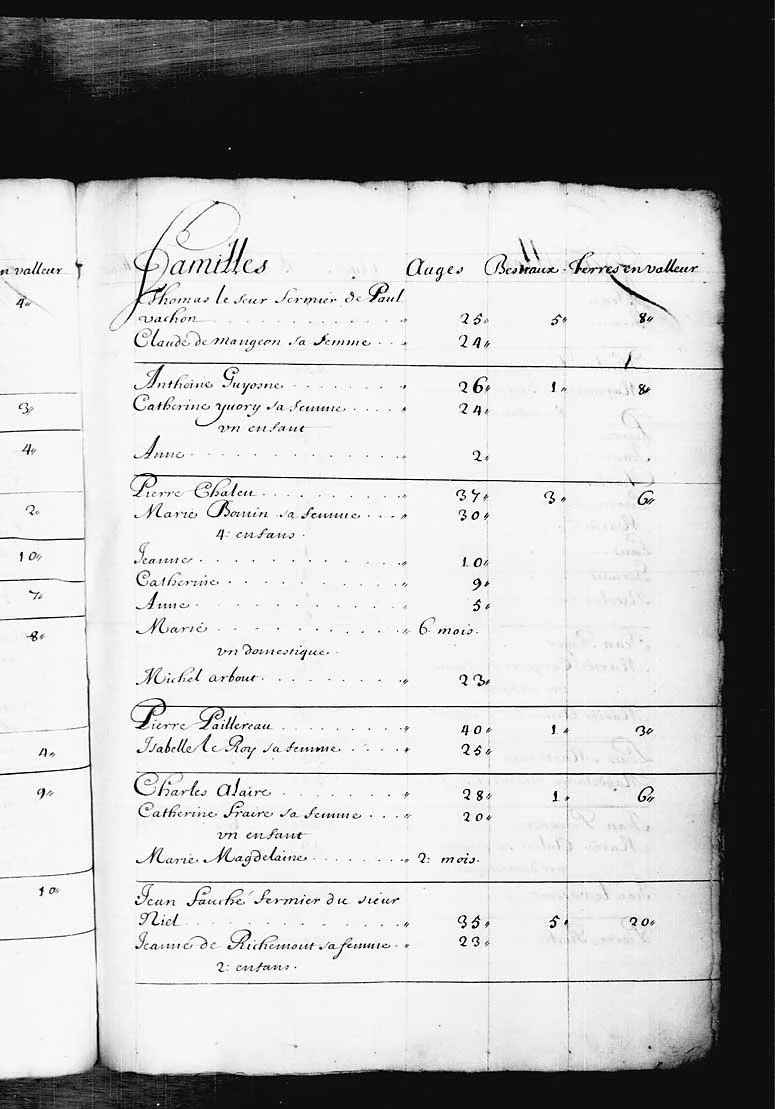
Recensement de 1667: "Pierre Paillereau — 40 — Isabelle le Roy sa femme — 25," with 1 head of cattle and 3 arpents en valeur. No child is entered with them. The nearest "Anne, 2" on the page belongs to the household of Anthoine Guyosne and Catherine Yvory, two entries above, and the four children beneath that to Pierre Chalen and Marie Bonin — neither group is Pallereau.
Their first daughter, Marie Marthe, was born on October 10, 1667 and baptized four days later at Sainte-Famille. The godmother was Marie Girou, wife of Abel Turcault; the space for the godfather's name was left blank in the register.

Parish register, Ste-Famille, Île d'Orléans: baptism of Marie Marthe Pallereau, 14 October 1667.
| # | Name / role | M.S. | Pr. |
|---|---|---|---|
| 01 | Marie Marthe PallereauChild | c | p |
| 02 | Pierre PallereauFather | m | p |
| 03 | Elisabeth RoyMother | m | p |
| 04 | Marie GirouGodmother · wife of 05 | m | p |
| 05 | Abel TurcaultHusband of 04 | m | — |
| 06 | [given name blank] PommierPriest | c | p |
| 07 | Thomas MorelPriest | c | p |
Database note: the godfather's name was left blank.
Transcribed from PRDH-IGD baptism record no. 31014. Database fields are the PRDH's reading of the register, not a transcription of it.
Pierre's age is recorded three times and never moves. He is 40 in 1666, 40 in 1667, and 40 again at his burial in November 1669. A man born about 1626 — the date the PRDH carries from the Fichier Origine — would have been about forty in 1666 and forty-three by the time he was buried. A round number repeated across three documents is a clerk's estimate carried forward, not a man who stopped ageing, and none of the three is treated here as a birth date. Élisabeth's ages behave better: 25 in both censuses, 40 in 1681, 46 in 1688, all pointing at a birth around 1641.
Two years later, Élisabeth was expecting again. But on November 23, 1669, Pierre Pallereau was buried at Sainte-Famille. The burial entry gives his age as forty and adds two words: mort subitement — he had died suddenly. Two weeks later, on December 7, 1669, his second daughter, Anne, was born and baptized the same day. Her godparents were Pierre Boucher and Anne Colin, wife of Vincent Boissonneau dit Saint-Onge. At twenty-eight years old, Élisabeth was a widow with a two-year-old and a newborn, alone on an island in the St. Lawrence at the start of winter.
That godmother is worth a second look, because she is the first sign of how the next eighteen years of Élisabeth's life were arranged. Vincent Boissonneau dit Saint-Onge was a soldier of the compagnie de Maximy — the company that had been garrisoned at Sainte-Famille since 1665. Six weeks after his wife stood at this font, Élisabeth contracted to marry another man of that company.

Parish register, Ste-Famille, Île d'Orléans: burial of Pierre Pallereau, 23 November 1669.
| # | Name / role | Age | M.S. | Pr. |
|---|---|---|---|---|
| 01 | Pierre PallereauDeceased · residence: Ste-Famille (Île d'Orléans) · origin: La Rochelle | 40 | — | d |
| 02 | Thomas MorelPriest, missionary, curé · residence: Ste-Famille | — | c | p |
Database note: "mort subitement."
Transcribed from PRDH-IGD burial record no. 32849. Database fields are the PRDH's reading of the register, not a transcription of it.
| # | Name / role | M.S. | Pr. |
|---|---|---|---|
| 01 | Anne PallereauChild | c | p |
| 02 | Pierre PallereauFather | m | — |
| 03 | Elisabeth RoyMother | m | p |
| 04 | Pierre BoucherGodfather | — | p |
| 05 | Anne ColinGodmother · wife of 06 | m | p |
| 06 | Vincent BoissonneauHusband of 05 | m | — |
| 07 | Thomas MorelPriest, missionary | c | p |
Transcribed from PRDH-IGD baptism record no. 31092. Database fields are the PRDH's reading of the register, not a transcription of it.
Children of Pierre Pallereau and Élisabeth Roy
| Name | Born / Baptized | Place | Marriage | Died |
|---|---|---|---|---|
| Marie Marthe | b. 10 Oct 1667 bp. 14 Oct 1667 |
Ste-Famille, I.O. | Thomas Plante, 9 Feb 1687, St-Jean, I.O. | 11 Sep 1747, St-Vallier Still transacting in 1732: donation of a quarter-arpent on the St Lawrence to her son François |
| Anne | b. & bp. 7 Dec 1669 | Ste-Famille, I.O. | None — she did not live to marry | Between 7 Dec 1669 and 20 Jan 1670; burial not located |
4. Second Marriage — Antoine Leblanc dit Jolicoeur
Widowhood in New France was a practical crisis as much as an emotional one. A woman alone with small children needed a husband to work the land, maintain the farm, and survive the colonial economy. Élisabeth wasted no time. Barely two months after Pierre Pallereau's burial she had her second marriage contract drawn up by the notary Paul Vachon, as act no. 384 of his greffe. Six days later, on January 26, 1670, at Sainte-Famille, Île d'Orléans, she married Antoine Leblanc dit Jolicoeur.
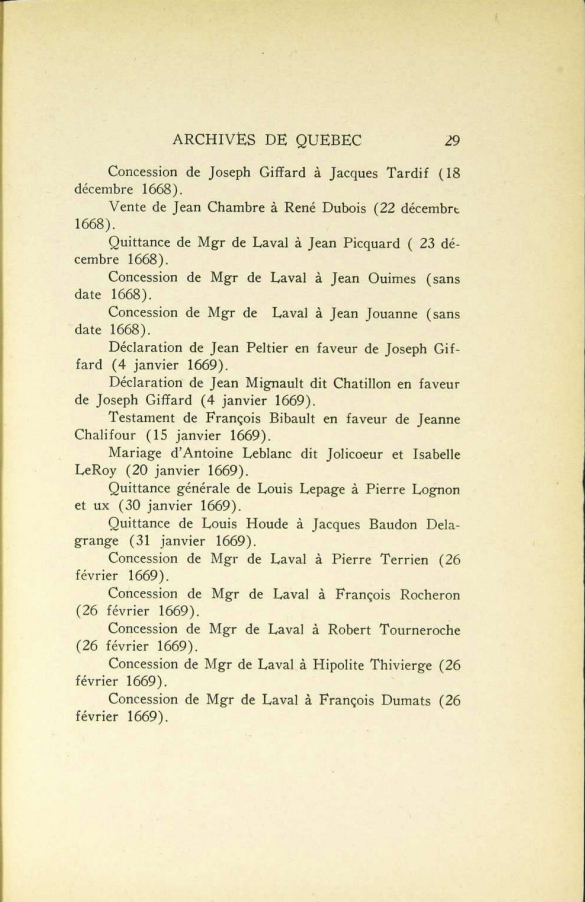
The contract is dated 20 January 1669 — on the wrapper and again in the body — and that date cannot stand. Pierre Pallereau was alive until 23 November 1669, and the act styles Élisabeth his widow. The printed inventory of the notarial records in the Archives de Québec reproduces the year faithfully, so the slip is the notary's or his clerk's, not the index's: in the third week of January, writing the year for the first time in a fortnight, Vachon wrote the one he had been writing all December. The marriage six days later fixes the true year as 1670.

Parish register, Ste-Famille, Île d'Orléans, 1666–1678: marriage of Antoine Leblanc dit Jolicoeur and Isabelle LeRoy, 26 January 1670. Drouin Collection, Ancestry.com.
Antoine Leblanc dit Jolicoeur is the subject of his own comprehensive documentary biography, with a complete source inventory. For the full account of their eighteen years together — the land concession, the children, the tragic joint burial of two sons, and Antoine's death at thirty-eight — see: Antoine Leblanc dit Jolicoeur & Élisabeth Roy → Documentary Biography

The wrapper, endorsed "20. Janvier 1669" — the year the act carries, and the year that cannot be right. Greffe de Paul Vachon, 1655–1693 (03Q,CN301,S266), Archives nationales à Québec.

The first leaf, naming both parties and the relatives and friends assembled on each side. The margin carries the act number, 384.
Antoine was a young man from the parish of Saint-Pierre in the diocese of Noyon, in Picardy — the same province as Élisabeth's Senlis, barely sixty kilometres apart. He was confirmed at Québec on 24 August 1664, his age entered as twenty — a year before the Carignan-Salières Regiment landed, which is a problem the companion page will have to work out rather than this one. At about twenty-one, he was younger than his bride by some eight years.
His mother's name is the one point where the two records of this marriage disagree. The contract of 20 January calls him "fils de Martin Le Blanc et de deffuncte Marie Flamen"; the parish register six days later gives the mother as Marie Flaniau. Both are contemporary, both were written from what Antoine told the man holding the pen, and neither is a copy of the other. The conflict is recorded here rather than resolved: his mother was already dead, no one in the colony had ever met her, and two clerks a week apart heard her name differently.
For Élisabeth the act does something the 1665 contract could not: it shows her standing in a room full of people. Each party came with parents et amis assembled to consent. On Antoine's side were Gabriel Dumas, master mason, and Jean Jouanne, both habitants of the island. On hers stood Abel Turcaud and Marie Girou his wife — the same Marie Girou who had held her daughter at the font at Sainte-Famille two years before, when the godfather's line was left blank. Four years into the colony, with no family of her own anywhere in it, the neighbour who stood up for her child stood up for her again.

The second leaf carries the terms — and the clauses about Marthe.
Community of property under the Coutume de Paris; neither liable for the other's debts contracted before the wedding.
Douaire of 150 livres tournois préfix or the douaire coutumier, at her choice — fifty livres less than Pierre Pallereau had settled on her in 1665.
Préciput of 100 livres tournois, reciprocal — the same figure as in 1665.
Before the wedding, Élisabeth was to have herself elected tutrice to the person and property of her daughter Marthe Pallereau, with a subrogé tuteur named, and an inventory taken of the community she had held with Pierre.
Marthe was to be "nourrie et entretenue aux despens de la dite communauté jusqu'à ce qu'elle ayt attaint l'âge de quinze ans" — fed and maintained at the new household's expense until she turned fifteen — without diminution of her own property.
Passed at the seigneurial place of Île d'Orléans. The bride, the groom, Dumas, and Turcaud and his wife all declared they could not write or sign.
Those last two clauses are the heart of the document. The Coutume de Paris did not permit a widow with minor children to remarry until their guardianship was settled and the first community inventoried, and the contract sets that machinery out in order. But the maintenance clause goes past what the law required. Élisabeth was marrying a man of twenty-one who owned little; she took care, before she married him, that her daughter would be fed out of the common purse for the next thirteen years and that the cost would not be charged against the child's own small inheritance from her father. She could not read the sentence that did it. She made sure it was there.
And there is something the act does not say. It names Marthe, and only Marthe. Anne — baptized at Sainte-Famille on 7 December 1669, six weeks before the contract was drawn — appears nowhere in it: no guardianship, no maintenance, no mention at all.
That silence is the whole case for what became of her, and it is worth setting out plainly, because the published accounts say Anne "died before 1681" and the documents will carry a tighter date than that.
What Happened to Anne Pallereau
The claim: Anne died between her baptism on 7 December 1669 and 20 January 1670 — within six weeks of birth, not "before 1681."
The evidence is entirely negative. It rests on three documents that should have named her, and on a register that should hold her burial and does not:
1. The Vachon marriage contract, January 1670. Under the Coutume de Paris a widow's remarriage required guardianship of all minor children of the dissolved marriage and an inventory of its community. The contract sets that machinery out in order, and names one child. A six-week-old daughter alive on that day could not have been left out of a tutelle clause; the law did not permit it.
2. Marthe's own marriage contract, February 1687. Élisabeth appears there in a capacity she had not used in seventeen years — not as Antoine Leblanc's wife, though he stands in the same room as the bride's beau-père, but as "Isabel Le Roy, vefve de deffunct Pierre Pallereau," stipulating "pour Marthe Pallereau sa fille." Thomas Plante takes his bride "avec tous et chacuns les droicts à elle escheus par le decès dudit deffunct Pierre Pallereau" — all and each of the rights devolved to her by the death of her father. Two surviving daughters would have split that succession in halves. The contract knows of no half.
3. Every index and register since. No marriage. No burial. Nothing.
4. The register has been searched, and the burial is not in it. The Sainte-Famille register has been worked through for that period entry by entry. No burial for Anne Pallereau is recorded. That is a stated negative, not an unfinished search — which means no record anywhere says when Anne died, and none is going to.
Why the entry may never have been made. A hypothesis, offered as one: Thomas Morel, who baptized Anne on 7 December and had buried her father a fortnight earlier, was a missionary serving several parishes across the island and the south shore. A newborn dying in the last weeks of December, in deep winter, may well have been buried by her family before he next came through, and the entry never written up. This is the same shape of explanation as an act passed en brevet and leaving no minute: the event happened, the paper did not.
The old date rests on a census that cannot carry it. The "before 1681" appears to come from Anne's absence from the 1681 household. That entry lists four Leblanc children — Marguerite 10, Joseph 7, Pierre 6, Anthoine 3 — and does not list Marthe, who was thirteen and demonstrably alive, marrying six years later. A census that omits a living daughter cannot be used to bury a dead one.
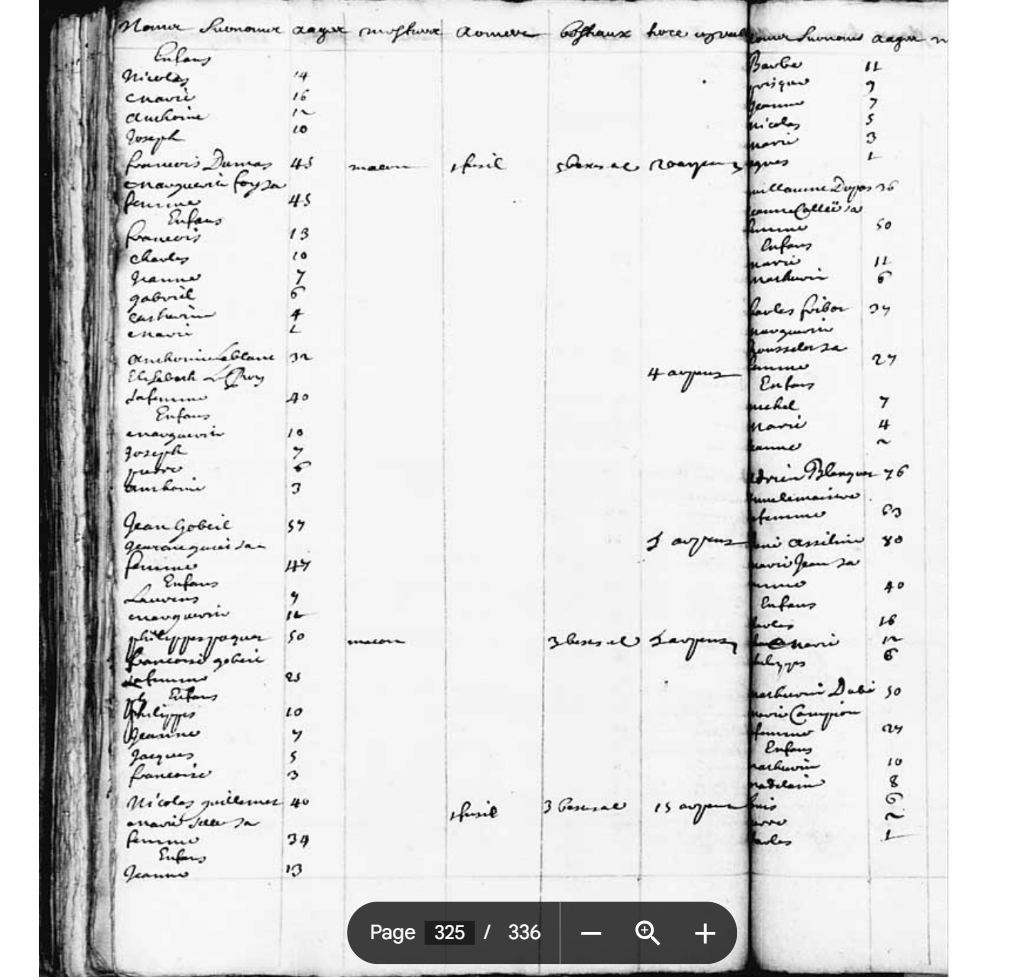
The couple stayed at Sainte-Famille, the parish where Élisabeth had lived with Pierre Pallereau and where Antoine's company had been garrisoned. The 1681 census still finds them there, and gives their household as Anthoine Leblanc, 32, and Elisabeth le Roy sa femme, 40, with four children entered beneath them — Marguerite 10, Joseph 7, Pierre 6, Anthoine 3 — and four arpents en valeur. Their youngest daughter, Marie, would not be born until 1683.
Some time in the twelve months after that census they moved across the island to Saint-Jean. Every record of the family after it comes from that parish — and the first of them is the worst.
Two things about that entry are worth noticing, because both cut against how it has been read. The household's figures are thin: four arpents, and nothing at all in the columns for arms or livestock, where their neighbours are credited with muskets, cattle and up to fifteen arpents. And the list of children is incomplete — Marthe, then thirteen, is not in it. She was alive; she married six years later. Whether she had been placed out in service, as girls of that age often were, or was simply passed over, the entry is not a reliable account of who was in that family.

Recensement de 1681, page 325: "Anthoine Leblanc 32 / Elisabeth le Roy sa femme 40," with Marguerite, Joseph, Pierre and Anthoine entered as enfans, and four arpents en valeur. Neither Marthe, then thirteen and living, nor any livestock appears. Taken one year before the double burial and six years before Antoine's death.
Together they had five children — and buried two of them on a single day.
Children of Antoine Leblanc dit Jolicoeur and Élisabeth Roy
| Name | Baptized | Place | Marriage | Died |
|---|---|---|---|---|
| Marie Marguerite | 8 Jul 1671 | Ste-Famille, I.O. | Nicolas Sustier dit Tranchemontagne, 30 Apr 1691, St-Jean | 31 Jul 1723, buried Notre-Dame-de-Montréal, aged 50 |
| Joseph | 15 Aug 1673 | Ste-Famille, I.O. | Marie Philibot, about 1697, St-Jean — nine children | 28 Nov 1741, St-Jean, aged 71 |
| Pierre | 29 Dec 1675 | Ste-Famille, I.O. | — | Buried 5 Jan 1682, St-Jean, I.O. |
| Antoine | 29 Oct 1678 | Ste-Famille, I.O. | — | Buried 5 Jan 1682, St-Jean, I.O. |
| Marie | 22 Aug 1683 | St-Jean, I.O. | Jean Bissonnette, contract 11 Jan 1709; then Jean Coulombe, 20 Apr 1716, St-Michel de Bellechasse | 18 Mar 1750, Berthier-sur-Mer |
One line of that table repays attention. Joseph was fourteen when his mother married Charles Phlibot in May 1688 and the two households came together under one roof, and within a decade he had married a Marie Philibot. Whether she was one of the five children Charles brought to that marriage is not established here — it wants Charles's own family record — but if she was, the household Élisabeth made in 1688 produced a marriage of its own.
The most devastating entry in this record is the burial of Pierre and Antoine on January 5, 1682 at Saint-Jean — two brothers, ages six and three, buried on the same day. The cause of death is not recorded, but simultaneous deaths of siblings almost always indicate an infectious disease. For Élisabeth and Antoine, it meant losing two children in a single blow.
The curé of Saint-Jean, writing up the entry for a woman new to his parish, put her surname down as Vervié. It is the fifth form her name takes in the records — after the Isabelle and Élisabeth of the 1665 contract, the Le Roy of everything official, and the Rachel that appears once, in the land sale of 1671. A woman who never wrote her own name was written down five different ways by the men who did.
Antoine Leblanc dit Jolicoeur died on December 18, 1687 at the age of thirty-eight. He was buried two days later at Saint-Jean. Élisabeth was forty-six years old. She had now buried two husbands. She had five surviving children to support — two Pallereau daughters and three Leblanc children.
5. Third Marriage — Charles Phlibot (Flibot)
Four months after Antoine's burial, Élisabeth Le Roy entered into a third marriage contract before the notary Claude Auber on April 25, 1688 — act no. 502 of his greffe. She married Charles Phlibot on May 16, 1688 at Saint-Jean, Île d'Orléans. The marriage entry names her Isabelle Leroy and gives her age as forty-six; Charles is given as forty-five. Both are recorded as widowed, and each one's late spouse is named: Marguerite Rousselot for Charles, Antoine Leblanc Jolicoeur for Élisabeth.

The répertoire of the Auber greffe, page 59: "1688 / Avril 25 / 502 / Mariage / Chas. Fribot & Elizabeth LeRoy, Vve Antne Leblanc. (Signé) Claude Chaslé, Nic. Gauvreau." A clerk's index to the greffe, and a finding aid rather than a second witness — but it names the act's two signing witnesses correctly, as the act itself confirms.

The act itself, first leaf, headed in the margin "25 avril 88 / Mariage / N° 502 / Fribot / Elizabeth." Greffe de Claude Auber, 1650–1692 (03Q,CN301,S4), Archives nationales à Québec.
His surname is the first thing the act settles. Auber writes him Fribot — in the margin, in the body, and in the répertoire that indexes him. The parish register a month later writes Phlibot. Denis Beauregard's database records the split without explaining it, giving "PHILIBOT (m) or FRIBOT (cm)" — the register's form for the marriage, the notary's for the contract. These two documents are what lies behind that note: not two men, but one man written down by two clerks who had never compared their spellings.

The closing leaf: passed at Québec in Auber's study, before Nicolas Gauvreau and Claude Chaslé. Charles signed. Élisabeth "dit et déclaré ne scavoir escrire ny signer."
Community of property in movables and acquests from the day of the wedding; prior debts payable out of the goods of whoever contracted them.
Charles's five children were to be "nourris et eslevez" at the community's expense until they reached fifteen.
Passed at Québec, in the notary's study, before Nicolas Gauvreau and Claude Chaslé, witnesses. Charles signed; Élisabeth declared she could not write or sign.
The maintenance clause is the same instrument, turned around. In January 1670 Élisabeth had it written into a contract so that a young husband would feed her daughter to the age of fifteen. In April 1688, at forty-six, she agreed to the identical undertaking for five children who were not hers. She had been on both sides of that sentence, eighteen years apart, and could read neither one.

Parish register, St-Jean, Île d'Orléans: marriage of Charles Phlibot and Isabelle Leroy, 16 May 1688.
| # | Name / role | Age | M.S. | Pr. |
|---|---|---|---|---|
| 01 | Charles PhlibotGroom · residence: St-Jean (Île d'Orléans) | 45 | v | p |
| 02 | Isabelle LeroyBride · residence: St-Jean (Île d'Orléans) | 46 | v | p |
| 03 | Marguerite RousselotLate wife of 01 | — | m | d |
| 04 | Antoine Leblan JolicoeurLate husband of 02 | — | m | d |
| 05 | Philippe PasquierResidence: St-Jean (Île d'Orléans) | — | — | p |
| 06 | Jacques Bidet DesrouzellesResidence: St-Jean (Île d'Orléans) | — | — | p |
| 07 | Jean MourierResidence: St-Jean (Île d'Orléans) | — | — | p |
| 08 | Pierre TerrienResidence: St-Jean (Île d'Orléans) | — | — | p |
| 09 | [given name blank] FranchevilleCuré · residence: St-Jean (Île d'Orléans) | — | c | p |
Transcribed from PRDH-IGD marriage record no. 38850. Database fields are the PRDH's reading of the register, not a transcription of it.
One of the four lay witnesses at that marriage deserves naming. Jacques Bidet dit Desroussels had served in the compagnie de Maximy alongside Antoine Leblanc. Five months after Antoine's burial, his old company mate stood up at his widow's third wedding. The company that brought her second husband to the island was still around her at her third marriage, nineteen years on.
Charles Phlibot was himself a remarkable figure. Born September 16, 1644 in Saint-Lambert-du-Lattay, diocese of Angers, and baptized the same day, he was the son of Jean Jacques Flibotte and Françoise Bendeau. Like Élisabeth, he had been widowed twice — and both of his previous wives had been Filles du Roi. His first wife, Anne Geoffroy (married 1 September 1670 at Ste-Famille), had died. His second wife, Marguerite Rousselot (married 22 September 1673 at Ste-Famille), had also died. He had at least five young children of his own at the time of this third marriage.
What this meant in practical terms was that Élisabeth and Charles were merging two large, bereaved households. Between them, they had something like ten children from previous marriages — a blended family of necessity and survival on the frontier.
Élisabeth and Charles had no children together — Gagné states it rather than merely leaving it unrecorded, and no baptism has ever been found. They continued to live at Saint-Jean, Île d'Orléans. The last record showing Élisabeth physically present at a parish event is July 4, 1692, when she served as godmother to her grandson Jean Baptiste Plante — the son of her eldest daughter Marie Marthe Pallereau, who had married Thomas Plante in 1687. The parish register names her clearly: "isabelle Le Roy fem. de charle phlibot laquelle a declaré ne scavoir signer" — Isabelle Le Roy, wife of Charles Phlibot, who declared she could not sign.

Baptism register, St-Jean, Île d'Orléans, 4 July 1692: Jean Baptiste Plante, son of Thomas Plante and Marthe Pallereau. Godfather: Jean Plante. Godmother: "isabelle Le Roy fem. de charle phlibot." Signatures: G.T. Erbery pbre, jean plante. Twenty-seven years after her arrival, Élisabeth still declared she could not sign. This is the last document placing her at a parish event.
| # | Name / role | M.S. | Pr. |
|---|---|---|---|
| 01 | Jean Baptiste PlanteChild | c | p |
| 02 | Thomas PlanteFather | m | p |
| 03 | Marthe PallereauMother | m | p |
| 04 | Jean PlanteGodfather | — | p |
| 05 | Isabelle LeroyGodmother · wife of 06 | m | p |
| 06 | Charles PhlibotHusband of 05 | m | — |
| 07 | G. T. ErberyPriest | c | p |
Transcribed from PRDH-IGD baptism record no. 38187. Database fields are the PRDH's reading of the register, not a transcription of it.
Per Jetté, Élisabeth was still living when her youngest daughter Marie Leblanc entered into a marriage contract on January 11, 1709 with Jean Bissonnet, a widower — the last documentary evidence of her being alive. She would have been about sixty-seven, a remarkable age for a woman of the founding generation.
| # | Name / role | M.S. | Pr. |
|---|---|---|---|
| 01 | Jean BissonnetGroom · residence: comté St-Laurent | v | p |
| 02 | Marie LeblancBride | c | p |
| 03 | Marie Charlotte DavesneLate wife of 01 | m | d |
| 04 | Antoine LeblancFather of the bride | m | d |
| 05 | Isabelle LeroyMother of the bride · wife of 06 | m | p |
| 06 | Charles Imbaut [sic in database]Husband of 05 | m | — |
| 07 | Étienne JacobNotary | — | p |
Transcribed from PRDH-IGD marriage contract record, couple no. 95097. Database fields are the PRDH's reading of the act, not a transcription of it.
Charles Phlibot's Burial and the Age of 111

Burial register, Hôpital général de Québec (Notre-Dame-des-Anges), 18 April 1730. The entry names the deceased "Jacques Philibot"; a note in the margin gives his age as 111.
| # | Name / role | Age | M.S. | Pr. |
|---|---|---|---|---|
| 01 | Jacques PhilibotDeceased | 111 | — | d |
| 02 | Luc HendrixAlmoner, performing curial duties · residence: Hôpital général | — | c | p |
Database note: marginal annotation giving his age as 111.
Transcribed from PRDH-IGD burial record no. 169785, which the PRDH links to Charles Flibotte (individual no. 26700). Database fields are the PRDH's reading of the register, not a transcription of it.
The PRDH identifies Charles Phlibot with a man buried as "Jacques Philibot" on April 18, 1730 at the Hôpital général de Québec, Notre-Dame-des-Anges. A note in the margin of the register gives his age as one hundred and eleven. His documented birth date of September 16, 1644 — taken by the PRDH from the Fichier Origine — would make him about eighty-five. Gagné accepts the identification, noting that Charles died at a claimed age of 111, possibly in a measles epidemic. Inflated ages at burial are common in the colonial registers, and a man of eighty-five in a hospital for the aged and poor would have been old enough for a clerk to believe almost any number.
6. One of Thirty-Five
Élisabeth Roy was far from the only Fille du Roi to marry three times. But she was part of an extraordinarily small group. According to historical demographer Yves Landry, the marriage patterns for the approximately 800 Filles du Roi are as follows: roughly 738 married at least once, 181 married twice, only 35 married three times, and just 2 married four times. Élisabeth's three marriages place her among the top 5% of the most-married Filles du Roi.
Married once: ~738 | Married twice: 181 | Married three times: 35 | Married four times: 2
Each of her three marriages tells its own story. The first — to Pierre Pallereau in 1665 — was the standard Fille du Roi arrangement: a young woman matched with an older, established colonist within months of arrival. The second — to Antoine Leblanc dit Jolicoeur in 1670 — was a widow's urgent necessity, contracted barely two months after her first husband's death, with two small children depending on her. The third — to Charles Phlibot in 1688 — was a merger of two broken households, both partners twice-widowed, both bringing children from previous marriages.
What stands out about Élisabeth is not just the number of marriages but the consistency of her geography. Every record of her New France life places her on Île d'Orléans — first at Sainte-Famille, then at Saint-Jean. She was rooted to the island. And in that rootedness, she became one of the founding mothers of the Île d'Orléans community — a woman whose children and grandchildren would populate the parishes of that island for generations.
Élisabeth is part of the specific group of roughly 800 women responsible for the population explosion of New France. Denis Beauregard's Genealogy of the French in North America estimates the descendants of her parents' line at between 770,000 and 1,190,000 Quebecers, across thirteen generations and 1,902 marriages in its database — and Élisabeth is the only child of Antoine Le Roy and Simone Gaultier it records. Through her daughter Marie Marthe Pallereau, who married Thomas Plante, she is an ancestor of the large Plante family of Quebec. Through her Leblanc children, she connects to the Bissonnet, Coulombe, and Sustier families.
7. Life Timeline
Methodology & Sources
This documentary biography was constructed from parish registers (Ste-Famille and St-Jean, Île d'Orléans; Hôpital général de Québec), notarial acts read in the original (Duquet act 153, Vachon act 384, Auber act 502, the Jacob contracts of 1687 and 1709, and the 1732 Fortier donation), the censuses of 1666, 1667 and 1681, and the PRDH-IGD database, whose records are presented here as transcription tables rather than screen images. Secondary sources include René Jetté's Dictionnaire généalogique des familles du Québec, Peter Gagné's King's Daughters and Founding Mothers, Yves Landry's demographic research on the Filles du Roi, and Denis Beauregard's Genealogy of the French in North America.
For the complete documentation of Élisabeth's second marriage, see the Antoine Leblanc dit Jolicoeur Documentary Biography and the Documentary Biography Source Inventory.
All citations meet BCG standards for source documentation and follow the Evidence Explained (Mills, 3rd ed.) formatting.
Document Gallery
Original records for Élisabeth Roy — parish registers, census returns, and notarial acts — with period views of Senlis. Records of her second marriage are gathered in the companion Antoine Leblanc documentary biography.




Questions about your own research? Begin a research inquiry.
