
The Other Pierre Morin
The Other Pierre Morin
Purpose of This Note
There is a second Pierre Morin in the Carignan-Salières Regiment. He was born about 1643 in the diocese of Saintes, he was confirmed at Fort Chambly in May 1668, and by 1681 he was working a Sulpician domain at Lachine. He never married in the colony and left no descendants. He is also, on the reading of the most recent specialist study of the regiment, the man named on the 1668 muster roll under the company this practice long claimed for its own ancestor.
This note sets out his record separately from the identification dispute, and as fairly as the documents allow. Anyone searching Pierre Morin in these decades will meet both men, and the surest way to keep them apart is to know exactly what each one's evidence consists of.
This note formerly argued the opposite of what it now says
The version published in February 2026 was subtitled Distinguishing the Chambly Company's Morin from Pierre Morin dit Champagne of the Naurois Company. It argued that the man confirmed at Chambly with the origin Xainctes was the Chambly company's soldier, and therefore not our ancestor. Three claims in that sentence are now withdrawn.
Withdrawn: that the Chambly company's Morin was this man. The Société des Filles du Roi et Soldats du Carignan's alphabetical listing (January 2025) identifies the Chambly company's soldier as Charles Morin. The Xainctes confirmand cannot be explained as the man garrisoned at the fort where he was confirmed.
Withdrawn: company assignment as a second ground of exclusion. The February note excluded the Chambly confirmation from our Pierre on two independent grounds. The second — that the confirmand belonged to the Chambly company and ours to Naurois — is withdrawn with the claim above. The first ground, geographic conflict, stands unaffected and is the stronger of the two.
Withdrawn: the dit name. "Pierre Morin dit Champagne" appeared in that subtitle and throughout this site. No source supports it. Verney's reconstruction of the La Noraye company gives a nom de guerre to six of its ten soldiers and gives Morin none; both the roll and the PRDH's transcription of it place Champagne as a separate entry, a different soldier whose surname was never recovered.
What replaces all of it is worse for the old argument than any single correction. Peter J. Gagné's From Soldiers to Settlers (2025) assigns the Xainctes confirmand not to Chambly but to Naurois — the very entry this practice claimed — and his entry carries the line "Not the Pierre Morin who married Catherine Lemesle in 1672." This man is not someone who can be set safely aside. He is the rival candidate, and this note is rebuilt to treat him as one.
The wider problem — four men of this surname in one regiment, and two specialists reading a single roll line in opposite directions — is set out in the case study.
What Is Securely His
One record, and one database reconstitution built on it. That is the whole of it.
The confirmation at Chambly, 20 May 1668
A mass confirmation was held at Fort Chambly on the Richelieu on 20 May 1668, during the months when the regiment was being demobilised. Seventeen men were confirmed. Entry 07 is Pierre Morin, with his origin recorded as XAINCTES — Saintes, in the province of Saintonge, now Charente-Maritime.
| Event | Confirmation |
| Date | 20 May 1668 |
| Place | Chambly |
| Confirmands | 17 |
| Entry 07 | Pierre MORIN · origin: XAINCTES |
| Linked to | PRDH individual no. 81890 |
| Entry 04 | Pierre Daupeus · origin rendered LUCON |
| Entry 17 | Etienne Abilliard · origin rendered LUSSON |
Why the last two rows are on this card. The same list writes the diocese of Luçon twice, in two different spellings, neither of which is Xainctes. Whatever else the scribe was doing that day, he was not collapsing Luçon into Saintes. That is what makes the origin field here load-bearing rather than incidental.
What the card is, and is not. The origin is the confirmand's own reported place, taken down by a scribe at a frontier fort — a statement made by a man about himself, not a document produced where he was born. It is the only origin statement in evidence for him.
PRDH-IGD, confirmation no. 403507, Chambly, 20 May 1668; www.prdh-igd.com. Card data restated, not reproduced.PRDH individual no. 81890
| Name | Pierre MORIN |
| Sex | m |
| Birth | Around 1643 |
| Origin | xainctes |
| Status | Immigrant · Deceased outside Quebec |
| Father | Not indexed |
| Mother | Not indexed |
| Marriage | None recorded in the colony |
| Children | None |
| Events | Confirmation, Chambly, 20 May 1668 (no. 403507) |
What the birth year rests on. No record in evidence states this man's age. "Around 1643" is a database estimate, and the origin is the confirmation list's own spelling carried forward in lower case. This is a reconstitution built from a single event, and it should be cited as one.
What "deceased outside Quebec" means. Only that the PRDH found no death or burial for him in the Quebec parish register system. It is a statement about the surviving records, not about the man.
PRDH-IGD, individual no. 81890, Pierre Morin; www.prdh-igd.com. Card data restated, not reproduced.Everything else said about him — including everything in the next section — is inference laid over these two entries.
What Is Attributed to Him
Gagné's entry gives this man a fuller life than the two records above can carry on their own. Each element is worth separating by how well it is anchored, because they are not all anchored the same way.
| Claim | Status | Why |
|---|---|---|
| Confirmed at Chambly, 20 May 1668, origin Xainctes | Documented | PRDH no. 403507, entry 07, linked by the database to individual no. 81890. |
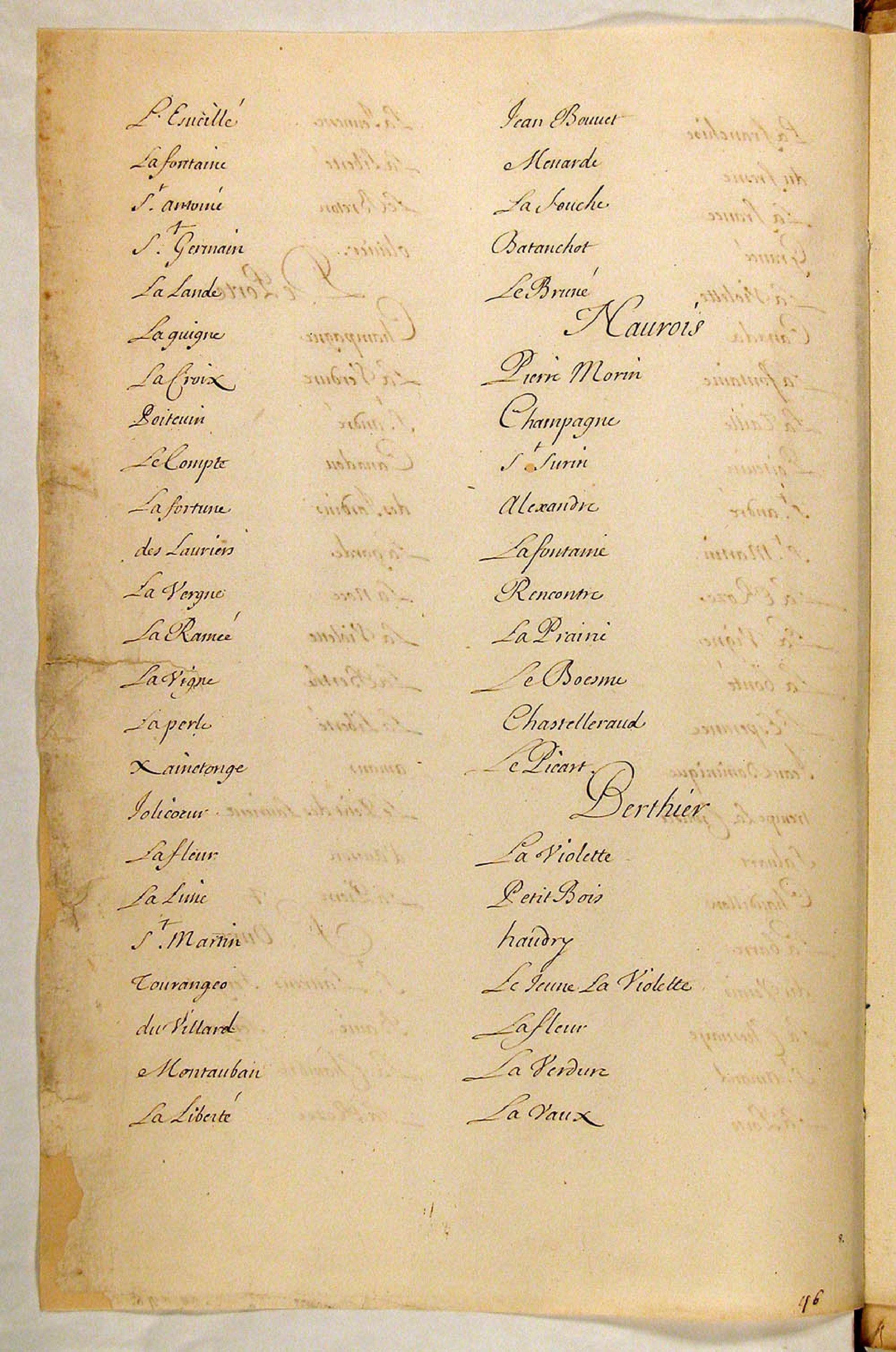
| Named on the 1668 muster roll under the Naurois company | Attributed | The roll gives a name and nothing else. Michel Langlois assigns the same entry to our Pierre Morin. No document in evidence links that line to either man. |
| Arrived at Québec, 14 September 1665 | Circular | That is the arrival date of the Justice, carrying the whole company. It follows from the company assignment and therefore cannot be used to support it. |
| Witness at the marriage of François Trotain, August 1668 | Attributed | See the section below. The record names a Pierre Morin and distinguishes him in no way whatever. |
| Witness at the marriage of Alexandre Téchenay | Not in the record | Téchenay's marriage is the next entry on the same register page, the same day. Its witnesses are Trotain, Antrade, de Fay and Larion. No Morin appears. Two acts have been compressed into one, and the appearance gained does not exist. |
| Bought a house at Petite Rivière, Québec, June 1672, from Jean Mérienne and Barbe Baron (notary Becquet) | Not located | The Becquet greffe images consulted at BAnQ carry no such act, and no Morin, Mérienne or Baron. The margins of the folio pulled read 30 June to 4 July, so the search may cover only the tail of the month; the act has not been produced either way. |
| Habitant of Lachine in 1681, at La Présentation | Attributed | A Pierre Morin is enumerated there. Our Pierre Morin is enumerated the same year at Petite Auvergne, so these are certainly two men — but which name belongs to which life rests on the identification at issue. |
What this table is not
It is not a case against Gagné. His is the most careful recent work on this regiment, and his entry flags a conflation in an earlier compilation that others had reproduced without noticing. Two of the items above are checkable errors; the rest is ordinary inference of a kind every genealogist uses, including this one.
What the table shows is how thin the underlying record is for either candidate. Strip the attributions from this man and one document remains. Strip them from ours and the military service disappears altogether.
The Witness Both Sides Claim
On 16 August 1668, at Notre-Dame-de-Québec, François Trotain dit Saint-Surin married Jeanne Hardy. Three days earlier the notary Gilles Rageot had drawn their marriage contract in the house of Jacques Doublet des Isles, and that contract names Trotain in so many words as Soldat de la Compagnie du Sr de Norrouest — a notarial act stating a company assignment outright, which is exactly what no document does for either Pierre Morin.
Among the friends named on the groom's side, and again among the witnesses at the church three days later, is a Pierre Morin.
That appearance is the hinge of the entire dispute. Gagné reads it as his Saintes man standing up for a fellow soldier from the same diocese — Trotain was from Saint-Séverin de Mortagne, évêché de Xaintes. Michel Langlois reads it as our Pierre Morin, and says so plainly: his stated grounds for the identification are the man's connections with the soldiers Lariou and Trotain, and his place of residence.
Both cannot be right, and the record cannot separate them. It gives Pierre Morin no occupation, no residence, no company, no age and no origin. He appears as an amy of the groom, and at the close of the contract he is among those who declared they did not know how to sign.
One further detail complicates the affinity reading in both directions. A co-witness at the church that day was Jean Mouflet, a soldier of the La Varenne company. The men standing around Trotain were not a single company's men. The group was mixed — which is what one would expect of a demobilised regiment in a small town, and which weakens any argument that reasons from who stood beside whom.
Two Men, Side by Side
What follows separates the two candidates on the evidence that genuinely distinguishes them — not on the disputed roll entry, which is the thing being argued about and cannot also be the thing that settles it.
| Attribute | The man from Xainctes | Pierre Morin of Petite Auvergne |
|---|---|---|
| PRDH individual | no. 81890 | no. 53641 |
| Origin | Xainctes (Saintes), Saintonge — from the confirmation list, once | Saint-Étienne-de-Brillouet, diocese of Luçon, Poitou — stated in four documents across thirty-four years |
| Birth | c. 1643 — database estimate; no record states his age | c. 1648 — no baptism found; the 1681 census gives his age as 34 |
| Parents | Unknown | Jacques Morin & Hilaire Guéry, both deceased by 1672 |
| Chambly confirmation, 1668 | Entry 07 — linked to him by the PRDH | Excluded on geographic grounds: the same list writes Luçon twice, as Lucon and Lusson, and neither is Xainctes |
| Marriage | None recorded in the colony | Catherine Lemesle, 13 June 1672, Notre-Dame-de-Québec |
| Children | None known | Eight, of whom five reached adulthood |
| 1681 census | A Pierre Morin at Lachine, on the Sulpician domain of La Présentation | Petite Auvergne, rivière Saint-Charles: with wife and four children, 1 gun, 5 cattle, 12 arpents |
| Literacy | Not established | Could not sign his name |
| Death | No record in the Québec parish system | 12 December 1706, Hôtel-Dieu de Québec |
| Descendants | None | Estimated 560,000–980,000 Québécois |
| Muster roll entry | Disputed. One line under the Naurois heading, claimed for both men by different specialists. No document assigns it, and the PRDH — which does link the Chambly confirmand to an individual — declined to link this one to anyone. | |
What Became of Him
If the Lachine identification holds, the last dated glimpse of this man is the census of 1681, and it is a vivid one. He was one of seven men at La Présentation, a domain held by the Sulpician priests who ran the Montréal seminary — two hundred arpents under cultivation, seventeen head of livestock, a fort and a mission, set across the water from the island known today as Île Dorval.
He would have been about thirty-eight. Unmarried, landless, labouring on someone else's ground at the exposed western edge of the settled colony, in the year the census-takers came through. Eight years later the Lachine settlement was destroyed. Whether he was still there is not known, because after 1681 there is nothing.
The possibilities are the ordinary ones, and none of them is documented. He may have returned to France; roughly eight hundred of the regiment's men did, and the roll he appears on records an intention to settle rather than a settlement achieved. He may have died on the crossing or after it, where no Québec record would reach him. Or he may have gone west into the fur trade and the pays d'en haut, where the record-keeping of the St Lawrence parishes simply does not extend.
For future researchers
The most promising unexplored avenue is the Archives départementales de la Charente-Maritime, which holds the parish registers for Saintes. A baptism for a Pierre Morin born about 1643 in one of the city's parishes — Saint-Pierre, Saint-Pallais or Saint-Eutrope — would give him parents and a family, and would be the first document to establish his origin from the French side rather than from a confirmand's own report at a colonial fort.
Discharge records (congés) at the Archives nationales d'outre-mer may document a departure from New France. And the 1681 Lachine entry deserves reading in the original with its surrounding households, as the Petite Auvergne entry has been — in that case the neighbours proved more informative than the subject.
Why This Man Matters
He has no descendants to write about him. He married nobody, fathered nobody, and left one line in a confirmation register and possibly a handful more in other people's records. It would be easy to treat him as an obstacle — the wrong Pierre Morin, the one to be cleared out of the way on route to the right one.
That was the shape of this note in its first version, and it was a failure of method as much as of fact. A rival candidate examined only in order to be dismissed has not been examined at all. The February note gave him four sentences and a column heading, and every one of those sentences was written to make him go away. Had he been described in his own right, the two errors withdrawn above would have been visible in February rather than August, because both of them turn on where he actually served.
He is also, on the reading of the most recent specialist study, the man who stood in the La Noraye company — which would make him the soldier, and our own ancestor a settler who was never a soldier at all. That may be right. It may not. The question is open, and this practice's published position is that it is open. But he deserves the same standard of description either way, and any researcher who confuses the two men will end up with a wrong province, a wrong birth year, and a wrong life.
Related pages
This note accompanies the disambiguation case study, which sets out all four men named Morin in the regiment and the conflict between the specialist compilations.
Case Study → Full Methodology → Documentary Biography →Sources
Confirmation at Chambly, 20 May 1668. PRDH-IGD event no. 403507. Seventeen confirmands; entry 07, Pierre Morin, origin XAINCTES; entry 04, Pierre Daupeus, origin LUCON; entry 17, Etienne Abilliard, origin LUSSON. Programme de recherche en démographie historique, Université de Montréal. prdh-igd.com
PRDH-IGD individual no. 81890. Pierre Morin, born around 1643, xainctes. Status: Immigrant, deceased outside Quebec.
PRDH-IGD individual no. 53641. Pierre Morin, born around 1648, Saint-Étienne-de-Brillouet, diocese of Luçon; married Catherine Lemesle 13 June 1672; died 12 December 1706, Hôtel-Dieu de Québec.
"Rolle des Soldats du Regiment de Carignan Salière qui se sont faits habitans de Canada en 1668." Library and Archives Canada, Colonies D²ᶜ 47 (ANOM COL D2C 47). Nine manuscript pages arranged by company; page 8 carries the Naurois roster. BAC PDF →
Gagné, Peter J. From Soldiers to Settlers: The Carignan-Salières Regiment in Canada, 1665–1668, vol. 2 (2025), p. 504, entry "Morin, Pierre," c. 1643 > 1681.
Langlois, Michel. Compagnie Naurois, reproduced at migrations.fr (Internet Archive capture, 25 September 2021), citing Langlois p. 419.
Verney, Jack. The Good Regiment: The Carignan-Salières Regiment in Canada, 1665–1668 (McGill-Queen's University Press, 1991), Appendix B, Table 4, p. 168, La Noraye company.
Société des Filles du Roi et Soldats du Carignan. Alphabetical Listing of Carignan-Salières Officers and Soldiers Who Settled in Canada, January 2025 edition. fillesduroi.org
Marriage contract of François Trotain and Jeanne Ardies. Notary Gilles Rageot, no. 307, 13 August 1668, Québec. Trotain named Soldat de la Compagnie du Sr de Norrouest; Pierre Morin named among the groom's friends, who declared they did not know how to sign.
Marriage register, Notre-Dame-de-Québec, 16 August 1668, p. 320. Witnesses to the Trotain marriage: Pierre Morin, Pierre Gilbert, Jean Mouflet. The following entry, the marriage of Alexandre Téchenay, carries different witnesses.
Census of New France, 1681. Library and Archives Canada, microfilm M-2330. Lachine (La Présentation) and Petite Auvergne, seigneurie de Notre-Dame-des-Anges.
Want to Know When New Stories Are Published?
Subscribe to receive updates on new family history research—no spam, just meaningful stories when there's something worth sharing.
SUBSCRIBE TO OUR NEWSLETTEREvery Family Has a Story Worth Telling
Whether you're just beginning your research or ready to transform years of work into a narrative your family will treasure, I'd love to help.
LET'S TALK ABOUT YOUR FAMILY