
Antoine Leblanc dit Jolicoeur & Elisabeth Roy
Antoine Leblanc dit Jolicoeur
& Élisabeth Roy
Quick Facts: Antoine Leblanc dit Jolicoeur
Quick Facts: Élisabeth Roy (also "Isabelle" or "Rachel")
1. Saint-Jean, December 1687
On the twentieth of December, 1687, the curé Francheville recorded the burial of a man in the parish register of Saint-Jean, Île d'Orléans: "Antoine Leblanc dit Jolicoeur, âgé de 38 ans." He had died two days earlier, on December 18. The witnesses were Pierre Terrien and Thomas Plante—neighbors on an island where everyone knew everyone. He was thirty-eight years old. He had been in New France for twenty-two years, married for seventeen, a father of five. Two of his children were already in the ground.
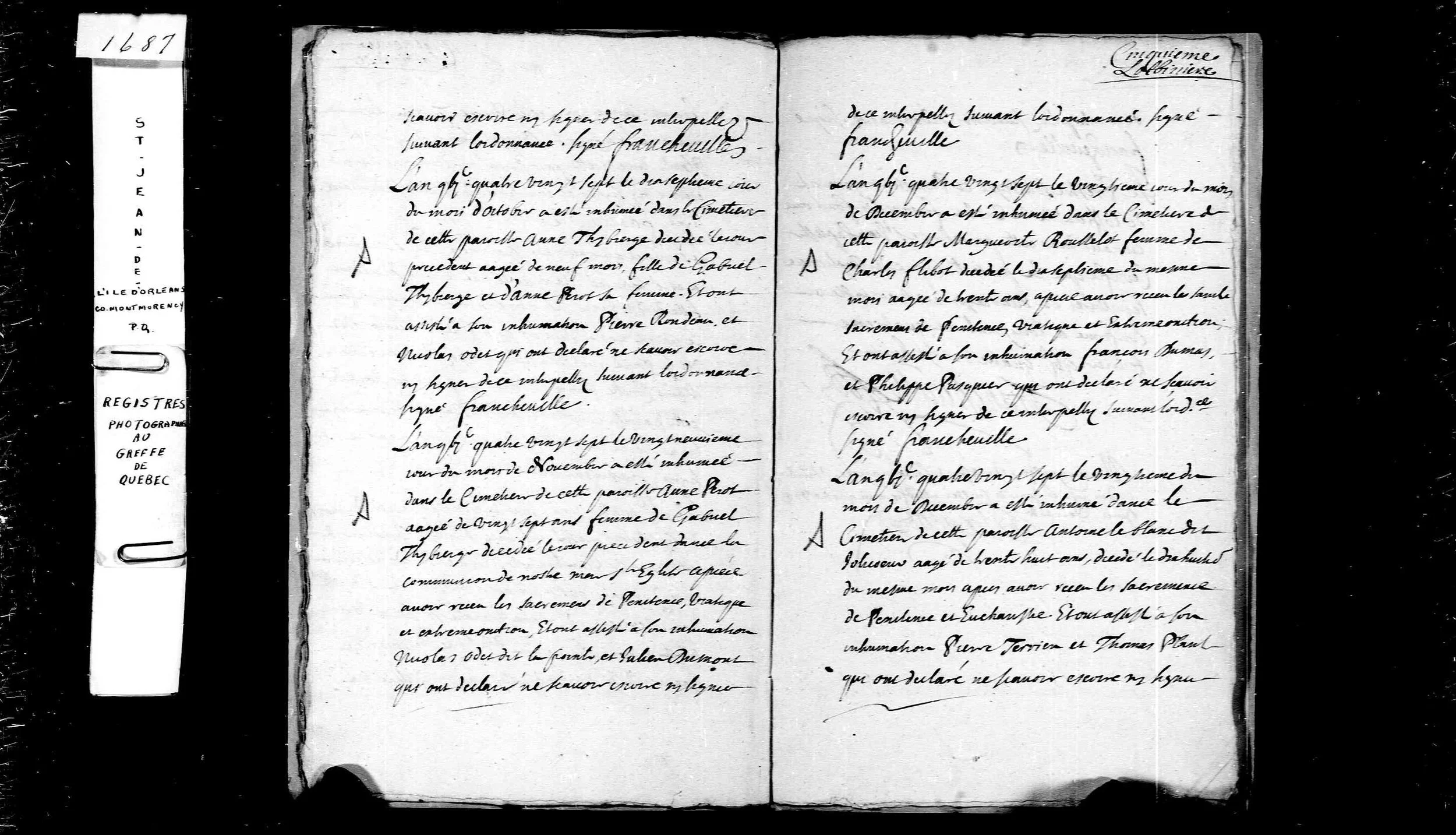
Registre paroissial, sépulture d'Antoine Leblanc dit Jolicoeur, 20 December 1687, Saint-Jean, Île d'Orléans. PRDH-IGD.
Thirty-eight. Among Carignan-Salières veterans, this was remarkably young to die. Pierre Morin dit Champagne, another soldier from the same regiment, lived to fifty-six. Most who survived the first brutal winters of settlement reached their fifties or sixties. Antoine Leblanc did not. The cause of his death is unrecorded—the seventeenth-century parish registers did not record diagnoses. He left behind a widow, Élisabeth Roy, who was approximately forty-seven, and three surviving children: Marguerite, eighteen; Joseph, fourteen; and Marie, four.
Élisabeth would marry again within four months. Charles Phlibot—sometimes written Fribault—became her third husband on 16 May 1688. She had been a Fille du Roi, a widow once before Antoine, and she would be a widow again. Three marriages to three men in New France. The colony consumed its people, and its women remarried quickly—out of necessity as much as custom. A farm could not run itself.
This is the story of a life that the documents tell in fragments. No diary survives. No letter. No portrait. What we know of Antoine Leblanc dit Jolicoeur comes from a confirmation record, a marriage register, census entries, notarial acts, baptisms, and burials—the bureaucratic skeleton of a colony that wrote its people into existence with remarkable thoroughness. To tell his story, we must begin in a place he left as a teenager and never saw again.
2. Noyon — A Cathedral Town in Picardy
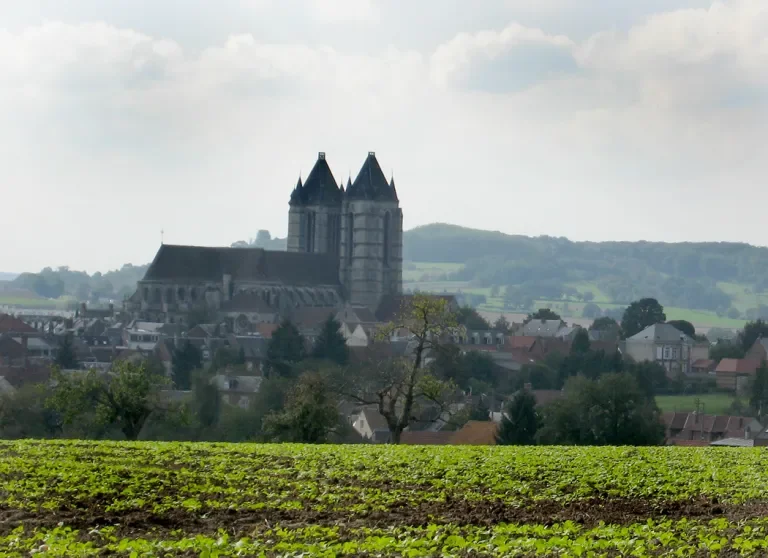
Cathédrale Notre-Dame de Noyon—an early masterpiece of Gothic architecture, built in the 12th century. This was the dominant structure of the town where Antoine Leblanc was born around 1649.
Antoine Leblanc was born around 1649 in Noyon, a small fortified city on the Oise River in Picardy, roughly eighty kilometers northeast of Paris. His parents were Martin Leblanc and Marie Flaniau. We know their names because their son, twenty-one years later and an ocean away, told a priest at Sainte-Famille who they were when he married Élisabeth Roy on 26 January 1670.
Noyon was an old city—far older than Paris in its ceremonial importance. Charlemagne had been crowned there in 768. Hugh Capet, founder of the royal dynasty, had been crowned there in 987. By Antoine's time those coronation days were eight centuries past, but the city still bore the weight of its history in stone. The Cathédrale Notre-Dame de Noyon, begun in 1145, was one of the earliest Gothic cathedrals in France—its four-towered silhouette visible for miles across the flat Picard farmland. It was also the birthplace of John Calvin, though the Reformation had been ruthlessly suppressed in the region, and by the 1640s Noyon was a firmly Catholic town under its bishop.
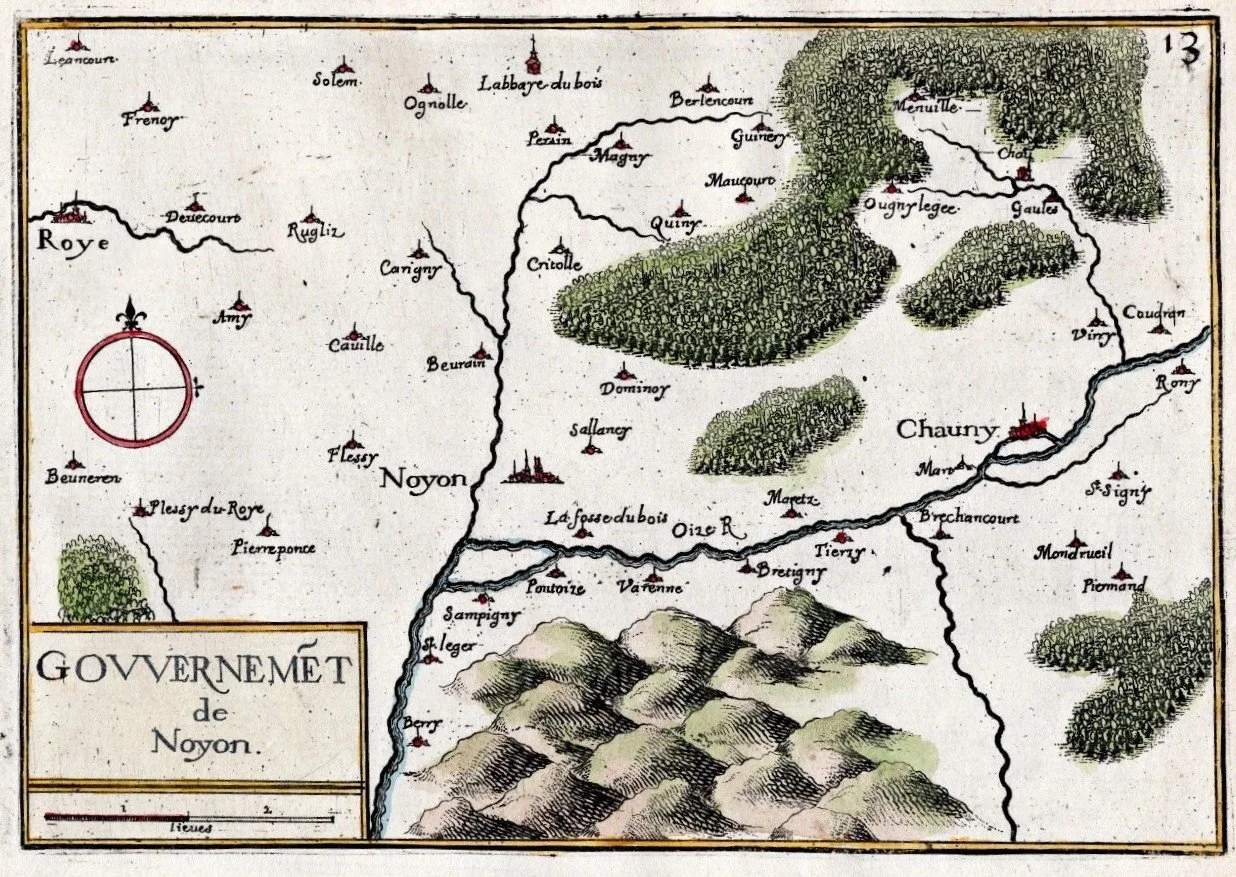
Nicolas Tassin, "Gouvernement de Noyon," copper plate map, 1634. Shows Noyon and surrounding Picardy region along the Oise River—the landscape where Antoine spent his childhood before enlisting.
The town Antoine knew was still recovering from the destruction of the previous century—heavily burned in 1557 during the Italian Wars—and was now a modest garrison town in a region frequently crossed by armies moving toward the Spanish Netherlands. Picardy was borderland, and the boys who grew up there grew up knowing soldiers. When the Carignan-Salières Regiment recruited men from across northern France in the early 1660s, a teenager from Noyon named Leblanc was among them.
No baptism record for Antoine has been found in the Noyon registers. The parish registers of the diocese have significant gaps from this period, and searches under variant spellings have not located his entry. What survives is the marriage register of 1670, which names his parents and his origin; the confirmation record of 24 August 1669, which gives his age as twenty; the 1681 census, which records him as thirty-two; and the burial register, which records him as thirty-eight at death. From these four documents, we calculate a birth year of approximately 1649—the same year that the Fronde civil wars convulsed France, and four years after the end of the Thirty Years' War.
Nothing is known of Martin Leblanc and Marie Flaniau beyond their names. No siblings of Antoine have been identified. Whether his parents were alive or dead when he left for New France is unrecorded. He left Noyon as a teenager and the town kept no trace of his departure. He would carry its name in colonial documents for the rest of his life.
3. The Regiment — Compagnie de Maximy, 1665
The Carignan-Salières Regiment was the first professional military force Louis XIV sent to defend New France. Formed in 1659, battle-tested against the Turks in Hungary, the regiment was redirected to the colonies in 1664 with a single mission: end the Haudenosaunee (Iroquois) raids that had nearly destroyed the colony. Antoine Leblanc, approximately fifteen or sixteen years old, was among its soldiers—assigned to the Compagnie de Maximy, commanded by Captain Abraham de Maximy.
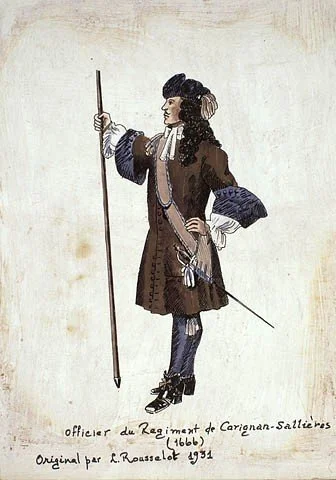
Officier du Régiment de Carignan-Salières (1666). Original by L. Rousselot, 1931. The brown justaucorps and blue cuffs were the regiment's distinctive colors.
The regiment departed La Rochelle in the spring of 1665 aboard several vessels. Antoine's company sailed on La Paix, a royal flûte of approximately 300 tonneaux—a broad-bellied transport ship designed to carry troops and supplies rather than to fight. She arrived at Québec on 19 August 1665, carrying the Maximy company along with Governor Courcelle and Intendant Talon. The voyage would have taken two to three months across the North Atlantic.
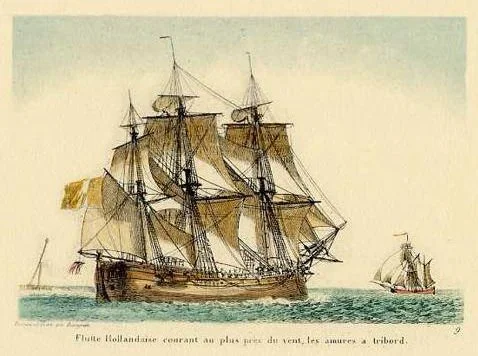
"Flutte Hollandaise courant au plus près du vent"—a period illustration of the type of vessel that carried Antoine and the Maximy Company across the Atlantic. La Paix was a royal flûte of approximately 300 tonneaux.
Approximately 1,200 soldiers and officers organized into 24 companies had been sent. Their first task was to build a chain of forts along the Richelieu River—the invasion corridor used by war parties coming north from present-day New York. Fort Richelieu at Sorel. Fort Chambly. Fort Sainte-Thérèse. Fort Saint-Jean. In January 1666, a disastrous winter campaign marched south into Mohawk territory and failed. In September 1666, a second campaign under Alexandre de Prouville de Tracy succeeded: villages were burned, crops were destroyed, and the peace that followed held for nearly two decades. That peace made settlement possible. It was the reason New France survived long enough to become a colony rather than remaining a fur-trading outpost.
After the campaigns, the Maximy company was stationed at Sainte-Famille on Île d'Orléans—the very place where Antoine would marry three years later. Captain Maximy himself returned to France in the autumn of 1668, but the company bearing his name continued to exist officially until at least 1671. The soldiers remained—some on land granted by their officers, some hiring out as laborers, all of them waiting for the opportunity the Crown had promised: land and a wife.
📋 The Passenger List
A compiled roster of the Compagnie de Maximy survives, listing officers (Captain Abraham de Maximy, Lieutenant Jean Lespinay de Bombardot, Enseigne Paul Dupuis) and soldiers including "Antoine Le Blanc" and "Dit Jolicoeur" as separate entries—reflecting the dual-identity system where a soldier's birth name and his military nickname were sometimes recorded separately. Cross-referencing with the 1668 Habitants List, which also shows both "Leblanc" and "Jolicoeur" on the same page of the Maximy roster, confirms these refer to one individual.
4. "Jolicoeur" — A Soldier's Name
Every soldier in the French army carried two names. The first was the name his parents gave him—in this case, Antoine Leblanc. The second was his nom de guerre, the military nickname assigned at enlistment or adopted by tradition within his company. Antoine's was Jolicoeur—literally "Pretty Heart" or "Cheerful Heart." It was a name that suggested good spirits, courage with a light touch, the kind of soldier who kept morale up on a long march.
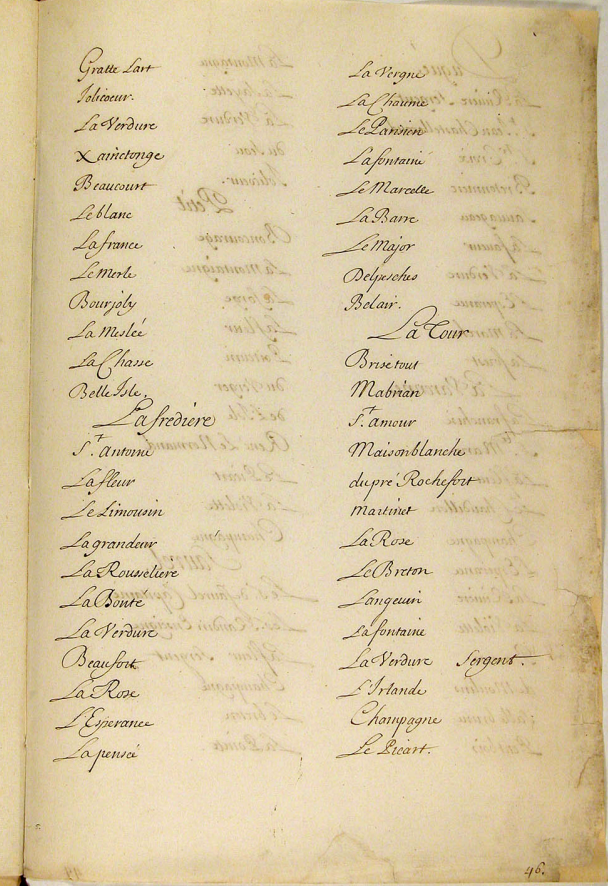
1668 Habitants List, Compagnie de Maximy, page 5. Both "Leblanc" and "Jolicoeur" appear on this page—the same individual listed twice under birth name and nom de guerre. ANOM, Série G¹, Vol. 460.
These military nicknames were everywhere in the Carignan-Salières Regiment. Other soldiers in the Maximy company carried names like Dampierre, Le Provençal, Gratte Lard (Fat Scraper), La Chasse, and Le Tambour (The Drum). The dit names often stuck after demobilization, becoming permanent family identifiers in the new colony. In Antoine's case, "Jolicoeur" followed him through every major document of his life: the marriage contract, the 1668 Habitants List, the notarial records, the Archives de Québec inventories. The 1687 concession from François Berthelot explicitly names him "Antoine Leblanc dit Jolicoeur."
The 1668 Habitants List demonstrates the system in action. On page 5 of the Maximy company roster, both "Leblanc" and "Jolicoeur" appear as separate entries. They are the same man—the compiler of the list evidently recorded both names without noting that they belonged to a single soldier. This is not uncommon in colonial records; the dual-name system regularly confused scribes who encountered the same individual under different names in different contexts.
In the generations that followed, the Leblanc name itself would fracture and evolve. Joseph's baptism in 1673 records his father as "Anthoine Le Blanc dit Joly Coeur"—the dit name fully spelled out. By the time of the descendants, many branches would carry "Leblanc" alone, while others preserved "Jolicoeur" as a surname in its own right. The soldier's nickname outlived him by centuries.
5. A Fille du Roi from Senlis — January 1670
Élisabeth Roy—also called Isabelle, also called Rachel in at least one notarial act—was born around 1640 or 1641 in Senlis, in the diocese of Senlis, Île-de-France. Her parents were Antoine Roy and Simone Gauthier. She came to New France as a Fille du Roi—one of the roughly 800 young women sent between 1663 and 1673 under royal sponsorship to marry the surplus of unmarried male settlers and soldiers.
She had already been married once before she met Antoine Leblanc. On 12 October 1665, she married Pierre Pallereau—a union that ended quickly, presumably with Pallereau's death, though the circumstances are unrecorded. By January 1670, she was a widow of approximately twenty-nine, available for remarriage, and living on Île d'Orléans where the demobilized soldiers of the Maximy company had settled.
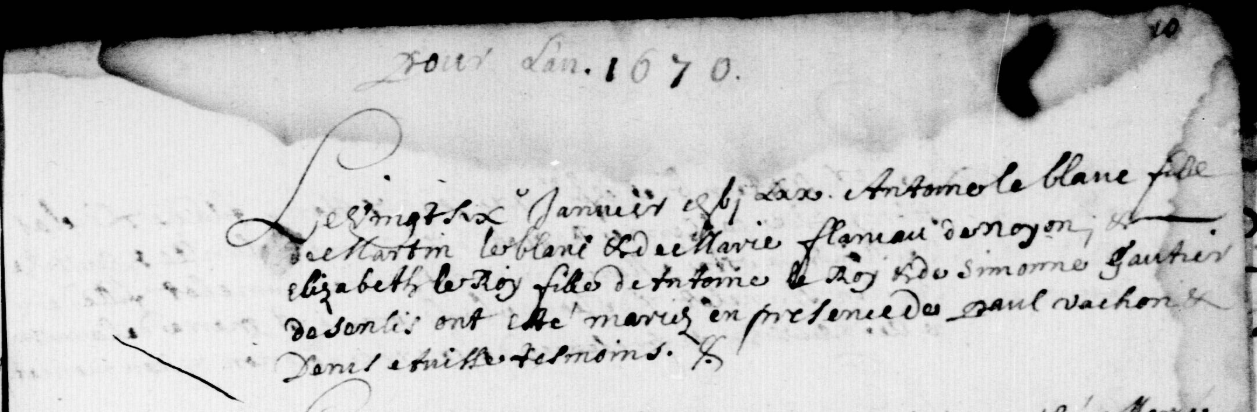
Detail from the marriage register, Sainte-Famille, Île d'Orléans, 26 January 1670. Parents identified: Martin Leblanc & Marie Flaniau (groom); Antoine Roy & Simonne Gauthier (bride). Witnesses: Paul Vachon, Denis Étuisse.
A marriage contract was drawn up on 20 January 1670 before the notary Paul Vachon. The contract appears in the Vachon répertoire as "Mariage Ant. Leblanc dit Jolicoeur et Isabelle Le Roy." Six days later, on 26 January 1670, the marriage ceremony took place at Sainte-Famille, the parish church of Île d'Orléans. The register names both sets of parents: Martin Leblanc & Marie Flaniau for the groom, Antoine Roy & Simonne Gauthier for the bride. The witnesses were Paul Vachon—the same notary who had drawn up the contract—and Denis Étuisse. The officiating priest was Père Thomas Morel.
The printed inventory from the Archives de Québec, compiled by Pierre-Georges Roy, records this marriage on page 29 of Volume II of the Inventaire des greffes des notaires du Régime français. But it is the handwritten répertoire of Paul Vachon that preserves the original entry in the notary's own hand—the marriage contract sitting among a sequence of declarations, testaments, quittances, and other concessions from January 1669 (Old Style, which corresponds to January 1670 in the New Style calendar adopted in France later).
Antoine was approximately twenty-one. Élisabeth was approximately twenty-nine—eight years his senior. The age difference was not unusual for Fille du Roi marriages, where women brought the dowry and the Crown's backing, and former soldiers brought the promise of land. What the marriage represented, for both of them, was economic partnership as much as companionship. The colony needed families. The Crown needed farms. Antoine and Élisabeth became both.
The name "Élisabeth" appears in the marriage register and the PRDH. The name "Isabelle" appears in the notarial records. The name "Rachel" appears in the 1671 sale of land. All three refer to the same woman—a common phenomenon in colonial French records where given names were often used interchangeably, particularly variants of the same root name.
6. Land on the Island — 1670–1671
Within six weeks of his marriage, Antoine had land. On 10 March 1670, Monseigneur de Laval—the first bishop of Québec, who also served as seigneur of much of Île d'Orléans—granted a concession to "Anthoine LeBlanc." The entry appears on page 32 of the printed inventory of notary Paul Vachon's records, sitting among a cluster of concessions issued on the same day to René Minaut, Pierre Mourier, Nicolas Delâge, and Nicolas Duret. The bishop was parceling out the island to the soldiers and settlers who would farm it.

Archives de Québec, Inventaire des greffes des notaires, Vol. II (Vachon), p. 32: "Concession de Mgr de Laval à Anthoine LeBlanc (10 mars 1670)." Among several concessions issued the same day.
But by November 1671—barely a year and a half later—Antoine and Élisabeth were selling. The full original document survives in the Bibliothèque et Archives nationales du Québec, in the Pouliot Family Fund. It is four pages of handwritten notarial text, and it is the most detailed document we have for Antoine's life on the island.
The sale names both parties in full: "Anthoine Leblanc dit Jolicoeur et Rachel le Roy sa femme"—using "Rachel" for Élisabeth, a variant that appears nowhere else in the record. The buyers were Guillaume Lemieux and his wife. The property was on the south side of Île d'Orléans, fronting on the fleuve Saint-Laurent. The price was 480 livres tournois—a substantial sum that suggests improved land with structures. The annual seigneurial dues were 3 livres tournois and 3 capons (castrated roosters), payable each year on November 11, the feast of Saint Martin.
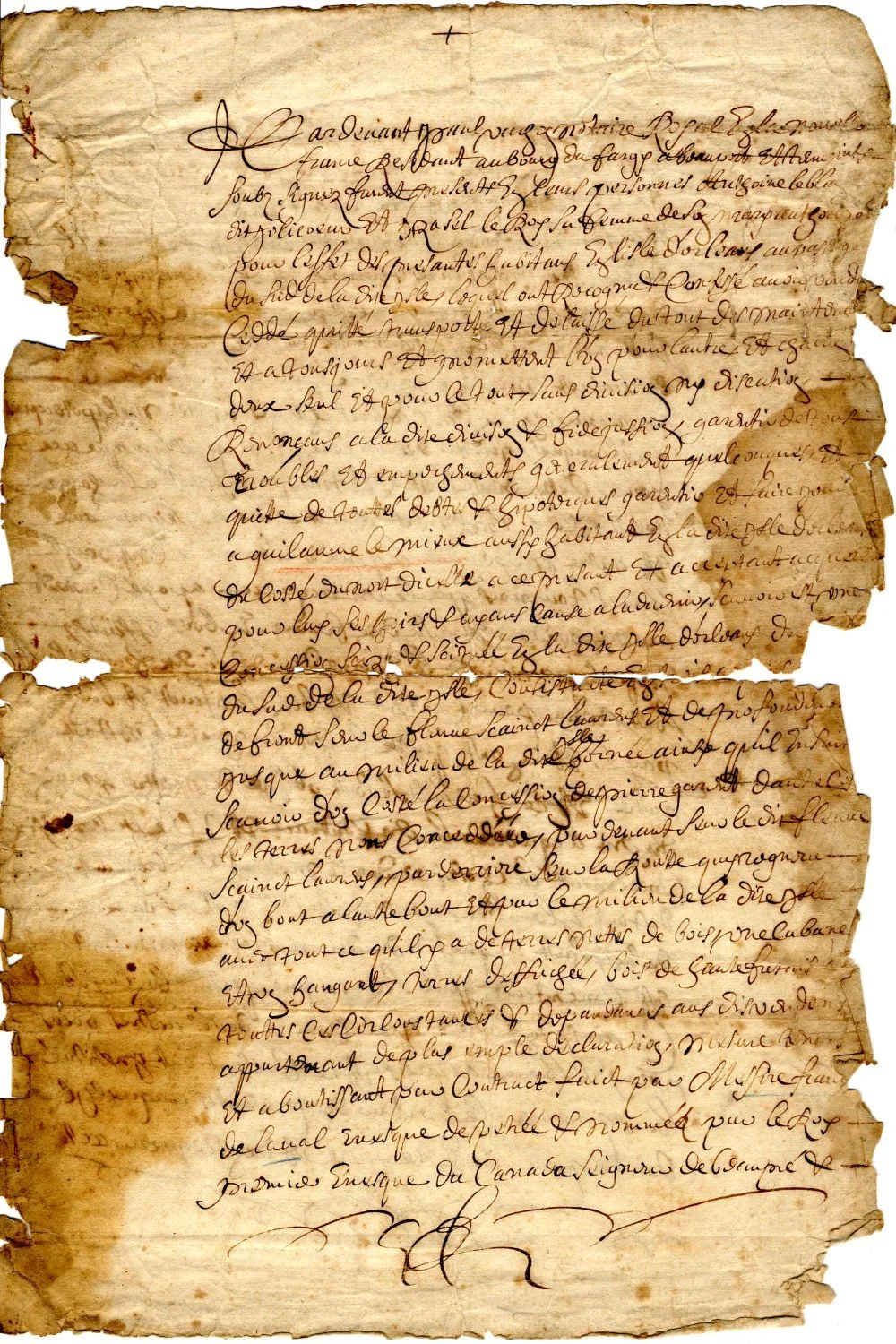
Page 1 of the 1671 sale of land: "Anthoine Leblanc dit Jolicoeur et Rachel le Roy sa femme" sell property on Île d'Orléans to Guillaume Lemieux. BAnQ, Fonds Famille Pouliot, P436, S999, P13.
Why did they sell? The document does not say. Perhaps they were consolidating—moving from one part of the island to another. Perhaps Antoine needed capital. Perhaps the original concession was not suitable for the farming he intended. What is clear is that he did not leave Île d'Orléans. The family remained on the island, and by 1681 the census records Antoine with 4 arpents under cultivation—a modest clearing, but steady work for a man with young children.
The sale document's third page preserves the closing signatures and witnesses: the notaire royal, Denis Guiffier (a sergeant), and Jean Cresteme, a habitant of Beauport. The document was drafted in the bourg du Fargy—the administrative center of the seigneurie—by a notaire royal whose ornate signature and paraph fill the bottom of page three. It is a complete legal transaction from 1671 New France, preserved across 353 years in the archival care of a single family's papers.
7. Five Children, Two Lost
Antoine and Élisabeth's life together can be measured in baptisms. Between 1671 and 1683, five children were born—each one recorded in the parish registers of Sainte-Famille or Saint-Jean on Île d'Orléans. The godparents at each baptism map the family's social world: neighbors, fellow settlers, the small community of families clearing land on an island in the St. Lawrence.

1681 Census, Comté de Saint-Laurent, Île d'Orléans: Antoine 32, Élizabeth 40, four children (Marguerite 10, Joseph 7, Pierre 6, Antoine 3), with 4 arpents cleared. LAC MIKAN 2318858.
| # | Name | Born | Died | Notes |
|---|---|---|---|---|
| 1 | Marie Marguerite | 2 Jul 1671 | 31 Jul 1723 | DIRECT ANCESTOR • m. Nicolas Sustier dit Tranchemontagne, 1691 |
| 2 | Joseph | 15 Aug 1673 | 28 Nov 1741 | m. Marie Flibotte (avant 1698) • 9 children • Continued on Île d'Orléans |
| 3 | Pierre | 23 Dec 1675 | 5 Jan 1682 (age 7) | Buried with his brother Antoine — "sépulture commune" |
| 4 | Antoine (son) | 25 Oct 1678 | 5 Jan 1682 (age 4) | Buried with his brother Pierre — same day, same grave |
| 5 | Marie | 19 Aug 1683 | 18 Mar 1750 | m. (1) Jean Bissonnet, 1709 • m. (2) Jean Baptiste Coulombe, 1716 |
The first child, Marie Marguerite, was baptized on 8 July 1671 at Sainte-Famille—our direct ancestor, who would marry Nicolas Sustier dit Tranchemontagne in 1691 and be buried at Notre-Dame-de-Montréal in 1723. Her godparents were Paul Vignaux and Marguerite Abraham, femme de Lavigne. Joseph followed in August 1673, with his baptism record preserving the most complete rendering of Antoine's full identity: "Joseph Le Blanc fils d'Anthoine Le Blanc dit Joly Coeur." Joseph would stay on Île d'Orléans his entire life, marrying Marie Flibotte and raising nine children at Saint-Jean.
Pierre was born on 23 December 1675, baptized six days later on the 29th. His godparents were Pierre Terrien and Marie Sel, femme de Nicolas Guillemet—the same Pierre Terrien who would witness Antoine's burial five years later. Antoine, named for his father, was born 25 October 1678 and baptized the 29th, with Gabriel Tibierge and Marguerite Foy as godparents. The youngest, Marie, was born 19 August 1683 and baptized three days later at Saint-Jean.
The 1681 census captures the family at its largest: Antoine, age 32; Élizabeth, age 40 (the census consistently records her as older than her husband); and four children—Marguerite 10, Joseph 7, Pierre 6, Antoine 3. Marie had not yet been born. The household had 4 arpents cleared—a small farm by island standards, but one that was sustaining a family of six.
Then came January 1682.
8. The Coldest Day — 5 January 1682
On the fifth of January, 1682, the curé F. Lamy recorded a burial in the register of Saint-Jean that is among the most poignant entries in the entire parish archive:
"les corps de feu Pierre et Antoine le Blanc frères fils d'Antoine le Blanc"

Detail from the joint burial register, Saint-Jean, 5 January 1682: "les corps de feu Pierre et Antoine le Blanc frères fils d'Antoine le Blanc." Pierre was 7, Antoine was 4. Witnesses: Pierre Rondeau, Nicolas Guillemet. Curé F. Lamy.
Two brothers, buried together on the same day. Pierre was seven years old. Antoine was four. The PRDH records their burials separately—#38953 for Pierre, #38954 for Antoine—but notes in each that it was a "sépulture commune," a shared burial. The witnesses were Pierre Rondeau and Nicolas Guillemet. The cause of death is unrecorded.
A shared burial of two children from the same family on the same day almost certainly means an acute illness—an epidemic, an infection, an accident. In January, on Île d'Orléans, the possibilities were many: smallpox, measles, dysentery, diphtheria, or any of the other diseases that swept through colonial settlements in waves. Whatever killed them killed them quickly—both boys lost within hours or days of each other, buried side by side in the frozen ground of Saint-Jean.
For Antoine and Élisabeth, the loss was staggering. Of the four children alive in the 1681 census, two were now dead. Marguerite, ten, and Joseph, eight, survived. The youngest, Marie, would not be born for another eighteen months—a child conceived in the aftermath of catastrophic loss, born into a family that had just buried half its children.
The joint burial register is one of the most important documents in this collection. It proves the family relationship, dates the deaths precisely, names the witnesses (Nicolas Guillemet's wife, Marie Sel, had been godmother to Pierre six years earlier—the community that baptized these boys also buried them), and reveals the terrible arithmetic of colonial childhood. Of Antoine's five children, two died before they turned eight. Three survived to marry and have children of their own. This was not unusual. It was the ordinary mathematics of seventeenth-century life.
9. The Last Concession — February 1687
Five years after burying his sons, Antoine received one final piece of land. On 15 February 1687, François Berthelot—who had held the seigneurie of Île d'Orléans since 1675 under the name Île et comté de Saint-Laurent—granted a concession to "Antoine Leblanc dit Jolicoeur." The entry appears on page 77 of Roy's inventory of Paul Vachon's notarial records.

Archives de Québec, Vol. II (Vachon), p. 77: "Concession de François Berthelot à Antoine Leblanc dit Jolicoeur (15 février 1687)." His last documented land transaction—ten months before his death.
This was Antoine's last documented land transaction. Ten months later, he was dead.
What happened in those final months is undocumented. He may have been clearing the new concession, building on it, preparing it for cultivation. He had three surviving children: Marguerite was now sixteen, Joseph thirteen, and Marie three. The family was rebuilding after the losses of 1682. The new land from Berthelot suggests forward planning—a man thinking about the future, about providing for a growing family on a growing island.
But the future was shorter than he knew. On 18 December 1687, Antoine Leblanc dit Jolicoeur died at Saint-Jean, Île d'Orléans. He was thirty-eight years old. The burial register, with its precise notation of his age, his dit name, and the names of the witnesses, is the last document to bear his name in life.
10. After Antoine — Élisabeth's Third Marriage
Élisabeth Roy buried her second husband in December 1687 and married her third within five months. On 16 May 1688, she wed Charles Phlibot (also written Fribault) at Saint-Jean. The speed of the remarriage was not callousness—it was colonial pragmatism. A woman with three children and a farm could not survive long without a partner. The seigneurial system demanded that land be worked; an unworked concession could be reclaimed. Élisabeth was approximately forty-seven years old, and she chose survival.
When Marie Marguerite Leblanc married Nicolas Sustier dit Tranchemontagne on 30 April 1691, the PRDH marriage record notes that her father Antoine was "deceased" and that her "stepfather Charles Phlibot" was present. This is one of the small human details the records preserve: Élisabeth's third husband stood in for the dead father at the daughter's wedding. The colonial family was a layered thing—multiple marriages, blended households, stepfathers standing witness for stepdaughters.
Élisabeth Roy's three marriages made her an ancestor many times over. Through her first husband Pierre Pallereau, through Antoine Leblanc, and through Charles Phlibot, her descendants spread across the colony. The FrancoGene database estimates that through her father Antoine Roy's line alone, she contributed to between 770,000 and 1,190,000 living descendants—a number that makes her one of the most prolific ancestors in French-Canadian genealogy.
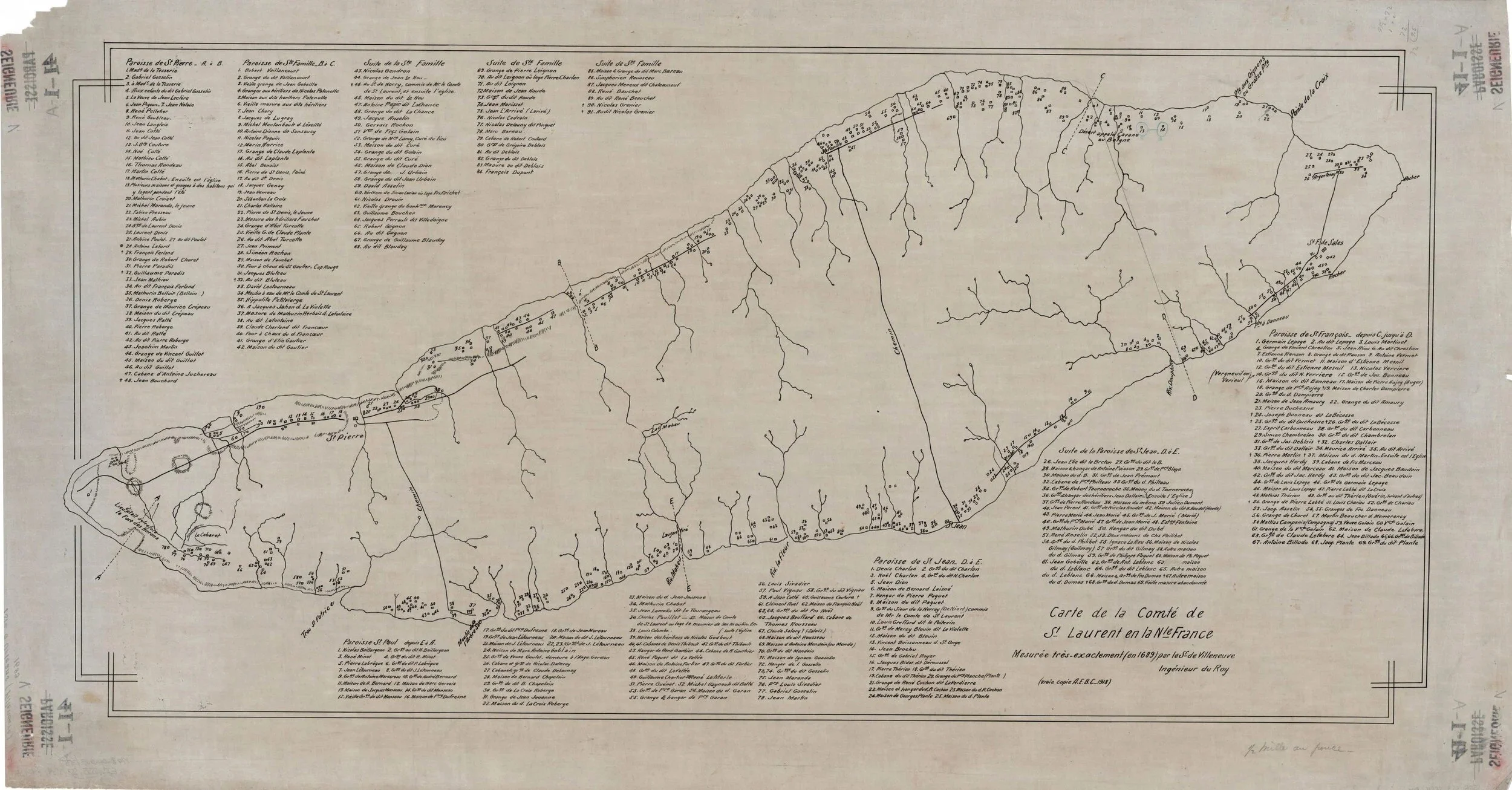
Carte de la Comté de St Laurent en la Nouvelle France, measured precisely in 1689 by the Sieur de Villeneuve, Ingénieur du Roy. This map, created just two years after Antoine's death, names 347 landowners on Île d'Orléans—the community he helped build. BAnQ.
Through Antoine Leblanc specifically, the FrancoGene database estimates 350,000 to 770,000 living Québécois descendants. His predicted Y-DNA haplogroup, by male descent, is R1b-M269—the most common haplogroup in western Europe, carried from Noyon across the Atlantic and into the genetic fabric of a nation that did not yet exist when he stepped off La Paix in August 1665.
11. How This Biography Was Built
This documentary biography rests on 63 primary source images and archival references spanning 1634 to 1741, assembled through a systematic research project documented in the accompanying catalog. The evidence base includes parish registers (baptisms, marriages, burials), census records, notarial acts (concessions, sales), military rosters, confirmation records, and compiled genealogical databases from PRDH-IGD, FrancoGene, FamilySearch, Library and Archives Canada, and Bibliothèque et Archives nationales du Québec.
The 1671 sale of land document—four original manuscript pages preserved in the BAnQ Pouliot Family Fund—is the most substantial single document in the collection, providing Antoine's full name with dit name, his wife's variant given name ("Rachel"), the land description, sale price, and seigneurial obligations. Its survival in a private family's papers, rather than in institutional archives, is a reminder that genealogical evidence often resides in unexpected places.
All citations follow Evidence Explained: Citing History Sources from Artifacts to Cyberspace, 3rd edition, by Elizabeth Shown Mills, using the templates for Church Records (§7.1–7.8), National Government Records (§6.1–6.18), Online Databases (§12.26), and Published Abstracts (§10.42).
What remains unfound: Antoine's baptism at Noyon (registers have gaps; searched, not found); the original marriage contract document (only the répertoire index entry survives in our collection); the engagement act linking "Antoine Leblanc" to François du Masts in 1674 (identity uncertain—common name); and the register baptism page for Marie Leblanc (1683, Saint-Jean). These absences are documented as negative findings rather than gaps in research.
Research and narrative by Mary Hamall Morales, Storyline Genealogy. Primary sources accessed through BAnQ, PRDH-IGD (Université de Montréal), FamilySearch, Library and Archives Canada, and FrancoGene. Source citations follow Evidence Explained, 3rd ed. (Mills, 2015). Full catalog of 63 documents with Evidence Explained citations available in the research file.
Complete Research File
This documentary biography presents a curated selection of evidence from a comprehensive inventory of 63 cataloged documents. The full research file encompasses parish registers, notarial acts, census records, military rosters, and compiled databases. Each entry in the complete catalog is supported by a full Evidence Explained citation, meeting the documentation standards of the Board for Certification of Genealogists (BCG).
Access the Complete Research File → (password protected)
Key Dates
Sources & Citations
Primary Sources
- Confirmation (1669): Antoine Leblanc, age 20, 24 August 1669. Confirmation register, PRDH-IGD.
- Marriage Contract (1670): Notary Paul Vachon, 20 January 1669 [O.S.]. Répertoire entry; printed: Roy, Inventaire, Vol. II (Vachon), pp. 29, 32.
- Marriage Register (1670): Sainte-Famille, Île d'Orléans, 26 January 1670. Witnesses: Paul Vachon, Denis Étuisse. Officiant: Père Thomas Morel.
- Land Concession (1670): Mgr de Laval to Anthoine LeBlanc, 10 March 1670. Notary Paul Vachon. Roy, Inventaire, Vol. II, p. 32.
- Sale of Land (1671): Antoine Leblanc dit Jolicoeur & Rachel le Roy to Guillaume Lemieux, 13 November 1671. BAnQ, Fonds Famille Pouliot, P436, S999, P13. Ark: collections.banq.qc.ca/ark:/52327/3269793.
- Census (1681): Recensement du Canada, Comté de Saint-Laurent. LAC, MIKAN 2318858, MG1-G1, vol. 460/1 & 460/3, image 325.
- Joint Burial (1682): Pierre and Antoine Leblanc, 5 January 1682, Saint-Jean. Curé F. Lamy. Witnesses: Pierre Rondeau, Nicolas Guillemet.
- Concession Berthelot (1687): François Berthelot to Antoine Leblanc dit Jolicoeur, 15 February 1687. Notary Paul Vachon. Roy, Inventaire, Vol. II, p. 77.
- Burial Register (1687): Antoine Leblanc dit Jolicoeur, 20 December 1687, Saint-Jean. Age 38. Witnesses: Pierre Terrien, Thomas Plante. Curé Francheville.
- Children's Baptisms (1671–1683): Sainte-Famille and Saint-Jean, Île d'Orléans. PRDH #31177, 31325, 31459, 31637, 38097.
- Military Roster (1665–1668): Compagnie de Maximy passenger list; 1668 Habitants List, pages 4–5. ANOM, Série G¹, Vol. 460.
Secondary Sources
- Roy, Pierre-Georges. Inventaire des greffes des notaires du Régime français. Québec: R. Lefebvre, 1942–1976. Vol. II (Paul Vachon), pp. 29, 32, 77; Vol. II (Pierre Duquet), p. 154.
- Beauregard, Denis. "Genealogy of the French in North America." Entries [1548] (Antoine Leblanc) and [4275] (Antoine Roy). © 2005–2021.
- PRDH-IGD. Individual, Family, Baptism, Marriage, Burial records. Université de Montréal (prdh-igd.com).
- Mills, Elizabeth Shown. Evidence Explained: Citing History Sources from Artifacts to Cyberspace. 3rd ed. Baltimore: Genealogical Publishing Co., 2015.
Are You Connected to the Souliere Line?
If you descend from the Souliere, Suliere, or Soulier (dit Tranchemontagne) family of L’Assomption and St-André-d’Argenteuil, from the nineteen children of Janvier Souliere Sr., or from the allied Gravel, Poulin, Migneron, Lacasse, or Lesage lines — whether your branch stayed in Quebec or came to Chicago — I’d like to compare notes. Documented trees, DNA matches, family papers, and even half-remembered stories have all moved this research forward.
Get in Touch About This FamilyCousin connections are informal and reciprocal — no fee, no obligation, just shared work on shared ancestry.
Every Family Has a Story Worth Telling
Whether you're just beginning your research or ready to transform years of work into a narrative your family will treasure, I'd love to hear your story.
BEGIN YOUR RESEARCH INQUIRY