
The Lieutenant and the Voyageurs
The Lieutenant and the Voyageurs
Lieutenant John Franklin needed men. He had walked 857 miles on snowshoes to reach Fort Chipewyan, and now he needed French-Canadian voyageurs willing to paddle him north toward the edge of the known world. Some agreed. Some refused. Three were paid off and discharged before the party went north, and Franklin never wrote down their names. One line in a company ledger may be all that survives of one of them.
In the spring of 1820, two worlds that rarely meet in the historical record occupied the same wooden post on the shore of Lake Athabasca. One was the Royal Navy’s — disciplined, hierarchical, obsessed with longitude and magnetic variation, convinced that finding the Northwest Passage was a matter of national honour. The other was the pays d’en haut: the vast interior of the continent, governed by the North West Company, paddle and portage and pemmican, French-Canadian men who had been working these rivers for generations.
Franklin needed the second world. And the second world, it turned out, was not entirely willing to be needed.
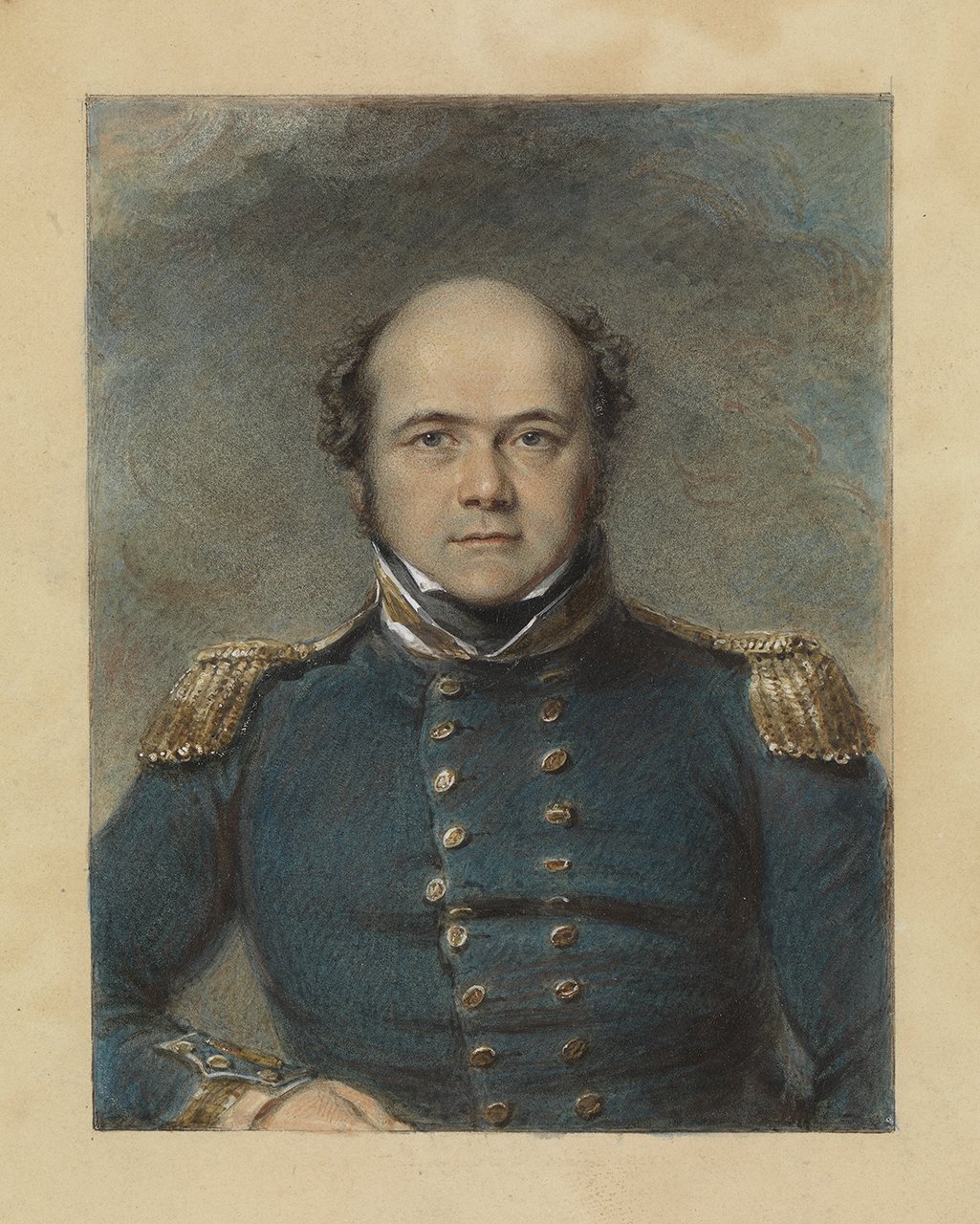
Captain Sir John Franklin (1786–1847). Watercolour drawn from life by William Derby, produced for an engraving published by Fisher in 1830. He wears the 1827 captain’s uniform. National Maritime Museum, Greenwich.
The Man Who Walked 857 Miles to Find Them
John Franklin was a Royal Navy officer who had survived the Battle of Trafalgar, the burning of Washington, and an Arctic winter before anyone had heard of him. The Admiralty assigned him to the great project of his era: finding the Northwest Passage, the sea route through the Arctic archipelago that cartographers had been trying to locate for three centuries.
His 1819–1822 overland expedition to the Polar Sea was his first attempt. He would leave England by ship, travel west across Canada by canoe and snowshoe, then press north overland to the Arctic coast, mapping as he went. To do any of it he needed voyageurs. Which meant he needed the North West Company.
He set out from Cumberland House on 18 January 1820 on snowshoes, with his officer George Back and the seaman John Hepburn. By 26 March, after sixty-eight days and 857 miles, he reached Fort Chipewyan. Then he waited — and recruited — for the better part of four months.
The Winter Journey
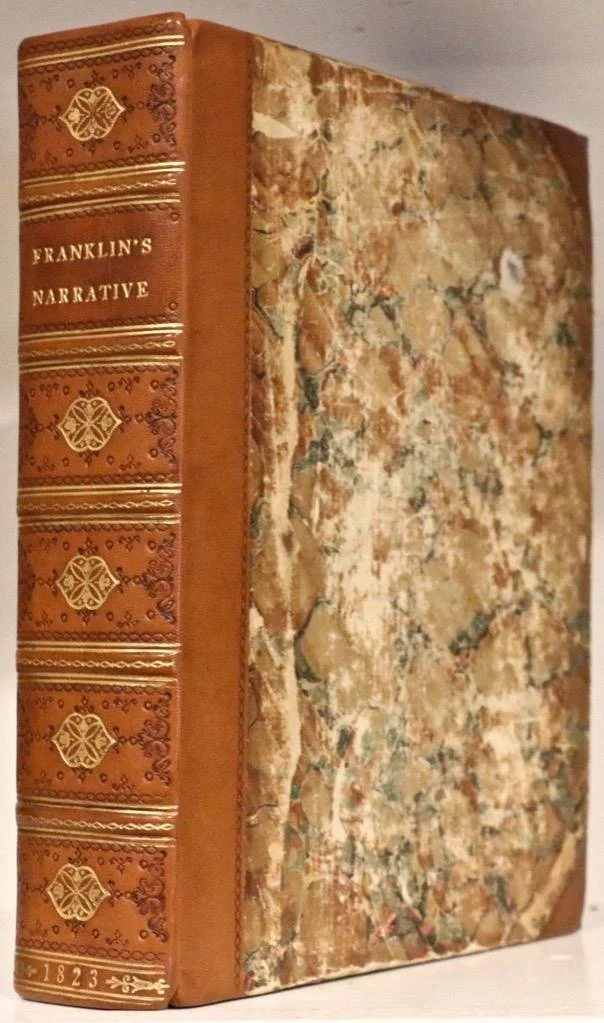
18 January – 26 March 1820 · What Franklin recorded along the wayFranklin published his account in 1823 — Narrative of a Journey to the Shores of the Polar Sea, in the Years 1819, 20, 21, and 22 — and it became an immediate bestseller. It is now in the public domain, and Chapter IV deserves to be read in full by anyone with a French-Canadian ancestor in the fur trade. Franklin was a careful, literate observer, and he was watching a world that was already changing around him.
He describes the voyageurs from the first day on the trail. Even loading the sledges at Cumberland House produced what became a recurring dynamic:
We did not set out without considerable grumbling from the voyagers of both Companies respecting the overlading of their dogs. However we left the matter to be settled by our friends at the fort who were more conversant with winter travelling than ourselves.
The grumbling is not a detail Franklin lingers on — he notes it, attributes it to experience, and moves on. But the dynamic it captures is real. These were professional men with their own expertise, their own standards, and their own sense of what they owed a Royal Navy officer who had just arrived in their country. They negotiated. They complained. They consulted their own judgment. A lieutenant’s rank meant nothing on the Athabasca.
What He Found in the Pays d’en Haut
Franklin’s portrait of the voyageur world — written from observationChapter IV is the richest source Franklin left us for the daily reality of fur trade travel. His officer Robert Hood kept a journal of extraordinary detail, and Franklin quotes it at length — including this methodical description of the snowshoe, a technology Europeans had been unable to improve upon:
A snowshoe is made of two light bars of wood fastened together at their extremities and projected into curves by transverse bars. The side bars have been so shaped by a frame and dried before a fire that the front part of the shoe turns up like the prow of a boat and the part behind terminates in an acute angle; the spaces between the bars are filled up with a fine netting of leathern thongs except that part behind the main bar which is occupied by the feet… All the superiority of European art has been unable to improve the native contrivance of this useful machine.
And of the voyageurs themselves, Franklin’s portrait is specific and observed. Despite the tension — and there was genuine tension throughout the journey — he developed real appreciation for the men who hauled his equipment through the sub-Arctic. The evening camp scene he describes is one of the most vivid portraits of voyageur life in the historical record:
There are other inconveniences which, though keenly felt during the day’s journey, are speedily forgotten when stretched out in the encampment before a large fire, you enjoy the social mirth of your companions who usually pass the evening in recounting their former feats in travelling. At this time the Canadians are always cheerful and merry and the only bar to their comfort arises from the frequent interruption occasioned by the dogs who are constantly prowling about the circle and snatching at every kind of food that happens to be within their reach. These useful animals are a comfort to them afterwards by the warmth they impart when lying down by their side or feet as they usually do.
Cheerful and merry in the evening, after eighteen miles through hip-deep snow. Recounting former feats of travel. Dogs sleeping at their feet. This is not romantic invention — it is a specific, observed scene, and it is precisely the world French-Canadian voyageur ancestors occupied.
While Franklin was at Fort Chipewyan recruiting in the spring of 1820, George Simpson — the man who would soon run the entire merged Hudson’s Bay Company empire — was in the same Athabasca department writing his own journal. The introduction to that journal, written a century later by the economic historian H.A. Innis, captured what made the French-Canadian voyageur essential in a single observation: nothing but their woodcraft and almost incredible hardihood could have survived the ordeal of the canoe routes.
The ordeal was specific and documented. From Montreal up the Ottawa and Mattawa, over the height of land to Lake Nipissing, down the French River to Georgian Bay, past Sault Ste. Marie and along the north shore of Lake Superior to Fort William — then by canot du Nord through Lake of the Woods, Rainy River and Rainy Lake, over the height of land again, and northwest to the Athabasca. No fewer than 60 large lakes, 130 portages and 200 smaller décharges between Ste-Anne on the Ottawa and the Athabasca country. A single voyage, every season, for the men who worked it.
Innis identified Rainy Lake — Lac La Pluie — as the depot for the season’s furs from the Athabasca: the strategic pivot of the whole northern operation, and the place where the men and the packs changed hands.
Source: George Simpson, Journal of Occurrences in the Athabasca Department, 1820 and 1821, ed. E. E. Rich, intro. H. A. Innis (Toronto: The Champlain Society, 1938). Archive.org.
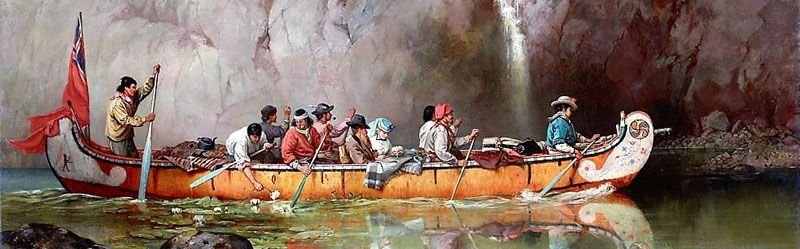
Frances Anne Hopkins, Voyageurs, 1869. Hopkins travelled the canoe routes herself and painted what she witnessed. The men Franklin needed — and eventually recruited — worked in brigades like this one, season after season, across thousands of miles of waterway. Library and Archives Canada.
Fort Chipewyan, March 1820
The capital of the northern fur trade — and the problem Franklin found thereFranklin arrived on 26 March 1820, after a journey he described with characteristic understatement:
At four P.M. we had the pleasure of arriving at Fort Chipewyan and of being received by Messrs. Keith and Black, the partners of the North-West Company in charge, in the most kind and hospitable manner. Thus terminated a winter’s journey of eight hundred and fifty-seven miles, in the progress of which there was a great intermixture of agreeable and disagreeable circumstances. Could the amount of each be balanced I suspect the latter would much preponderate; and amongst these the initiation into walking in snowshoes must be considered as prominent. The suffering it occasions can be but faintly imagined by a person who thinks upon the inconvenience of marching with a weight of between two and three pounds constantly attached to galled feet and swelled ankles. Perseverance and practice only will enable the novice to surmount this pain.
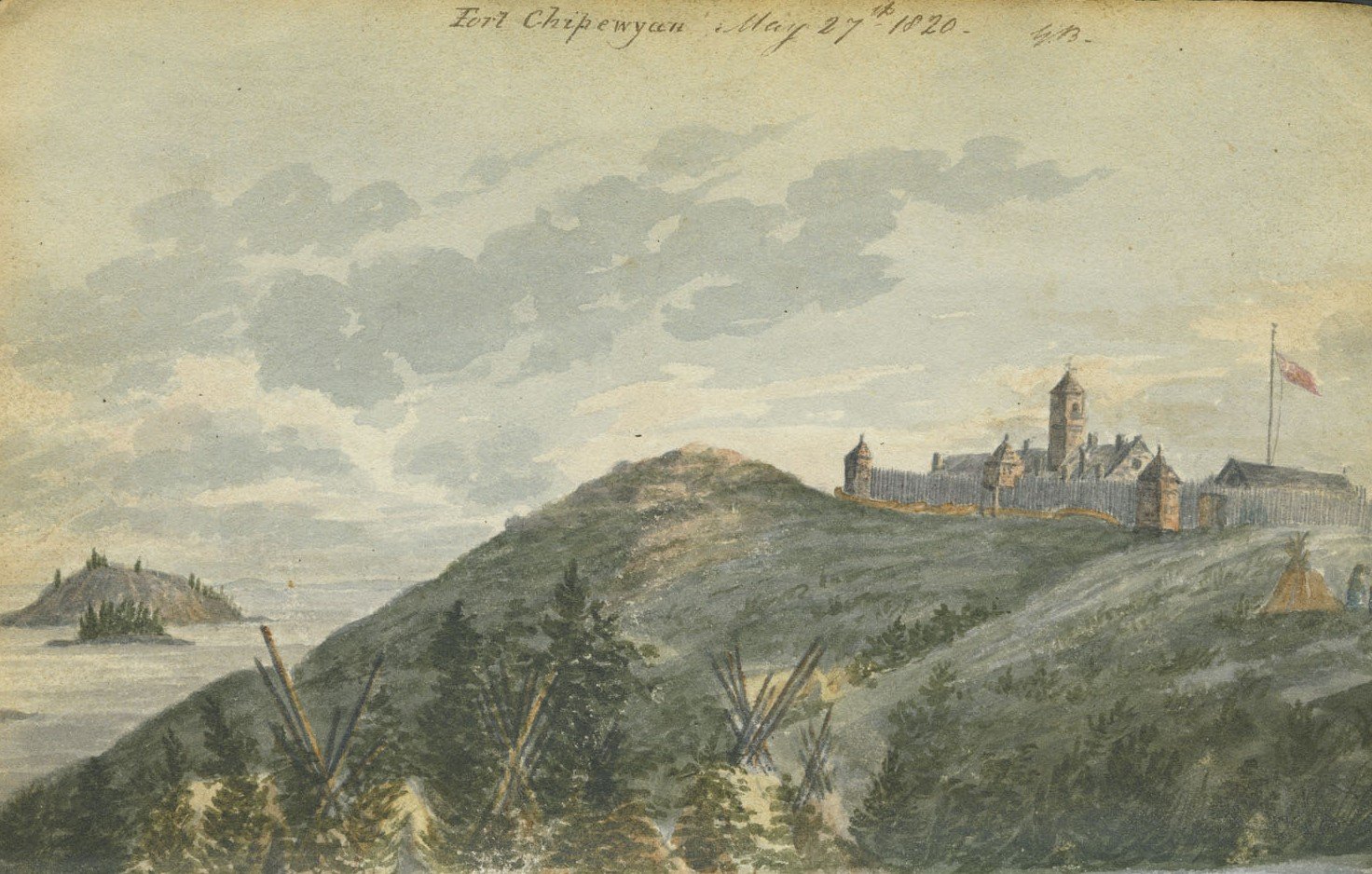
Fort Chipewyan, 27 May 1820 — sketched by George Back, who travelled with Franklin. The North West Company post stands on its rocky promontory above Lake Athabasca; Dene tipis are visible in the foreground. Franklin was present when Back made this sketch, still waiting for his full complement of voyageurs. Library and Archives Canada.
Fort Chipewyan was not a remote outpost. It was the capital of the Athabasca fur trade, established in 1788 and operating for over thirty years by the time Franklin arrived — a substantial compound of storehouses, living quarters and the partners’ mess, with a resident population of Métis and Dene families and a steady traffic of hunters and voyageurs moving between the Athabasca, the Peace and the Mackenzie river systems.
Franklin had arrived early; the open-water season was still months away, and he began pressing both companies for men at once. What he heard was not encouraging. The North West Company partner John Stuart had already warned him at Pierre au Calumet that experienced men would be backward in offering their services. The reason was specific and well known. A previous North West Company expedition under Mr. Livingstone, sent to open trade with the Inuit near the mouth of the Mackenzie, had been attacked and its crew destroyed. Every voyageur in the Athabasca district knew the story.
Franklin was asking men to paddle north of Great Slave Lake, down the Coppermine River, and along an unmapped Arctic coastline toward country where another party had recently been killed. These were professional watermen, not adventurers. They understood the risk precisely — better than Franklin did.
What changed the calculation was money, pressure from the companies, and eventually the particular courage of individual men. Franklin assembled his full complement in the end. It took from 26 March to early July.
The Recruitment
How Franklin got his men — and who didn’t go northChapter IV documents the recruitment in granular detail. Franklin kept notes on every conversation, every arrangement, every refusal. The key passage comes from pages 148–149 of the first edition, describing a joint meeting on 25 May with the partners of both companies:
Several of them seemed now disposed to volunteer; indeed, on the same evening, two men from the North-West Company offered themselves and were accepted.
That sentence matters for the documentary record. It establishes the date, the company, and the mechanism: men came forward voluntarily, and Franklin paid through the company books. Wages and short-term payments were recorded as credits in the individual men’s North West Company accounts — not in the published Narrative, which names only the core voyageurs who travelled all the way to the Arctic coast.
By early July the final complement was assembled. Then came the discharge. Page 166 closes the chapter and opens a research question:
…by discharging those men who were less willing to undertake the journey; of these three were Englishmen, one American, and three Canadians.
Three Canadians. Engaged at Fort Chipewyan, outfitted, paid off and released before the expedition turned north toward Great Slave Lake. The sixteen who went are named in the roster Franklin published. The three who were discharged are not. They were paid and they went back to their lives in the Athabasca district, and Franklin never recorded who they were.
A Hundred Livres in a Ledger
Where the Narrative and the account books touch — and stopThe Hudson’s Bay Company Archives in Winnipeg hold the surviving account books of the North West Company: thousands of individual accounts for the more than 3,700 men the company employed between 1795 and 1821. A search of the name index under the Guilbault surname cluster returns seven entries on guilb and six more on gib that the first search misses entirely.
Two of those accounts belong to two different men, both called Paul, both in the Athabasca department in the same season. And on one of them, in the general blotter for 1820–21, sits an entry that ordinary company business does not explain:
By Lieut Franklin — 100
The mechanism is exactly right. Franklin requisitioned men through the companies and settled what he owed against their accounts rather than in cash. A credit reading By Lieut Franklin is precisely what that practice produces. And a man engaged in June, outfitted in goods, then discharged in July would leave one trace and no name on the roster — one hundred livres, and nothing else.
It fits. It does not identify anybody.
Why This Cannot Be Assigned
The credit sits on the account of a man the company’s clerks wrote as Paul Gibeau — and also as Gibeault, and as Gebeault. He carries a wage of 500 livres and settles at 617 livres 14 sols. He has ten consecutive years of wages in the general ledger and two signed engagements to his name, and not one of those documents records a parish, a parentage or an age. He has never been identified.
But the account whose charges actually trace Franklin’s own corridor belongs to somebody else. Transferred in from Fort William, then purchases at Fort Chipewyan, then at Slave Lake, then tobacco and sundries at Fort Providence — in that order, in that season, ending at the post where the Copper Indian guides were to meet the expedition. That is the second Paul, who runs at 350 livres throughout, and who is probably the man later documented in the Pacific Northwest.
One man has the credit. The other has the itinerary. Fort Providence was an ordinary company post as well as the expedition’s rendezvous, and any servant might be charged for tobacco there. The duller reading is the safer one, and nothing yet forces the other.
Who Was Paul Gibeau? — the full case study →
The Voyageur Years: Which Gabriel Guilbault? — the parallel problem in the same family →
The Evidentiary Chain — What Each Source Establishes
| What it shows | Source | Status |
|---|---|---|
| Franklin at Fort Chipewyan, 26 March to approximately 10 July 1820 | Franklin, Narrative, Chapter IV, pp. 142–166 | Confirmed |
| Formal requisition of Canadian voyageurs from both companies, 25 May 1820 | Franklin, Narrative, pp. 148–149 | Confirmed |
| Franklin paid engaged men in goods, on company account | Franklin, Narrative, pp. 165–166 | Confirmed |
| Three Canadians discharged and paid before the party went north; none named | Franklin, Narrative, p. 166 | Confirmed |
| A 100-livre credit reading “By Lieut Franklin” on a North West Company account | HBCA F.4/37, Athabasca general blotter, the account at 500 livres | Confirmed |
| The Fort William – Chipewyan – Slave Lake – Fort Providence charge sequence | HBCA F.4/37, the account at 350 livres | Confirmed |
| Which man the credit belongs to | The credit and the itinerary sit on different accounts | Unresolved |
| Who the man carrying the credit was | No company document names a parish, parentage or age | Unidentified |
| A named payment in the Admiralty financial records | ADM 1/2414, The National Archives; SPRI MS 248, Cambridge | Not yet examined |
What this post used to say
An earlier version identified the man carrying the Franklin credit as Paul Guilbault père of St-Paul-de-Lavaltrie, and followed him home to a life annuity in 1827 and a burial register in 1831. That identification is withdrawn. Three Quebec documents place Paul Guilbault père at home inside the years the account books pay this man, and Athabasca is a wintering department.
Two further claims went with it. This post read the appearance of a Gabriel and a Paul two entries apart in the Lac La Pluie index as evidence that both were working at that post together. Proximity in an alphabetically ordered index is not evidence of anything, and that argument is withdrawn. And the ledger account attributed here to Gabriel Guilbault has since been detached from him as well — the parish registers place Gabriel père in Lower Canada during its wage years.
None of the Franklin history required correction. The Narrative is quoted as published, the dates and page references are unchanged, and the mechanism by which a credit of this kind arises is exactly as it was described. What changed is only the claim about whose account it landed on.
The Asymmetry Worth Sitting With
Franklin wrote a book. It went through multiple editions, made him famous, and preserved in careful prose the snowshoes, the encampments, the dogs at the men’s feet and the reluctance of professionals asked to do something foolish.
The men he hired left figures. A wage, a balance, a hundred livres credited on an afternoon in 1820 — and a surname a clerk spelled three different ways because he was writing down a sound. One of those men can be followed across two centuries. The others cannot be named at all, and the record that would name them was never made.
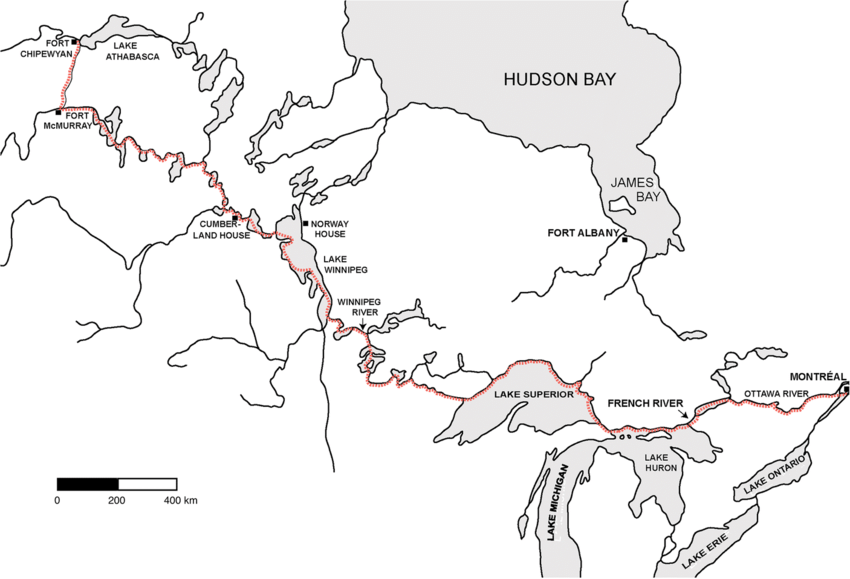
The voyageurs’ highway: the dotted line marks the canoe route from Montreal through the Great Lakes, across Lake Winnipeg and northwest to Fort Chipewyan on Lake Athabasca — over 3,000 miles that the fur trade brigades travelled every year. Franklin covered the final segment on snowshoes in the winter of 1819–1820.
What Happened Next
The lieutenant, and the men who did not go with himFranklin survived the 1819–1822 expedition, just. The return journey in the autumn of 1821 became a catastrophe of starvation and violence; eleven men died. He returned to England, wrote his Narrative, and became famous. He went back to the Arctic in 1825–27 for a second, more successful overland expedition. Then, in 1845, at fifty-nine, he sailed again in command of HMS Erebus and HMS Terror, on what was intended to be the final, triumphant transit of the Northwest Passage.
Both ships became icebound in Victoria Strait in September 1846. Franklin died on 11 June 1847. The remaining 105 men abandoned the ships and walked south. None survived.
HMS Erebus was found by Parks Canada in September 2014 in the shallow waters of Queen Maud Gulf. HMS Terror was discovered in Terror Bay in 2016, remarkably well preserved on the sea floor. Both discoveries were guided in significant part by Inuit oral tradition — knowledge that had held the ships’ approximate positions for a hundred and seventy years. Excavations continue.
The three Canadians discharged at Fort Chipewyan in July 1820 never saw the Coppermine River or the Polar Sea. They took their pay and went back to the Athabasca. Their names are not in the Narrative, and no company document has yet been found that supplies one.
Franklin’s name is on a cairn on King William Island and on two wrecks at the bottom of Queen Maud Gulf. The man who took his hundred livres is a line in a ledger, spelled three ways, with no parish beside it. That is not a failure of research. It is what the fur trade wrote down, and what it did not.
Every Family Has a Story Worth Telling
Whether you're just beginning your research or ready to transform years of work into a narrative your family will treasure, I'd love to hear your story.
BEGIN YOUR RESEARCH INQUIRY