
Paul Guilbault père
Paul Guilbault père
Paul Guilbault was born on 23 April 1761 and baptized at Notre-Dame-de-Montréal, one year before his brother Gabriel and to the same parents: Gabriel Guilbault and Marie Charlotte Morin. He married at Varennes in 1783, settled at St-Paul-de-Lavaltrie on the north shore of the St. Lawrence, buried a great many children there, and died in the same parish in January 1831.
Across forty-eight years the priests of three parishes wrote down what he was every time something happened to him or to one of his twenty-three children. They wrote maçon. They wrote cultivateur. They wrote laboureur, and agriculteur, and once, in 1802, both at the same time. The record is dense, continuous, and unusually complete.
That completeness is the reason this page exists. For several years this biography told a second story on top of the first — that the same man had gone to the Athabasca country in his fifties and earned wages from the North West Company. He did not. The parish and notarial record was thorough enough to test that claim and thorough enough to defeat it, and the way it did so is set out below in full.
Vital Records Summary
Researcher’s Notes
A researcher’s note records a claim this page once made, the evidence that unsettled it, and the date it was withdrawn. Nothing is deleted. A page on which nothing has ever failed is a page nobody has tested.
The North West Company career is withdrawn in full Withdrawn
This page previously stated that Paul Guilbault père served the North West Company, signing engagements in 1798 and 1821 and settling an Athabasca account at 617 livres 14 sols. The identification rested on a given name and a phonetic surname in a company index. It is withdrawn.
The company documents spell the man Gibeau, Gibeault and Gebeault. Not one of them says Guilbault, and not one names a parish, so nothing internal to them ever tied the career to Lavaltrie. When the general ledger account was finally read, it showed wages credited in ten consecutive years from 1812 to 1821 and a balance carried forward from an earlier ledger — a man permanently in the interior, not a farmer who went up twice.
Against that, three entries place Paul Guilbault père in Lower Canada in the words of the records themselves. On 10 October 1798 he stood godfather at St-Paul-de-Lavaltrie, eleven weeks after the first contract was signed at Rainy Lake by a man engaged to winter at Great Slave Lake. On 22 July 1820 he appeared before a notary at Industry and made his mark, in a year the ledger credits him 500 livres of wages and charges him 600 livres on the Athabasca book. On 16 October 1821 he was present at his daughter’s marriage, months after a contract engaged that other man to winter at Lake Athabasca for the following season.
Athabasca is a wintering department. It cannot be worked seasonally. The two men cannot be one.
Evidence: HBCA F.4/32 p. 389, read 2026; registres paroissiaux, St-Paul-de-Lavaltrie, 10 Oct 1798 and 16 Oct 1821; BAnQ CN605,S24, Notary Barthélémy Joliette, 22 Jul 1820.The occupation gap of 1815–1818 was not a gap, and did not mean what this page said Withdrawn
An earlier version stated that no Quebec record of any kind survives for 1815 to 1818, and read that silence as the trace of a departure for the interior. Both halves are withdrawn.
The silence is not four years. Paul is recorded as maçon at his daughter Ursule’s marriage on 25 September 1815, and named as tutor in a notarial act of 14 June 1816. The genuine interval without any surviving document is shorter and unremarkable in a man whose children had all been born by 1811.
And the inference itself was unsound even when the dates were right. A gap in a parish register is an absence of events, not evidence of absence from the parish — families stop generating baptisms when they stop having children.
Evidence: registres paroissiaux, St-Paul-de-Lavaltrie, 25 Sep 1815; BAnQ CN605,S11, Notary François Allard, 14 Jun 1816.The figure 617 livres 14 sols was never a wage Withdrawn
A caption on this page read “617 livres wages.” The account it described contracted at 500 livres and settled at 617.14, the difference arising from a hundred-livre credit entered through a Royal Navy lieutenant’s account. The wage reading is withdrawn, and on the present evidence neither figure belongs to Paul Guilbault père at all.
The error is instructive. It survived for a long time because the number appeared on the page beside the word wages, and nobody added the column. The account only foots one way.
Evidence: HBCA F.4/37, Athabasca general blotter; HBCA F.4/32 p. 389.“Paul is the better-documented voyageur of the two brothers” Withdrawn
This page once closed with an inversion: that Gabriel advertised the trade in his parish record and left little company paper, while Paul never used the word and left two signed contracts. It was a good sentence and it is withdrawn, because the contracts were not his.
What survives of the comparison is smaller and truer. Gabriel is styled voyageur et maintenant agriculteur in one entry of October 1798, and three of his children were born in the pays d’en haut, which is where his interior career is actually evidenced. Paul is styled a voyageur nowhere, and no document now attaches him to the trade.
Evidence: registres paroissiaux, St-Paul-de-Lavaltrie, 10 Oct 1798.One claim on this page was right, and had never been sourced Confirmed
The timeline stated that Paul stood godfather at Lavaltrie in October 1798 and that the register records him present. No research log carried the entry, and the claim was flagged for removal as unsupported. The register was then read, and it says exactly that.
The entry has been promoted from a passing line in a timeline to the earliest presence evidence on the page, and it now carries a good deal of weight — both here and in the withdrawal at W-1.
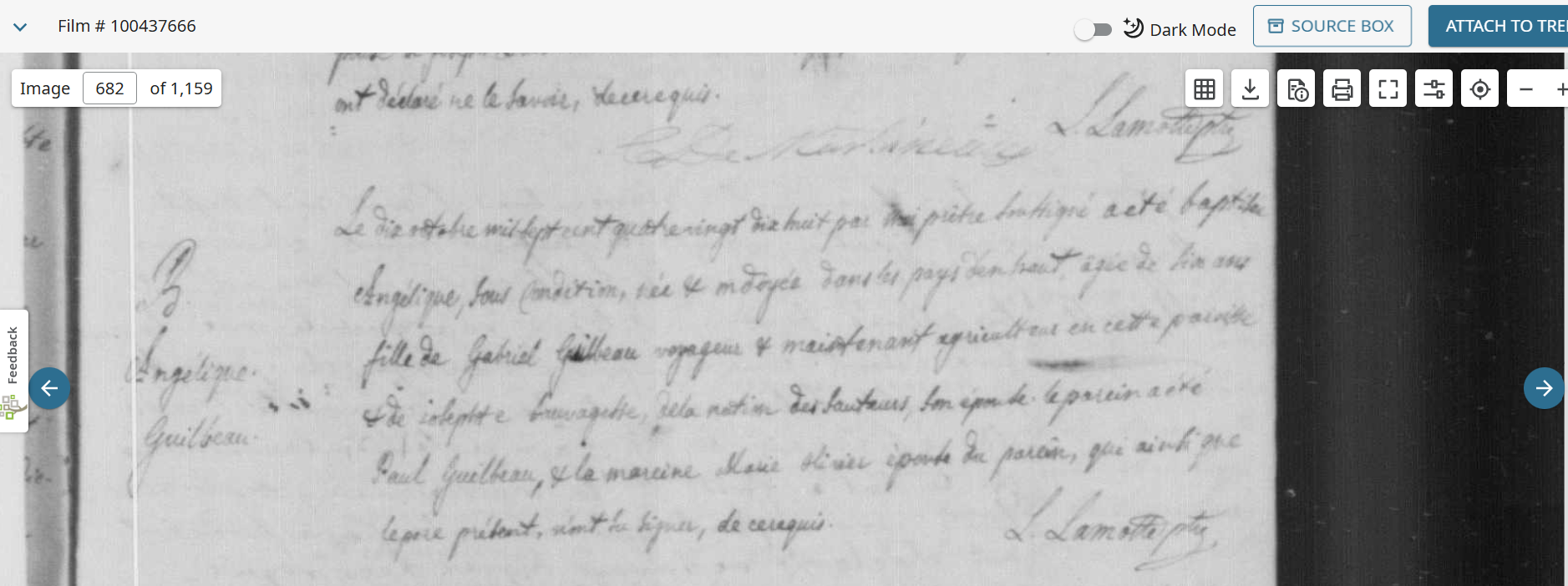
Evidence: registres paroissiaux, St-Paul-de-Lavaltrie, 10 October 1798, baptism of Angélique Guilbeau; L. Lamotte, ptre.Two Paul Guilbaults, one parish, both unable to sign Open
Paul Guilbault fils was baptized at St-Paul-de-Lavaltrie on 6 October 1792 and did not marry until 1846. From roughly 1813 to 1846 there were two adult, illiterate Paul Guilbaults living in the same parish, and both signed by cross. Five weeks before the father rendered his guardianship accounts in July 1820, the son bought land before the same notary.
The mark does not tell them apart. Neither does occupation. What does is the styling the notary or the priest used — père, fils — and, for the father, his wife’s name in the act. Three records on this page’s subject remain unresolved between the two men and are marked where they occur.
Evidence: PRDH #841045; BAnQ CN605,S24, Notary Barthélémy Joliette, 15 June 1820 and 22 July 1820.“Paul signed; Pierre made his mark” Withdrawn
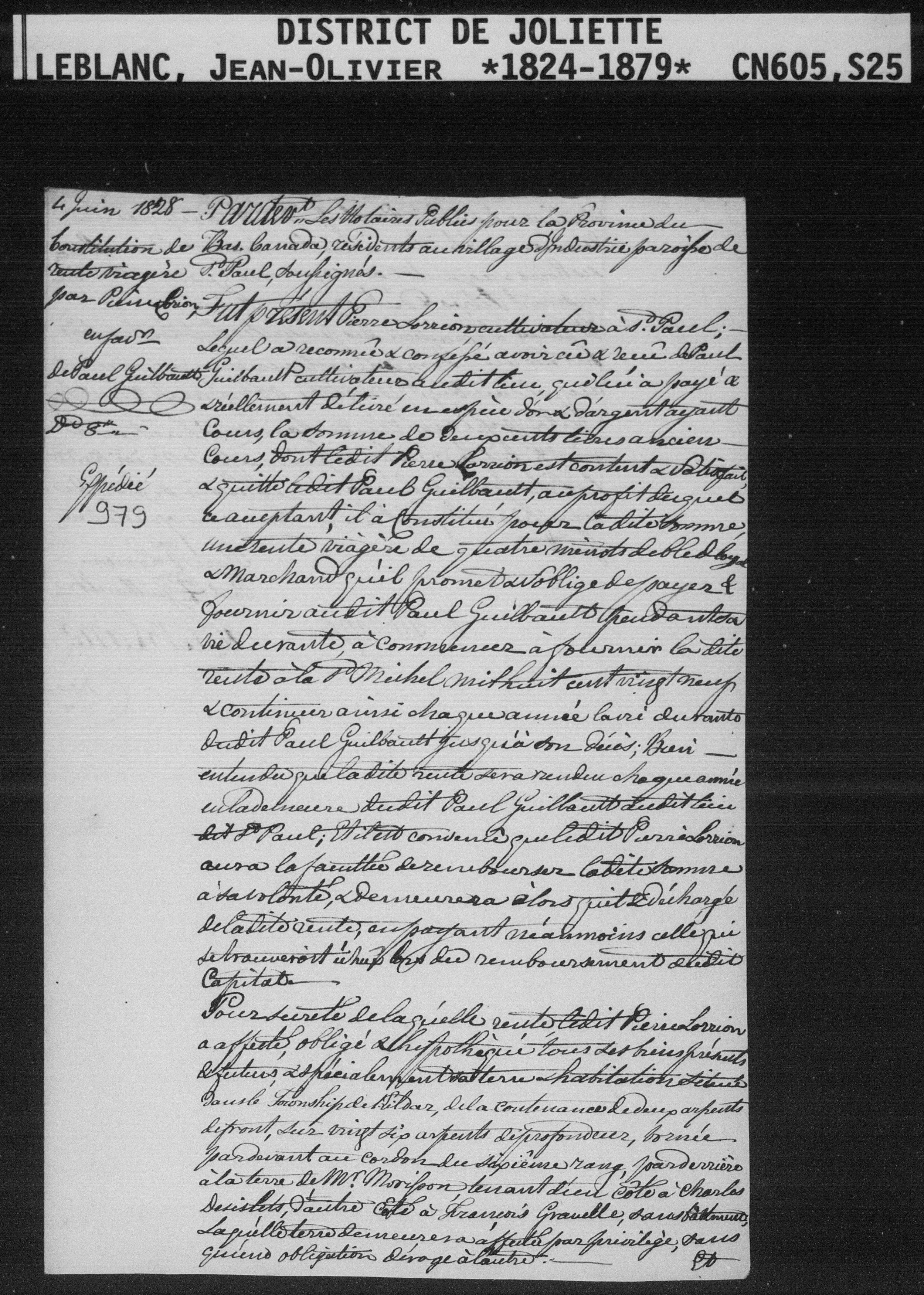
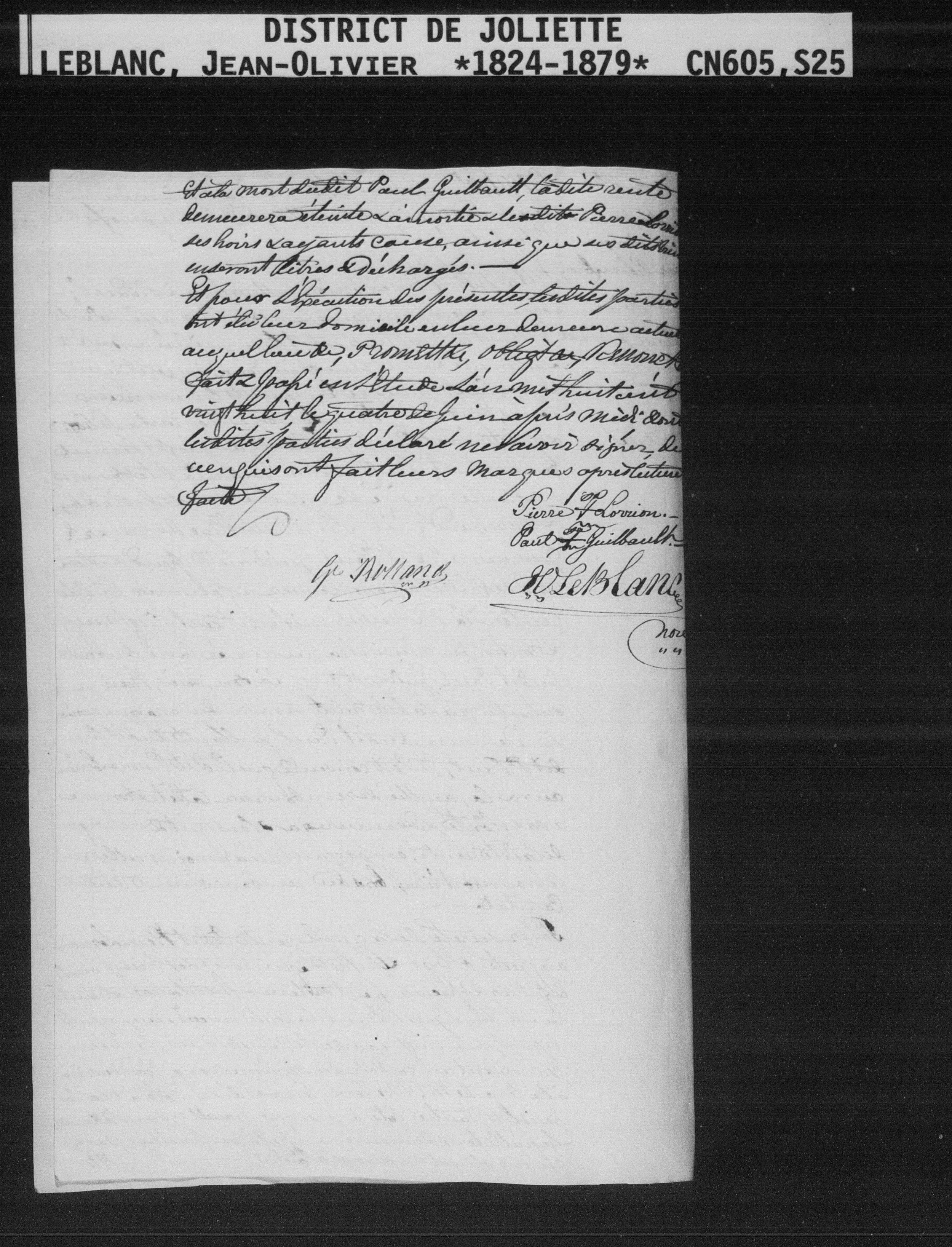
The description of the 1828 annuity carried on this site stated that Paul signed the act while Pierre Lorion made his mark. The act has now been read, and it is withdrawn. Neither man signed. The closing clause records both parties declaring that they did not know how to write, and both crosses stand in the margin above the notaries’ signatures.
The correction is small and it settles something larger. Paul Guilbault père could not sign in 1798, made his mark before a notary in 1820, was recorded unable to sign in 1821, and made his mark again in 1828. Four instruments across thirty years agree, and the one apparent exception was a misreading.
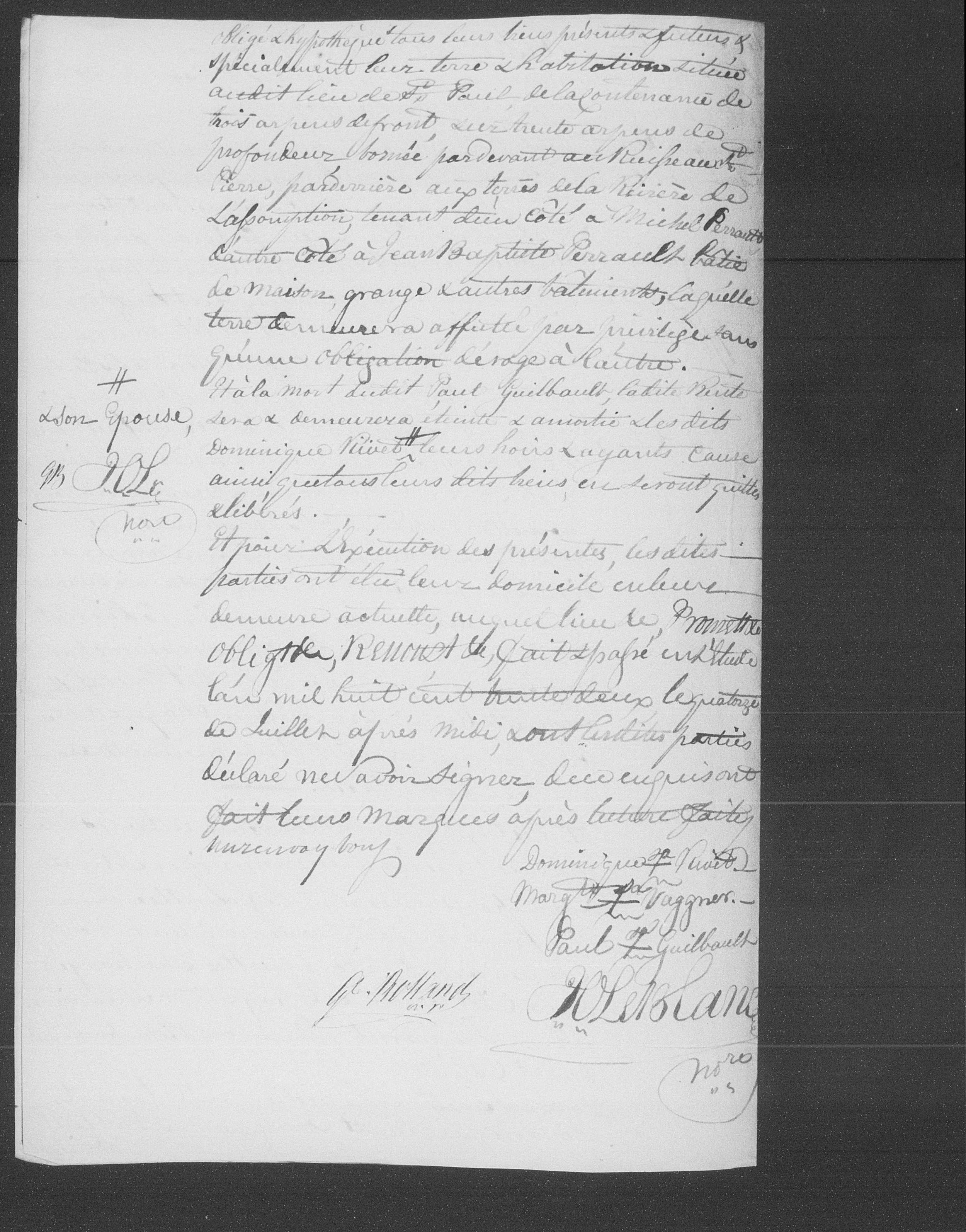
Evidence: BAnQ CN605,S25, Notary Jean-Olivier Leblanc, 4 June 1828, closing clause and marks.The act of 14 July 1832 is not a discharge, and the man in it is not this Paul Withdrawn
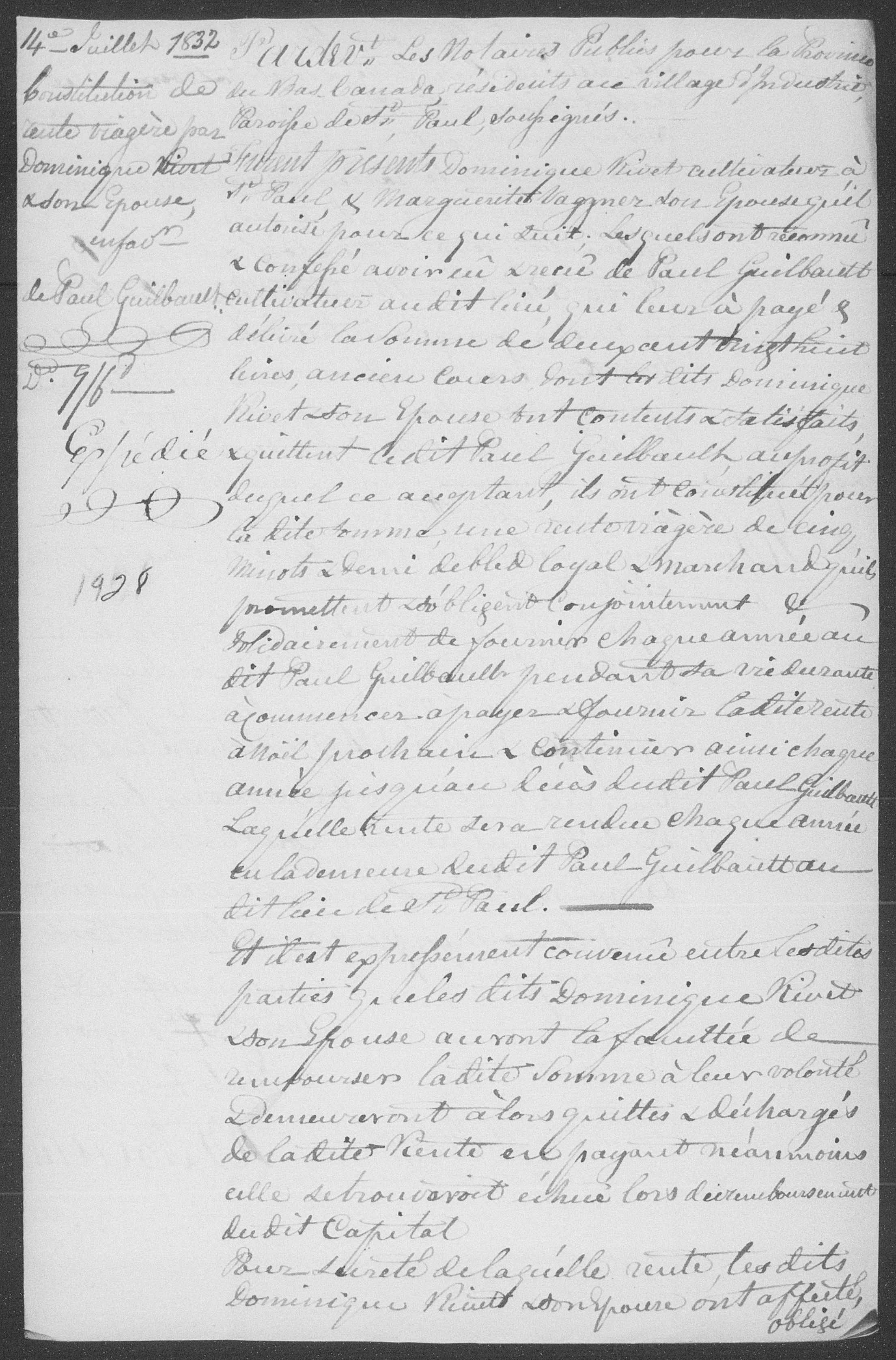
The research log and this page both described a notarial act of 14 July 1832 as Paul fils receiving repayment of the 1827 Lorion capital and giving final discharge, and used it to establish that Paul père had died. That description is withdrawn in every part.
The act is a constitution de rente viagère. Dominique Rivet, cultivateur at St-Paul, and his wife Marguerite Vagner acknowledge receiving 228 livres from Paul Guilbault and constitute in his favour a life annuity of five and a half minots of wheat a year, to begin at Christmas next and continue every year until his death, secured on three arpents by thirty at St-Paul between the Ruisseau St-Pierre and the lands of the Rivière de L’Assomption. It is a third annuity, not the closing of the first, and no Lorion is party to it.
Paul Guilbault père died on 2 January 1831. An annuity constituted in July 1832 to run for the annuitant’s life is not his, and the man who received it must be Paul fils. His death is not affected — the burial register establishes it independently — but the act that was cited to prove it proves nothing of the kind.
One detail supports the reading rather than merely permitting it. The same 228 livres of capital bought ten minots a year in 1827 and five and a half in 1832. A life annuity on a younger life pays less, and Paul fils was thirty-nine in 1832 where his father had been sixty-six. That is consistent, and it is not proof.
Evidence: BAnQ CN605,S25, Notary Jean-Olivier Leblanc, 14 July 1832; registres paroissiaux, St-Paul-de-Lavaltrie, 4 January 1831.The Mason’s Life
Over three decades at St-Paul-de-Lavaltrie, every baptism, burial and marriage in the family generated a document, and most of those documents recorded Paul’s occupation. Five designations appear, and they do not run in a tidy sequence from one trade to the next. They alternate, sometimes within a single year.
The table below separates two things the older version of this page ran together. A priest recording a man’s trade in his child’s marriage entry is telling you what the man did for a living. He is not telling you the man was in the church that day. Only a handful of entries do that, and they are marked.
Five Designations, and What They Are Evidence Of
Across more than thirty parish and notarial entries, five occupation designations appear: maçon, laboureur, maçon et laboureur, cultivateur and agriculteur. The word voyageur appears in none of them.
That absence is worth recording and is worth very little on its own. It does not prove a man never went to the interior — men came home and resumed their parish identities, and the registers followed. What matters far more is the small number of entries that place him somewhere on a named day.
| Year | Document | Occupation | Does it place him? |
|---|---|---|---|
| 1796 | Judith’s baptism, 12 Sep | Agriculteur | No — father named, no presence clause |
| 1798 | Marriage of his brother Joseph, 5 Feb | — | YES — “en présence de Paul Guilbaut frère” |
| 1798 | Burial of an infant son, 17 Mar | Maçon | No |
| 1798 | Baptism of his niece Angélique, 10 Oct | — | YES — godfather, with his wife as godmother |
| 1798 | Joint burial of twin infants, 25 Nov | Laboureur | No |
| 1800 | Rose’s baptism, 13 May | Laboureur | No |
| 1801 | Olivier’s burial and Marie-Angélique’s baptism, one page | Maçon | No |
| 1802 | Sophie I baptism and burial | Maçon et laboureur | No — the only dual designation in the archive |
| 1804 | Olivier II baptism and burial; Louis’s baptism | Maçon | No |
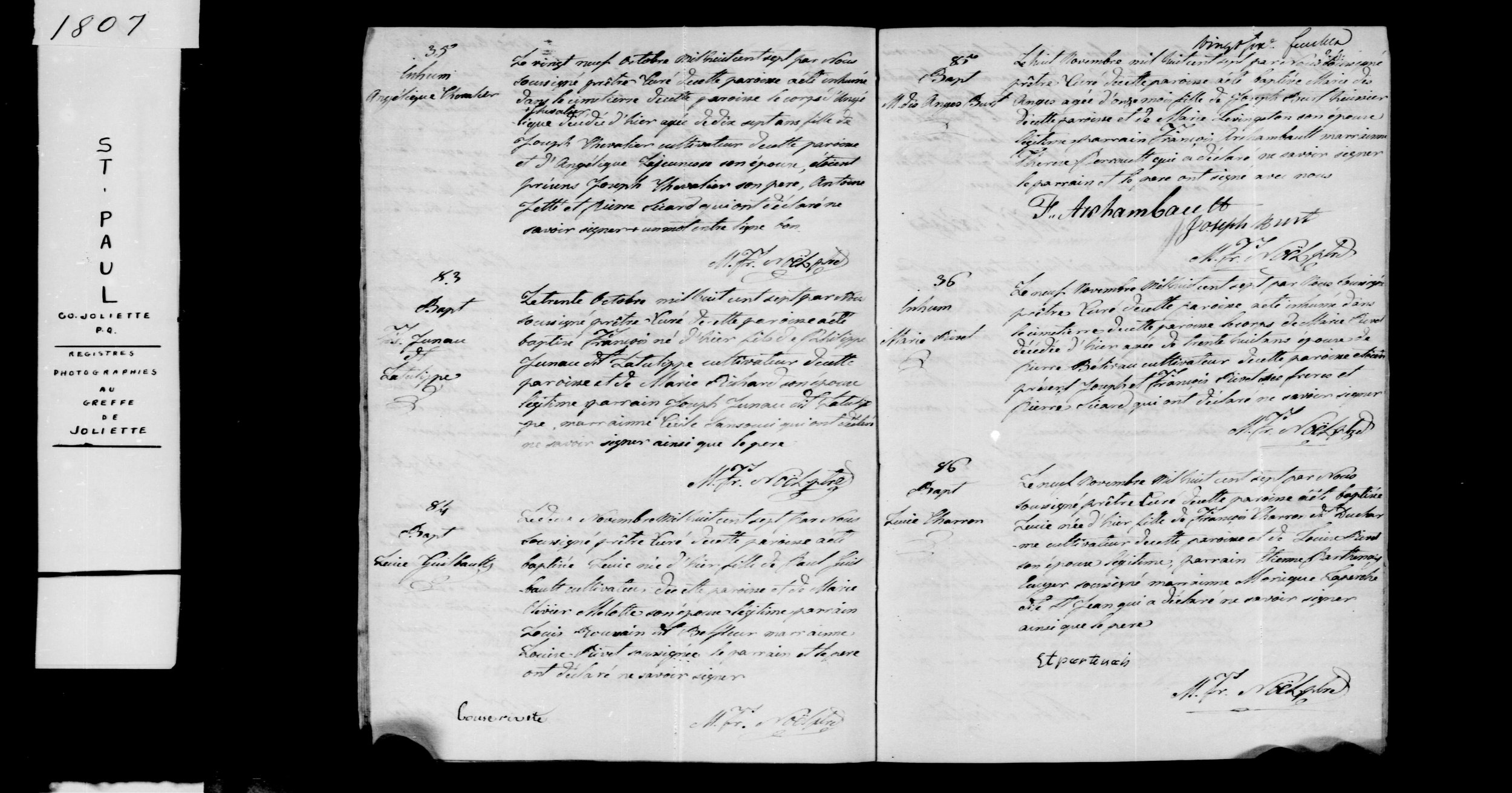
| 1807 | Lucie’s baptism, 1 Nov | Cultivateur | No — first farming designation |
| 1810 | François’s marriage, L’Assomption, 27 Feb | Maçon | No — filiation clause only |
| 1810 | Lucille’s baptism and burial | Laboureur | No — same year as the entry above, different trade |
| 1811 | Joseph’s marriage, Verchères, 23 Sep | Agriculteur | Unresolved — a bare “Paul Guilbeaut” witnesses; père or fils not stated |
| 1812 | Michel Olivier’s burial, 14 Jan | Maçon | No — witness Pierre Lorion, sixteen years before the annuity |
| 1814 | Marie’s and Étienne’s marriages, July and September | Maçon | No — filiation clauses only |
| 1815 | Ursule’s marriage, 25 Sep | Maçon | No — filiation clause only |
| 1819 | Judith’s marriage, 8 Feb | Cultivateur | No — filiation clause only |
| 1820 | Tutelle account, Notary Joliette, 22 Jul | — | YES — appeared in person, made his mark |
| 1821 | Rose’s marriage, 16 Oct | Laboureur | YES — named in the witness clause |
| 1825 | Sophie II’s marriage | Agriculteur | No |
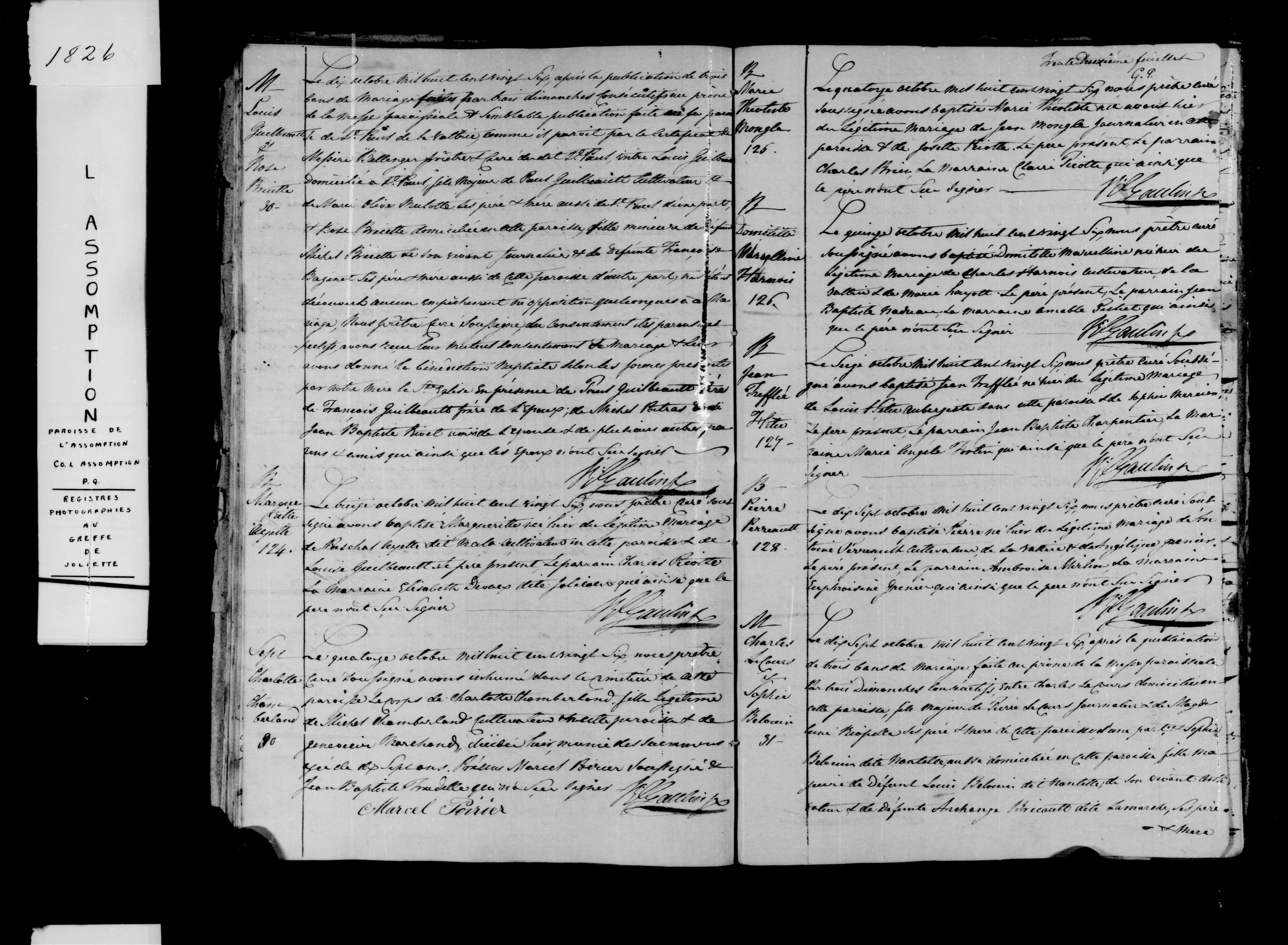
| 1826 | Louis’s marriage, L’Assomption, 10 Oct | Cultivateur | No — filiation clause only |
| 1831 | His burial, 4 Jan | Cultivateur | He is the subject. Age recorded 73; he was 69 |
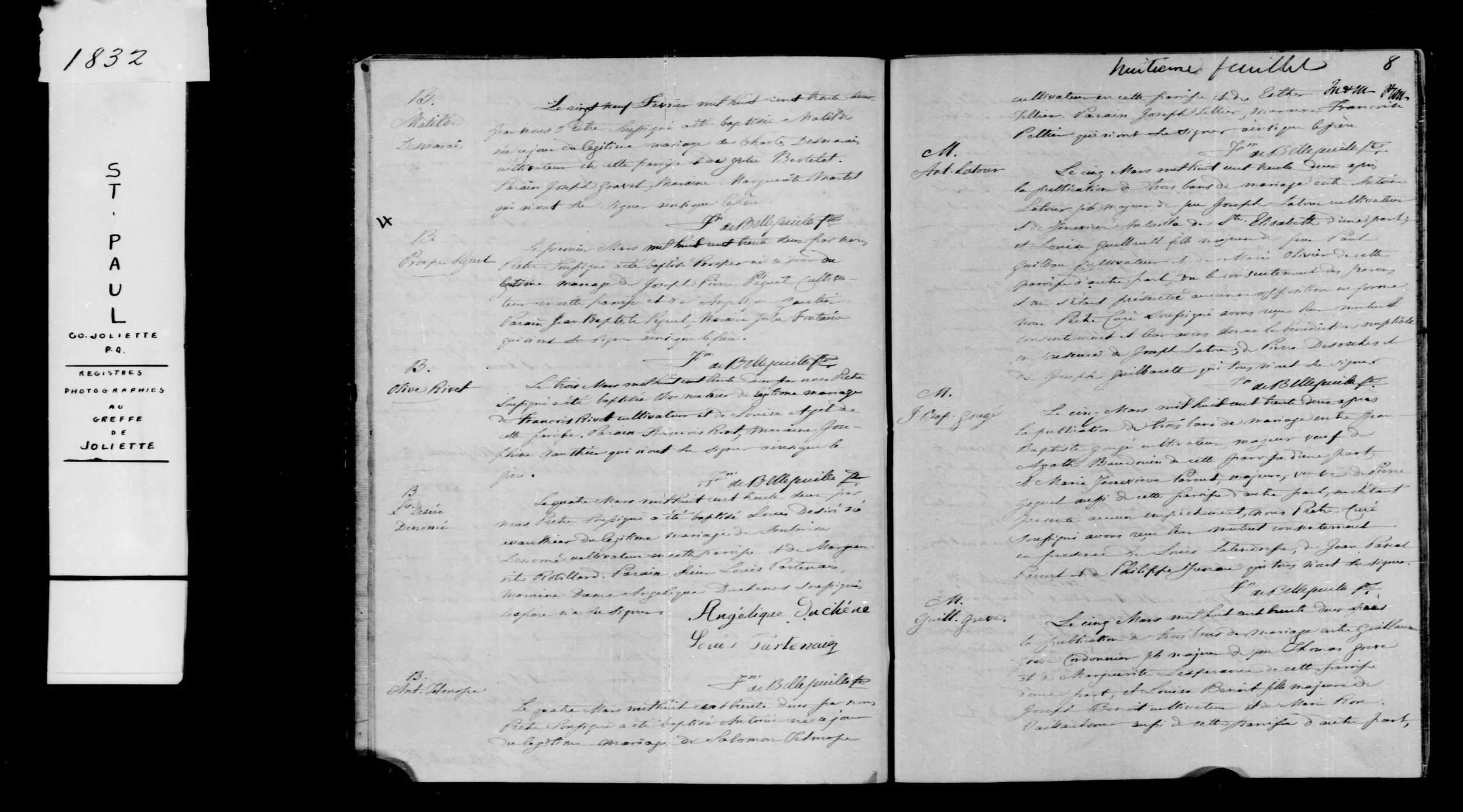
| 1832 | Louise’s marriage, 5 Mar | Cultivateur | No — recorded a year after his death |
Two entries in that table repay attention. The 1802 baptism of Sophie is the only place in the whole archive where a priest writes maçon et laboureur in one breath — a moment of specificity in a system that usually forced a choice. And 1810 supplies both designations in a single year, from two different priests in two different parishes, which is a caution against reading any one entry as a statement about a man’s settled identity.
The last row is the plainest warning of all. Paul had been dead fourteen months when a priest at Lavaltrie wrote him down as a cultivateur in his daughter’s marriage entry. An occupation in a parish register is what the clerk understood on the day he wrote, and sometimes not even that.
Twenty-Three Children
Paul and Marie Geneviève married at Varennes in February 1783 and their first two children were baptized there. By December 1786 the family was at St-Paul-de-Lavaltrie, where the remaining twenty-one were born across the next twenty-five years. Every baptism has been located, and every burial.
The losses are heavy even by the standards of the period. An infant son died half an hour after birth in March 1798; twins were born and died on the night of 23 November the same year and were buried together two days later. Olivier and Angélique, twins born in February 1801, died within a fortnight of each other. Two names — Sophie and Olivier — were used a second time after the first child of each name died.
The last child, Michel Olivier, was born on 1 December 1811 and died six weeks later. One of the witnesses at his burial was Pierre Lorion.
The Lorion Connection
Pierre Lorion witnessed the burial of Paul’s last-born child in January 1812. Sixteen years later, the same Pierre Lorion received 200 livres from Paul and constituted a life annuity in his favour, secured by mortgage on a farm.
The financial relationship that appears abruptly in the notarial record of 1828 was not new. It rested on decades of parish community — neighbours standing at each other’s baptisms and burials, in the ordinary way of a rural parish.
Children of Paul Guilbault and Marie Geneviève Olivier dit Mulot
Twenty-three children documented, 1783–1811 (PRDH family #59291). Selected entries shown; the complete inventory with PRDH references and occupation data for each record is in the family archive.
October 1798
On 10 October 1798 Paul’s brother Gabriel brought three children down from the pays d’en haut to be baptized at St-Paul-de-Lavaltrie. They had been born in the interior and given emergency baptism there, and the ceremonies were now supplied conditionally: Gabriel fils at eight years and four months, Joseph Claude at sixteen months, and Angélique at six years.
Paul and his wife stood as godparents to Angélique. Both were asked to sign, and neither could.
Registres paroissiaux, St-Paul-de-Lavaltrie · 10 October 1798
That last function is the one that mattered when this page was rebuilt. A contract had been signed at Rainy Lake on 19 July of the same year, engaging a Paul Gibeau to travel to the Athabasca posts, winter at Great Slave Lake, and remain bound until his return to Montreal. Eleven weeks later Paul Guilbault was at Lavaltrie holding a child at the font.
There is a further consequence, small but useful. The same entry establishes that he could not write in 1798 — which agrees with the mark he made before a notary in 1820, and with the register’s statement in 1821 that none of the witnesses at his daughter’s wedding could sign.
The Guardian
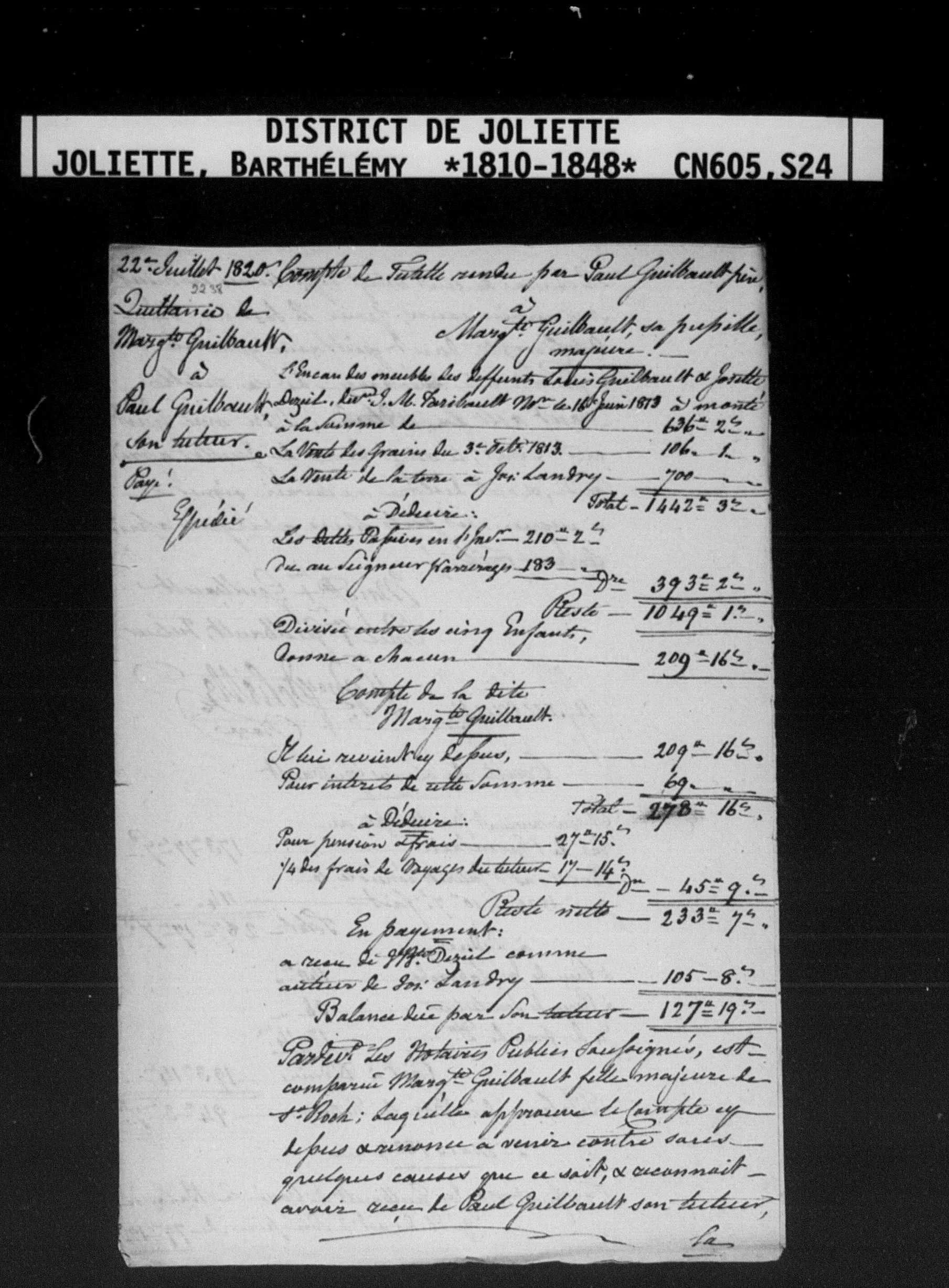
In May 1813 Paul’s youngest brother Louis died at St-Roch-de-l’Achigan. His wife, Josephte Déziel dit Labrèche, had died five days earlier. They were buried by the same priest before the same two witnesses, and they left five children.
Paul took the guardianship, and held it for seven years. The account he rendered at the end of it is the most detailed document of his life, and the only one that shows him working.
and Josette Déziel, 16 June 1813 — 636.2
Sale of the grain, 3 October 1813 — 106.1
Sale of the land to Joseph Landry — 700
Total — 1442.3
Less passive debts — 210.2
Less seigneurial arrears — 183
Remainder — 1049.1
Divided among the five children — 209.16 each
Marguerite’s share with interest — 278.16
Less pension and costs — 27.15
Less one quarter of the tutor’s travel expenses — 17.14
Received from Déziel for Joseph Landry — 105.8
Balance paid by her tutor — 127.19
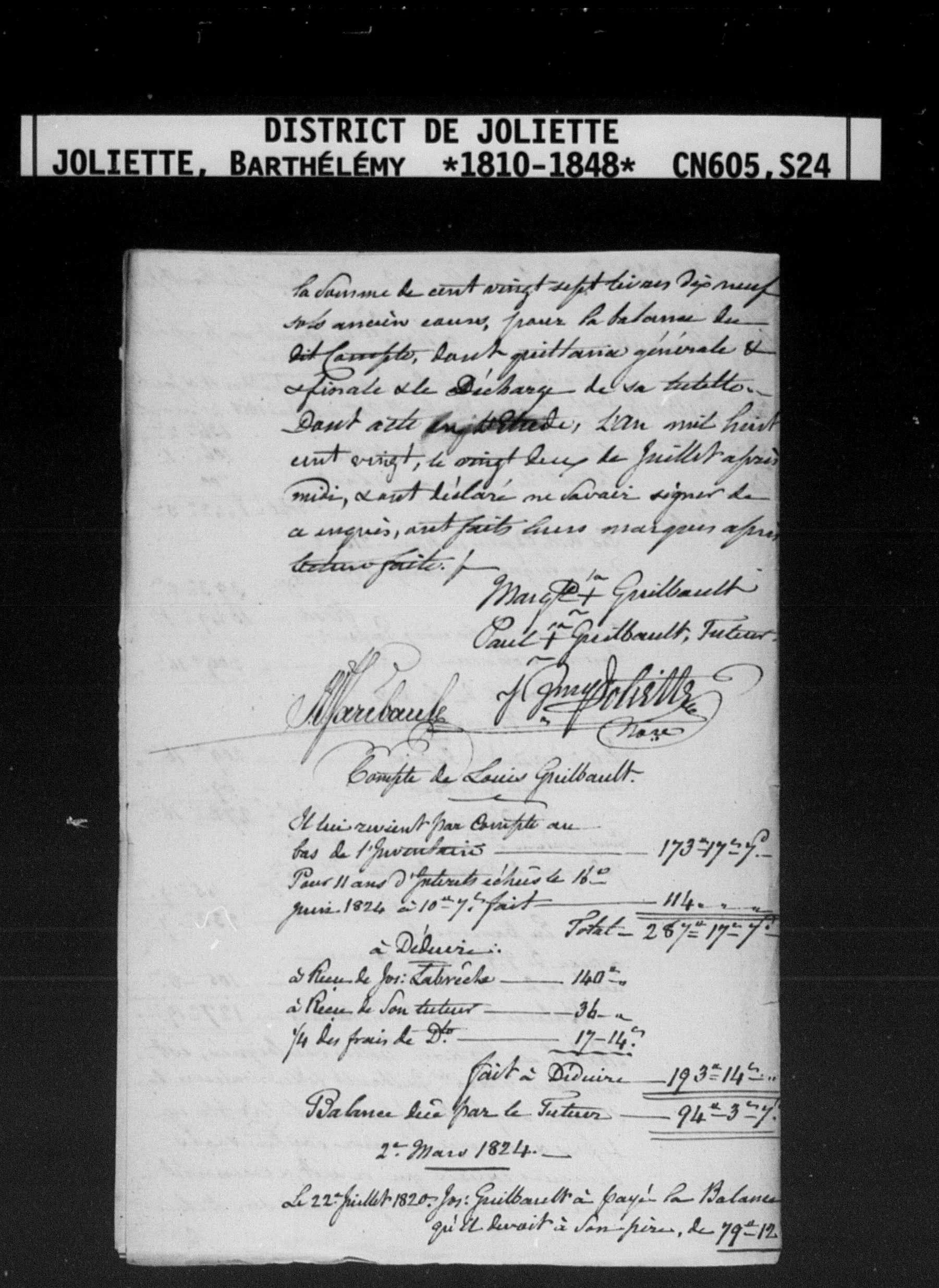
Marguerite Guilbault, the eldest, had come of age. She appeared, approved the account, renounced any action against her uncle and acknowledged receipt of the balance in full. The act closes on the afternoon of 22 July 1820, and both of them made their marks after it was read aloud.
Two details in that document deserve to be lifted out. The first is the charge for the tutor’s travel expenses, divided in quarters among the wards — the only trace anywhere in the record of Paul actually moving around Lower Canada, between St-Paul, St-Roch and the notary’s office at Industry. The second is that on the same afternoon his son Joseph settled a debt of 79 livres 12 sols owed to his father.
Father and son closing accounts on one afternoon. It was read, for several years, as a man putting his affairs in order before leaving for the interior. It is better read as what it plainly is: the end of a seven-year administration, on the day the eldest ward turned twenty-one.
The Annuity Years
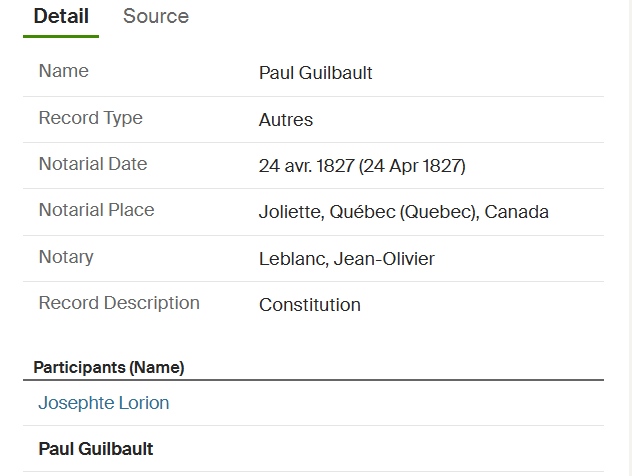
On 24 April 1827 Joseph Lorion, a cultivateur at Grand Ruisseau in Kildare Township, received 228 livres from Paul and constituted a life annuity secured by mortgage. The notary’s own index for that year records it on line 24: constitution de rente viagère par Jos. Lorion en faveur de Paul Guilbault.
Fourteen months later Paul did it again, and the second act survives in full. On the afternoon of 4 June 1828, in the notaries’ study at the village of Industry, Pierre Lorion acknowledged receiving two hundred livres in gold and silver coin and undertook to deliver four minots of good merchantable wheat every year for the rest of Paul’s life, beginning at Michaelmas 1829 and delivered each year to Paul’s own house at St-Paul.
The security is described down to the fence lines: two arpents of frontage by twenty-six deep in Kildare Township, fronting on the road of the sixth range, backing on the land of Mr Morison, Charles Desilets on one side and François Gravelle on the other, and no buildings on it. Pierre Lorion reserved the right to repay the capital whenever he chose and be free of the annuity thereafter.
BAnQ CN605,S25 · Notary Jean-Olivier Leblanc · 4 June 1828
Pierre × Lorrion · Paul × Guilbault
Total capital deployed across the two acts: 428 livres. Annual income at its peak: fourteen minots of wheat, running until his death and extinguished with it — the 1828 act says so expressly, in a clause written for a man of sixty-seven who knew what he was buying.
Where the money came from is now an open question. It was previously explained as interior wages, and that explanation is withdrawn. What can be said is smaller and better founded: a man with a farm, grown children and no dependants had 428 livres to lend, and lent it to neighbours he had known for twenty years — one of whom had stood at his youngest child’s burial sixteen years before.
The rate that does not fit
Two hundred livres bought four minots of wheat a year in June 1828. Two hundred and twenty-eight livres is recorded as having bought ten minots fourteen months earlier, from the same kind of lender in the same township before the same notary.
Those two rates cannot both be right for one annuitant in adjacent years. The 1828 figures have been read from the act; the 1827 figures have not. The 1827 act needs re-reading before either number is relied on, and the discrepancy is recorded here rather than averaged away.
A Life in Context
The Brothers
Gabriel was born fourteen months after Paul, to the same parents, and the two brothers left documentary records of entirely different shapes.
Gabriel’s interior career is evidenced by where his children were born. Three of them were born and given emergency baptism in the pays d’en haut and brought down to Lavaltrie in October 1798 to have the ceremonies supplied; the eldest was eight, which puts his father in the interior around 1789 or 1790. The same entry styles him voyageur et maintenant agriculteur. He married a woman the registers describe as de la nation des hauteurs, and the family lived afterwards at Rigaud and in the seigneurie d’Argenteuil.
Paul’s record is the opposite in every respect. He is in one parish for forty-five years, with twenty-three children baptized in it, a guardianship administered from it, and two mortgages lent within it. No document places him further from home than Verchères or L’Assomption.
For a while this page argued that the brothers had inverted the expected pattern — that the one who never used the word had the better paper trail in the trade. That reading depended on company records now attributed elsewhere, and it is withdrawn at W-4. What is left is simpler. One brother went to the interior and the registers show it obliquely, through his children’s birthplaces and a single phrase. The other stayed, and the registers show that directly, on almost every page.
What This Case Means
A complete parish record is not just a portrait of a life. It is a testing instrument.
Because Paul Guilbault père can be placed at named locations on named days — at a font in 1798, before a notary in 1820, at a wedding in 1821 — a claim about him made from a company ledger two thousand miles away could be checked and found wrong. Most men of his generation cannot be checked that way. The ordinary, unremarkable density of his record is what made the correction possible, and it is the most useful thing about him.
Document Gallery
Primary sources documenting Paul Guilbault père
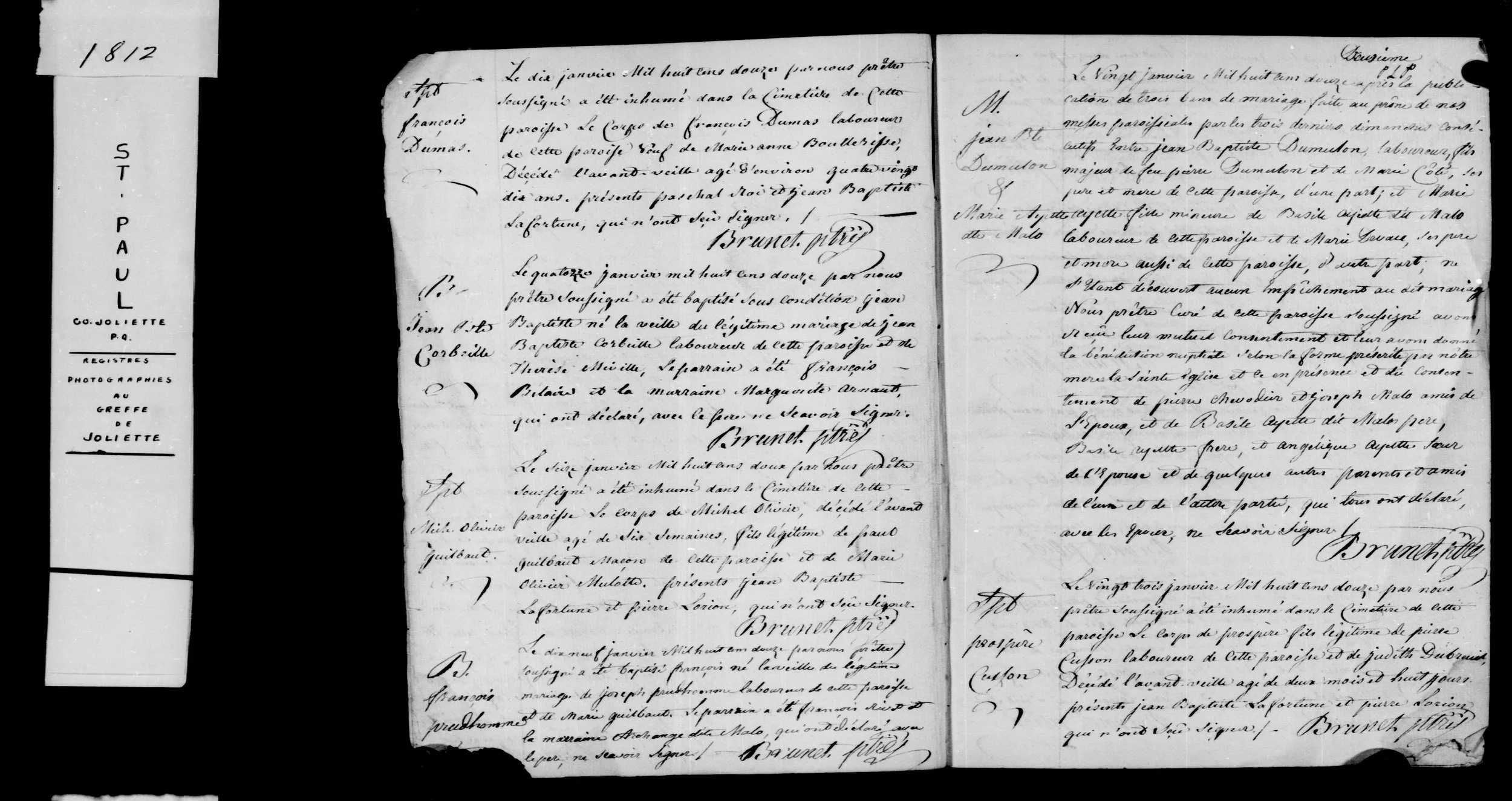
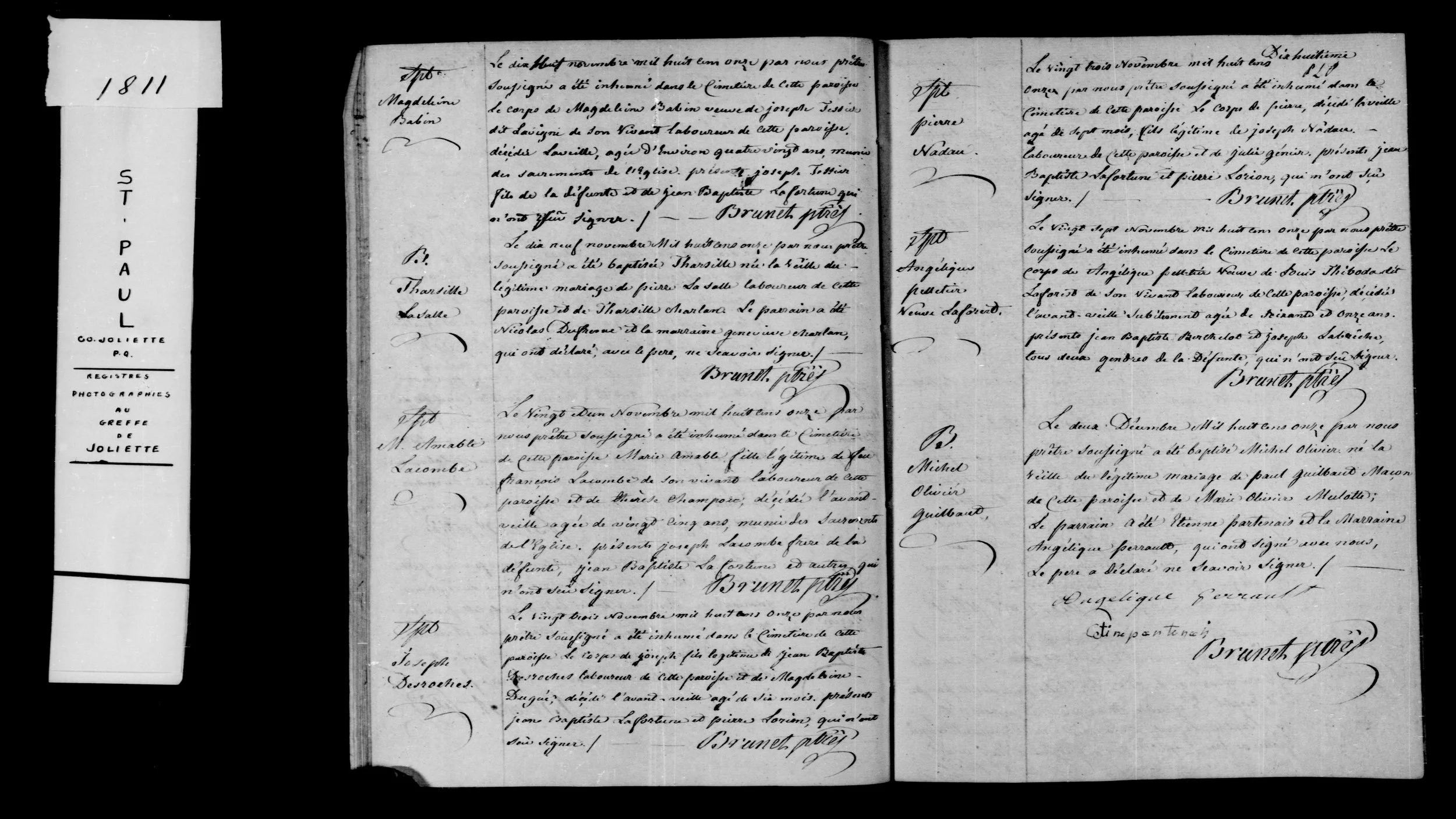
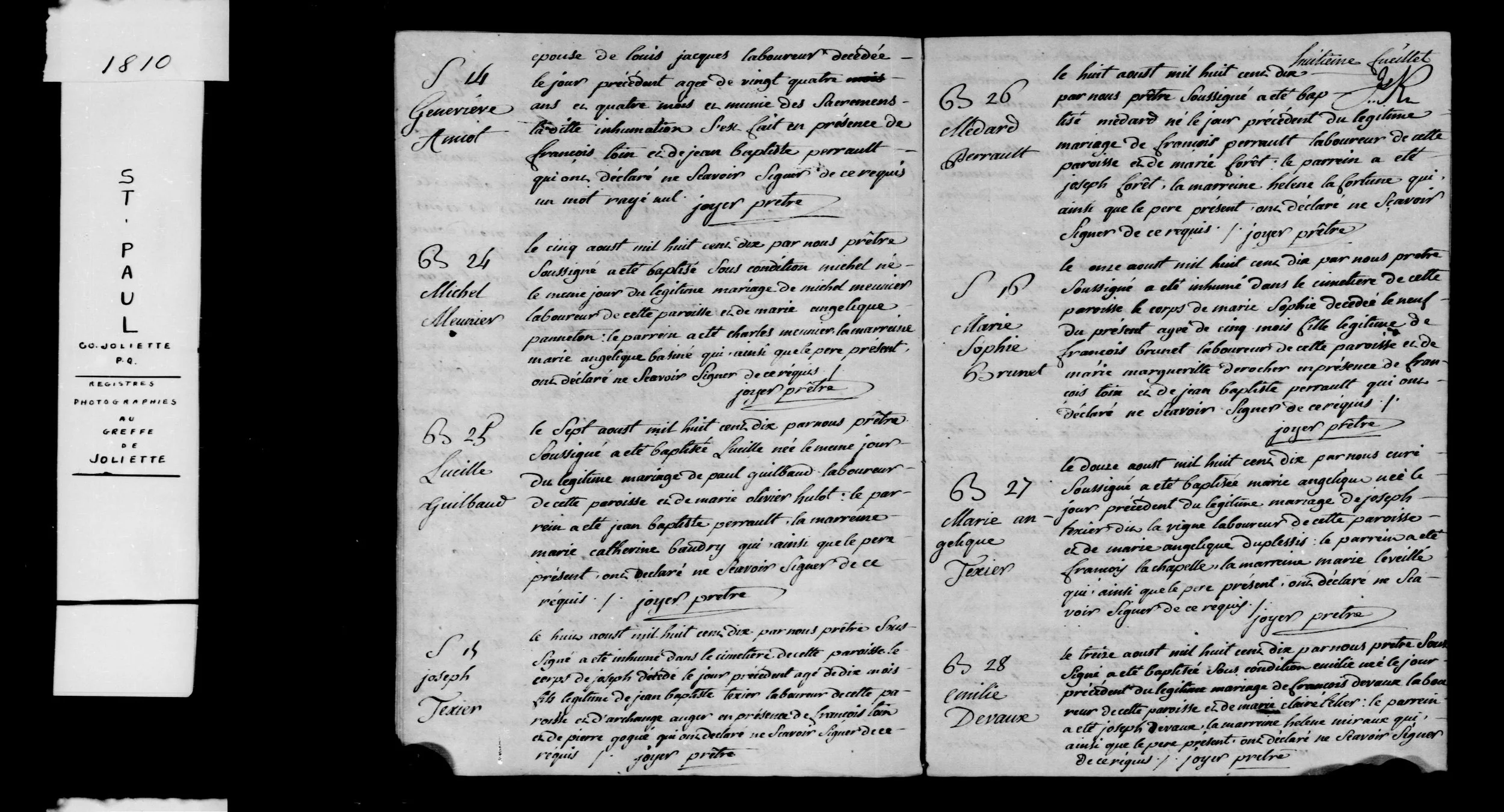
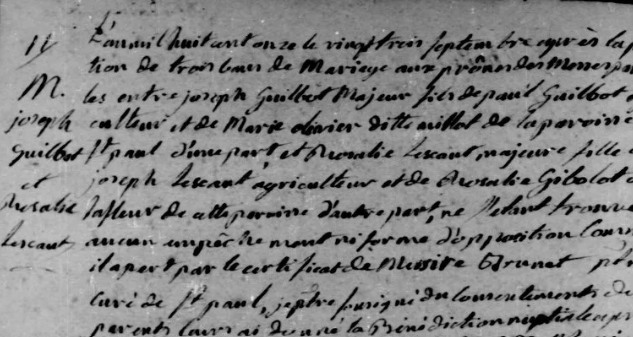
The Complete Archive
All twenty-three children’s records — baptisms, burials, marriages, PRDH individual records and parish register images — with occupation data and a presence assessment for every entry.
Enter Family Archive →Family member? Contact Mary for archive access.
Are You Connected to the Guilbault Line?
If you descend from the Guilbault (Guilbeau, Guilbeault) family of Charlesbourg and the Quebec parishes, from the children of Marie Josephte Abitakijikokwe, or from the founding families of the line — Senécal, Séguin dit Ladéroute, Morin, Couillaud dit Roquebrune, Gaulin — I’d like to compare notes. Documented trees, DNA matches, family papers, and even half-remembered stories have all moved this research forward.
Get in Touch About This FamilyCousin connections are informal and reciprocal — no fee, no obligation, just shared work on shared ancestry.
Questions about your own research? Begin a research inquiry.
