
The Storyline
Real families. Real discoveries. Real stories.
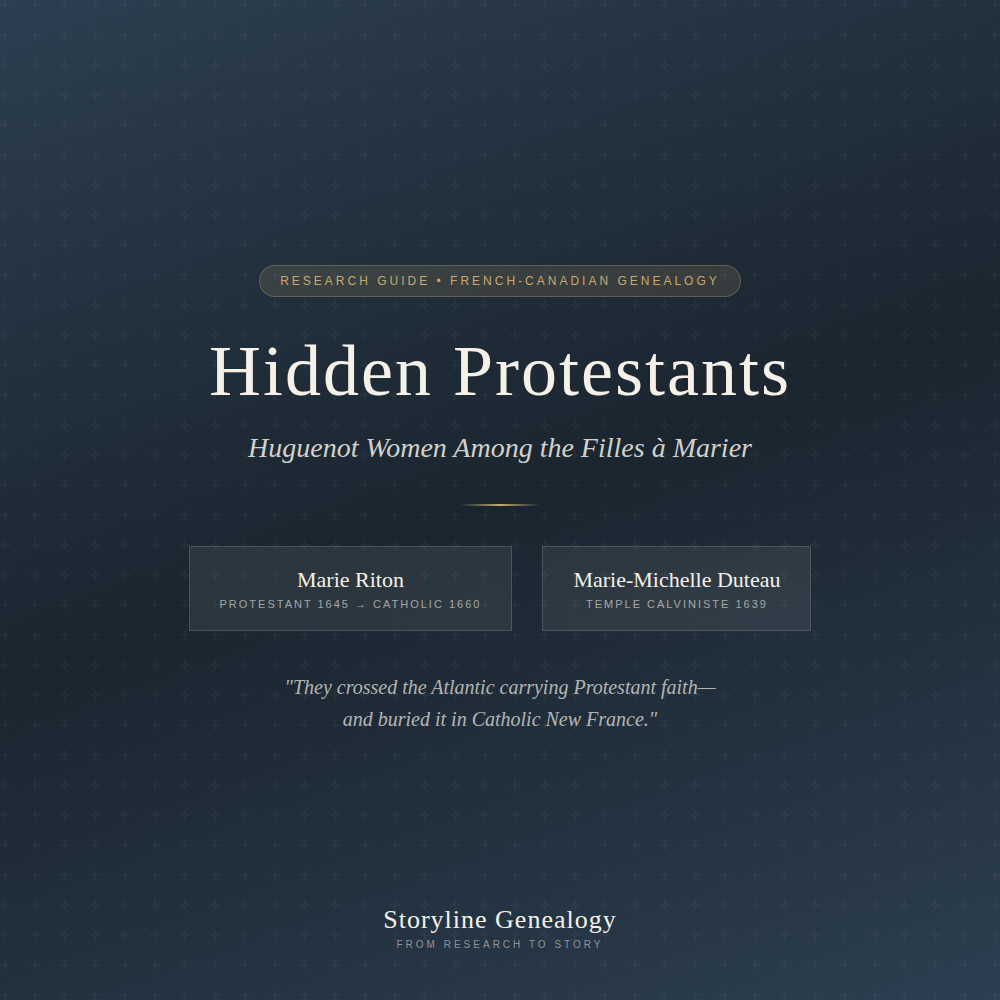
Hidden Protestants: Huguenot Women Among the Filles à Marier
Among the first women who settled Quebec were hidden Protestants—Huguenots forced to convert to Catholicism to survive. Learn how to trace their buried heritage through temple registers and abjuration records.
Part of the Storyline Genealogy series: Filles du Roi & Filles à Marier — The Women Who Built New France
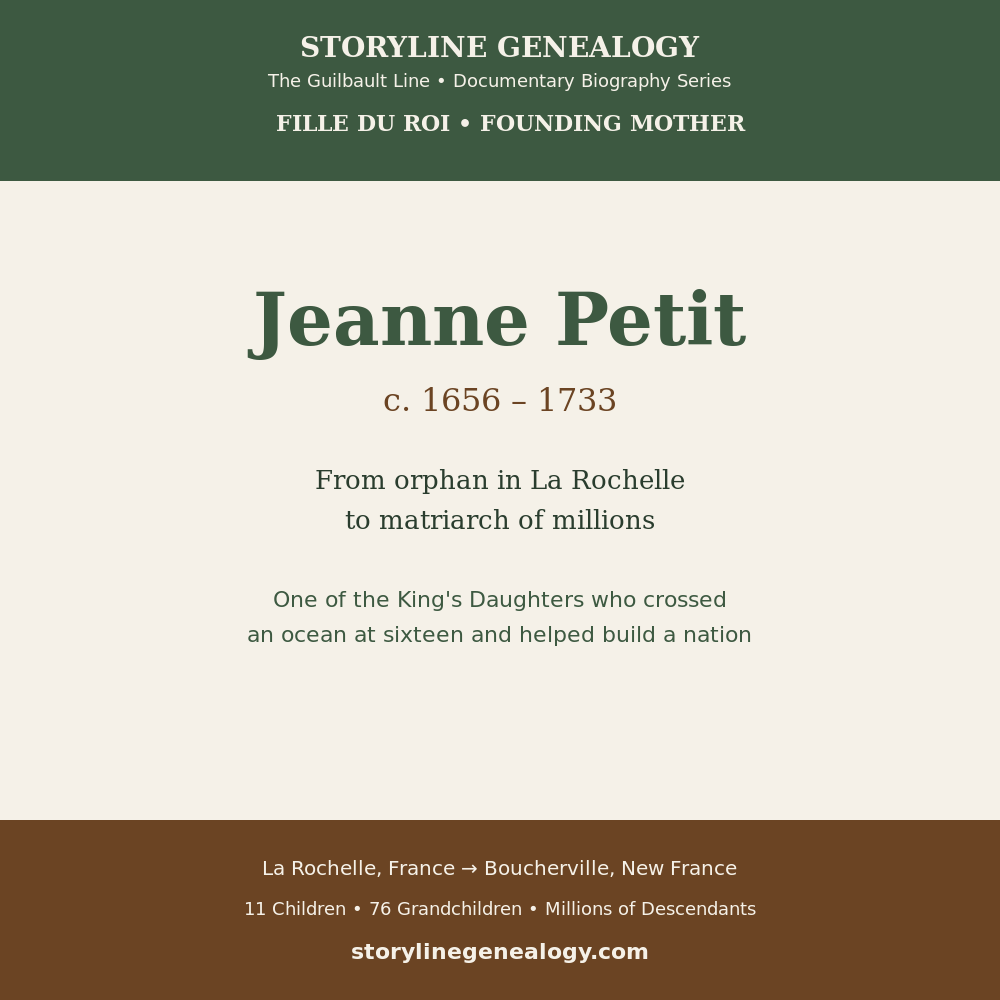
Jeanne Petit: From Orphan in La Rochelle to Matriarch of Millions
Jeanne Petit was a young woman protected by the king, part of the contingent of 125 Filles du Roi who came to New France in 1671. At just 16 years old, already orphaned, she crossed the Atlantic to build a new life. She married François Séguin dit Ladéroute, a soldier turned weaver, and together they raised 8 children to adulthood at Boucherville. Today, her descendants number nearly 2 million people—a legacy built from nothing but hope and determination.
Part of the Storyline Genealogy series: Filles du Roi & Filles à Marier — The Women Who Built New France
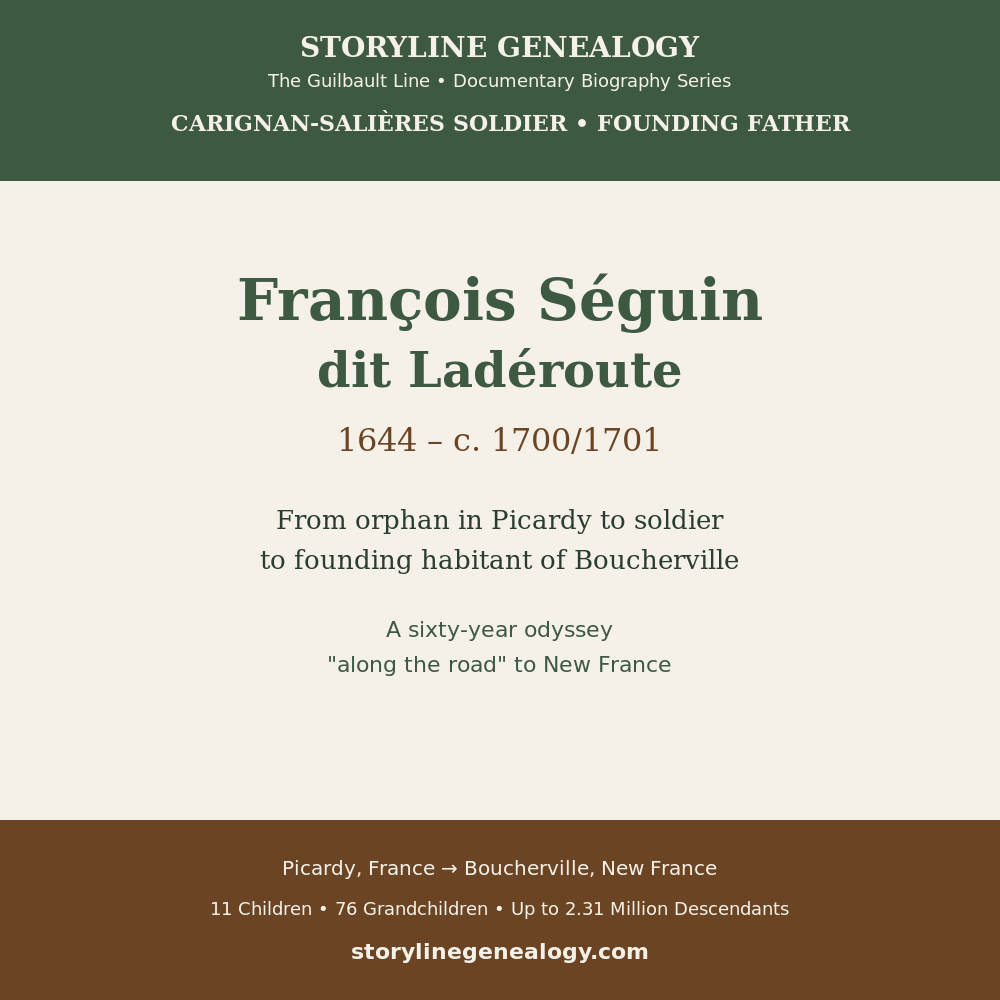
François Séguin dit Ladéroute: Carignan Soldier, Weaver, and Settler of Boucherville
François Séguin dit Ladéroute came from the region of Bray, west of Beauvais, in the former province of Picardy. Orphaned at age six when his mother Marie Massieu died, he enlisted in the Carignan-Salières Regiment and arrived in New France aboard the Saint-Sébastien on September 12, 1665. After marrying Fille du Roi Jeanne Petit in 1672, he settled at Boucherville as a weaver, raising 11 children. Today, his descendants number between 1.89 and 2.31 million people.
Part of the Storyline Genealogy series: Carignan-Salières — From Soldiers to Settlers
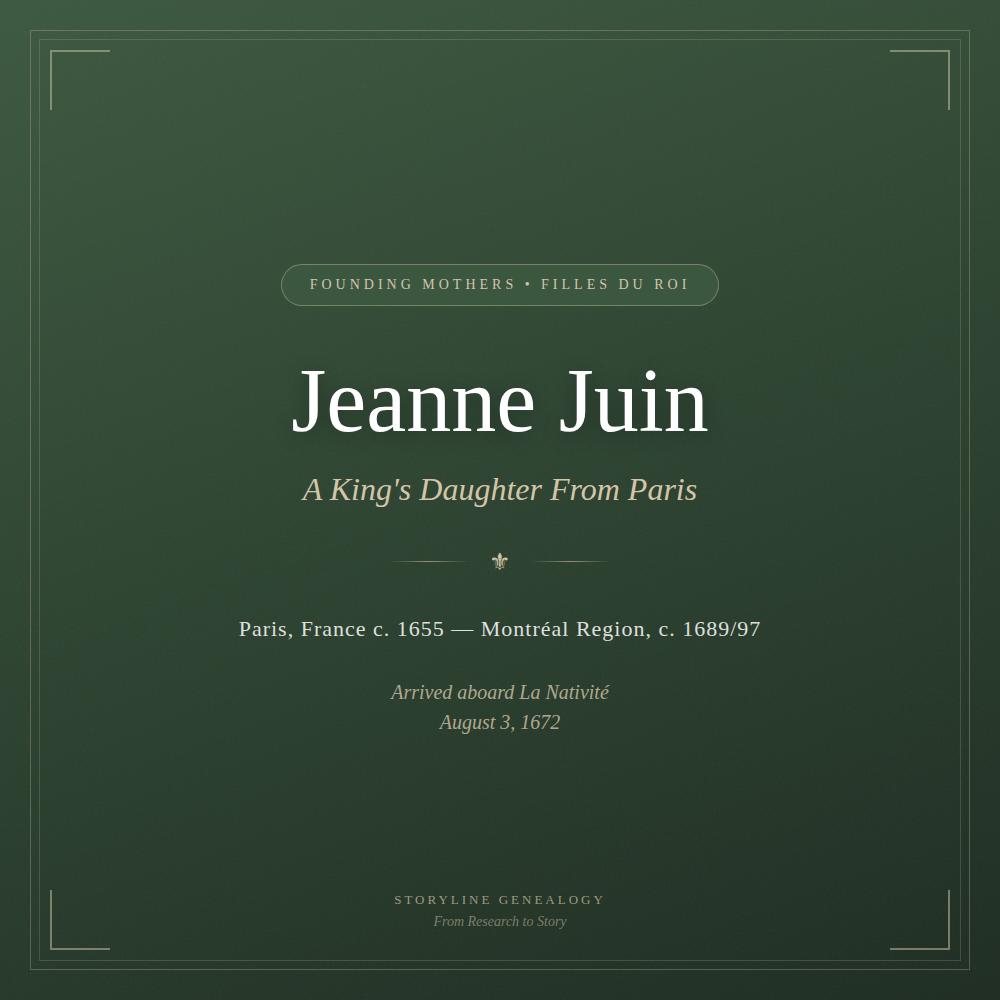
Jeanne Juin: A King’s Daughter From Paris
On August 3, 1672, the ship La Nativité arrived at Québec carrying a young Parisian woman named Jeanne Juin. One of approximately 770 Filles du Roi sent to populate New France, she married Norman cobbler Bernard Dumouchel dit Laroche and raised six children across the frontier settlements from Champlain to Longueuil. Today, her descendants number in the hundreds of thousands.
Part of the Storyline Genealogy series: Filles du Roi & Filles à Marier — The Women Who Built New France
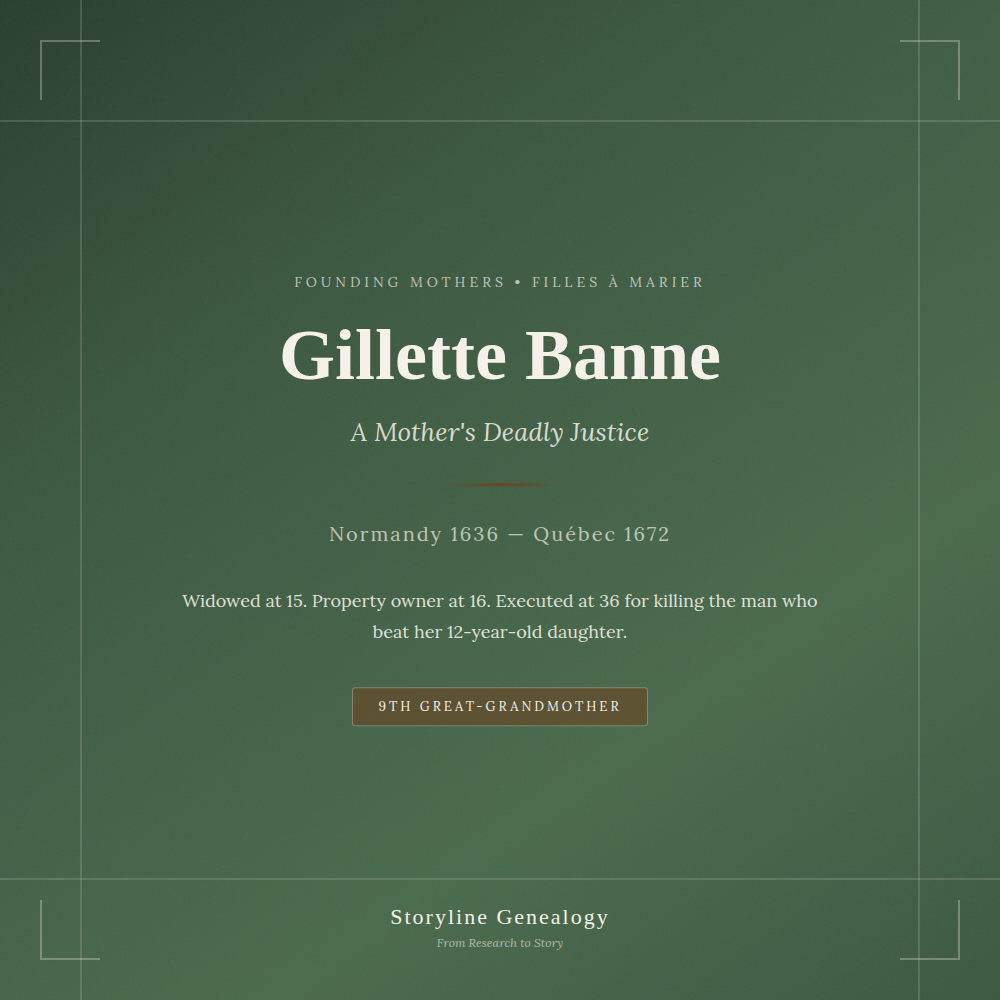
Gillette Banne: A Fille à Marier in New France
Shipped to New France at 13. Widowed at 15. Property owner at 16. Executed at 36. Gillette Banne's life spans only three and a half decades, but within it lies the full complexity of women's experience in colonial New France. When her 12-year-old daughter was beaten bloody by a drunk husband and the law offered no refuge, she made her own justice—and paid with her life. Her descendants now number over 2 million.
Part of the Storyline Genealogy series: Filles du Roi & Filles à Marier — The Women Who Built New France
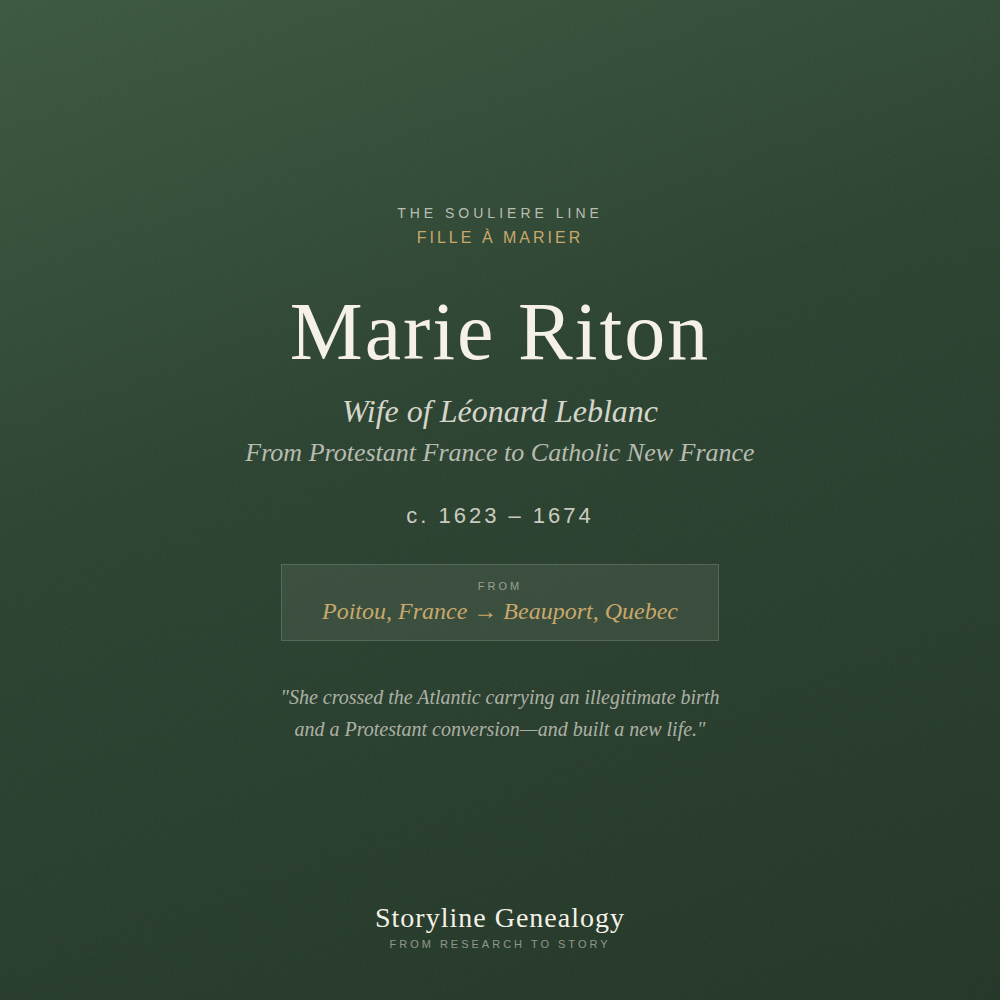
Marie Riton: A Fille à Marier in New France
Marie Riton crossed the Atlantic carrying the weight of an illegitimate birth and a Protestant conversion. In New France, she reinvented herself as a Catholic matriarch at Beauport—mother of seven, ancestor to millions.
Part of the Storyline Genealogy series: Filles du Roi & Filles à Marier — The Women Who Built New France
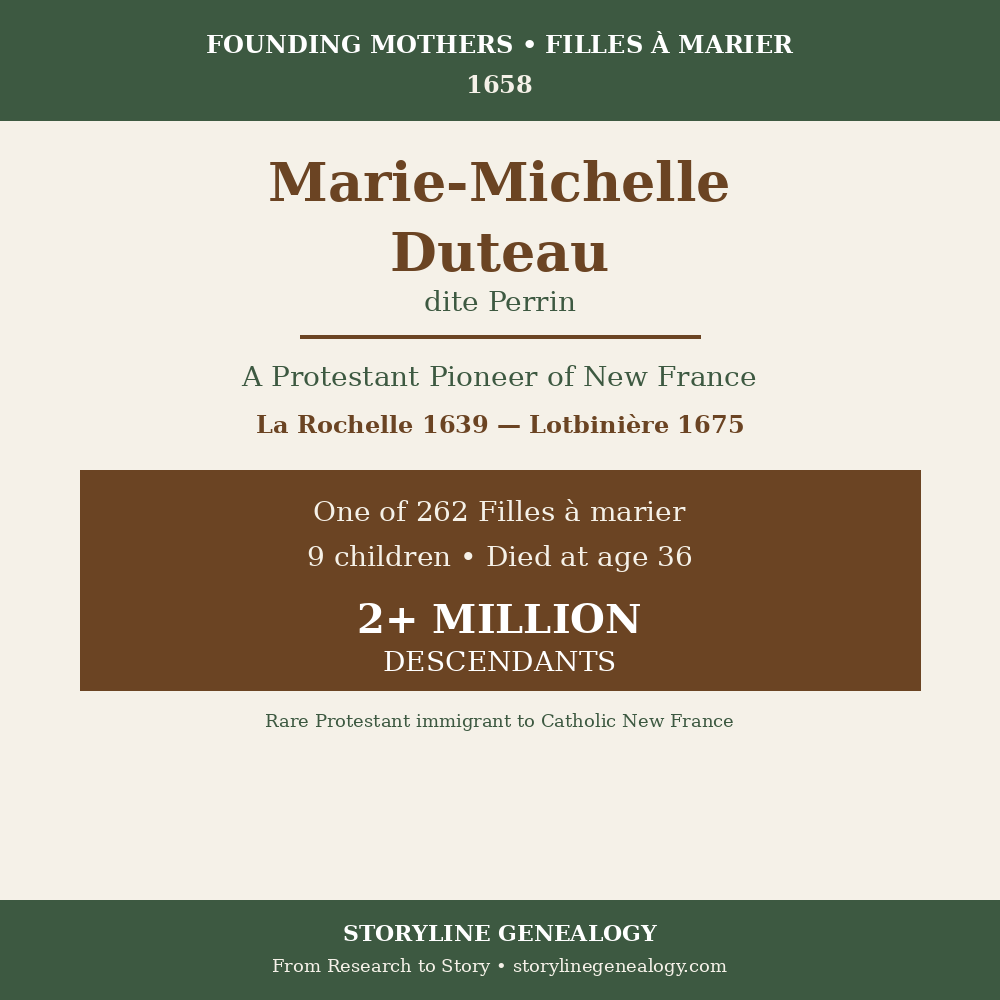
Marie-Michelle Duteau dite Perrin: A Protestant Pioneer of New France
Before the King's Daughters. Before royal dowries. Before the colony had a plan, there were the Filles à marier—262 brave women who crossed the Atlantic on their own terms. Marie-Michelle Duteau was one of them: a Protestant girl from La Rochelle who emigrated at 19, converted to Catholicism to marry, bore 9 children, and died at 36 on the frontier she helped settle. Today, over 2 million Québécois carry her DNA.
Part of the Storyline Genealogy series: Filles du Roi & Filles à Marier — The Women Who Built New France
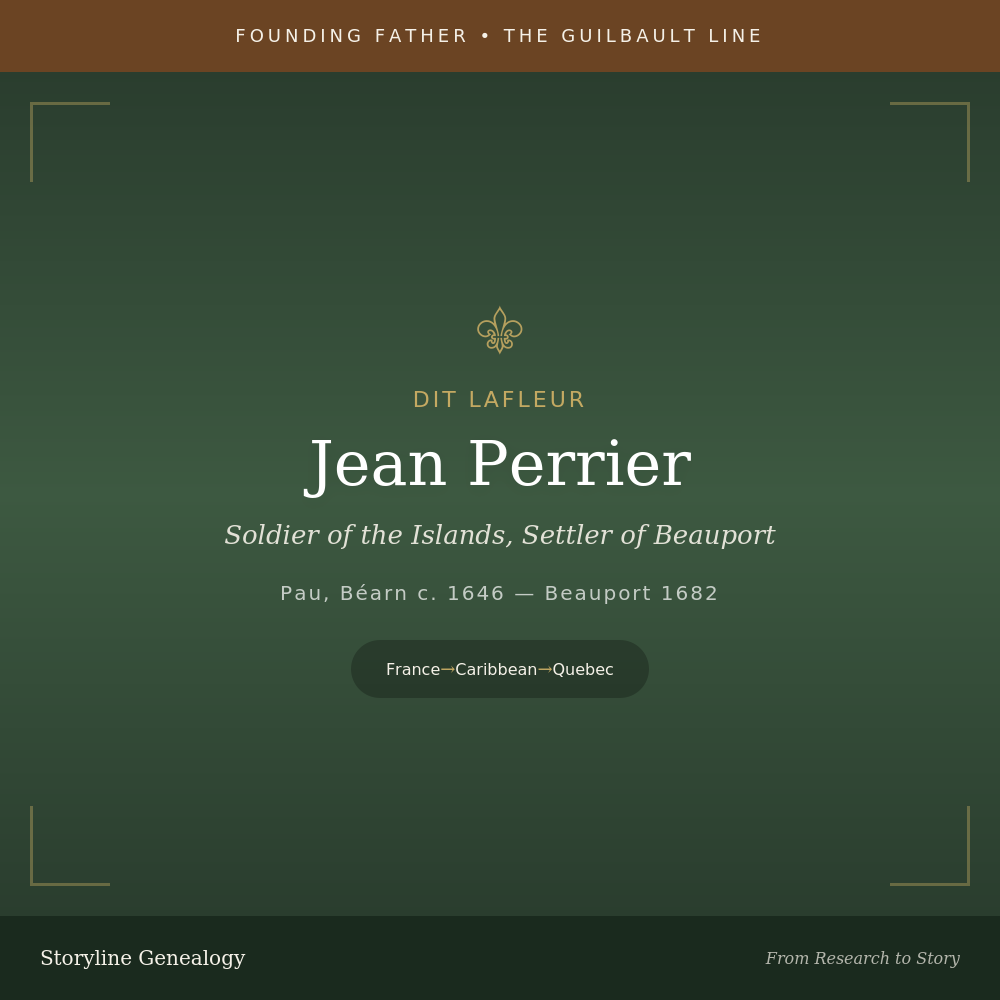
Jean Perrier dit Lafleur: Soldier of the Islands, Settler of Beauport
He sailed from La Rochelle to the Caribbean, survived the siege of Cayenne, built forts along the Richelieu, and chose to stay in New France when his regiment went home. Jean Perrier dit Lafleur died at thirty-five, leaving behind a widow, five young children, and a lineage that would number over a million descendants.
Part of the Storyline Genealogy series: Carignan-Salières — From Soldiers to Settlers
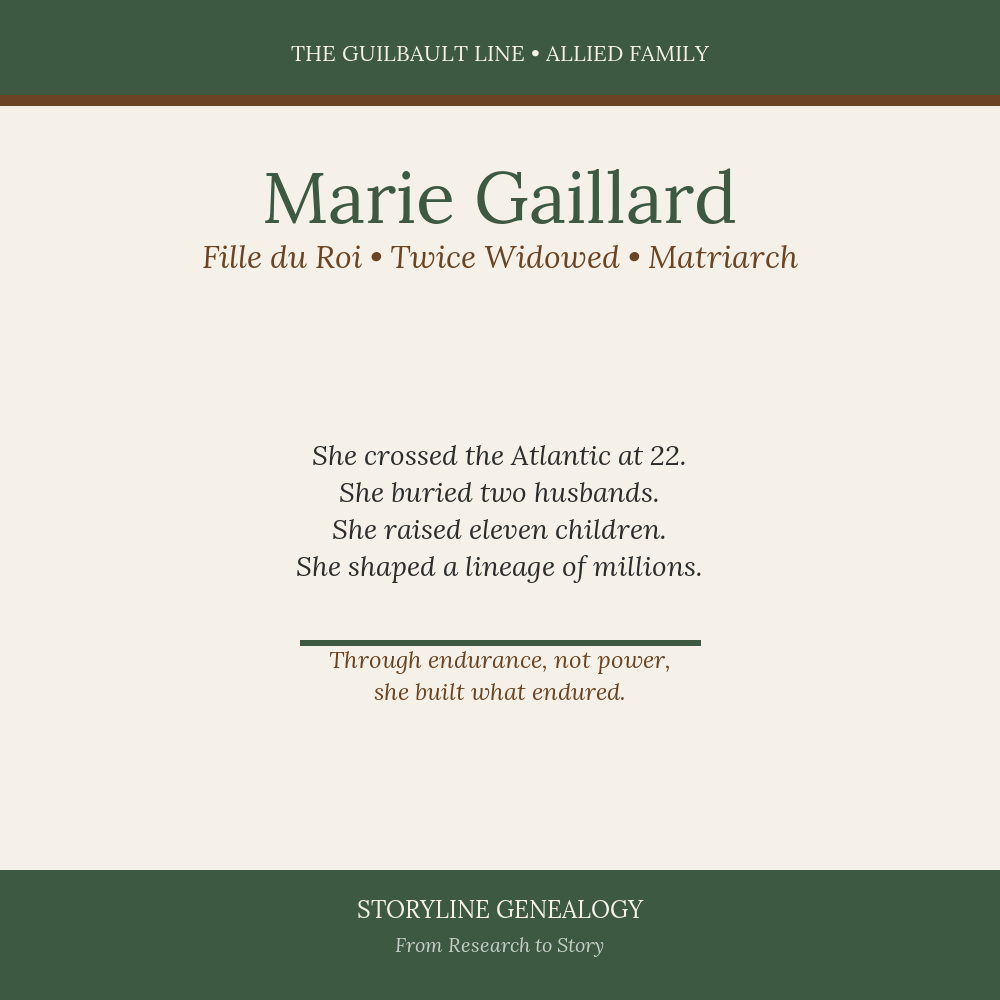
Marie Gaillard: Fille du Roi, Matriarch of Two Lines
Marie Gaillard, Fille du roi, widow twice over, and matriarch of two converging family lines, stands among the most consequential women of early New France. She crossed the Atlantic at 22, buried her first husband before she was 35, merged two families into a household of eleven children, watched her daughter marry her stepson, relocated westward to build a new life, and died at 89—having outlived nearly everyone she had ever known. Her descendants now number over a million Quebecers. Yet Marie left no letters, signed no documents. Her power was the power of survival, adaptation, and deliberate family-building in a world where women's choices were constrained but never irrelevant.
Part of the Storyline Genealogy series: Filles du Roi & Filles à Marier — The Women Who Built New France
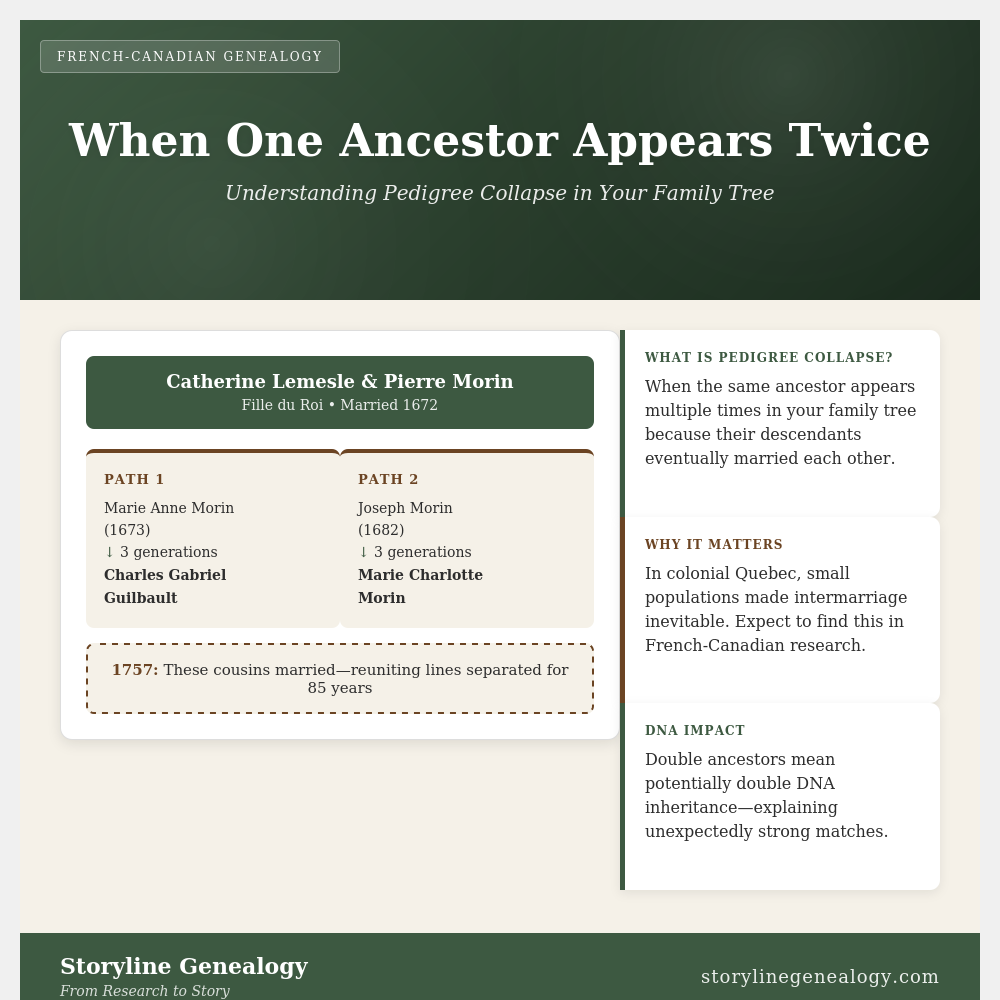
When One Ancestor Appears Twice: Catherine Lemesle
How does the same woman become your 8th great-grandmother twice? Discover pedigree collapse through Catherine Lemesle, a Fille du Roi whose descendants married each other 85 years later—and what this common phenomenon means for your French-Canadian research.
Part of the Storyline Genealogy series: Filles du Roi & Filles à Marier — The Women Who Built New France
The Seven Fires: Understanding Marie Josephte’s Ojibwe Heritage
Before French traders arrived at the St. Mary's Rapids, before the fur trade reshaped the Great Lakes, Marie Josephte Abitakijikokwe's ancestors had already completed a 500-year journey guided by prophecy—from the Atlantic coast to the land where food grows on water. To understand who she was, we must understand where her people came from.
Part of the Storyline Genealogy series: From Research to Story
Following the Canoe Routes: How the Fur Trade Families Moved Between the Interior and Quebec
Genealogists researching French-Canadian voyageurs often encounter a puzzling pattern: a man appears in Quebec records, disappears for years, then resurfaces—sometimes with a wife and children who seem to have materialized from nowhere. The explanation lies in the geography of the fur trade. Understanding how these families traveled helps you know where to look for records.
Part of the Storyline Genealogy Series: A Storyline Genealogy Research Guide
The North West Company: A Genealogist’s Guide to the “Pedlars from Quebec”
From 1779 to 1821, the North West Company employed thousands of French-Canadian men as voyageurs, paddlers, and laborers across a network stretching from Montreal to the Pacific. Their records survive—and they can tell you where your ancestor worked, what he earned, what he purchased, and who he may have married in the pays d'en haut.
Part of the Storyline Genealogy Series: A Storyline Genealogy Research Guide
Gabriel’s World: Life as a Voyageur in the Pays d'en Haut
What was it actually like to be a voyageur? To paddle 18 hours a day, carry 180 pounds across brutal portages, sleep under an overturned canoe, and spend years in the wilderness waiting to be paid? This was Gabriel Guilbault's life—and understanding it helps us understand the man behind the records.
Part of the Storyline Genealogy series: Documentary Biographies From Research to Story
Baawitigong: The Place of the Rapids
At the St. Mary's River, where Lake Superior tumbles twenty-one feet into the lower Great Lakes, two worlds met. For the Ojibwe, it was Baawitigong—the gathering place. For the voyageurs, it was the strategic gateway to the fur trade interior. Somewhere at this crossroads, Marie Josephte Abitakijikokwe and Gabriel Guilbault's lives first intersected.
Part of the Storyline Genealogy series: Documentary Biographies From Research to Story
Abitakijikokwe: The Woman Behind the Name
On January 26, 1801, Father Leclerc at L'Annonciation in Oka did something extraordinary: he recorded the full Ojibwe identity of an Indigenous bride—her personal spirit name Abitakijikokwe ("Half-Day Woman") and her tribal affiliation as Saulteaux of Lake Superior. This rare documentation preserved both identifiers when most priests simply wrote "Sauvagesse." Discover what her name means and why this record matters for Métis genealogy.
Part of the Storyline Genealogy series: When a name carries centuries of meaning.
Marriage à la façon du pays: The Unions That Built a Nation
During the 1700s and 1800s, marriages between French fur traders and Indigenous women were fundamental social and economic institutions in North America. These unions—called mariage à la façon du pays—created strategic alliances that facilitated the fur trade and led to the emergence of the distinct Métis culture. Learn where to find these families in the records, from Hudson's Bay Company Archives to Métis Scrip.
Part of the Storyline Genealogy series: Documenting the lives of our earliest ancestors through primary sources.
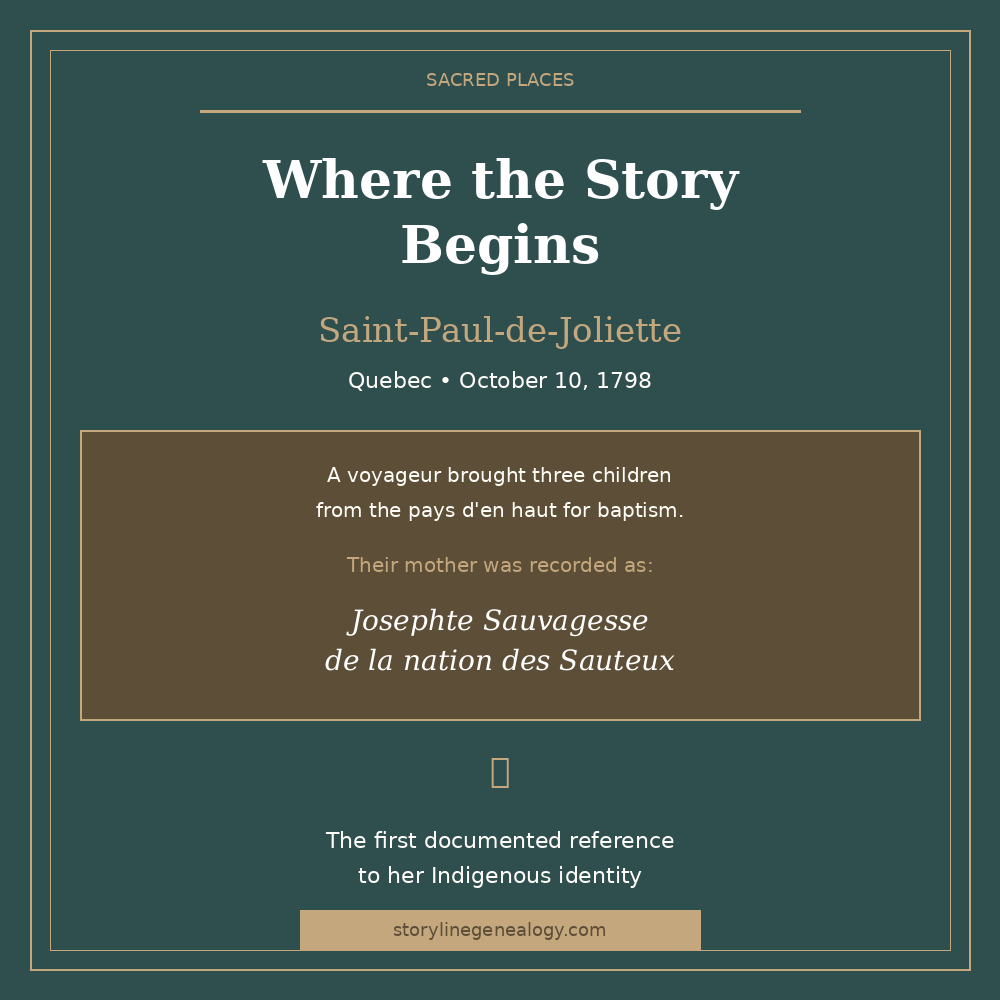
Saint-Paul-de-Joliette : Where the Story Begins
On October 10, 1798, a voyageur named Gabriel Guilbault brought three children to Saint-Paul-de-Joliette for baptism. They had been born and "ondoyé" (emergency baptized) in the pays d'en haut—the upper country of the fur trade. Their mother was identified as "Josephte Sauvagesse de la nation des Sauteux"—the first documented reference to her Indigenous identity. The story of Marie Josephte Abitakijikokwe begins here.
Part of the Storyline Genealogy series : Sacred Places
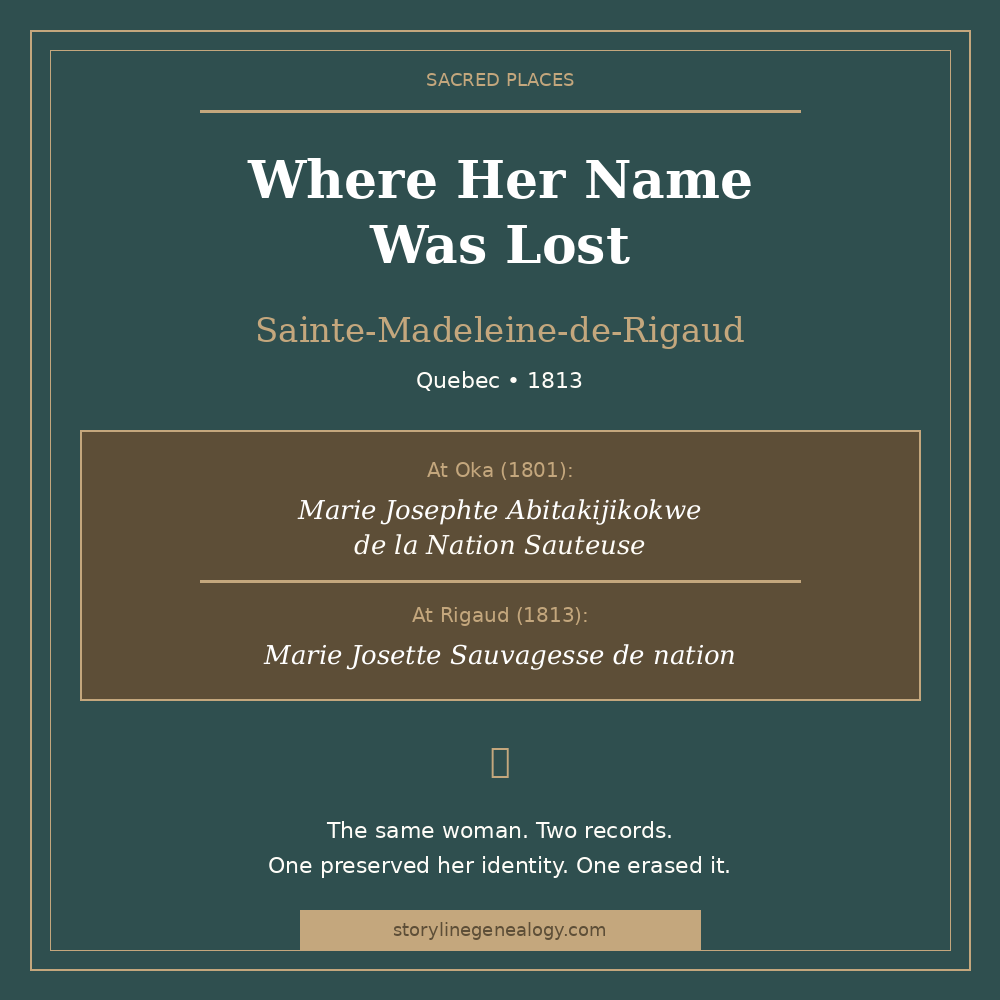
Sainte-Madeleine-de-Rigaud : Where Her Name Was Lost
In 1801, Father Leclerc at Oka carefully recorded her full Ojibwe name: Marie Josephte Abitakijikokwe de la Nation Sauteuse. Twelve years later, when she was buried at Rigaud, she had become simply "Marie Josette Sauvagesse de nation"—an Indigenous woman, unnamed. The contrast tells the story of colonial record-keeping and the erasure of Indigenous identity.
Part of the Storyline Genealogy series : Sacred Spaces
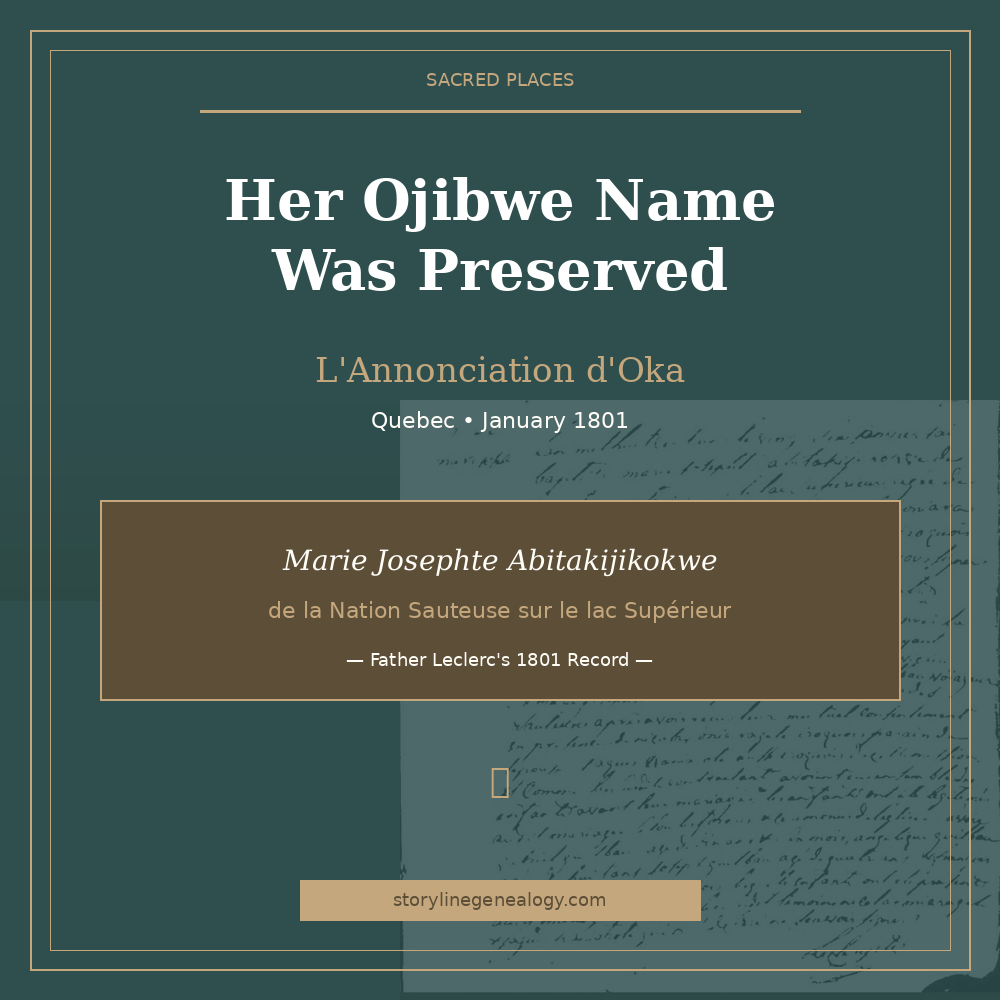
L’Annonciation d’Oka : Mission of the Lake of Two Mountains
For three centuries, this Sulpician mission has stood at the confluence of Indigenous and French Canadian cultures. Here, on January 27, 1801, Father Leclerc did something extraordinary: he recorded the full Ojibwe name of an Indigenous bride—Marie Josephte Abitakijikokwe de la Nation Sauteuse sur le lac Supérieur—preserving her identity when most priests simply wrote "Sauvagesse."
Part of the Storyline Genealogy series : Sacred Spaces