
Gabriel’s World: Life as a Voyageur in the Pays d'en Haut
Gabriel's World
What was it actually like to be a voyageur? To paddle 18 hours a day, carry 180 pounds across brutal portages, sleep under an overturned canoe, and spend years in the wilderness waiting to be paid? This was Gabriel Guilbault's life—and understanding it helps us understand the man behind the records.
Gabriel Guilbault
c. 1762 – 1833
The records call him “voyageur.” A baptism register at Saint-Paul-de-Lavaltrie in October 1798 says it outright: voyageur et maintenant agriculteur — voyageur, and now farmer, the curé catching him mid-transition. But that single word contained an entire world of experience the records never describe.
Gabriel Guilbault spent roughly a decade in the interior, from about 1789 into the late 1790s. We know because of where his children were born — three of them in the pays d’en haut, carried down to Quebec and baptized together in one sitting in 1798. To understand the man, we need to understand what that life demanded.
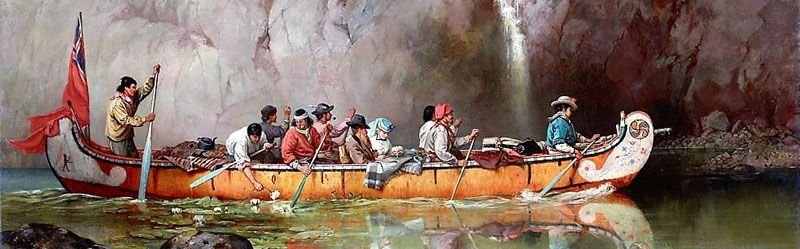
Frances Anne Hopkins traveled the canoe routes herself and painted what she saw with near-photographic accuracy. This is as close as we can get to seeing what Gabriel's working life looked like—the crowded canoe, the synchronized paddling, the endless water stretching ahead.
Two Kinds of Voyageurs
The fur trade companies divided their paddlers into two classes, and the distinction shaped every aspect of a man's life.
Seasonal workers who paddled the Montreal-to-Fort William route each summer. Named dismissively after their diet of salt pork and dried peas. They returned home each winter to their farms and families in the St. Lawrence valley—never venturing past Lake Superior.
Route: Montreal → Fort William
Contract: Single season
Canoe: Canots du maître (35-40 feet, 8-10 paddlers)
Multi-year contract workers who served in the interior—the pays d'en haut. Many married Indigenous women, started families, and never returned to Quebec. They became the ancestors of the Métis nation. This was Gabriel's world.
Route: Fort William → Interior posts
Contract: 3-5 years (or permanent)
Canoe: Canots du nord (25-30 feet, 5-6 paddlers)
Gabriel Guilbault was an homme du nord, and the register proves it rather than merely suggesting it. Three of his children were born and privately baptized in the pays d’en haut — Gabriel about June 1790, Angélique about 1792, Joseph Claude about June 1797 — and all three were entered at Saint-Paul-de-Lavaltrie on 10 October 1798, each act stating the interior birth explicitly. A man who fathers three children in the interior across eight years is not a seasonal paddler who left in May and came home in September. He was living where he worked.
That distinction has a long shadow. The men who came home each autumn appear in their parish registers like everyone else. The men who stayed out do not — which is why a winterer’s career is so often invisible in Quebec, and why the fur trade records that might document it are so often ambiguous about which man they mean.
"The voyageurs were the essential 'blue-collar' workers of the fur trade. They were the men who paddled, portaged, and provisioned the vast commercial network that stretched from Montreal to the Pacific."
The Work: What Gabriel Did Every Day
A voyageur's job was simple to describe and brutal to perform: transport furs and trade goods across thousands of miles of lakes, rivers, and portages. The physical demands were extraordinary—and relentless.
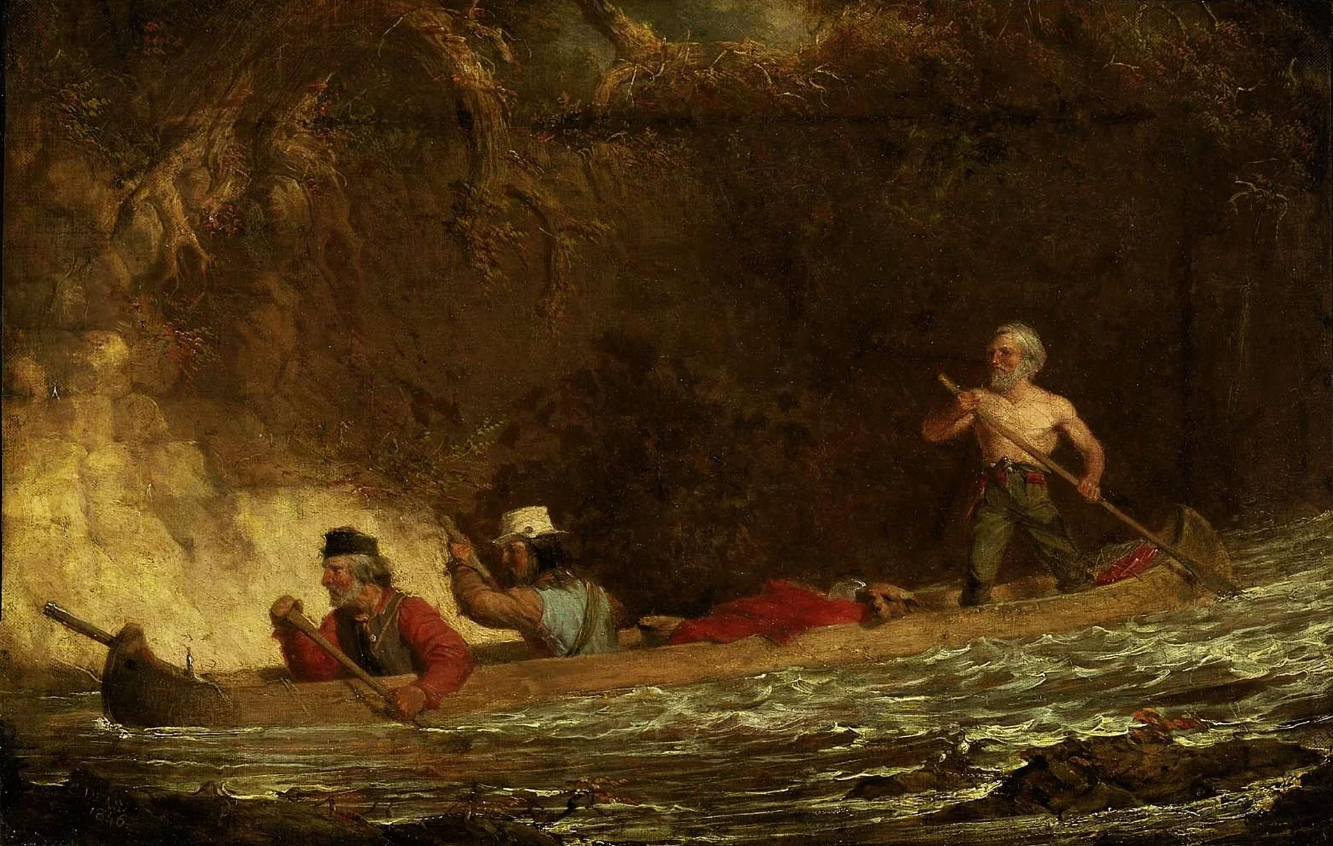
Charles Deas's 1846 painting The Voyageurs captures the dramatic, dangerous work of navigating rapids. The man standing at the stern, controlling the canoe with a long steering paddle, held the lives of everyone aboard in his hands. One wrong move in fast water could kill them all.
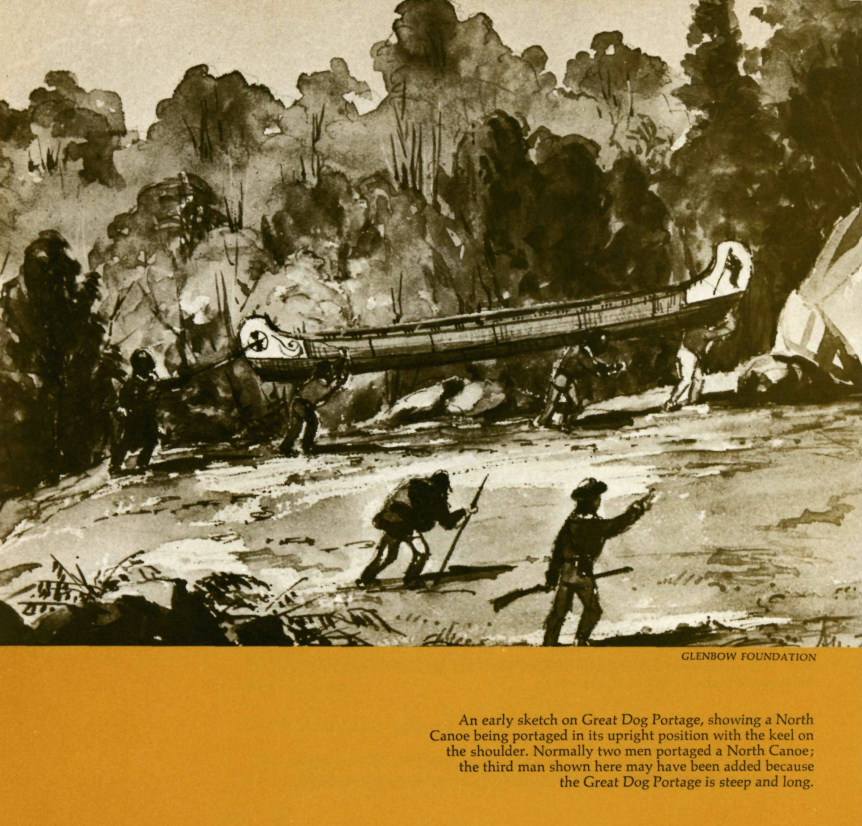
An early sketch of the Great Dog Portage shows a North Canoe being portaged in its upright position, the keel resting on the men's shoulders. Normally two men carried a canoe; the third man here may have been added because this portage—on the route Gabriel would have traveled—was steep and long. (Glenbow Foundation)
The image has become iconic: a rugged French-Canadian man wearing a red or blue tuque (knit cap), a brightly colored ceinture fléchée (arrow-head sash), moccasins, a loose linen shirt, and leather leggings. Short and compact—the canoes were cramped, and smaller men fit better. Weathered skin from years of sun and wind. Calloused hands from the paddle. And a reputation for being hardy, cheerful, and proud of work that would have broken most men.
The Contract System: Debt and Dependency
When a voyageur committed to the North West Company, he went before a notary and signed an employment contract specifying his duties, wages, and term of service. The contracts survive in archives—thousands of them—and they reveal a system that often trapped men in perpetual debt.
Voyageurs bought supplies on credit from company stores at post prices — clothing, tools, tobacco, alcohol — and the balance followed them from contract to contract. Wages were credited on one side of an account, purchases debited on the other, and a man could finish a season owing more than he had earned. Payment was often years in arriving. Contemporary observers of the trade reported large numbers of Montreal-engaged men carrying debts far exceeding what their remaining contracts could ever repay.
Not every man ended that way. Some closed their accounts in credit, and one account examined for this research settled with the company owing the man 336 livres rather than the reverse. But the structure of the system made the other outcome easy, and common.
When the account books were eventually retrieved and read, one leaf showed exactly this in miniature. A single day’s outfitting at Lac La Pluie in July 1820, bought on credit at the post store: a cloth capot at 40, a common cotton shirt at 12, half a pound of soap, cold thread, a horn comb, six needles and six flints, a yard and a half of fine calico, a large black silk handkerchief, a trunk and three cords, two pints of rum — and a portage sling at 6, the one item on the list that only a working canoeman buys. The run foots at 133 livres, charged against wages not yet earned.
Whose day that was turns out to be a harder question than it looked, and it is the subject of a separate study. But the shape of the thing is exactly what the contracts describe: a man outfitting himself for the interior, on the company’s credit, before the season began.
The Currency of the Wilderness
The voyageurs transported trade goods west and furs east. But what exactly were they carrying? The unit of trade was the "made beaver" (MB)—equal to a prime beaver pelt or its equivalent. The price lists below were typical for the late 1700s, the very years when Gabriel was working in the trade:
What One "Made Beaver" Could Buy
These were the goods Gabriel carried in his canoe, paddled across lakes, and portaged over trails. Glass beads, gunpowder, knives, blankets, buttons—manufactured items from Britain that Indigenous traders wanted, exchanged for the beaver pelts that European markets craved. Gabriel was a link in this chain, his labor measured in beaver skins and the goods they could buy.
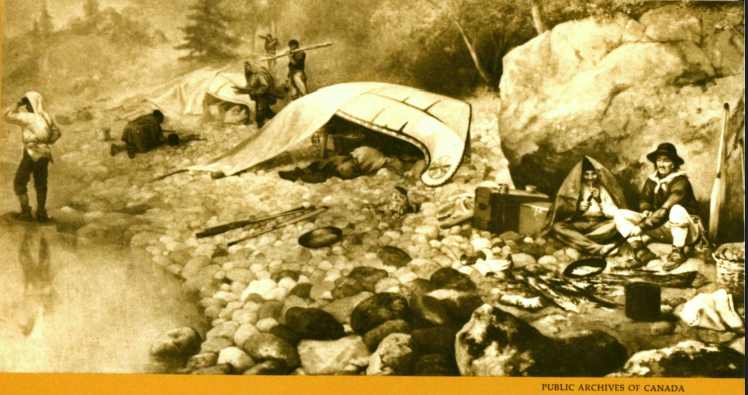
Frances Anne Hopkins's "Bivouac of a Canoe Party" shows the evening routine: wood-gathering, cooking over open fires, defense against insects, and sleeping arrangements under overturned canoes. Note the two different paddle types at right—those used by the milieux (middle paddlers) and the bouts (end paddlers). (Public Archives of Canada)
Marriage in the Pays d'en Haut
For an homme du nord like Gabriel, marriage to an Indigenous woman wasn't unusual—it was expected. These weren't casual relationships. They were marriages, recognized by Indigenous custom, essential to the trade, and productive of children, communities, and an entirely new people: the Métis.
"The first Métis were the offspring of 'country marriages' between North West Company voyageurs and traders and Indigenous women in western Canada."
Gabriel's union with Marie Josephte Abitakijikokwe—an Ojibwe woman of the Saulteaux Nation on Lake Superior—followed this pattern. They lived together "à la façon du pays" for over a decade, raising at least four children before formalizing their marriage in a Catholic ceremony at Oka in January 1801.
These marriages served practical purposes too. Indigenous wives provided voyageurs with kinship connections to trading partners, knowledge of local languages and customs, and the survival skills—processing food, making and repairing clothing, maintaining equipment—that kept men alive in the wilderness. The fur trade depended on these relationships. So did Gabriel.
The Man Behind the Records
Gabriel Guilbault spent roughly a decade in the interior. He paddled thousands of miles and carried cargo on his back — and the proof is not a company account book. It is three children born and privately baptized in the pays d’en haut, entered at Lavaltrie in a single sitting in October 1798, their father styled voyageur et maintenant agriculteur in the same line.
A parish register documented a wintering career that no company record in this file captures. The records call him voyageur. Now you know what the word meant.
Continue the Story
Baawitigong: The Place of the Rapids →
The St. Mary's River crossroads where Gabriel and Marie Josephte's worlds first met.
Abitakijikokwe: The Woman Behind the Name →
What Father Leclerc's 1801 record preserved about Marie Josephte's Ojibwe identity.
The North West Company: A Genealogist's Guide →
How to find your voyageur ancestor in the NWC records.
Want to Know When New Stories Are Published?
Subscribe to receive updates on new family history research—no spam, just meaningful stories when there's something worth sharing.
SUBSCRIBE TO OUR NEWSLETTEREvery Family Has a Story Worth Telling
Whether you're just beginning your research or ready to transform years of work into a narrative your family will treasure, I'd love to help.
LET'S TALK ABOUT YOUR FAMILY