
Sainte-Madeleine-de-Rigaud : Where Her Name Was Lost
Rigaud, Vandreuil-Soulanges, Quebec
Sainte-Madeleine-de-Rigaud
In 1801, Father Leclerc at Oka carefully recorded her full Ojibwe name: Marie Josephte Abitakijikokwe de la Nation Sauteuse. Twelve years later, when she was buried at Rigaud, she had become simply "Marie Josette Sauvagesse de nation"—an Indigenous woman, unnamed. The contrast tells the story of colonial record-keeping and the erasure of Indigenous identity.
The Guilbault Family at Sainte-Madeleine-de-Rigaud
Status: Legitimate wife of Gabriel Guilbeault, Mason
Residence: Seigneury of Argenteuil
Witnesses: Gabriel Guilbeault (husband), Ignace Poiriault père, François Décardoy
Priest: A.C. Labroquerie
Died June 23, 1813 "d'avant'hier au soir" (the evening before yesterday). Buried in the mission cemetery nine years before the first permanent church was built.
Bride: Josette Closier, of age, day laborer (journalière)
Witnesses: Joseph Ménard (father-in-law), Joseph Guilbeault (son), J. Bte. Dupuis, and others
Priest: A.C. Labroquerie
Less than two years after Marie Josephte's death, Gabriel remarried. His son Joseph—legitimized at Oka in 1801—was present as a witness.
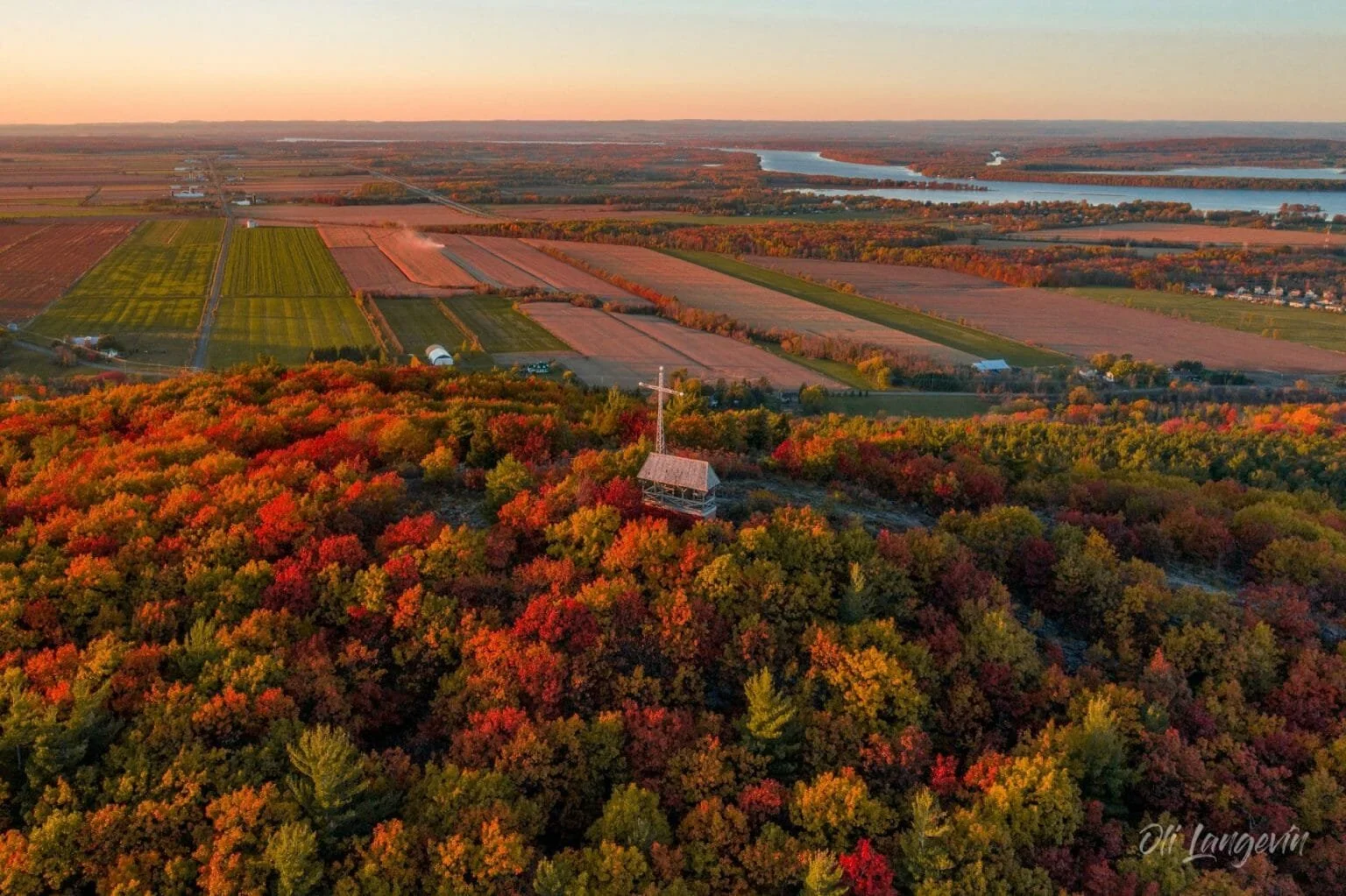
Église Sainte-Madeleine-de-Rigaud today, with its distinctive twin spires of red granite. The current church, built 1917-1920, replaced the 1822 structure where Gabriel Guilbeault remarried in 1815—and stands near the mission cemetery where Marie Josephte was buried in 1813.
The journey from Oka to Rigaud is only about 25 kilometers along the shores of Lake of Two Mountains. But for Marie Josephte Abitakijikokwe, that short distance marked the boundary between being named and being forgotten. At Oka, a careful priest preserved her identity; at Rigaud, another priest—perhaps hurried, perhaps indifferent—reduced her to a category: "Sauvagesse de nation."
She died on the evening of June 23, 1813, at approximately fifty years of age. She had been Gabriel Guilbeault's wife for over two decades, first "à la façon du pays" in the fur trade territories, then legitimately before the Church since 1801. She had borne him at least seven children. She had made the transition from the Indigenous world of Lake Superior to the settled farms of the St. Lawrence Valley. And when she was laid to rest in the mission cemetery at Rigaud, all of that was compressed into four words: Sauvagesse de nation.
The Contrast That Tells the Story
At Oka (1801):
At Rigaud (1813):
The same woman. The same Church. Two very different acts of record-keeping—one preserving identity, one erasing it.
The Seigneury of Rigaud
The Seigneury of Rigaud was granted in 1732 to the brothers Pierre and François-Pierre de Rigaud de Vaudreuil, governors in New France. Located on the south shore of the Ottawa River at its junction with Lake of Two Mountains, the territory encompassed what would become the parishes of Sainte-Madeleine, Sainte-Marthe, Très-Saint-Rédempteur, and Saint-François-Xavier de Pointe-Fortune.
Rigaud sits on traditional Algonquin land—the same peoples who, along with the Nipissing and various Iroquoian nations, populated the mission at Oka. The Algonquins had largely fled the region before French arrival due to Iroquois conflicts. When the first European settlers arrived in 1783—families named Chevrier, Gauthier, Quesnel, Séguin, and Villeneuve—they found a land shaped by Indigenous presence but largely emptied of Indigenous people.
The seigneury changed hands in 1763, sold to Michel Chartier de Lotbinière, who gave it to his son in 1771. The parish takes its name from Louis-Madeleine Chaussegros de Léry, seigneuress and widow of the Marquis de Lotbinière. By the early 19th century, Rigaud had developed rapidly as an accommodation relay for loggers and a loading point for timber and cereals traveling down the Ottawa River.
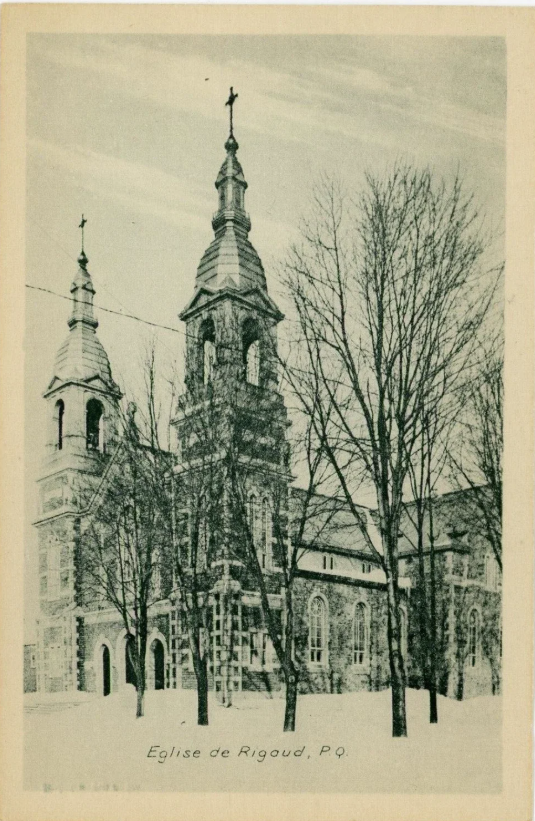
Vintage postcard: "Eglise de Rigaud, P.Q." showing the current church in winter, circa 1920s-1930s. The red granite façade, quarried locally by the Rigaud Granit Company, gives the building its distinctive warm color.
From Mission Chapel to Parish Church
In 1795, the parish priest of Vaudreuil celebrated Mass once a month at Rigaud "in a decent house." A chapel was built in 1800 and consecrated on December 22, 1801. On October 1, 1804, the first resident priest, Abbé Clément-Amable Boucher de la Broquerie, was appointed to serve the mission. The parish registers—the documents that would record Marie Josephte's burial—begin in 1802.
The same priest—Father Labroquerie—recorded both Marie Josephte's burial in 1813 and Gabriel's remarriage in 1815. In both documents, he referred to her simply as "Sauvagesse de nation." Unlike Father Leclerc at Oka, who took the time to record her full Ojibwe name and tribal affiliation, Father Labroquerie used the generic colonial term that reduced all Indigenous women to a single category.
The first permanent church was contracted in 1819 and opened for worship in July 1822—nine years after Marie Josephte was buried in the mission cemetery. The building measured 110 feet deep by 40 feet wide, with a 30-foot bell tower topped by an iron cross and iron rooster. The wood came from the forested lands of Rigaud Mountain; the stone from a nearby quarry.
Timeline: Sainte-Madeleine-de-Rigaud
June 25, 1813: A Name Lost
Marie Josephte died on the evening of June 23, 1813. Two days later, her body was carried to the mission cemetery at Rigaud and laid to rest. Gabriel Guilbeault—her husband of over two decades—was present, along with Ignace Poiriault père and François Décardoy. None of them could sign their names.

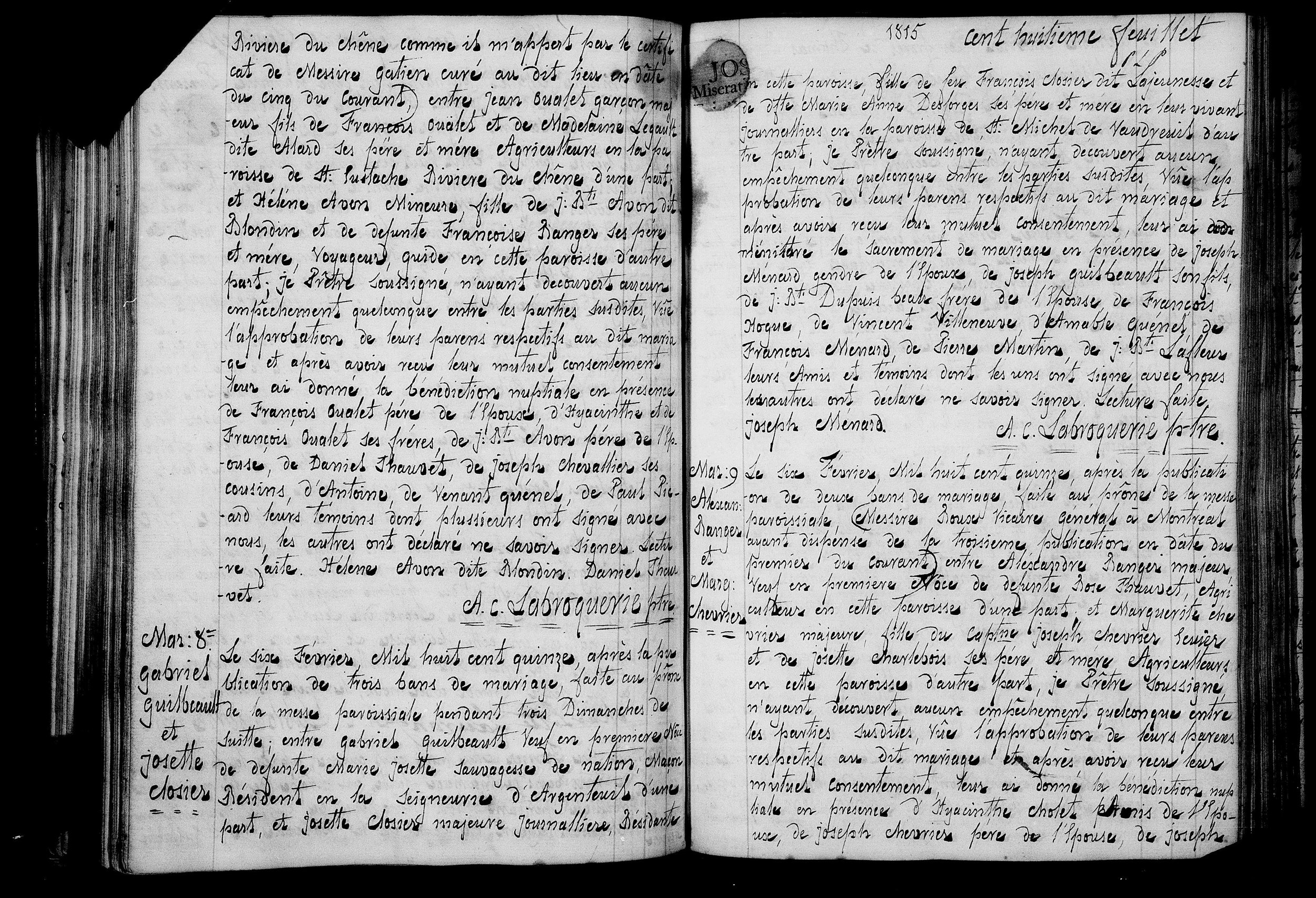
Detail from the burial record: "Marie Josette Sauvagesse de nation... Epouse légitime de Gabriel Guilbeault Maçon." Her Ojibwe name—Abitakijikokwe—goes unrecorded.
Marie Josette, Sauvagesse de nation
Deceased: Marie Josette, Sauvagesse de nation
Status: Munie des Secours de l'Eglise (received Last Rites)
Age: Approximately 50 years
Relationship: Épouse légitime de Gabriel Guilbeault, Maçon (legitimate wife of Gabriel Guilbeault, Mason)
Residence: Seigneury of Argenteuil
Date of Death: "décédée d'avant'hier au soir" (died the evening before yesterday—June 23)
Witnesses: Gabriel Guilbeault (mari de la défunte), Ignace Poiriault père, François Décardoy
February 6, 1815: Life Continues
Less than two years after Marie Josephte's death, Gabriel Guilbeault returned to the mission church at Rigaud—this time to marry again. His new bride was Josette Closier, a day laborer (journalière) of legal age. The same priest who had buried Marie Josephte now united Gabriel with his second wife.
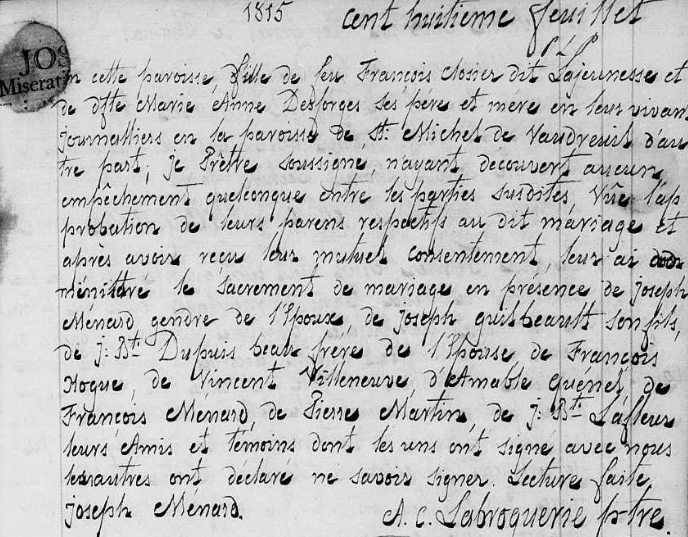
Detail from the 1815 marriage record: Gabriel described as "veuf en premières noces de défunte Marie Josette Sauvagesse de nation" (widower from first marriage to the late Marie Josette, Indigenous woman by nation).
Gabriel Guilbeault & Josette Closier
Groom: Gabriel Guilbeault, veuf en premières noces de défunte Marie Josette Sauvagesse de nation, Maçon, Résident en la Seigneurie d'Argenteuil (widower from first marriage to the late Marie Josette, Indigenous woman by nation, Mason, resident in the Seigneury of Argenteuil)
Bride: Josette Closier, majeure journalière (of age, day laborer)
Witnesses: Joseph Ménard (gendre de l'Epouse—father-in-law of the groom?), Joseph Guilbeault (son fils—his son), J. Bte. Dupuis (beau frère de l'Epouse—brother-in-law), François Hogue, Vincent Villeneuve, Amable Quesnel, François Ménard, Pierre Martin, J. Bte. Lafleur
Priest: A.C. Labroquerie
The Church Today
The current Église Sainte-Madeleine-de-Rigaud was built between 1917 and 1920, replacing the original 1822 structure. Designed by Montreal architects Louis-Zéphirin Gauthier and Joseph-Égilde-Césaire Daoust in the Corinthian style with Italian and neoclassical influences, the church was inaugurated on September 19, 1920 by Bishop Émard of the Diocese of Valleyfield, who described it as "the richest temple in the diocese."
Then & Now
The façade is made of red granite extracted from the quarry of the Rigaud Granit Company, located just behind the current cemetery. Renowned artisans completed the interior: the decoration was entrusted to Quebec artist Toussaint-Xénophon Renaud; the stained glass windows, installed in 1925, are by Italian-born artist Guido Nincheri; the high altar, side altars, and communion table are by Montreal sculptor Thomas Carli. The choir loft features a Casavant organ, opus 838.
Rigaud Mountain dominates the landscape, its ancient forest home to one of the only two old-growth stands in the Suroît region. The Guilbault family, residing in the neighboring Seigneury of Argenteuil, would have known these slopes well.
Visiting the Site
Address: 4 Rue Saint-Jean-Baptiste Est, Rigaud, QC J0P 1P0
Setting: Located on the shores of Lake of Two Mountains, at the confluence with the Ottawa River—the same waterway that connected Rigaud to Oka and, beyond, to the fur trade routes of the pays d'en haut
Note: The mission cemetery where Marie Josephte was buried in 1813 predates the current church by over a century. The exact location of her grave is unknown.
Document Gallery

✦ Free Download: Five Signs of Indigenous Ancestry in Quebec Parish Records
Learn the phrases, naming patterns, and record clues that reveal Indigenous ancestors hidden in Quebec parish records—the same methodology that identified Marie Josephte Abitakijikokwe. Includes FamilySearch Full Text Search strategies.
Get Your Free GuideEvery Family Has a Story Worth Telling
Whether you're just beginning your research or ready to transform years of work into a narrative your family will treasure, I'd love to help.
LET'S TALK ABOUT YOUR FAMILY