
Abitakijikokwe: The Woman Behind the Name
Abitakijikokwe
On January 26, 1801, Father Leclerc at L'Annonciation in Oka did something extraordinary: he recorded the full Ojibwe identity of an Indigenous bride — her personal spirit name and her tribal affiliation — preserving both for posterity when most priests simply wrote "Sauvagesse."
What Father Leclerc Preserved
de la Nation Sauteuse sur le lac Supérieur
For most Indigenous women who married French-Canadian voyageurs, history recorded only a single word: Sauvagesse. No name. No nation. No origin. Just a generic French term meaning "Indigenous woman." But in January 1801, at the Sulpician mission of L'Annonciation at Oka, a priest named Leclerc took the time to ask — and to listen — and to write down the full identity of the woman standing before him.
That act of attention preserved something genealogically priceless: both Marie Josephte's personal Ojibwe spirit name and her tribal affiliation. Fewer than 0.1% of Indigenous ancestors have such thorough documentation. For her descendants — including me — this record opens a door to understanding who she was and where she came from.
Two Identities, One Woman
Father Leclerc's record gives us two distinct pieces of information about Marie Josephte's Indigenous identity — each carrying its own meaning and significance.
This name is built from three Algonquian roots, each of which carries layered meaning:
Abita- meaning "half" or "halfway" — positioned in the middle of something
-kijik- meaning cedar, sky, and day simultaneously — and in the Saulteaux dialect specifically, also sky/heaven, the firmament — a single word holding the tree, the heavens, and the light all at once
-kwe meaning "woman"
In Anishinaabe tradition, spirit names were often received through ceremony and carried throughout life. A name connecting a woman to the cedar — medicinal tree of the forest — and to the sky suggests a spiritually significant identity, someone positioned at the threshold between earth and sky.
The Saulteaux (also called Saulteurs) were Ojibwe people associated with Sault Ste. Marie — Baawitigowininiwag in Ojibwe, meaning "People of the Rapids."
French explorers called them Saulteurs (from saut, meaning "leap" or "waterfall") because they lived at the 21-foot drop where Lake Superior flows into the St. Marys River.
This tribal designation tells us she came from the Lake Superior Ojibwe — expert navigators, traders, and the people who controlled the strategic Straits of Mackinac.
Research into the Algonquian lexique of Jean-André Cuoq — the nineteenth-century linguist who documented the language of the Oka Mission community — reveals that kijik is a single root carrying meanings that in English require separate words. Cuoq records two primary entries for KIJIK on page 159 of his 1886 Lexique de la Langue Algonquine, with a critical footnote that adds a third:
| Root | Cuoq's Definition | Significance |
|---|---|---|
| kijik (1) | jour, journée — day, the time the sun is above the horizon | Time: the full arc of the sun from horizon to horizon |
| kijik (2) | cèdre — cedar (Thuia occidentalis) | Tree: medicinal, sacred, the wood of the forest edge |
| kijik (3) | ciel, firmament, séjour des Bienheureux — sky, heaven | Cuoq's footnote: present specifically in the Sauteux and Ottawa dialects. Locative: kijikong — used to render "qui es in caelis" in the Pater Noster. Marie Josephte was Saulteux: she carried this meaning with her name. |
| kij— (root) | chaleur — heat; perfection, ouvrage bien fini — completion; ripeness | Related root (Cuoq pp. 156–157): the solar field underlying all three kijik meanings — the heat of midday producing the ripe, completed day beneath the cedar and beneath the sky. |
| kije | grand (grandeur morale) — great, moral greatness | Related root: used in chiefly titles — Kije ininiwak = les Chefs de la Tribu; Kije ikwewak = les Cheffesses |
That a single root holds cedar, sky, and day simultaneously is not a translation difficulty — it is a feature of Algonquian worldview. The cedar tree, which grows at the water's edge and reaches toward the sky, is linguistically fused with the heavens and with light. When Father Leclerc wrote "Abitakijikokwe," he preserved a name that resists any single English rendering. "Half-Sky Woman" captures one truth. "Halfway in the Cedar" captures another. "Woman in the Middle of the Day" captures a third. And for Marie Josephte specifically — a Saulteux woman — all four senses were simultaneously present in the word she had been carrying since before she arrived at Oka.
For a full exploration of the kijik naming tradition at Oka Mission and the 55 documented individuals who bore this root across five nations, see: A Name Written in Cedar and Sky: The Kijik Naming Tradition at Oka Mission, 1786–1913 →
Spirit names carried deep personal and ceremonial significance that cannot be fully captured in any English translation. What we can say with confidence is that this appears to be a vision name — one that connects Marie Josephte to the threshold between earth and sky, between the forest floor and the canopy. Historical French records sometimes rendered this name as "Abitakijikok8e," with the "8" being Jesuit shorthand for the soft "ou" or "w" sound common in Algonquian languages. The name appears in nine primary records at Oka Mission under ten different spellings, recorded by three different priests over nineteen years.
Colonial priests typically had no interest in Indigenous names or tribal affiliations. A woman like Marie Josephte would usually appear in records only as "Sauvagesse" or "une femme sauvage." Father Leclerc's careful documentation — her personal name, her nation, her approximate age, her geographic origin — represents an exceptional act of record-keeping that preserved her identity when so many others were erased.
The 1801 Record at L'Annonciation


L'Annonciation d'Oka: Then & Now
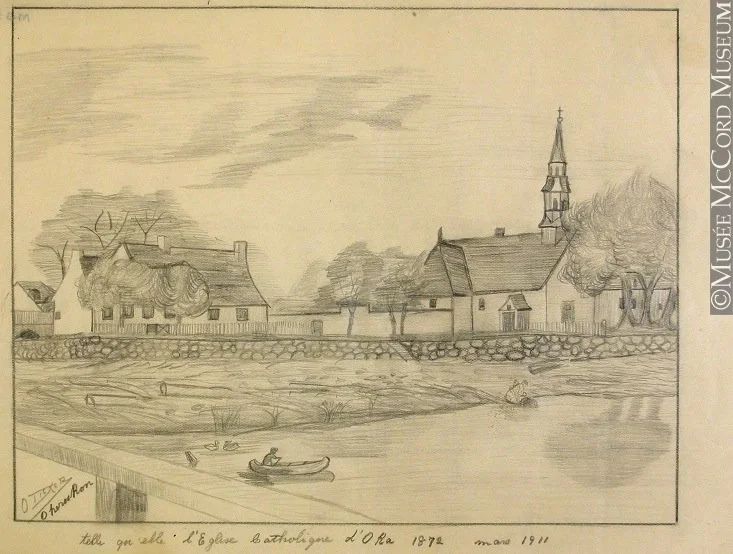
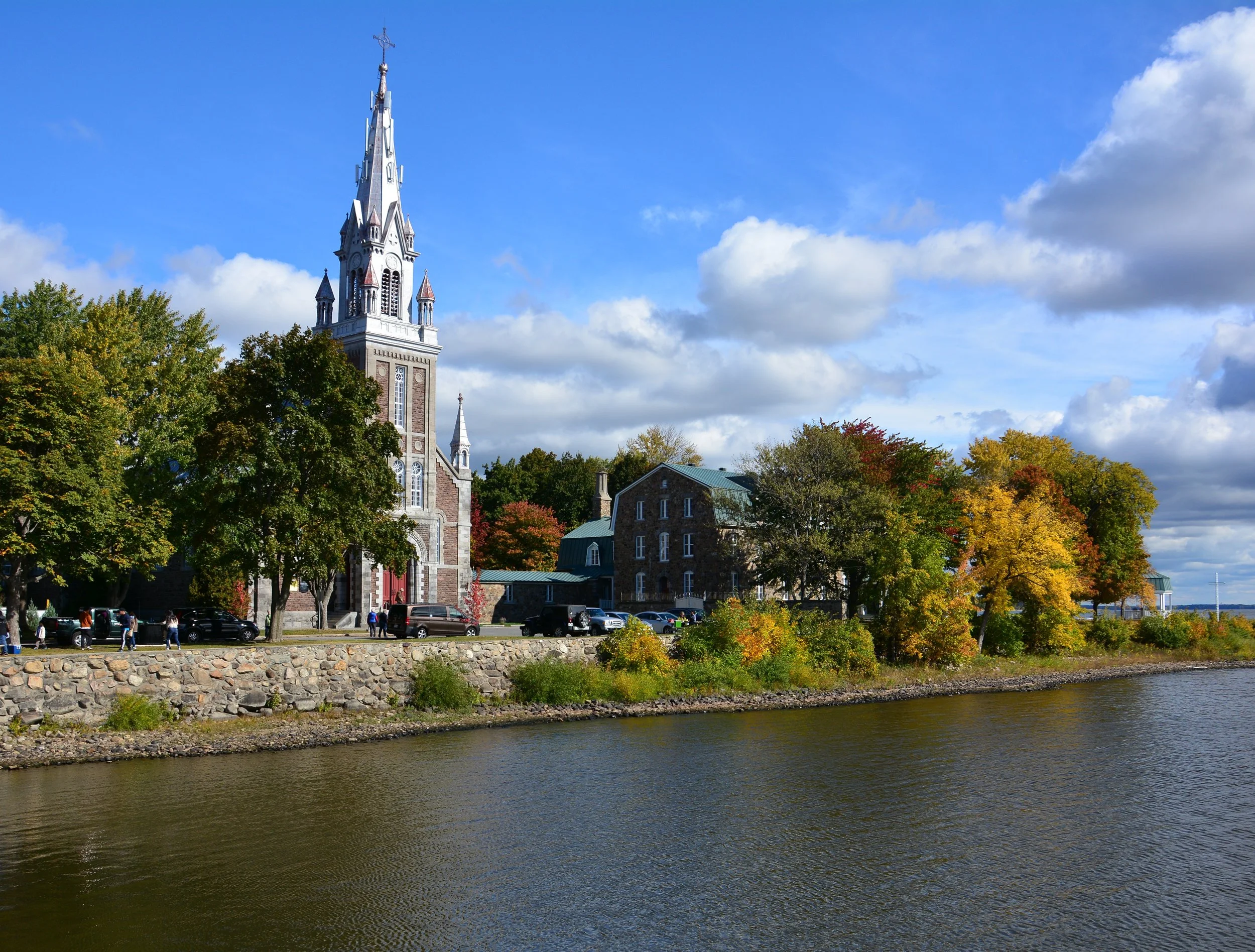
The Saulteaux: People of the Rapids
Marie Josephte's tribal designation — de la Nation Sauteuse sur le lac Supérieur — connects her to one of the most strategically important Indigenous nations in the fur trade. The Saulteaux controlled the crucial waterways around Sault Ste. Marie, where Lake Superior's waters drop into the St. Marys River through turbulent rapids.
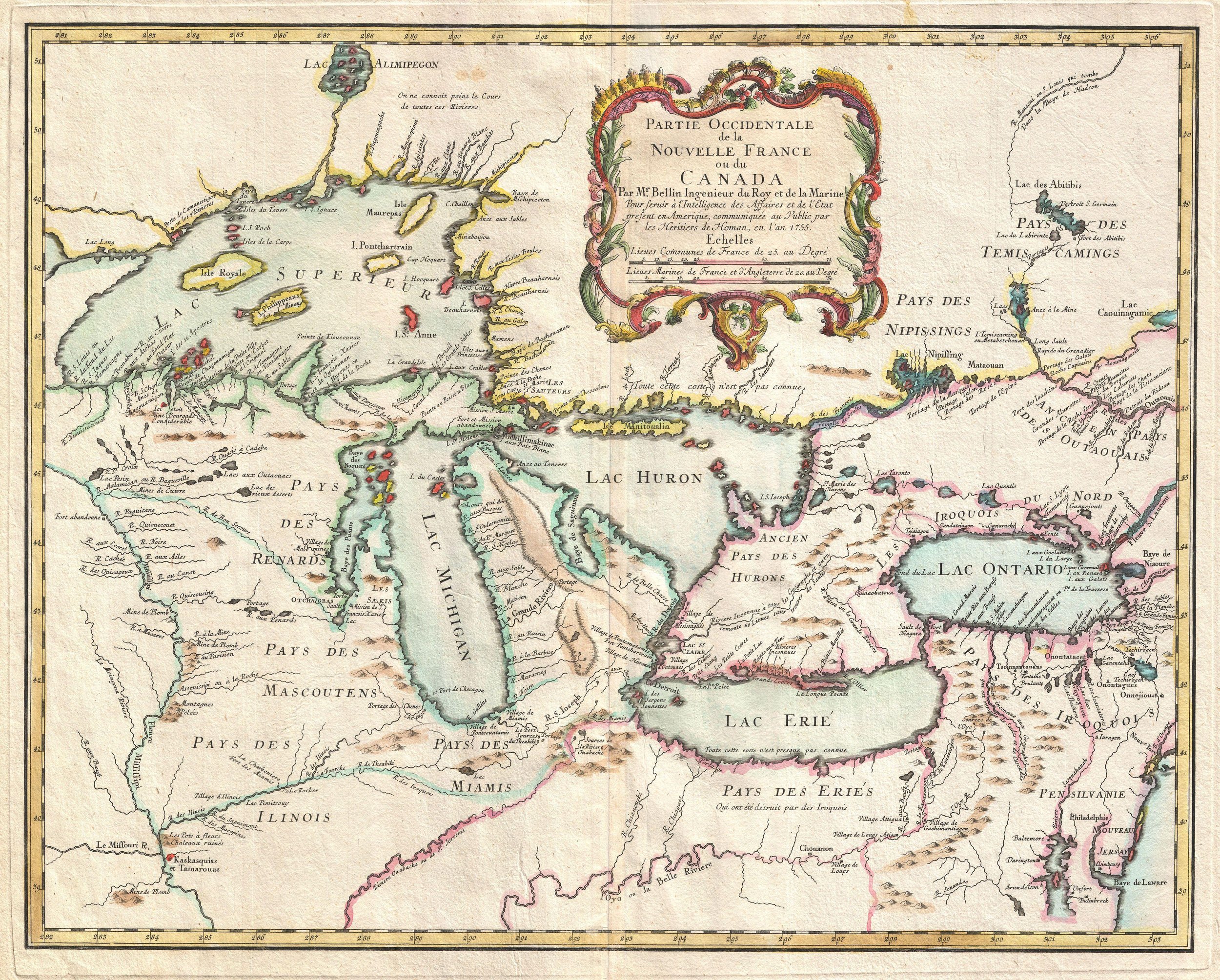
A 1755 map by Jacques Nicolas Bellin showing the Great Lakes region. Lake Superior (upper left) was the homeland of Marie Josephte's people, the Saulteaux — the "People of the Rapids" who controlled the strategic waterways of the fur trade.
The French called these Ojibwe people Saulteurs ("Leapers" or "Jumpers") because of their remarkable ability to navigate the dangerous rapids at Sault Ste. Marie. Standing in birchbark canoes, they would "jump" through the boiling water using long poles and dip nets to catch massive amounts of whitefish. They also served as "Rapids Pilots," guiding fur traders safely through the fast-moving water. This geographic and navigational expertise made them invaluable partners — and formidable negotiators — in the fur trade.
Why Her Name Matters
For descendants searching for Métis heritage or First Nations ancestry in the Pays d'en Haut, Marie Josephte Abitakijikokwe represents something profound: a named ancestor. In an era when Indigenous women were routinely erased from the historical record, her full Anishinaabe spirit name was preserved — a testament to her significance and to Father Leclerc's unusual attention to detail.

Floral designs created by Ojibwe artists represent the flowers and plants found close to their woodland homes. This artistic tradition — carried through generations of Indigenous women like Marie Josephte — continues today as a living connection to Ojibwe culture.
Her name connects thousands of modern descendants to their Indigenous heritage. It provides a direct linguistic link to Ojibwe culture and language. And it reminds us that behind every genealogical record is a real woman with a real name — one that carried meaning for her people long before colonial scribes tried to transcribe it.
A Tangible Connection
As part of my research into Marie Josephte, I searched for tangible connections to Ojibwe material culture. On eBay, I found two treasures: an antique Chippewa Ojibwe beaded velvet purse and a petite birch bark basket — objects created using techniques her ancestors perfected over generations. When I hold them, I'm connecting to the same artistic traditions she would have known.

My antique Chippewa Ojibwe beaded velvet purse and birch bark basket — tangible connections to my Ojibwe heritage through Marie Josephte Abitakijikokwe.
For Marie Josephte Abitakijikokwe
(c. 1760–1813)
Ojibwe woman of the Saulteaux Nation · Wife of Gabriel Guilbault · Mother of six children · My 4th-great-grandmother
Half-Sky Woman. Cedar Woman. Woman in the middle of the day. That's who she was. And now, after two centuries, her story is finally being told.
This Series · The Guilbault Line: At the Lake of Two Mountains
Part 1: Marriage à la façon du pays — The Unions That Built a Nation
Understanding the marriages between French fur traders and Indigenous women that created the Métis people — and where to find these families in the records.
Linguistic Source: Cuoq, Jean-André. Lexique de la Langue Algonquine. Montréal: J. Chapleau & Fils, 1886. Primary entries: KIJIK (p. 159): (1) jour, journée, le temps que le soleil est sur l'horizon; (2) cèdre (Thuia occidentalis); footnote 1: "Dans quelques dialectes, comme le Sauteux, l'Ottawa, KIJIK se prend aussi dans le sens de ciel, firmament, séjour des Bienheureux; et son locatif est kijikong." Related root: KIJ— (pp. 156–157): heat/warmth; perfection, completion; ripeness. KIJE (p. 158): grand, s'entend surtout de la grandeur morale.
✦ Free Download: Five Signs of Indigenous Ancestry in Quebec Parish Records
Learn the phrases, naming patterns, and record clues that reveal Indigenous ancestors hidden in Quebec parish records—the same methodology that identified Marie Josephte Abitakijikokwe. Includes FamilySearch Full Text Search strategies.
Get Your Free GuideEvery Family Has a Story Worth Telling
Whether you're just beginning your research or ready to transform years of work into a narrative your family will treasure, I'd love to hear your story.
BEGIN YOUR RESEARCH INQUIRY