
The Storyline
Real families. Real discoveries. Real stories.
The North West Company: A Genealogist’s Guide to the “Pedlars from Quebec”
For forty years the North West Company employed thousands of French-Canadian voyageurs and kept remarkably detailed accounts of what they earned and what they bought. This is a guide to those records — what survives, where it's held, and how to search it. Including the limitation nobody warns you about: an account book gives you a name and a number, and nothing else.
Part of the Storyline Genealogy Series: A Storyline Genealogy Research Guide
Gabriel’s World: Life as a Voyageur in the Pays d'en Haut
What was it actually like to be a voyageur? To paddle 18 hours a day, carry 180 pounds across brutal portages, sleep under an overturned canoe, and spend years in the wilderness waiting to be paid? This was Gabriel Guilbault's life—and understanding it helps us understand the man behind the records.
Part of the Storyline Genealogy series: Documentary Biographies From Research to Story
Baawitigong: The Place of the Rapids
At the St. Mary’s River, Lake Superior drops twenty-one feet into the lower Great Lakes. The Ojibwe called the place Baawitigong; the French called its people the Saulteurs. When Father Leclercq baptized Marie Josephte at Oka in 1801, he wrote that she was “de la nation Sauteuse sur le lac supérieur.” This is the world that phrase points to.
Part of the Storyline Genealogy series: Documentary Biographies From Research to Story
Abitakijikokwe: The Woman Behind the Name
On January 26, 1801, Father Leclercq baptized a Saulteaux woman from Lake Superior at the Oka mission and wrote down who she was: Marie Josephte Abitakijikokwe. Her name means Mid-Sky Woman. This post looks at what the name means, who the Saulteaux were, and why her name survived at Oka when most parish registers would have written only “Sauvagesse.”
Part of the Storyline Genealogy series: When a name carries centuries of meaning.
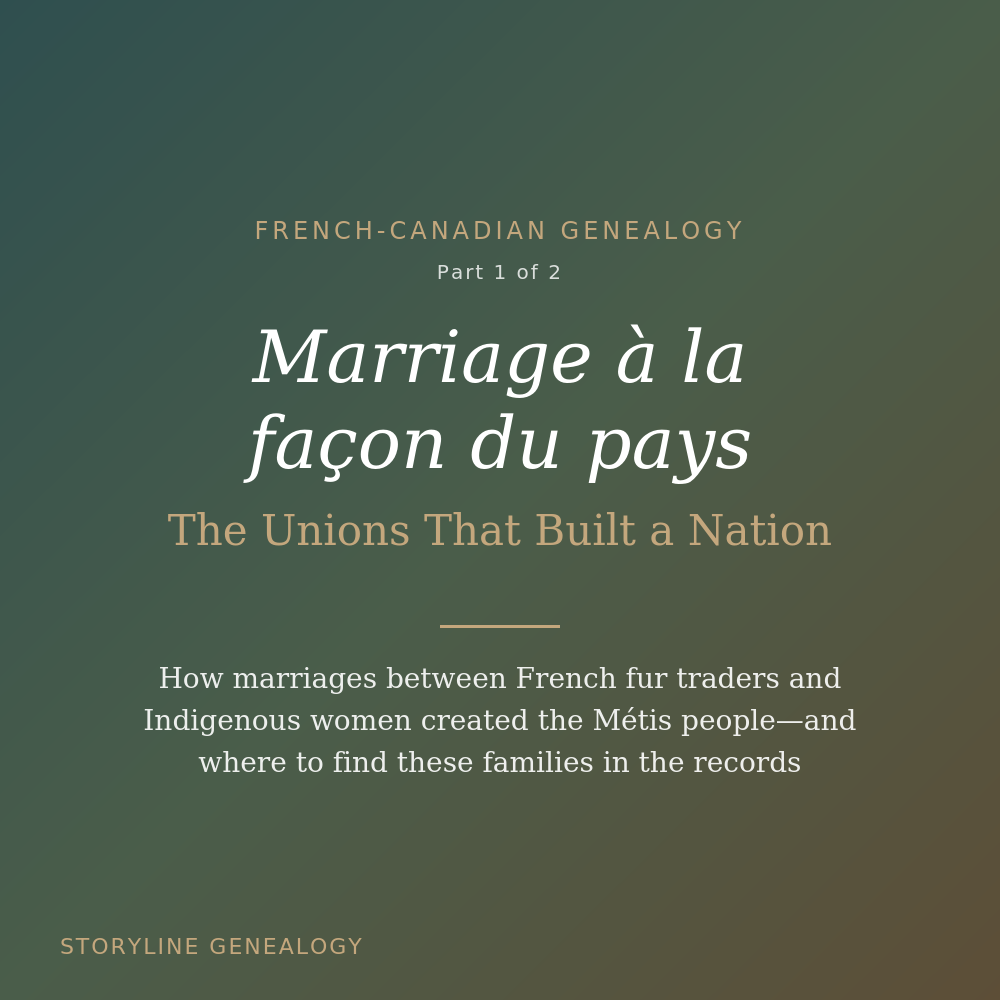
Marriage à la façon du pays: The Unions That Built a Nation
During the 1700s and 1800s, marriages between French fur traders and Indigenous women were fundamental social and economic institutions in North America. These unions—called mariage à la façon du pays—created strategic alliances that facilitated the fur trade and led to the emergence of the distinct Métis culture. Learn where to find these families in the records, from Hudson's Bay Company Archives to Métis Scrip.
Part of the Storyline Genealogy series: Documenting the lives of our earliest ancestors through primary sources.
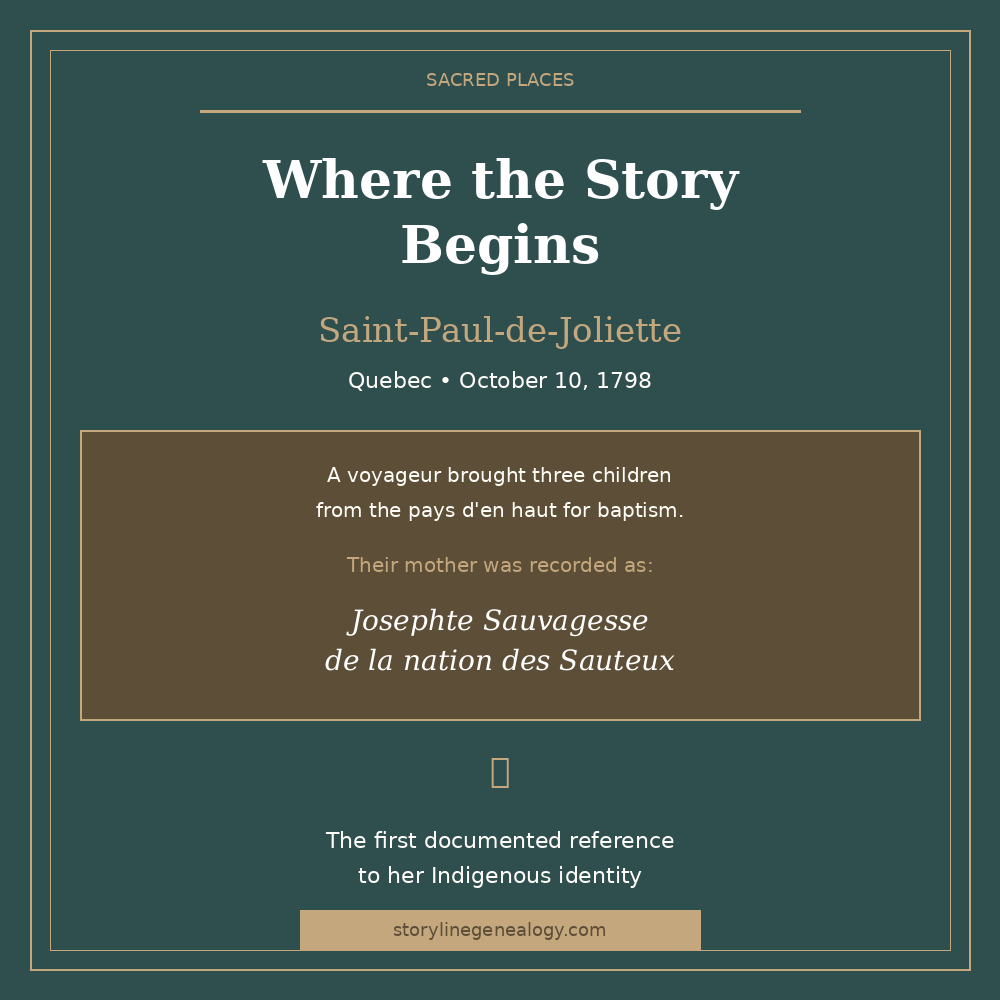
Saint-Paul-de-Lavaltrie
On October 10, 1798, a voyageur named Gabriel Guilbault brought three children to Saint-Paul-de-Joliette for baptism. They had been born and "ondoyé" (emergency baptized) in the pays d'en haut—the upper country of the fur trade. Their mother was identified as "Josephte Sauvagesse de la nation des Sauteux"—the first documented reference to her Indigenous identity. The story of Marie Josephte Abitakijikokwe begins here.
Part of the Storyline Genealogy series : Sacred Places
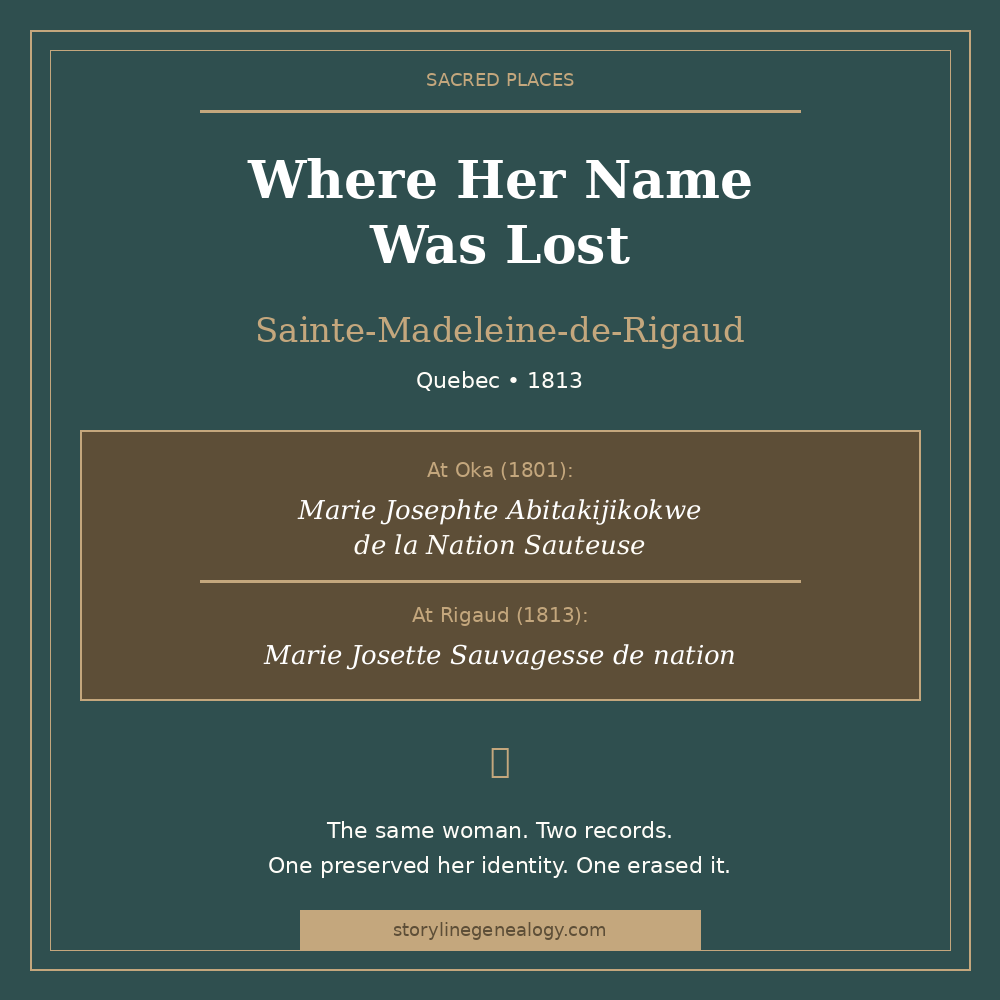
Sainte-Madeleine-de-Rigaud
In 1801, Father Leclerc at Oka carefully recorded her full Ojibwe name: Marie Josephte Abitakijikokwe de la Nation Sauteuse. Twelve years later, when she was buried at Rigaud, she had become simply "Marie Josette Sauvagesse de nation"—an Indigenous woman, unnamed. The contrast tells the story of colonial record-keeping and the erasure of Indigenous identity.
Part of the Storyline Genealogy series : Sacred Spaces
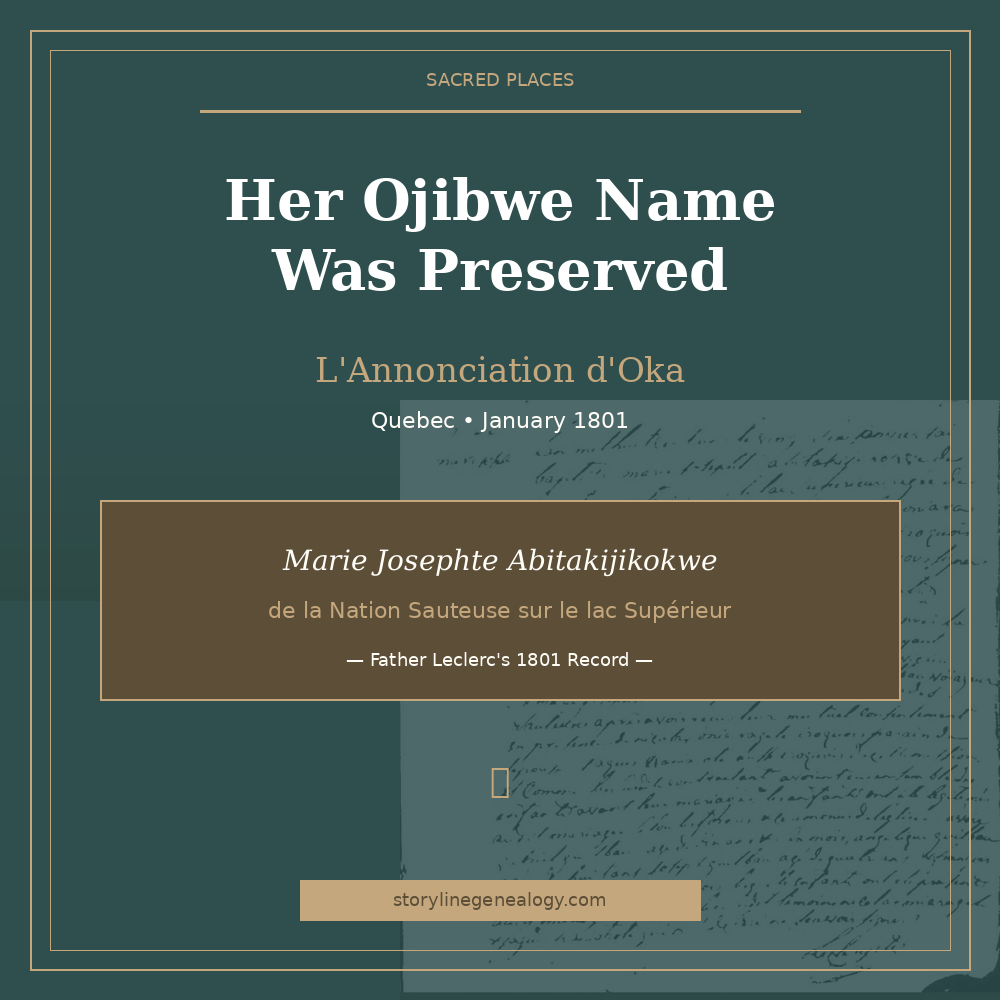
L’Annonciation d’Oka : Mission of the Lake of Two Mountains
For three centuries, this Sulpician mission has stood at the confluence of Indigenous and French Canadian cultures. Here, on January 27, 1801, Father Leclerc did something extraordinary: he recorded the full Ojibwe name of an Indigenous bride—Marie Josephte Abitakijikokwe de la Nation Sauteuse sur le lac Supérieur—preserving her identity when most priests simply wrote "Sauvagesse."
Part of the Storyline Genealogy series : Sacred Spaces
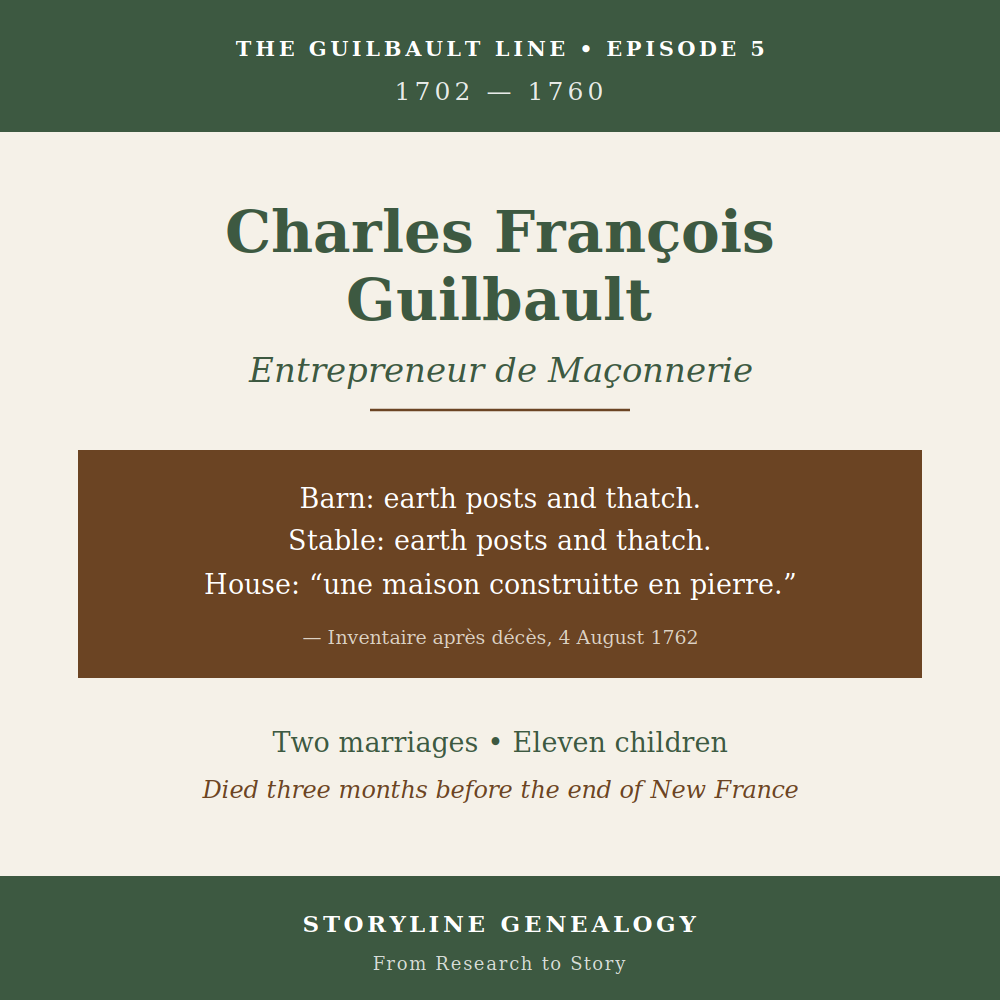
Charles Francois Guilbault 1702 - 1760
The parish registers call him a habitant. His notary, twice in one afternoon, called him something more particular: entrepreneur de maçonnerie, and tailleur de pierre. Two years after his death an inventory walked his farm on the Rivière des Prairies and found a barn of earth posts, a thatched stable — and a house built of stone.
Part of the Storyline Genealogy series: Documentary Biographies From Research to Story
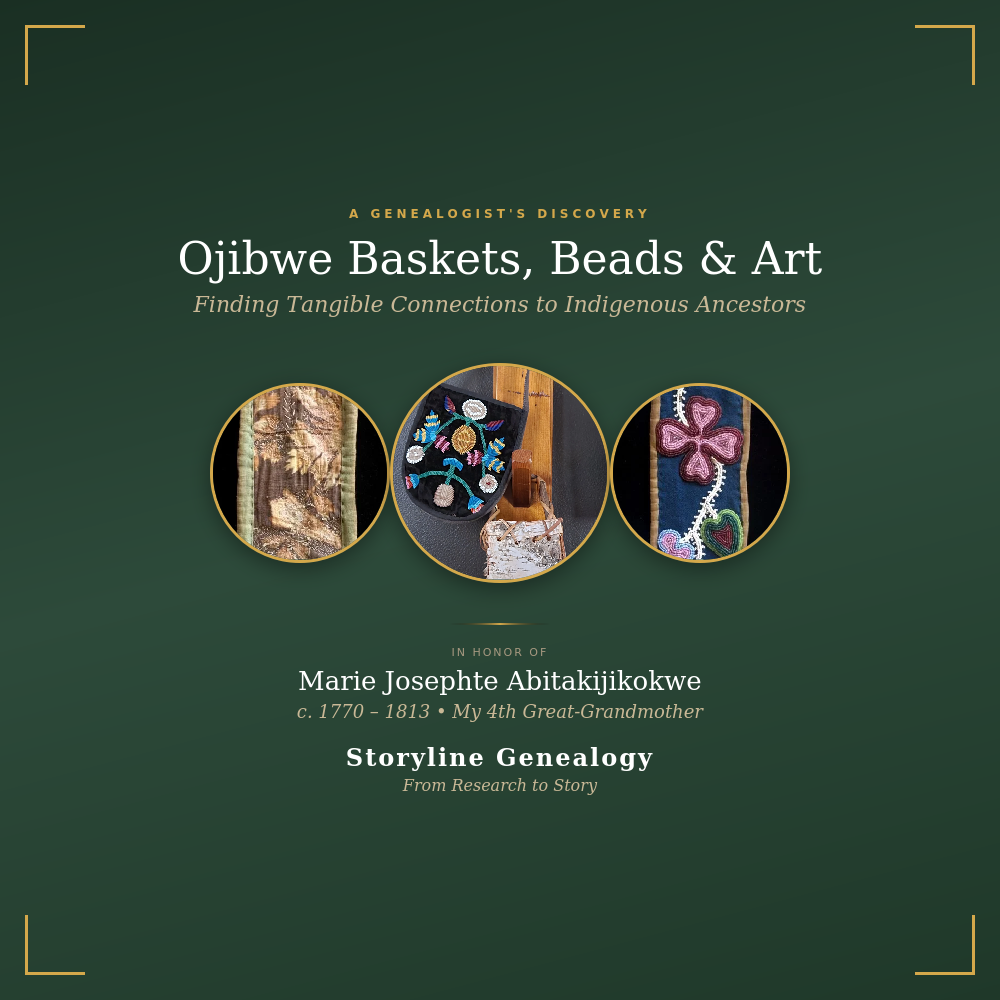
Ojibwe Baskets, Beads, and Art
When I discovered my Ojibwe 4th great-grandmother, Marie Josephte Abitakijikokwe, I wasn't prepared for how profoundly that discovery would change the way I understood my family's history. For generations, she had existed only as a shadow in the records—"Sauvagesse," a generic French term meaning "Indigenous woman." No name. No story. No identity.
Then, in a marriage record from 1801, a priest had written her full Ojibwe name: Abitakijikokwe. After 200 years of silence, she emerged from the records with her Indigenous identity intact.
And so began my journey into the world of Ojibwe art—searching for tangible connections to the woman who founded my Métis family line.
Part of the Storyline Genealogy series: Documentary Biographies — From Research to Story
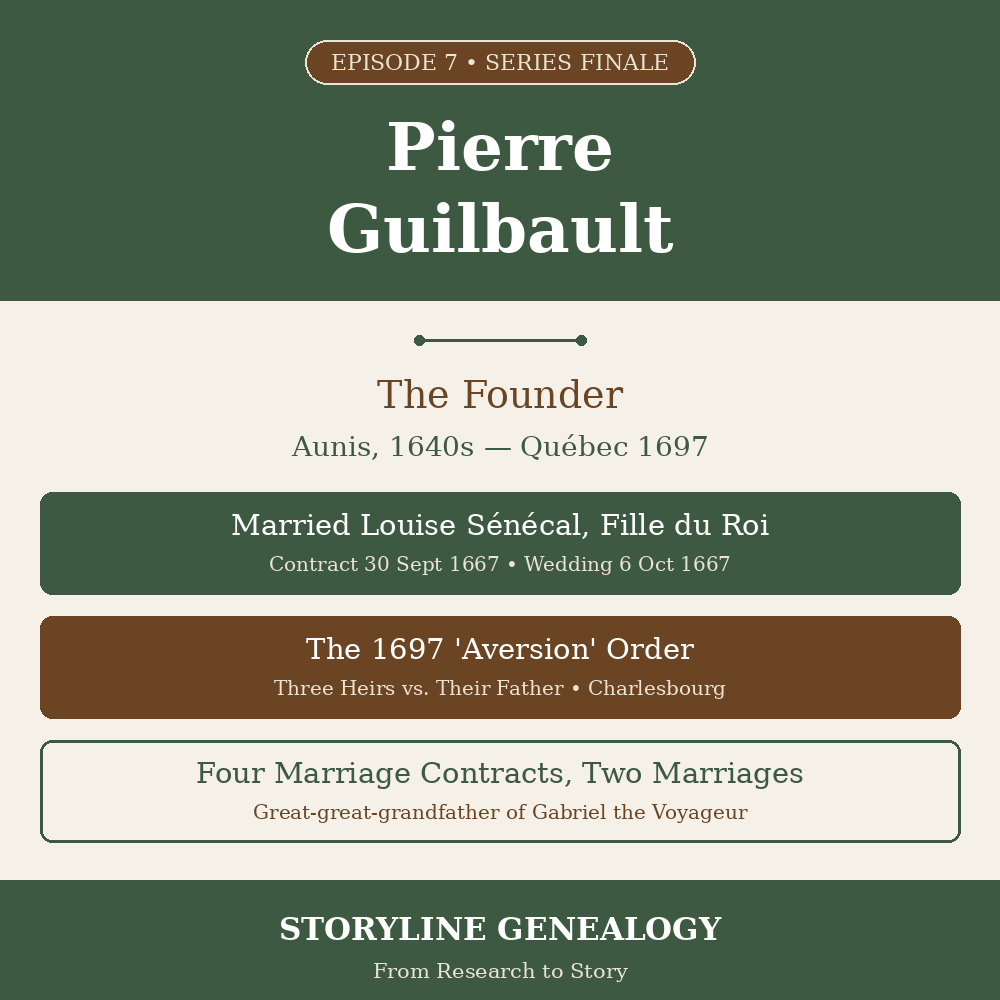
Pierre Guilbault 1640s - 1697
He came from Aunis, could not write his name, and made four marriage contracts in twenty-eight years. In 1679 his daughter was baptised in Québec with the note that her mother was separated from him. In January 1697 he remarried; seven weeks later a judge recorded the "aversion" between Pierre Guilbault and his own children. Episode 7, the finale of The Guilbault Line.
Part of the Storyline Genealogy series: Documentary Biographies From Research to Story
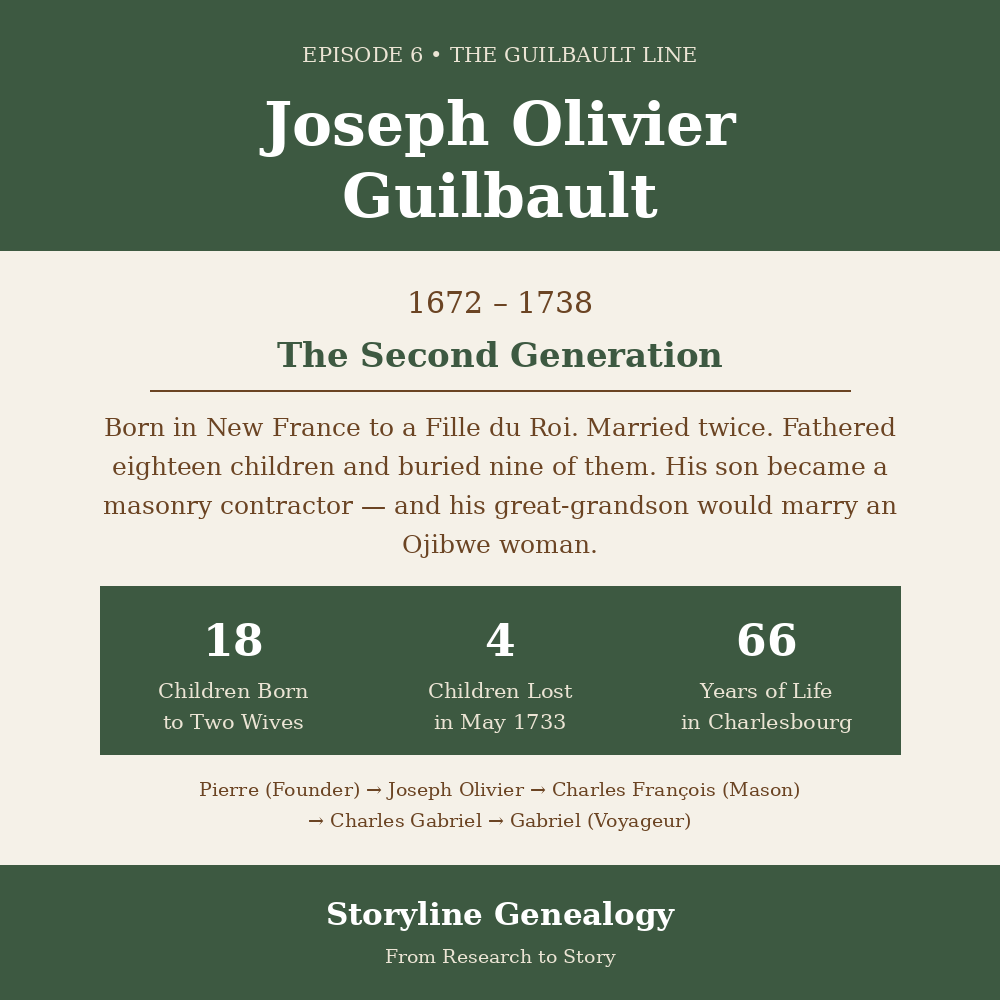
Joseph Olivier Guilbault 1672 - 1738
His father crossed an ocean; Joseph Olivier Guilbault spent sixty-six years in one parish. He took his father to court, married twice, fathered eighteen children and buried nine of them — and in November 1706 had a notary inventory his house room by room, down to his late wife's cloak, still in the walnut chest. Episode 6 of The Guilbault Line.
Part of the Storyline Genealogy series: Documentary Biographies From Research to Story
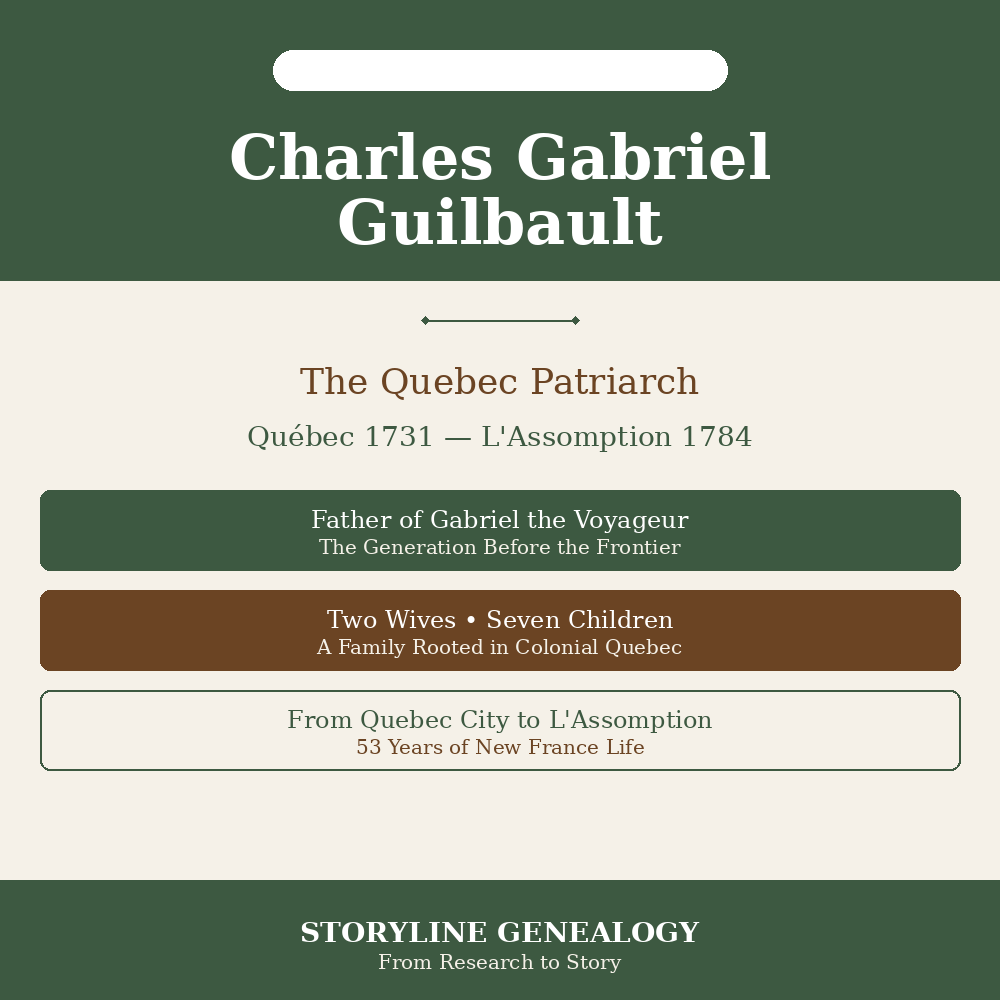
Charles Gabriel Guilbault: 1731 -1784
Before Gabriel Guilbault paddled canoes into the pays d'en haut and married an Ojibwe woman, there was his father—another Gabriel, born Charles Gabriel Guilbault in Quebec City in 1731. This Quebec patriarch married twice, raised four sons to adulthood, and established the family in L'Assomption that would eventually bridge French and Indigenous worlds. His 53-year life span encompassed the British Conquest and the transformation of New France, setting the stage for his son's frontier adventures.
Part of the Storyline Genealogy series: Documentary Biographies From Research to Story
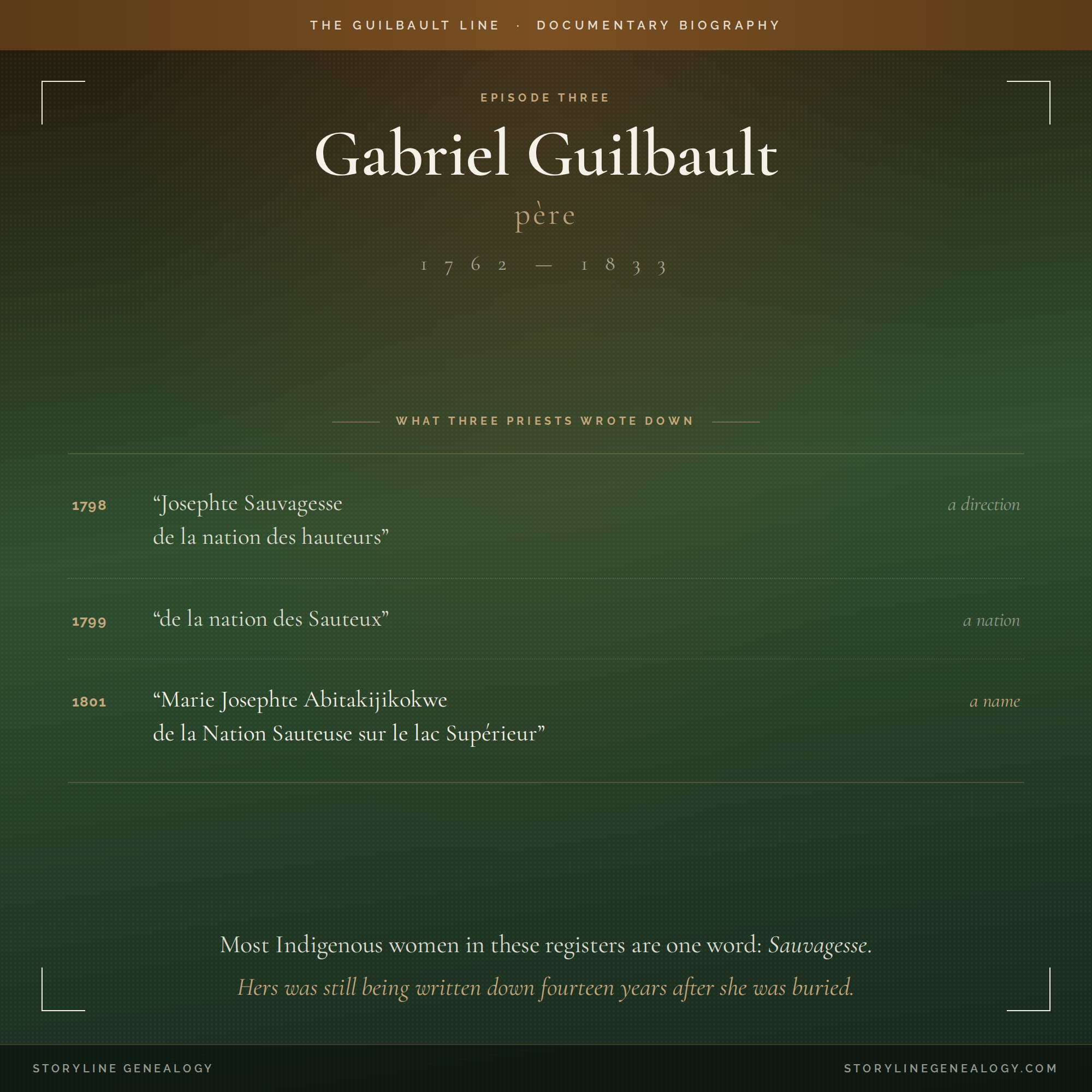
Gabriel Guilbault père 1762 - 1833
Gabriel Guilbault was born at L'Assomption in 1762, in the last year of New France, and lived to see the world that made him disappear. He went to the pays d'en haut as a voyageur; three of his children were born there and did not see a parish church until 1798. The Ojibwe woman he married is named in the registers of three parishes across nearly thirty years — the last of them written fourteen years after she was buried. His own record runs voyageur, farmer, mason for twenty-five years, and day labourer at the end.
Part of the Storyline Genealogy series: Documentary Biographies From Research to Story
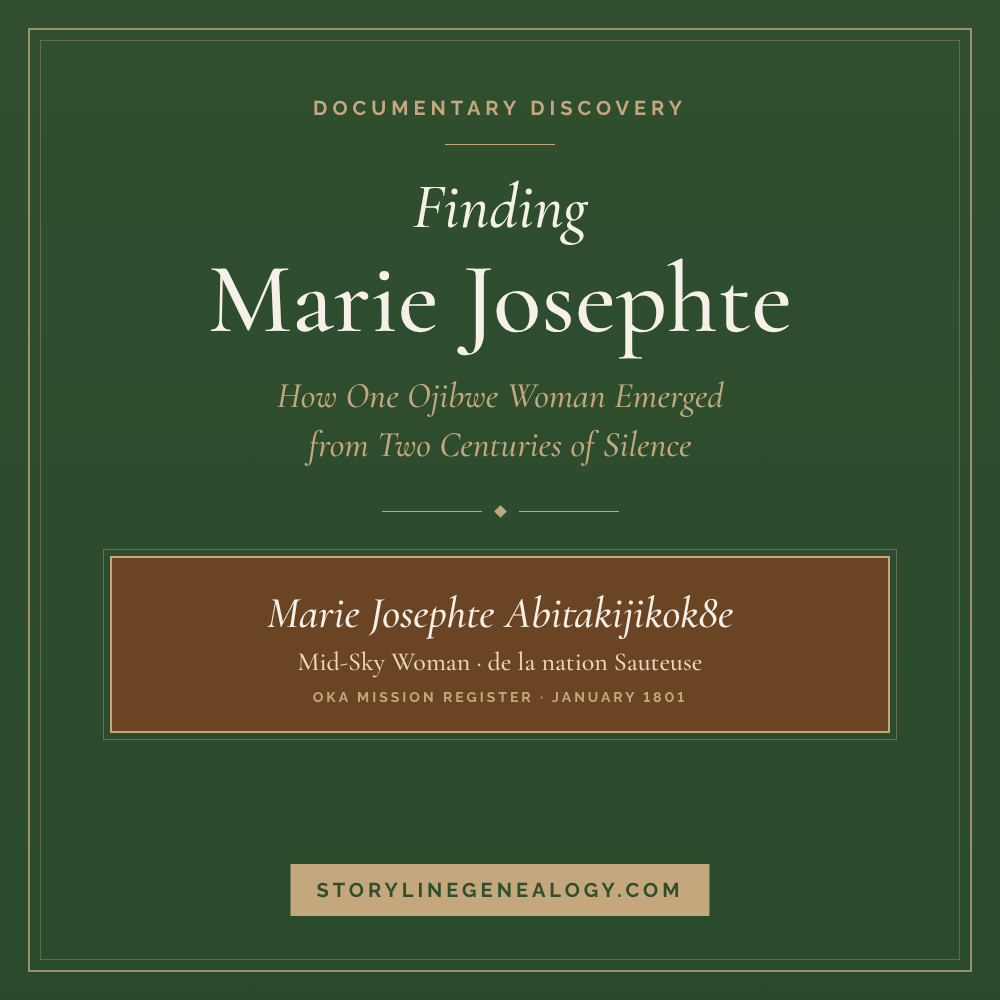
Finding Marie Josephte Abitakijikokwe
For generations she was only “Sauvagesse,” the wife of Gabriel Guilbault. FamilySearch’s Full Text Search found her: first as “Sauteuse” at a triple baptism in 1798, then at Oka in 1801, where her own baptism and marriage give her name, Abitakijikokwe, and her homeland on Lake Superior. This post traces how she was found, and what any researcher can learn from it.
Part of the Storyline Genealogy series: At the Lake of Two Mountains
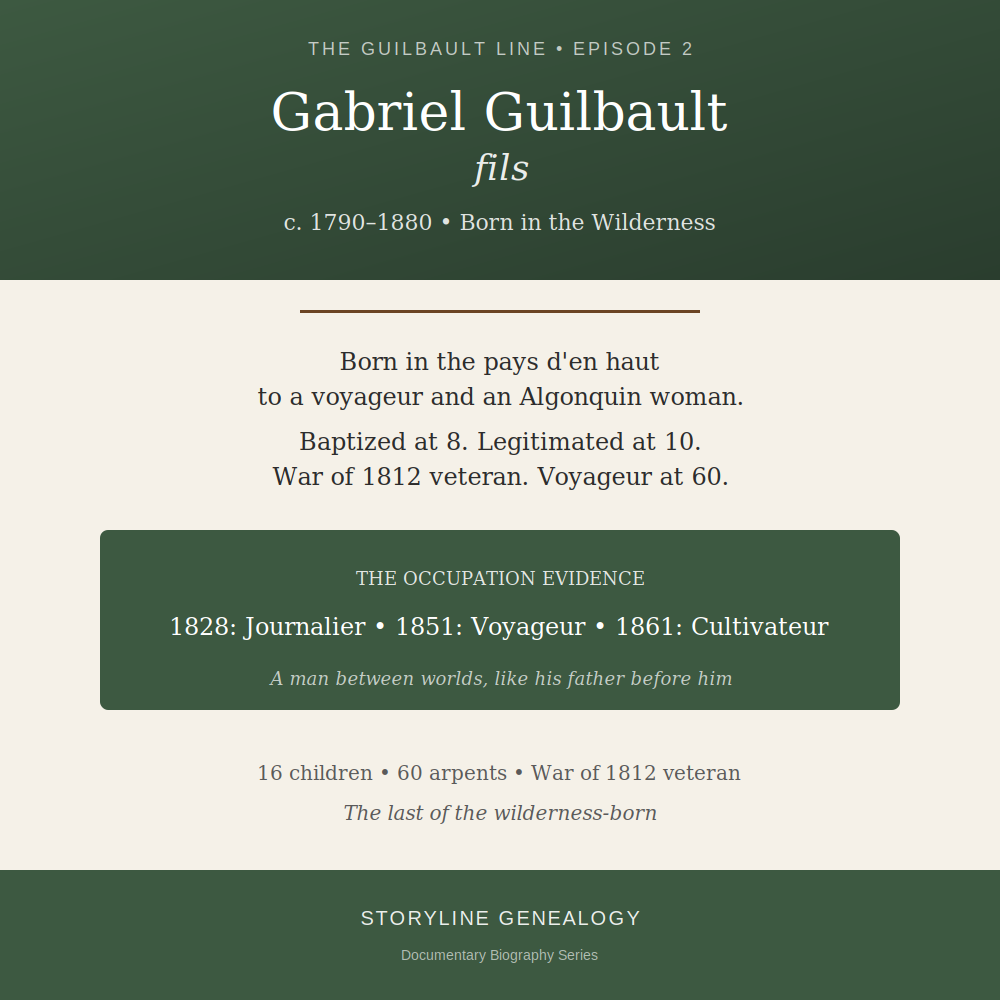
Gabriel Guilbault fils 1790 - 1880
Gabriel Guilbault fils was born around 1790 in the pays d'en haut—the vast interior wilderness of the fur trade—to a French-Canadian voyageur and an Algonquin woman named Marie Josephte Abitakijikokwe. Conditionally baptized at age eight when his family returned to the St. Lawrence Valley, legitimated at ten when his parents formally married, Gabriel lived a life between worlds. The records show his occupation shifting from journalier to voyageur to cultivateur—still claiming the paddle at sixty years old. Father of sixteen children, owner of sixty arpents, he died in 1880 as the last of the wilderness-born.
Part of the Storyline Genealogy Documentary Biography series: Following one family line through the documents that prove it—birth to death, generation to generation.
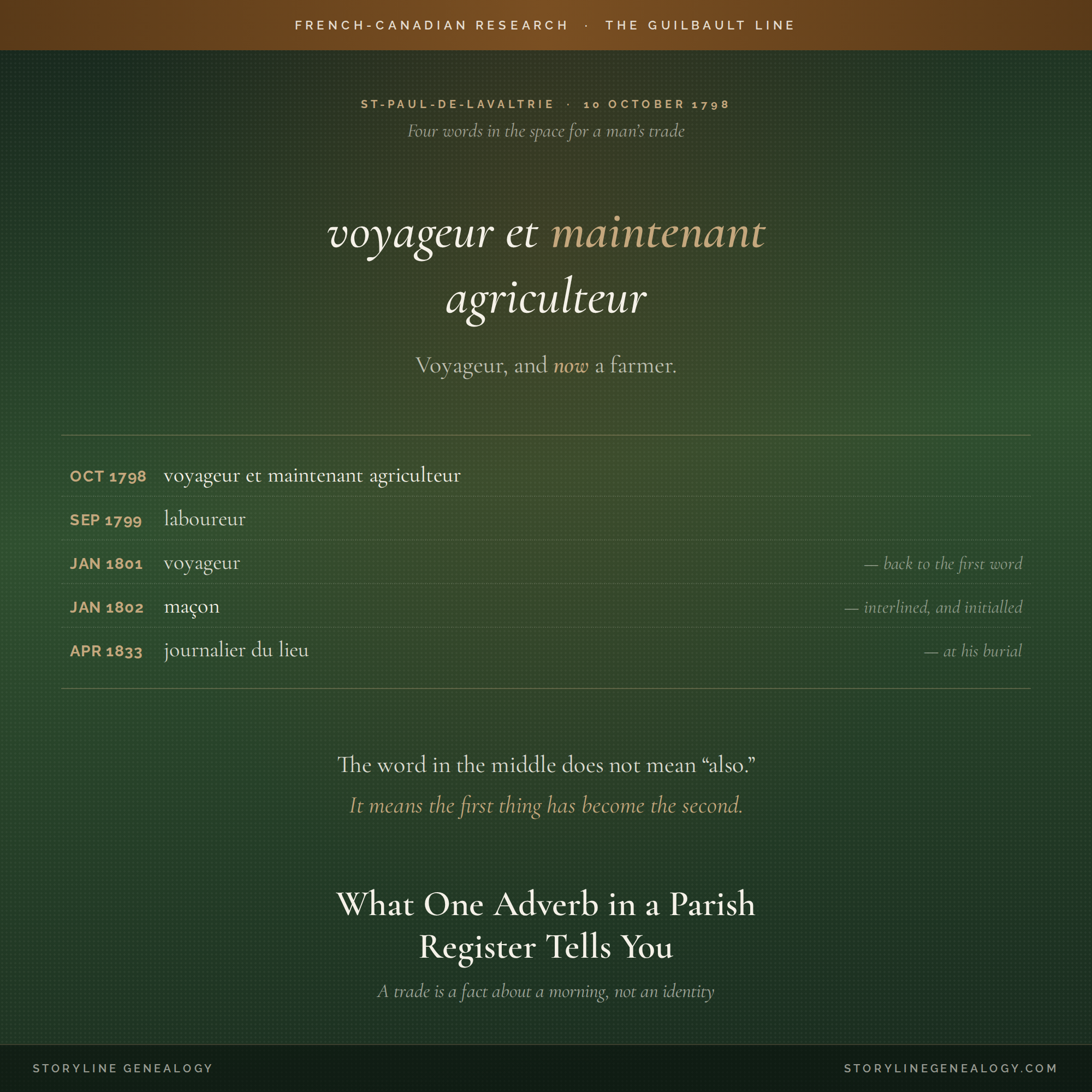
“Voyageur et Maintenant Agriculteur”
On 10 October 1798 a priest at St-Paul-de-Lavaltrie baptized three children of one family on the same day. The eldest was eight, born in the pays d'en haut, and had never been inside a parish church. In the space where a priest recorded a man's trade, this one wrote four words: voyageur et maintenant agriculteur. Voyageur, and now a farmer. The word in the middle does not mean "also" — it means the first thing has become the second. The priest wasn't describing a way of life. He was dating a change of one.
Part of the Storyline Genealogy French-Canadian Research series: Understanding the records, the context, and the lives they document.
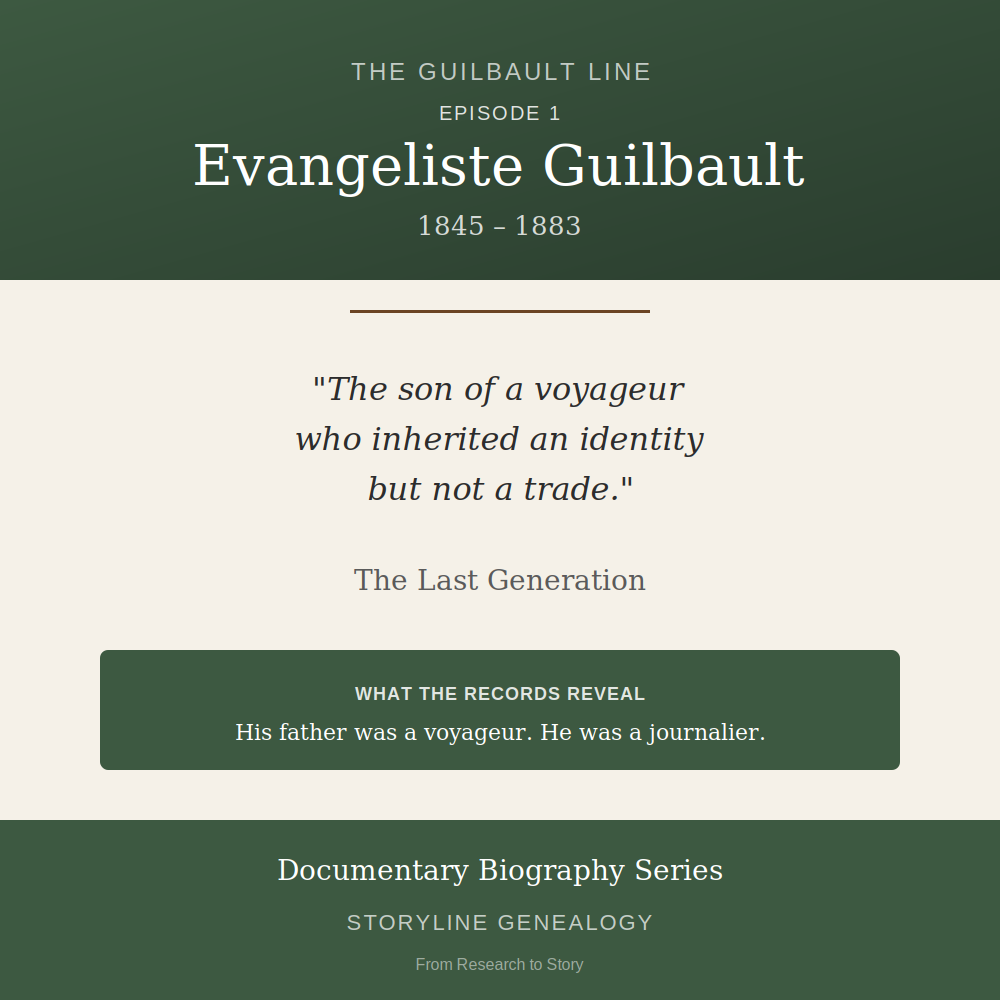
Evangeliste Guilbault 1845 – 1883
His father was a voyageur. He was a journalier. The primary sources tell a story that family narratives overlooked—of a man caught between eras, who died at 38 leaving three children under four and a widow who would live to ninety-one. This is not the story of a voyageur. This is the story of the last generation.
Part of the Storyline Genealogy series: Documentary Biographies From Research to Story
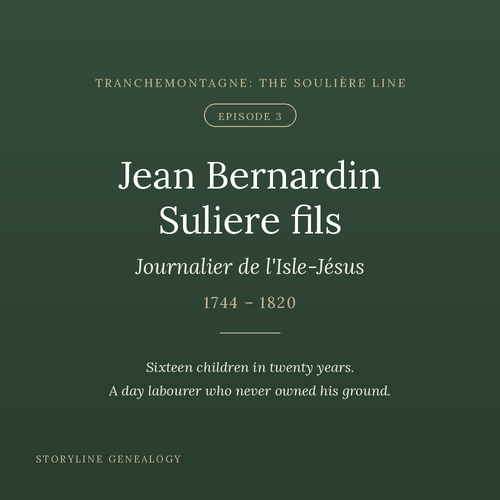
Jean Bernardin Suliere fils 1744-1820
On 11 April 1744 a boy was baptised at L'Assomption the day he was born, and his grandfather stood as godfather. Three weeks later his mother was buried — not in childbirth, as the family long believed, but after weeks of illness and the last rites. He lived seventy-six years, fathered sixteen children across four parishes, buried five of them small, and worked as a journalier: a day labourer who never owned the ground he worked.
Part of the Storyline Genealogy series: Documentary Biographies From Research to Story
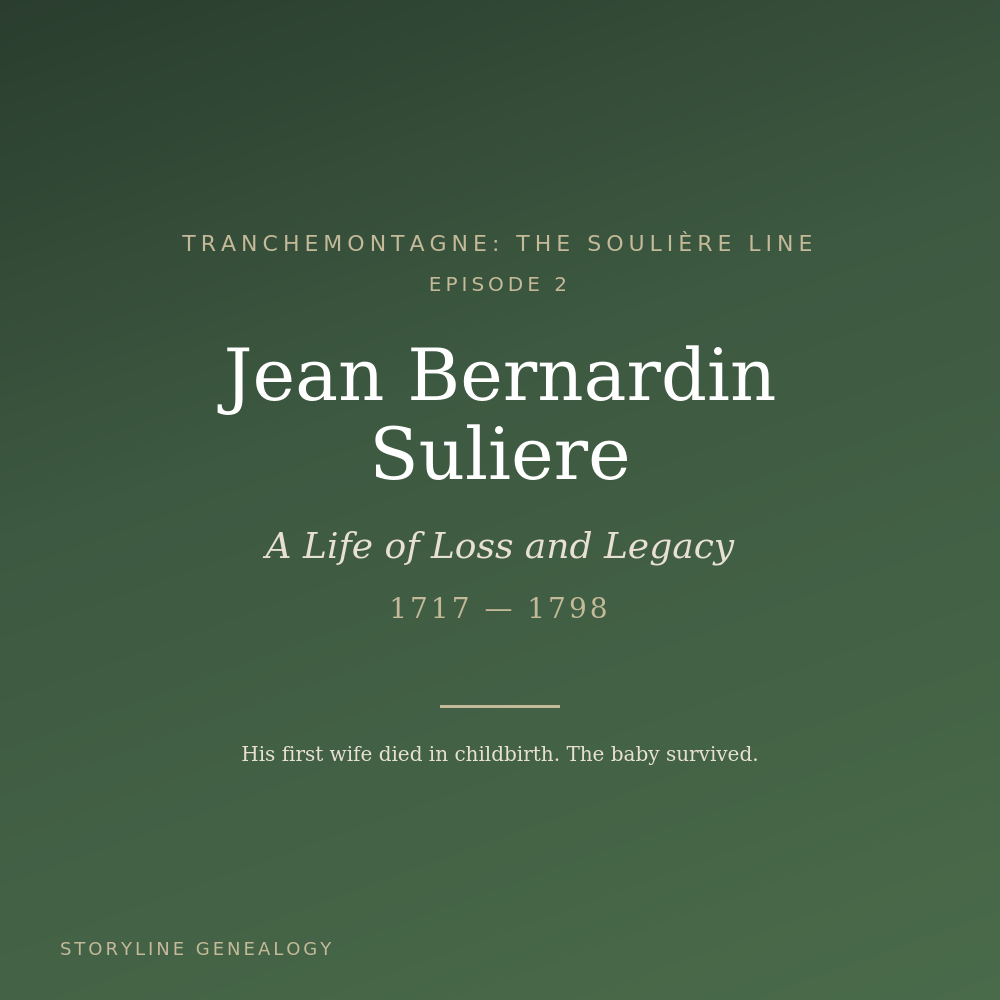
Jean Bernardin Suliere 1717-1798
His first wife died in childbirth just fourteen months after their wedding. The baby survived. Jean Bernardin Suliere would live another fifty-four years, remarry, raise a second family, and see his descendants spread across L'Assomption. Through parish registers that document both tragedy and resilience, we trace one man's eighty-one year journey through colonial Quebec.
Part of the Storyline Genealogy series: Documentary Biographies From Research to Story