
Gabriel Guilbault fils 1790 - 1880
Gabriel Guilbault fils
Sometime around June 1790, a child was born in the pays d'en haut — the interior country stretching from the Great Lakes to the prairies. His father was Gabriel Guilbault, a French-Canadian voyageur. His mother was Marie Josephte Abitakijikokwe, recorded at her own baptism as de la nation Sauteuse sur le lac supérieur — Ojibwe, or Saulteaux, of the Lake Superior country. Her name is not translated here. No Ojibwe-language authority has yet reviewed it, and the registers and databases spell it at least five different ways. The boy would be named Gabriel, like his father. Unlike most children born to the habitants of the St. Lawrence valley, he would not see the inside of a church for eight years.
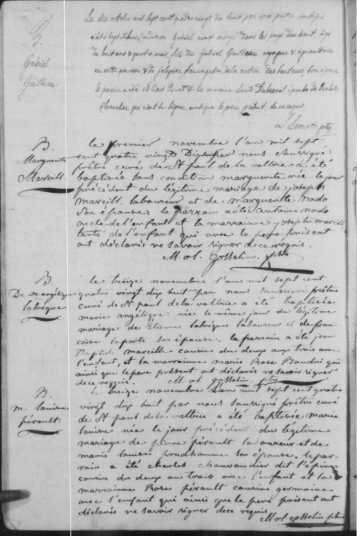
In October 1798 the family came down to the St. Lawrence parishes. At St-Paul-de-Joliette a priest supplied the ceremonies of baptism for the eight-year-old boy. The entry gives the reason outright: he had been né et ondoyé dans les pays d'en haut — born and ondoyé in the upper country, the water poured without the ceremonies of the Church. It does not say by whom, or why. In the interior the ordinary cause was that there was no priest within reach.
Three of Gabriel's siblings went to the font that same morning. And the father who stood there while it was done — and who could not sign the act — is entered as voyageur & agriculteur en cette paroisse: both trades, set side by side, in the year the family came down out of the interior.
A note on one word
Earlier versions of this page quoted the 1798 entry as voyageur et maintenant agriculteur — voyageur, and now a farmer — and read it as the priest marking one trade giving way to the other.
That word is not in Gabriel's act. It is in the entries for his brother Joseph Claude and his sister Angélique, written by the same priest on the same morning. Gabriel's own reads voyageur & agriculteur, with nothing between them.
And the reading does not survive the next two records. In September 1799 the father is laboureur. At Oka in January 1801 he is voyageur again. Whatever maintenant meant to Father Lamothe, it did not mark a one-way change of trade.
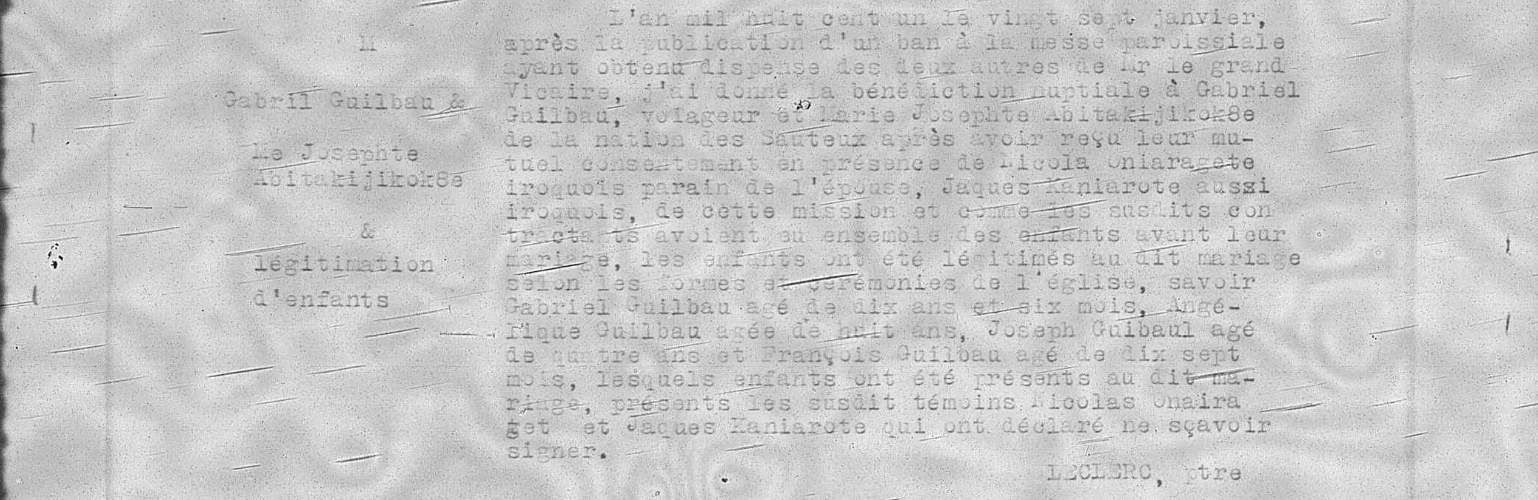
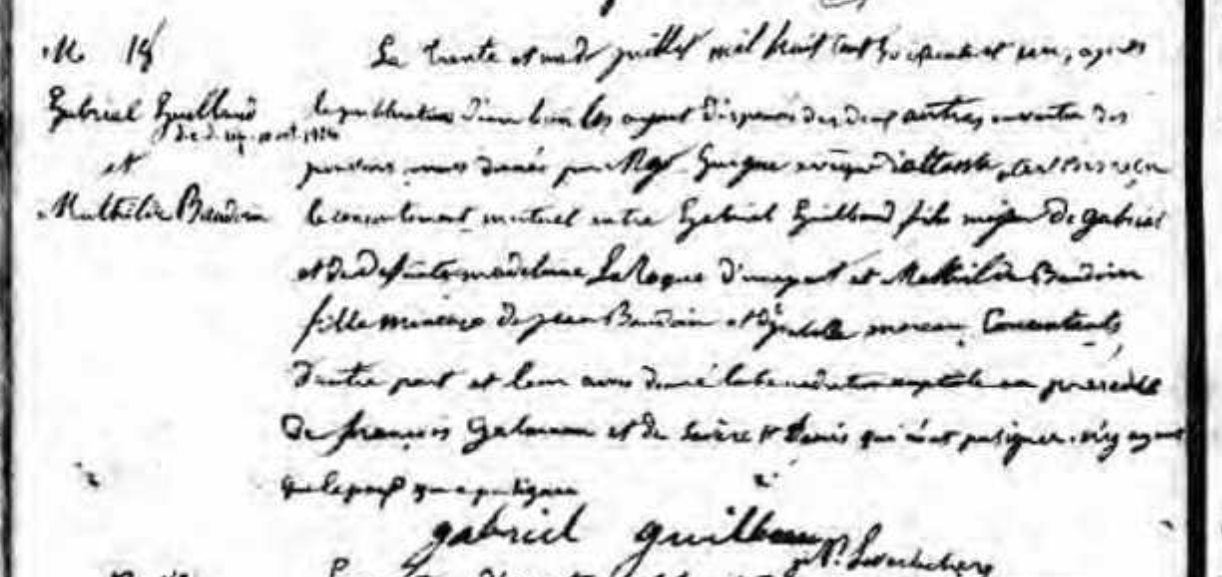
Three years later, in January 1801, Gabriel's parents formalised their union before the Church. The marriage record at Oka documents not only the wedding but the legitimation of four children born before it: Gabriel, ten and a half; Angélique, eight; Joseph, four; and François, seventeen months.
Vital Records Summary
The Legitimation
The 1801 marriage record at Oka is one of the most consequential documents in this family's archive. It records the church wedding of Gabriel Guilbault, voyageur, to Marie Josephte Abitakijikok8e, de la nation des Sauteux. It also legitimates a family.
From the Marriage Record, 27 January 1801
For Gabriel, ten and a half, this changed his legal standing. Born in the interior to parents not married in the Church, he had been illegitimate in its eyes. The legitimation made him a recognised son, with rights of inheritance and standing in colonial society.
The witnesses were Indigenous men: Nicolas Oniaragehte, who had stood godfather at Marie Josephte's baptism the day before, and Jaques Kaniarote. This was not a marriage that erased her identity or community. It was witnessed at a mission church serving Indigenous Catholics, by men of that mission. Their own nations are not stated in the entry and are not assumed here; the mission at the Lake of Two Mountains held Mohawk, Algonquin and Nipissing communities alike.
A Life Between Trades
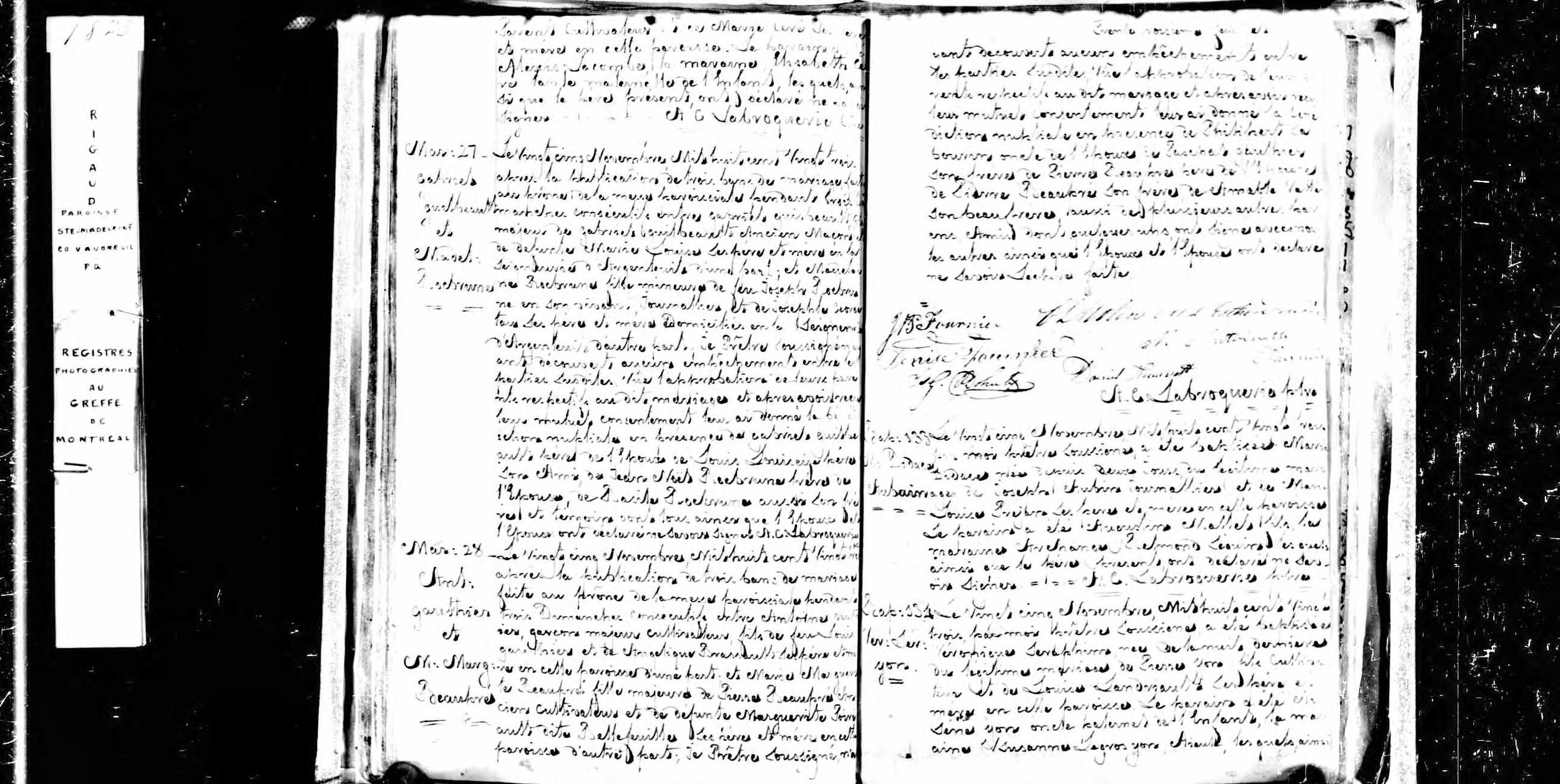
In November 1823, at thirty-three, Gabriel married Madeleine Rocbrune — also written Larocque — at Ste-Madeleine-de-Rigaud. He is fils majeur; she is fille mineure, daughter of the late Joseph Rocbrune, journalier, and Josephte Georgeteau. Both declared they could not sign.
The act names four men in the room. Gabriel's father was present — styled ancien maçon, the mason's trade already behind him. Beside him stood Louis Louisseize père, called simply son ami; the act leaves it ambiguous whose friend he was. For the bride, her brothers Jean Noël and Basile Rocbrune.
His mother's name in this act
The 1823 act names the groom's mother as défunte Marie Louise — given name only, no surname, and dead. She had died in 1813, so défunte is right. Marie Louise is not the name any contemporary record gives her.
She is Josephte in 1798, Marie Josephte Abitakijikok8e in 1801, Marie Josette at her burial in 1813. Six records, and only this one — written ten years after her death, for a groom who was three at her legitimation — calls her Marie Louise. This page records the discrepancy rather than smoothing it away.
Over the next quarter century Gabriel and Madeleine had sixteen recorded children. The baptisms scatter across four parishes — Ste-Madeleine-de-Rigaud, St-Benoît, St-André-d'Argenteuil, St-Hermas — a family that moved, and kept moving.
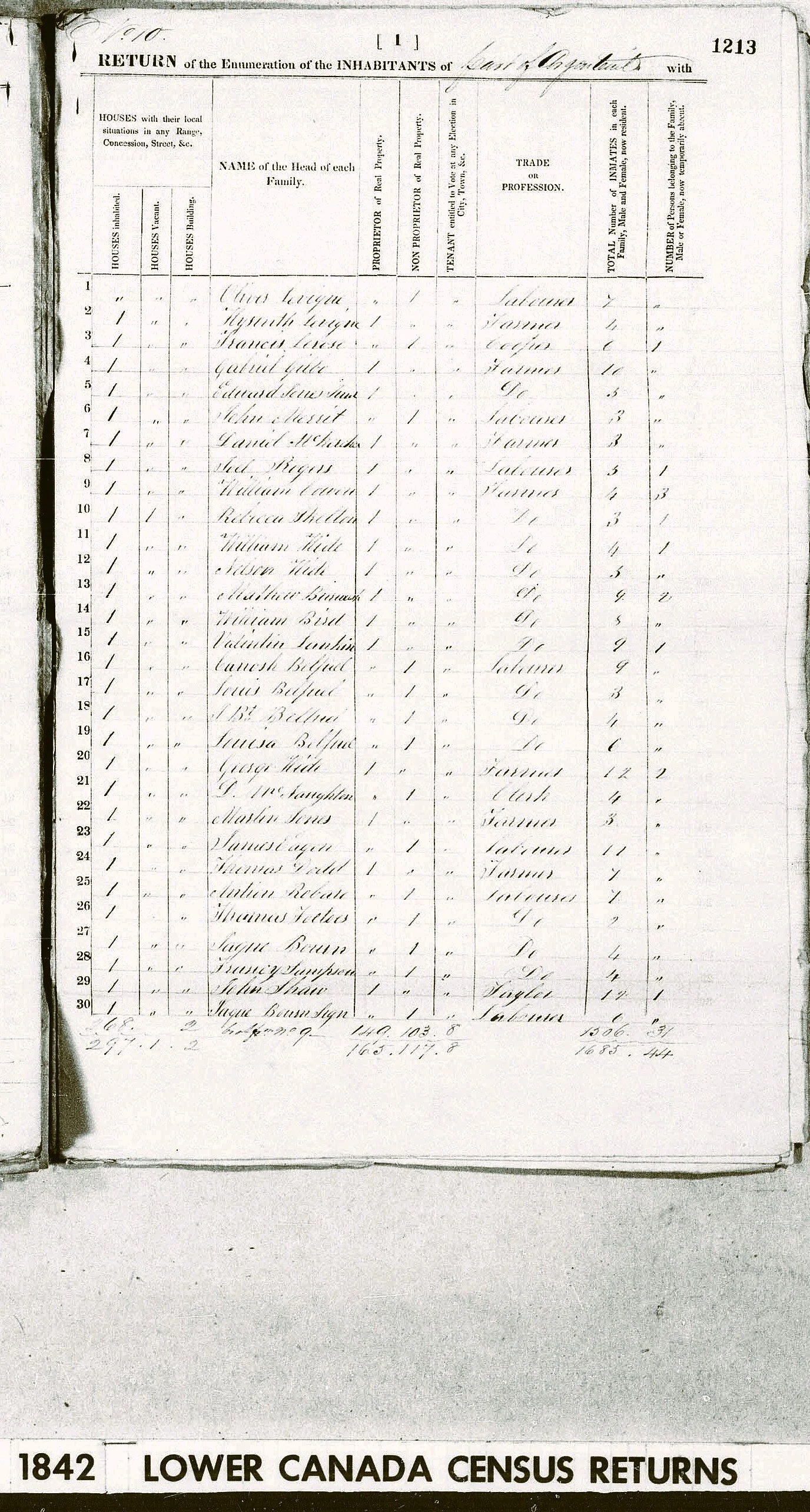
In 1842 an enumerator found him at “East of Argenteuil” and wrote him down as Gabriel Gilbo — one of the many spellings this family collects — proprietor of real property, trade or profession Farmer, ten persons in the house.
Ten is exactly right. Gabriel at fifty-one and Madeleine at thirty-seven, with Gabriel 17, Florence 14, André 12, Julie 11, Scholastique 9, Rosalie 7, Marie Claudimène 3 and Philomène 1. Joseph and Jean Baptiste had died in infancy; John, Évangéliste, Marie and Éloïse were not yet born. The count identifies the household without anyone having to argue about it.

A proprietor in 1842, a voyageur in 1851
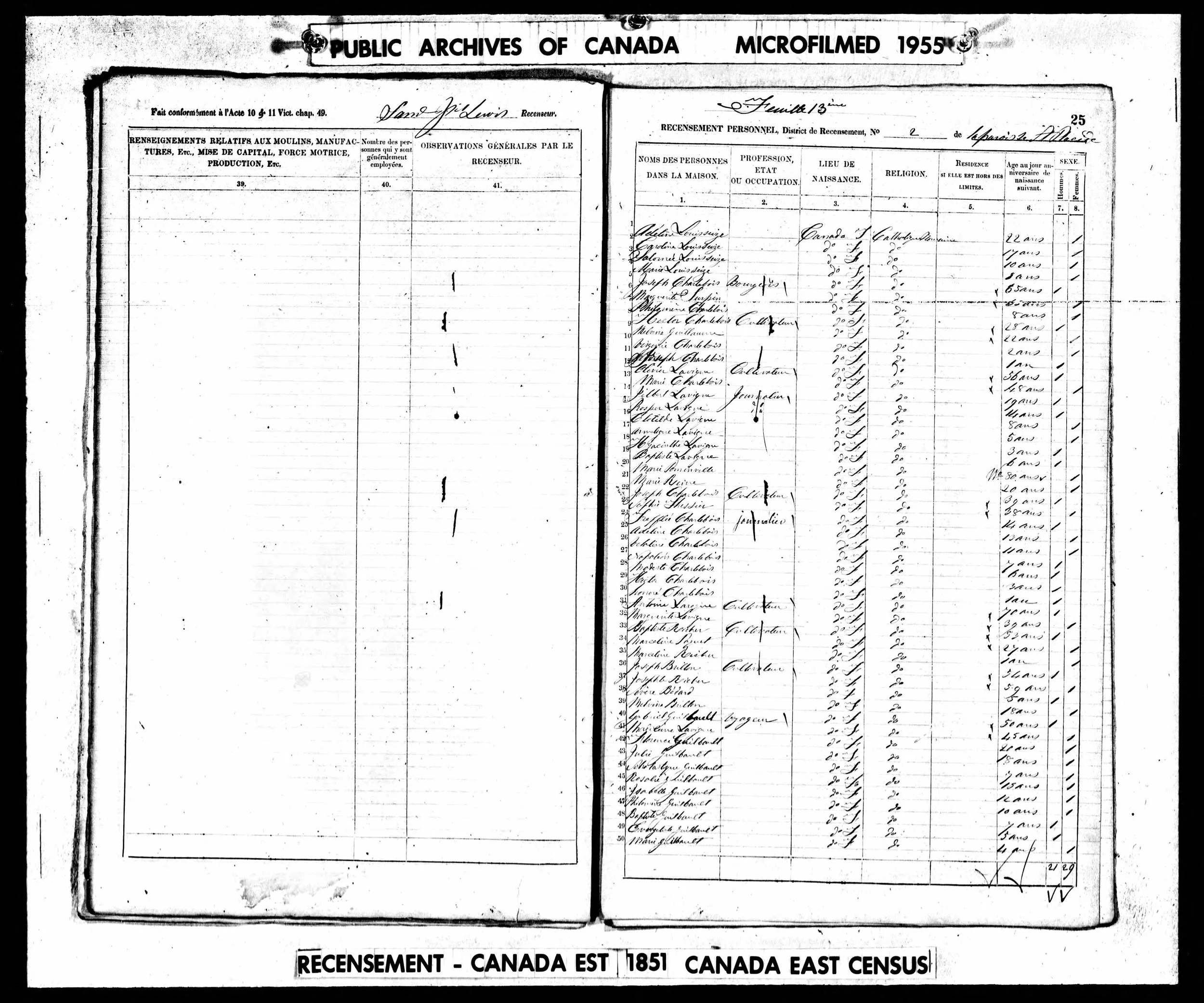
The 1842 return has him owning his land and calling himself a farmer at fifty-one. Nine years later, across the county line, an enumerator wrote Voyageur beside the same man at sixty-one.
That is the order the records give, and it is worth stating plainly: settled first, then the older word. The 1851 entry is not the trace of a man who never came off the canoe routes. It is a farmer of at least nine years' standing describing himself another way.
Then, between Éloïse's baptism at St-André in September 1849 and the enumeration of January 1851, they moved further: across the county line to St-Placide, in Deux-Montagnes. They are there in 1851, in 1861 and in 1871. Madeleine is buried there in 1857 and Gabriel in 1880.
| Year | Document | Occupation | Stated age |
|---|---|---|---|
| 1828 | Baptism of Florence, Rigaud | Journalier | — |
| 1842 | Census, Argenteuil (seigneurie) | Farmer — proprietor | — (he was 51) |
| 1849 | Baptism of Éloïse, St-André | Cultivateur | — |
| 1851 | Census, St-Placide | Voyageur | 50 — he was 61 |
| 1857 | Burial of Madeleine, St-Placide | Cultivateur | — |
| 1861 | Census, St-Placide | Cultivateur | 70 * |
| 1871 | Census, St-Placide | Cultivateur | 80 — correct |
| 1879 | Marriage of Évangéliste, St-André | Journalier | — (he was 89) |
* The age column of the 1861 return for this household does not align with the baptisms — Évangéliste, born November 1845, is entered at 23 rather than 15 or 16, and the error is not confined to his line. Ages from that page are reported as the enumerator wrote them and should not be used as evidence of birth years. The 1851 column is different: the children's ages on that page are right, and only the head's is wrong — by eleven years.
The 1851 entry is the striking one. Gabriel was sixty-one — an age when most men had long since left the physical demands of the canoe brigades — and the enumerator wrote Voyageur beside his name. Whether he was working shorter routes, guiding on decades of river knowledge, or simply describing himself by the trade he had been raised in, the return does not say. What it records is the word.
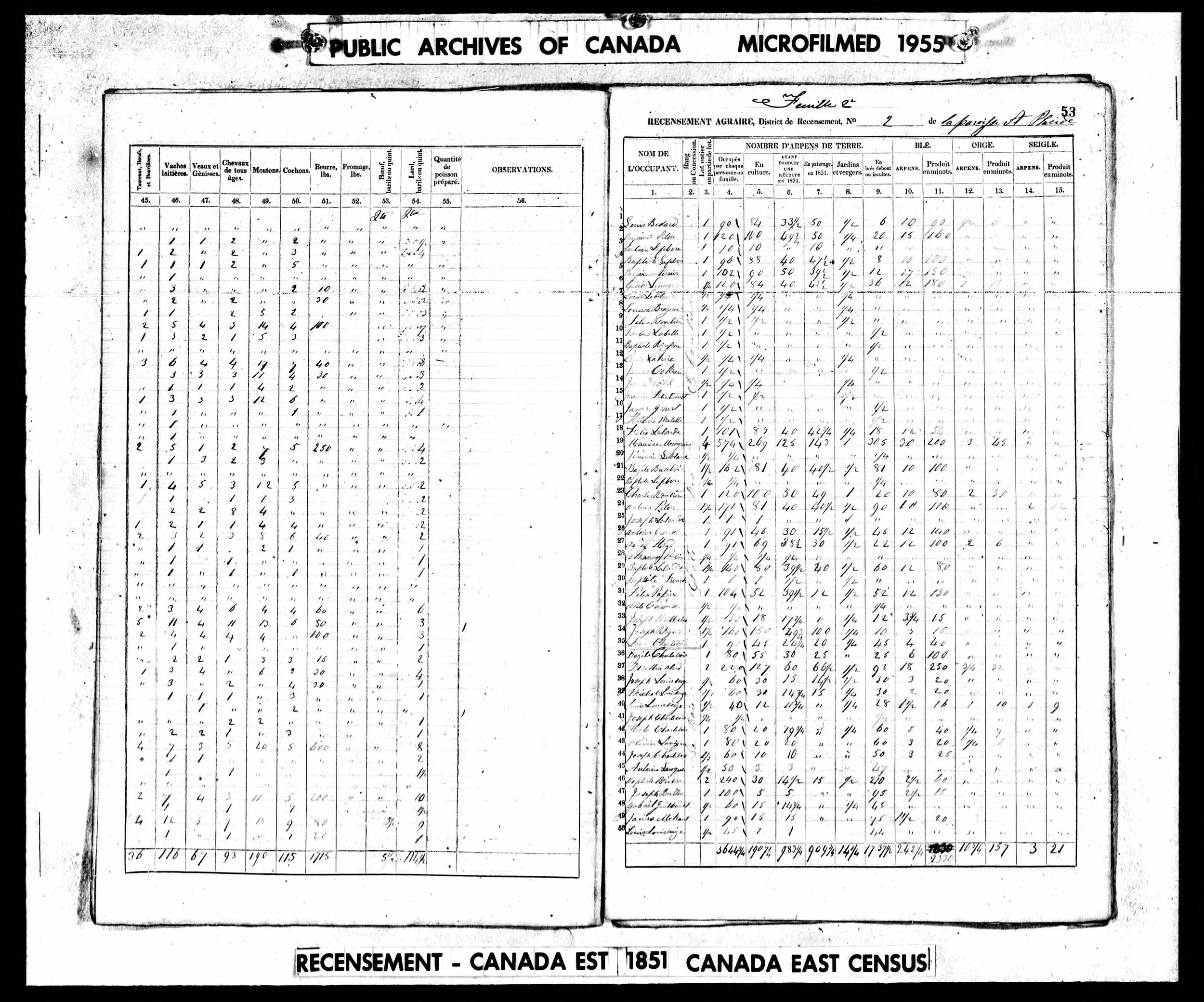
The same enumeration shows sixty arpents of land. This was not a landless labourer. Like his father in 1798, Gabriel was paddler and farmer at once.
And then it ends the way his father's did
He is cultivateur at his wife's burial in 1857, and in the censuses of 1861 and 1871. Then, in his son's marriage act of May 1879, he is journalier — day labourer, at eighty-nine.
His father had made the same descent: voyageur, then mason of the Seigneurie d'Argenteuil, then ancien maçon by 1823, and journalier du lieu at his death in 1833. Two generations, the same ending.
A War of 1812 Veteran
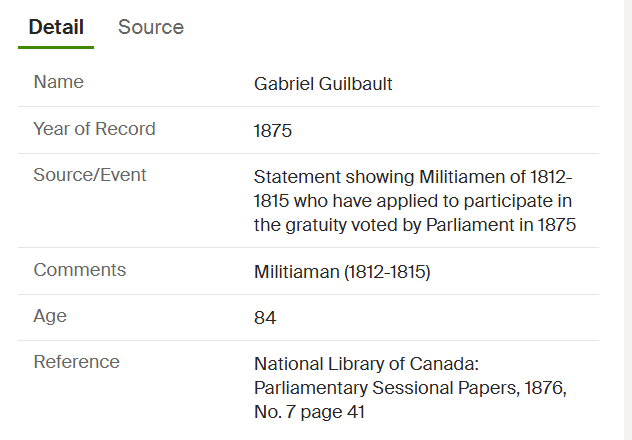
In 1875 an eighty-four-year-old Gabriel Guilbault applied for the gratuity voted by Parliament for militiamen who had served in the War of 1812. The record gives service between 1812 and 1815, when he would have been about twenty-two to twenty-five.
The stated age fits: eighty-four in 1875 implies a birth about 1791, against the June 1790 the baptism gives. That agreement is the basis for the identification; the application itself does not name his parents.
Sixteen Children
Between 1824 and 1849 Gabriel and Madeleine baptised sixteen children across four parishes. Four did not survive infancy.
PRDH-IGD · Family record no. 149155 — Gabriel Guilbault and Madeleine Rocbrune
| Child | Born (baptised) | Place | Died (buried) |
|---|---|---|---|
| Gabriel | 20 Dec 1824 | Ste-Madeleine-de-Rigaud | — |
| Marie Josephe | 29 Jul 1826 | Ste-Madeleine-de-Rigaud | 4 Sep 1826 |
| Marie Florence | 16 Mar 1828 | Ste-Madeleine-de-Rigaud | — |
| André | 7 Apr 1830 | St-Benoît | — |
| Julie | 4 May 1831 | Ste-Madeleine-de-Rigaud | — |
| Scholastique | 7 Jul 1833 | St-André-d'Argenteuil | — |
| Rosalie | 4 Jul 1835 | St-Benoît | — |
| Joseph | 15 Apr 1837 | St-Hermas (Deux-Montagnes) | 20 Jul 1837 |
| Jean Baptiste | 3 May 1838 | St-André-d'Argenteuil | 7 May 1838 |
| Marie Claudimène | 22 Aug 1839 | St-André-d'Argenteuil | — |
| Philomène | 25 May 1841 | St-André-d'Argenteuil | — |
| Joseph | vers 6 Feb 1843 | — | 8 Feb 1843 |
| John | 3 Aug 1844 | St-André-d'Argenteuil | — |
| Évangéliste | 15 Nov 1845 | St-André-d'Argenteuil | 5 Dec 1883 |
| Marie | 22 Aug 1847 | Ste-Madeleine-de-Rigaud | — |
| Éloïse | 9 Sep 1849 | St-André-d'Argenteuil | — |
The fourteenth child, born in November 1845 at St-André-d'Argenteuil, was Évangéliste, the subject of Episode 1 — the one son of this house whose occupation column, in two censuses, was left blank.
Madeleine Rocbrune died on 15 December 1857 and was buried two days later at St-Placide, entry S.30. The act calls her épouse de Gabriel Guilbault cultivateur de cette paroisse and gives her age as fifty-four; baptised in August 1805, she was fifty-two. Present were Joseph Lalonde and Joseph Louis Seize, neither able to sign. No Guilbault is named present. She had borne sixteen children across twenty-five years, in a marriage of thirty-four. Gabriel outlived her by twenty-three.
Three Sons, One Column
The 1861 census at St-Placide does something no other record in this family does. In the occupation column the enumerator wrote Voyageur against Gabriel fils — the eldest son, born 1824, a third Gabriel in three generations — and then ran do, ditto, down the next two lines: André and Jean Baptiste.
Three brothers, one trade, one household. Their father, the man who had been the voyageur of the 1851 return, is cultivateur at the head of the same page. The generation that went back to the canoes was not his. It was his sons'.
The line below theirs is Évangéliste's, aged fifteen, with the column blank.
Not only this family
The same page carries André Charlebois, Voyageur, with Napoléon and Tréflé Charlebois on do beneath him, and Gilbert Lavigne, Voyageur — who had been entered as journalier on the 1851 page. Several St-Placide households were sending men out in the same year. Whether they travelled together is untested.
That same year the eldest Gabriel married Mathilde Domitille Beaudoin — not in the settled parishes but at L'Assomption-de-la-Vierge-Marie in Maniwaki, a mission on the Gatineau, deep in the Ottawa valley. Frontier country, where river skills still earned a living. He had gone north, following the receding edge of the trade into territory his grandfather had paddled.
A Signature in the Record
The 1861 marriage record at Maniwaki preserves something unusual: the groom signed his name. “gabriel guilbau”, in a careful hand, at the foot of the page. His father — the subject of this episode — is recorded in the same document as unable to sign.
It is the first signature in this line. In 1727 neither of his great-great-grandparents could sign their own marriage; in 1757 neither bride, groom nor either father signed. Five generations to a signature, and it appears at a mission on the Gatineau.
Three Gabriels. The first, a voyageur who married an Ojibwe woman and brought his children down for baptism. The second, legitimated at ten, voyageur at sixty-one, father of sixteen, journalier at eighty-nine. The third, carrying the trade north to Maniwaki as it ended, and signing his name in a mission register while his father, who could not, farmed at St-Placide.
The Last of the Pays d'en Haut
Gabriel Guilbault fils died on 5 September 1880 and was buried two days later at St-Placide, entry S.21. The act calls him époux de défunte Magdeleine Larocque, de la paroisse de St André. St-André was where he lived; St-Placide was where they buried him, in the ground where his wife had lain for twenty-three years. The priest was J. B. Bertrand. Present were Jean Baptiste and Évangéliste Guilbeault, neither able to sign. The register does not style them as his sons — they are named and nothing more — though both are documented children of his.
The entry estimates his age at environ quatre-vingt douze ans, about ninety-two. He was ninety. His 1798 baptism gives eight years and four months, placing his birth about June 1790, and the 1801 legitimation independently agrees within six weeks. The overshoot is two years — modest by this family's standards, where the 1851 census understates him by eleven and the 1861 age column does not align at all.
A Life in Context
He had outlived the world he was born into. The pays d'en haut of his childhood had become surveyed territory crossed by railways. The brigades were gone. But he had been there, and the record of it is the four words a priest wrote at Joliette in 1798 — né et ondoyé dans les pays d'en haut — and the age he carried away from that font.
When Évangéliste and Jean Baptiste stood at his grave in 1880, neither able to sign the act, they were standing at the end of a connection. Gabriel had been born in the interior. His sons were born in parishes and baptised within days. What the interior had been to their father, it could not be to them.
Document Gallery
Primary sources documenting Gabriel Guilbault fils. Database records are given as tables in the text above rather than here.






Sources
Parish registers — examined
- Baptism, 10 October 1798, St-Paul-de-Joliette. Sous condition; aged eight years and four months; né et ondoyé dans les pays d'en haut; father voyageur & agriculteur en cette paroisse and stated présent; mother Josephte Sauvagesse, de la nation des Sauteurs, son épouse. Godparents Alexis Rivet and Louise Dubreuil, neither able to sign. Signed L. Lamothe, ptre.
- Baptism of François, 29 September 1799, St-Paul-de-Lavaltrie — the father here laboureur; mother again de la nation des Sauteurs son épouse. Signed M. Ol. Gosselin, ptre.
- Baptism and marriage, 26–27 January 1801, L'Annonciation, Oka. His mother baptised as Marie Josephte Abitakijikok8e de la nation Sauteuse sur le lac supérieur, aged about forty; the marriage on one ban, two dispensed by the Grand Vicaire; four children legitimated. Witnesses Nicolas Oniaragete and Jaques Kaniarote. Signed Leclerc, ptre.
- Marriage, 25 November 1823, Ste-Madeleine-de-Rigaud, entry M.27. Fils majeur of Gabriel Guilbeault, ancien maçon, and of défunte Marie Louise; the bride fille mineure of feu Joseph Rocbrune, journalier, and Josephte Georgeteau. Present: the groom's father; Louis Louisseize père, son ami; Jean Noël and Basile Rocbrune, the bride's brothers. Signed A. C. Labroquerie, ptre.
- Burial of Madeleine Larocque, 17 December 1857, St-Placide, entry S.30. Died 15 December, stated age fifty-four. Present: Joseph Lalonde and Joseph Louis Seize. Signed Alf. Taupin, ptre.
- Marriage of Évangéliste, 20 May 1879, St-André-d'Argenteuil, entry M.1 — Gabriel present and entered as journalier. Signed B. Champoux, ptre curé.
- Burial, 7 September 1880, St-Placide, entry S.21. Signed J. B. Bertrand, ptre.
Census
- 1842 — district Deux-Montagnes no. 5, sub-district Argenteuil (seigneurie) no. 1, “East of Argenteuil”, page 1213, line 4. Gabriel Gilbo, proprietor of real property, Farmer, ten inmates. LAC MG 31 C1, container 40, reel C-728, image 004569592_00678; indexed by LAC as “Gille, Gabriel”.
- 1851 — district de recensement no. 2, paroisse de St-Placide, Deux-Montagnes, feuille 13, page 25, lines 40–50. Voyageur, stated age 50. Agricultural schedule: sixty arpents.
- 1861 — district 7, paroisse de St-Placide, Comté des Deux-Montagnes, page 26 (291). Gabriel cultivateur; Gabriel fils voyageur; André and Jean Bte do; Évangéliste blank.
- 1871 — district 97 Deux-Montagnes, sub-district 2, St-Placide, page 44, household 144–150. Cultivateur, veuf, age 80.
Database
- PRDH-IGD, family record no. 149155, rendered above as a table. Its coverage of baptisms and burials ends about 1849; children born to this couple after Éloïse would not appear.
Not located, or not resolved
- Where in the pays d'en haut he was born, and who performed the ondoiement. The act says neither, and its conditional form suggests the priest did not know.
- An engagement contract for his father. The Société historique de Saint-Boniface indexes some 35,000 Montreal engagements, 1714–1830.
- Why his mother is Marie Louise in the 1823 act and Josephte or Josette in every other record.
- Whether children were born to this couple between 1849 and Madeleine's death in 1857, beyond PRDH's coverage.
- When exactly the family moved to St-Placide (between September 1849 and January 1851) and back to St-André (between 1871 and May 1879).
- The 1825 and 1831 returns. A Gabriel Guilbault heads a household of nine at Baie de Carillon in 1825 and one of seven at La Baie in 1831 — the same neighbourhood as the 1842 entry, with the same Lavigne and Rogers families around it. Which Gabriel headed the 1825 household is unresolved; it cannot be this one, who had been married two years and had one child. The 1831 age columns want re-reading against the printed headings. Neither return is used on this page.
- Where André and Jean Baptiste went after being entered as voyageurs in 1861, and whether the St-Placide men travelled with the Charlebois and Lavigne households on the same page.
Every Family Has a Story Worth Telling
Whether you're just beginning your research or ready to transform years of work into a narrative your family will treasure, I'd love to help.
LET'S TALK ABOUT YOUR FAMILY