
“Voyageur et Maintenant Agriculteur”
"Voyageur et maintenant agriculteur"
On 10 October 1798, a priest at St-Paul-de-Joliette baptized three children of the same family on the same day. The eldest was eight years and four months old. He had been born in the pays d'en haut — the upper country, the interior of lakes and rivers running west from the Great Lakes — and this was the first parish church he had ever been brought to. His mother was Indigenous. His father was a voyageur named Gabriel Guilbault.
In the space where a priest recorded a man's trade, this one wrote four words: voyageur et maintenant agriculteur.
Voyageur, and now a farmer.
It would be easy to read that as a man wearing two hats — paddler in summer, habitant in winter, the seasonal double life that a great many French-Canadian men genuinely lived. That reading is tempting, and it is wrong. The word in the middle is maintenant, and it does not mean "also." It means the first thing has become the second. The priest was not describing a way of life. He was dating a change of one.
What the priest could not know is that the registers would keep following Gabriel for another thirty-five years, and that they would not settle. He is a labourer the next autumn, a voyageur again at his own wedding in 1801, a mason from 1802, a mason still at Rigaud through the 1810s, and a day labourer at his burial. Maintenant was true on the day it was written and not much longer.
That is the useful thing here, and it is not the thing the phrase is usually quoted for. A parish occupation is not a description of a man. It is a dated observation, made by a clerk with no interest in your research question, and the only way to read one honestly is to put it beside all the others.
The Primary Source
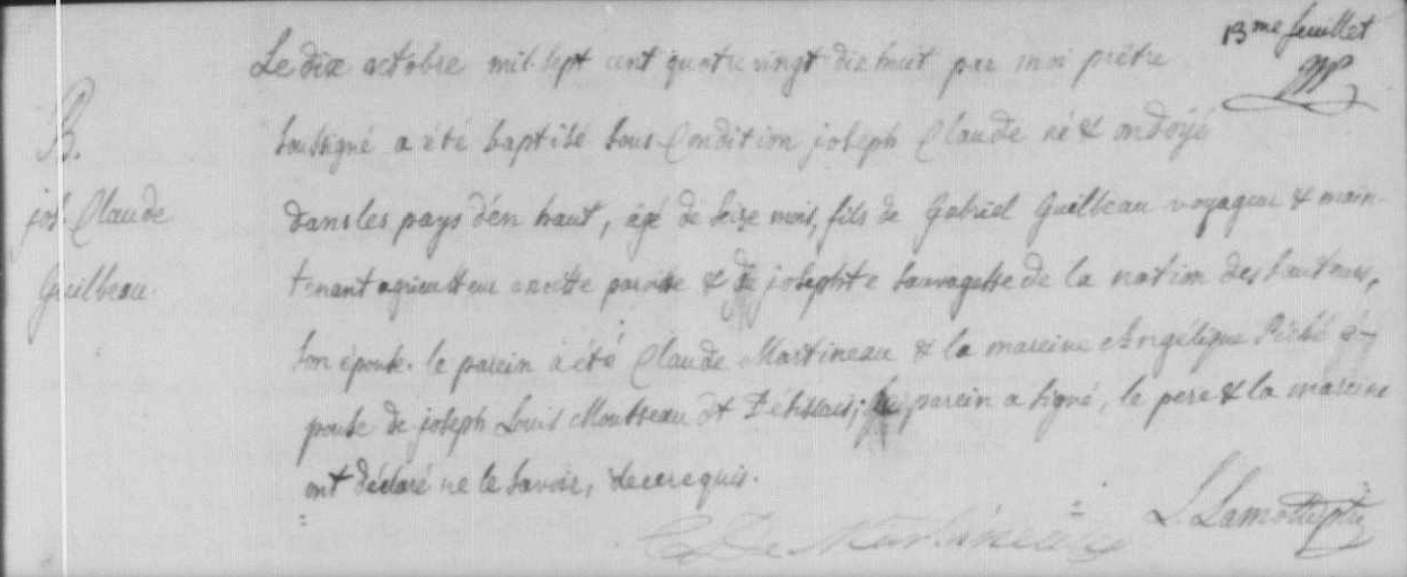
"...a été baptisé sous condition Joseph Claude, né et ondoyé dans les pays d'en haut, âgé de seize mois, fils de Gabriel Guilbeau voyageur et maintenant agriculteur en cette paroisse, et de Josephte Sauvagesse de la nation des hauteurs, son épouse..."
"...was conditionally baptized Joseph Claude, born and given emergency baptism in the upper country, aged sixteen months, son of Gabriel Guilbeau, voyageur and now a farmer of this parish, and of Josephte, an Indigenous woman of the nation of the uplands, his wife..."
Baptism of Joseph Claude Guilbeau, St-Paul-de-Joliette, 10 October 1798; officiating, L. Lamotte, priest. Three children of this family were baptized that day, and the entries are not identical: two of the three carry maintenant, the eldest boy's does not. The parish appears in the PRDH indexes as St-Paul-de-Lavaltrie — one parish under two names, and both will be met when following these citations.
Two phrases in that line are doing heavy work, and both are easy to lose in transcription.
The first is maintenant. Drop it and the sentence says something the priest did not say.
The second is de la nation des hauteurs — of the nation of the uplands. Priests writing about Indigenous women in this period overwhelmingly wrote one word, Sauvagesse, and stopped. A woman recorded that way is, for research purposes, gone: there is nothing to search on. Lamotte wrote more than that, but it is worth being exact about how much more. Des hauteurs is a direction, not a nation — the high country, the interior, the same place the children were born. It narrows the search without naming her people.
The naming comes later, and in two stages. Eleven months after the mass baptism, at the same parish, a second priest baptizing the couple’s newborn son wrote de la nation des Sauteux — of the Saulteaux, which is to say Ojibwe. Then at the mission of Oka in January 1801, a third wrote her name, her nation and her homeland together: Marie Josephte Abitakijikokwe, of the Saulteaux nation on Lake Superior. Those are the records that identify her. The 1798 entries are what make them findable — they point west, and they give a husband, a parish and a date to search from. Her band and her family connections remain the open frontier of this research.
What Was a Voyageur?
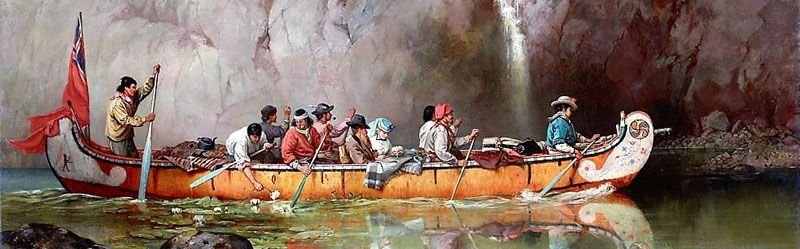
The word voyageur — French for "traveller" — referred to the contracted employees who worked as canoe paddlers, bundle carriers and general labourers for the fur trading companies, from the late seventeenth century through the middle of the nineteenth. Unlike the earlier coureurs de bois, who traded independently and often illegally, voyageurs worked inside a licensed system, hired under formal written contracts before a notary.
Their job was transportation. They moved trade goods west and furs east along a route that ran from Montreal to the far posts of the interior — better than three thousand miles to Fort Chipewyan in the Athabasca country. They did not, as a rule, trap or process pelts; that work belonged to Indigenous hunters and their families. The voyageurs were the supply chain: the human engines that drove birchbark canoes up rapids, across lakes, and over an endless succession of portages.
The Physical Reality
Days of fourteen hours and more at the paddle. Standard fur bales weighed ninety pounds and were carried two at a time across a portage, sometimes more. The men spent much of their working lives wet — out of the canoe to lighten it through shallows, lining it up rapids, wading. Hernias were common and frequently fatal. Rheumatism, crushed feet and ruined backs were the ordinary retirement conditions of the trade.
Which is worth holding in mind when the registers show a man in his thirties putting the paddle down.
The Language of the Trade
The Seasonal Economy — and Its Limits
The romantic picture of the voyageur as a wild man of the woods, unattached and permanently gone, is wrong for most of the men who did the work. The trade was seasonal by design. Brigades left Lachine in May, after the ice went out, and were meant to be back before freeze-up. A man could paddle west, spend a summer at a post, and be home for the harvest. A great many were.
The Mangeur de Lard
Novices made the round trip from Montreal to Grand Portage inside a single season, May to September, and returned to their farms for the winter. This is the genuinely seasonal pattern.
The Hivernant
Experienced men stayed in the pays d'en haut year-round, sometimes for years together, frequently marrying Indigenous women and raising families in the interior. This is not seasonal at all.
Gabriel Guilbault was the second kind. His three eldest children were born in the upper country, not in a parish; the eldest was eight before he saw a church. Whatever he was doing between about 1789 and 1798, he was not paddling out in May and coming home in September.
So the seasonal economy is real, and it is the reason a French-Canadian man could hold a farm and a paddling contract in the same year. But it is not what this record documents, and the distinction matters. A researcher who assumes the seasonal pattern will read every occupational shift as an oscillation and will stop looking. A researcher who reads the registers as a sequence will notice that Gabriel's shifts run one way.
Five Designations, Thirty-Five Years
What makes the Guilbault registers unusual is not that they record an occupation. It is that they record one repeatedly, in the same hand-to-hand chain of parish events, across most of a working life — and that one of the changes is datable to the day.
Read in order, they do not describe a man alternating between two trades. They describe a man leaving one and taking up another, then losing it.
| Date | Record | Designation |
|---|---|---|
| Oct 1798 | Baptisms of three children, St-Paul-de-Joliette | voyageur et maintenant agriculteur |
| Sep 1799 | Baptism of his son François, St-Paul-de-Lavaltrie | laboureur — working the land, near enough to agriculteur to read as continuous |
| Jan 1801 | His marriage to Marie Josephte, L'Annonciation d'Oka | voyageur — and back to the first word again |
| Jan 1802 | Baptism of Marie Louise, Oka — the word interlined, the priest validating his own insertion | maçon |
| 1806–1815 | Baptism of Louis; burial of Marie Josephte; his second marriage — all at Rigaud | maçon of the seigneurie d'Argenteuil |
| 1816–1821 | Baptisms at Rigaud in 1816 and June 1819; a baptism at St-Eustache in February 1821 — present in person at all three | maçon — and in Lower Canada throughout |
| Apr 1833 | His burial, St-Benoît | journalier du lieu — day labourer of this place |
The January 1802 entry is the hinge, and it is the single best thing in the file. Baptizing Gabriel's infant daughter at Oka, the priest wrote out the father's name, then squeezed maçon in above the line — and closed the entry with the formula un mot ajouté, one word added, initialling his own correction so that no one could later claim the register had been tampered with.
That notation is why the change of trade is datable rather than approximate. A priest does not interline a word he had no reason to add. Something in that conversation, on that January day, told him the man in front of him was now a mason, and he went back and put it in.

And then the ending, which is the part a triumphal version of this story would leave out. A Gabriel Guilbault held land in the Argenteuil seigneury — about sixty superficial acres of Ottawa River frontage, bought on 23 July 1827 and declared before a notary the following year. The obvious arc runs voyageur to tradesman to proprietor, and it would be a satisfying one. Two things spoil it. The declaration styles the man simply Farmer and carries no père or fils, and in those same years the register calls the father maçon and journalier while calling his son cultivateur — so the deed cannot be assigned to either man. And the last register entry in Gabriel’s life, the burial at St-Benoît in April 1833, calls him journalier du lieu. A day labourer. What happened between the deed and the grave is not documented, and inventing a reason would be worse than admitting the gap.
The honest reading is that occupational designations record moments, and the moments do not have to add up to a story with a shape. Gabriel was a voyageur, then a farmer, then a mason for thirty years, then a labourer. His registers say so, in that order, and they do not explain themselves.
The Counter-Case: Paul
Gabriel had an older brother, Paul, born the year before him to the same parents. For several years this research had a fur-trade career for Paul too — two signed engagements and an Athabasca account settling at 617 livres 14 sols, with a hundred-livre credit attributed to Lieutenant John Franklin, who was outfitting his first overland expedition and hiring Canadians out of Fort Chipewyan.
That identification has been withdrawn. The company documents spell their man Gibeau, Gibeault and Gebeault, and record no parish, no parentage and no age; and three Quebec documents place Paul Guilbault at home inside the years those account books pay their man. One of the three is the entry this page is about.
So the brothers are still a matched pair, but not the pair this section originally claimed. Look at what the Quebec parish registers say about Paul across forty-eight years, from his marriage in 1783 to his burial in 1831.
Paul Guilbault, as the parish registers have him
1796 agriculteur · Mar 1798 maçon · Nov 1798 laboureur · 1800 laboureur · 1801 maçon · 1802 maçon et laboureur · 1803 maçon · 1804 maçon · 1806 maçon · 1807 cultivateur · Feb 1810 maçon · Aug 1810 laboureur · Sep 1811 agriculteur · Dec 1811 maçon · 1814 maçon · Sep 1815 maçon · Feb 1819 cultivateur · Oct 1821 laboureur · 1825 agriculteur · 1826 cultivateur · 1831 cultivateur, at his burial
The word voyageur does not appear once.
Paul is not a distant figure in this story, either. On 10 October 1798, when Gabriel brought his wilderness-born children down to St-Paul-de-Joliette, it was Paul Guilbeau who stood godfather to his niece Angélique, with his wife Marie Olivier as godmother. The act records that both were asked to sign and neither could. That clause is one of the three documents that took Paul’s fur-trade career away from him — godparents appear in person, and eleven weeks earlier a contract had been signed at Rainy Lake engaging its man to winter at Great Slave Lake and not be free until Montreal.
One entry, one morning, two brothers — and it has now been used against both of them. It is Gabriel’s only surviving record as a voyageur, and it is part of the reason Paul is no longer one.
Twenty-one occupational statements for Paul, drawn from his children’s baptisms, burials and marriages, and not one of them says voyageur. For years this research read that silence as concealment — a career the parish system could not see. It was simply silence.
What Negative Evidence Can and Cannot Do
The absence of a word is not evidence of the absence of the thing. A priest recording a baptism in February had no occasion to mention what a father did in the interior in July, and probably no interest. So parish silence cannot close a fur-trade question, and if your French-Canadian ancestor lived within reach of Montreal between roughly 1700 and 1850, the fact that no register calls him a voyageur tells you very little.
But the reverse holds just as hard, and it is what this family taught the hard way. Silence is not evidence either. It is an empty space, and an empty space will accept whatever you put in it. The engagement contracts at BAnQ and the company account books at the HBCA name men the parishes do not — and a name in a company index is not a man until something outside it supplies a parish.

What It Paid
Fur trade wages are often described in round rhetorical terms — a fortune, or a pittance, depending on the telling. The account books settle it, provided you are careful about whose account you are reading.
The ledger account that runs under Gabriel’s name credits wages of 551, 330, 687.10, 500 and 650 livres across five years, and closes at the 1821 merger with 336 livres owed to whoever held it. Its purchases are itemised and entirely legible as a life: capotes, tobacco, gun flints, soap, three pints of rum at ninety livres. Whether the man was Gabriel is now an open question — the registers place him at Rigaud in June 1819 and at St-Eustache in February 1821, inside the account’s own wage years — but the figures are real, and they tell you what the trade paid a working middleman in its last years.
A wage in the 500 to 650 range is a real wage. It is not three times what a farm earned in a year, and the men who took it home mostly went back to their farms.
One financial fact in this family is beyond dispute, and it belongs to Paul. In April 1827 and June 1828 he lent 228 livres to one neighbour and 200 to another, taking secured grain annuities in return — wheat delivered to his own house each year, charged against the borrowers’ farms, and extinguished at his death. He was not a poor man being carried by his children; he was a man in his sixties living on interest. Where the capital came from was once explained as fur-trade wages. That explanation went with the career, and the question is now open.
Key Dates in the Fur Trade
Indigenous Connections
The trade depended utterly on Indigenous peoples. They trapped and processed the pelts. They taught the French to build and handle birchbark canoes, to make and carry pemmican, to survive a winter in the interior. They held the geographic knowledge that made the routes usable at all. Without Indigenous partners the enterprise does not exist.
Marriage was central to the partnership. A trader who married an Indigenous woman gained entry to a kinship network that turned a stranger into a relative. His wife could teach him the language and the protocols, process furs, manage a household in country he could not read. Her relatives became his trading partners. These unions were commonly contracted à la façon du pays — according to the custom of the country — without a priest, and the communities of mixed-ancestry families they produced around the trading posts are the origin of the Métis nation.
Gabriel and Marie Josephte lived that way for something like eleven years and had four children before a church was involved. In January 1801 they came to the mission at Oka and regularised it: she was baptized on the 26th, they were married on the 27th, and all four children were legitimated in the same entry. The witnesses were Indigenous men of the mission.
Her name survives because three priests — at St-Paul in 1798 and again in 1799, and at Oka in 1801 — wrote down more than the single word the convention called for. Everything that has since been recovered about her — three parishes, four period spellings, records naming her from 1798 to 1827, fourteen years past her own burial — descends from that.
The Abitakijikokwe Discovery
How an Indigenous woman recorded as Sauvagesse was identified by name, nation and homeland from Quebec parish registers — and what the method can and cannot establish. Told in full in the case study.
Reading Occupations in Parish Records
The practical lesson of the Guilbault registers is narrow and useful: an occupational designation is a statement about the day it was written, made by a clerk who had no interest in your research question. Treat it as a data point with a date attached, not as a description of a man.
Plot them, don't average them
Put every designation on a timeline before drawing a conclusion. A single record showing "cultivateur" means one thing; six in a row means another; six alternating with "maçon" means something else again.
Watch for interlineations
A word squeezed above the line, especially one the priest validates in the closing formula, is a correction made deliberately. It usually dates a change more precisely than anything else on the page.
Silence is not evidence
Paul Guilbault’s twenty-one Quebec records never call him a voyageur. That silence cannot close the question — and it cannot open it either. An empty space will accept whatever you put in it.
Go to the trade's own records
Notarial engagement contracts at BAnQ and company account books at the HBCA name the men the parishes do not. Both are indexed, and both hold spellings you would never search for.
Three generations of this family make the point without further comment. Gabriel père: voyageur, then farmer, then mason for thirty years, then day labourer at his burial in 1833. Gabriel fils, the boy baptized at eight in the 1798 entry: still entered as voyageur in the census enumerated at St-Placide in January 1852, recorded at sixty and working a farm of sixty arpents, an old man claiming a trade that had effectively ended thirty years before. And Evangéliste, the grandson, born in 1845 into a world with no brigades left in it, recorded all his life as journalier.
Same family, same river, three completely different answers to the question of what a man did for a living. All of them true on the day they were written.
Are You Connected to the Guilbault Line?
If you descend from the Guilbault (Guilbeau, Guilbeault) family of Charlesbourg and the Quebec parishes, from the children of Marie Josephte Abitakijikokwe, or from the founding families of the line — Senécal, Séguin dit Ladéroute, Morin, Couillaud dit Roquebrune, Gaulin — I’d like to compare notes. Documented trees, DNA matches, family papers, and even half-remembered stories have all moved this research forward.
Get in Touch About This FamilyCousin connections are informal and reciprocal — no fee, no obligation, just shared work on shared ancestry.
Every Family Has a Story Worth Telling
Whether you're just beginning your research or ready to transform years of work into a narrative your family will treasure, I'd love to help.
LET'S TALK ABOUT YOUR FAMILY