
Charles Gabriel Guilbault: 1731 -1784
Charles Gabriel Guilbault
Father of the Voyageur
Before Gabriel Guilbault paddled canoes into the pays d'en haut and married an Ojibwe woman whose name would echo through centuries, there was his father—another Gabriel, born Charles Gabriel Guilbault in the shadow of Quebec City's great cathedral.
This earlier Gabriel lived a more settled life than his adventurous son would choose. Born in New France's capital during the prosperous years before the British Conquest, he moved to the farming communities northeast of Montreal, married twice, and raised the family that would eventually connect two worlds—French and Indigenous, colonial and frontier.

Origins: Quebec City, 1731
On August 6, 1731, in the parish of Notre-Dame-de-Québec, a boy was baptized Charles Gabriel. His parents were Charles Guilbault and Marie Catherine Antoinette Deguise Flamand—respectable members of Quebec City's colonial society.
The godparents recorded that day carry their standing in their titles: Sr Charles Larchevêque and Dame Marie Magdeleine De Buirre. In a register where most sponsors are named flat, without style, those two honorifics are the whole social statement.
The entry closes on a different note. The priest wrote "le père étant absent" — the father being absent. Charles Guilbault was not present at his son's baptism, and the register records it without comment or explanation. PRDH renders the abbreviation in its profession column as "has," which is almost certainly abs, absent, rather than habitant; the index has turned an absence into an occupation.
"Le sixieme aoust mil sept cent trente et un par nous Curé de Québec a été baptisé Charles Gabriel né ce jour du légitime mariage de Charles Guilbault et de Catherine de Guise..."
— Notre-Dame-de-Québec Parish Register, August 6, 1731Though baptized "Charles Gabriel," he would come to be known simply as Gabriel—the name that would pass to his son, the voyageur, creating a lineage of Gabriels stretching across generations and across the continent.

First Marriage: Marie Charlotte Morin
By 1757, Gabriel had left Quebec City for the growing communities around Montreal. On September 26, 1757, at Notre-Dame in Montreal, he married Marie Charlotte Morin, daughter of Joseph Morin and Marie Charlotte Charles Croquelois Laviolette.
Marie Charlotte was nineteen, born in Montreal on August 4, 1738. Gabriel was twenty-six. The church record identifies him as a resident of La-Visitation-du-Sault-au-Récollet—his father Charles's parish—while Charlotte lived in Montreal proper.

The Marriage Contract
A notarial marriage contract—a sign of property and planning—preceded their church wedding. The contract, recorded by notary Hodiesne, Gervais (Document No. 343), established the legal framework for their married life under the Coutume de Paris, the civil code governing New France.
What the contract reveals goes beyond legal formalities. It preserves the names, occupations, and social networks of two families united by marriage—and by trade.

The contract names Gabriel as a maçon—a mason—aged twenty-four, residing with his father Charles Guilbault. The bride's father, Joseph Morin, is identified as a maître tailleur de pierre—a master stone cutter. The bride's trousseau of clothing and linens was valued at 380 livres.
— Notary Hodiesne, Gervais, Marriage Contract No. 343, Archives Nationales du Québec, MontréalBoth 1757 documents give the groom's age as twenty-four and the bride's as twenty. Both are wrong, and wrong in the same direction: his baptism at Québec in August 1731 makes him twenty-six, hers at Montreal in August 1738 makes her nineteen years and one month. When two documents drawn up weeks apart agree with each other and disagree with the registers, what they are recording is usually what the couple said about themselves.
The assembled witnesses painted a picture of both families' social circles: on the groom's side, his father Charles, his half-brother Louis Guilbault — who stood in an odd double relation to the day, as will become clear — and friends François Meau dit Laumanville and Jean Baptiste Charron. On the bride's side, her parents Joseph Morin and Marie Charlotte Croqueloise, siblings Joseph and Rose Morin, Demoiselle Marie Joseph Morin, cousin François Papin, and family friends including Joseph Regnault.

A Dispensation for Kinship
The marriage register says something the contract does not. After noting the publication of the three banns, the priest recorded that the couple came to the altar under a dispensation:
"Après la publication des trois bans, vu la dispense de parenté qui est entre les parties, accordée par Mre Étienne Montgolfier, grand vicaire de dit Mgr l'Évesque de Québec..."
— Notre-Dame-de-Montréal, Marriage Register, 26 September 1757Dispense de parenté. A dispensation for kinship. Gabriel Guilbault and Marie Charlotte Morin were related closely enough that canon law barred the marriage, and the impediment had to be lifted before a priest could perform it. Étienne Montgolfier — Sulpician superior and vicar general at Montreal — granted it.
This matters for a reason that goes beyond the couple. Consanguinity in colonial families is usually something a modern researcher reconstructs by building descent charts backward and finding a shared ancestor. Here it is not a reconstruction. It is a statement made in 1757, by the men who had to satisfy themselves it was true, written into the register at the moment of the wedding. The Church investigated the couple's ancestry and found a blood relationship, and the finding survives.
What the entry does not do is state the degree. Second cousins, third, third-to-fourth — the register is silent, and the silence is the open question.
Where the Kinship Runs
One path can be ruled out immediately, and it is the one that looks most promising.
Twenty years before this wedding, on 4 March 1737, the groom's widowed father Charles Guilbault remarried at this same church. His second wife was Marie Croquelois dit Laviolette — and the bride's mother was Marie Charlotte Croquelois dit Laviolette. The two women were sisters, daughters of Jacques Croquelois dit Laviolet and Marie Françoise Dumouchel.
So the two families were already joined. The groom's stepmother was the bride's aunt. The Louis Guilbault standing among the witnesses on the groom's side was the son of that second marriage — the groom's half-brother and the bride's first cousin, in one person, at one table.
But a stepmother creates affinity, not consanguinity, and affinity of that kind raises no impediment requiring this dispensation. Whatever Montgolfier found, he did not find it here.
Which leaves the blood. The groom's paternal grandmother — Catherine Déguise's mother, named in the 1727 marriage register — was Marie Anne Morin. The bride was a Morin. The kinship almost certainly runs there, through the Morin line, and the surviving documents do not yet say how.
That last step is an inference, not a finding. It follows from eliminating the Croquelois route rather than from any document naming the common ancestor, and it is recorded here as such. Montgolfier's office registered dispensation petitions, and those petitions ordinarily stated the degree and set out the genealogy submitted to prove it. If that register survives among the Sulpician archives or at the Archives de l'Archidiocèse de Montréal, it holds an eighteenth-century pedigree of this family, compiled by people with a professional reason to get it right.
Four Dispensations, 150 Years
This family met the Church's marriage law four times across four generations, and each time the impediment was different.
Four impediment types, two levels of authority, four parishes, a century and a half. Taken together they are a small demonstration of how completely the Church governed who could marry whom in this society — and of how much genealogy the Church was prepared to do before it answered.
A Building Trades Alliance
The marriage contract reveals something more than a legal agreement between two families. It documents an occupational alliance—a marriage forged within the building trades of colonial Montreal.
The Groom
Worked with stone, brick, and mortar to construct walls, foundations, and structures
The Bride's Father
Shaped raw stone into dressed blocks for construction—the mason's essential material
This was no coincidence. In 18th-century Montreal, the building trades formed tight social networks. Stone cutters and masons worked hand in hand—the cutter prepared the dressed stone, the mason laid it. These men shared worksites, knew each other's skills, and trusted each other's craftsmanship. A marriage between a mason's son and a stone cutter's daughter would have been the natural culmination of a professional relationship between the two families.
This occupational connection echoed through the next generation. Both surviving elder sons of the first marriage carried their father's trade forward. Gabriel the voyageur — after years paddling into the pays d'en haut — settled as a maçon, the word interlined into a baptism entry at Oka in January 1802 and holding for the next twenty-five years, though his own burial in 1833 would call him journalier. His brother Paul alternated between maçon, laboureur and cultivateur throughout his working life. The stone cutter's daughter had married a mason, and both her elder sons took up the trade.
One detail complicates the neat division of labour, and improves it. At Marie Charlotte's own baptism in August 1738, her father's profession is entered simply as maçon — the same word that would describe her husband nineteen years later. The maître tailleur de pierre of the 1757 contract is where Joseph Morin finished, not where he began. He had risen within the trade, taken the mastership, and married his daughter to a mason of twenty-six who had not yet done either.
The designation maître before Joseph Morin's trade is significant. A master craftsman had completed formal training and was authorized to operate independently, take apprentices, and bid on contracts. This placed the Morin family at the upper tier of Montreal's artisan class—and suggests that Gabriel, as a working mason at twenty-six, may have trained in or near the Morin workshop.
When Marie Charlotte was baptized in August 1738, her godfather was Louis Marie Rocbert, garde-magasin du roi — the King's storekeeper at Montreal — and her godmother Demoiselle Marie Anne Legardeur de Tilly. A royal office-holder and a daughter of one of the colony's seigneurial families, standing for the infant daughter of a mason.
The King's storekeeper controlled the flow of construction materials in the colony. Sponsors of that rank do not appear in a tradesman's family by accident, and the tie was in place nineteen years before the marriage contract that this page has been reading as a trades alliance.
— Notre-Dame-de-Montréal, 4 August 1738A Decade of Family Life
Between 1758 and 1766, Gabriel and Marie Charlotte had seven children. The family settled in L'Assomption, northeast of Montreal—the same parish where their son Gabriel would later be baptized and from which he would set out on his voyageur adventures.
The children arrived regularly, but not all survived. Three of the seven died before their second birthday.
| Child | Born / baptised | Place | Married | Died / buried |
|---|---|---|---|---|
| Marie Charles Charlotte | 7 Oct 1758 | Notre-Dame-de-Montréal | — | 14 Aug 1759, buried the 15th, aged nine months |
| Marie Louise Charlotte | 11 Dec 1759 | Notre-Dame-de-Montréal | — | 23 Aug 1760, aged eight months |
| Paul | 23 Apr 1761 | Notre-Dame-de-Montréal | 3 Feb 1783, Varennes — Marie Geneviève Olivier Milot | 2 Jan 1831, St-Paul-de-Lavaltrie |
| Gabriel | 13 Jun 1762 | L'Assomption | 27 Jan 1801, Oka — Marie Josephte Abitakijikokwe | 6 Apr 1833, St-Benoît |
| Joseph | 27 Aug 1763, baptised the 28th | L'Assomption | 5 Feb 1798, St-Paul-de-Lavaltrie — Charlotte Jette Beaurivage | 17 Apr 1848, St-Paul-de-Lavaltrie |
| Marie Geneviève | 7 Nov 1764 | L'Assomption | — | 16 Jul 1765, aged eight months |
| Louis | 8 May 1766, baptised the 9th | L'Assomption | 18 Nov 1788, St-Roch-de-l'Achigan — Josephe Deziel Labreche | 15 May 1813, St-Roch-de-l'Achigan |
Family reconstitution at PRDH-IGD, famille no. 34045, rendered here as a table rather than a database card image, so that what a database reports is not shown as though it were a record. Where the card gives a single date and the register distinguishes birth from baptism — Joseph and Louis are both entered né d'hier — the register is followed.
Documentary Evidence: The Children
Each child left traces in the parish registers—baptisms that document births, sometimes burials that document early deaths. These records allow us to reconstruct the rhythm of family life in colonial Quebec.
The First Daughters: A Pattern of Loss
The first two children—both daughters, both named for their mother—died before their first birthdays. Marie Charles Charlotte, born October 7, 1758, died on 14 August 1759 and was buried at Notre-Dame the next day. She was nine months old. Present at her burial were François Dezery, a student, and Gabriel Bled StMartin.
Charlotte and Gabriel tried again almost immediately. Marie Louise Charlotte was baptized December 11, 1759—barely four months after the first daughter's death. The same godparents stood again: Charles Renault and the maternal grandmother Marie Charlotte Croqueloy. This second daughter survived only to August 1760.
What the sponsors say about the household. At the first daughter's baptism in October 1758 the godparents were her maternal grandfather Joseph Morin and grandmother Marie Croquelois, with the paternal grandfather Charles Guilbot also named in the entry. Both families in the church, three grandparents present for a first child.
At the second daughter's, fourteen months later, the sponsors are Charles Renault and the grandmother again. The Morin grandfather does not appear.
The Sons Who Survived
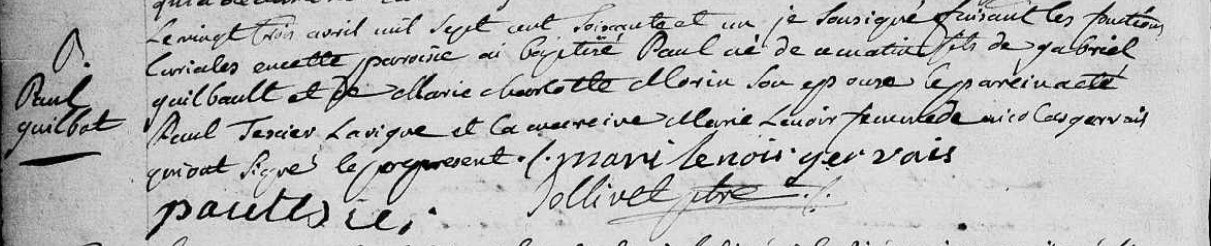
A move, dated by a baptism. Paul was baptised at Notre-Dame de Montréal in April 1761. Fourteen months later his brother Gabriel was baptised at L'Assomption — the first of the family's children christened there — and every subsequent child of both marriages would be baptised in that parish.
The register entry indexes the boy as "Gabriel GIBBORT", the most extreme of this family's many spellings, with his father entered under the same form. Godparents: Michel Hayet and Catherine Jourdin; officiating, Degeay, priest of L'Assomption.

Notice how the surname spelling varies across records: Guilbault, Guilbot, Guillebeau, Gilbeau, Gelbeau, Gibbort, Gilbort. Standardized spelling was not yet a feature of colonial record-keeping—names were recorded as they sounded to the priest or notary. This fluidity is also why PRDH indexes these records under several different headings, and why the disambiguation below matters.
Research Note: Guilbault vs. Gibeau
The fluid spelling of 18th-century surnames creates a specific research challenge: distinguishing this Guilbault family from the Gibeau families whose name a priest or an indexer could render the same way.
Disambiguation: two "Gabriel" families, 1757–58
A "Gabriel Gibeau Fils" appears as a witness at two marriages in the La Prairie area — the Bisson-Riel marriage at St-Constant on 24 January 1757, where he is witness rank 07, and the Patenotre-Bisaillon marriage at La Prairie on 22 April 1758, where the index gives "Gabriel Gibault" at rank 08. Was this our Charles Gabriel Guilbault?
Resolution: No. This was Gabriel Gibeau (PRDH no. 99425), born 6 July 1709 at Lachine, son of another Gabriel Gibeau and Elisabeth Isabelle Messague Laplaine. He married Marie Angelique Amable Tremblay in June 1755 at Lachine and had a son baptised at La Prairie on 7 September 1757 — placing his family squarely in that area during these appearances.
Our Charles Gabriel Guilbault was based at La-Visitation-du-Sault-au-Récollet and married at Notre-Dame de Montréal in September 1757. A different parish, a different community, a different family.
The hazard is not confined to the eighteenth century, and this is the part worth carrying forward.
A second and separate Gibeau family lived in the Argenteuil parishes across exactly the years this line occupies them. Étienne Gibeau married Marie Sureau Blondin at Rigaud in January 1807; their children were baptised at Rigaud and St-Benoît and the family's events move to St-André-Est from 1828. Their son Étienne married Esther Plouf at Rigaud in 1829 — and stood godfather at a Guilbault baptism at St-André in 1844, where a published compilation silently turned him into a Guilbault.
There was also a notary, Alfred-T. Gibeau, practising at St-André-d'Argenteuil in the 1850s and at St-André-Avellin after that.
So the rule this page sets is a standing one, and it runs both ways: any Guilbault appearing as witness or godparent in a Rigaud, St-André or St-Benoît record must be checked against Gibeau before the name is accepted — and any Gibeau checked against Guilbault.
Loss: November 1767
Marie Charlotte Morin was buried at L'Assomption on 3 November 1767. She was twenty-nine. She left four young sons: Paul (6), Gabriel (5), Joseph (4), and Louis (1).
Gabriel was now a widower with four children under seven. The youngest, Louis, was barely a year old and would have no memory of his mother.
Marie Charlotte Morin — born and baptised 4 August 1738 at Notre-Dame-de-Montréal, daughter of Joseph Morin and Marie Charlotte Charles Croquelois Laviolette; married Gabriel Guilbault 26 September 1757 at Notre-Dame-de-Montréal; buried 3 November 1767 at L'Assomption. Twenty-nine years, seven children, ten years of marriage.
— PRDH-IGD, individual no. 154845. The card gives the burial date; the date of death is not separately recorded.Within eight months, Gabriel would remarry—a practical necessity as much as an emotional choice.
Second Marriage: Marie Catherine Beaudoin
On July 18, 1768, Gabriel married Marie Catherine Beaudoin at L'Assomption. She was twenty-five, daughter of Jacques Beaudoin and Marie Josephe Renaud Blanchard Rainaud. The marriage record identifies Gabriel as "veuf de Marie Charlotte Morin"—widower of Marie Charlotte Morin.

Marie Catherine outlived him by a long way. Gabriel died in 1784; she survived until 25 March 1827 and was buried at St-Eustache at eighty-four — forty-three years a widow.
Children of the Second Marriage
Six children came of this marriage. The pattern of loss that marked the first continued: only two reached adulthood.
| Child | Born / baptised | Place | Married | Died / buried |
|---|---|---|---|---|
| Marie | 1 Jun 1770 | L'Assomption | — | 19 Sep 1770, aged three and a half months |
| Marie Charlotte | 18 Oct 1771 | L'Assomption | 1 Feb 1796, St-Paul-de-Lavaltrie — Joseph Prudhomme | 22 Jul 1819, St-Paul-de-Lavaltrie |
| Marie Desanges | 13 Oct 1774 | L'Assomption | — | 16 Jun 1778, aged three and a half years |
| Charles | 12 Oct 1778 | L'Assomption | — | 28 Jul 1781, aged nearly three |
| Gabriel Amable | 2 Feb 1780 | L'Assomption | — | 26 Jul 1781, aged eighteen months |
| Charles | 27 Oct 1782 | L'Assomption | 12 Oct 1807, St-Eustache — Marie Angelique Lebrun Stantoine; (2) Adelaide Payfer, 1833, St-Eustache | 30 Sep 1854, St-Eustache |
Family reconstitution at PRDH-IGD, famille no. 45374, rendered as a table rather than a card image. Every one of these six children was baptised at L'Assomption. Earlier versions of this page gave the last Charles's birthplace as Rivière-Rouge; that phrase belongs to his mother, not to him — see below.
« De la Rivière Rouge ». The phrase appears in this family's records as a description of Marie Catherine Beaudoin. The Rivière Rouge was a côte — a concession road — in the Seigneurie de Lavaltrie, not a parish. People who lived along it were baptised, married and buried at the parish church.
So it is a residence, and a more useful fact than the birthplace it was mistaken for: it says where in the seigneury this household actually was, rather than which church they walked to. Reported by M. H. Morales from the act; the image is not reproduced here.
The July 1781 losses deserve particular attention. Gabriel Amable died on the 26th at eighteen months; Charles died on the 28th at nearly three. Two funerals in three days. Whatever swept through that household took both boys and left one child of this marriage standing: Marie Charlotte, aged nine. Gabriel turned fifty a week later. The Charles who would survive him was not yet born — he arrived the following autumn and was given the same name a third time.
First Marriage: Marie Charlotte Morin
- Married: 26 September 1757
- Wife's dates: 1738–1767
- 7 children (4 survived)
- 10 years of marriage
- Included Gabriel the voyageur
- Building trades alliance
Second Marriage: Marie Catherine Beaudoin
- Married: 18 July 1768
- Wife's dates: 1742–1827
- 6 children (2 survived)
- 16 years of marriage
- Wife survived 43 years after Gabriel
- Son Charles settled at St-Eustache
An Occupational Question
The marriage contract of 1757 identified Gabriel as a maçon. But when his youngest son Charles married at St-Eustache in 1807, the parish register described the deceased father as "feu Gabriel Guilbault laboureur"—farmer. This is the only document in the entire collection that assigns Gabriel a different occupation.
Did he shift from mason to farmer during his L'Assomption years? It is possible that Gabriel, like many colonial artisans, combined the two: masonry when construction work was available, farming the rest of the time. Or the 1807 priest may simply have applied the generic laboureur posthumously, as was common for rural men a generation dead.
His son would make the same question harder to answer. Gabriel the voyageur is agriculteur in 1798, laboureur in 1799, voyageur again in 1801, maçon from 1802, and journalier at his death. In this family a single occupational word has never been a reliable guide to a man's working life.
August 22, 1784: Burial at L'Assomption
Gabriel Guilbault died on August 21, 1784, and was buried the following day in the parish cemetery of L'Assomption. The register records his age as approximately fifty-two years—he was fifty-three.
"Le vingt deux aoust mil sept cent quatre vingt quatre par nous soussigné a été inhumé dans le Cimetière de cette paroisse le Corps de Gabriel Guilbeau décédé hier agé de cinquante deux ans ou environ muni des Sacrements de l'Église..."
— L'Assomption Parish Register, August 22, 1784He had received the sacraments of the Church—"muni des Sacrements de l'Église"—and witnesses present at the burial included Pierre Nolan dit Laville and Joseph Panneton.
One year off is the closest any stated age in this family comes to the truth. His son's burial in 1833 would overshoot by twenty-three years; his grandson's in 1880 by two; the 1851 census would understate that grandson by eleven.
At the time of his death, his son Gabriel—the future voyageur—was twenty-two. His youngest child, Charles, was not yet two. Marie Catherine Beaudoin was left a widow at forty-two, with two surviving children of her own and four adult stepsons. Within a few years, the younger Gabriel would paddle west into the pays d'en haut, meet an Ojibwe woman named Marie Josephte Abitakijikokwe, and begin the family line that would connect French Canada to the Indigenous peoples of the Great Lakes.
The Burial Record

The Legacy: Thirteen Children, Two Marriages
Across two marriages and twenty-seven years, Charles Gabriel Guilbault fathered thirteen children. Six survived to adulthood—four sons from his first marriage, one daughter and one son from his second. Each established their own families in the parishes of Quebec:
| Child | Life Dates | Marriage | Spouse |
|---|---|---|---|
| First Marriage — Marie Charlotte Morin | |||
| Paul | 1761–1831 | 1783, Varennes | Marie Geneviève Olivier Milot |
| Gabriel | 1762–1833 | 1801, Oka | Marie Josephte Abitakijikokwe |
| Joseph | 1763–1848 | 1798, St-Paul-de-Lavaltrie | Charlotte Jette Beaurivage |
| Louis | 1766–1813 | 1788, St-Roch-de-l'Achigan | Josephe Deziel Labreche |
| Second Marriage — Marie Catherine Beaudoin | |||
| Marie Charlotte | 1771–1819 | 1796, St-Paul-de-Lavaltrie | Joseph Prudhomme |
| Charles | 1782–1854 | 1807, St-Eustache | Marie Angelique Lebrun Stantoine |
Of the first-marriage sons, it was Gabriel—the second-born—who would forge the connection to Indigenous heritage that makes this family line remarkable. While his brothers married French-Canadian women and stayed in the settled parishes, Gabriel ventured into the fur trade, formed a family "à la façon du pays," and preserved for his descendants a documented Métis heritage.
But the father's trade left its mark. Gabriel the voyageur settled into the same craft — parish records identify him as maçon from January 1802, and in 1827 a Gabriel Guilbault declared title to about sixty acres of Ottawa River frontage at Baie Carillon, though the register that buried him in 1833 called him a day labourer. Paul carried the maçon designation on and off for thirty years, alternating with laboureur and cultivateur as the recording priest and the season dictated. The building trades alliance their father cemented by marrying a stone cutter's daughter had become a family inheritance.
The blended family remained close. When the last-born Charles was baptized at L'Assomption in the autumn of 1782, his godfather was Paul Guilbeau—his twenty-one-year-old half-brother from the first marriage. And when Joseph married Charlotte Jette at St-Paul-de-Lavaltrie in 1798, his brother Paul served as witness. The bonds between the first- and second-marriage children endured.
Gabriel Guilbault — born and baptised 6 August 1731, Notre-Dame-de-Québec, son of Charles Guilbault and Marie Catherine Antoinette Deguise Flamand. First marriage 26 September 1757, Notre-Dame-de-Montréal, to Marie Charlotte Morin. Second marriage 18 July 1768, L'Assomption, to Marie Catherine Beaudoin. Died 21 August 1784; buried 22 August, L'Assomption.
— PRDH-IGD, individual no. 154844; families nos. 34045 and 45374. Given as a table and as text throughout this page rather than as card images.Connecting the Generations
Charles Gabriel Guilbault's life bridged two eras in Quebec history. Born under French rule in 1731, he witnessed the British Conquest, lived through the transition to British colonial administration, and died in 1784—the year after the Treaty of Paris ended the American Revolution and reshaped North America once again.
He could not have known that his son Gabriel would venture into the pays d'en haut, marry an Ojibwe woman, and create a family that would bridge French and Indigenous worlds. He could not have imagined that two centuries later, his descendants would search through parish registers to reconstruct the family story.
The documentary trail that leads from Charles Gabriel Guilbault in 1731 Quebec to Marie Josephte Abitakijikokwe in 1801 Oka spans seventy years and crosses cultural boundaries that seemed impassable. Yet the records survived—baptisms, marriages, burials, notarial contracts—each one a thread in a story that connects us to ancestors we never knew.
Document Gallery
Parish register and notarial images only. Database records — the PRDH family reconstitutions and individual cards — are given as tables and text in the sections above, so that what a database reports is never shown as though it were a record.


Continue the Journey
Charles Gabriel Guilbault's story is one generation in a longer narrative. His son Gabriel—the voyageur—would carry the family name into new territory, both geographic and cultural. The marriage to Marie Josephte Abitakijikokwe created a bridge between the French-Canadian world of parish records and the Indigenous world of the pays d'en haut.
To understand how a Quebec City family came to have Métis descendants, we must trace these connections generation by generation, document by document. Each parish register entry is a thread; together, they weave a story of movement, adaptation, and survival across two centuries.
Research Note: Episode 5 will continue back another generation, exploring the origins of the Guilbault family in New France. Episode 3 follows Charles Gabriel's son forward into the fur trade and his marriage to Marie Josephte Abitakijikokwe.
Are You Connected to the Guilbault Line?
If you descend from the Guilbault (Guilbeau, Guilbeault) family of Charlesbourg and the Quebec parishes, from the children of Marie Josephte Abitakijikokwe, or from the founding families of the line — Senécal, Séguin dit Ladéroute, Morin, Couillaud dit Roquebrune, Gaulin — I’d like to compare notes. Documented trees, DNA matches, family papers, and even half-remembered stories have all moved this research forward.
Get in Touch About This FamilyCousin connections are informal and reciprocal — no fee, no obligation, just shared work on shared ancestry.
Every Family Has a Story Worth Telling
Whether you're just beginning your research or ready to transform years of work into a narrative your family will treasure, I'd love to help.
LET'S TALK ABOUT YOUR FAMILY