
Evangeliste Guilbault 1845 – 1883
Évangéliste Guilbault
When Évangéliste Guilbault was five years old, a census taker wrote a single word beside his father's name: voyageur.
In most families that word would want handling carefully. In this one it does not. Gabriel Guilbault had been born in the pays d'en haut himself, about June 1790, to a voyageur father and an Ojibwe mother, and he did not see the inside of a church until he was eight years old. When the census taker wrote voyageur beside his name in 1851, he was writing down the world the man came out of.
Nor did the word die with him. In 1861 an enumerator at Saint-Placide wrote Voyageur beside Évangéliste's brother Gabriel, and then ran do — ditto — down the next two lines, for André and for Jean Baptiste. Three brothers in one household, all voyageurs. Ten years later John still had the word.
Évangéliste is the line beneath them, aged fifteen, with nothing written in the occupation column at all.
He never took it up. Five records name his occupation across four years, and four of them are legible. All four say the same thing.
This is not the story of a voyageur. It is the story of what happened two generations after one — a labouring man in a river county who married at thirty-three, had three children in four years, and was dead at thirty-eight, leaving a widow of twenty-nine and a daughter not four months old.
What the Records Say
Family accounts have long carried Évangéliste forward as a voyageur — a natural inheritance from the word beside his father's name. The documents do not support it.
| Record | Year | Whose | Word used |
|---|---|---|---|
| Census of Canada | 1851 | Gabriel, the father | Voyageur |
| Burial act of his wife, Saint-Placide | 1857 | Gabriel, the father | Cultivateur |
| Census of Canada, Saint-Placide | 1861 | Gabriel, the father | Cultivateur |
| Census of Canada, Saint-Placide | 1861 | Gabriel fils, the brother | Voyageur |
| Census of Canada, Saint-Placide | 1861 | André, the brother | Voyageur (do) |
| Census of Canada, Saint-Placide | 1861 | Jean Bte, the brother | Voyageur (do) |
| Census of Canada, Saint-Placide | 1861 | Évangéliste, aged 15 | blank |
| Census of Canada, Saint-Placide | 1871 | Gabriel, the father | Cultivateur |
| Census of Canada, Saint-Placide | 1871 | John, the brother | Voyageur |
| Census of Canada, Saint-Placide | 1871 | Évangéliste, aged 25 | blank |
| Marriage act, Saint-André | 1879 | Évangéliste | Journalier |
| Marriage act, Saint-André | 1879 | Gabriel, the father | Journalier |
| Baptism of Isidore Georges | 1880 | Évangéliste | Journalier |
| Census of Canada | 1881 | Évangéliste | Labourer |
| Baptism of Jean Baptiste Gabriel | 1881 | Évangéliste | not legible |
| Baptism of Elisabeth Emma | 1883 | Évangéliste | Journalier |
Baptism, 10 October 1798, Saint-Paul-de-Joliette
« Le dix octobre mil sept cent quatre vingt dix huit par moi prêtre soussigné a été baptisé sous condition Gabriel né et ondoyé dans les pays d'en haut, âgé de huit ans & quatre mois, fils de Gabriel Guilbeau voyageur & agriculteur en cette paroisse, & de Josephte Sauvagesse, de la nation des Sauteurs, son épouse. Le parrain a été Alexis Rivet & la marraine Louise Dubreuil épouse de Robert Chevalier, qui n'ont su signer, ainsi que le père présent, de ce requis. »
Parish register of Saint-Paul-de-Joliette, 1786–1799, entry of 10 October 1798. Signed L. Lamothe ptre. Working reading, September 2026.
A voyageur named in a parish act
Not a word in a census column: Évangéliste's grandfather, entered as voyageur & agriculteur in the same breath — the two set side by side, in the year the family came down out of the interior. The act does not say the one had replaced the other, and this page does not claim it.
And it dates his son's birth exactly. Eight years and four months before 10 October 1798 is about 10 June 1790, in the pays d'en haut. When a census taker wrote voyageur beside that son's name in 1851, he was writing down the country the man was born in.
« Sous condition »
The priest did not merely supply missing ceremonies. He baptised the boy conditionally — the form used when it is not certain a valid baptism has already taken place. Somebody had poured water in the interior eight years earlier; who, and how, the register does not say, and Father Lamothe would not assume it had been done rightly.
The father stood there while it was done and could not sign the act. Nor could either godparent.
Fourteenth of Sixteen
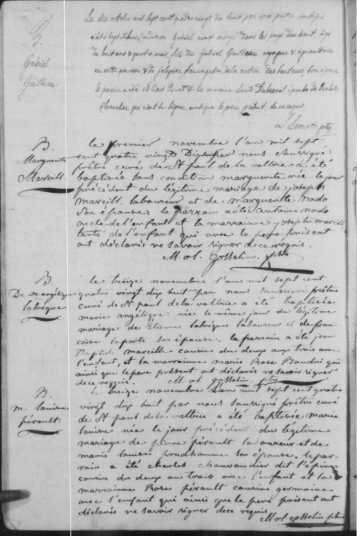
15 November 1845 Évangéliste Guilbault was born and baptised at Saint-André-d'Argenteuil, son of Gabriel Guilbault and Madeleine Larocque dit Rocbrune. His godparents were André and Julie Guilbault — his own brother and sister, then fifteen and fourteen.

His parents had married at Sainte-Madeleine-de-Rigaud on 25 November 1823. He was the fourteenth of their sixteen recorded children.
Where his father came from
Gabriel Guilbault was born about 10 June 1790 in the pays d'en haut — the interior country running from the Great Lakes to the prairies — and ondoyé there: the water poured without the ceremonies of the Church, by whoever was at hand. The act gives no reason and names no one; in the interior the ordinary cause was that there was no priest within reach. His father was a voyageur; his mother is entered in the 1798 act as Josephte Sauvagesse, de la nation des Sauteurs, and elsewhere as Marie Josephte Abitakijikokwe — Ojibwe of the Lake Superior country.
The family came down to the St. Lawrence in 1798 and the boy was baptised at Saint-Paul-de-Joliette at eight years and four months. That act already calls his mother son épouse, but his parents did not marry in the Church until 27 January 1801, at Oka — eleven years after he was born.
So Évangéliste's grandmother was Ojibwe, and his father spent his first eight years in the interior. The name Abitakijikokwe is not translated here: the registers spell it several different ways and no Ojibwe-language authority has reviewed it.
| Child | Born | Place | Died |
|---|---|---|---|
| Gabriel | 20 Dec 1824 | Ste-Madeleine-de-Rigaud | — |
| Marie Josephe | 29 Jul 1826 | Rigaud | 4 Sep 1826 |
| Marie Florence | 16 Mar 1828 | Rigaud | — |
| André | 7 Apr 1830 | St-Benoît | — |
| Julie | 4 May 1831 | Rigaud | — |
| Scholastique | 7 Jul 1833 | St-André-d'Argenteuil | — |
| Rosalie | 4 Jul 1835 | St-Benoît | — |
| Joseph | 15 Apr 1837 | St-Hermas | 20 Jul 1837 |
| Jean Baptiste | 3 May 1838 | St-André | 7 May 1838 |
| Marie Claudimène | 22 Aug 1839 | St-André | — |
| Philomène | 25 May 1841 | St-André | — |
| Joseph | vers 6 Feb 1843 | — | 8 Feb 1843 |
| John | 3 Aug 1844 | St-André | — |
| Évangéliste | 15 Nov 1845 | St-André | 5 Dec 1883 |
| Marie | 22 Aug 1847 | Rigaud | — |
| Éloïse | 9 Sep 1849 | St-André | — |
Four died small, and the family kept moving
Marie Josèphe at six weeks. Joseph at three months. Jean Baptiste at four days. A second Joseph at two days. Two of the sixteen never got past a week.
And the birthplaces move: Rigaud, Saint-Benoît, Saint-André, Saint-Hermas, back to Rigaud, back to Saint-André, across twenty-five years. That is not a farming family staying on its land. It is consistent with a man whose work moved him — which is what the 1851 census word suggests, without saying so.
Then they move once more, and further. Éloïse was baptised at Saint-André in September 1849; by the enumeration of January 1851 the household is across the county line at Saint-Placide, in Deux-Montagnes. They are still there in 1861, and in 1871. All three of Évangéliste's censuses are Saint-Placide censuses.

Saint-Placide, 1861
Which ages are wrong, and which are not
The father is entered at fifty. Born about June 1790, he was sixty-one — eleven years light, and the worst stated age anywhere in this family.
The children's are right. Philomène at ten against a baptism in May 1841; Baptiste at seven against August 1844; Évangéliste at five against November 1845; Marie at four against August 1847. Whoever answered the enumerator's questions knew the children's ages perfectly well and was eleven years out on the head of the house — or the enumerator wrote down what he was told and the household did not know.
On the same page, four lines above: Adeline, Caroline, Salomé and Marie Louisseize. The Louisseize family had moved with them, or to the same place — and six years later Joseph Louis Seize would stand at Madeleine Larocque's burial in this parish.
1861 Ten years on they are still at Saint-Placide — the parish where Madeleine had been buried four years earlier, and where they would still be living in 1871. What changes between the two returns is not the address. It is the occupation column.
| Name | Profession, métier ou occupation |
|---|---|
| Gabriel Guilbault | Cultivateur |
| Gabriel Guilbault fils | Voyageur |
| André Guilbault | do |
| Jean Bte Guilbault | do |
| Évangéliste Guilbault | — blank — |
| Rosalie Guilbault | — |
| Elisabeth Guilbault | — |
| Philomène Guilbault | — |
| Marie Guilbault | — |
| Lysée Guilbault | — |
Three dos down the column
The enumerator wrote Voyageur once, against Gabriel fils, and then ditto marks for André and Jean Baptiste beneath him. Three of Évangéliste's brothers, in one house, in one trade.
The next line is his. The column beside his name is empty. He was fifteen.
Their father, who had been the voyageur of the 1851 return, is cultivateur here — the word he keeps in 1857, in 1861 and in 1871. The generation that took the canoes back up was not his; it was his sons'.

And not only this family
The same page carries André Charlebois, Voyageur, with Napoléon and Tréflé Charlebois on do beneath him, and Gilbert Lavigne, Voyageur. Whatever was drawing young men out of Saint-Placide in 1861 was drawing several households' worth, and the Guilbault brothers were going with them.
Saint-Placide, 1871
1871 The family had crossed the county line. Gabriel, his widowed household and four of his grown children were enumerated not at Saint-André but at Saint-Placide, in Deux-Montagnes — which is where Madeleine had been buried fourteen years before, and where Gabriel himself would be buried nine years later.
| Name | Age | Occupation | Status |
|---|---|---|---|
| Guilbault, Gabriel | 80 | Cultivateur | Veuf |
| John | 23 | Voyageur | — |
| Évangeliste | 22 | — | — |
| Philomène | 29 | — | — |
| Lisa | 20 | — | — |
The decade that was said to be missing
Évangéliste was reported absent from the 1871 census in earlier versions of this page. He is not absent. The search had been run at Saint-André, and the family was at Saint-Placide. He is in his father's house at twenty-five, unmarried, with no trade recorded against his name.
Gabriel is veuf — Madeleine had died in December 1857. And his age is right: eighty, against a birth in June 1790. So is Philomène's, twenty-nine against a baptism in May 1841.
The sons' ages are not. John is entered at twenty-three and was twenty-six; Évangéliste at twenty-two and was twenty-five. Both understated by three, in a household where the father's and the daughter's figures are exact.
A voyageur in the next line of the page
Against John's name the enumerator wrote Voyageur. He was twenty-three, born August 1844, and this is the last record in this family to carry the word.
It is worth being exact about what that word is doing. A trade written into a census column is a man's description of himself to an enumerator — not an engagement, not a wage in a company ledger, and it carries none of that weight. But it was written down, in 1871, beside a brother sitting in the same house as Évangéliste. The trade was available to him and he did not take it.
“Lisa”, aged twenty, may be Éloïse, baptised September 1849 — the youngest child in PRDH's list, and the right age within a year or two. Not established.

Marriage, 1879
20 May 1879 He married Marie Louise Soulière at Saint-André-d'Argenteuil. He was thirty-three; she was twenty-four. He is journalier; his father Gabriel is journalier; his mother is défunte Magdelaine Larocque. The bride is the daughter of Janvier Soulière, maçon, and the late Elisabeth Gravel.
The dispensation was not a formality
The couple married on a dispensation from all three publications of banns, granted by Messire Hippolyte Moreau, vicar general of the diocese of Montreal, dated the fifteenth. They married on the twentieth. Five days.
The same register shows what the ordinary grant looked like. Entry M.2, three weeks later — same priest, same parish, the same vicar general — dispenses two banns, with the third published at the prône. Évangéliste's was the heavier grant of the two.
The act gives no reason, and none is supplied here. A full dispensation generally answers to something specific; what it was in this case is not on the page and is not in the register. The diocesan dispensation register at Montreal would state the ground. It has not been consulted.
A word about her father
This act calls Janvier Soulière maçon. Five other parish acts between 1862 and 1887 call him journalier, while the censuses of 1871 and 1881 call him Mason. He is recorded both ways, by different hands, across twenty-five years.
And nobody in the room could write. Not the groom, not the bride, not either father. The same page carries a marriage signed by six people — a merchant's family — three weeks later.

Three children in four years

September 1880
Burial, 7 September 1880, Saint-Placide
« Ce sept Septembre, mil huit cent quatre-vingt, nous Prêtre soussigné avons inhumé dans le cimetière de cette paroisse le corps de Gabriel Guilbeault, époux de défunte Magdeleine Larocque, de la paroisse de St André, décédé avant hier à l'âge d'environ quatre-vingt douze ans. Présents Jean Baptiste Guilbeault et Évangéliste Guilbeault qui ont déclaré ne savoir signer. »
Parish register of Saint-Placide (Deux-Montagnes), 1880, douzième feuillet, page 12, entry S.21. Signed J. B. Bertrand ptre. Working reading, September 2026.
Buried where his wife lay
The act is careful about it: Gabriel was de la paroisse de St André — that is where he lived — but he was buried at Saint-Placide, in the cemetery where Madeleine Larocque had been buried on 17 December 1857, and in the parish where the family had been enumerated in 1871.
He is named in her burial act as her husband, and she in his as his wife. Twenty-three years apart, in the same ground.
Évangéliste at his father's grave
He was thirty-four. His first son had been baptised six months earlier; his second would be born the following June. Beside him was Jean Baptiste — the brother PRDH enters as John, born 1844, the voyageur of the 1871 census. Neither could sign.
This is the only record in which Évangéliste appears as a son. Everywhere else he is a groom, a father, or a name in a census.
The priest was nearly right, and the census was not
About ninety-two, says the act. Born about June 1790, Gabriel was ninety. He had married at Rigaud at thirty-three and fathered his last recorded child, Éloïse, at fifty-nine.
It is the 1851 census that is out, by eleven years — though not because its ages are bad generally: on that page the children's ages are right and only the father's is wrong. The 1871 enumerator got Gabriel right at eighty and both sons wrong by three. The 1881 enumerator made Évangéliste twenty-nine when he was thirty-five. The errors cluster on the men, and not one of them could read what was written down about him.

December 1883
Burial, 7 December 1883, Saint-André
« Le sept Décembre mil huit cent quatre vingt trois, nous curé soussigné avons inhumé dans le cimetière de cette paroisse le corps d'Évangéliste Guilbeault, époux de Louise Soulière, décédé l'avant-veille, âgé d'environ trente-six ans. Témoins: Joseph Ladouceur et Joseph Clément de cette paroisse, lesquels ont déclaré ne savoir signer. Lecture faite. »
Parish register of Saint-André-d'Argenteuil, 1883, folio 25, entry S.33. Signed J. B. Bourget ptre. Working reading, September 2026.
He was thirty-eight
The priest wrote about thirty-six. Baptised on 15 November 1845, he was thirty-eight. Every stated age for this man runs light — twenty-two in 1871 against twenty-five, twenty-nine in 1881 against thirty-five, about thirty-six at his burial against thirty-eight. Four independent records, all short, none long, for a man who could not read what was written down about him.
And the witnesses were the family. Joseph Ladouceur had married Louise's sister Marcelline that April; Joseph Clément had married her sister Anne the year before. Two brothers-in-law carried him, and neither could sign.
No cause is stated, and none is supplied here.
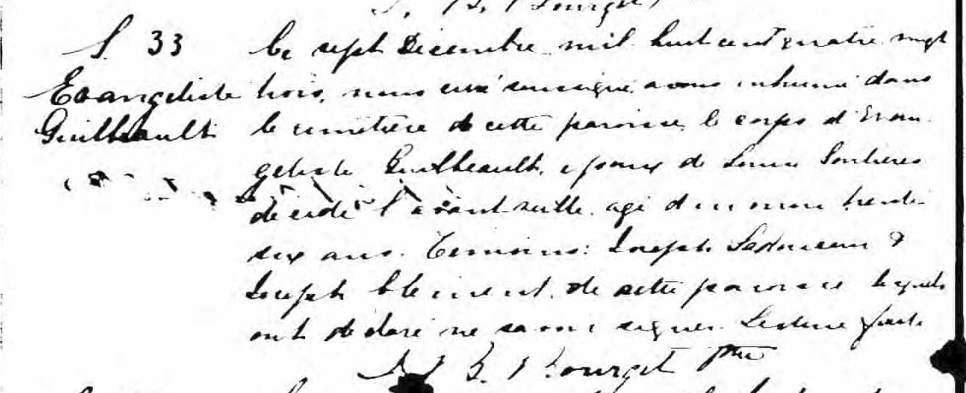
His daughter had been christened sixteen weeks earlier, and he had not been there. Whether he was away at work that August or already ill, nothing records. By Christmas of 1883 Marie Louise Soulière was twenty-nine, a widow with three children under four.
He was buried in the parish cemetery at Saint-André-d'Argenteuil — not at Saint-Placide with his father and mother. No stone has been found.
What He Left
Within three years his widow had left Quebec for Chicago and married again. Nothing documents the crossing. Their three children grew up American: Isidore Georges stayed on the Canadian side and married at Montreal in 1899; Jean Baptiste Gabriel became John Gilbert; Elisabeth Emma married into an Irish family from County Monaghan and died in New Jersey in 1970, at eighty-six.
Nine documents, thirty-eight years
A baptism, four censuses, a marriage act, three children's baptisms and a burial. That is what a landless journalier generates, and it is a complete life at the register level. There is no shortage here, only the shape of the evidence a labouring man leaves.
He is thinly served by the databases for a mechanical reason: PRDH's systematic coverage ends about 1849 for baptisms and burials. His birth in 1845 falls just inside it. His marriage, his children and his death all fall outside.
His father was given the word voyageur in a census column, and his brother was given it in another. Évangéliste was never given it at all.
Primary Sources
The parish acts and census pages behind this episode. Database records are given as tables in the text above rather than here.
Baptism, 10 Oct 1798
His father, at eight years and four months, né et ondoyé dans les pays d'en haut
Baptism
Baptism, 15 Nov 1845
Full register page, Saint-André-d'Argenteuil
Baptism
Baptism — detail
Gabriel Guilbault & Madeleine Larocque; godparents André and Julie
Baptism
Census, 1851
Gabriel Guilbault household, Saint-Placide, feuille 13, page 25
Census
Census, 1851 — detail
Line 40: Gabriel, 50, “Voyageur”; Évangéliste at line 49, aged 5
Census
Census, 1861
Saint-Placide — three brothers voyageur, Évangéliste's column blank
Census
Census, 1861 — detail
The occupation column: Voyageur, do, do — then a blank
Census
Census, 1871 — detail
Saint-Placide, household 144–150 — John, 23, Voyageur
Census
Marriage, 20 May 1879
Full register page — with the dispensation from all three banns
Marriage
Marriage — detail
Évangéliste, journalier; Janvier Soulière, maçon
Marriage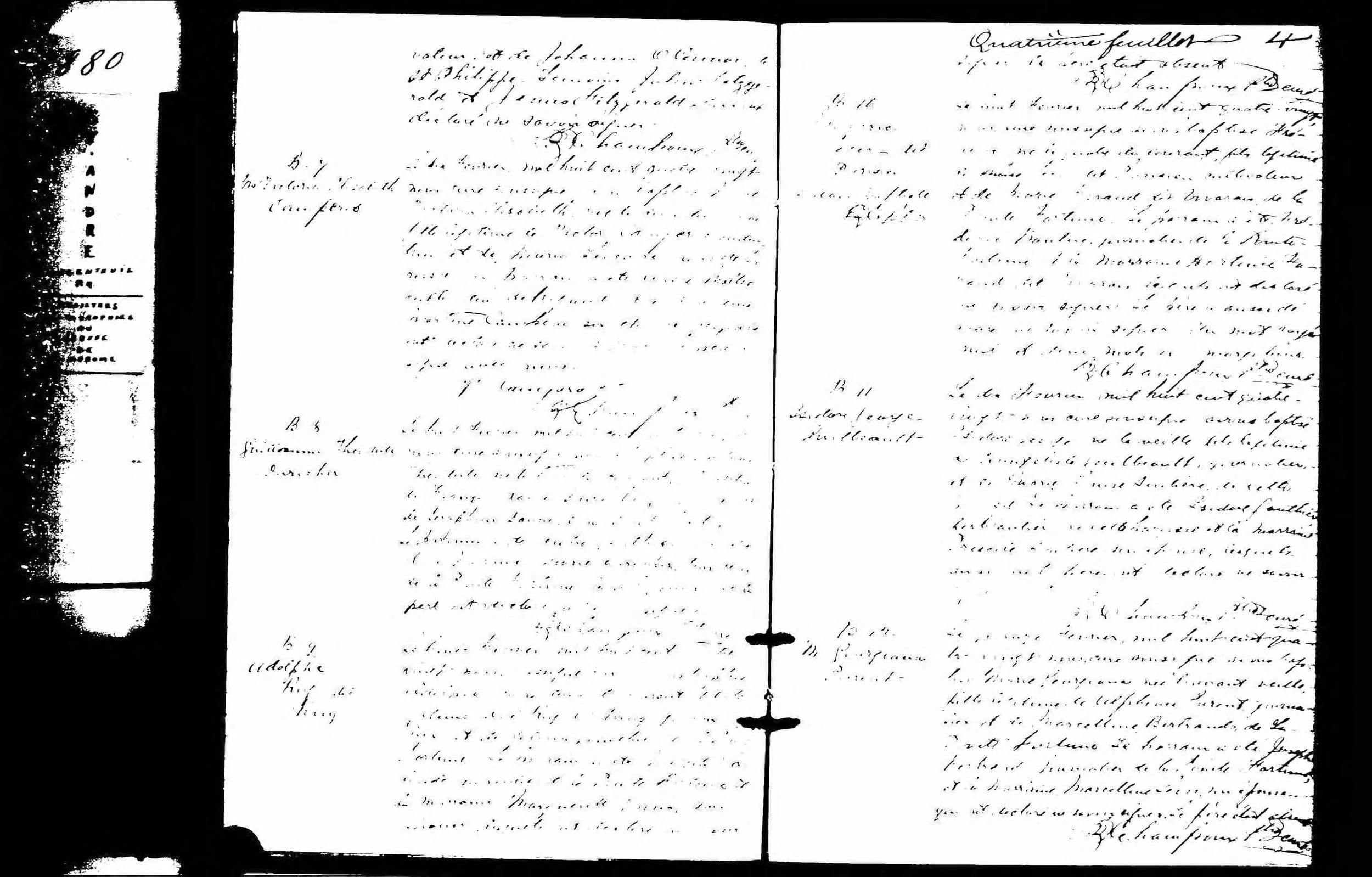
Baptism, 26 Feb 1880
Isidore Georges — the first child
Baptism
Baptism, 1880 — detail
The father again journalier
Baptism
Census, 1881
Évangéliste, Louise and George — the last census of his life
Census
Baptism, 17 Aug 1883
Elisabeth Emma — le père absent
Baptism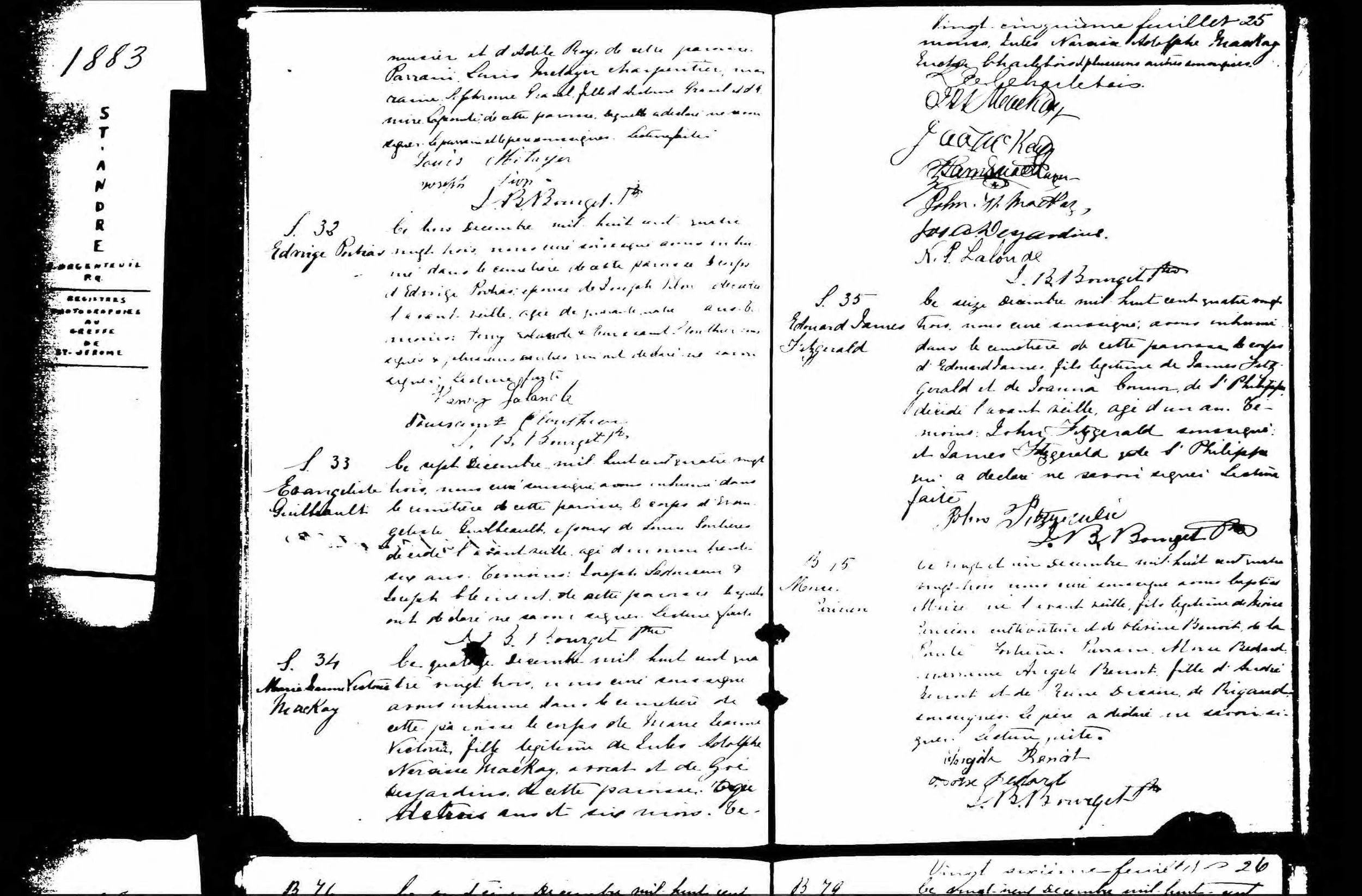
Burial, 7 Dec 1883
Full register page, folio 25
Burial
Burial — detail
« époux de Louise Soulière »; witnesses Ladouceur and Clément
BurialSources
Parish registers — parish copy, examined
- Burial of Évangéliste Guilbeault, 7 December 1883, Saint-André-d'Argenteuil, folio 25, entry S.33. Transcribed above. Died 5 December; stated age about thirty-six; witnesses Joseph Ladouceur and Joseph Clément, neither able to sign.
- Burial of Gabriel Guilbault, 7 September 1880, Saint-Placide (Deux-Montagnes), douzième feuillet, p. 12, entry S.21. Transcribed above. Died 5 September; described as de la paroisse de St André but buried at Saint-Placide; stated age about ninety-two, against ninety. Present: Jean Baptiste and Évangéliste Guilbault, neither able to sign. Signed J. B. Bertrand ptre.
- Burial of Magdelaine Larocque, 17 December 1857, Saint-Placide, treizième feuillet, p. 13, entry S.30. Died 15 December, aged fifty-four; épouse de Gabriel Guilbault cultivateur de cette paroisse. Present: Joseph Lalonde and Joseph Louis Seize, neither able to sign. Signed Alf. Taupin ptre.
- Baptism of Gabriel Guilbault, 10 October 1798, Saint-Paul-de-Joliette. Transcribed above. Baptised sous condition, aged eight years and four months, né et ondoyé dans les pays d'en haut; father voyageur & agriculteur; mother Josephte Sauvagesse, de la nation des Sauteurs. Signed L. Lamothe ptre. Discussed further in the study “Voyageur et agriculture”.
- Baptism, 15 November 1845, Saint-André-d'Argenteuil — detail and full page. Godparents André and Julie Guilbault.
- Marriage, 20 May 1879, Saint-André-d'Argenteuil, huitième feuillet, p. 8, entry M.1. Signed B. Champoux, ptre curé. With a dispensation from all three publications of banns granted by Messire Hippolyte Moreau, vicar general, dated 15 May. Compare entry M.2 on the same page, 27 May 1879: two banns dispensed, the third published.
- Baptisms of Isidore Georges (26 Feb 1880, Saint-André), Jean Baptiste Gabriel (4 Jun 1881, Saint-André-Avellin) and Elisabeth Emma (17 Aug 1883, Saint-André).
Census
- Census of Canada East, 1851 — district de recensement no. 2, paroisse de Saint-Placide, Deux-Montagnes, feuille 13, page 25, lines 40–50. Gabriel Guilbault, Voyageur, age 50; Évangéliste at line 49, age 5. Enumerator James McLewis. Louisseize entries appear on the same page.
- Census of Canada East, 1861 — district 7, paroisse de Saint-Placide, Comté des Deux-Montagnes, page 26 (291). Gabriel Guilbault cultivateur; Gabriel Guilbault fils voyageur; André and Jean Bte do; Évangéliste, occupation column blank; Rosalie, Elisabeth, Philomène, Marie, Lysée. The stated ages on this page do not align with the baptisms.
- Census of Canada, 1871 — district 97 Deux-Montagnes, sub-district 2, Saint-Placide, page 44, household 144–150, enumerator A. Bernard. Gabriel 80 cultivateur veuf; John 23 voyageur; Évangeliste 22; Philomène 29; Lisa 20.
- Census of Canada, 1881 — district 96 Argenteuil, sub-district St Andrews, page 78, household 326/354. Gilbeaux, Evangelist 29 Labourer; Louise 25; George 1.
Database
- PRDH-IGD — family record no. 149155 (Gabriel Guilbault and Madeleine Rocbrune), rendered above as a table. PRDH's systematic coverage ends about 1849 for baptisms and burials and 1871 for marriages; most of Évangéliste's adult life falls outside it.
Searched without result
- A marriage contract for 1879. The act carries no contrat de mariage clause and no marginal note of one. The Saint-André-d'Argenteuil notary whose practice covers 1879 is Michel-Gaspard Denys Thibaudière Delaronde (1825–1882); the published index has been searched and shows nothing for this couple. With four illiterate journalier principals and no property, a contract is unlikely to exist.
- An inventaire après décès, 1883–84, and a tutelle for the minor children. Both nil.
Not located, or not resolved
- The ground of the 1879 dispensation. The diocesan dispensation register at Montreal, May 1879, would state it. Not consulted.
- An engagement contract for either Gabriel. The Société historique de Saint-Boniface indexes some 35,000 Montreal engagements, 1714–1830. One under the elder Gabriel would name a bourgeois, a destination and a wage, and would place him in the interior in the years his son was born there.
- What he died of. The burial states no cause.
- Whether PRDH's family record is complete — it stops at children born before 1850. “Lisa”, aged 20 in 1871, may be Éloïse (b. 1849) or a later child the database does not carry.
- Where in the pays d'en haut Gabriel was born, about 10 June 1790, and who performed the ondoiement. The act does not say, and its conditional form suggests the priest did not know either.
- When the family moved to Saint-Placide. Narrowed to between September 1849 (Éloïse baptised at Saint-André) and January 1851 (enumerated at Saint-Placide). And when they moved back to Saint-André — between the 1871 census and the marriage of May 1879.
- Joseph Charlebois, “Bourgeois”, enumerated a few lines above Gabriel in 1851 at Saint-Placide. In fur-trade usage a bourgeois is the man who hires voyageurs; in a census return the word more often means a man of independent means. Not investigated.
- Where the voyageur brothers went. Gabriel fils, André and Jean Baptiste all carry the word in 1861. Engagements, if any survive, would name a bourgeois and a destination.
- André Charlebois and Gilbert Lavigne, voyageurs on the same 1861 page — whether the Saint-Placide men travelled together.
Are You Connected to the Guilbault Line?
If you descend from the Guilbault (Guilbeau, Guilbeault) family of Charlesbourg and the Quebec parishes, from the children of Marie Josephte Abitakijikokwe, or from the founding families of the line — Senécal, Séguin dit Ladéroute, Morin, Couillaud dit Roquebrune, Gaulin — I’d like to compare notes. Documented trees, DNA matches, family papers, and even half-remembered stories have all moved this research forward.
Get in Touch About This FamilyCousin connections are informal and reciprocal — no fee, no obligation, just shared work on shared ancestry.
Every Family Has a Story Worth Telling
Whether you're just beginning your research or ready to transform years of work into a narrative your family will treasure, I'd love to help.
LET'S TALK ABOUT YOUR FAMILY