
Charles Francois Guilbault 1702 - 1760
Charles François Guilbault
The House of Stone
When the notary came to inventory his estate in August 1762, two years after his death, he walked a farm of two arpents fronting the Rivière des Prairies at Sault-au-Récollet. The barn was poteaux-en-terre under thatch. So was the stable. But the house was something else: une maison construite en pierre—a house built of stone, with a chimney, floored above and below, valued at three hundred and fifty livres.
In the parish registers he is a habitant, which is what the curé called every man who held land. In his own notarial record he is something more particular. Two acts drawn the same afternoon by the same notary give him two designations: entrepreneur de maçonnerie—a masonry contractor—and tailleur de pierre—a stonecutter. The craft and the business. He cut stone, and he took masonry work by the job.
He lived in the only kind of house that trade could build.
Entrepreneur de Maçonnerie
Masonry contractor • Sault-au-Récollet • Inventaire après décès, 4 August 1762
Charles François is the voyageur's grandfather.

Origins: Charlesbourg, 1702
On 30 October 1702, in the parish of St-Charles-Borromée at Charlesbourg, René Le Boullenger baptised a boy born that same day: Charles François, son of Joseph Guilbeau, habitant de Charlesbourg, and Marie Anne Pageot his wife. The godfather was Pierre Louis Roy; the godmother Agnès Giguère, wife of Joseph Blondo, who signed the register.
The family had been at Charlesbourg for a generation. His grandfather Pierre Guilbault had married Louise Sénécal at Notre-Dame-de-Québec in 1667, and their sons Joseph and Étienne both married at Charlesbourg in the 1690s. Pierre's own parents were François Guilbault and Marie Pignan.
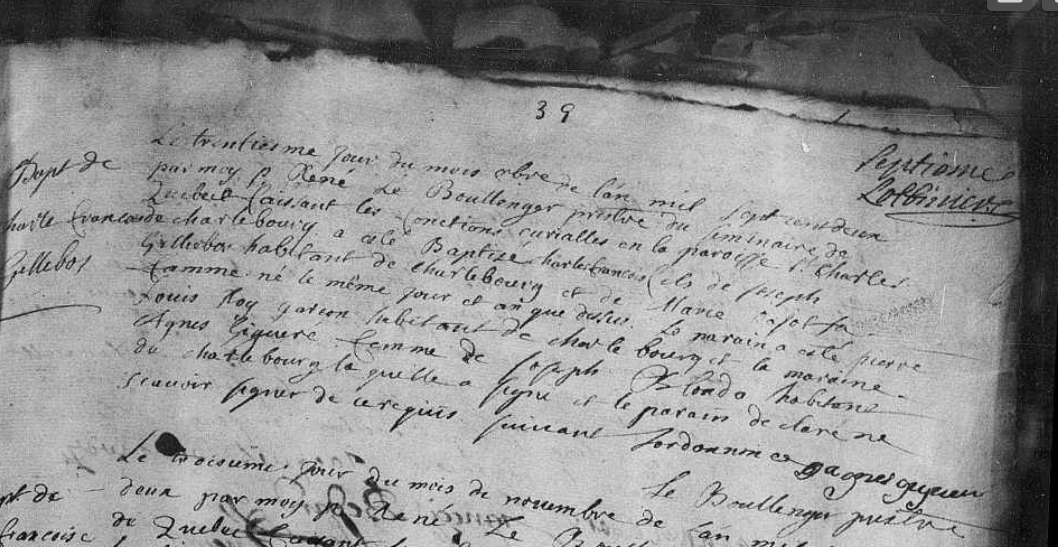
The Children of Joseph Guilbault and Marie Anne Pageot
He was the fourth of five children, and the elder of the two who reached adulthood. Two of his sisters did not: Marie Charlotte lived three days, Anne Elisabeth three years.
| Marriage | 3 May 1694, Charlesbourg (St-Charles-Borromée) |
|---|---|
| His parents | Pierre GUILBAULT & Louise SÉNÉCAL |
| Her parents | Thomas PAGEOT & Marie Catherine ROY |
| Marie Marguerite | bap. 17 Dec 1695 — m. 8 Nov 1717, Jean Baptiste Maranda — bur. 11 Nov 1766, Notre-Dame-de-Québec |
| Marie Charlotte | bap. 16 Oct 1698 — bur. 19 Oct 1698, Charlesbourg |
| Anne Elisabeth | bap. 31 Dec 1699 — bur. 26 Jan 1703, Charlesbourg |
| Charles | bap. 30 Oct 1702 — m. 19 Mar 1727, Marie Catherine Antoinette Deguise Flamand — d. 16 Jun 1760, Sault-au-Récollet |
| Joseph | bap. 2 Apr 1705, Charlesbourg |
First Marriage: A Double Dispensation
On 19 March 1727 at Notre-Dame-de-Québec, Charles married Marie Catherine Antoinette Deguise Flamand, daughter of Guillaume Deguise Flamand and Marie Anne Morin. He was twenty-four; she was twenty-two.
The record is unusual, and the unusual part is in its first line. The Bishop of Quebec had granted, in person, a dispensation from the three banns of marriage and from the time of Lent. Both waivers at once. The 19th of March fell inside the closed season, when weddings were ordinarily forbidden, and the bishop set aside the ordinary publication as well.
The reason arrived eighty-one days later. Their first son, Charles Thomas, was baptised on 8 June 1727, born that same day.
Neither the bride nor the groom could sign. Among those present were Jacques de Guise, Pierre de Guise, Thomas Alard and Jean Thesier.

The First Family: Four Years
Four children in four years, and then it ended. Marie Catherine died on 11 November 1731, three months after the birth of her youngest son, and was buried the same day.
Marie Catherine Antoinette Deguise Flamand died on 11 November 1731 and was buried that day at Notre-Dame-de-Québec. Charles was left a widower at twenty-nine with two surviving sons: Charles Thomas, four, and Gabriel, three months.
Documentary Evidence: The First Family


| Marriage | 19 March 1727, Québec (Notre-Dame-de-Québec) |
|---|---|
| Charles Thomas | bap. 8 Jun 1727 — m. 8 Jun 1750, Marie Catherine Jourdain Bellerose — d. 3 Dec 1764, L'Assomption |
| Madeleine Catherine | bap. 8 Jan 1729 — bur. 20 Feb 1729, Québec |
| Jean Louis | bap. 31 Mar 1730 — bur. 23 Aug 1730, Québec |
| Gabriel | bap. 6 Aug 1731 — m. 26 Sep 1757, Montréal, Marie Charlotte Morin — d. 21 Aug 1784, L'Assomption |
| Parents | Guillaume DEGUISE FLAMAND & Marie Anne MORIN |
|---|---|
| Birth | 25 May 1704 |
| Baptism | 26 May 1704, Québec (Notre-Dame-de-Québec) |
| Death | 11 November 1731 |
| Burial | 11 November 1731, Québec (Notre-Dame-de-Québec) |
| Marriage | 19 March 1727, Québec, with Charles GUILBAULT |
Second Marriage: Montreal, 1737
Five years after burying his first wife, Charles married again — this time at Villemarie, in the parish of Notre-Dame-de-Montréal. On 4 March 1737, after the publication of the three banns, without opposition or impediment of any kind, the priest of the Seminary took the consent of Charles Guillebaut, aged thirty-four, widower of Catherine Deguise, and Marie Croquelois, aged twenty-five, widow.
Nothing was waived. No dispensation, no closed season, no haste. Set against the double waiver of 1727, the contrast is the whole difference between the two marriages, and it is legible in the first line of each.
Marie Croquelois was the daughter of Jacques Croquelois Laviolette and Marie Françoise Dumouchel, and had been married before, to Denis Bernard Laterreur Benard, in 1728. She was baptised at Notre-Dame-de-Montréal on the day of her birth in November 1712. She would outlive her second husband by thirty-six years.
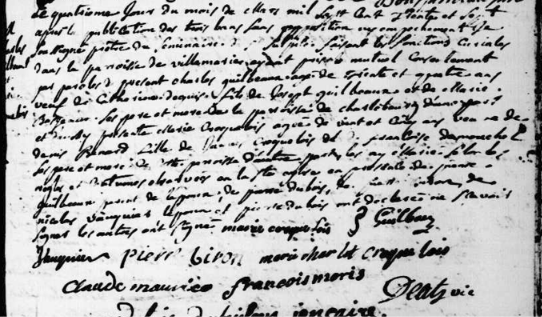
The Women Who Signed
At the foot of the entry, those who could not sign are named and excepted. The rest signed, and two of the names are sisters: Marie Croquelois, the bride, and Marie Charlotte Croquelois. A Morin signed beside them.
It is a small thing on the page and a large one in the family. The Croquelois women wrote their own names; the Guilbault men, across four generations of records, did not. And twenty years before Charles's son married Marie Charlotte Morin — a marriage that would need a dispensation for kinship — the Morins and the Croquelois were already standing together at this wedding. Charles's own remarriage is what made the two families one.
| Parents | Jacques CROQUELOIS LAVIOLETTE & Marie Françoise DUMOUCHEL |
|---|---|
| Birth & Baptism | 20 November 1712, Montréal (Notre-Dame-de-Montréal) |
| First marriage | 27 July 1728, Montréal, with Denis BERNARD LATERREUR BENARD |
| Second marriage | 4 March 1737, Montréal, with Charles GUILBAULT |
| Death | 10 May 1796 |
| Burial | 12 May 1796, L'Assomption (L'Assomption-de-la-Ste-Vierge) |
1727 — Marie Catherine Deguise
- Notre-Dame-de-Québec
- Three banns and Lent dispensed, by the Bishop
- First child born 81 days later
- 4 children, 2 surviving
- 4 years of marriage
1737 — Marie Croquelois
- Notre-Dame-de-Montréal
- Three banns published, nothing waived
- First child born 9 months later
- 7 children, 5 surviving
- 23 years of marriage
Downriver: Montreal Town to the Sault
The first three children of the second marriage were baptised at Notre-Dame-de-Montréal — Pierre in December 1737, Louis Joseph in September 1739, Joseph in January 1742. From October 1744 the family is at Sault-au-Récollet, on the north shore of the island, and there it stayed.
So the move came seven years after the wedding, somewhere between January 1742 and October 1744, and not at the marriage itself.
He was not moving alone. His father Joseph had died at Charlesbourg in December 1738, and across these same decades his first cousins — the children of his uncle Étienne Guilbault — were leaving Charlesbourg for the same stretch of country: Louis to Montreal by 1744, Pierre and Marie Josephe to Lachenaie, Étienne and Joseph to Mascouche. When Charles François arrived at the Sault, his cousins were already downriver.
What looks like one man's decision is a cousin group relocating. The Charlesbourg Guilbaults of his generation moved, nearly all of them, into the Montreal region between the 1730s and the 1750s — and they kept turning up in each other's records for the rest of their lives.
The Second Family: Seven Children
Seven children came of the second marriage, five of whom lived to adulthood. Two daughters died small. The three eldest were born in Montreal town, the four youngest at the Sault.
| Child | Baptised | Married | Died |
|---|---|---|---|
| Pierre | 16 Dec 1737, Montréal | 16 Aug 1762, Marie Marguerite Labelle | 29 Dec 1806, Sault-au-Récollet |
| Louis Joseph | 15 Sep 1739, Montréal | — | 21 Oct 1763, Montréal, aged 24 |
| Joseph | 29 Jan 1742, Montréal | 10 Oct 1768, Marie Françoise Colleret Bourguignon | 16 Sep 1816, Sault-au-Récollet |
| Marie Angélique | 7 Oct 1744, Sault-au-Récollet | — | 10 Nov 1747, aged three |
| Marie Rose | 17 Nov 1747, Sault-au-Récollet | 28 Jan 1765, Jean Jacques Baptiste Labelle | 19 Apr 1778, Laval (St-Vincent-de-Paul) |
| Marie Victoire | 30 Mar 1750, Sault-au-Récollet | — | 28 Sep 1751, "âgée d'environ dix-huit mois" |
| Marie Archange | 31 Mar 1752, Sault-au-Récollet | 1 Feb 1768, Jacques Labelle | 2 Jun 1782, Laval (St-Vincent-de-Paul) |
Marie Angélique was buried on 10 November 1747. Her sister Marie Rose was baptised a week later.
The Labelle Alliance
Three of the children married Labelles within six years. Pierre married Marie Marguerite Labelle in August 1762. Marie Rose married Jean Jacques Baptiste Labelle in January 1765, and Marie Archange married his elder brother Jacques in February 1768 — two sisters to two brothers, which needed no dispensation, since affinity does not extend from one spouse's kin to the other's.
Both Guilbault daughters were buried at Laval, across the river, with their husbands' family. Their mother went the other way, to L'Assomption.


| Marriage | 4 March 1737, Montréal (Notre-Dame-de-Montréal) |
|---|---|
| Baptised at Montréal | Pierre (1737), Louis Joseph (1739), Joseph (1742) |
| Baptised at the Sault | Marie Angélique (1744), Marie Rose (1747), Marie Victoire (1750), Marie Archange (1752) |
| Surviving in 1762 | Pierre 24, Louis Joseph 22, Joseph 20, Marie Rose 14, Marie Archange 10 |
17 June 1760: Burial at Sault-au-Récollet
Charles Guilbault died on 16 June 1760 and was buried the following day in the cemetery of La-Visitation-de-la-Bienheureuse-Vierge-Marie at Sault-au-Récollet. The register calls him habitant de cette paroisse and gives his age as about fifty-nine. He was fifty-seven years, seven months and seventeen days. Present were Charles Le Blanc and Joseph Marie Tureau, who declared they could not sign.
He died in the last summer of New France. Montreal capitulated that September, and the civil business of the district passed to a bench of militia captains. His estate would be settled in their court.
He left a widow of forty-seven and five living children, none of them yet twenty-five and so all of them minors in law: Pierre, Louis Joseph, Joseph, Marie Rose and Marie Archange. His two surviving sons by his first marriage — Charles Thomas, thirty-two, and Charles Gabriel, twenty-eight, married three years and newly a father — were grown.

The Fourth of August, 1762
The estate stayed open for two years. Under the British military regime the courts of the Montreal district were held by a bench of militia captains — Bernieux, Ignace Gamelin and Rouillard sat, with the notary Pierre Panet as their clerk — and it was before them, on 3 August 1762, that Marie Croquelois was confirmed guardian of her five minor children.
The next day the family's notary cleared the whole estate in a single sitting. Charles-François Coron, royal notary of Montreal residing on the Île Jésus, drew three acts for them on 4 August 1762. They are numbered consecutively in his register.
Inventaire après décès
At the widow's request, as guardian of Louis about twenty-two, Joseph twenty, Marie fourteen and Archange eleven. Appraised by François Colleret and Jean Labelle, militia officer, both of the Sault.
Contrat de mariage
Marie Croquelois, widow, stipulating for Pierre Guilbau her son; Jean Labelle, habitant of Rivière-des-Prairies, for his daughter Marie Marguerite. Dower of three hundred livres.
Cession à rente viagère
The widow, citing her age and infirmities, cedes one arpent of the farm to her son, against a life annuity in wheat, money, firewood, a pig and a cow — and six livres to each of his brothers and sisters.
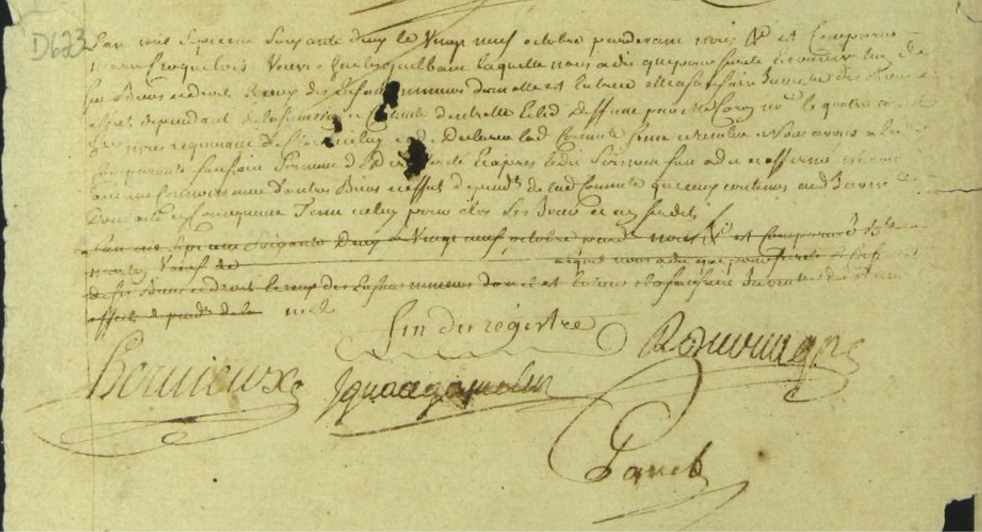
Two weeks later, on 16 August, Pierre married Marie Marguerite Labelle at Sault-au-Récollet. The donation in their contract was registered with the court on 26 October, inside the four months the ordinance allowed, and on 29 October Marie Croquelois appeared once more to swear the closing of the inventory: that nothing had been omitted, concealed or diverted.


What the Widow's Hand Says
At the foot of each of these acts, the same thing happens. Those who cannot write are named and excepted; then Marie Croquelois signs her own name. She signs the tutelle, the inventory, the marriage contract and the cession. She had signed her wedding register twenty-five years earlier. Her husband, in four separate acts of his life, is recorded as unable to.

The Property
The land of the succession lay in the Île de Montréal, parish of Sault-au-Récollet: two arpents of frontage by forty in depth, fronting the Rivière des Prairies, backing on the Côte St-Michel, Antoine Charon on one side and François Colleret on the other.
Upon it stood a house built of stone, with a chimney, plank roof and floors above and below, valued at three hundred and fifty livres. A barn of poteaux-en-terre, thirty-five feet by twenty-five, thatched and ringed with cross-staves. A stable of the same construction, and a small remise: four hundred livres for the three.
The moveables came to six hundred and thirty-eight livres — a pair of oxen, three horses, two cows and a calf, pigs, a plough with its harness, a shod traîne and chain, cartwheels, three beds of little value, a small palmier stove with its pipe at a hundred livres, three cooking pots, pewter spoons and forks, and one small silver goblet at fifteen.
Against it, two debts only: two hundred and twenty-one livres to the Seigneurs of Montreal, and eighty to Étienne Guilbau, cooper. The estate was solvent.
The barn was earth-post and thatch. The stable was earth-post and thatch. The house was stone. On a côte farm in 1762 that was not the ordinary case — and it is the one building on the property that the man who owned it could have raised himself.

The Trade, and Where It Went
Neither designation appears in a single parish record of his life. Not his marriage, not his burial, not the marriages of his daughters. Four register entries that might ordinarily have carried a trade give nothing but habitant. The words survive because a notary, twice in one day, needed to say precisely which dead man he meant.
It went to his son. In September 1757 Charles Gabriel signed a marriage contract in which he is a maçon, marrying Marie Charlotte Morin, whose father Joseph Morin worked stone as well. The 1757 marriage joined a stonecutter's son to a stone cutter's daughter.
And then it stopped. Charles Gabriel's own son Gabriel, baptised at L'Assomption in June 1762, would become a voyageur and paddle west into the pays d'en haut, and marry Marie Josephte Abitakijikokwe. Three generations: the man who cut stone, the son who laid it, and the grandson who left.
A note on the record. Earlier versions of this page described Charles François as a maître maçon. No act gives him that title, and the description came from a different man — a Charles Guilbault, master mason of St-Eustache village, recorded in 1832, seventy-two years after this one died. The trade was real; the title was not. What the records actually say is set out above, with the acts cited below.
| Parents | Joseph GUILBAULT & Marie Anne PAGEOT |
|---|---|
| Birth & Baptism | 30 October 1702, Charlesbourg (St-Charles-Borromée) |
| First marriage | 19 March 1727, Québec (Notre-Dame-de-Québec), Marie Catherine Antoinette DEGUISE FLAMAND |
| Second marriage | 4 March 1737, Montréal (Notre-Dame-de-Montréal), Marie CROQUELOIS LAVIOLETTE |
| Death | 16 June 1760 |
| Burial | 17 June 1760, Montréal, Sault-au-Récollet (La-Visitation-de-la-Bienheureuse-Vierge-Marie) |
Connecting the Generations
Charles François Guilbault's life runs from the radial village lots of Charlesbourg to a stone house on the Rivière des Prairies, and from the reign of Louis XIV to the month the French regime ended. His two marriages produced eleven children in two cities. His estate was settled in a British military court by a bench of militia captains, in French, under the Coutume de Paris.
François Guilbault & Marie Pignan
Pierre Guilbault & Louise Sénécal — m. 1667, Québec
Joseph Guilbault & Marie Anne Pageot — m. 1694, Charlesbourg
Charles François Guilbault (1702–1760) — entrepreneur de maçonnerie
Charles Gabriel Guilbault (1731–1784) — maçon
Gabriel Guilbault "le voyageur" (1762–1833)
married Marie Josephte Abitakijikokwe (Ojibwe)
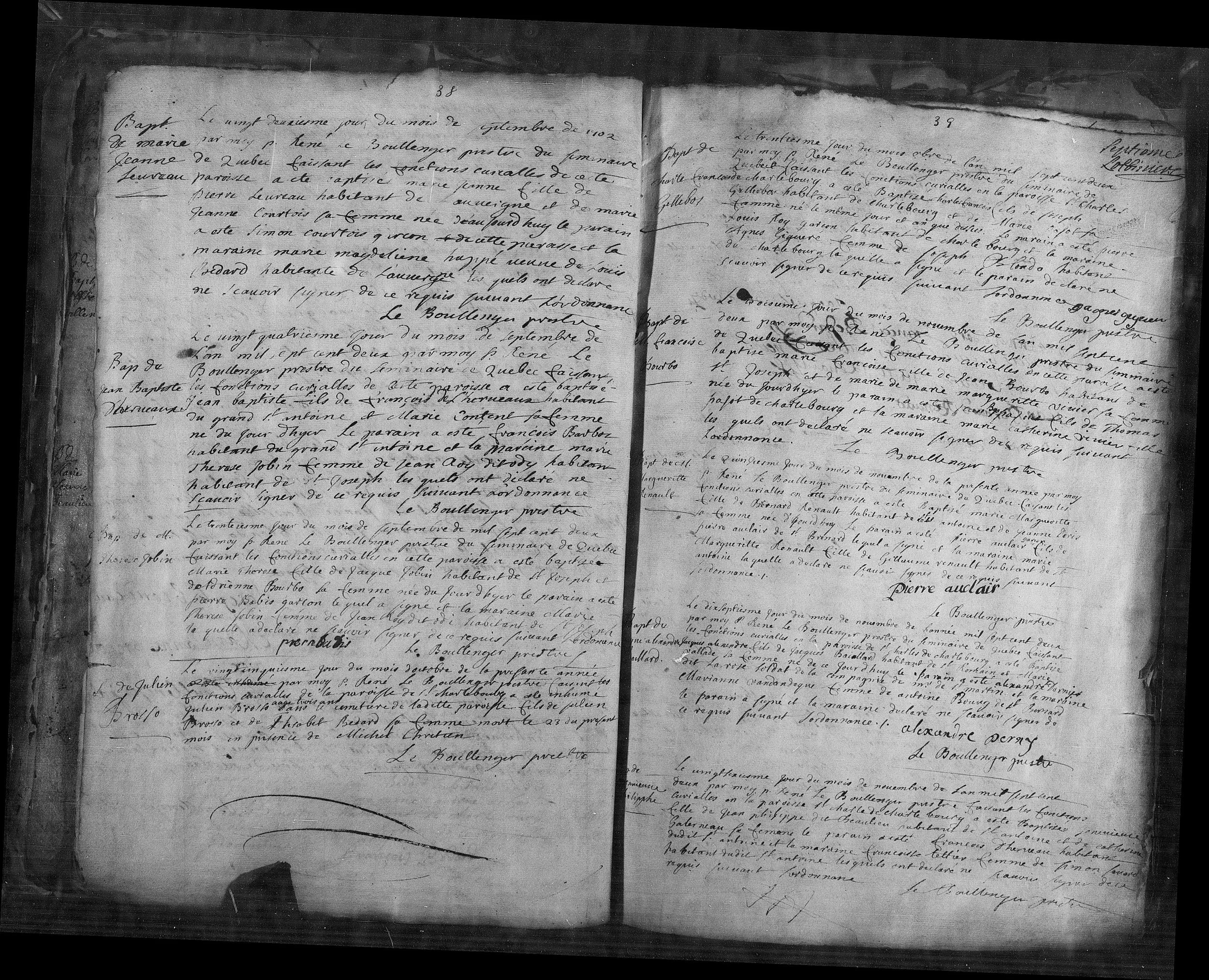
Document Gallery






Sources
- Parish registers St-Charles-Borromée de Charlesbourg, 30 October 1702 (baptism). Notre-Dame-de-Québec, 19 March 1727 (marriage); 8 June 1727, 8 January 1729, 31 March 1730, 6 August 1731 (baptisms); 20 February 1729, 24 August 1730, 11 November 1731 (burials). Notre-Dame-de-Montréal, 4 March 1737 (marriage). Montréal, Sault-au-Récollet (La-Visitation-de-la-Bienheureuse-Vierge-Marie), 1744–1768 (baptisms, burials, marriages); 17 June 1760 (burial of Charles Guilbault).
- Notarial acts — greffe de Charles-François Coron, notaire royal (1734–1767)
Archives nationales à Montréal, Fonds Cour supérieure, District judiciaire de Montréal, Greffes de notaires, 06M,CN601,S98.
• Inventaire des biens de la succession et communauté de feu Charles Guilbault, 4 août 1762, acte no 3723.
• Contrat de mariage de Pierre Guilbault et Marie Marguerite Labelle, 4 août 1762, acte no 3722.
• Cession à rente viagère par Marie Croquelois à Charles Guilbault, 4 août 1762, acte no 3724. - Court records — Chambre des capitaines de milice de Montréal
Archives nationales à Montréal, Fonds Cour supérieure, District judiciaire de Montréal, Procédures en matières non contentieuses.
• Tutelle des enfants mineurs de feu Charles Guillebeau et de Marie Croclois, 3 août 1762, 06M,CP601,S4,SS1,D520.
• Insinuation de la donation portée au contrat de mariage, 26 octobre 1762, 06M,CP601,S4,SS1,D616.
• Clôture d'inventaire des biens de la succession et de la communauté de feu Charles Guilbault et Marie Croquelois, 29 octobre 1762, 06M,CP601,S4,SS1,D623. - PRDH-IGD Programme de recherche en démographie historique, Université de Montréal. Families nos. 2198, 7236, 8332, 15831, 20270; Individuals nos. 9776, 18158, 30603, 163967, 163968, 168393, 217386.
Research note. The PRDH database reconstructs families from the parish registers and is indispensable for linking generations across variant spellings — Guilbeau, Guillebeau, Guillebauer, Gillebot. Its cards are indexes, not transcriptions, and where a card and a register disagree, the register governs. The occupational evidence on this page comes entirely from the notarial record; the parish registers preserve none of it.
Are You Connected to the Guilbault Line?
If you descend from the Guilbault (Guilbeau, Guilbeault) family of Charlesbourg and the Quebec parishes, from the children of Marie Josephte Abitakijikokwe, or from the founding families of the line — Senécal, Séguin dit Ladéroute, Morin, Couillaud dit Roquebrune, Gaulin — I’d like to compare notes. Documented trees, DNA matches, family papers, and even half-remembered stories have all moved this research forward.
Get in Touch About This FamilyCousin connections are informal and reciprocal — no fee, no obligation, just shared work on shared ancestry.
Every Family Has a Story Worth Telling
Whether you're just beginning your research or ready to transform years of work into a narrative your family will treasure, I'd love to help.
LET'S TALK ABOUT YOUR FAMILY